 .
The fines for murder, manslaughter, &c. (Hidayah, vol. iv. p. 448.) [DIYAH.]
.
The fines for murder, manslaughter, &c. (Hidayah, vol. iv. p. 448.) [DIYAH.]
MA'AQIL.
.
The fines for murder, manslaughter, &c. (Hidayah, vol. iv. p. 448.) [DIYAH.]
AL-MA'ARIJ.
 .
Lit. "The Ascents." The title of the LXXth chapter of the Qur'an, in the second verse of which occurs the sentence: "God, the possessor of the Ascents (or Steps) by which the angels ascend unto Him, and the Spirit (i.e. Gabriel), in a day whose space is fifty thousand years."
.
Lit. "The Ascents." The title of the LXXth chapter of the Qur'an, in the second verse of which occurs the sentence: "God, the possessor of the Ascents (or Steps) by which the angels ascend unto Him, and the Spirit (i.e. Gabriel), in a day whose space is fifty thousand years."
Sale, translating from al-Baizawi and Zamakhsahri says: "This is supposed to be the space which would be required for their ascent from the lowest part of the creation to the throne of God, if it were to be measured, or the time which it would take a man to perform a journey; and this is not contradictory to what is said elsewhere (if it be to be interpreted to the ascent of the angels), that the length of the day whereon they ascend is 1,000 years, because that is meant only of their ascent from earth to the lower Heaven, including also the time of their descent.
"But the commentators, generally taking the day spoken of in both these passages to be the Day of Judgment, have recourse to several expedients to reconcile them, and as both passages seem to contradict what Muhamman doctors teach, that God will judge all creatures in the space of half-a-day, they suppose those large numbers of years are designed to express the time of the previous attendance of those who are to be judged, or else to the space wherein God will judge the unbelieving nations, of which, they say, there will be fifty, the trial of each nation taking up 1,000 years, though that of the true believers will be over in the short space above mentioned."
MABNA 'T-TASAWWUF.

 .
Lit. "The Foundation of Sufiism." A term used by the Sufis to embrace the three principle of their system. (1) The choice of the ascetic life; (2) The
.
Lit. "The Foundation of Sufiism." A term used by the Sufis to embrace the three principle of their system. (1) The choice of the ascetic life; (2) The
intention to bestow freely upon others ; (3) The giving up of one's own will and desire, and desiring only the will of God. (See 'Abdu 'r-Razzaq's Dict. of Sufi Terms.)
AL-MADINAH.
 .
Lit. "The city." The city celebrated as the burial place of Muhammad. It is called Yatrib (see Qur'an, Surah xxxiii. 13), but was distinguished as al-Medinah. "the city," and Madinatu 'n-Nabi," the city of the Prophet," after it had become famous by giving shelter to Muhammad it is esteemed only second to Makkah in point of sanctity. Muhammad is related to have said. "There are angels guarding the roads to al-Madinah, on account of which neither plague, or the Dajjal (Anti-Christ) can eater it." "I was ordered," he said, "to flee to a city which shall eat up (conquer) all other cities, and its name is now al-Madinah (the city); verily she puts away evil from man, like as the forge purifies iron." "God has made the name of al-Madinah both tabah and taiyiba." i.e. both good and odoriferous.
.
Lit. "The city." The city celebrated as the burial place of Muhammad. It is called Yatrib (see Qur'an, Surah xxxiii. 13), but was distinguished as al-Medinah. "the city," and Madinatu 'n-Nabi," the city of the Prophet," after it had become famous by giving shelter to Muhammad it is esteemed only second to Makkah in point of sanctity. Muhammad is related to have said. "There are angels guarding the roads to al-Madinah, on account of which neither plague, or the Dajjal (Anti-Christ) can eater it." "I was ordered," he said, "to flee to a city which shall eat up (conquer) all other cities, and its name is now al-Madinah (the city); verily she puts away evil from man, like as the forge purifies iron." "God has made the name of al-Madinah both tabah and taiyiba." i.e. both good and odoriferous.
Al-Madinah is built on the elevated plain of Arabia, not far from the eastern base of the ridge of mountains which divide the table-land from the lower country, between it and the Red Sea. The town stands on the lowest part, on the plain whore the water courses unite, which produce in the rainy season numerous pools of stagnant water, and render the climate unhealthy. Gardens and date-plantations, interspersed with fields, inclose the town on three sides; on the side towards Makkah the rocky nature of the soil renders cultivation impossible. The city forms an oval about 2,800 paces in circuit, ending in a point. The castle is built at the point on a small rocky elevation. The whole is inclosed by a thick wall of stone, between 35 and 40 feet high, flanked by about 80 towers and surrounded by a ditch. Three well-built gates lead into the town. The houses are well built of atone, and generally we stories high. As this stone is of a dark colour, the streets have a gloomy aspect, and are for the most part very narrow, often only two or three paces across; a few of the principal streets are paved with stone. There are only two large streets which contain shops. The principal buildings within the city are the great mosque containing the tomb of Muhammad, two fine colleges, and the castle, standing at the western extremity of the city, which is surrounded by strong walls and several high and solid towers, and contains a deep well of good water.
The town is well supplied with sweet water by a subterranean canal which runs from the village of Quba', about three-quarters of a mile distant in a southern direction. In several parts of the town steps are made down to the canal, where the inhabitants supply themselves with water which, how-ever, contains nitre, and produces indigestion in persons not accustomed to it. There are also many wells scattered over the town; every garden has one by which it is irrigated; and when the ground is bored to the depth of twenty-five or thirty feet, water is found in plenty. During the rainy season, many torrents descend from the higher grounds to lower depression in which al-Madinah is built, and part of the city is inundated. This plentiful supply of water made this site a considerable settlement of Arabs long before it became sacred among the Muhammadans, by the flight, residence, and death of the Prophet, to which it owes its name of Madinatu 'n-Nabi, or the City of the Prophet. (See Burckhardt's Travals in Arabia.)
An account of the Prophet's mosque is given under MASJIDU 'N-NABI, and of the burial chamber of Muhammad under HUJRAH.
MADRASAH.
 .
A school.
[EDUCATION.]
.
A school.
[EDUCATION.]
MADYAN.
 .
Midian. The descendants of Midian, the son of Abraham and Keturah, and a city and district bearing his name, situated on the Red Sea, south-east of Mount Sinai.
.
Midian. The descendants of Midian, the son of Abraham and Keturah, and a city and district bearing his name, situated on the Red Sea, south-east of Mount Sinai.
Mentioned in the Qur'an, Surah vii. 83. "We sent to Madyan their brother Shu'aib." [SHUAIB.]
MAFQUD.
 .
A legal term for a person who is lost, and of whom no information can be obtained. He is not considered legally dead until the period expires when he would be ninety years old.
.
A legal term for a person who is lost, and of whom no information can be obtained. He is not considered legally dead until the period expires when he would be ninety years old.
MAGIANS.. [MAJUS.]
MAGIC..
Arabic sihr  A
belief in the magical art is entertained by almost all Muhammadans, and there is a large number of persons who study it.
A
belief in the magical art is entertained by almost all Muhammadans, and there is a large number of persons who study it.
Although magic (as-sihr) is condemned in the Qur'an (Surah ii. 96) and in the Traditions (Mishkat, book xxi. ch. iii ch. in. pt. 1), there are still many superstitious practices resembling this occult science, which are clearly permitted according to the sayings of Muhammad.
Anas says, "The Prophet permitted a spell, (ruqyah) being used to counteract the ill effects of the evil eye; and on those bitten by snakes or scorpions." (Sahihu Muslim p. 238.)
Umm Salmah relates "that the Prophet allowed a spell to be used for the removal of yellowness in the eye, which, be said, proceeded from the malignant eye." (Sahihu 'l-Bukhari, p. 854.)
'Auf ibn Malik says "the Prophet said there is nothing wrong in using spells, provided the use of them does not associate anything with God." (Mishkat, book xxi. ch. i.)
The terms used to express the magical arts are da'wah, lit. "an invitation of the spirits," exorcism; 'azimah, an incantation; kihanah, divination, or fortune-telling: ruqyah, a spell; and sihr, magic.
The term da'wah is held to imply a lawful incantation, in which only the assistance of God is invited by the use of either the Ismir 'l-A'zam, or great and unknown name of God.
or the recital of the ninety-nine names attributes of the Almighty. As-Sihr, or the magical use of evil spirits: and kihanah, fortune-telling, are hold to be strictly unlawful.
Incantation and exorcism as practiced by Muhammadans is treated of in the article on DA'WAH.
Mr. Lane in his annotated edition of the Arabian Nights, says:-
There are two descriptions of magic, one spiritual, regarded by all but freethinkers true; the other, natural, and denounced by the more religious and enlightened as deceptive.
1. Spiritual magic, which is termed Roohanee ' (ar-ruhani), chiefly depends upon the virtues of certain names of God, and passages from the Kuran, and the agency of angels, and jinn, or genii. It is of two kinds, Divine and Satanic (" Rahmanee," i.e. relating to "the Compassionate" [who God], and Sheytanee," relating to the Devil.)
1. Divine magic is regarded as a sublime science, and is studied only by good men, at practised only for good purposes. Perfection in this branch of magic consists in the knowledge of the most great name of God [ISMU 'L- AZAM]; but this knowledge is imparted to none but the peculiar favourites of heaven. By virtue of this name, which was engraved c his seal ring, Solomon subjected to his dominion the jinn and the birds and the winds. By pronouncing it, his minister Asaf (Asaf), also transported in an instant, to the presence his sovereign, in Jerusalem, the throne of the Queen of Sheba. But this was a small miracle to effect by such means, for, by uttering this name, a man may even raise the dead, Other names of the Deity, commonly known are believed to have particular efficacies when uttered or written; as also are the names the Prophet, and angels and good jinn are said to be rendered subservient to the purposes of divine magic by means of certain ii vocations. Of such names and invocation together with words unintelligible to the uninitiated in this science, passages from the Kuran, mysterious combinations of number and peculiar diagrams and figures, are chief composed written charms employed for good purposes. Enchantment, when used for benevolent purposes is regarded by the vulgar as branch of lawful or divine magic; but not so by the learned, and the same remark applies to the science of divination.
2. Satanic magic, as its name implies, is science depending on the agency of the Devil and the inferior evil jinn, whose services are obtained by means similar to those which propitiate, or render subservient, the good jmn. It is condemned by the Prophet and all good Muslims, and only practised for his purposes. Es sehr (as-Sihr), or enchantment is almost universally acknowledged to be a branch of Satanic magic, but some few persons assert (agreeably with several tales: the Arabian Nights), that it may be, and I some has been, studied with good intention and practised by the aid of good jinn; consequently, that there is such a science as good enchantment, which is to be regarded as a branch of divine or lawful magic. The metamorphoses are said to be generally effected by means of spells, or invocations to jinn, accompanied by the sprinkling of water or dust. &c., on the object to be transformed. Persons are said to be enchanted in various ways some paralyzed, or even deprived of life, others, affected with irresistible passion for certain objects, others, again, rendered demoniacs, and some, transformed into brutes, birds, &r. The evil eye is believed to enchant in a very powerful and distressing manner. This was acknowledged even by the Prophet. Diseases and death are often attributed to its influence. Amulets are worn by many Muslims with the view of counteracting or preserving from enchantment; and for the same purpose many ridiculous ceremonies are practised. Divination, which is termed El-Kihaneh (al-Kihanah), is pronounced on the highest authority to be a branch of Satanic magic; though not believed to be so by all Muslims. According to an assertion of the Prophet, what a fortuneteller says may sometimes be true; because one of the jinn steals away the truth, and carries it to the magician's ear; for the angels come down to the region next the earth (the lowest heaven), and mention the works that have been pre-ordained in heaven; and the devils (or evil jinn) listen to what the angels say, and hear the orders predestined in heaven, and carry them to the fortune-tellers. It is on such occasions that shooting stars are hurled at the devils. It is said that, "the diviner obtains the services of the Sheytan (Shaitan) by magic arts, and by names invoked, and by the burning of perfumes, and he informs him of secret things ; for the devils, before the mission of the Apostle of God, it is added, used to ascend to heaven, and hear words by stealth. That the evil jinn are believed still to ascend sufficiently near to the lowest heaven to hear the conversation of the angels, and so to assist magicians, appears from the former quotation, and is assorted by all Muslims. The discovery of hidden treasures is one of the objects for which divination is most studied. The mode of divination called "Darb-el-Mendel" (Zarbu 'l-Mandal), is by some supposed to be effected by the aid of evil jinn; but the more enlightened of the Muslims regard it as a branch of natural magic. Some curious performances of this kind, by means of a fluid mirror of ink, have been described in the Account of the Manners and Customs of the Modern Egyptians, and in No. 117 of the Quarterly Review.
There are certain modes of divination which cannot properly be classed under the head of spiritual magic, but require a place between the account of this science and that of natural magic. The most important of these branches of Kihaneh is Astrology, which is called Lim en Nujoom ('Ilmu 'n-Nujum). This is studied by many Muslims in the present day, and its professors are often employed by the Arabs to determine a fortunate period for laying the
foundation of a building, commencing a journey, &C: but more frequently by the Persians and Turks. The Prophet pronounced Astrology to be a branch of magic. Another branch of Kihaneh is Geomancy, railed "Darb er Raml" (Zarbu Raml); a mode of divination from certain marks made on sand (whence its appellation), or on paper; and said to be chiefly founded on astrology. The science called "ez Zijr," or "el; Eyafeh" (al-'Iyafah), is a third brunch of Kihanehr being divination or auguration, chiefly from the motions and positions and postures, of birds, or of gazelles and ether beasts of the chase. Thus what was termed a "Saneh " (Sanih) that is, such an animal standing or passing with its right side towards the spectator, was esteemed among the Arabs as of good omen; and a "Barch" (Barih), or an animal of this kind, with its left side towards the spectator, was field as inauspicious. "El Kiyafeh" (al-Qiyafah), under which term are included Chiromancy and its kindred sciences, is a fourth branch of Kihaneh. "El Tefaul (at-Tafawwa1), or the taking an omen. particularly a good one, from a name or words accidentally heard or seen, or chosen from a book belonging to the same science. The taking a "fal", or omen, from the Kuran, is generally held to be lawful. Various trifling events are considered as ominous. For instance, a Sultan quitting his palace with his troops, a standard happened to strike a "tsurayya" a cluster of lamps so called from resembling the Pleiades), and broke them: he drew from this an evil omen, and would have relinquished the expedition; hut me of his chief' officers said to him, "O our Lord, thy standard has reached the Pleiades," and being relieved by this remark, he proceeded, amid returned victorious.
(See The Thousand and One Nights, a new translation, with copious notes, by Edward W. Lane; new ed. By E. S. Poole, vol. i. p. 60.)
MAGISTRATES.
 .
. [QAZI.]
.
. [QAZI.]
MAGPIE. Arabic 'aq'aq  . According to Ab'u Hanifnh, the flesh of the magpie is mubah, or indifferent; but the
Imam Yusuf held it to be makruh, or reprobated, because it frequently feeds on dead bodies. (Hiddyah, vol. iv. p. 74.)
. According to Ab'u Hanifnh, the flesh of the magpie is mubah, or indifferent; but the
Imam Yusuf held it to be makruh, or reprobated, because it frequently feeds on dead bodies. (Hiddyah, vol. iv. p. 74.)
AL-MAHDI.
 .
Lit. 'The Directed One," hence, "who is fit to direct
others, Guide, Leader." A. ruler who shall in the last days appear upon the earth. According to the Shi'ahs, he has already appeared in the person of Muhammad Abu '1-Qasim, the twelfth Imam, who is believed to be concealed in some secret place until the day of his manifestation before the end of the world. But the Sunnis say he has not yet appeared. In the history of Muhammadanism, there are numerous instances of impostors having assumed the character of this mysterious personage, amongst others, Saiyad
Ahmad, who fought against the Sikhs on the North-West frontier of the Punjab, AD. 1826, and still
who has claimed to be al-Mahdi in Sudan in Egypt.
.
Lit. 'The Directed One," hence, "who is fit to direct
others, Guide, Leader." A. ruler who shall in the last days appear upon the earth. According to the Shi'ahs, he has already appeared in the person of Muhammad Abu '1-Qasim, the twelfth Imam, who is believed to be concealed in some secret place until the day of his manifestation before the end of the world. But the Sunnis say he has not yet appeared. In the history of Muhammadanism, there are numerous instances of impostors having assumed the character of this mysterious personage, amongst others, Saiyad
Ahmad, who fought against the Sikhs on the North-West frontier of the Punjab, AD. 1826, and still
who has claimed to be al-Mahdi in Sudan in Egypt.
The sayings of the Prophet on the subject, according to al-Bukhari and other traditionists are as follows :—
"The world will not come to an end until a man of my tribe and of my name shall be master of Arabia."
"When you see black ensigns coming from the direction of Khorosan, then join them, for the Imam of God will be with the standards, whose name is al-Mahdi."
"The Mahdi will be descended from me, he will be a man with an open countenance and with a high nose. He will fill the earth with equity and justice, even as it has been filled with tyranny and oppression, and be will reign over the earth seven years."
Quarrelling and disputation shall exist amongst men, and than shall a man of the people of al-Madinah come forth, and shall go from al-Madinah to Makkah, and the people of Makkah shall make him Imam. Then shall the ruler of Syria send up army against the Mahdi, but the Syrian army shall perish by an earthquake near Bada', between al-Madinah and Makkah. And when the people shall see this, the Abdal [ABDAL] will come from Syria, and also a multitude from al-'Iraq. After this an enemy to the Mahdi sha1l arise from the Quraish tribe, whose uncles shall be of the tribe of Kalb, and this man shall send an array against the Mahdi. The Mahdi shall rule according to the examp1e of your Prophet, and shall give strength and stability to Islam. He shall reign for seven years, and than die."
"There shall be much rain in the days of the Mahdi and the inhabitants both of heaven and earth shall he pleased with him. Men's lives shall pass so pleasantly, that they will wish even time dead were alive again." (Mishkatu'l-Masanih, book xxiii. ch. 3.)
According to Shi'ah traditions, Muhammad is related to have said "O ye people! I am the Prophet and 'Ali is my heir, and from us will descend al-Mahdi, the seal (i.e. the last) of the Imams, who will conquer all religion; and take vengeance on the wicked. He will take fortresses and will destroy them and slay every tribe of idolaters and he will avenge the deaths of the martyrs of God. He will be the champion of the Faith, and a drawer of water at the fountain of divine knowledge. He will reward merit and requite every fool according to his fo1ly. He will he the approved and chosen of God, and the heir of all knowledge. He will be the valiant in doing right, and one to whom the Most High has entrusted Islam. . . O ye people, I have explained to you, and 'Ali also will make you understand it." (Hiyatu 'l-Qulub, Merrick's ed., p. 342.)
It is probable that it is from these traditions that the opinion became current amongst the Christians that the Muhammadans expected their Prophet would rise again.
MAHJUR.
 . A slave inhibited by the ruler from exercising any
MAHMAL.
 .
A covered litter borne on a camel, both from Cairo and from Damascus, to Makknh, as an emblem of royalty at the time of the pilgrimage.
.
A covered litter borne on a camel, both from Cairo and from Damascus, to Makknh, as an emblem of royalty at the time of the pilgrimage.
It is said that Sultan 'az-Zahir Beaybars, king of Egypt, was the first who sent a mahmal with the caravan of pilgrims to Makkah in A.D. 1272, but that it had its origin a few years before his accession to the throne, under the following circumstances:-
Shaghru 'd-Durr, a beautiful Turkish
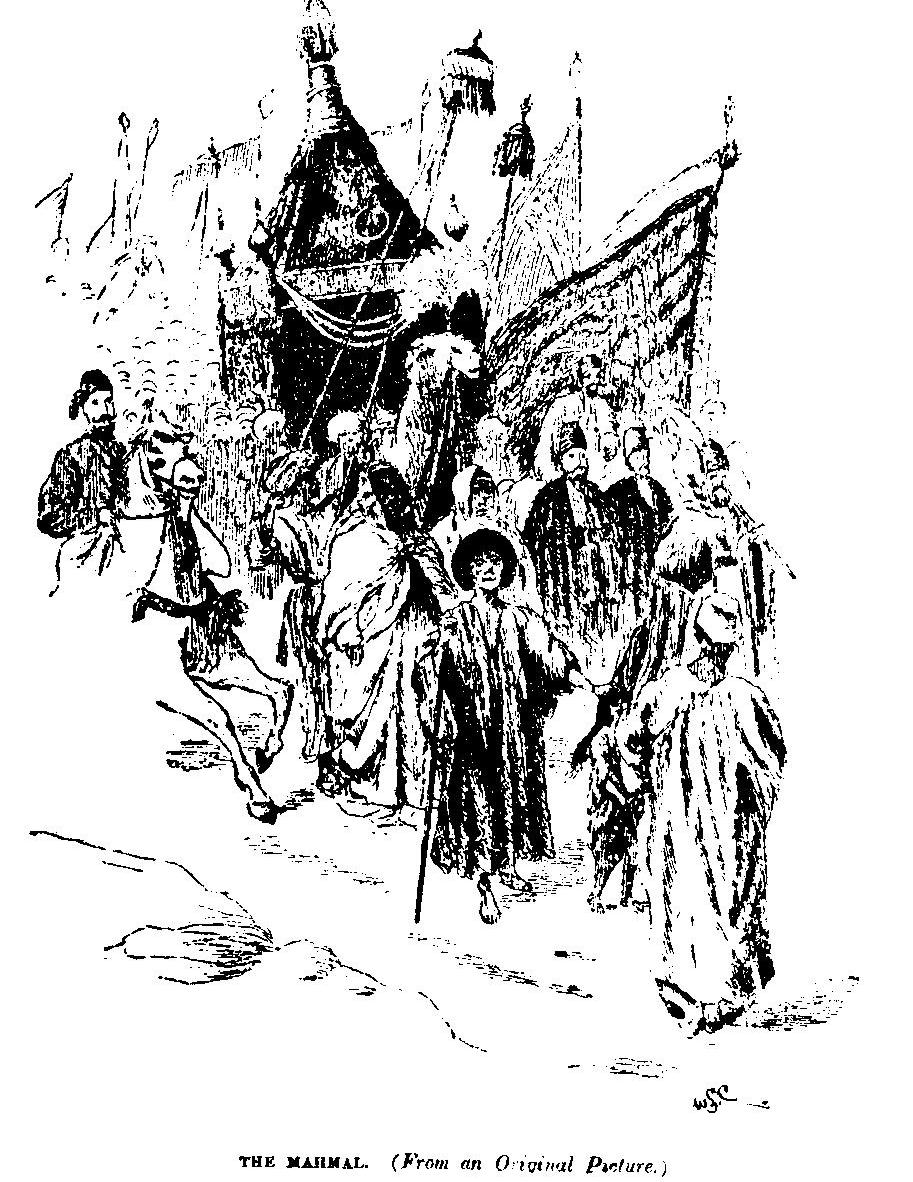
female slave, who became the favourite wife of Sultan as-Salih' Najmu 'd-din, and who on the death of his son (with whom terminated the dynasty of Aiyub) caused herself to be acknowledged Queen of Egypt, performed the hajj in a magnificent litter borne by a camel. And for successive years her empty litter was sent yearly to Makkah, as an emblem of state. After her death, a similar litter was sent each veer with the caravan of pilgrims
from Cairo and Damascus, and 5 is called muhmal or mahmil, a word signifying that by which anything is supported.
Mr. Lane, in his Modern Egyptains, vol. ii. p. 162; thus describes the mahmal:-
"It is a square skeleton frame of wood with a pyramidal top, and has a covering of black brocade richly worked with inscriptions and ornamental embroidery in gold, in some parts upon a ground of green or red silk, and bordered with a fringe of silk, with tassels, surmounted by silver balls. Its covering is not always made after time same pattern with regard to the decorations; but in every cover that I have seen, I have remarked or the upper part of the front view of the Temple of Makkah. worked in gold, and over it the Sultan's cipher. It contains nothing; but has two copies of the Kuran, one on a small scroll, and the other in the usual form of a book, also small, each inclosed in a case of
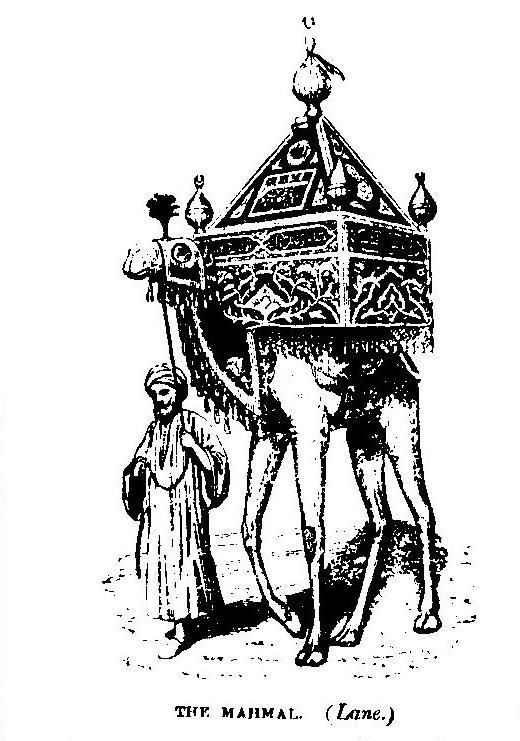
gilt silver, attached externally at the top, the five balls with crescents, which ornament the mahmal, are of gilt silver. Time mahmal is borne by a fine tall camel, which is generally indulged with exemption from every kind of labour during the remainder of its life."
Eastern travellers often confuse the mahmal with the kiswah, or covering for the Ka'bah, which is a totally distinct thing, although it is made in Cairo and sent at the Same time as the mahmal. [KISWAH.]
The Wahbabis prohibited the mahmal as an object of vain pomp, and on one occasion intercepted the caravan which escorted it. Captain Burton saw both the Egyptian and the Damascus mahmal. on the plain below Arafah at the time of the pilgrimage
MAHMUDIYAH.. . A
Shi'ah sect founded by Mir Sharif, who in the reign of Akbar held a military appointment in Bengal. He was a disciple of Mahmud of Busakwan, the founder of the Nuqtawiyah sect. Mabmud lived in the reign of Timur, and professed to ho al-Mahdi. He also called himself the Shakhs-i-Wahid — the Individual one. He used to quote the verse, 'It may be that thy Lord will raise thee up to a glorious (mahmud) station" (Surah xvii. 81). From this he argued that the body of man had been advancing in purity since the creation, and that on its reaching to a certain degree, one Mahmud (glorious) would arise, and that then the dispensation of Muhammad would come to an end. He claimed to be the Mahmud, He also taught the doctrine of transmigration, and that the beginning of everything was the earth atom (nuqtah). it is on this account that they are called in Persian the Nuqtawiyah sect. They are also known by the names Mahmudiyab and Wahidiyah. Shah 'Abbas, King of Persia, expelled them from his dominion., but Akbar received the fugitives kindly, and promoted some amongst thorn to high offices of State,
. A
Shi'ah sect founded by Mir Sharif, who in the reign of Akbar held a military appointment in Bengal. He was a disciple of Mahmud of Busakwan, the founder of the Nuqtawiyah sect. Mabmud lived in the reign of Timur, and professed to ho al-Mahdi. He also called himself the Shakhs-i-Wahid — the Individual one. He used to quote the verse, 'It may be that thy Lord will raise thee up to a glorious (mahmud) station" (Surah xvii. 81). From this he argued that the body of man had been advancing in purity since the creation, and that on its reaching to a certain degree, one Mahmud (glorious) would arise, and that then the dispensation of Muhammad would come to an end. He claimed to be the Mahmud, He also taught the doctrine of transmigration, and that the beginning of everything was the earth atom (nuqtah). it is on this account that they are called in Persian the Nuqtawiyah sect. They are also known by the names Mahmudiyab and Wahidiyah. Shah 'Abbas, King of Persia, expelled them from his dominion., but Akbar received the fugitives kindly, and promoted some amongst thorn to high offices of State,
MAHR..  .
(p.). Heb.
.
(p.). Heb.  The
dower or settlement of money or property on the wife, without which a marriage ma not legal, for an explanation of which see the article on DOWER.
The
dower or settlement of money or property on the wife, without which a marriage ma not legal, for an explanation of which see the article on DOWER.
The Hebrew word occurs three times in the old Testament, viz. Gen. xxxiv. 12; Ex. xxii. 17: 1 Sam. xviii. 25. [DOWER and MARRIAGE.]
MAHRAM.. . Lit. "Unlawful." A near relative with whom it is unlawful to marry. Muhammad enjoined that every woman performing pilgrimage should have a mahram with her night and day, to prevent scandal. (Mishkat, book xi. ch. i.)
AL-MA'IDAH.. . Lit. "The table." The title of the vth Surah of the Qur'in, in the 114th verge of which the word occurs: "O Jesus, son of Mary I is thy Lord able hr send down to us a table?"
"This miracle is thus related by the commentators. Jesus having at the request of his followers asked it of God, a red table immediately descended, in their sight, between two clouds, and was set before them; whereupon he rose up, and, having made the ablution, prayed, and then took off the cloth which covered the table, saying. 'in the name of God, the best provider of food!' What the provisions were with which this table was furnished, is a matter wherein the expositor are not agreed. One will have them to be nine cakes of bread and nine fishes; another, bread and flesh; another, all sorts of food except flesh; another, all sorts of food except
bread and flesh; another, all except bread and fish another, one fish which had the taste of all manner of food; and another, fruits of paradise, but the most received tradition is that when the table was uncovered, there appeared a fish ready dressed, without scales or prickly fins, dropping with fat, having salt placed at its head and vinegar at its tail, and round it all sorts of herbs except leeks, and fine loaves if bread, on one of which there were olives, on the second honey, on the third butter, on the. fourth cheese, and on the fifth dried flesh. They add that Jesus, at the request of the Apostles, showed them another miracle, by restoring the fish to life, and causing its scales and fins to return to it, at which the standers-by being affrighted, he caused it to become as it was before; that one thousand three hundred men and women, all afflicted with bodily infirmities or poverty ate of these provisions, and were satisfied, the fish remaining whole as it was at first; that then the table flew up to heaven in the sight of all: and every one who had partaken of this food were delivered from their infirmities and misfortunes; and that it continued to descend for forty days together, at dinner-time, and stood on the ground till the sun declined, and was then taken up into the clouds. Some of the Muhammadan writers are of opinion that this table did not really descend, but that it was only a parable; but most think the words of the Qur'an are plain to the contrary. A. further tradition is that several men were changed into swine for disbelieving this miracle, and attributing it to magic art; of, as others pretend, far stealing some of the victuals from off it. Several other fabulous circumstances are also told, which are scarce worth transcribing. Some say the table descended on a Sunday, which was the reason of the Christian observing that day as sacred. Others pretend that this day is still kept among them as very great festival, and it seems as if the story and its rise from an imperfect notion of Christ's last supper and the institution of the Eucharist." (Sale's Qur'an.)
MAIMUNAH.. .
The last of Muhammad's wives. A sister to Ummu 'l-Fazl, the wife of al Abbas, and consequently related to the Prophet. She was a widow, 51 years of age, when Muhammad married her. She survived him and died at the age of 81, being buried on the very spot on which she had celebrated her marriage.
(Muir's Life of Mahomet, new ed. p. 403)
.
The last of Muhammad's wives. A sister to Ummu 'l-Fazl, the wife of al Abbas, and consequently related to the Prophet. She was a widow, 51 years of age, when Muhammad married her. She survived him and died at the age of 81, being buried on the very spot on which she had celebrated her marriage.
(Muir's Life of Mahomet, new ed. p. 403)
MAINTENANCE..
Arabic nafaqah  , which, in the language of the
law, signifies all those timings which are necessary to the support of life, such as food, clothes, and lodging, although many confine it solely to food. Durru 'l-Mukhtar, p. 283.)
There are three causes of maintenance established by law. (1) Marriage: (2) Relationship (3) Property (i.e. in case of a slave).
, which, in the language of the
law, signifies all those timings which are necessary to the support of life, such as food, clothes, and lodging, although many confine it solely to food. Durru 'l-Mukhtar, p. 283.)
There are three causes of maintenance established by law. (1) Marriage: (2) Relationship (3) Property (i.e. in case of a slave).
A husband is bound to give proper maintenance to his wife or wives, provided she or they have not become refractory or rebellious, but have surrendered herself or themselves to the custody of their husband.
Maintenance may be decreed out of the property of an absent husband, whether it be held in trust, or deposit, or murzazbah for him.
I the husband become poor to such a degree as to be unable to provide his wife her maintenance, still they are not to be separated on this account, but the Qazi shall direct the woman to procure necessaries for herself upon her husband's credit, the amount remaining a debt upon him.
A divorced wife is entitled to food, clothing, and lodging during the period of he 'iddah, and until her delivery, if she be pregnant. No maintenance is, however, due a woman, whether pregnant or not, for the 'iddah observed upon the death of her husband. No maintenance is due to a woman upon separation caused by her own fault.
A father is bound to support his infant children; and no one shares the obligation with him.
A mother who is a married wife, cannot be compelled to suckle her infant, except where a nurse cannot be procured, or the child refuses to take the milk of any other than of the mother, who in that case is bound to suckle it, unless incapacitated for want of health, or there sufficient cause.
If neither the father nor the child has any property, the mother may be compelled to suckle it.
The maintenance of an infant child is incumbent upon the father, although he be of a different religion; and, in the same manner, the maintenance of a wife is incumbent upon her husband, notwithstanding this circumstance.
Maintenance of children becomes, however, incumbent upon the father only where they possess to independent property.
When the father is poor and the child's paternal grandfather is rich, and the child's own property is unavailable, the grandfather may be directed to maintain him, and the amount will be a debt due to him from the father, for which the grandfather may have recourse against him; after which the father may reimburse himself by having recourse against the child's property, if there is any.
When the father is infirm and the child has no property of his own, the paternal grandfather may be ordered to maintain him, without right of recourse against anyone; and, in like manner, if the child's mother be rich, or the grandmother rich, while its father is poor, she may be ordered to maintain the child, and the maintenance will be a debt against the child if he be not infirm, but if he be so, he is not liable.
If the father is poor and the mother is rich, and the young child has also a rich grandfather, the mother should be ordered to maintain the child out of her own property,
with a right of recourse against the father and the grandfather is not to be called upon to do so. When the father is poor and has a rich brother, he may be ordered to maintain the child, with the right of recourse against the father.
When male children have strength enough to work for their livelihood, though not actually adult, the father may set them to work for their own maintenance, or hire them out, and maintain them out of their wages; but he has no power to hire females out for work or service.
A father must maintain his female children absolutely until they are married, when they have no property of their own. But he is not obliged to maintain his adult male children unless they are disabled by infirmity or disease.
It is also incumbent on a father to maintain his son's wife, when the son is young, poor, or infirm.
The maintenance to an adult daughter, or to an adult son who is disabled, rests upon the parents in three equal parts, two-thirds being furnished by the father, and one-third by the mother.
A child in east circumstances may be compelled to maintain his poor parents, whether they be Muslim or not, or whether by their own industry they be able to earn anything for subsistence or not.
Where there are male and female children, or children only of the male sex, or only of the female sex, the maintenance of both parents is alike incumbent upon them.
Where there is a mixture of male and female children, the maintenance of both parents is incumbent on them alike.
When a mother is poor, her son is bound to maintain her, though he be in straitened circumstances himself, and she not infirm. When a son is able to maintain only one of his parents, the mother has the better right; and if he have both parents and a minor son, and is able to maintain only one of them, the son has the preferable. When he has both parents, and cannot afford maintenance to either of them, he should take them to live with him, that they might participate in what food he has for himself. When the son, though poor, is earning something, and his father is infirm, the son should allow the father to share his food with him.
As of a father and mother, so the maintenance of grandfathers and grandmothers, if they be indigent, is incumbent upon their grandchildren, though the former be of different religion.
It is a man's duty to provide maintenance for all his infant male relations within prohibited degrees who are in poverty; and also to all female relations within the same degrees, whether infants or adults, where they are in necessity; and also to all adult male relations within the same degrees who are poor, disabled, or blind; but the obligation does not extend beyond those relations.
No adult male, if in health, is entitled to maintenance though he is poor, but a person is obliged to maintain an adult female relationship, through in health in body if they require it. The maintenance of a male relative is not incumbent on any poor person, contrary to the maintenance of a wife and child, for whom poor and rich are equally liable.
When a poor person has a father and a son's son, both in easy circumstances, the father is liable for his maintenance; and when there is a daughter and a son's son, the daughter only is liable, though they both divide the inheritance between them. So also, when there is a daughter's, daughter or daughter's son, and a full brother, the child of the daughter, whether male or female, is liable, though the brother is entitled to the inheritance. When a person has a parent and a child, both in easy circumstances, the latter is liable, though both are equally near to him. But if he have a grandfather and a son's son, they are liable for his maintenance in proportion to their shares in the inheritance, that is, the grandfather for a sixth, and the son's son for the remainder. If a poor person has a Christian son and a Muslim brother, both in easy circumstances, the son is liable for the maintenance, though the brother would take the inheritance. If he has a mother and grandfather, they are both liable in proportion to their shares as heirs, that is, the mother in one-third, and the grandfather in two-thirds. So also, when with the mother there is a full brother, or the son of a full brother, or a full paternal uncle, or any other of the 'usabah or residuaries the maintenance from them by thirds according to the rules of inheritance. When there is a maternal uncle, and the son of a full paternal uncle, the liability for maintenance is on the former, though the latter would have the inheritance; because the condition of liability is wanting on the latter, who is not within the forbidden degrees.
If a man have a paternal uncle and aunt, and a maternal aunt, his maintenance is on the uncle; and if the uncle be in straitened circumstances, it is on both the others. The principle in this case is that when a person who takes the whole of the inheritance is in straitened circumstances, his inability is the same as death, and being as it were dead, the maintenance is cast on the remaining relatives in the same proportions as they would be entitled to in the inheritance of the person to be maintained, if the other were not in existence, and that when one who takes only a part of the inheritance is in straitened circumstances, he is to be treated as if here were dead, and the maintenance is cast on the others, according to the shares of the inheritance to which they would be entitled if they should succeed together with him. (See Durru 'l-Mukhtar, Babu 'n-Nafaqah.)
AL-MAISIR.. .
A game of chance forbidden in the Qur'an, Surahs ii. 216; v. 92, 93. It signifies a game performed with arrows, and much in use with pagan Arabs. But the term al-maisar is
.
A game of chance forbidden in the Qur'an, Surahs ii. 216; v. 92, 93. It signifies a game performed with arrows, and much in use with pagan Arabs. But the term al-maisar is
now understood to include all games of chance or hazard.
MAJBUB.
 . A complete eunuch, as distinguished from khasi, or one who is simply castrated. (Hidayah, vol. i, p. 356.)
AL-MAJID.
 . "The Glorious One." One of the ninety-nine names or attributes of God. It occurs in the Qur'an, Surah ii. 76: "Verily He is to be praised and glorified.
MAJORITY. [PUBERTY.]
MAJUJ.
AL-MAJUS.
 . pl. of Majusi.
The Magians. Mentioned in the Qur'an only once, Surah xxii. 17: "As to those who believe, and the Jews, and the Sabeites, and the Christians, and the Magians, and those who join other gods with God, of a
God shall decide between them on the Day of
Resurrection: for God is witness of all things."
. pl. of Majusi.
The Magians. Mentioned in the Qur'an only once, Surah xxii. 17: "As to those who believe, and the Jews, and the Sabeites, and the Christians, and the Magians, and those who join other gods with God, of a
God shall decide between them on the Day of
Resurrection: for God is witness of all things."
Most Muhammadan writers (especially amongst the Shi'ahs) believe them to have formerly possessed a revelation from God which they have since lost.
The Magians ware a sect of ancient philosophers which arose in the East at a very early period, devoting much of their time to the study of the heavenly bodies. They were the learned men of their time and we find Daniel the Prophet promoted to the head of this sect in Chaldea. (Dan v. 11.) They are supposed to have worshipped the Deity under the emblem of fire-; whilst the Sabians, to whom they were opposed, worshipped the heavenly bodies. They held in the greatest abhorrence the worship of images, and considered fire the purest symbol of the Divine Being. This religious sect was reformed by Zoroaster in the sixth century before Christ, and it was the national religion of Persia until it was supplanted by Muhammadanism. The Magians are now known in Persia as Gabrs, and in India as Parsis. Their sacred book is the Zend Avesta, an English translation of which has been published by Mr. A. B. Bleeck (Hertford, 1864), from Professor Spiegel's German translation. There is an able refutation of the Parsi religion by the late Rev. John Wilson, D.D. (Bombay. 1843).
MAJZUB.
 Lit. "Attracted." A term used by the Sufis for a person whom God has chosen for Himself, for a manifestation of His love, and who is thus enabled to attain to all the stages of Sufism without any effort or trouble. (See 'Abdu 'r-Razzaq's Dict. of Sufi Terms.)
MAKKAH.
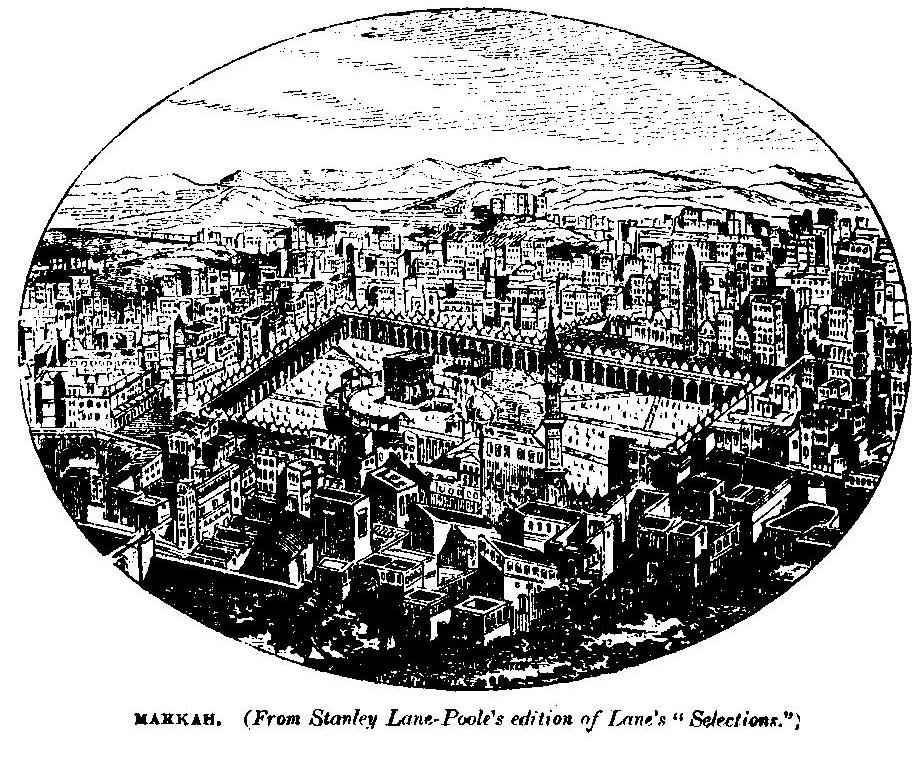
 The capital of Arabia, and the most sacred city of the Muslims. It is celebrated as the birth-place of Muhammad, and as the site of the Ka'bab,
or Sacred Cube, building. Muhammad is related to have said of Makkah, "What a
splendid city thou art! If I had not been
driven out of thee by my tribe, I would dwell in no other place but in thee." ''It is not
man bur God who made Makkah sacred."
The capital of Arabia, and the most sacred city of the Muslims. It is celebrated as the birth-place of Muhammad, and as the site of the Ka'bab,
or Sacred Cube, building. Muhammad is related to have said of Makkah, "What a
splendid city thou art! If I had not been
driven out of thee by my tribe, I would dwell in no other place but in thee." ''It is not
man bur God who made Makkah sacred."
My people will be always safe in this world and the next, as long as they respect Makkah" (Mishkat, book xi. ch. xv.)
Makkah (the ancient name of which was Makkah) is situated in about 21° 30' N. lat, 40° 20' E. long., and 70 miles from the Red Sea, in a sandy valley running north and south, and from 100 to 70 paces broad. The chief part of the city is placed where the valley is widest. In the narrower part there are single rows of houses only, or detached shops. The town itself covers a space of about 1,500 paces in length, but the whole extent of ground comprehended under the denomination of Makkah, amounts to 3500 paces in length The surrounding rocky hills are from 200 to 500 feet in height, barren, and destitute of trees. Most of the town is situated in the valley itself, but there are some parts built on the sides of the hills. The streets are in general broader than those of Eastern cities, for the purpose of accommodating the vast number of pilgrims who resort to it. The houses are lofty and of stone, and the numerous windows that face the streets give to these quite a European aspect. Many of the houses are three stories high.
The only public place in the body of the town is the large square of the great mosque, which is enlivened during the Hajj (Pilgrimage) by a great number of well-stored shops. The streets are all unpaved, and in summer the sand and dust are as great a nuisance as the mud is in the rainy season, during which they are scarcely passable after a storm.
Makkah is badly provided with water. There are a few cisterns for receiving rain, and the well-water is brackish. The famous well of Zamzam, in the great mosque is indeed copious enough to supply the whole town, but the water is not well tasted. The best water is brought by an aqueduct from the vicinity of Arafah, six or seven miles distant There are two places in the interior of the city, where the aqueduct runs above ground, and in these parts it is let off into small channels or fountains, at which some slaves of the Sharif (the ruler of the city) are stationed to exact a toll from persons who fill their water-skins.
All the houses in Makkah except those of the principal and richest inhabitants, are constructed for the accommodation of lodgers, and divided into numerous separate apartments, each consisting of a sitting-room and a small kitchen. Except four or five houses belonging to the Sharif, two colleges, and the sacred mosque, Makkah has no public edifices of any importance.
The inhabitants of Makkah, with few exceptions, are Arabians. They have two kinds of employment, trade and the service of the temple. During the Hajj, Makkah becomes one of the largest fairs in the East, and certainly the most interesting, from the
variety of nations which frequent it. The merchants of the place make large profit during this time by their merchandise. They have also a considerable trade with the Beduins and with other parts of Arabia. The greatest profit. however, is derived from supplying food for 60.000 pilgrims and 20,000 camels. The only articles of manufacture are some pottery and beads: (hero are a few dyeing-hormsea in the city. Makkah is governed by a Sharif, who is chosen from the Saiyids (or descendants of the Prophet) settled in the Hijaz, who were one numerous, but are now reduced to a few families in Makkah. Although he obtains his office by the choice of his people, or by force, he holds his authority from the Turkish Sultan.
Makkah was the seat of government during the reigns of the first five Khalifahs.
(For an account of the sacred temple, see the article on MASJIDU 'L-HARAM.)
MAKRUH.
 Lit. "That which is hateful and unbecoming." A term used in the religious, civil, and ceremonial law of Islam, for an act the unlawfulness of
which is not absolutely certain, but which is considered improper and unbecoming.
Lit. "That which is hateful and unbecoming." A term used in the religious, civil, and ceremonial law of Islam, for an act the unlawfulness of
which is not absolutely certain, but which is considered improper and unbecoming.
The author of the Hidiyah remarks that the doctors of the Hanafi sect have disagreed as to the extent to which the term can be received.
The Imam Muhammad is of opinion that is unlawful, but as he could not draw any convincing argument in favour of his opinion from either the Qur'an or Traditions, he renounced the general application of "unlawfulness" with respect to such things or acts, and classed them under those which are merely improper.
The Imams Abu Hanifah and Abu Yusuf hold that the term applies to that which in its qualities nearly approaches to unlawful without is being actually so. (Hidayah, vol. iv p. 86.)
In the Kitabu 't-Ta'rifat, that which is makruh is divided into makruh tahrimi, "That which is nearly unlawful"; and makruh tanzihi, "that which approaches the lawful."
In all works on Muhammadan law, a section is devoted to the consideration of things which are held to be makruh.
AL-MALA'IKAH.
 Lit. "The Angels." The title of the xxxvth Chapter of the Qur'an in the first verse of which the word occurs:- "Who employeth the angels as envoys." It is called Suratu 'l-Fatir, the "Chapter of the Originator."
MALAKU 'L-MAUT.
 "The Angel of Death." See Qur'an, Surah xxxii. 11: "The angel of death who is charged
with you shall cause you to die: then ye shall he returned to your Lord." He is also called 'Iza'il.
MALANG.
 . An order of Muhammadan faqirs or darveshes, who are the descendants and followers of Jaman Juti a follower of Zindu Shah Madar. They usually wear the hair of the head very full and matted amid formed into a knot behind. The order is a very common one in India. (Herklot's Musalmans, p. 290.)
AL-MALIK.
 ."The Possessor, lord, ruler." One of the ninety-nine names or attributes of God. It frequently occurs in the Qur'an, e.g. in the first Surah, "Ruler of the Day of Judgment."
MALIK.
 . Lit. "One in authority. a possessor." The angel who is said to preside over hell, and superintend the torments of the damned. He is mentioned in the Qur'an, Surah xlii, 77 : And they shall cry out, O Malik! let thy Lord make an end of us; he shall say, Verily, tarry here." Perhaps the same as
  Molech the fire-god and tutelary deity of the children of Ammon.
MALIK.
 .
The founder of a
sect of Sunni Muslims.
.
The founder of a
sect of Sunni Muslims.
The Imam Abu 'Abdi 'llah Malik ibn Anns, the founder of one of the four orthodox sects of Sunnis, was born at al-Madinah, A.H. 94 (A.D. 716). He lived in the same place and received his earliest impression of Islam form Sahl ibn Sa'd, the almost sole survivor of the Companions of the Prophet. He was considered to be the most learned man of his time, and his self-denial and abstinence were such that he usually fasted four days in the week. He enjoyed the advantages of a personal acquaintance and familiar intercourse with the Imam Abu Hamifah, although differing from him on many important question regarding the authority of the Traditions. His pride, however, was at least, equal to his literary endowments. In proof of this, it is related of him that when the great Khalifah Harunu 'r-Rashid came to al—Madinah to visit the tomb of the Prophet, Malik having gone forth to meet him, the Khalifah addressed him "O Malik! I entreat as a favour that you will come every day to me and my two sons, Amin and Ma'mun, and instruct us in traditional knowledge." To which the sage haughtily replied. "O Khalifah, science is of a dignified nature, and instead of going to any person requires that all should come to it.' The story further says that the sovereign with much humility, asked his pardon, acknowledged the truth of his remark, and sent both his sons to Malik who seated them among his other scholars without. any distinction.
With regard to the Traditions, his authority is generally quoted as decisive; in fact, he considered them as altogether superseding the judgment of a man, and on his death-bed severely condemned himself for the many decisions he had presumed to give on the mere suggestion of his own reason. The Qur'an and the Sunnah excepted, the only study to which he applied himself in this latter days, was, the contemplation of the Deity : and his mind was at length so much absorbed in the immensity of the Divine attributes and perfections, as to lose sight of all insignificant objects! Hence he gradually withdrew himself from the world, became indifferent to it concerns, and after some years of complete retirement, he died at al-Madinah, A.H. 179 (A.D. 795). His authority is at present chiefly received in Barbary and the other northern states of Africa. Of his works the only one upon record is one of tradition, known as the Muwatta'. His principal pupil was ash-Shafi'i, who afterwards himself gave the name to a sect.
MALIKU 'L-MULK.
 .
"The Lord of the Kingdom." One of the ninety-nine names or attributes of God. It occurs once in the Qur'an,Surah iii. 25: "Say O God, Lord of the Kingdom. Thou givest the kingdom to whomsoever Thou pleasest."
.
"The Lord of the Kingdom." One of the ninety-nine names or attributes of God. It occurs once in the Qur'an,Surah iii. 25: "Say O God, Lord of the Kingdom. Thou givest the kingdom to whomsoever Thou pleasest."
MAL ZAMINI.
 .
Bail for property. A legal term. (Hidayah, vol. ii. p. 568). Bail for the person is nazir zamini.
.
Bail for property. A legal term. (Hidayah, vol. ii. p. 568). Bail for the person is nazir zamini.
MAMAT.
 .
"Death"; e.g. Surah vi. 163: My prayers. any sacrifice. my life, and my death, belong to God." [MAUT.]
.
"Death"; e.g. Surah vi. 163: My prayers. any sacrifice. my life, and my death, belong to God." [MAUT.]
MAMLUK.
 .
pl. mamalik.
"A slave." A term used in Muslim law for a bond-slave, the word 'abd signifying both "slave" and "a servant of God." It occurs only once in the Qur'an, Surah xvi. 77: "God propounds a comparison between a slave (mamluk) and the property of his master."
.
pl. mamalik.
"A slave." A term used in Muslim law for a bond-slave, the word 'abd signifying both "slave" and "a servant of God." It occurs only once in the Qur'an, Surah xvi. 77: "God propounds a comparison between a slave (mamluk) and the property of his master."
This word has become historic in the Malmuks, or that military body of slaves who for a long time ruled Egypt. These military slaves were first organized by Malik as-Salih who purchased many thousands of slaves in the markets of Asia, and brought them to Egypt in the 13th century. They were by him embodied into a corps of 12,000 men, but in A.D. 1254, they revolted, and killed Turan Shah, the last prince of the Aiyub dynasty. They then raised to the throne of Egypt al-Mu'izz, who was himself a Turkoman slave. The Mamlukes continued the ruling power in Egypt till A.D. 1517, when Salim I. defeated them and put to death Tumaun Bey, the last of the Mamluke dynasty. They were, however, maintained in Egypt as a military aristocracy, and were a powerful body at the time of the French invasion. Muhammad 'Ali Pasha of Egypt destroyed their power and influence by murdering many of them in A.D. 1811.
MA'MUDIYAH.
 .
A word used by the commentator al-Baizàwi for Christian Baptism. In remarking on Surah
.
A word used by the commentator al-Baizàwi for Christian Baptism. In remarking on Surah
ff 182, the baptism of God" (Sibghatu 'llah), he says. "The Nazarenes used to dip their children in yellow water, and they called it Ma'widiya; and they said, whoever was dipped in Ma'widiya was purified, and that it was a sign of his becoming a Nazarene." (See Tafsiru 'l- Bazaiwi, in loco)
MANARAM.
 . Anglice minaret. From manar, "a place were a fire is
lit, lighthouse, pillar," The lofty turret of a mosque. from which the Mu'azzin, or "caller to prayer," invites the people to prayer. In the early days of Islam there were no minarets to the mosques, those as Quba' and al-Madinah being erected by 'Umar ibn 'Abdi 'l-'Aziz, A.H. 86. [MOSQUE.]
. Anglice minaret. From manar, "a place were a fire is
lit, lighthouse, pillar," The lofty turret of a mosque. from which the Mu'azzin, or "caller to prayer," invites the people to prayer. In the early days of Islam there were no minarets to the mosques, those as Quba' and al-Madinah being erected by 'Umar ibn 'Abdi 'l-'Aziz, A.H. 86. [MOSQUE.]
MANASIK.
 . From mansik, "a place of sacrifice.' The sacred rites and ceremonies attending the pilgrimage.
[HAJJ.]
. From mansik, "a place of sacrifice.' The sacred rites and ceremonies attending the pilgrimage.
[HAJJ.]
MANAT.
 .An idol mentioned in the Qur'an, Surah liii. 19, 20: 'What think ye, then, of al-Lat and ai-'Uzza, and Manat, the third idol besides."
According to Husain, it was an idol of the tribes of Huzail and Khaza'ah. For a discussion of the subject, see the article on LAT.
AL-MANI'.
 . "The Withholder." One of the ninety-nine names or
attributes of God. It does not occur in the Qur'àn, but is given in the Hadis.
. "The Withholder." One of the ninety-nine names or
attributes of God. It does not occur in the Qur'àn, but is given in the Hadis.
MANIHAH.
 .
A legal term for a camel lent, with permission to use its milk, its hair, and its young, but on condition of returning the camel itself. Such an animal cannot be sacrificed. (Mishkat, book
iv. ch. 50.)
.
A legal term for a camel lent, with permission to use its milk, its hair, and its young, but on condition of returning the camel itself. Such an animal cannot be sacrificed. (Mishkat, book
iv. ch. 50.)
MANLA.
 . A learned man.
A Muhammadan priest. The Egyptian form of Maulavi or Mulla.
. A learned man.
A Muhammadan priest. The Egyptian form of Maulavi or Mulla.
MAN LA -YASTAHZIRAHU 'L-FAQIH.
 .
A book of Shi'ah traditions compiled by Saiyid Razi, A.H. 406.
.
A book of Shi'ah traditions compiled by Saiyid Razi, A.H. 406.
MANNA.
. Arabic mann  ; Heb.
  man; Greek
  . The giving of manna to the children of Israel is mentioned three-times in the Qur'an.
Surah ii. 54; "And we overshadowed them with the cloud, and sent down manna and the quails.
Surah xx. 82: "We caused the manna and the quails to descend upon you."
Surah vii. 160: "We caused clouds to overshadow them, and sent down upon them the manna and the quails."
'Abdu 'l-'Aziz, in his commentary, says it was like white sugar.
MANSLAUGHER. [MURDER.]
MANLA.
.
Arabic 'Itq  [SLAVERY.]
MAQAM MAHMUD.

 .
"A glorious station," or
place in heaven, and to he reserved for Muhammad. Is is mentioned in the xviith chapter of the Qur'an, verse 81: "It may be that thy Lord will raise thee to a glorious station.
.
"A glorious station," or
place in heaven, and to he reserved for Muhammad. Is is mentioned in the xviith chapter of the Qur'an, verse 81: "It may be that thy Lord will raise thee to a glorious station.
Religious Muslims always pray that God will grant the Maqam Mahmud to their Prophet, when they hear the Azan recited. [AZAN.]
MAQAMU IBRAHIM.
 .
"The place or station of Abraham." Mentioned twice in the Qur'an.
.
"The place or station of Abraham." Mentioned twice in the Qur'an.
Surah iii. 91: "In it (Makkah) are evident signs, even the place of Abraham."
Surah ii 119: "Take ye the station of Abraham for a place of prayer."
It is a place at Makkah within the Masjid boundary, supposed to have the impression of the feet-marks of Abraham. Burckhardt says this is a small building, supported by six pillars about eight feet high, four of which are surrounded from the top to bottom by a fine iron railing, while they leave the space behind the two hind pillars open. Within the railing is a frame about five feet square, terminating in a pyramidal top, and said to contain the sacred stone upon which Abraham stood when he built the Kabah.
MAQSURAH.
 .
A closet or place of retirement. A place set apart in mosques, enclosed with curtains, where devout men recite their supererogatory prayers, and perform zikr. [ZIKR.]
.
A closet or place of retirement. A place set apart in mosques, enclosed with curtains, where devout men recite their supererogatory prayers, and perform zikr. [ZIKR.]
MARIYATU 'L-QIBTIYAH.

 . [MARY THE COPT.]
MARRIAGE.
The celebration of the marriage contracts called nikah  . The festive rejoicings urs
  Persian shadi). Marriage is enjoined upon every Muslim, and celibacy is frequently condemned by Muhammad. It is related in the Traditions that Muhammad said :" When the servant of God marries, he perfects half of his religion;"
and that "on one occasion Muhammad asked a man if he was married, and being answered in the negative, he said, 'Art thou sound and healthy? Upon the man replying that he was, Muhammad said, 'Then thou art one of the brothers of the devi.'" (Mishkat, book xiii. ch. i.) Consequently in Islam, even the ascetic orders are rather married than single.
Persian shadi). Marriage is enjoined upon every Muslim, and celibacy is frequently condemned by Muhammad. It is related in the Traditions that Muhammad said :" When the servant of God marries, he perfects half of his religion;"
and that "on one occasion Muhammad asked a man if he was married, and being answered in the negative, he said, 'Art thou sound and healthy? Upon the man replying that he was, Muhammad said, 'Then thou art one of the brothers of the devi.'" (Mishkat, book xiii. ch. i.) Consequently in Islam, even the ascetic orders are rather married than single.
It is related that one of the Companions, named 'Usman Ibn Maz'un, wished to lead a life of celibacy, but Muhammad forbad him.
The following are come of the sayings of Muhammad on the subject of marriage (see Mishkatu 'l-Masibih, book xiii) :— "The best wedding is that upon which the least trouble and expense is bestowed."
"The worst of feasts are marriage feasts, to which the rich are invited and the poor left out, and he who abandons the accepta-
tion of en invitation, then verily disobeys God and His Prophet."
"Matrimonial alliances (between two families or tribes) increase friendship more than anything else."
Woman who will love their husbands and be very prolific, for I wish you will be more numerous than my other people."
"When anyone demands your daughter in marriage, and you are pleased with his disposition and his faith, then give her to him; for if you do not so, then there will be strife and contention in the world."
"A woman may be married either for her money, her reputation, her beauty, or her religion; then look out for a religious woman, for if you do marry other than a religious women, may your hands be rubbed with dirt"
"All young men who have arrived at the ago of puberty should marry, for marriage prevents sins. He who cannot marry should fast."
"When a Muslim marries he perfects half his religion, and he should practice abstinence for the remaining half."
"Beware! make not large settlements upon women; because, if great settlements were a cause of greatness in the world and of righteousness before God, surely it would be most proper for the Prophet of God to make them."
"When any of you wishes to demand a woman in marriage, if he can arrange it, let him see her first."
"A woman ripe in years shall have her consent asked in marriage, and if she remain silent her silence is her consent, and if she refuse she shall not be married by force."
"A widow shall not be married until she be consulted, nor shall a virgin be married until her consent be asked." The Companions said," in what manner is the permission of virgin?" He replied, "Her consent is by her silence."
"If a woman marries without the consent of her guardian, her marriage is null and void, is null and void, is null and void; then, if her marriage hath been consummated, the woman shall take her dower; if her guardians dispute about her marriage, then the king is her guardian."
The subject of Muslim marriages will now be treated in the present article under the headings — I. The Validity of Marriage; II. The Legal Disabilities to Marriage; III. The Religious Ceremony; IV. The Marriage Festivities.
Muslims are permitted to marry four free women, and to have as many slaves for concubines as they may have acquired. See Qur'an, Surah iv. 8: "Of women who some good in your eyes, marry two, or three, or four; and if ye still fear that ye shall not act equitably, then one only; or the slave whom ye have acquired." [WIVES.]
Usufructory or temporary marriages were sanctioned by the Prophet, but this law is said by use Sunnis to have been abrogated. although it is allowed by the Shi'ahs, and is practised in Persia in the present day. [MUT'AH.] Those temporary marriages are undoubtedly the greatest blot in Muhammad's moral legislation, and admit of no satisfactory apology.
Marriage, according to Muhammadan law, is simply a civil contract, and its validity does not depend upon any religious ceremony. Though the civil contract is not positively prescribed to be reduced to writing, its validity depends upon the consent of the parties, which is called (izab and qabul, "declaration" and " acceptance"; the presence of two male witnesses (or one male and two female witnesses); and a dower of not lees than ten dirhams, to be settled upon the woman. The omission of the settlement does not, however, invalidate the contract, for under any circumstances, the woman becomes entitled to her dower of ten dirhams or more. (a dower suitable to the position of the woman is called Mahru 'l-misl.)
Liberty is allowed a woman who has reached the age of puberty, to marry or refuse to marry a particular man, independent of her guardian, who has no power to dispose of her in marriage without her consent or against her will; while the objection is reserved for the girl, married by her guardian during her infancy, to ratify or dissolve the contract immediately on reaching her majority. When a woman, adult and sane, elect to be married through an agent (wakil), she empowers him, in the presence of competent witnesses, to convey her consent to the bridegroom. The agent, if a stranger, need not see her, and it is sufficient that the witnesses, who see her, satisfy him that she, expressly or impliedly, consents to the proposition of which he is the bearer. The law respects the modesty of the sex, and allows the expression of consent on the part of the lady by indirect ways, even without words. With a virgin, silence is taken as consent, and so is a smile or laugh.
Mr. Syed Ameer Ali says:-
"The validity of a marriage under the Muhammadan law depends on two conditions: first, on the capacity of the parties to marry each other; secondly, on the celebration of the marriage according to the forms prescribed in the place where the marriage is celebrated, or when are recognised as legal by the customary law of the Mussalmans. It is a recognised principle that the capacity of each of the parties to a marriage is to be judged of by their respective lex domicilii. 'If they are each, whether belonging to the same country or to different, countries, capable according to their lex domicilii of marriage with the other, they have the capacity required by the rule under consideration. In short, as in other contracts, so in that of marriage, personal capacity must depend on the law of domicile.'
"The capacity of a Mussalmen domiciled in England will be regulated by the English law, but the capacity of one who is domiciled in the
Belad-ul-Islam (i.e. a Muhammadan country), by the provisions of the Mussalman law. It is, therefore, important to consider what the requisite conditions are to vest in an individual the capacity to enter into a valid contract of marriage. As a general rule, it may ho remarked, that under the Islamic law, the capacity to contract a valid marriage rests on the same basis as the capacity to enter into any other contract. 'Among the conditions which are requisite for the validity of a contract of marriage (says the Fatawa-i-Alamgiri, p. 377), are understanding, puberty, and freedom, in the contracting parties, with this difference, that whilst the first requisite is essentially necessary for the validity of the marriage, as a marriage cannot be contracted by a majnun (non compos mentis), or a boy without understanding, the other two conditions are required only to give operation to the contract, as the marriage contracted by a (minor) boy (possessed) of understanding is dependent for its operation on the consent of his guardian.' Puberty and discretion constitute, accordingly, the essential conditions of the capacity to enter into a valid contract of marriage. A person who is an infant in the eye of the law is disqualified from entering into any legal transactions (tassaruj'at--shariyeh--tasarrufat-i-shar'iah), and is consequently incompetent to contract a marriage. Like the English common law, however, the Muhammadan law makes a distinction between a contract made by a minor possessed of discretion or understanding and one made by a child who does not possess understanding. A marriage contracted by a minor who has not arrived at the age of discretion, or who does not possess understanding, or who cannot comprehend the consequences of the act, is a mere nullity.
"The Mohammedan law fixes no particular age when discretion should be presumed. Under the English law, however, the age of seven marks the difference between want of understanding in children and capacity to comprehend the legal effects of particular acts. The Indian Penal Code also has fined the age of seven as the period when the liability for offences should commence. It may be assumed, perhaps not without some reason, that the same principle ought to govern oases tinder the Muhammadan law, that is, when a contract of marriage is entered into by a child under the age of seven, it will be regarded as a nullity. It is otherwise, however, is, the case of a marriage contracted by a person of understanding. 'It is valid, say, the Fatawa, 'though dependent for its operation on the consent of the guardian.
"A contract entered into by a person who is insane is null and void, unless it is made during a void interval. A slave cannot enter into a contract of marriage without the consent of his master. The Mussalman lawyers, therefore, add freedom (hurriyet) as one of the conditions to the capacity for marriage.
"Majority is presumed, among the Hanafis and the Shiahs, on the completion of the fifteenth year, in the case of both males and females, unless there is any evidence to show that puberty was attained earlier.
"Besides puberty and discretion, the capacity to marry requires that there should be no legal disability or bar to the union of the parties; that in fact they should not be within the prohibited degree, or so related to or connected with each other as to make their union unlawful." (See Syed Ameer Ali's Personal Law off the Muhammadans, p. 216.)
With regard to the consent of the woman, Mr. Syed Ameer Ali remarks :—
"No contract can be said to be complete unless the contracting parties understand its nature and mutually consent to it. A contract of marriage also implies mutual consent, and when the parties see one another, and of their own accord agree to bind themselves, both having the capacity to do so, there is no doubt as to the validity of the marriage. Owing, however, to the privacy in which Eastern women. generally live, amid the difficulties under which they labour in the exercise of their own choice in matrimonial matters the Mohammadan law, with somewhat wearying particularity, lay down the principle by which they may not only protect themselves from the cupidity of their natura guardians, but may also have a certa scope in the selection of their husbands.
"For example, when a marriage is contracted on behalf of an adult person of either sex, it is an essential condition to the validity that such person should consent thereto, or in other words, marriage contracted without his or her authority or consent is null, by whomsoever it may have been entered into.
"Among the Hanafi and the Shiah., the capacity of a woman, who is adult and sane, to contract herself in marriage is absolute. The Shiah law is most explicit on this point. It expressly declares that, in the marriage of a discreet female (rashidah) who is adult, no guardian is required. The Hidaya holds the same opinion. A woman (it says) who is adult and of sound mind, may be married by virtue of her own consent, although the contract may not have been made or acceded to by her guardians, and this whether she be a virgin or saibbah. Among the Shafais and the Malikis, although the consent of the adult virgin is an essential to the validity of contract of marriage entered into on her behalf, as among the Hanafis and the Shiahs, she cannot contract herself in marriage without the intervention of a wali. (Hamilton's Hidayah, vol. i. p. 95.)
"Among the Shafais, a woman canot personally consent to the marriage. The presence of the wali, or guardian, is essentially necessary to give validity to the contract. The wali's intervention as required by the Shafais and the Maslikis to supplement the presumed incapacity of the woman to understand the nature of the contract, to settle the terms and other matters of a similar import, and to guard the girl from being victimised by an unscrupulous adventurer, or
from marrying a person morally or socially unfitted for her. It is owing to the importance and multifariousness of the duties with which a wali is charged, that the Sunni law is particular in ascertaining the order in which the right of guardianship is possessed by the different individuals who may be entitled to it. The schools are not in accord with reference to the order. The Hanafis entrust the office first to the agnates in the order of succession; then to the mother, the sister, the relatives on the mother's side, and lastly to the Kazi. The Shafais adopt the following order: The fattier, the father's father, the son (by a previous marriage), the full brother, the consanguineous brother, the nephew, the uncle, the cousin, the tutor, and lastly the Kazi; thus entirely excluding the female relations from the wilayet. The Malikis agree with the Shafais in confiding the office of guardian only to men, but they adopt an order slightly different. They assign the first rank to the sons of the woman (by a former marriage), the second to the father: and then successively to the full brother, nephew, paternal grandfather. paternal uncle, cousin, manumittor, and lastly to the Kazi. Among the Malikis and the Shafais, where the presence of the guardian at a marriage is always necessary, the question has given birth to two different systems. The five; of these considers the guardian to derive his powers entirely from the law. It consequently insists not only on his presence at the marriage, but on his actual participation in giving the consent. According to this view, not only is a marriage contracted through a more distant guardian invalid, whilst one more nearly connected is present, but the latter cannot validate a marriage contracted at the time without his consent, by according his consent subsequently. This harsh doctrine, however, does not appear to be forced in any community following the Maliki or Shafai tenets. The second system is diametrically opposed to the first, and seems to have been enunciated by Shaikh: Ziad as the doctrine taught by Malik. According to this system the right of the guardian, though no doubt a creation of the law, is exercised only in virtue of the power or special authorization granted by the woman: for the woman once emancipated from the patria potestas is mistress of her own actions. She is not only entitled to consult her own interests in matrimony, but can appoint whomsoever she chooses to represent her and. protect her is legitimate interests. If she think the nears guardian inimically inclined towards her, she may appoint one more remote to act for he during her marriage. Under this view a the law, the guardian acts as an attorney on behalf of the woman. deriving all his powers from her and acting solely for her benefit., This doctrine has been adopted by Al-Karkhi, Ibn al-Kasim, and Ibn-i-Salamun and has been formally enunciated by the Algerian Kazis in several consecutive judgments. When the wali preferentially entitled to act is absent, and his whereabouts unknown, when he is a prisoner or has been reduced to slavery, or is absent more than ten days' journey from the place where the woman is residing, or is insane or an infant, then the wilayet passes to the person next in order to him. The Hanafis hold that the woman is always entitled to give her consent without the intervention of a guardian. When a guardian is employed and found acting on her behalf, he is presumed to derive his power solely from her, so that he cannot act in any circumstances in contravention of his authority or instructions. When the woman has authorised her guardian to marry her to particular individual, or has consented to a marriage proposed to her by a specific person, the guardian has no power to marry her to another. Under the Shiah law, a woman who is 'adult and discreet,' is herself competent to enter into a contract of marriage. She requires no representative or intermediary, through whom to give her consent. 'If her guardians,' says the Sharaya, 'refuse to marry her to an equal when desired by her to do so, there is no doubt that she is entitled to contract herself, even against their wish.' The Shiahs agree with the Hanafis in giving to females the power of representing others in matrimonial contracts. In a contract of marriage, full regard is to be paid to the words of a female who is adult and sane, that is, possessed of sound understanding; she is, accordingly, not only qualified to contract herself, but also to act as the agent of another in giving expression either to the declaration or to the consent. The Mafátih and the Jama-ush-Shattat, also declare 'that it is not requisite that the parties through whom a contract is entered into should both be males, since with us (the Shiahs) a contract made through (the agency or intermediation of) a female is valid.' To recapitulate. Under the Maliki and Shafai law, the marriage of an adult girl is not valid unless her consent is obtained to it, but such concept must be given through a legally authorised wali who would act as her representative. Under the Hanafi and Shiah law, the woman can consent to her own marriage, either with or without a guardian or agent." (Personal Law of the Muhammadans, p. 238.)
There are nine prohibitions to marriage, namely:-
1. Consanguinity, which includes mother, grandmother, sister, niece, aunt, &c.
2. Affinity, which includes mother-in-law, step-grandmother, daughter-in-law, step-granddaughter, &c.
3. Fosterage. A man cannot marry his foster mother, nor foster sister, unless the foster brother and sister were nursed by the same mother at intervals widely separated. But a man may marry the mother of his foster sister, or the foster mother of his sister.
4. A man may not marry his wife's sister during his wife's lifetime, unless she be divorced.
5. A man married to a free woman cannot marry a slave.
6. It is not lawful for a man to marry the wife of mu'taddah of another, whether the 'iddah be on account of repudiation or death. That is, he cannot marry until the expiration of the woman's 'iddah, or period of probation.
7. A Muslim cannot marry a polytheist, or Majusiyah. But he may marry a Jewess, or a Christian, or a Sabean.
8. A woman is prohibited by reason of property. For example, it is not lawful for a man to marry his own slave, or a woman her bondsman.
9. A woman is prohibited by repudiation or divorce. If a man pronounces three divorces upon a wife who is free, or two upon a slave, she is not lawful to him until she shall have been regularly espoused by another man, who having duly consummated the marriage, afterwards divorces her, or dies, and her 'iddah from him be accomplished.
Mr. Syed Ameer Ali says:-
"The prohibitions may be divided into four heads viz. relative or absolute, prohibitive, or directory. They arise in the first place from legitimate and illegitimate relationship of blood (consanguinity); secondly, from alliance or affinity (al-musaharat); thirdly, from fosterage (ar-riza'); and fourthly, from completion of number (i.e. four). The ancient Arabs permitted the union of step-mothers and mothers-in-law on one side, and step-sons and sons-in-law on the other. The Kuran expressly forbids this custom: 'Marry not women whom your fathers have had to wife (except what is already past), for this is an uncleanliness and abomination, and an evil way.' (Surah iv. 26.) Then come the more definite prohibitions in the next verse: 'Ye are forbidden to marry your mothers, your daughters, your sisters, your aunts, both on the father's and on the mother's side; your brother's daughters and your sister's daughters; your mothers who have given you suck, and your foster sisters; yours wive's mothers, your daughters-in-law, born of your wives with whom ye have cohabited. Ye are also prohibited to take to wife two sisters (except what is already past) nor to marry women who are already married. (Surah iv. 27.)
"The prohibitions founded on consanguinity (tahrimu 'n-nasab) are the same among the Sunnis as among the Shirahs. No marriage can be contracted with the ascendants, with the descendents, with relations of the second rank, such as brothers and sisters or their descendents, with paternal and maternal uncles and aunts. Nor can a marriage be contracted with a natural offspring or his or her descendents. Among the Shiahs, marriage is forbidden for fosterage in the same order as in the case of nasab. The Sunnis, however, permit marriage in spite of fosterage in the following cases: The marriage of the father of the child with the mother of his child's foster-mother with the brother of the child whom she have fostered, the marriage With the foster-mother of an uncle or aunt. The relationship by fosterage arises among the Shiahs when the child has been really nourished at the breast of the foster-mother. Among the Sunnis, it is required that the child should have been suckled at least fifteen times, or at least a day and night. Among the Hanafis, it is enough if it have been suckled only once. Among the Shafais it is necessary that it should have been suckled four times. There is no difference among the Sunnis and the Shiahs regarding the prohibitions arising from alliance. Under the Shiah law, a woman against whom a proceeding by laan (li'an) has taken place on the ground of her adultery, and who is thereby divorced from her husband, cannot under any circumstance re-marry him. The Shaiais and Malikis agree in this opinion with the Shiahs. The Hanafis, however, allow a re-marriage with a woman divorced by laan. The Shiahs as well as the Shafias, Malikis, and Hanbalis, hold that a marriage with a woman who is already pregnant (by another) is absolutely illegal. According to the Hidaya, however, it would appear that Abu Hanifah and his disciple Muhammad were of opinion that such a marriage was allowable. The practice among the Indian Hanafis is variable. But generally specking, such marriages are regarded with extreme disapprobation. Among the Shafais, Malikis, and Hanbalis, marriages are prohibited during the state of ihram (pilgrimage to Makkah), so that when a marriage is contracted by two persons, either of whom is a follower of the doctrines of the above-mentioned schools whilst on the pilgrimage, it is illegal. The Hanafis regard such marriages to be legal. With the Shiahs, though a marriage in a state of ihram is, in any case, illegal, the woman is not prohibited to the man always, unless he was aware of the illegality of the union. All the schools prohibit contemporaneous marriages with two women so related to each other that, supposing either of them to be a male a marriage between them would be illegal. Illicit intercourse between a man and a woman, according to the Hanafis an Shiahs prohibits the man from marrying the woman's mother as well as her daughter. The observant student of the law of the two principle sects which divide the world of Islam, cannot fail to notice the distinctive peculiarity existing between them in respect to their attitude to outside people. The nations who adopted the Shiah doctrines never seem to have come in contact with the Christian races of the West to any marked extent; whilst their relations with the Mago-Zoroastrians of the East were both intimate and lasting. The Sunnis, on the other hand, seem always to have been more or less influenced by Western nations. In consequence of the different positions which the followers of the sects occupied towards non-Muslims, a wide divergence exists between the Shiah and Sunni schools of law regarding intermarriages between Muslims and non-Muslims. It has already been pointed out
that the Kuran, for political reasons, forbade all unions between Mussalmans and idolaters. It said in explicit terms, "Marry not a woman of the Polytheists (Mushrikin) until she embraces Islam." But it also declared that 'such women as are muhsinas (of chaste reputation) belonging to the scriptural sects,' or believing in a revealed or moral religion, 'are lawful to Muslims.'
"From these and similar directions, two somewhat divergent conclusions have been drawn by the lawyers of the two schools. The Sunnis recognise as legal and valid a marriage contracted between a Muslim on one side, and a Hebrew or a Christian woman on the other. They hold, however, that a marriage between a Mussalman and a Magian or a Hindu woman is invalid. The Akhbari Shiahs and the Mutazalas agree with the Sunni doctors. The Ursuli Shiahs do not recognise as legal a permanent contract of marriage between Muslims and the followers of any other creed. They allow, however, temporary contracts extending over a term of years, or a certain specified period, with a Christian, Jew, or a Magian female. Abu Hanifah permits a Mussalman to marry a Sabean woman, but Abu Yusuf and Muhammad and the other Sunni Imams, hold such unions illegal.
"A female Muslim cannot under any circumstances marry a non-Muslim. Both schools prohibit a Muhammadan from marrying an idolatrous female, or one who worships the stars or any kind of fetish whatsoever.
"These prohibitions are relative in their nature and in their effect. They do not imply the absolute nullity of the marriage. For example, when a Muhammadan marries a Hindu woman in a place where the laws of Islam are in force, the marriage only is invalid, and does not affect the status of legitimacy of the offspring." (See Personal Law of the Muhammadans, p. 220.)
The Muhammadan law appoints no specific religious ceremony, nor are any religious rites necessary for the contraction of a valid marriage. Legally, a marriage contracted between two persons possessing the capacity to enter into the contrast, is valid and binding, if entered into by mutual consent in the presence of witnesses. And the Shi'ah law even dispenses with witnesses.
In India there is little difference between the rites that are practised at the marriage ceremonies of the Shi'ahs and Sunnis.
In all cases the religious ceremony is left entirely to the discretion of the Qazi or person who performs the ceremony, and consequently there is no uniformity of ritual. Some Qazis merely recite the Fatihah (the first chapter of the Qur'an), and the durud, or blessing. The following is the more common order of performing the service. The Qazi, the bridegroom, and the bride's attorney, with the witnesses, having assembled in some convenient place (but not in a mosque), arrangements are made as to the amount of dower or mahr. The bridegroom than repeats after the Qazi the following:-
1. The Istighfar. I desire forgiveness from God."
2. The four Quls. The four chapters of the Qur'an commencing with the word "Qul". (cix., cxii, cxiii, cxiv.). These chapters have nothing in them connected with the subject of marriage, and appear to be selected on account of their brevity.
8. The Kalimah, or Creed. "There is no Deity hut God, and Muhammad is the Prophet of God."
4. The Sifwatu 'l—Iman A profession of belief in God, the Angels, the Scriptures, the Prophets, the Resurrection, and the Absolute Decree of good and evil.
The Qazi then requests the bride's attorney to take the hand of the bridegroom, and to say, "Such an one's daughter, by the agency of her attorney and by the testimony of two witnesses, has, in your marriage with her, had such a dower settled upon her; do you consent to it?" To which the bridegroom replies, "With my whole heart and soul, to my marriage with this woman, as well as to the dower already settled upon her, I consent, I consent, I consent."
After this the Qazi raises his hands and offers the following prayer "O great God! grant that mutual love may reign between this couple, as it existed between Adam and Eve, Abraham and Sarah, Joseph and Zalikha, Moses and Zipporah, his highness Muhammad and 'Ayishah, and his highness 'Ali al-Murtaza and Fatimatu 'z-Zahra."
The ceremony being over, the bridegroom embraces his friends and receives their congratulations.
According to the Durru 'l-Mukhtar, p. 196, and all schools of Muslim law, the bridegroom is entitled to see his wife before the marriage, but Eastern customs very rarely allow the exercise of this right, and the husband, generally speaking, sees his wife for the first thus when leading her to the nuptial chamber.
Nikah is preceded and followed by festive rejoicings which have been variously described by Oriental travel1ers, but they are not parts of either-the civil or religious ceremonies.
The following account of a shadi or wedding in Hindustan is abridged (with some correction) from Mrs. Meer Hasan Ali's Musalmans of India.
The marriage ceremony usually occupies three days and three nights. The .day being fixed, the mother of the bride actively employs the intervening time in finishing her preparations for the young lady's departure from the paternal roof with suitable articles, which might prove the bride was not sent forth to her new family without proper provision: A silver-gilt bedstead with the necessary furniture; a silver pawn-dan, shaped, very like an English spice box; a chillumchi or wash-hand basin; a lota or water-jug, re-
sembling an old-fashioned coffee-pot; a silver luggun, or spittoon a suraal, or water-bottle; silver basins for water; several dozens of copper pots; plates, and spoons for cooking; dishes; plates and platters in endless variety and numerous other articles needful for house-keeping, including a looking-glass for the bride's toilette, masnads, cushions, and carpets.
On the first day the ladie's apartments of both houses are completely filled with visitors of all grades, from the wives and mothers of noblemen, down to the humblest acqnaintance of the family, and to do honour to the hostess, the guests appear in their best attire and most valuable ornaments. The poor bride is kept in strict confinement in a dark closet or room during the whole three days' merriment, whilst the happy bridegroom is the most prominent person in the assembly of the males, where amusements are contrived to please and divert him, the whole party vying in personal attentions to him. The ladies are occupied in conversations and merriment and amused with native songs and music of the domain, smoking the buqqa, eating pawn, dinner, &c. Company is their delight and time passes pleasantly with them in such an assembly.
The second day is one of bustle and preparation in the bride's home; it is spent in arranging the various articles that are to accompany the bride's mayndi or hinna (the Lawsonia inervis), which is forwarded in the evening to the bridegroom's house with great parade. The herb mayndi or henna is in general request amongst the natives of India, for the purpose of dyeing the hands and feet; and is considered by them an indispensable article to their comfort, keeping those members cool, and a great ornament to the person. Long established custom obliges the bride to send mayndi on the second night of the nuptials to the bridegroom; and to make the event more conspicuous, presents proportioned to the means of the party accompany the trays of prepared mayndi.
The female friends of the bride's femur attend the procession in covered conveyances, and the male guests on horses, elephants, and in palkies; trains of servants and bands of music swell the procession (amongst persons of distinction) to a magnitude inconceivable to those who have not visited the large native cities of India.
Amongst the bride's presents with mayndi may be noticed everything requisite for a fell-dress suit for the bridegroom, and the etcetras of his tollette; confectionary, dried fruits, preserves, the prepared pawns, and a multitude of trifles too tedious to enumerate, but which are nevertheless esteemed luxuries with the native young people, and are considered essential to the occasion. One thing I must not omit, the sugar candy, which forms the source of amusement when the bridegroom is under the dominion of the females in his mother's zananah. The fire-works sent with the presents are concealed in flowers formed of the transparent uberuck; these flowers are set out in frames, and represent beds of flowers in their varied forms and colors, these in their number and gay appearance have a pretty effect in the procession, interspersed with the trays containing the dresses, &c. All the trays are first covered with basketwork raised in domes, and over these are thrown draperies, neatly fringed in bright colors. The mayndi procession having reached the bridegroom's house, bustle and excitement pervade through every department of the mansion. The gentlemen are introduced to the father's hall; the ladies to the youth's mother, who in all possible state is prepared to recetye the bride's friends.
The, ladies crowd into the centre hall to witness through the blinds of bamboo, the important process, of dressing the bridegroom in his bride's presents. The centre purdah is let down, in which are opening to admit the hands and feet: and close to thin purdah a low stool is placed. When all these preliminary preparations are made and the ladies securely under cover, notice is sent to the male assembly that "the bridegroom is wanted"; and he then enters the zananah courtyard, amidst the deafening sounds of trumpets and drums from without, and a serenade from the female singers within. He seats himself on the stool planed for him close to the purdah, and obeys the several commands he receives from the hidden females, with childlike docility. The moist mayndi is then tied on with bandage by hands he cannot see and, if time admits, one hour is requisite to fix the dye bright and permanent on the hands and feet. During this delay, the hour is passed in lively dialogues with the several purdahed dames, who have all the advantages of seeing though themselves unseen; the singers occasionally lauding his praise in extempore strains, after describing the loveliness of his bride (whom they know nothing about), and foretelling the happiness which awaits him in his marriage, but which, in the lottery, may perhaps prove a blank. The sugar-candy, broken into small lumps, is presented by the ladles whilst his hands and feet are fast bound in the bandages of mayndi, but as be cannot help himself, and it is an omen of good to eat the bride's sweets at this ceremony, they are sure he will try to catch the morsels which they present to his mouth and then draw back, teasing the youth with their bantering, until at last he may successfully snap at the candy, and seize the fingers also with the dainty, to the general amusement of the whole party and the youth's entire satisfaction.
The mayndi supposed to have done its duty the bandages are removed, the old nurse of his infancy (always retained for life), assists him with water to wash off the leaves, dries his feet and hands, rubs him with perfume, and robes him in his bride's present.. Thus attired, he takes leave of his tormentors, sends respectful messages to his bride's family, and bows his way from their guar-
dianship to the male apartment, where he is greeted by a flourish of trumpets and the congratulations of the guests, many of whom make him presents and embrace him cordially.
The dinner is introduced at twelve, amongst the bridegroom's guests, and the night passed in good-humoured conviviality, although the strongest beverage at the feast consists of sugar and water sherbet, the dancing- women's performances, the displays of fire-works, the dinner, pawn, and huqqah, form the chief amusements of the night, and they break up only when the dawn of morning approaches.
The bride's female friends take sherbet and pawn after the bridegroom's departure from the zananah, after which they hasten away to the bride's assembly, to detail the whole business of their mission.
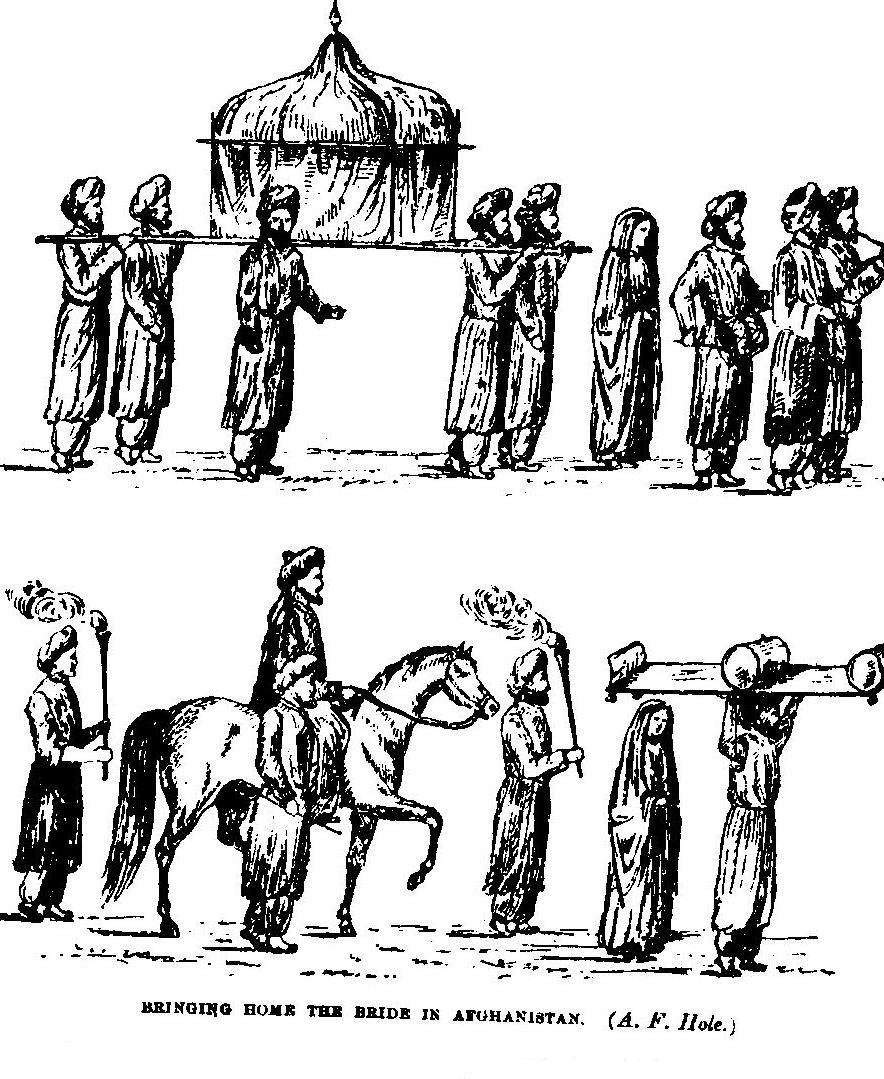
The third day, the eventful barat, arrives to awaken in the heart of a tender mother all the good feelings of fond affection; she is, perhaps, about to part with the great solace of her life under many domestic trials; at any rate, she transfers her beloved child to another protection. All marriages are not equally happy in their termination; it is a lottery, a fate, in the good mother's calculation. Her darling child may be the favoured of heaven, for which she prays; she may be however, the miserable first wife of a licentious pluralist; nothing is certain, but she will strive to trust in God's mercy, that the event prove a happy one to her dearly-loved girl.
The young bride is in close confinement during the days of celebrating her nuptials; on the third, she is tormented with the preparations for her departure. The mayndi must
be applied to her hands and feet, the formidable operations of bathing, drying her hair oiling and dressing her head, dyeing her lips, gums, and teeth with antimony, fixing on her the wedding ornaments, the nose-ring presented by her husband's family; the many rings to be placed on her fingers and toes, the rings fixed in her ears, are all so many new trials to her, which though a complication of inconvenience she cannot venture to murmur at, and therefore submits to with the passive weakness of a lamb.
Towards the close of the evening, all these preparations being fulfilled, the marriage portion is set in order to accompany the bride. The guests make their own amusements for the day: the mother is too much occupied wish her daughter's affairs to give much of her time or attention to them; nor do they expect it, for they alt know by experience the nature of a mother's duties at such an interesting period.
The bridegroom's house is nearly in the same state of bustle as the bride's, though of a very different description, as the preparing for the reception of a. bride is an event of vast importance in the opinion of a Musalman. The gentlemen assemble in the evening, and are regaled with sherbet and the huqqah, and entertained with the nauch-singing and fire-works, until the appointed hour for setting out in the procession to fetch the bride to her new home.
The procession is on a grand scale every friend or acquaintance, together with their elephants, are pressed into the service of the bridegroom on this night of Barat. The young man himself is mounted on a handsome charger the legs, tail, and mane of which are dyed with mayndi, whilst the ornamental furniture of the horse is splendid with spangles and embroidery. The dress of the bridegroom is of gold cloth, richly trimmed, with a turban to correspond to the top of which is fastened an immense bunch of silver trimming, that falls over his face to his waist, and answers the purpose of a veil (this is in strict keeping with the Hindu custom at their marriage processions). A select few of the females from the bridegroom's house attend in his train to bring home the bride, accompanied by innumerable torches, with bands of music, soldiers, and servants, to give effect to the procession. On their arrival at the gate of the bride's residence, the gentlemen are introduced to the father's apartments, where fire-works, music, and singing, occupy their time and attention until the hour for departure arrives.
The marriage ceremony is performed in the presence of witnesses, although the bride is not seen by any of the males at the time, not even by her husband, until they have been lawfully united according to the common form.
The Maulawi commences by calling on the young maiden by name, to answer to his demand, 'It is by your own consent this marriage takes place with —?" naming the person who is the bridegroom; the bride answers," It is by my consent." The Maulawi then explains the law of Muhammad, and reads a certain chapter from that portion of the Qur'an which binds the parties in holy wedlock. He then turns to the young man, and asks him to name the sum he proposes as his wife's dowry. The bridegroom thus called upon, names ten, twenty, or perhaps, a hundred lacs of rupees; the Maulawi repeats to all present the amount proposed, and then prays that the young couple thus united may be blessed in this world and in eternity. All the gentlemen then retire except the bridegroom, who is delayed entering the hall until the bride's guests have retreated into the side rooms; as soon as this is accomplished he is introduced into the presence of his mother-in-law and her daughter by the women servants. He studiously avoids looking up at he enters the hall, because, according to the custom of this people, he must first see his wife's face in a looking—glass, which is placed before the young couple, when he is seated an the masnad by his bride. Happy for himself he then beholds a face that bespeaks the gentle being he hopes fate has destined to make him happy. If otherwise, he must submit; there is no untying the sacred contract.
Many absurd. customs follow this first introduction of the bride and bridegroom. When the procession is all formed, the goods and chattels of the bride are loaded on the heads of the carriers; the bridegroom conveys his young wife in his arms to the covered palankeen, which is in readiness within the court, and the procession moves off in grand style, with a perpetual din of noisy music, until they arrive at the bridegroom's mansion.
The poor mother has, perhaps, had many struggles with her own heart to save her daughter's feelings during the preparation for departure; but when she separation takes place, the scene is affecting beyond description. I never witnessed anything equal to it in other societies; indeed, so powerfully are the feelings of the mother excited, that she rarely acquires her usual composure until her daughter is allowed to revisit her, which is generally within a week after. her marriage. (See Mrs. Meer Hasan Ali's Indian Musalmans, vol. 1. p. 46.)
The above description of a wedding in India has been selected as representative of such ceremonies; but there is no uniform custom of celebrating Muslim nuptials, the nuptial ceremonies in Afghanistan being much more simple in their character, as will be seen by the illustration given on the preceding page.
Mr. Lane, in his Modern Egyptians, gives the following interesting account of a wedding in Egypt:-
"Marriages in Cairo are generally conducted, in the case of a virgin, in the following manner; but in that of a widow, or a divorced, woman, wilth little ceremony. Most commonly, the mother, or some other near female relation, of the youth or man who is desirous of obtaining a wife, describes to him the personal and other qualifications of the young women with whom she is acquainted,
and directs his choice; or he employs 'khat'beh' or 'khatibeh' (khatibah) a, woman whose regular business it is to assist men in such cases. Sometimes two or more women of this profession are employed. A khat'beh gives her report confidentially, describing one girl as being like a gazelle, pretty and elegant and young; and another as not pretty, but rich, and so forth. If the man have a mother and other near female relations, two or three if these usually go with s khat'beh to pay visits to several harems, to which she has access in her professional character of a matchmaker; for she is employed as much by the women as the man. She sometimes, also, exercises the trade of a 'dellaleh' (or broker), for the sale of ornaments, clothing, &c., which procures her admission into almost every harem. The women will accompany her in search of a wife for their relation, are introduced to the different harems merely as ordinary visitors; and as such, if disappointed they soon take their leave, though the object of their visit is of course well understood by the other party, but if they find among the females of a family "and they are sure to see all who are marriageable a girl or young woman having the necessary personal qualifications, they state the motives of their visit, and ask, if the proposed match be not at once disapproved of, what property, ornaments, &c., the objects of their wishes may possess. If the "father of the intended bride be dead, she may perhaps possess one or more houses shops, &c.; and in almost every case a marriageable girl of the middle or higher ranks has a set of ornaments of gold and jewels. The women visitors having asked these and other question bring their report to the expectant youth or man. If satisfied with their report, he gives a present to the khat'beh, and sends her again to the family of his intended wife, to make known to them his wishes. She generally gives an exaggerated description of his personal attractions, wealth, &c. For instance, she will say of a very ordinary young man, of scarcely any property, and of whose disposition she knows nothing. 'My daughter, the youth who wishes to marry you is young, graceful, elegant, beard-less, has plenty of money, dresses handsomely, is fond of delicacies, but cannot enjoy his, luxuries alone; he wants you as his companion; be will give you everything that money can procure; he is a stayer at home, and will spend his whole time with you, caressing and fondling you.'
"The parents may betroth their daughter to whom they please, and marry her to him without her consent, if she be not arrived at the age of puberty; but after she has attained that age, she may choose a husband for herself, and appoint any man to arrange and effect her marriage. In the former case how ever, the khat'beh and the relations of a girl sought in marriage usually endeavoar to obtain her consent to the proposed union. Very often a father objects to giving a daughter in marriage to a man who is not of the same profession or trade as himself; and to marrying a younger daughter before an elder! The bridegroom can scarcely over obtain even a surreptitious glance at the features of his bride, until he finds her in his absolute possession. Possession, unless she belong to the lower classes of society; in which case it is easy enough for him to see her face.
'When a female is about to marry, she should have a 'wakeel' (wakil, or deputy) to settle the compact and conclude the contract, for her, with her proposed husband. If she be under the age of puberty, this is absolutely necessary; and in this case, her father, if living, or (if he be dead) her, nearest adult male relation, or a guardian appointed by will, or by the Kadee, performs the office of wakeel; but if she be of age, the appoints her own wakeel, or may even make the contract herself; though this is seldom done.
"After a youth or man has made choice of a female to demand in marriage, on the record of his female relations or that of the khat'beh, and, by proxy, made the preliminary arrangements before described with her and her relations in the harem, he repairs with two or three of his friends to her wakeel. Having obtained the wakeel's consent to the union, if the intended bride be under age, he asks what is the amount of the required mahr (or dowry).
"The siring of a dowry is indispensable. The usual amount of the dowry, if the par-ties be in possession of a moderately good income, is about a thousand riyals (or twenty-two pounds ten shillings); or, sometimes, not more than half that sum. The wealthy calculate the dowry in purses of five hundred plasters (about five pounds sterling) each; and fix its amount at ten purses or more.
"It must be borne in mind that we are considering the case of a virgin bride; the dowry of a widow or divorced woman is much less. In settling the amount of the dowry, as in other pecuniary transactions, a little haggling frequently takes place; if a thousand riyals be demanded through the wakeel, the party of the intended bridegroom will probably make an offer of six hundred: the former party then gradually lowering the demand, and the other increasing the offer, they at length agree to fix it at eight hundred. It in generally stipulated that two-thirds of the down shall be paid immediately before the marriage contract is made; and the remaining third held in reserve, to be paid to the wife in case of divorcing her against her own consent, or in case of the husband's death.
"This affair being settled, and confirmed by all persons present reciting the opening chapter of the Kuran (the Fat'hah), an early day (perhaps the day next following) is appointed for paying the money, and performing the ceremony of the marriage-contract, which is properly called 'akd en-nikah' ('aqdu 'n-nikah). The making this contract is commonly called ketb el-kitab' (katbu 'l-kitab, or the writing of the writ); but it is very seldom the ease that any document is written to confirm the marriage, unless the bridegroom is about to
travel to another place, and fears that he may have occasion to prove his marriage where witnesses of the contract cannot be procured. Sometimes the marriage contract is concluded immediately after the arrangement respecting the dowry, but more generally a day or two after.
"On the day appointed for this ceremony, the bridegroom again accompanied by two or three of his friends, goes to the house of his bride, usually about noon, taking with him that portion of the dowry which he has promised to pay on this occasion. He and his companions are received by the bride's wakeel, and two or more friends of the latter are usually present. It is necessary that there be two witnesses (and those must be Muslims) to the marriage-contract, unless in a situation where witnesses cannot be procured. All persons present recite the Fat'hah and the bridegroom then pays the money. After this, the marriage-contract is performed. It is very simple. The bridegroom and the bride's wakeel sit upon the ground. face to face, with one knee upon the ground, and grasp each other's right hand, raising tie thumbs, and pressing them against each other. A fekeeh (faqih) is generally employed to instruct them what they are to say. Having placed a handkerchief over their joined hands, he usually prefaces the words of the contract with a khutbeh (khutbah), consisting of a few words of exhortation and prayer, with quotations from the Kuran and Traditions, on the excellence and advantages of marriage. He then desires the bride's wakeel to say, 'I betroth (or marry) to thee my daughter (or the female who has appointed me her wakeel), such a one (naming the bride), the virgin (or the adult.), for a dowry of such an amount.' (The words 'for a dowry,' &c., are sometimes omit' -) The bride's wakeel having said them the bridegroom says, 'I accept from thee hot betrothal [or marriage] to myself, and take her under my care, and myself to afford her my protection; and ye who are present bear witness of this.' The wakeel addressee the bridegroom in the same manner a second and a third time; and each time, the latter replies as before. Both then generally add, 'And blessing be on the Apostles; and praise be to God, the Lord of the beings of the whole world. Amen.' After which all present again repeat the Fat'hah. It is not always the same form of khutbeh that is recited on those occasions: any form may be used, and it may be repeated by any person it is not even necessary, and is often altogether omitted.
"The contract concluded, the bridegroom sometimes (but seldom, unless he be a person of the lower orders) kisses the hands of his friends and others there present; and they are presented with sharbat, and generally remain to dinner. Each of them receives an embroidered handkerchief, provided by the family of the bride; except the fekeeh, who receives a similar handkerchief, with a small gold coin tied up in it, from the bridegroom. Before the persons assembled on this occasion disperse, they settle when the 'leylet ed-dakbleh' is to be. This is the night when the bride is brought to the house of the bridegroom, and the latter, for the first time, visits her.
"The bridegroom should receive his bride on the eve of Friday, or that of Monday; but the foremer is generally esteemed the more fortunate period. Let us say, for instance, that the bride is to be conducted to him on the eve of Friday.
"During two or three or more preceding nights, the street or quarter in which the bridegroom lives is illuminated with chandeliers and lanterns, or with lanterns and small lamps, some suspended from cords drawn across from the bridegroom's and several other houses on each side to the houses opposite; and several small silk flags, each of two colours, generally red and green, are attached to these or other cords.
"Art entertainment is also given on each of these nights, particularly on the last night before that on which the wedding is concluded, at the bridegroom's house. On these occasions, it is customary for the persons invited, and for all intimate friends, to send presents to his home, a day or two before the feast which they purpose or expect to attend. They generally send sugar, coffee, rice, wax candles, or a lamb. The former articles are usually placed upon a tray of copper or wood, and covered with a silk or embroidered kerchief. The guests are entertained on these occasions by musicians and male or female singers, by dancing girls, or by the performance of a 'khatmeh' (khatmah), or 'zikr' (zikr).
"The customs which I am now about to describe are observed by those classes that compose the main bulk of the population of Cairo.
"On the preceding Wednesday (or on the Saturday if the wedding be to conclude on the eve of Monday), at about the hour of noon, or a little later, the bride goes in state to the bath.. The procession to the bath is called. 'Zeffet el-Harmmam.' It is headed by a party of musicians, with a hautboy or two, and drums of different kinds. Sometimes at the head of the bride's party, are two men, who carry the utensils and linen used in the bath, upon two round trays, each of which is covered with an embroidered or a plain silk kerchief; also a sakka (saqqa) who gives water to any of the passengers, if asked; and two other persons, one of whom bears a 'kamkam,' or bottle, of plain or gilt silver, or of china, containing rose-water, or orange-flower water, which he occasionally sprinkles on the passengers; and the other, a 'mibkharah' (or perfuming vessel) of silver, with aloes-wood, or some other odoriferous substance, burning in it; but it is seldom that the procession is thus attended. In general, the first persona among the bride's party are several of her married female relations and friends, walking in pairs;. and next, a number of young virgins. The former are dressed in the usual manner, covered
with the black silk habarah; the latter have white silk habarahi, or shawls. Then follows the bride, walking under a canopy of silk of some gay colour, as pink, rose-colour, or yellow; or of two colours, composing wide stripes, often rose-colour and yellow. It is earned by four men, by means of a pole at each corner, and is open only in front; and at the top of each of the four poles is attached an embroidered handkerchief.
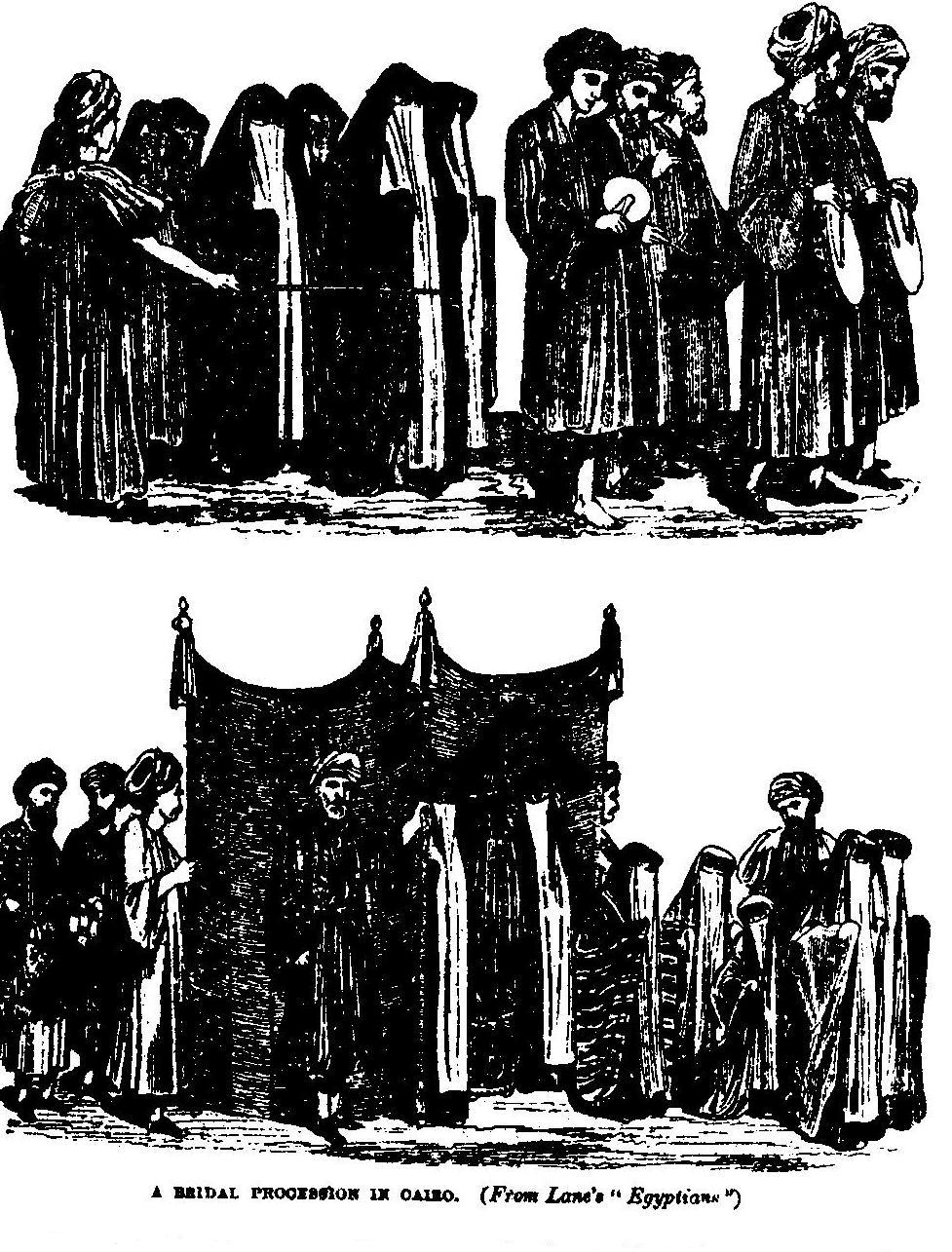
"The dress of the bride, during this procession, entirely conceals her person. She is generally covered from head to foot with a red kashmere shawl or with a white or yellow shawl, though rarely. Upon her head is placed a small pasteboard cap, or crown. The shawl is placed over this, and conceals from the view of the public the richer articles of her dress, her face, and her jewels, &c., except one or two kussaha' (and sometimes
other ornaments), generally of diamonds and emeralds, attached to that part of the shawl which covers her forehead.
"She is accompanied by two or three of her female relations within the canopy; and often, when in hot weather, a woman, walking backwards before her, is constantly employed in fanning her, with a large fan of black ostrich-feathers, the lower pare of the front of which is usually ornamented with a piece of looking-glass. Sometimes one zaffeh, with a single canopy, serves for two brides, who walk side by side. The procession moves very slowly, and generally pursues a circuitous route, for the sake of greater display. On leaving the house, it turns to the fight. It is closed by a second party of musicians similar to the first, or by two or three drummers.
"In the bridal processions of the lower orders, which are often conducted in the same manner as that above described, the women of the party frequently utter, at intervals, those shrill cries of joy called 'zaghareet'; and females of the poorer classes, when merely spectators of a zeffeh, often do the earns. The whole bath is sometimes hired for the bride and her party exclusively.
"They pass several hours, or seldom less than two, occupied in washing, sporting, and feasting; and frequently 'al-mehs,' or female singers, are hired to amuse them in the bath; they then return in the same order in which they came.
"The expense of the zeffeh falls on the relations of the bride, but, the feast that follows it is supplied by the bridegroom.
"Having returned from the bath to the house of her family, the bride and her companions sup together. If 'almehs have contributed to the festivity in the bath., they, also, return with the bride, to renew their concert. Their songs are always on the subject of love, and of the joyous event which occasions their presence. After the company have been thus entertained, a large quant of henna having been prepared, mixed into a paste, the bride takes a lump of it in her hand, and receives contributions (called 'nukeet') from her guests; each of them sticks a coin (usually of gold) in the hennsa which she holds upon her hand, and when the lump is closely stuck with these coins, she scrapes it off her hand upon the edge of a basin of water. Having collected in this manner from all her guests, some more henna is applied to her hands and feet, which are then bound with pieces of linen; and in this state they remain until the next morning, when they are found to be sufficiently dyed with its deep orange red tint. Her guests make use of the remainder of the dye for their own hands This night is called 'Leylet el-Henna.' or, 'the Night of the Henna.'
"It is on this night, and sometimes also during the latter half of the preceding day that the bridegroom gives his chief entertainment.
Mobobbazeen' (or low farce-players) often perform on this occasion before the house, or, if it be large enough in the court.
The other and more common performances by which the guests are amused, have been before mentioned.
"On the following day, the bride goes in procession to the house of the bridegroom. The procession before described is called 'the zeffeh of the bath,' to distinguish it from this, which is the more important, and which is therefore particularly called 'Zeffeh al-'Arooseh,' or 'the Zeffeh of the Bride' In some tame, to diminish the expenses of the marriage ceremonies, the bride is conducted privately to the bath, and only honoured with a zeffeh to the bridegroom's house. This procession is exactly similar to the former. The bride and her party, after breakfasting together, generally set out a little after midday. "They proceed in the same order, and at the same slow pace, as in the zeffeh of the bath; and. if the house of the bridegroom is near, thee follow a circuitous route, through several principal streets, for the sake of display. The ceremony usually occupies three or more hours.
"Sometimes, before bridal processions of this kind, two swordsmen, clad in nothing but their drawers, engage each other in a mock combat; or two peasants cudgel each other with nebboots or Long staves. In the procession of a bride of a wealthy family, any person who has the art of performing some extraordinary feat to amuse the spectators is almost sure of being a welcome assistant, and of receiving a handsome present. 'When the Seyyid Omar, the Nakeel el-Ashraf (or chief of the descendants of the Prophet), who was the ream instrument of advancing Mohammad Alec to the dignity of Basha of Egypt, married a daughter about forty-five years since, there walked before the procession a young man who had made an incision in his abdomen, and drawn one a large portion of his intestines, which he carries before him on a silver tray. After the procession he restored them to their proper place, and remained in bed many days before he recovered from the effects of this foolish and disgusting act. Another man, on the same occasion, ran a swere through his arm, before the crowding spectators, and then bound over the wound, without withdrawing the sword, several handkerchiefs, which were soaked with the blood. These facts were described to me by an eye witness. A spectacle of a more singular and more disgusting nature used to be not uncommon on similar occasions, but is now very seldom witnessed. Sometimes, also, 'hawees' (or conjurors and sleight of hand performers) exhibit a variety of tricks on these occasions. But the most common of all the performances here mentioned are the mock fights. Similar exhibitions are also sometimes witnessed on the occasion of a circumcision. Grand zeffehs are, sometimes accompanied by a numbers of cars, each bearing a group of persons of some manufacture or trade, performing the usual work of their craft; even such as builders, whitewashers &c., including member, of all, or almost all, the arts and
manufacture practised in the metropolis. In one car there are generally some men making coffee which they occasionally present to spectators in another, instrumental musicians, and in another, 'al'mehs (or female singers).
"The bride, in zeffehs of this kind, is sometimes conveyed in a close European carriage, but more frequently, she and her female relations and friends are mounted on high-saddled asses, and, with musicians and female singers, before and behind them, close the procession.
"The bride and her party having arrived at the bridegroom's house, sit down to a repast. Her friends shortly after take their departure, leaving with her only her mother and sister, or other near female relations, and one or two other women; usually the belláneh. The ensuing night is called 'Leylet ed-Dakhleh,' or 'the Night of the Entrance.'
"The bridegroom site below. Before sunset he goes to the bath, and there changes his clothes, or he merely does the latter at home; and, after having supped with a party of his friends, waits till a little before the night prayer, or until the third or fourth hour of the night, when, according to general custom, he should repair to some celebrated mosque, and there say his prayers. If young, he is generally honoured with a zeffeh on this occasion. In this case he goes to the mosque preceded by musicians with drums and a hautboy or two, and accompanied by a number of friends, and by several men bearing 'mashals' (mash'al). The mashals are a kind of cresset, that is, a staff with a cylindrical frame of iron at the top, filled with flaming wood, or having two, three, four, or five of these receptacles for fire. The party usually proceeds to the mosque with a quick pace, and without much order. A second group of musicians, with the same instruments, or with drums only, closes the procession.
"The bridegroom is generally dressed in a kuftan with red stripes, and a red gibbeh, with a kashmers shawl of the same colour for his turban, and walks between two friends similarly dressed. The prayers are commonly performed merely as a matter of ceremony, and it is frequently the ease that the bridegroom does not pray at all, or prays without having previously performed the wudoo like memlooks, who say their prayers only because they fear their master. The procession returns from the mosque with more order and display, and very slowly; perhaps because it would be considered unbecoming in the bridegroom to hasten home to take possession of his bride, it is headed, as before) by musicians, and two or more bearers of mashals. These are generally followed by two men, beaming, by means of a pole resting horizontally upon their shoulders, a hanging frame, to which are attached about sixty or more small lamps, in four circles, one above another, the uppermost of which circles is made to revolve, being turned round occasionally by one of the two bearers. These numerous before mentioned, brilliantly illumine the streets through which the procession passes, and produce a remarkably picturesque effect. The bridegroom and his friends and other attendants follow, advancing in the form of an oblong ring, all facing the interior of the ring, and each bearing in his hand one or more wax candles, and sometimes a sprig of henna, or some other flower, except the bridegroom and the friend on either aide of him. These three form the latter part of the ring, which generally consists of twenty or more persons.
"At frequent intervals, the party stops for a few minutes, and during each of the pauses, a boy or a man, one of the persons who compose the ring, sings a few words of an epithalamium. The sounds of the drums, and the shrill note of the hautboy (which the bride hears half an hour or more before the procession arrives at the house), cease during these songs. The train is closed, as in the former case (when on the way to the mosque) by a second group of musicians.
"In the manner above described, the bridegroom's zeffeh is most commonly conducted; but there is another mode that is more respectable, called 'zeffeh sádatee,' which signifies the 'gentlemen's zeffeh.' In this, the bridegroom is accompanied by his friends in the manner described above, and attended and preceded by man bearing mashals, hut not by musicians; in the place of these are about six or eight men, who, from their being employed as singers on occasions of this kind, are called 'wilad el-layalee,' or 'sons of the nights. Thus attended, he goes to the mosque; and while he returns slowly thence to his house, the singers above mentioned chant, or rather sing, 'muweshshahs' (lyric odes) in praise of the Prophet. Having returned to the house, these same persons chant portions of the Kuran, one after another, for the amusement of the guests; then, all together, recite the opening chapter (the Fathah); after which, one of them sings a 'kaseedeh' ' (or short poem), in praise of the Prophet lastly, all of thorn again sing musweshahahs. After having thus performed, they receive 'nukoot' (or contributions of money) from the bridegroom and his friends.
"Soon after his return from the mosque, the bridegroom leaves his friends in a lower apartment, enjoying their pipes and coffee and sharbat. The bride's mother and sister, or whatever other female relations were left with her, are above, and the bride herself and the belláneh, in a separate apartment. If the bridegroom is a youth or young man, it is considered proper that he as well as the bride should exhibit some degree of bashfulness; one of his friends, therefore, carries him a part of the way up to the hareem. Sometimes, when the parties are persons of wealth, the bride is displayed before the bridegroom in different dresses, to the number of seven; but generally he finds her with the belláneh alone, and on entering the apartment he gives a present to this attendant,
"The bride has a shawl thrown over her head, and the bridegroom must give her a present of money, which is called 'the price of the uncovering of the face, before be attempts to remove this, which she does not allow him to do without same apparent reluctance, if not violent resistance, in order to show her maiden modesty. On removing the covering, he says, 'In the name of God, the Compassionate, the Merciful,' and then greets her with this compliment: 'The night be blessed,' or ' — is blessed,' to which she replies, If timidity do not choke her utterance, 'God bless thee! The bridegroom now, in most cases, sees the face if his bride for the first time, and generally finds her nearly what he has been led to expect. Often, but not always, a curious ceremony is then performed.
"The bridegroom takes off every article of the bride's clothing except her shirt, seats her upon a mattress or bed, the head of which is turned towards the direction of Makkah, placing her so that her back is also turned in that direction, and draws forward and spreads upon the bed, the lower part of the front of her shirt; having done this, he stands at the distance of rather less than three feet before her, and performs the prayers of two rak'ahs laying his head and hands in prostration upon the part of her shirt that is extended before her lap. He remains with her but a few minutes longer. Having satisfied his curiosity respecting her personal charms, he calls to the women (who generally collect at the door, where they wait in anxious suspense) to raise their cries of joy, or zaghareet, and the shrill sounds make known to the persons below and in the neighbourhood, and often, responded to by other women, spread still further the news that he has acknowledged himself satisfied with his bride. He soon after descends to rejoin his friends, and remains with them an hour, before he returns to his wife. It very seldom happens that the husband, if disappointed in his bride, immediately disgraces and divorces her; in general, he retains her in this case a week or more.
"Marriages, among the Egyptians, are sometimes conducted without any pomp or ceremony, even in the case of virgins, by mutual consent of the bridegroom and the bride's family, or the bride herself; and widows and divorced women are never honoured with a zeffeh on marrying again. The mere sentence, 'I. give myself up to thee,' uttered by a female to a man who proposes to become her husband (even without the presence of witnesses, if none can easily be procured), renders her his legal wife, if arrived at puberty; and marriages with widows and divorced women, among the Muslims of Egypt, and other Arabs, are sometimes concluded in this simple manner. The dowry of widows and divorced women is generally one quarter or third or half the amount of that of a virgin.
"In Cairo, among persons not of the lowest order, though in very humble life, the marriage in conducted in the same manner as among the middle orders. But when the expenses of inch zeffehs as I have described cannot by any means be paid, the bride in paraded in a very simple manner, covered with a shawl (generally red), and surrounded by a group of her female relations and friends, dressed in their best, or in borrowed clothes, and enlivened by no other sounds of joy than their zaghareet, which they repeat at frequent intervals." (Lane's Modern Egyptians.)
(For the law of marriage in Hanafi law, see Fatawa-i-'Alamgiri p. 377; Fatawa-i-Qazi Khan, p. 380; Hamiton's Hidayah, vol. i. p. 89; Durru 'l-Mukhtu, p. 196. In Shi'ah law, Jami'u 'sh-Shattat; Shara'i' l'-Islam, p. 260. For marriage ceremonies, Lane's Egyptians; Herklott's Musalmans; Mrs. Meer Hasan Ali's Musalmans; M.C. de Perceval, His. des Arabes.)
MARSIYAH.
 .
A funeral elegy. Especially applied to those sung during the Muharram in commemoration of al-Hasan and al-Husain.
.
A funeral elegy. Especially applied to those sung during the Muharram in commemoration of al-Hasan and al-Husain.
MARTYR.
The Arabic word for
"martyr" in the Qur'an, and in Muslim theology, is shahid  , pl. shuhud, or shahid
  pl. shuhada', the literal meaning of which is "present as a witness." It implies all that is understood by the Greek
  , and the English martyr; but it is also a much more comprehensive term, for, according to Muhammadan law, not only those who die in witness of, or in defence of the faith, are martyrs, but all those who die such deaths as are calculated to excite the compassion and pity of their fellow men.
The word occurs in the Qur'an, Surah iv. 71: "Whoso obeys God and the Apostle, these are with those with whom God has been well pleased—with prophets (nabiyin), and confessors (siddiqin), and martyrs (shuhada'), and the righteous (salihin): a fair company are they."
A perfect martyr, or ash-shahidu 'l-kamil, is one who has either been slain in a religious war, or who has been killed unjustly. But the schools of divinity are not agreed an to whether it is necessary, or not, that such persons should be in a state of ceremonial purity at the time of their death, to entitle them to such a high rank.
A special blessing is promised to those who die in jihad, or religious war, see Qur'an, Surah iii. 163: "Count not those who are killed in the way of God as dead, but living with their Lord." And, according to Muslim law, all persons who have died in defence of the faith, or have been slain unjustly, are entitled to Muslim burial without the usual ablution or any change of clothes, such as are in the case of ordinary persons, the rank of martyrdom being such as to render the corpse legally pure.
But in addition to these two classes of persons, namely those who are slain in religious war, and those who have been killed unjustly, the rank of shahid is given in a figurative
sense, to any who die in such a manner as to excite the sympathy and pity of mankind, such as by sudden death, or from some malignant disease, or in childbirth, or in the acquirement of knowledge, or a stranger in a foreign country, or dying on Thursday night. These persons are entitled to the rank of martyr, but not to the honour of being buried without legal washing and purification.
MARUT.
 . [HARUT.]
MARWAH.
 .
A hill near
Makkah, connected with the rites of the pilgrimage. According to Burton, it means "hard white flints, full of fire" [HAJJ.]
.
A hill near
Makkah, connected with the rites of the pilgrimage. According to Burton, it means "hard white flints, full of fire" [HAJJ.]
MARYAM.
 .
[MARY.]
.
[MARY.]
MARY THE VIRGIN.
Arabic Maryam  Heb.
Heb.  The mother of Jesus. According to Muhmmadan tradition, and the Qur'an, she was the daughter of 'Imran and his wife Hannah, and the sister of Aaron.
The account of her birth as given hi the Qur'an is in Surah iii. 31 :—
"Remember when the wife of Imran said, 'O my Lord! I vow to Thee what is in my womb, for thy special service. Accept it from me, for Thou Hearest, Knowest!' And when she bad given birth to it, she said, 'O my Lord? Verily I have brought forth a female,'—God knew what she had brought forth a male is not as a female— 'and I have named her Mary, and I take refuges with Thee for her and for her offspring, from Satan the stoned. So with goodly acceptance did her Lord accept her, and. with goodly growth did he make her grow. Zacharias reared her. So oft as Zacharias went in to Mary at the sanctuary, he found her supplied with food. Oh Mary!' said he 'whence hast thou this?' She said., it is from God; for God supplieth whom He will, without reckoning !'"
In Surah xix. 28, is the story of her giving birth to Jesus. [JESUS CHRIST]. And when she brought the child to the people, they exclaimed, "O sister of Aaron! Thy father was not a bad man, nor was thy mother a harlot."
Chistian critics have assumed, and not without much reason, that Muhammad has confused the Mary of the New Testament with the Miriam in the Old, by representing her as the daughter of 'Imran and the sister of Aaron. It is certainly a cause of some perplexity to the commentators. Al—Baizawi says she was called "sister of Aaron" because she was of the Levities race: but Hussain says that the Aaron mentioned in the verse is not the same person as the brother of Moses.
Muhammad is related to have said that "no child is born but the devil hath touched it, except Mary and her son Jesus."
MARY THE COPT.
Arabic Mariyatu 'l-Qibtiyah  A concubine of Muhammad's, and the mother
of his son Ibrahim, who died in infancy. She was a Christian slave girl presented to Muhammad by the Roman governor of Egypt. [MUHAMMAD.]
A concubine of Muhammad's, and the mother
of his son Ibrahim, who died in infancy. She was a Christian slave girl presented to Muhammad by the Roman governor of Egypt. [MUHAMMAD.]
MASAH.
 .
The act of touching the boots or the turban for purification, by
drawing the three central fingers over the boot or turban at once, whereby they become ceremonially clean. (Mishkat, book ii. Ch. vii., book iii. ch. x.)
.
The act of touching the boots or the turban for purification, by
drawing the three central fingers over the boot or turban at once, whereby they become ceremonially clean. (Mishkat, book ii. Ch. vii., book iii. ch. x.)
AL-MASANI.
 .
From
Masna, "two-and-two." A title given to the Qur'an on account of its numerous repetitions.
.
From
Masna, "two-and-two." A title given to the Qur'an on account of its numerous repetitions.
AL-MASIH.
.
An evident corruption of the Heb.  which anawers
to the
which anawers
to the  of the New Testament, and
our English Christ. It occurs seven times in the Qur'an as the surname of Jesus. Al-Baizawi the commentator says, "It is originally a Hebrew word, signifying 'the blessed one, although some have erroneously as he thinks) held it to come from Masah, to
anoint, either because Jesus healed people
with his touch or because he had been anointed by Gabriel as a prophet.. [JESUS.]
of the New Testament, and
our English Christ. It occurs seven times in the Qur'an as the surname of Jesus. Al-Baizawi the commentator says, "It is originally a Hebrew word, signifying 'the blessed one, although some have erroneously as he thinks) held it to come from Masah, to
anoint, either because Jesus healed people
with his touch or because he had been anointed by Gabriel as a prophet.. [JESUS.]
AL-MASIHU 'D-. DAJJAL.

 .
"The lying Christ." The Antichrist which Muhammad said would appear before the Day of Resurrection. He is generally
called ad-Dajjal, but in the Traditions he is called al-Masilu 'd-Dajjal, and very many have been the speculations as to why he is called al-Masih. The compiler of the Qamus says there have been at least fifty reasons assigned for his being called al-Masih. Some say it is because he will have his eyes touched (masah) and be rendered blind; others, that the word was originallymasikh a 'monster."
(See Hujaju 'l-Kalimah, p. 401) Sale, in the preface of his translation of the Qur'an. says Muslim writers state that the Jews will give him the name of al-Masih, because they will mistake him for the tree Messiah, who has come to restore the kingdom of Israel to these.
.
"The lying Christ." The Antichrist which Muhammad said would appear before the Day of Resurrection. He is generally
called ad-Dajjal, but in the Traditions he is called al-Masilu 'd-Dajjal, and very many have been the speculations as to why he is called al-Masih. The compiler of the Qamus says there have been at least fifty reasons assigned for his being called al-Masih. Some say it is because he will have his eyes touched (masah) and be rendered blind; others, that the word was originallymasikh a 'monster."
(See Hujaju 'l-Kalimah, p. 401) Sale, in the preface of his translation of the Qur'an. says Muslim writers state that the Jews will give him the name of al-Masih, because they will mistake him for the tree Messiah, who has come to restore the kingdom of Israel to these.
Regarding this personage Abu Hurarah relates that Muhammad said:-
"'The Resurrection will not be until the Grecians shall attack 'Amiq and Dabiq. Then an army will come out from al-Madinah against them, the best of man on that day and when the lines of battle shall be drawn up, the Grecians will say, 'Vacate a place between us and those who made captives a tribe of ours' (and their design will be to separate the Musalmans). And the Musalmans will say, By God! we will not clear a place between you and our brother Musalmans.' And the Musalmans will fight the Grecians and a third of the Musalmans will be defeated and God will not acept their repentance And a third of the Musalmans will be slain, and they will be the best of martyrs before God. And a third of them will conquer the countries of Greece; after which they will be thrown into commotions, and Constantinople will be taken. And whilst the Musalmans shall be dividing the plunder.
having hung up their swords upon the olive tree, all of a sudden the Devil will call out, "Verily, Dajjal has attacked your wives and children in your absence.' Then, on hearing this, the Musalmans will come out of the city; and this information of devils will be false, but when they enter Syria, Dajjal will come out, and whilst the Musalmans shall be preparing their implements of war, and dressing their ranks, all of a sudden prayers will begin, and Jesus Son of Mary will come down, and act as Imam to them. And when Dajjal this enemy of God, shall see Jesus, he will fear to be near, dissolving away like salt in water. And if Jesus lets him alone, verily he will melt and perish, and God will kill him by the hand of Jesus, who will show to the people the blood of Dajjal upon his lance" (Mishkat, book xxiii. ch. ii.)
In other traditions. Muhammad is related to have said that ad-Dajjal will be a young man with long hair and blind in the one eye, and on his forehead will be the three letters K F R, signifying kafir or infidel. He will first appear midway between Syria and 'Iraq, and will do many wonders and perform many miracles, and will eventually be slain by Jesus.
MASJID.
 .Lit. "The place of prostration? The mosque, or place of public prayer. Mosques are generally built of stone or brick, in the form of a square, in the centre of which is an open court-yard, surrounded with cloisters for students. In the centre of the wall facing Makkah is the mihrab, or niche, which marks the direction of the Ka'bah at Makkah, and to the right of this niche is the mimbar or pulpit, from which the khatbah, or Friday oration, is recited. In the centre of the open courtyard there is usually a large tank, in which the worshippers perform their ablutions (wazu'), and adjoining
the mosque are latrines, in which the legal washings (ghusl) can be performed. Along the front within the, doorway is a low barrier, a few inches high, which denotes the sacred part of the mosque.
.Lit. "The place of prostration? The mosque, or place of public prayer. Mosques are generally built of stone or brick, in the form of a square, in the centre of which is an open court-yard, surrounded with cloisters for students. In the centre of the wall facing Makkah is the mihrab, or niche, which marks the direction of the Ka'bah at Makkah, and to the right of this niche is the mimbar or pulpit, from which the khatbah, or Friday oration, is recited. In the centre of the open courtyard there is usually a large tank, in which the worshippers perform their ablutions (wazu'), and adjoining
the mosque are latrines, in which the legal washings (ghusl) can be performed. Along the front within the, doorway is a low barrier, a few inches high, which denotes the sacred part of the mosque.
The mosques in India and Central Asia are generally constructed on the following plan:-
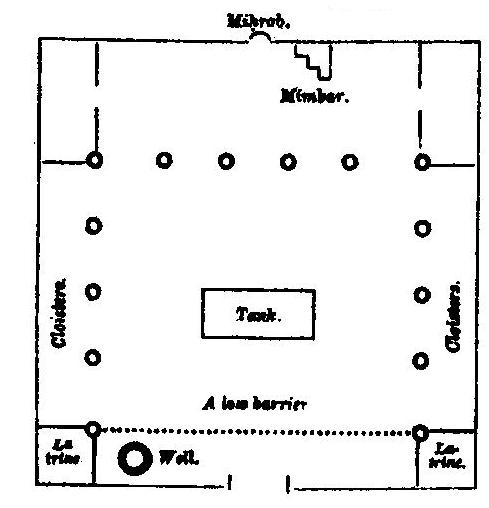
The mosques in Turkey, Syria and Egypt are often covered buildings, not unlike Christian churches.
The first mosque erected by Muhammad was at Quba', near al-Madinah. It was without cupola niche, or minaret, these. being added by at Walid about eighty years afterwards, nor were there arches supported by pillars, nor cloisters. An ordinary mosque in an Afghan village is still of this description.
The Muslim as he enters the mosque steps at the barrier and takes off his shoes, carries them in his left hand, sole to sole, and puts his right foot first as he passes into the square devoted to prayer. If he have not previously performed the ablution, he repairs
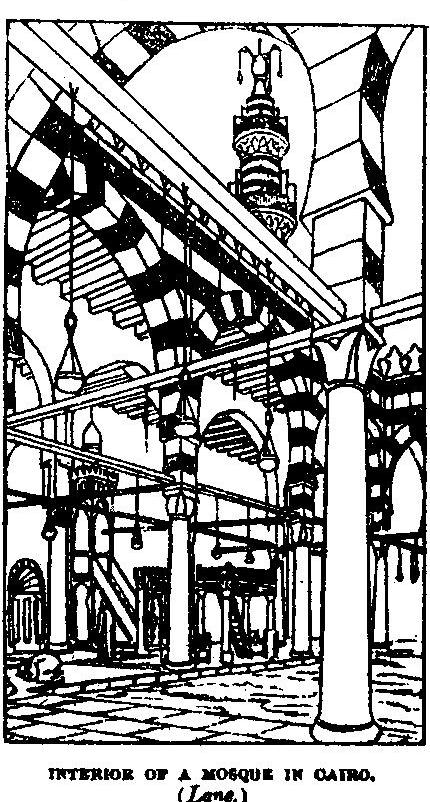
at once to the tank or well to perform the necessary duty, and before he commences his prayers he places his shoes and his sword and pistol, if he be thus armed; a little before the spot where his head will touch the ground as he prostrates; his shoes must be put one upon the other, sole to sole.
The chief officer of a mosque is the Imam, or leader of prayers, but there are generally Maulawis, or learned men, attached to mosques for the instruction of the students. Sometimes the Imam and Maulawi are combined in one, and sometimes a learned Maulawi will possess the mosque, but pay an Imam as his curate to say the stated prayer. There is also a Mu'azzin, or "caller to
prayer," whose duty it is to give the Azan. The trustee or superintendent of a mosque is called mutawali.
Although mosques are esteemed sacred buildings, they are also places of general resort, and persons may be seen in them lounging and chattering together on secular topics, and eating and sleeping, although such things were forbidden by Muhammad. They are, in all parts of Islam, used as rest-houses for strangers and travellers.
The Imam, or priest, of the mosque, is supported by endowments, or offerings, the Maulawis, or professors of divinity by fees, or offerings, and the students of a mosque are supported either by endowments or the benefactions of the people. In towns and villages there is a parish allotted to each mosque, and the people within the section of the parish claim the services of the Imam at their marriages and funerals, and they pay to him the usual offerings made on the two festivals.
In a large mosque, known as the Masjidu 'l-Jami', where the khutbah, or Friday oration is delivered, a person known as the khatib (also khatib), or preacher, is appointed. whose duty it is to lead the Friday prayer and to preach the sermon.
Muhammad did not forbid women to attend public prayers in a mosque, but it pronounced better for thorn to pray in private.
The following injunctions are given in the Qur'an regarding mosques:-
Surah vii. 29: "O children of Adam! Wear your goodly apparel when ye repair to any mosque."
Surah ix. 18: "He only should visit the Masjids of God who believeth in God and the last day, and observeth prayer, and payeth the legal alms, and dreadeth none but God.
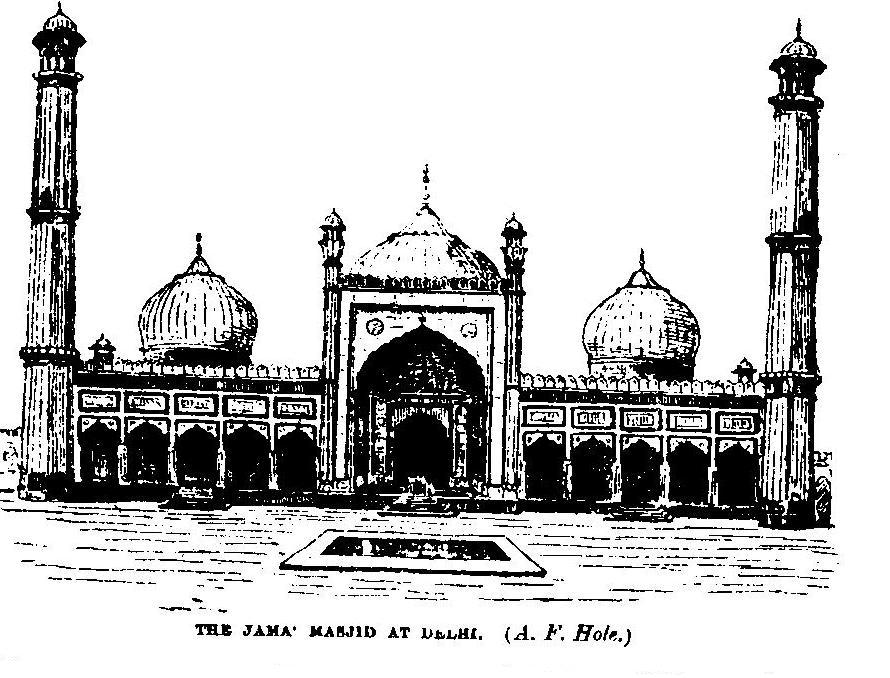
Muhammad's injunctions regarding mosques, as handed down in the Traditions, are as follows:-
"When you enter a Masjid, you must say, 'O Creator! open on us the doors of Thy compassion'; and when you leave the Masjid, say. 'O Lord! we supplicate thy munificence.'"
"It is a sin to spit in a Masjid, and the removal of the sin is to cover it over."
"Whoever shall enter a Masjid, let him enter it for a good object, namely, to learn something himself or so teach others. For he ranks as an equal with him who fights in the cause of God, who thus enters a Masjid; but he who enters a Masjld on any other account, is like unto a man who covets the property of another. Verily, a time will come when men will attend to worldly matters in a Masjid. But sit ye not with such."
"Do not prevent your women from coming to the Masjids, but their homes are better for them."
Do not read poetry in Masjid, and do not buy and sell there, nor sit in a circle talking before prayers on a Friday."
"The prayers of a man in his own house are equal to the reward of one prayer, but prayers in a Masjid near his home are equal to twenty-five prayers, and in a Jami' (or central mosque), they are equal to five hundred prayers, and in Jerusalem to fifty thousand, and in my Masjid (at al-Madinah) fifty thousand, and at the Ka'bah, one hundred thousand."
The Muslim law regarding the erection and endowment (waqf) of Masjids, is contained in
Sunni and Shi'ah works, is as follows According to the Sunnis:-
When a person has erected a Masjid, his right therein does not cease until in has separated both the area occupied by the Masjid and also the road and entrance thereunto from his own private property.
If a person build a Masjid, his right of property in it does not cease at, tong as he does not separate it from his private property, and give general permission to the people to come and worship in it. But as soon as he separates it from his property and allows even a single person to say his prayers in is, his rights to the property devoted to God as a mosque ceases.
When a trustee or superintendent (mutawalli) has been appointed in a Masjid and delivery of the property has been made to him the Masjid ceases to be private pro perty. So also, when delivery of it is made to the Qazi, or his deputy.
If a person appropriate ground for the purpose of erecting a Masjid, he cannot afterwards resume or sell it, neither can it be claimed by his heirs and inherited, because this ground is altogether alienated from the right of the individual, and appertains solely to God..
When a man has an unoccupied space of ground fit for building upon, and has directed a body of persons to assemble on it for prayers, the space becomes a Masjid, if the permission were given expressly to pray on it for ever; or, in absolute torsos, intending that it should be for ever; anti the property does not go to his heirs at his death. But if the permission were given for a day, or a month, or a year, the space would not become a Masjid, and on his death it would be the property of his heirs.
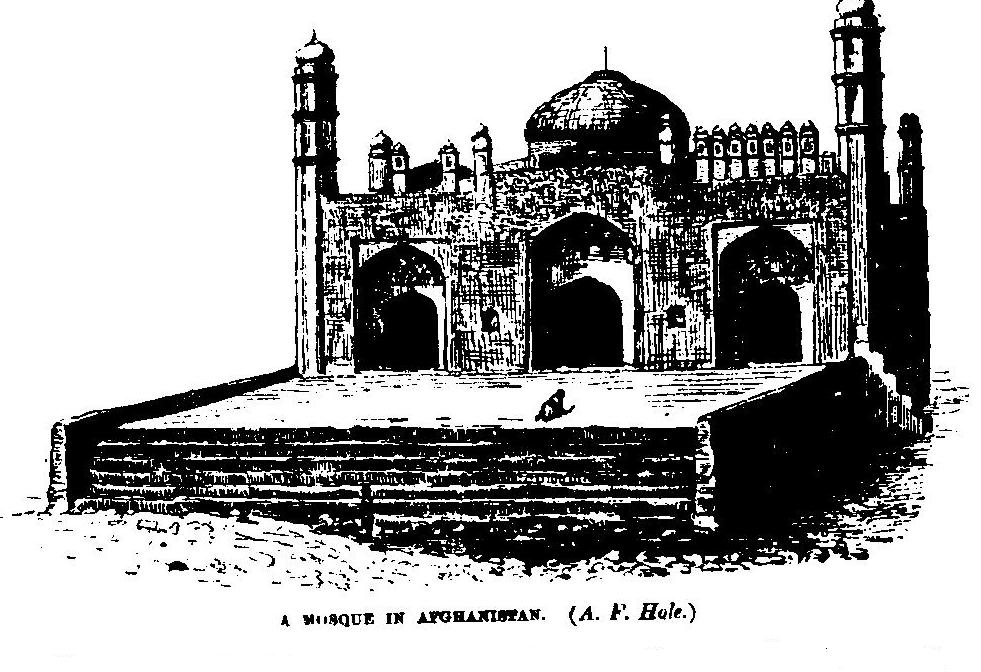
If a man during his sickness has made his own house a Masjid, and died, and it neither falls within a third of his property nor is allowed by his heirs, the whole of it is heritage, and the act of making it a Masjid is void, because, the heirs having ii right in it, there has been no separation from the rights of mankind, and an undefined portion has been made a Masjid, which is void. In the same way as if he should make his land a Masjid, and another person should establish an undefined right, in which case the remainder would revert to the property of the appropriator; contrary to the case of a person making a bequest that a third of his residence shall be made a Masjid, which would be valid; for in such a case there is a separation as the house may be divided and a third of it converted into a Masjid. (A third of a man's property being the extent to which be can bequeath to other than his heirs.)
When a man has made his land a Masjid, and stipulated for something out of it for himself, it Is not valid, according to all the jurists.
It is also generally agreed that if a man makes a Masjid on condition that he shall have an option, the waqf is lawful and the condition is void.
When a man has built a Masjid and called persons to witness that he shall have the power to cancel and sell, it, the condition is void, and the Masjid is as if he had erected a Masjid for the people of the street, saying. "It is for this street especially," when it would, notwithstanding, be for others as well as for them to worship in.
When a Masjid has fallen into decay and is no longer used for prayers, nor required by the people, it does not revert to the appropriator or his heirs, and cannot be sold ccording to the most correct opinions.
When of two Masjids one is old and gone to decay the people cannot use its materials to repair the more recent one, according to either the Imam Muhammad or Imam Abu Yusuf. Because though the former thought that the materials may be so supplied, he held that it is the original appropriator or his
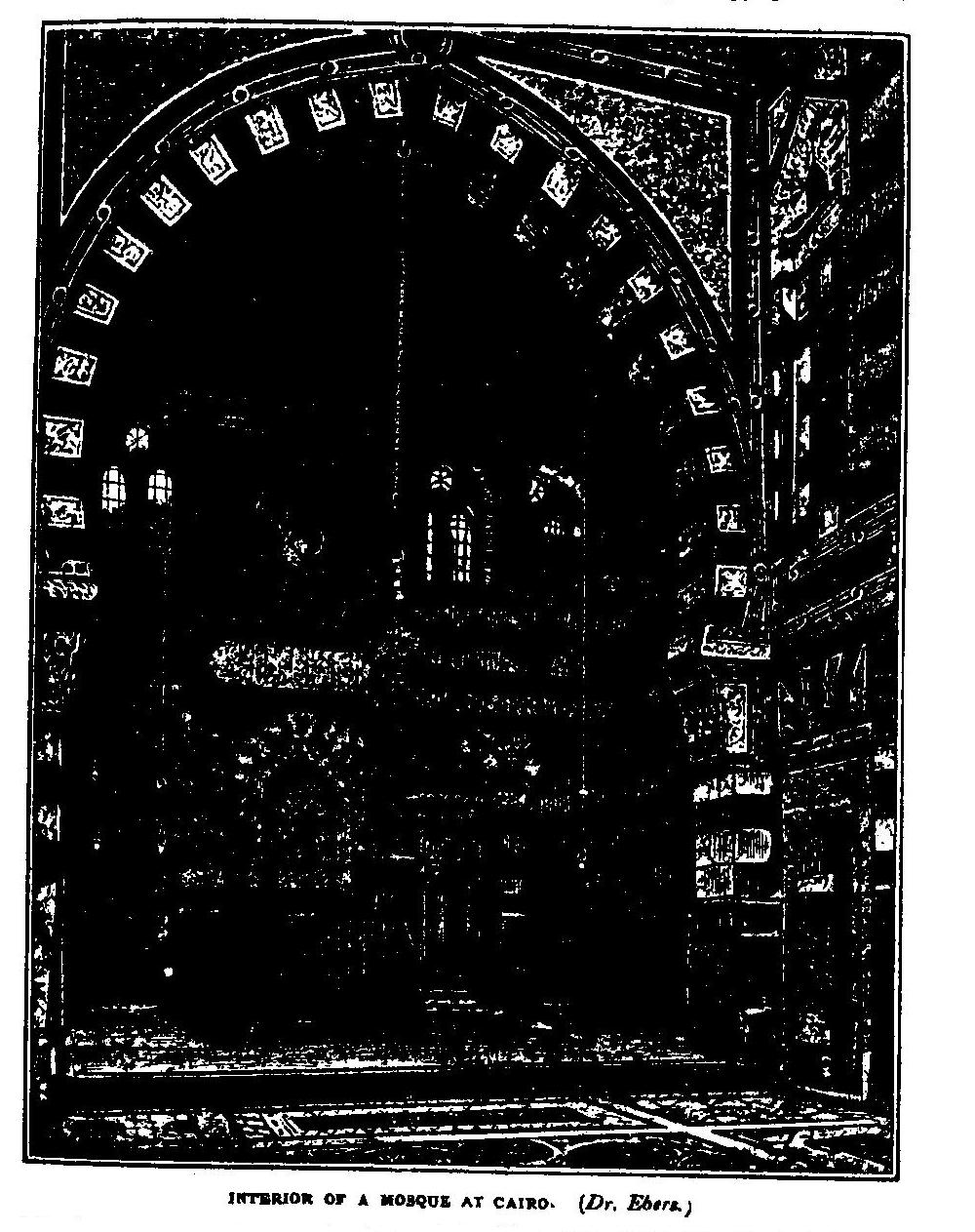
heirs, to whom the property reverts, that can so apply them, and because Abu Yusuf was of opinion that the property in a Masjid never resorts to the original appropriator though it should fall to ruin and be no longer used by the people.
If a man appropriate his land for the benefit of a Masjid, and to provide for Its repairs and necessaries, such as oil &c., and when nothing more is required for the Masjid, to apply what remains to poor Muslims the appropriation is lawful.
If a man has appropriated his land for the benefit of a Masjid, without any ultimate destination for the poor, the appropriation is lawful, according to all opinions.
If a man gives money for the repairs of a Masjid, also for its maintenance a and for its benefit, it is valid. For if it cannot operate as a waqf, it operates as a transfer by way of gift to the Masjid, and the establishing of property in this manner to a Masjid is valid, being completed by taking possession.
If a person should say, "I have bequeathed a third of my property to the Masjid," it would not be lawful, unless he says "to expend on the Masjid." So if he were to say, "I have bequeathed a third of my property to the lamps of the Masjid," it would not be lawful unless he say, "to give light with it in the Masjid." If he say, "I have given my house for a Masjid, it is valid as a transfer, requiring delivery. (Fatdwa-i-'Alamgiri, vol. ii. p. 545; Hidayah, vol ii p. 356; Baillie's Digest, pp. 504-405.)
The Shi'ah law regarding the endowment of Masjids, or land for the benefit of Masjids, does not differ in any important particular from that of the Sunnis. But there is a provision in the Shi'ah law regarding the sale of an endowment which is important.
If dissensions arise among the persons in whose favour the waqf is made, and there is apprehension of the property being destroyed, while on the other hand the sale thereof is productive of benefit, then, in that case, its sale is lawful.
If a house belonging to a waqf should fail into ruins, the space would not cease to be waqf, nor would its sale be lawful. If, however, discursions should arise among the persons for whom it was appropriated, insomuch as to give room (or apprehension that it will be destroyed, its sate would be lawful.
And even if there should be no such difference, nor any room for such apprehensions, but the sale would be more for the advantage of the parties interested, some are of opinion that the sale would be lawful; but the approved doctrine is to forbid it. (Mafatih; Shara I 'u Islam, p. 239.)
AL-MASUIDU 'L-AQSA..
 .
Lit. "The Most Distant
Mosque." The temple at Jerusalem erected by Solomon, called also al-Baitu 'l-Muqaddas, or "the Holy House." Known also in Muhammadan literature as as-Sakhrah, "the Rock." from which it is believed Muhammad ascended to heaven on the occasion of his celestial journey. (See Qur'an, Surah xvii.)
.
Lit. "The Most Distant
Mosque." The temple at Jerusalem erected by Solomon, called also al-Baitu 'l-Muqaddas, or "the Holy House." Known also in Muhammadan literature as as-Sakhrah, "the Rock." from which it is believed Muhammad ascended to heaven on the occasion of his celestial journey. (See Qur'an, Surah xvii.)
Jalalu 'd-din as-Suyuty has devoted a whole volume to the consideration of the superabundant merits existing in the Masjidu 'l-Aqsa, which work has been translated into English by the Rev. James Reynolds (Oriental Translation Fund, 1836). He says ft is called al-Aqsa, because it is the most distant mosque to which pilgrimage is directed. [JERUSALEM, AS-SAKHRAH.]
MASJIDU 'L-HARAM...
 .
"The Sacred Mosque."
The temple at Makkah which contains the Ka'bah, or Cube-house in which is placed the Hajara 'l-Aswad, or "Black Stone." The term Baitu 'llah, or "House of God," is applied to the whole enclosure, although it more specially denotes the Ka'bah itself.
.
"The Sacred Mosque."
The temple at Makkah which contains the Ka'bah, or Cube-house in which is placed the Hajara 'l-Aswad, or "Black Stone." The term Baitu 'llah, or "House of God," is applied to the whole enclosure, although it more specially denotes the Ka'bah itself.
The following graphic account of this celebrated building is given by the travaller Burckhardt, who visited it in AD. 1814. Captain R. Burton, who visited the temple thirty-eight years later, testifies to the great accuracy of Burckhardt's description, and quotes his description in extensor. The account by Burckhardt is given in the present article, with some alight corrections.
The Ka'bah stands in an oblong square, two hundred and fifty paces long, und two hundred broad, none of the sides of which runs quite in a straight line, though at first sight the whole appears to be of a regular shape. This open square is enclosed on the eastern side by a colonnade; the pillars stand in a quadruple row; they are three deep un the other sides, and united by pointed arches, every four of which support a small dome, plastered and whitened on the outside, These domes, according to Qutbu 'd-din, are one hundred and fifty two in number. Along the whole colonnade, on the four sides, lamps are suspended from the arches. Some are lighted every night, and all during the nights of Ramazan. The pillars are above twenty feet in height and generally from one foot and a half to one foot and three quarters in diameter; but little regularity has been observed in regard to them. Some are of white marble, granite, or porphyry, but the greater number are of common stone of the Makkah mountains. Fasy states the whole at five hundred and eighty-nine, and says they are all of marble excepting one hundred and twenty-six, which are of common stone, and three of composition. Qutbu d-din reckons five hundred and fifty-five, of which, according to him, three hundred and eleven are of marble, and the rest of stone taken from the neighbouring mountains; but neither of these authors lived to see the latest repairs of the mosque after the destruction occasioned by a torrent, in A.D. 1628. Between every three or four columns stands an octagonal one, about four feet in thickness. On the east side are two shafts of reddish gray granite, in one piece, and one fins gray porphyry column with slabs of visits feldspath. On the north side is one red granite column, and one of fine-grained red porphyry; these are probably the columns which Qutbu 'd-din states to have been brought from Egypt, end principally from Akhinim (Panopolis), when the chief Mahdi enlarged the mosque, in A.H. 168. Among the four hundred and fifty or five hundred columns, which form the enclosure, I found not any two capitals or bases exactly alike. The capitals are of coarse Saracenic workmanship; some of them, which had served for former buildings, by the ignorance
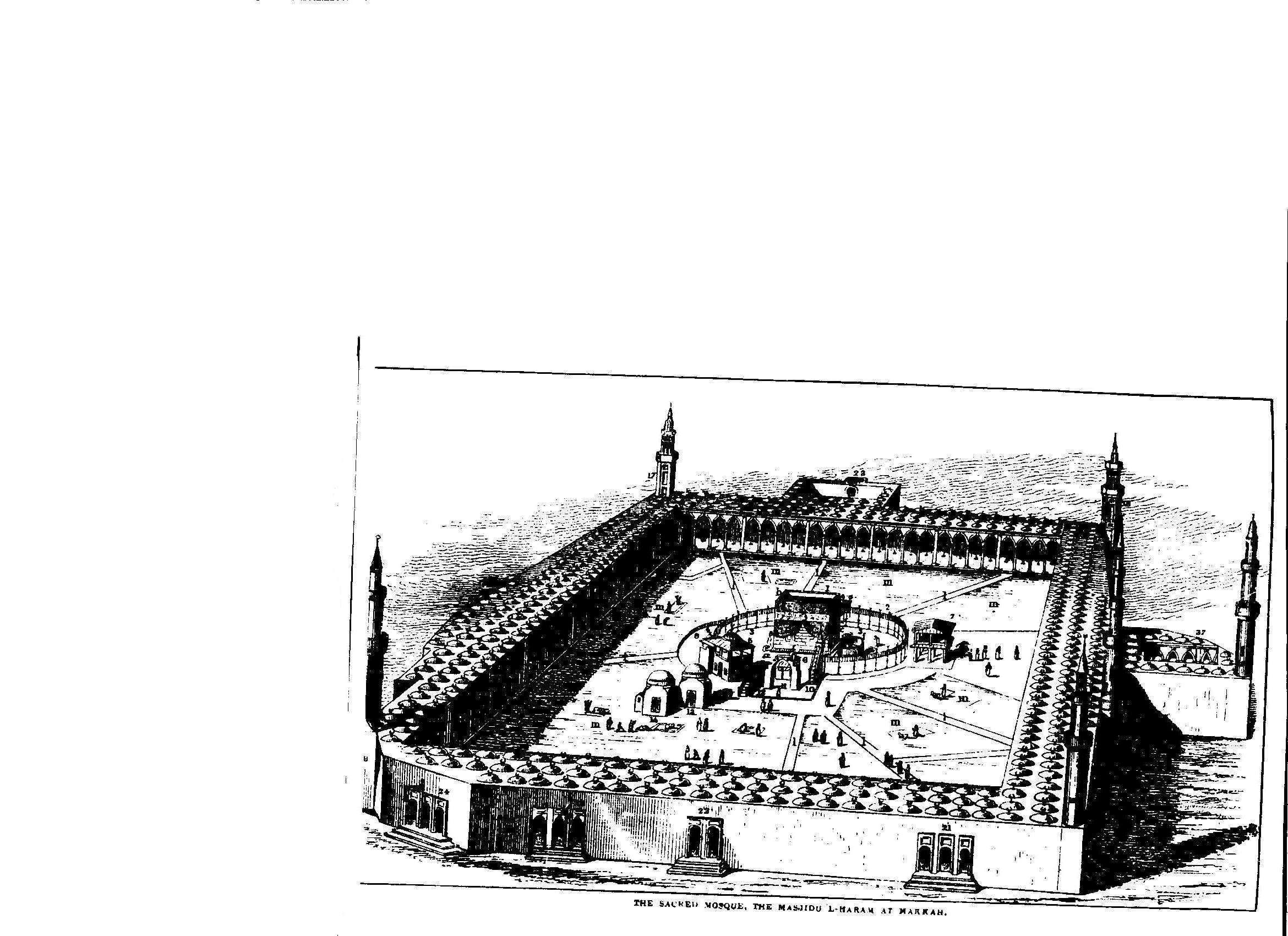
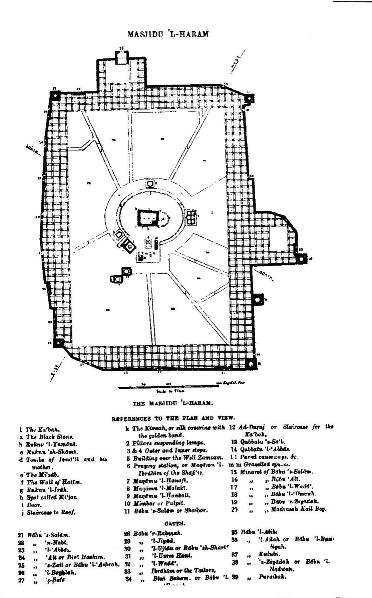
of the workmen have been pieced upside down upon the shafts. I observed about half a dozen marble bases of good Grecian workmanship. A few of the warble columns bear Arabic or Cufic inscriptions in which I read the dates A.H. 863 and A.H. 762. A column on the east side exhibits a very ancient Cufic inscription. somewhat defaced which I could neither read nor copy. Those shafts, formed of the Makkan stones, cut principally from the side of the mountain near the Shubaikah quarter. are mostly in three pieces; but the marble shafts are in one piece.
Some of the columns are strengthened with broad iron rings or bands, as in many ether Saracen buildings of the East; they were first employed here by ibn Dhaher Berkouk, King of Egypt, in rebuilding the mosque, which had been destroyed by fire in A.H. 802.
This temple has been so often ruined and repaired, that no traces of remote antiquity are to be found about it. On the inside of the great wall which encloses the colonnades, a single Arabic inscription is seen, in large characters, but containing merely the names of Muhammad and his immediate successors, Abu Bakr, 'Umar, 'Usman, and 'Ali. The name of Allah, in large characters, occurs also in several places. On the outside, over the gates, are long inscriptions. in the Sulusi character. commemorating the names of those by whom the gates were built, long and minute details of which are given by the historians of Makkah.
The inscription on the south side, over Babu Ibrahim, most conspicuous; all that side was rebuilt by his Egyptian Sultan al-Ghauri, A.H. 906. Over the Babu Ali and Babu l-'Abbas is a long inscription, also in the Sulusi character, placed there by Sultan Murad ibn Sulaiman, A.H. 984, after he had repaired the whole building. Qutbu 'd-din has given this inscription at length; it occupies several places in his history, and is a comment of the Sultans vanity. This side of the mosque having escaped destruction in A.D. 1623, the inscription remains uninjured.
Some parts of the walls and arches are gaudily painted, in stripes of yellow, red, and blue, as are also the minarets. Paintings of flowers, in the usual Muslim style, are nowhere seen; the floors of the colonnades are paved with large stones badly cemented together.
Seven paved causeways lead from the colonnades towards the Kabah, or holy house, in the centre. They are of sufficient breadth to admit four or five persons to walk abreast, and they are elevated about fine inches above the ground. Between these causeways, which are covered with fine gravel or sand, grass appears growing in several places, produced by the zamzam water oozing out of the jars, which are placed in the to ground in long rows during the day. The whole area of the mosque is upon a lower level than any of the streets surrounding it. There ii a descent of eight or ten steps from the gates on the north side into the platform of the colonnade, and of three or (our steps from the gates, on the south side.
Towards the middle of this area stands the Ka'bah; it is one hundred and fifteen paces from the north colonnade, and eighty-eight from the south.
For this want of symmetry we may readily account, the Ka'bah having existed prior to the mosque, which was built around it, and enlarged at different periods.
The Ka'bah is an oblong massive structure, eighteen paces in length, fourteen in breadth, and from thirty-five to forty feet in height. I took the bearing of one of its longest sides, and found it to be N.N.W 1/2 W. It is constructed of the grey Makkan stone, in large blocks of different sizes, joined together in a very rough manner, and with bad cement. It was entirely rebuilt as it now stands in A.D. 1627: the torrent, in the preceding year, had thrown down three of its sides; and, preparatory to its re-erection, the fourth side was, according to Assami, pulled down, after the 'Ulama', or learned divines, had been consulted on the question whether mortals might be permitted to destroy any part of the holy edifice without incurring the charge of sacrilege and infidelity.
The Ka'bah stands upon a base two feet in height, which presents a sharp inclined plane; its roof being flat, it has at a distance the appearance of a perfect cube. The only door which affords entrance, and which is opened but two or three times in the year, is on the north side, and about seven feet above the ground in entering it, therefore, wooden steps are used; of them I shall speak hereafter. In the first periods of Islam, however, when it was rebuilt in A.H. 64, by Ibn Zubair, Chief of Makkah, the nephew of 'Ayishah, it had two doors eyen with the ground-floor of the mosque. The present door which, according to Azraqi, was brought hither from Constantinople in A.H. 1633), is wholly coated with silver, and has several gilt ornaments. Upon its threshold are placed every night various small lighted wax candles, and perfuming, pans, filled with music, aloe-wood, &c.
At the north-east corner of the Ka'bah, near the door, is the famous "Black Stone'; it forms a part of the sharp angle of the building, at four or five feet above the ground. It is an irregular oval, about seven inches in diameter, with an undulated surface, composed of about a dozen smaller stones of different sizes and shapes, well joined together with a small quantity of cement, and perfectly smoothed; it looks as if the whole had been broken into many pieces by a violent blow, and then united again. It is very difficult to determine accurately the quality of this stone, which has been worn to its present surface by the millions of touches and kisses it has received. It appeared to me like a lava, containing several small extraneous particles, of a whitish and of a yellowish substance. Its colour is now a deep reddish brown, approaching to black; it is surrounded on all sides by a border, composed
of a substance which I took to he a close cement of pitch and gravel, of a similar, but not quite the same brownish colour. This border serves to support its detached pieces; it is two or three inches in breadth, and rises a little above the surface of the stone itself the border and the stone itself are encircled by a silver band, broader below than above and on the two sides, with a considerable swelling below, as if a part of the stone were bidden under it. The lower part of the border is studded with silver nails,
In the southeast corner of the Ka'bah, or, as the Arabs call it, Ruknu 'l-Yamani, there is another atone, about five feet from the ground; it is one foot and a half in length, and two inches in breadth, placed upright and of the common Makkah stone. This the people walking round the Ka'bah touch only with the right hand; they do not kiss it.
On the north side of the Ka'bah just by its door, and close to the wall, is a slight hollow in the ground, lined with marble, and sufficiently large to admit of three persons sitting. Here it is thought meritorious to pray. The spot is called Mi'jan, and supposed to be that where Abraham and his son Ishmael kneaded the chalk and mud which they used in building the Ka'bah; and near this Mi'jan the former is said to have placed the large stone upon which he stood while working at the masonry. On the basis of the Kab'ah, just over the Mi'jan, is an ancient Cufic inscription, but this I was unable to decipher, and had no opportunity of copying it. I do not find it mentioned by any of the historians.
On the west side of the Ka'bah, about two feet below its summit, is the famous Mizab, or water-spout, through which the rain-water collected on the roof of the building is discharged so as to fall upon the ground. It is about four feet in length, and six inches in breadth, as well as I could judge from below, with borders equal in height to its breadth. At the mouth hangs what is called the beard of the Mi'zab, a gilt board, over which the water falls. This spout was sent hither from Constantinople in A.H. 981. and is reported to be of pure gold. The pavement round the Ka'bah, below the Mi'zab, was laid down in A.H. 820, and consists of various coloured stones, forming a very handsome specimen of mosaic. There are two large slabs of fine verde-antico in the centre, which, according to Makrizi, were sent thither as presents from Cairo in A.H. 241. This is the spot where, according to Muhammadan tradition, Ishmael, the son of Abraham, and his mother Hager, are buried; and here it is meritorious for the pilgrim to recite a prayer of two rak'ahs.
On this west side is a semi-circular wall, the two extremities of which are in a line with the sides of the Ka'bah, and distantfrom it three or four feet, leaving an opening which leads to the burying-place of Ishmael. The wall bears the name of Hatim, and the area which it encloses is galled Hijr, or Hijru Isma'il, on account of its being "separated from the Ka'bah. the wall itself, also, is sometimes call; and the name Hatim is given by the historians to the space of ground between, the Ka'bah and the wall on one side, and the Bi'rn 'z-Zamzam and Maqamu Ibrahim on the other. The present Makkans, however, apply the name Hatim to the wall only.
Tradition says that the Ka'bah once extended as far as the Hatim, and that this side having fallen down just at the time of the Hajj, the expenses of repairing it were demanded from the pilgrims, under a pretence that the revenues of government were not acquired in a manner sufficiently pure to admit of their application towards a purpose so sacred, whilst the money of the pilgrims would possess the requisite sanctity. The sum, however, obtained from them, proved very inadequate: all that could be done, therefore, was to raise a wall, which marked the space formerly occupied by the Ka'bah. This tradition, although current among the Makkans, is at variance with history, which declares that the Hijr was built by the Banu Quraish, who contracted the dimensions of the Ka'bah, that it was united to the building by Hajjaj, and again separated from it by Ibn Zubair.
It is asserted by Fasy, that a part of the Hijr, as it now stands, was never comprehended within the Ka'bah. The law regards it as a portion of the Ka'bah, inasmuch as it is esteemed equally meritorious to pray In the Hijr as in the Ka'bah itself; and the pilgrims who have not an opportunity of entering the latter, are permitted to affirm upon oath that they have prayed in the Ka'bah, although they may have only prostrated themselves within the enclosure of the Hatim. The wall is built of solid stone, about five feet in height, and four in thickness, cased all over with white marble, and inscribed with prayers and invocations, neatly sculptured upon the stone in modern characters. These and the casing are the work of al-Ghauri, the Egyptian Sultan, in A.H. 917, as we learn from Qutbu 'd-din.
The walk round the Ka'bah is performed on the outside of the wall—the nearer to it the better, The four sides of the Ka'bah are covered with a black silk stuff, hanging down, and leaving the roof bare. This curtain, or veil, is called kiswah, and renewed annually at the time of the Hajj, being brought from Cairo, where it is manufactured at the Sultan's expense. On it are various prayers, interwoven in the same colour as the stuff, and it is, therefore, extremely difficult to read them. A little above the middle, and running round the whole building, is a line of similar inscriptions, worked in gold thread. That part of the kiswah which covers the door is richly embroidered with silver. Openings are left for the black stone, and the other in the south-east corner, which thus remain uncovered
The kiswah is always of the same form and pattern; that which I saw on my first visit to the mosque was in a decayed state,
and full of holes. On the 25th of the month Zu 'l-Qadah, the old one is taken away; and the Ka'bah continues without a cover for fifteen days. It is then said that "The Ka'bah has assumed the ihram,." which lasts until the tenth of Zu 'l-Hijjah, the day of the return of the pilgrims from 'Arafah to Wadi Mina, when the new kiswah is put on. During the first days, the new covering is tucked up by cords fastened on the roof, so as to leave the lower part of the building exposed; having remained thus for many days, it is let down, and covers the whole structure, being then tied to strong brass wings in the basis of the Ka'bah. The removal of the old kiswah was performed in a very indecorous manner; and a contest ensued among the pilgrims and the people of Makkah, both young and old, about a few rags of it. The pilgrims even collect the dust which sticks to the walls of the Ka'bah, under the kiswah, and sell it, on their return as a sacred relic. [KISWAH.]
At the moment the building is uncovered and completely bare ('uryan), a crowd of women assemble round it, rejoicing with cries called walwalah.
The black colour of the kiswah, covering a large cube in the midst of a vast square gives to the Ka'bah, at first sight, a very singular and imposing appearance: as it is not fastened down tightly, the slightest breeze causes it to move in slow undulations which are halled with prayers by the congregation assembled round the building, as a sign of the presence of its guardian angels, whose wings, by their motion, are supposed to be the cause of the waving of the covering. Seventy thousand angels have the Ka'bah in their holy care, and are ordered to transport it, to Paradise, when the trumpet of the Day of Judgment shall be sounded.
The clothing of the Ka'bah was an ancient custom of the Pagan Arabs. The first kiswah, says Azraqi, was put on by Asad Tubba', one of the Himyarite kings of Yaman; before Islam, it had two coverings, one for winter and the other for summer. In the early ages of Islam, it was sometimes white and sometimes red, and consisted of the richest brocade. In subsequent times it was furnished by the different Sultans of Baghdad, Egypt, or Yaman, according to their respective influence over Makkah prevailed; for the clothing of the Ka'bah appears to have always been considered as a proof of sovereignty over the Hijaz. Kalaun, Sultan of Egypt, assumed to himself and successors the exclusive right, and from them the Sultans at Constantinople have inherited it. Kalaun appropriated the revenue of the two large villages, Bisaus and Sandabair in Lower Egypt, to the expense of the kiswah and Sultan Sulaiman ibn Salim subsequently added several others: but the Ka'bah has long been deprived of this resource.
Round the Ka'bah is a good pavement of marble, about eight inches below the level of the great square; it was laid in A.H. 98l, by order of the Sultan, and describes an irregular oval: it is surrounded by thirty-two slender gilt pillars, or rather poles. between every two of which are suspended seven glass lamps, always lighted after sunset Beyond the poles is second pavement, about eight paces broad, somewhat elevated above the first, but of a coarser work; then another six inches higher, and eighteen paces broad upon which stands several small building; beyond this is the graveled ground, so that two broad steps may be said to lead from the square down to the Ka'bah. The small buildings just mentioned, which surround the Ka'bah are the five Maqams, with the well of Zamzam, the arch called Babu s-Salam (the Gate of Peace), and the mimbar pulpit). Opposite the four sides of the Ka'bah stand four other small buildings. where the Imams of the four orthodox Muhammadan sects, the Hanafi, Shafi'I, Hanbali, and Malaki, take their station, and guide the congregation in their prayers. The Maqamu 'l-Malaki, on the south, and that of Hanbali, opposite the Black Stone, are small pavilions, open on all sides and supported by four slender pillars, with a tight sloping roof, terminating in a point, exactly in the style of Indian pagodas.
Thei Maqmu 'l-Hanafi, which is the largest, being fifteen paces by eight, is open on all aides, and supported by twelve small pillars, it has an upper storey, also open, whore the Mu'azzin, who calls to prayers, takes his stand. This was first built in A.H. 923. by Sultan Salim I.; it was afterwards rebuilt by Khushgildi, Governor of Jiddah, in A.H. 947; but all the four Maqams, as they now stand, were built in A.H. 1074. The Maqamu 'sh-Shafi'i is over the well Zamzam, to which it serves as an upper chamber.
Near their respective Maqams, the adherents of the four different sects seat themselves for prayers. During my stay at Makkah, the Hanafis always began their prayer first: but, according to Muslim custom, the Shafi'is should pray first in the mosque, then the Hanafis, Malakis, and Hanbalis. The evening prayer is an exception, which they are all enjoined to utter together. The Maqam 'l-Hanbali is the place where the officers of government and other great people are seated during prayers; here the Pusha and the Sharif are placed, and, us their absence the eunuchs of the temple. These fill the space under this Maqam in front, and behind it the female pilgrims who visit the temple have their places assigned to which they repair principally for the two evening prayers, few of them being seen in the mosque at the three other daily prayers. They also perform the tawaf, or walk round the Ka'bah, but generally at night, though it is not uncommon to see them walking in the daytime among the men.
The present building which encloses Zamzam. stands close by the Maqamu l-Hanbali, and was erected in A.H. 1072; it is of a square shape, and of massive construction, with an entrance to the north, opening into the room which contains the well. This room is beautifully ornamented with marbles of various
colours; and adjoining to it, but having a separate door, is a small room with a stone reservoir, which is always full of Zamzam water, this the pilgrims get to drink by passing their hand with a cup through an iron grated opening, which serves as a window, into the reservoir, without entering the room.
The mouth of the well is surrounded by a wall five feet in height, and about ten feet in diameter. Upon this the people stand who draw up the water, in leathern buckets, an iron railing being so placed as to prevent their falling in. In Fasys time, there were eight marble basins in this room for the purpose of ablution.
From before dawn to near midnight. the well-room is constantly crowded with visitors. Everyone is at liberty to draw up the water for himself, but the labour is generally performed by persons placed there on purpose, and paid by the mosque; they expect also a trifle from those who come to drink, though they date net demand it. I have been more than once in the room a quarter of an hour before I could get a draught of water, so great was the crowd. Devout pilgrims sometimes mount the wall and draw the bucket for several hours in the hope of thus expiating their evil deeds.
Before the Wahhabi invasion, the well Zamzam belonged to the Sharif, and the water becoming thus a monopoly. was only to be purchased at a high price: but one of Sa'ud's first orders, on his arrival at Makksh, was to abolish this traffic, and the holy water is now dispensed gratis. The Turks consider it a miracle that the water of this well never diminishes notwithstanding the continual draught from it. There is certainly no diminution in depth for, by an accurate inspection of the rope by which the buckets are drawn up, I found that the same length war required both at morning and evening, to reach the surface of the water. Upon inquiry, I learned from one of time persons who had descended in the nine of the Wahhabis to repair the masonry, that the water was flowing at the bottom, and that the well is therefore supplied by a subterraneous rivulet. The water is heavy to the taste, and sometimes in its colour resembles milk ; but it is perfectly sweet, and differs very much from that of the brackish wells dispersed over the town. When first drawn up, it is slightly tepid, resembling in this respect, many other fountains of the Hijaz.
Zamzam supplies the whole town, and there is scarcely one family that does not daily fill a jar with the water. This only serves. however, for drinking or for ablution as it is thought impious to employ water so sacred for culinary purposes or on common occasion. Almost every pilgrim when he repairs to the mosque for evening prayer, has a jar of the water placed before him by those who earn their livelihood by performing this service.
The water is distributed in the mosque to all who are thirsty for a trifling fee, by water-carriers, with large jars upon their backs; these men are also paid by charitables pilgrims for supplying the poorer ones with this holy beverage immediately before or after prayers.
The water is regarded as an infallible cure for all diseases and the devotees believe that the more they drink of it, the better their health will be, and their prayers the more acceptable to the Deity. I have seen some of them at the well swallowing such a quantity of it, as I should hardly have thought possible. A man who lived in the same house with me, and was ill of an intermittent fever, repaired every evening to Zamzam, and drank of the water till he was almost fainting; after which he lay for several hours extended upon his back, on the pavement near the Ka'bah, and then returned to renew his draught. When by this practice he was brought to the verge of death, he declared himself fully convinced that the increase of his illness proceeded wholly from his being unable to swallow a sufficient quantity of the water. Many pilgrims, not content with drinking it merely, strip themselves in the room, and have buckets of it thrown over them, by which they believe that he heart is purified as well as the outer body
Few pilgrims quit Makkah without carrying away some of this water in copper or tin bottles, either for the purpose of making presents, or for their own use in ease of illness, when they drink it, or for ablution after death. I carried away four small bottles, with the intention of offering them as presents to the Muhammadan kings in the black countries. I have seen it sold at Suez by pilgrims returning from Makkah, at the rate of one piastre for the quantity that filled a coffee-cup.
The chief of Zamzam is one of the principal 'Ulama' of Makkah. I need not remind the reader that Zamzam is supposed to be the spring found in the wilderness by Hagar, at the moment when her infant son Ishmael was dying of thirst. It seems probable that the town of Makkah owes its origin to this well For many miles round, no sweet water is found, nor is there found in any part of the adjacent country so copious a supply.
On the north-east side of Zamzam stand two small buildings, one behind the other, called al-Qubbatam; they are covered by domes painted in the same manner as the mosque, and in them are kept water-jars, lamps, carpets, mats, brooms, and other articles used in the very mosque. These two ugly buildings are injurious to the interior appearance of the building, their heavy forms and structure being very disadvantageously contrasted with the light and airy shape of the Maqams. I heard some pilgrims from Greece, moon of better taste than, the Arabs, express their regret that the Qubbatain should be allowed to disfigure the mosque. Their contents might be deposited in some of the buildings adjoining the mosque, of which they form no essential part, no religious importance being attached to them. They were built by Khushgildi, Governor of Jiddah. A.H. 947
one is called Qubbatu 'l-'Abbas, from having been placed on the site of a small tank, said to have been formed by al-'Abbas, the uncle of Muhammad.
A few paces west of Zamzam, and directly opposite to the door of the Ka'bah, stands a ladder or staircase, which is moved op to the wall of the Ka'bah, on the days when that building is opened, and by which the visitors ascend to the door; it is of wood, with some carved ornaments, moves on low wheels, and is sufficiently broad to admit of four persons ascending abreast. The first ladder was sent hither from Cairo in A.H. 818, by Mu'yad Abu 'n-Nasir, King of Egypt; for in the Hijaz, it seems, there has always been so great a want of artisans, that whenever the mosque required nay work it was necessary to have mechanics brought from Cairo, and even sometimes from Constantinople.
In the same line with the ladder, and close by it stands a lightly-built, insulated, and circular arch, about fifteen feet wide and eighteen feat high, called Babu 's-Salam, which must not be confounded with the great gate of the mosque bearing the same name. Those who enter the Baitu'llah for the first time, are enjoined to do so by the outer and inner Babu 's-Salam; in passing under the latter, they are to exclaim, "O God, may it be a happy entrance! " I do not know by whom this arch was built, but it appears to be modern.
Nearly in front of the Babu 's-Salam, and nearer to the Ka'bah than any of the other surrounding buildings, stands the Maqamu Ibrahim. This is a small building, supported by six pillars about eight feet high, four of which are surrounded from top to bottom by a fine iron railing, which thus leaves the space beyond the two hind pillars open; within the railing is a frame about five feet square, terminating in a pyramidal top, and said to contain the sacred stone upon which Abraham stood when he built the Ka'bah, and which, with the help of his son Ishmeel, he had removed from hence to the place called Mi'jan, already mentioned. The stone is said to have yielded under the weight of the Patriarch, and to preserve the impression of his foot still visible upon it; but no pilgrim has ever seen it, as the frame is always entirely covered with a brocade of red silk richly embroidered. Persons are Constantly seen before the railing, invoking the good offices of Abraham, and a short prayer must be uttered by the side of the Maqam, after the walk round the Ka'bah is completed. It is said that many of the Companions, or first adherents of Muhammad, were interred in the open space between this Maqam and Zamzam, from which circumstance it is one of the most favourite places of prayer in the mosque. In this part of the area, the Khalifah Sulaiman ibn 'Abdi 'l-Malik, brother of al-Wahid, built a fine reservoir, in A.H. 97, which was filled from a spring cast of 'Arafat; but the Makkans destroyed it after his death, on the pretence that the water of Zamzam was preferable.
On the aide of Maqamu Ibrahim, facing the middle part of the front of the Ka'bah, stand the Minibar, or pulpit, of the mosque; it is elegantly formed of fine white marble, with many sculptured ornaments, and was sent as a present to the mosque in A.H. 969, by Sultan Sulaimin ibn Salim. A straight narrow staircase leads up to the post of the khatib or preacher, which is surmounted by a gilt polygonal pointed steeple, resembling an obelisk. Here a sermon is preached on Fridays and on certain festivals; these, like the Friday sermons of all mosques in the Muhammadan countries, are usually of the same tenour, with some alight alterations upon extraordinary occasions. Before the Wahhabis invaded Makkah, prayers were added for the Sultan and the Sharif; but these were forbidden by Saud. Since the Turkish conquest, however, the ancient custom has been restored. The right of preaching in the Mimbar is vested in several of the first 'Ulama' in Makkah they are always elderly persons, and officiate in rotation. In ancient times Muhammad himself, his successors, and the Khalifahs,whenever they came to Makkah; mounted the pulpit, and preached to the people.
The khatib, or preacher, appears in the Mimbar wrapped in a white cloak, which covers his head and body, and with a stick in hand; a practice observed also in Egypt and Syria, in memory of the first age of Islam, when the preachers found it necessary to be armed, from fear of being surprised. As in other mosques, two green flags are placed on each aide of him.
About the Mimbar, the visitors of the Ka'bah deposit their shoes; as it is neither permitted to walk round the Ka'bah with covered feet, nor thought decent to carry the shoes in the hand, as is done in other mosques. Several persons keep watch over the shoes for which they expect a small present; but the vicinity of the holy temple does not intimidate the dishonest, for I lost successively from this spot three new pairs of shoes; and the same thing happens to many pilgrims.
I have now described all the buildings within the enclosure of the temple.
The gravel-ground, and part of the adjoining outer pavement of the Ka'bah is covered, at the time of evening prayers, with carpets of from sixty to eighty feet in length, and four feet in breadth, of Egyptian manufacture, which are rolled up after prayers. The greater part of the pilgrims bring their own carpets with them. The more distant parts of the area, and the floor under the colonnade, are spread with mats brought from Souakin; the latter situation being the usual place for the performance of the mid-day and afternoon prayers. Many of these mats are presented to the mosque by the pilgrims, for which they have in return the satisfaction of seeing their names inscribed on them in large characters.
At sunset, great numbers assemble for the first evening prayer; they form themselves into several wide circles, sometimes as many
as twenty around the Ka'bah, as a common centre before which every person makes his prostration; and thus, as the Mohammedan doctors observe, Makkah is the only spot throughout the world in which the true believer can, with propriety, turn during his prayers towards any point of the compass. The Imam takes his post near the gate of the Ka'bah, and his genuflexions are imitated by the whole assembled multitude. The effect of the joint prostrations of six or eight thousand persons, added to the recollection of the distance and various quarters from whence they come, or for what purpose, cannot fail to impress the most cool-minded spectator with some degree of awe. At night, when the lamps are lighted, and numbers of devotees are performing the Tawaf round the Ka'bah, the sight of the busy crowds, the voices of the Mutawwifs, intent upon making themselves beard by those to whom they recite their prayers, the loud conversation of many idle persons, the running, playing, and laughing of boys, give to the whole a very different appearance, and one wore resembling that of a place of public amusement. The crowd, however, leaves the mosque about nine o'clock, when it again becomes the place of silent meditation and prayer to the few visitors who are led to the spot by sincere piety, and not worldly motives or fashion.
There is an opinion prevalent at Makkah, founded on holy tradition, that the mosque will contain any number of the faithful; and that if even the whole Muhammadan community were to enter at once, they would all find room in it to pray. The guardian angels, it is said, would invisibly extend he dimensions of the building, and diminish the size of each individual. The fact is, that during the most numerous pilgrimages, the mosque, which can contain, I believe, about thirty-five thousand persons in the act of prayer, is never half-filled. Even on Fridays, the grater part of the Makkans, contrary to the injunctions of the law, pray at home, if at all, and many pilgrims follow their example. I could never count more than ten thousand individuals in the mosque at one time, even after the return from 'Arafat, when the whole body of pilgrims was collected for a few days in and about the city.
At every hour of the day, persons may be seen under the colonnade, occupied in reading the Qur'an and other religious books; and here many poor Indians, or negroes, spread their mats, and pass the hole period of their residence at Makkah. Here they both eat and sleep but cooking is not allowed. During the hours of noon, many persons come to repose beneath the cool shade of the vaulted roof of the colonnade; a custom which not only accounts for the mode of construction observed in the old Muhammadan temples of Egypt and Arabia, but for that also of the ancient Egyptian temples, the immense porticoes of which were probably left open to the idolatrous natives, whose mud-built houses could afford them but an imperfect refuge against the mid-day heats.
It is only during the hours of prayer that the great mosques of these countries partake of the sanctity of prayer, or in any degree seem to be regarded as consecrated places. In al-Azhar, the first mosque at Cairo, I have seen boys crying pancakes for sale, barbers shaving their customers, and many of the lower orders eating their dinners, where, during prayers, not the slightest motion, nor even whisper, diverts the attention of the congregation. Not a sound but the voice of the Imam, is heard during prayers in the great mosque at Makkah, which at other times is the place of meeting for men of business to converse on their affairs, and is sometimes so full of poor pilgrims, or of diseased persons lying about under the colonnade, in midst of their miserable baggage, as to have the appearance of a hospital rather than a temple. Boys play in the great square, and servants carry luggage across it, to pass by the nearest route from one part of the town to the other. In these respects, the temple of Makkah resembles the other great mosques of the East. But the holy Ka'bah is rendered the scene of such indecencies and criminal acts, as cannot with propriety be more particularly noticed. They are not only practised here with impunity, but, it may be said, almost publicly; and my indignation has often been excited, on witnessing abominations which called forth from other passing spectators nothing more than a laugh or a slight reprimand.
In several parts of the colonnade, public schools are held, where young children are taught to spell and read they are most noisy groups, and the schoolmaster's stick is a constant action. Some learned men of Makkah deliver lectures on religious subjects every afternoon under the colonnade, but the auditors are seldom numerous. On Friday's after prayer, some Turksth 'Ulama' explain to their countrymen assembled around them a few chapters of the Qur'an, after which each of the audience kisses the hand of the expositor, and drops money into his cup. I particularly admired the fluency of speech of one of these 'Ulama', although I did not understand him, the lecture being delivered in the Turkish language. His gesticulations and the inflexions of his voice, were most expressive; but, like an actor on the stage, he would laugh and cry in the same minute, and adapt his features to his purpose in the most skilful manner. He was a native of Brusa, and amassed a considerable sum of money.
Near the gate of the mosque called Babu 's-Salam, a few Arab shaikhs daily take their seat, with their inkstand and paper, ready to write, for any applicant, letters, accounts, contracts, or any similar document.
They also deal in written charms, like those current in the Black countries, such as amulets, love-receipts, &c. They are principally employed by Bedouins, and demand an exorbitant remuneration.
Winding sheets (kafan and other linen washed in the waters of Zamzam, are constantly seen hanging to dry between the columns. Many pilgrims purchase at Makkah the shroud in which they wish to buried, and wash it themselves at the well of Zamzam, supposing that, if the corpse be wrapped in linen which has been wetted with this holy water, the peace of the soul after death will he more effectually secured. Some pilgrims make this linen an article of traffic.
Makkah generally, but this mosque in particular, abounds in flocks of wild pigeons, which are considered to be the inviolable property of the temple, and are called the pigeons of the Baitu 'llah. Nobody dares to kill any of them, even when they enter the private houses. In the square of the mosque. several small stone basins are regularly filled with water for their use; here, also, Arab women expose for sale, upon small straw mats, corn and durrah, which the pilgrims purchase, and throw to the pigeons. I have seen some of the public women take this mode of exhibiting themselves, and of bargaining with the pilgrims, under pretence of selling them corn for the sacred pigeons.
The gates of the mosque are nineteen in number, and are distributed about it. without any order or symmetry. The principal of these gates are: on the north side, Babu 's-Salam. by which every pilgrim enters the mosque Babu 'l-'Abbas; Babu 'n-Nabi, by which Muhammad is said to have always entered the mosque; Babu 'Ali. On the east side: Babu Zai. or Babu 't-Ashrah, through which the ten first adherents of Muhammad used to enter; Babu 's-Safa: two gates called Babanu 'ah-Sharif, opposite the palaces of the Sharif. On the south aide Bau Ibrahim, where the colonnade projects beyond the straight line of the columns, and forms a small square Babu 'l-'Umrah, through which it is necessary to pass, on visiting the Umrah. On the west side: Babu z-Ziyadah, forming a projecting square similar to that at Babu Ibrahim, but larger.
Most of these gates have high-pointed arches, but a few round arches are seen among them, which like all the arches of this kind in the Hijaz, are nearly semicircular. They are without any ornament, except the inscription on the exterior, which commemorates the name of the builder and they are all posterior in date to the fourteenth century. As each gate consists of two or three arches, or divisions, separated by narrow walls, these divisions are counted in the enumeration of the gate, leading into the Ka'bah and thus make up the number thirty-nine.
There being no doors to the gates, the mosque is consequently open at all times. I have crossed at every hour of the night and always found people there, either at prayers or walking about.
The outside walls of the mosque are those of the houses which surround it on all sides. These houses belonged originally to the mosque, the grater part are now the propery of individuals, who have purchased them. They are let out to the richest pilgrims at very high prices, as much as five hundred piastres being given, during the pilgrimage, for a good apartment, with windows opening into the mosque. Windows have, in consequence, been opened in many parts of the walls, on a level with the street, and above that of the floor of the colonnades. Pilgrims living in these apartments are allowed to perform the Friday's prayers at home because, having the Ka'bah in view from the windows, they are supposed to be in the mosque itself, and to join in prayer those assembled within the temple. Upon a level with the ground-floor of the colonnades, and opening into them, are small apartments formed to the walls, having the appearance of dungeons, those have remained the property of the mosque, while the houses above them belong to private individuals. They are let out to watermen, who deposit in them the Zamzam jars, or to less opulent pilgrims who wish to live in the mosque. Some of the surrounding houses still belong to the mosque, and were originally intended for public schools, as their name of Madrasah implies: they are now all let out to pilgrims. In one of the largest of them, Muhammad 'Ali Pasha lived; in another Hasan Pasha.
Close to Babu Ibrahim is a large madrasah, now the property of Saiyid Ageyl, one of the principal merchants of the town, whose warehouse opens into the mosque. This person, who is aged, has the reputation of great sanctity; and it is said that the hand of the Sharif Gahlib, when once in the act of collaring him for refusing to advance some money, was momentarily struck with palsy. He has evening assemblies in his house, where theological books are read, and religions topics discussed.
Among other buildings forming the enclosure of the mosque, is the Mihkam, or house of justice, close by the Babu 'z-Ziyadah; it is a flue, firmly built structure, with lofty arches in the interior, and has a row of high windows looking into the mosque. It is inhabited by the Qazi. Adjoining to it stands a large Madrasah, enclosing a square, known by the name of Madrasah Sulaiman, built by Sultan Sulaiman and his son Salim II., in A.H. 973. It is always well filled with Turkish pilgrims, the friends of the Qazi, who disposes of the lodgings.
The exterior of the mosque is adorned with seven minarets, irregularly distributed: 1. Minaret of Babu 'l-'Umrah; 2. of Babu 's-Salam; 3. of Babu 'Ali; 4. of Babu'l-Wada 5. of Madrasah Kail Beg; 6. of Babu 'z-Ziyadah; 7. of Madrasah Sultan Sulaiman. They are quadrangular or round steeples, in no way differing from other minarets. The entrance to them is from the different buildings round the mosque, which they adjoin. A beautiful view of the busy crowd below is obtained by ascending the moat northern one. Taken with slight alterations, chiefly in the spelling of Arabic words and names, from Burckhardt's Travels in Arabia vol. i. p. 243.)
Mr. Sale says: "The temple of Mecca was a place of worship, and in singular veneration with the Arabs from great antiquity, and many centuries before Muhammad. Though it was most probably dedicated at first to an idolatrous use, yet the Muhammadans are generally persuaded that the Ka'bah is almost coeval with the world; for they say that Adam, after his expulsion from Paradise, begged of God that he might erect a building like that he had seen there, called Baitu l-Ma'mur, or the frequented house, and al Durah towards which he might compass, as the angels do the celestial one. Whereupon God let down a representation of that house in curtains of light, and set it in Mecca, perpendicular under its original, ordering the patriarch to turn towards it when he prayed, and to compass it by way of devotion. After Adam's death, his son Seth built a house in the same form, of stone and clay, which being destroyed by the Deluge, was rebuilt by Abraham and Ishmael at God's command, in the place where the former had stood, and after the same model, they being directed therein by revelation.
"After this edifice had undergone several reparations, it was, a few years after the birth of Muhammad, rebuilt by the Quraish on the old foundation, and afterwards repaired by Abdullah Ibn Zubair, the Khalif of Mecca; and at length again rebuilt by Yusuf, surnamed al Hijaj Ibn Yusuf, in the seventy-fourth year of the Hijrah, with some alterations in the form wherein it now remains. Some years after, however, the Khalif Harun al Rashid (or, as others write, his father al Mahdi, or his grandfather al Mansur) intended again to change what had been altered by al Hijaj, and to reduce the Ka'bah to the old form in which it was left by Abdullah, but was dissuaded from meddling with it, lest so holy a place should become a sport of princes, and being new modeled after everyone's fancy, should lose that reverence which was justly paid it. But nothwithstanding the antiquity and holiness of this building, they have a prophecy by tradition of Muhammad, that in the last times, the Ethiopians shall come and utterly demolish it, after which it will not be rebuilt again for ever." (Prelim. Dis., p. 83).
The following are the references to the Sacred Mosque in the Qur'an:-
Surah ii. 144, 145: "From whatever place thou comest forth, then turn your face towards the Sacred Mosque: for this is a duty enjoined by they Lord; and God is not inattentive to your doings. And from whatever place thou comest forth, then turn thy face toward the Sacred Mosque; and wherever ye be, to that part turn your faces, that men have no cause of dispute against you."
Surah v.2: "O Believers! Violate neither the rites of God, nor the sacred month, nor the offering, nor its ornaments, nor those who press on to the Sacred Mosque, seeking favor from their Lord and His good pleasure in them."
Surah viii. 33-35: But God chose not to chastise them while thou wast with them not would God chastise them when they sued for pardon. But because they debarred the faithful from the Sacred Mosque, albeit they are not its guardians, nothing is there on their part why God should not chastise them. The God- fearing only are its guardians, but most of them know it not. And their prayer at the house is no other than whistling through the fingers and clapping of the hands – 'Taste then the torment, for that ye have been unbelievers.
Surah ix. 7: "How shall they who add gods to God be in league with God and with His Apostle, save those with whom ye made a league at the Sacred Mosque? So long as they are true to you, be ye true to them: for God loveth those who fear Him.
Surah ix. 28: "O Believers! Only they who join gods with God are unclean! Let them not, therefore, after this their year, come near the Sacred Mosque. And if ye fear want, God, if He please, will enrich you of His abundance; for God is Knowing, Wise."
Surah xvii. 1: "Glory be to Him who carried his servant by night from the Sacred Mosque to the temple that is more remote (i.e. Jerusalem), whose precincts we have blessed, that we may show him of our signs; for He is the Hearer, the Seer."
Surah xxii. 25: "From the Sacred Mosque which we have appointed to all men, alike for those who abide therein, and for the stranger."
Surah xlviii. 25: "These are they who believed not, and kept you away from the Sacred Mosque, as well as the offering which was prevented from reaching the place of sacrifice."
Surah xlviii. 27: "now hath God in truth made good to His Apostle the dream in which he said 'Ye shall surely enter the Sacred Mosque, if God will, in full security, having your heads shaved and your hair cut; ye shall not fear; for He knoweth what ye know not; and He hath ordained you, beside this, a speedy victory."
AL-MASJIDU 'L-JAMI'.

 Lit. "The collecting mosque." A title given to the chief mosque of any city in which people assemble for the Friday prayer and khutbah. [KHUTBAH.]
MASJIDU 'L-KHAIF.

 A mosque at Mina, three miles from Makkah. Here, according to the Arabs, Adam is buried, "his head being at one end of a long wall, and his feet at another, whilst the dome covers his emphalic region." (Burton's Pigrimage, vol. ii, p. 203.)
MASJIDU 'N-NABI.
 "The Prophet's Mosque" at al-Madinah. It is held to be the second mosque in Islam in point of seniority, and the same, or, according to others the first, in dignity, ranking with the Sacred Mosque at Makkah.
The following is Captain R.F. Burton's account of its history:-
"Muhammad ordered to erect a place of worship there. sent for the youths to whom it belonged and certain Ansar, or their guardians; the ground was offered to him in free gift, but he insisted upon purchasing it, paying more than its value. Having caused the soil to be levelled and the trees to be felled, be laid the foundation of the first mosque.
"In those times of primitive simplicity its walls were made of rough stone and unbaked bricks, and trunks of date-trees supported a palm-stick roof, concerning which the Archangel Gabriel delivered an order that it should not be higher than seven cubits, the elevation of Solomon's temple. All ornament was strictly forbidden. The Ansar, or men of Medinah, and the Muhajirin, or fugitives from Mecca, carried the building materials in their arms from the cemetery Baki', near the well of Aiyub, north of the spot where Ibrahim's mosque now stands, and the Prophet was to be seen aiding them in their labours, and rejoicing for their encouragement:
"The length of this mosque was fifty-four cubits from north to south, and sixty-three in breadth, and it was hemmed in by houses on all sides save the western. Till the seventeenth month of the new era, the congregation faced towards the northern wall. After that time a fresh 'revelation' turned them in the direction of Makkah—southwards; on which occasion the Archangel Gabriel descended and miraculously opened through the hills and wilds a view of the Ka'bah, that
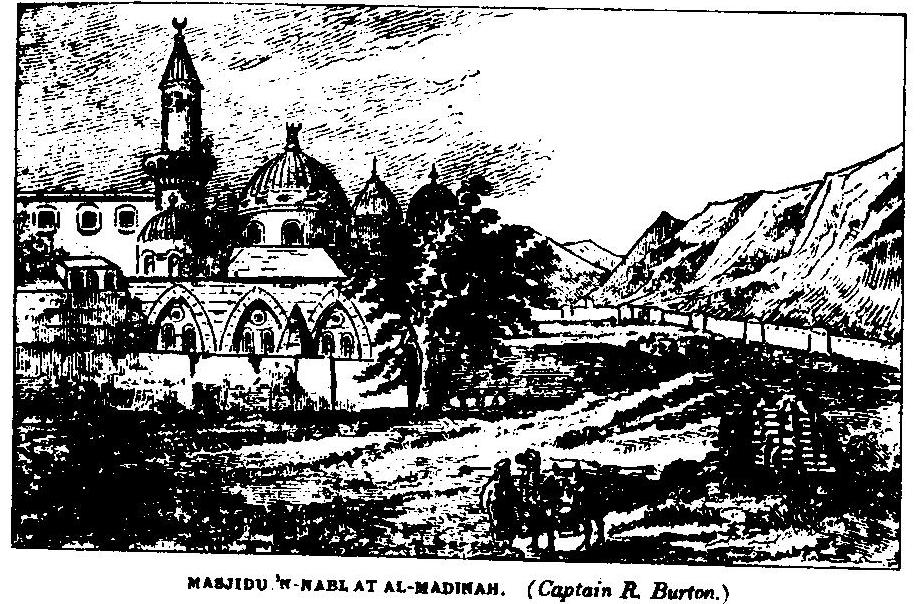
there might be no difficulty In ascertaining its true position.
"After the capture of Khaibar in A.H. 7, the Prophet and his first three successors restored the mosque, but Muslim historians do not consider this a second foundation. Muhammad laid the first brick, and Abu-Hurayah declares that he saw him carry heaps of building material piled up to his breast. The Khalifahs, each in the turn of his succession, placed a brick close to that laid by the Prophet, and aided him in raising the walls. Tabrari relates that one of the Ansar had a house adjacent, which Muhammad wished to make part of the place of prayer; the proprietor was offered in an change for it a borne in Paradise, which he gently rejected, pleading poverty. His excuse was admitted, and 'Usman, after purchasing the place for 10,000 dirhams, gave it to the Prophet on the long credit originally offered. The mosque was a square of 100 cubits. Like the former building, it had three doors: one on the south side, where the Mihrabu 'n-Nabawi, or the ' Prophet's niche," now is, another in the place of the present Babu 'r Ramah, and the third at the Babu 'Usman, now called the "Gate of Gabriel." Instead of a mihrah or prayer niche, a large block of stone, directed the congregation. At first it was placed against the northern wall of the mosque, and it was removed to the southern when Makkah became the Qiblan. In the beginning the Prophet, whilst preaching the khutbah or Friday sermon, leaned, when fatigued, against a post. The mimbar, or pulpit, was the invention of a Madinah man of the Banu Najjar. It was a wooden frame, two cubits long by one broad, with three steps, each one span high; on the top-
most of these the Prophet sat when he required rest.. The pulpit assumed its present form about A.H. 90, during the artistic reign of Walid.
"In this mosque Muhammad spent the greater part of the day with his companions. conversing, instructing, and comforting the poor. Hard by were the abodes of his wives, his family, and his principal friends. Here he prayed, hearkening to the Azan, or devotion call, from the roof. Here he received worldly envoys and embassies, and the heavenly messages conveyed by the Archangel Gabriel. And within a few yards of the hallowed spot, he died, and found, it is supposed a grave.
"The theatre of events so important to Islam could not be allowed—especially as no divine decree forbade the change-to remain in its pristine lowliness. The first Khalifah contented himself with merely restoring some of the palm pillars, which had fallen to the ground. 'Umar, the second successor, surrounded the Hujrah, or 'Ayishah's chamber in which the Prophet was buried, with a mud wall, and in A.H. 17, he enlarged the mosque to 140 cubits by 120, taking in ground on all sides except the eastern, where stood the abodes of the 'Mothers of the Moslems' (Ummu 'l-Mu'minin). Outside the noithern wall he erected a suffah, called Batha - a raised bench of wood, earth, or stone, upon which the people might recreate themselves with conversation and quoting poetry, for the mosque was now becoming a place of peculiar reverence to men.
"The second Masjid was erected A.H. 29 by the third Khalifah, 'Usman, who, regardless of the clamours of the people, overthrew the old one, and extended the building greatly towards the north, and a little towards the west; but he did not remove the eastern limit on account of the private houses. He made the roof of Indian teak, and erected walls of hewn and carved stone. These innovations caused some excitement. which he allayed by quoting a tradition of the Prophet, with one of which he appears perpetually to have been prepared. The saying in question was, according to some, 'Were this my mosque extended to Safa, it verily would still be my mosque: according to others, Were the Prophet's mosque extended to Zu l-Hulafa it would still be his,' But 'Usman's skill in the quotation of tradition did not prevent the new building being in part a cause of his death. It was finished on the 1st Muharram A.H. 30.
At length. Islam, grown splendid and powerful, determined to surpass other nations in the magnificence of its public buildings, In A.H. 38, al-Walid the First, twelfth Khalifah of the Banu Umayah race after building the noble .Jami'-Masjid of the Ommiades at Damascus, determined to display his liberality at al-Madinah. The governor of the place 'Umar ibn 'Abdu 'l-Aziz, was directed to buy to 7,000 diners all the hovels of new brick that hedged in the eastern side of the old mosque They were inhabited by descendents of the Prophet and of the early Khalifahs, and in more than one case, the ejection of the holy tenantry was effected with considerable difficulty. Some of the women (ever the most obstinate on such occasions) refused to take money, and Umar wee forced to the objectionable measure of turning them out of doors with exposed faces in full day. The Greek Emperor, applied in by the magnificent Khalifah, sent immense presents, silver lamp chains, valuable curiosities, forty leads of small cut stones for pietra-dura, and a sum of 80,000 diners. or, as others say, 40,000 mishkals of gold. He also despatched forty Coptic and forty Greek artists to carve the marble pillars and the casings of the walls, and to superintend the gilding and the mosaic work.
"One of these Christians was beheaded for sculpturing a hog on the Qiblah wall, and another, in an attempt to defile the roof, fell to the ground, and his brains were dashed out. The remainder apostatized, but this did not prevent the older Arabs murmuring that their mosque had been turned into a kanisah (or Church). The Hujrah, or chamber, where, by Muhammad's permission, 'Izra'il, the Angel of Death, separated his soul from his body, whilst his head was lying in the lap of Ayishah, his favourite wife, was now for the first time taken into the mosque. The raw brick enceinte which surrounded the three graves was exchanged for one of carved stone, enclosed by an outer precinct with a narrow passage between. These double walls were either without a door, or had only a small blocked-up wicket on the northern side; and from that day (A.H. 90), no one has been able to approach the sepulchre. A minaret was erected at each corner of the mosque. The building was enlarged to 200 cubits by 167, and was finished in A.H. 91. When Walid, the Khalifah, visited it in state, he inquired of his lieutenant why greater magnificence had not been displayed in the erection; upon which 'Umar informed him, to his astonishment, that the walls alone had cost 45,000 dinars.
" The fourth mosque was erected in A.H. 191 by al-Mahdi, third prince of the Banu 'Abbas or Baghdad Khalifahs—celebrated in history only for spending enormous sums upon a pilgrimage. He enlarged the building by adding ten handsome pillars of carved marble, with gilt capitals, on the northern side, In A.H. 202, al-Ma'mun made further additions to this mosque.
"It, was from al-Mahdi's Masjid that Hakim ibn Amri 'llah, the third Fatimite Khalifah of Egypt. and the deity of the Druse sect, determined to steal the bodies of the Prophet and his two companions. About A.H.. 412, he sent emissaries to al-Madinsh; the attempt, however, failed, and the would be violators of the tomb lost their lives. It is generally supposed that Hakim's object was to transfer the visitation to his own capital but in one so manifestly insane it is difficult, to discover the spring of action. Two Christians, habited like Maghrabi pilgrims, in A.H. 550, dug a mine from a neighboring house into the
temple. They were discovered, beheaded, and burned to ashes. In relating these events, the Muslim historians mix up many foolish preternaturalisms with credible matter. At last to prevent a recurrence of such sacrilegious attempts, Maliku 'l-'Adil Nuru 'il-din, of the Baharite Mamluk Sultans or, according to others, Sultan Nuru 'd-din Shahid Mahmud bin Zengi, who, warned by a vision of the Prophet, had, started for al-Madinah only in time to discover the two Christians, surrounded the holy place with a deep trench, filled with molten lead. By this means Abu Bakr and 'Umar, who had run considerable risks of their own, have over since been enabled to occupy their last-home undisturbed.
"In A.H. 664, the fifth mosque was erected in consequence of a fire, which some authors attribute to a volcano that broke out close to the town in terrible eruption; others, with more fanaticism and less probability, to the schismatic Banu Husam, then the guardians of the tomb, On this occasion the Hujrah was saved, together with the old and venerable copies of the Qur'an, there deposited, especially the Cufic MSS,. written by Usman, the third Khalifah. The piety of three sovereigns, Musta'sim (last Khmalifah of Baghdad) Muzaffir Shems-ud-din-Yusuf. chief of Yamen, and. Zahir Beybars, Baharite Sultan of Egypt, completed the work in A.H. 688. This building was enlarged and beautified by the princes of Egypt, and lasted upwards of 200 years.
"The sixth mosque was built, almost as it now stands, by Kaid Bey, nineteenth Sultan of the Circasian Mamluk kings of Egypt, in A.H. 888. Musta'sim's mosque had been struck by lightning during a storm; thirteen men were killed at prayers, and the destroying element spared nothing hut the interior of the Hujrah. The railing and dome were restored: niches and a pulpit were sent from Cairo, and the gates and minarets wore distributed as they are now. Not content with this, Kaid Bey established 'waqf' (bequests) and pensions, and introduced order among the attendants on the tomb. In the tenth century, Sultan Sulaiman the Magnificent paved with fine white marble the Rauzah or garden, which Kaid Bey, not daring to alter, had left of earth, and erected the fine minaret that bears his name. During the dominion of the later Sultans and of Mohammad Ali, a few trifling presents of lamps, carpets, wax candles, and chandeliers, and a few immaterial alterations have been made." (See Personal Narrative of a Pilgrimage to El Medinah and Meccah, by Richard F. Burton, 2nd edition, vol. i, p 345.)
MASJIDU 'T-TAQWA.

 .
Lit. "The Mosque of Piety."
The mosque at Quba', a place about three mites southeast of al-Madinah. It was here that it is said that the Prophet's camel, al-Qaswa rested on its way from Makkah to al-Madinah, on the occasion of the Flight. And when Muhammad desired the Companions to mount the camel, Abu Bakr and 'Umar did so,
but she still remained on the ground; but when 'Ali obeyed the order, she arose. Here the Prophet decided to erect a place for prayer. It was the first mosque erected in Islam. Muhammad laid the first brick, and with an iron javelin marked out the direction for prayer. The Prophet, during his residence at al-Madinah, used to visit it once a week on foot, and he always made a point of praying there the morning prayer on the 17th of Ramazan. A prayer in the mosque of Quba' is said to be equal in merit to a Leaser Pilgrimage to Makkah and the place itself bears rank after the mosques al-Makkah and al-Madinah and before that of Jerusalem. It was originally a square building of very small size, but the Khalifah 'Usman enlarged it Sultan 'Abdu 'l-Hamid rebuilt the place, but it has no pretensions to grandeur. (See Burton's Pilgrimage, vol. i. p. 390.)
.
Lit. "The Mosque of Piety."
The mosque at Quba', a place about three mites southeast of al-Madinah. It was here that it is said that the Prophet's camel, al-Qaswa rested on its way from Makkah to al-Madinah, on the occasion of the Flight. And when Muhammad desired the Companions to mount the camel, Abu Bakr and 'Umar did so,
but she still remained on the ground; but when 'Ali obeyed the order, she arose. Here the Prophet decided to erect a place for prayer. It was the first mosque erected in Islam. Muhammad laid the first brick, and with an iron javelin marked out the direction for prayer. The Prophet, during his residence at al-Madinah, used to visit it once a week on foot, and he always made a point of praying there the morning prayer on the 17th of Ramazan. A prayer in the mosque of Quba' is said to be equal in merit to a Leaser Pilgrimage to Makkah and the place itself bears rank after the mosques al-Makkah and al-Madinah and before that of Jerusalem. It was originally a square building of very small size, but the Khalifah 'Usman enlarged it Sultan 'Abdu 'l-Hamid rebuilt the place, but it has no pretensions to grandeur. (See Burton's Pilgrimage, vol. i. p. 390.)
MASNUN.
 That which is founded upon the precept or practice of Muhammad. [SUNNAH.]
AL-MATIN.
 "The Strong" (as a fortification is strong). One of the ninety-nine names or attributes of God. It occurs in the Qur'an, Surah li. 58: "God is the provider, endowed with power, the Strong."
MATN.
 The text of a book.
The notes, or commentary upon the text are called the sharh. A word frequently used by Muhammadans in theological books.
The text of a book.
The notes, or commentary upon the text are called the sharh. A word frequently used by Muhammadans in theological books.
MA'UDAH.
 From wa'ad,
"to' bury alive." A damsel buried alive. A custom which existed before the time of
Muhammad in ancient Arabia, but which
forbidden by him. Surah xvii. 33: "Kill not your children from fear of want." See also Surahs xvi. 61; lxxxi. 8.
From wa'ad,
"to' bury alive." A damsel buried alive. A custom which existed before the time of
Muhammad in ancient Arabia, but which
forbidden by him. Surah xvii. 33: "Kill not your children from fear of want." See also Surahs xvi. 61; lxxxi. 8.
MAULA.
 pl. mawali. A term used in Muslim law for a slave, but in the Qur'an for "a protector or helper," i.e. God Almighty.
Surah viii. 41 : "Know ye that God is your protector."
Surah ii 386: "Thou (God) art our protector.
Surah xlvii 12: "God is the protector of those who believe." The plura1 form occurs in the Qur'an, Surah iv. 87, where it is translated by Palmer thus: "To everyone have we appointed kinsfolk" (mawali).
MAULAWI.
 From maula
"a lord or master." A term generally used for a learned man.
From maula
"a lord or master." A term generally used for a learned man.
MAULID.
 The birthday, especially of a prophet or saint. The birthday of Muhammad, which is known as Maulidu 'n-Nabi, is celebrated on the 12th of Rabi'u 'l-Awwal. It is a day observed in Turkey and Egypt and in some parts of Hindustan, but not in Central Asia, by the recital of numerous zikrs, and by distribution
Mr. Lane, in his Modern Egyptians, vol. li. p. 171, gives the following specimen of a zikr recited in the Maulidu 'n-Nabi: "O God bless our lord Muhammad among the latter generations; and bless our lord Muhammad in every time and period, and bless our lord Muhammad among the most exalted princes, unto the Day of Judgment; and bless all the prophets and apostles among the inhabitants of the heavens, and of the earth, and may God (whose name be blessed and exalted) be well pleased with our lord" and our masters, those persons of illustrious estimation, Abu Bakr, and 'Umar, and 'Usman, and 'Ali, and with all the other favouriyes of God. God is our sufficiency, excellent is the Guardian. And there is no strength nor power but in God, the Highb, the Great. O God, O our Lord, O Thou liberal of pardon, O Thou most bountiful of the most bountiful, O God. Amin."
MA'U 'L-QUDS.
 .
Lit.
"Water of Holiness" A term used by the Sufis for such holy influences on the soul of man as enable him to overcome the lusts of the flesh, and to become holy. (See 'Abdu'r-Razzaqs Dict. of Sufi Terms.)
.
Lit.
"Water of Holiness" A term used by the Sufis for such holy influences on the soul of man as enable him to overcome the lusts of the flesh, and to become holy. (See 'Abdu'r-Razzaqs Dict. of Sufi Terms.)
AL-MA'UN.
 .
Lit. "Necessaries." The title of the cviith Surah of the Qur'an, in the last verse of which the word occurs.
.
Lit. "Necessaries." The title of the cviith Surah of the Qur'an, in the last verse of which the word occurs.
MAUT.
 .
"Death." Heb.
.
"Death." Heb.  The word is always used. in
the Qur'an. In its literal sense, meaning the departure of the spirit from the body, e.g. Surah ii. 182: "Every soul must taste of death." But amongst the Sufis it is employed in a figurative sense, e.g. al-mautu 'l.-abyaz, or "the white death'," is held to mean abstinence from food, or that feeling of hunger which purifies the soul. A person who frequently abstains from food is said to have entered this state of death. Al-mautu 'l-akhzar, "the green death," the wearing of old clothes in a state to of voluntary poverty. When a person has given up wearing purple and fine linen, and has chosen the garments of poverty, he is said to have entered this state of death, the Al-mautu 'l-aswad, "the black death," the voluntary taking up of trouble, and submitting to be evil spoken of for the truth's sake. When a Muslim has learnt to submit to such troubles and persecutions, he is said to have entered into the state of death (See 'Abdu r-Razzaq's Dict. of Sufi Terms.) [MAMAT.]
The word is always used. in
the Qur'an. In its literal sense, meaning the departure of the spirit from the body, e.g. Surah ii. 182: "Every soul must taste of death." But amongst the Sufis it is employed in a figurative sense, e.g. al-mautu 'l.-abyaz, or "the white death'," is held to mean abstinence from food, or that feeling of hunger which purifies the soul. A person who frequently abstains from food is said to have entered this state of death. Al-mautu 'l-akhzar, "the green death," the wearing of old clothes in a state to of voluntary poverty. When a person has given up wearing purple and fine linen, and has chosen the garments of poverty, he is said to have entered this state of death, the Al-mautu 'l-aswad, "the black death," the voluntary taking up of trouble, and submitting to be evil spoken of for the truth's sake. When a Muslim has learnt to submit to such troubles and persecutions, he is said to have entered into the state of death (See 'Abdu r-Razzaq's Dict. of Sufi Terms.) [MAMAT.]
MA'ZUN.
 .
A licensed or privileged slave. A slave who has received a remission of all the inhibitions attending his state of bondage.
.
A licensed or privileged slave. A slave who has received a remission of all the inhibitions attending his state of bondage.
MEDICINE. Arabic dawa'  The only medicine recommended lathe Qu'ran is honey. See Surah xvi. 71: "From its (the bee's) belly cometh forth a fluid of varying hues, which yieldeth medicine to man."
MEDINA. [AL-MADINAH.]
MEDITATION. [MURAQABAH.]
MENSTRUATION.
Arabic makis  The catamenia, or menses, is termed hayz. The woman in this condition is called ha iz or ha izah. All books of Muhammadan theology contain a chapter devoted to the treatment of women in this condition. During the period of menstruation, women are not permitted to say their prayers, or to touch or read the Qur'an, or enter a. mosque, and are forbidden to their husbands. But it is related in the traditions that Muhammad abrogated the law of Moses which set a menstruous woman entirely apart for seven day.. (Leviticus xv. 19). And Anas says that a hen the Jews heard this they said, "This man opposes our customs in everything."
(Sets Qur'an, Surah ii. 222; Miskatu 'l-Masabih, Hamilton's ed. vol. 1. p. 121; Arabic ed. Babu 'l- Haiz.)
When the 1eriod of menses ceases, bathing must be performed and prayer said.
MERCY.
Arabic Rahmah Heb.  The attribute of mercy is specially mentioned in the Qur'an as one which characterizes the Divine Being; each chapter of that book (with the exception of the ixth), beginning with the superscription, Bishmillahi 'r-Rahmani 'r-Rahim, "In the name of God the Merciful, the Compassionate." In
the Tafsir-i-Raufi it is said that ar-Rahman is only applicable to God, whilst ar-Rahim may be applied to the creature as well as to God; but the Jalalan say the two terms are synonymous, and on this account they are used together. Al-Baizawi remarks that the attribute as mercy expresses "softness of heart" (riqqatu 'l-qalb), and "a turning with kindness and favour towards a person," and in this way it expresses God's sympathy with mankind, although the terms are not strictly applicable to an unchangeable Being. In the Qur'an. Job is described as speaking of God as "the most merciful of merciful ones."
(Surah xxi. 83). And the angels who bear the throne, and those around it who celebrate God's praises, cry out "Our Lord! thou dost embrace all things in mercy and knowledge!" (Surah xl. 7.) The "Treasuries of the mercies of the Lord," are often referred to in the Qur'an (e.g. Surahs xvii. 102; xviii. 81). The word Rahmah, "a mercy," is a term used for a divine book; it is frequently applied to the Qur'an, which is called "a mercy and a guidance" (Surahs x. 58; xvii. 84), and also to the books of Moses (Surahs xi. 20; xli. 111). In one place it is used f or Paradise, "They are in God's mercy" (Surah iii. 108). The bounty of God's mercy is the constant theme both of the Qur'an and the traditions; e.g. Surah vii. 155: "My mercy embraceth everything." To despair of God's mercy is a cardinal sin. Surah xxxix. 54: "Be not in despair of The mercy of God; verily, God forgives sins, all of them." Surah xv. 56: "Only those who err despair of the mercy of their Lord."
The attribute of mercy is specially mentioned in the Qur'an as one which characterizes the Divine Being; each chapter of that book (with the exception of the ixth), beginning with the superscription, Bishmillahi 'r-Rahmani 'r-Rahim, "In the name of God the Merciful, the Compassionate." In
the Tafsir-i-Raufi it is said that ar-Rahman is only applicable to God, whilst ar-Rahim may be applied to the creature as well as to God; but the Jalalan say the two terms are synonymous, and on this account they are used together. Al-Baizawi remarks that the attribute as mercy expresses "softness of heart" (riqqatu 'l-qalb), and "a turning with kindness and favour towards a person," and in this way it expresses God's sympathy with mankind, although the terms are not strictly applicable to an unchangeable Being. In the Qur'an. Job is described as speaking of God as "the most merciful of merciful ones."
(Surah xxi. 83). And the angels who bear the throne, and those around it who celebrate God's praises, cry out "Our Lord! thou dost embrace all things in mercy and knowledge!" (Surah xl. 7.) The "Treasuries of the mercies of the Lord," are often referred to in the Qur'an (e.g. Surahs xvii. 102; xviii. 81). The word Rahmah, "a mercy," is a term used for a divine book; it is frequently applied to the Qur'an, which is called "a mercy and a guidance" (Surahs x. 58; xvii. 84), and also to the books of Moses (Surahs xi. 20; xli. 111). In one place it is used f or Paradise, "They are in God's mercy" (Surah iii. 108). The bounty of God's mercy is the constant theme both of the Qur'an and the traditions; e.g. Surah vii. 155: "My mercy embraceth everything." To despair of God's mercy is a cardinal sin. Surah xxxix. 54: "Be not in despair of The mercy of God; verily, God forgives sins, all of them." Surah xv. 56: "Only those who err despair of the mercy of their Lord."
In the Traditions, Muhammad is related to have said: ' When God created the world He wrote a book, which is with him on the exalted throne, and therein is written, Verily my mercy overcomes my anger. And again, Verily, God has one hundred mercies: one mercy hath he sent down to men and genii, but He hath reserved ninety-nine mercies, by which He will be gracious to His people. (Mishkat, book a. ch. 4.)
The LVth Surah of the Qur'an is entitled the Suratu 'r- Rahman, or the "Chapter of the Merciful," in which are set forth the "bounties of the Lord." It is a chapter which is sadly marred by its concluding description of the sensual enjoyments of Muhammad's paradise.
The Christians are spoken of in the Qur'an, Surah lvii 27, as those in whose hearts God "placed mercy (rahmah) and compassion ra'fah)
MICHAEL.
In Muhammadan works generally, the Archangel Michael is called Mika'il  Heb.
Heb.  but in the Qur'an, in which his name once occurs, he in called Mikal
  . Al- Bazaiwi says that a Jew named 'Abdu'llah ibn Suriyi', objected to Muhammad's assertion that the Archangel Gabriel revealed the Qur'an to him, because he was an avenging angel and said that if it had been sent by Michael, their own guardian angel (Daniel xli. 1), they might have believed. This assertion called forth the following verses from Muhammad in Surah ii. 92:—
"Whoso is the enemy of Gabriel—For he it is who by God's leave hath caused the Qur'an to descend on thy heart, the confirmation of previous revelations, and guidance, and good tidings to the faithful-.—Whoso is an enemy to God or his angels, or to Gabriel, or to Michael, shall have God us his enemy: for verily God is an enemy to the infidels. Moreover, clear signs have we sent down to thee and none will disbelieve them but the perverse."
MIFTAHU 'L-JANNAH.

 . "The Key of Paradise." A
term used by Muhammad for prayer. (Mishkat, book iii. ch. i.)
. "The Key of Paradise." A
term used by Muhammad for prayer. (Mishkat, book iii. ch. i.)
MIHJAN.
 A hook-headed stick about four feet long, which, it is said, the Prophet always carried; now carried by men of religious pretensions.
MIHRAB.
 A niche in the centre of a wall of a mosque which marks the direction of Makkah, and before which the Imam taken his position when he leads the congregation in prayer. In the Masjidu 'n-Nabi, or Prophet's mosque at at-Madinah, a large black stone, placed against the northern wall, facing Jerusalem directed the congregation, but it was removed to the
southern side when the Qiblah was changed to Makkah.
A niche in the centre of a wall of a mosque which marks the direction of Makkah, and before which the Imam taken his position when he leads the congregation in prayer. In the Masjidu 'n-Nabi, or Prophet's mosque at at-Madinah, a large black stone, placed against the northern wall, facing Jerusalem directed the congregation, but it was removed to the
southern side when the Qiblah was changed to Makkah.
The Mihrab, as it now exists, dates from the days of al-Walid (A.H. 90), and it seems probable that the Khalifah borrowed the idea
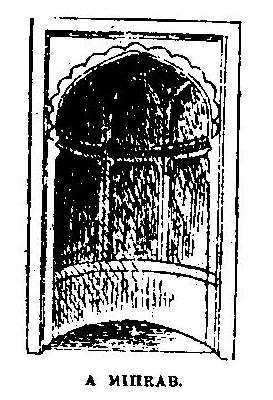
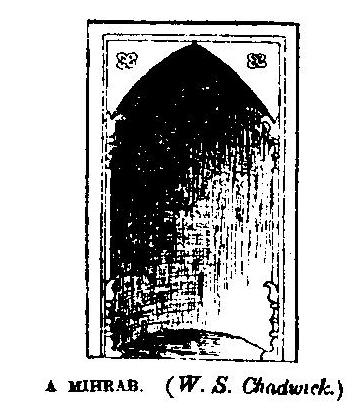
from the Hindus, such a niche being a peculiarly Hindu feature in sacred buildings.
The word occurs four times in the Qur'an, where it is used for a. chamber (Surahs iii. 32, 33; xix. 12; xxxviii. 20), and its plural maharib, once (Surah xxxiv. 12).
MIKA'IL.
 [MICHAEL.]
MILLAH.
 A word which occurs in the Qur'an fifteen times. Eight times for the religion of Abraham (Surahs ii. 124, 129; iii. 89; iv. 124; vi. 102; iii. 38:
xvi. 124; xxii. 77); twice for the religion of former prophets (Surahs xiv. 16; xxxviii. 6); once for the religion of the seven children of the cave (Surah xviii. 19); three times for idolatrous religions (Surah xii. 37, vii 86, 87); and once for the religion of Jews and Christians (Surah ii. 114). The word is used in the Traditions for the religion of Abraham (Mishkat, book x. ch. v.).
A word which occurs in the Qur'an fifteen times. Eight times for the religion of Abraham (Surahs ii. 124, 129; iii. 89; iv. 124; vi. 102; iii. 38:
xvi. 124; xxii. 77); twice for the religion of former prophets (Surahs xiv. 16; xxxviii. 6); once for the religion of the seven children of the cave (Surah xviii. 19); three times for idolatrous religions (Surah xii. 37, vii 86, 87); and once for the religion of Jews and Christians (Surah ii. 114). The word is used in the Traditions for the religion of Abraham (Mishkat, book x. ch. v.).
According to the Kitabu 't-Ta'rifat, it is expressive of religion an it stands in relation to the prophets, as distinguished from Din  , which signifies religion as it stands in relation to God, or from Mazhal
  , which signifies religion wills reference to the
learned doctors [RELIGION.] Sprenger and Deutsch have invested the origion and meaning of this word with a certain amount of mystery, which is interesting.
Dr Sprenger says (Das Leben und die Lehre des Mohammad, vol. ii. p 276 n) —.' When Mohammad speaks of the religion of Abraham, he generally uses the word Milla (Millah) and not Din. Arabian philologists have tried to trace the meaning of the word from their mother tongue, thus, Malla (Mallah) signifies fire or hot ashes in Arabic and Zaggag says (Thalaby, vol. ii. p. 114), that religion is called Milla because of the impression which it makes, and which may be compared to that which fire makes upon the bread baked in ashes. Since the Arabs are unable to give a better explanation, we must presume that milla is a foreign word, imported by the teachers of the 'Milla of Abraham" in the Hijaz. Philo considered Abraham the chief promoter of the doctrine of the Unity of God, and doubtless, oven before Philo, Jewish thought, in tracing the doctrine of the true religion, not only as far back as Moses, but even to the father of their nation, emancipated the indispensability of the Coran the law, and so prepared the road to Essaism and Christianity."
Mr Emanuel Deutsch, in his article on Islam (Literary Remains, p 130), save: "The word used in the Quran for the religion of Abraham is generally Milla. Sprenger after ridiouling the indeed absurd attempts made to derive it from an Arabic root, concludes that. it must be a foreign word introduced by the teachers of the 'Milla of Abraham' into the Hijaz. He is perfectly right. Milla=Memra=Logos, are identical; being the Hebrew, Chaldee (Targum, Peshito in slightly varied Spelling), and Greek terms respectively for the 'Word,' that surrogate for the Divine name used by the Targum by Philo. by St. John. This Milla or 'Word, which Abraham proclaimed, he, 'who was not an astrologer but a prophet,' teaches according to the Haggada, first of all, the existence of one God, the Creator of the Universe, who rules this universe with mercy and lovingkindness."
MILK.
Arabic laban  . The sale of milk in the udder is unlawful (Hidayah, vol. ii. p. 433). In the Qur'an it is mentioned as one of God's special gifts. "Verily, ye have in cattle a lesson: we give you to drink from that. which is in their bellies betwixt chyme and blood—pure milk—easy to swallow for those who drink." (Surah xvi.
68)
. The sale of milk in the udder is unlawful (Hidayah, vol. ii. p. 433). In the Qur'an it is mentioned as one of God's special gifts. "Verily, ye have in cattle a lesson: we give you to drink from that. which is in their bellies betwixt chyme and blood—pure milk—easy to swallow for those who drink." (Surah xvi.
68)
MINA.  Lit. "A wish."- A sacred valley near Makkah in which part of the Pilgrimage ceremonies take place. According to 'Abdu 'l-Haqq. it was so called because Adam wished for paradise in this valley.
MINARET. [MANARAH.]
MINBAR.
Generally pronounced
mimbar,  . The pulpit in a mosque from which the khutbah (or sermon)
is recited. It consists of three steps and is sometimes a metal or wooden structure, and sometimes a mixture of brick or stone both against the wall. Muhammad in addressing the congregation stood on the uppermost
. The pulpit in a mosque from which the khutbah (or sermon)
is recited. It consists of three steps and is sometimes a metal or wooden structure, and sometimes a mixture of brick or stone both against the wall. Muhammad in addressing the congregation stood on the uppermost
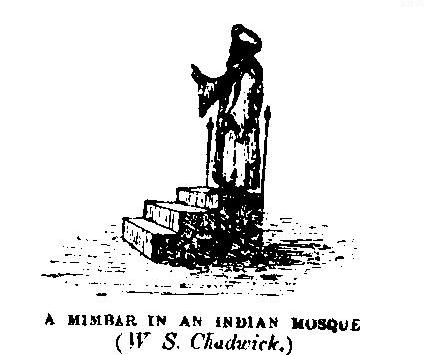
step, Abu Bakr on the second, and 'Umar on the third or lowest. 'Usman fixed upon the middle step, and since then it had been the custom to preach from that step. The Shiah' have four steps to their mimbars.
The mimbars in the mosques of Cairo are
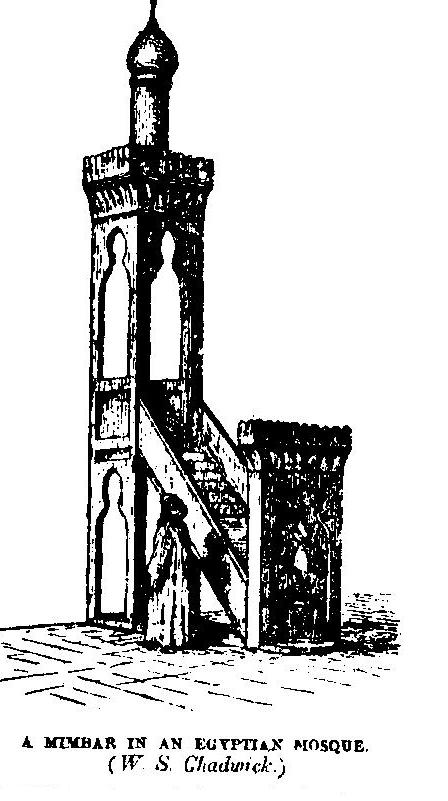
elevated structures, but in Asia they are of a more primitive character.
Burton says: "In the beginning the Prophet leaned, when fatigued, against a post, whilst preaching the khutbah or Friday ser-
mon. The mimbar, or pulpit, was an invention of a Madinah man of the Banu Najjar. It was a wooden frame, two cubits long by one broad, with three steps, each one span high; on the topmost of these the Prophet sat when he required rest. The pulpit assumed its present form about A.H. 90, during the artistic reign of El Walid."
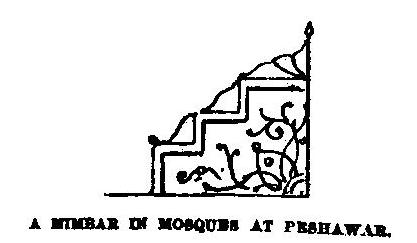
MINES.
Arabic ma'din  ,
pl. ma'adin. In Zakat, mines are subject to a payment of one fifth. (Hidayah, vol. i. 39.)
,
pl. ma'adin. In Zakat, mines are subject to a payment of one fifth. (Hidayah, vol. i. 39.)
MINHAH. A legal term for a portion of camel's or sheep's milk which another is allowed to draw, but afterwards to restore the animal to its original owner.
MINORITY. [PUBERTY.]
MIQAT. Lit. "A stated time, or place." The stations at which Makkan pilgrims assume the ihram or "pilgrnn's garment. Five of these stations are established by Muhammad (Mishkat, book xi. ch. i. pt. 1) and the sixth, has been added since to stilt the convenience of travellers from the East. They are as follows: (1) Zu 'l-Hulafa', for the pilgrims from al-Madinah; (2) Juhfah, for Syria' (3) Qarnu 'l-Manazil, for Najd; (4) Yaulamlam, for Yaman; (5) Zat-i-Irq, for 'Iraq;. (6) Ibrahim Mursia, for those who arrive by sea from India and the east.
The putting on of the ihram at Jerusalem is highly meritorious, according to a tradition, which says, " The Prophet said, Whoever wears the ihram for hajj or 'umrah, from the Masjidu 'l-Aqsa (i.e. the Temple at Jerusalem) to the Masjidu'l-Haram, shall be forgiven for all his past and future sins." (Mishkat, book xi. ch. i. pt. 2.)
MIR. A title of respect used for the descendants of celebrated Muhammadan saints. More generally used for Saiyids, or descendants of Fatimah, the Prophet's daughter.
MIRACLES.
Supernatural powers
given to men are spoken of by Muslim lexicographers as khariqu 'l-'adat  , or "things contrary to custom." In Muslim theology, they are expressed by eight terms: 1) Ayah
  , pl. ayat, "a sign"; the only
word used in the Qur'an for a miracle (see Surahs xiii. 27: xxix. 49; lii. 2). (2) Mu'jizah
, pl. ayat, "a sign"; the only
word used in the Qur'an for a miracle (see Surahs xiii. 27: xxix. 49; lii. 2). (2) Mu'jizah  , pl. mu'jizat, making weak
or feeble," or that which renders the adversaries to the truth weak and feeble; a term used only for miracles performed by prophets; (3) Irhas
, pl. mu'jizat, making weak
or feeble," or that which renders the adversaries to the truth weak and feeble; a term used only for miracles performed by prophets; (3) Irhas  pl. irhasat, lit. "laying a foundation"; used for any miracle, performed by a prophet before his assumption of the prophetical office. (4) 'Alamah
  , pl.
'alamat, "a sign," the same as ayah, and used for the signs of the coming Resurrection. (5)
Karamah
, pl.
'alamat, "a sign," the same as ayah, and used for the signs of the coming Resurrection. (5)
Karamah  pl. karamat, lit. "beneficence"; wonders wrought by saints for the good of the people as well as in proof of their own saint-ship. (6) Ma'unah
  pl.
ma'wanat, lit. "help or assistance;" used also for the wonders wrought by saints. (7) Istidraj
pl.
ma'wanat, lit. "help or assistance;" used also for the wonders wrought by saints. (7) Istidraj  lit. "promoting by degrees "; a term employed to express the miracles wrought by the assistance of the Devil with the permission of God. (8) Ihanah
  pl. Ihanat, lit. "contempt"; miracles wrought by the assistance of the Devil, but when they turn out to the disdain and contempt of the worker.
It does not appear from the Qur'an that Muhammad ever claimed the power of working miracles, but, on the contrary, he asserted that it was not his mission to work signs and wonders in proof of his apostleship. This seems to be evident from the following verses in the Qur'an :—
Surah xxix. 49: "They say, Why are not signs (ayat) sent down to him from his Lord? Say: Signs are in the power of God alone, and I am only an open warner."
Surah xiii. 27—30: "And they who believe not say, Why is not a sign (ayah) sent down to him from his Lord? Say: God truly misleadeth whom He will, and guideth to Himself him who turneth to Him. . . - If there were a Qur'an by which the mountains would be set in motion, or the earth cleft by it, or the dead be addressed by it, they would not believe."
Surah xvii. 92—97: "And they say, By no means will we believe on thee till thou cause a fountain to gush forth for us from the earth, or till thou have a garden of palm trees and grapes, and thou cause gushing rivers to gush forth in its midst, or till thou make heaven to fall upon us, as thou hast given out in pieces; or thou bring God and the angels to vouch for thee; or thou have a house of God, or thou mount up into heaven; nor will we believe in thy mounting up until thou send us down a book which we may read. Say: Praise be to my Lord! Am I more than a man, and an apostle? And what hindereth men from believing, when she guidance bath come to them, bat that they say, hath God sent a mere man as an apostle? Say: Did angels walk the earth as its familiars, we had surely sent them an angel-apostle out of heaven."
But notwithstanding these positive assertions on the part of their Prophet against him ability to work miracles, there are at least four places in the Qur'an where the Muhammadans believe that miracles are referred to 1. The clefting of the moon (Surah liv. 1. 2):
"The hour hath approached, and the moon hath been cleft. But if the unbelievers see a sign (ayah), they turn aside and say, Magic! that shall pass away!"
Al-Baizawi says, in his commentary on this verse, "Some say that the unbelievers demanded this sign of the Prophet, and the moon was cleft in two; but others say it refers to a sign of the coming Resurrection, the words 'will be cleft' being expressed in the prophetic preterite."
Rodwell renders it "hath been cleft," as he thinks Muhammad may possibly allude to some meteor or comet which he fancied to be part of the moon.
2. The assistance given to the Muslims at the battle of Badr. Surah iii. 120, 121: "When thou didst say to the faithful: -'Is it not enough for you that your Lord aideth you with three thousand angels sent down from on high?' Nay; but if ye be steadfast, and fear God, and the foe come upon you in haste, your Lord will help you with five thousand angels with their distinguishing marks."
These "distinguishing marks," say the commentators, were when the angels rode on black and white horses, and had on their heads white and yellow turbans, the ends of which hung down between their shoulders.
3. The celebrated night journey. Surah xvii 1: "We declare the glory of Him who transports his servant by night from the Maajid 'l-Haram to the Masjidu 'l-Aqsa (i.e. from Makkah to .Jerusalem)."
4. The Qur'an itself. which the Muhammadans say is the great miracle of Islam, the like of which has not been created, nor ever will be, by the power of man. In proof of this they quote Surah xxix. 48: "It is a clear sign (ayah) in the hearts of whom the knowledge hath reached."
Although these very doubtful assertions in the Qur'an fall to establish the miraculous powers of the Prophet, the Traditions record numerous occasions when he worked miracles in the presence of his people.
The following are recorded in the traditions of al-Bukhari and Muslim:-
(1) On the flight from Makkah, Suraqah being cursed by the Prophet, his horse sank up to its belly in the hard ground.
(2) The Prophet marked out at Badr the exact spot on which each of the Idolaters should be slain, and Anas says not one of them passed alive beyond the spot marked by the Prophet.
(3) He cured the broken leg of 'Abdu'llah ibn Atiq by a touch.
(4) Reconverted hard ground into a heap of sand by one stroke of an axe.
(5) He fed a thousand people upon one kid and a sa' of barley.
(6) He gave a miraculous supply pf water at the battle of al-Hudaibiyah.
(7) Two trees miraculously moved to form a shade for the Prophet.
(8) He made Jabir a good horseman by his prayers.
(9) A wooden pillar wept to such-an extent that it nearly rent in two parts because the Prophet desisted from leaning against it.
(10) A sluggish horse became swift from being ridden by the Prophet.
(11) Seventy or eighty people miraculously fed on a few barley loaves and a little butter.
(12) Three hundred men fed from a single cake.
The following are recorded by various writers:-
(1) The Prophet was saluted by the hills and trees near Makkah, with the salutation, "Peace be to thee, O Messenger of God!"
(2) A tree moved from its place to the shade when the Prophet slept under it.
(3) The Prophet cured a maniacal boy by saying. "Come out of him."
(4) A wolf was made to speak by the Prophet.
(For further information, see Kitabu 'l-Mu'jizat, Sahihu 'l-Bukhari, Mishkatsu 'l-Masabih, Sahihu Muslim.)
MI'RAJ.
Lit. "An ascent."
Muhammad's supposed journey to heaven; called also Isra  "the nocturnal journey." It is said to have taken place in the twelfth year of the Prophet's mission, in the month of Rabi'u 'l-Awwal.
According to 'Abdu 'l-Haqq, there are some divines who have regarded this miraculous event as a mere vision, but, he adds, the majority hold if to he a literal journey.
The only mention of the vision in the Qur'an is contained in Surah xvii. 1 :"Praise be to Him who carried His servant by night from the Masjidu '1-Haram (i.e. the Makkan temple) to the Masjidu 'I-Aqsa (i.e. the Temple of Jerusalem)."
The following is the description of the supposed journey given in the Mishkatu 'l-Masabih. Muhammad is related to have said "Whilst I was sleeping upon my side, us (Gabriel) came to me, and cut me open from my breast to below my navel, and took out my heart, and washed the cavity with Zamzam water, and then filled my heart with Faith and Science. After this, a white animal was brought for me to ride upon. Its size was between that of a mule and an ass, and it stretched as far as the eye could see. The name of the animal was Buraq. Then I mounted the animal, and ascended until we arrived at the lowest heaven, and Gabriel demanded that the door should be opened. And it was asked, ' Who is it? and he said, 'I am Gabriel.' And they then said, 'Who is with you ? and he answered, It is Muhammad.' They said, Has Muhammad been called to the office of a prophet?' He said, Yes.' They said, 'Welcome Muhammad, his coming is well.' Then the door was opened; and when I arrived in the first heaven, behold, I saw Adam. And Gabriel said to me, 'This is your father Adam, salute him.' Then I saluted Adam, and he answered it, and said, 'You are welcome, O good son, and good Prophet! - After that Gabriel took me above and we reached the second heaven; and he asked the door to be opened, and it
was said Who is it? He said, I am Gabriel.' It was said, Who is with you? He said, Muhammad.' It was said, was he called?' He said, 'Yes.' It was said, 'Welcome Muhammad; his coming is well.' Then the door was opened, and when I arrived in the second region, behold, I saw John and Jesus (sisters sons). And Gabriel said, ' This is John, and this is Jesus both or them.' Then I saluted them, and they returned it. After that they said, 'Welcome good brother and Prophet." After that we went up to the third heaven, and asked the door to be opened; and it was said, ' Who is it?' Gabriel said, I am Gabriel.' They said.' Who is with you?' He said,' Muhammad.' They said, 'Was he called? Gabriel said, 'Yes.' They said, 'Welcome Muhammad; his coming is well.' Then the door was opened: and when I entered the third heaven, behold, I saw Joseph. And Gabriel said, 'This is Joseph, salute him.' Then I did so, and he answered it, and said, 'Welcome, good brother and, good Prophet.' After that Gabriel took me to the fourth heaven, and asked the door to he opened; it was said, Who is that? He said, 'I am Gabriel. It was said Who is with you?' He said, Muhammad, It was said 'Was he called? He said Yes.' They said, ' Welcome Muhammad ; his coming his well.' And the door was opened and when I entered the fourth heaven, behold. I saw Enoch. And Gabriel said, this is Enoch, salute him.' And I did so and he answered it and said, 'Welcome, good brother and Prophet. After that Gabriel took me to the fifth heaven, and asked the door to he opened; and it was said. 'Who is there? ' He said, 'I am Gabriel.' it was said, 'Who is with you ? ' He said. Muhammad.' They said, Was he called? he said, ' Yes.' 'They said, ' Welcome Muhammad ; his coming is 'well.' Then the door was opened: and when I arrived in the fifth region, behold. I saw Aaron and Gabriel said. ''This is Aaron, salute him.' And I did so, and he returned it, and "said, Welcome, good brother and Prophet.' After that Gabriel took me to the sixth heaven, and asked the door to be opened, and, they said. 'Who is there? He said, I am Gabriel.' They said, And who is with you? ' He said, ' Muhammad.' They 'is he called?' He said, ' Yes.' They sail. ' Welcome Muhammad : his coming is well.' Then the door was opened; and when I entered the sixth heaven, behold I saw Moses. And Gabriel said. ' This is Moses, salute him ' And I did; and he returned it and said, 'Welcome good brother and Prophet.' And when I passed him, he wept. And I said to him, ' what makes you weep? ' He said," Because one, is sent after me whose people more will enter Paradise. than of mine. After that Gabriel took me to the seventh heaven, and asked the door to be opened: and it was and, 'Who is it?' He said. I am Gabriel.' And it was said, . Who is with you?' He said, ' Muhammad. They said Was he called?' He said 'Yes.' They said, 'Welcome, Muhammad; his coming is well.' Then I entered the seventh heaven and behold, I saw Abraham. And Gabriel said. 'This is Abraham, your father, salute him, which I did, and he returned it, and said,' Welcome good son and good Prophet.' After that, I was taken up to the tree called Sidratu 'l-Muntaha: and behold its fruits were like water-pots, and its leaves like elephant's ears". And Gabriel said, 'This is Sidratu l-Muntahz.' And I saw four rivers there; two of them hidden, and two manifest. I said to Gabriel, 'What are these?' He said, 'These two concealed rivers are in Paradise; and the two manifest are the Nile and the Euphrates.' After that, I was shown the Baitu 'l-M'amur. After that, a vessel full of wine, another full of milk, and another of honey, were brought to me; and I took the milk and drank it. And Gabriel said Milk is religion; you and your people will be of it." After that the divine orders for prayers were fifty every day. 'Then I returned, and passed by Moses; and he add, 'What have you been ordered?' I said, ' Fifty prayers every day.' Then Moses said. Verily, your people will not be able to perform fifty prayers every day ; and verily, I swear by God, I tried men before you: I applied a remedy to the sons of Israel, but it had not the desired effect. Then return to your Lord, and ask your people to be released from that. And I returned; and ten prayers were taken off. Then went, to Moses and he said as before; and I returned to God's court, and ten prayers more were curtailed. Then I retuned to Moses, and he said as before; then I returned to God and ten more were taken off. And I went to Moses, and he said as before; then I returned to God, and ten more were lessened. Then, I went to Moses, and he said as before; then I went to God's court, and was ordered five prayers every day Then I went to Moses, and he said. 'how many hare you beets ordered?' I said, 'Five prayers every day.' He said, ' Verily, your people will not be able to perform five prayers every day; for, verily, I tried men before you, and applied the severest remedy to the sons of Israel. Then return to your Lord, and ask them to be lightened.' I said, I have asked Him till I am quite ashamed. I cannot return to Him again. But I am satisfied, and resign the work of my people to God.' Then. when I passed from that place a crier called out, 'I have established My divine commandments, and have made them easy to My servants."
Suratu l-Mi'raj is a title of the xviiith chapter of the Qur'an, in the first verse of which there is a reference to the night Journey of Muhammad. It is called also the Sur'atu Bani Israil, or the Chapter of the Children of Israel.
MIRAS.  [INHERITANCE.]
MIRZA.  A title of respect
given to persons of good family.
A title of respect
given to persons of good family.
MIRZABAH, MIRZABBAH.  "A clod-crusher. The iron hammer with
which the dead air beaten who cannot reply satisfactorily to the questions put to them by Munkar and Nakir. Called also Mitraqat  . [PUNISHMENTS FROM THE GRAVE.]
MISAQ.  . A covenant." A word used in the Qur'an for God's covenant with his people. [COVENANT.]
MISHKATTU 'L-MASABIH. 
 . A well-known book of Sunni
tradition, much used by Sunni Muslims in India, and frequently quoted in the present work. It was originally compiled by the Imam Husain al-Baghawi, the celebrated commentator, who died A.H. 510 or 516, and called the Masabihu 's-unnah, or the Lamps of the Traditions." in the year 737, Shaikh Waliyu 'd din revised the work of al-Baghawi, adding an additional chapter to each section, and called the Mishkatu 'l-Masabih, or the "Niche for lamps." In the time of the Emperor Akbar', Shaikh 'Abdu 'l-Haqq translated the work into Persian, and added a commentary. (See Kashfu 'Zunun,
in loco.)
. A well-known book of Sunni
tradition, much used by Sunni Muslims in India, and frequently quoted in the present work. It was originally compiled by the Imam Husain al-Baghawi, the celebrated commentator, who died A.H. 510 or 516, and called the Masabihu 's-unnah, or the Lamps of the Traditions." in the year 737, Shaikh Waliyu 'd din revised the work of al-Baghawi, adding an additional chapter to each section, and called the Mishkatu 'l-Masabih, or the "Niche for lamps." In the time of the Emperor Akbar', Shaikh 'Abdu 'l-Haqq translated the work into Persian, and added a commentary. (See Kashfu 'Zunun,
in loco.)
MISKIN.  "A poor person." Heb. Eccles. ix. 15,
  According to Muslim law, a person who has no property whatever, as distinguished front a faqir
  , or a person who possesses a little property, but is poor. (Hidayah, vol. i. p. 54.)
MISQAL.  An Arabic weight, which frequently occurs in Muhammadan law books. Richardson gives it at a dram and three-sevenths. It is also used for a gold coin of that weight. [MONEY.]
MISR.  [EGYPT.]
MISWAK.  . (1) A tooth-cleaner made of wood, about a span long. It is preferred when made of a wood which has a bitter flavour. The Salvadora indira is the tree, the wood of which is used in India.
(2) The act of cleaning the teeth, which is a religious ceremony founded upon the example of Muhammad, and forms the first part of the wazu', or "ablution before prayer."
. (1) A tooth-cleaner made of wood, about a span long. It is preferred when made of a wood which has a bitter flavour. The Salvadora indira is the tree, the wood of which is used in India.
(2) The act of cleaning the teeth, which is a religious ceremony founded upon the example of Muhammad, and forms the first part of the wazu', or "ablution before prayer."
The Prophet was particularly careful in the observance of miswak (see Mishkat, book iii. Ch. 4.) It is amongst these things which are called fitrah (q.v.).
MITRAQAH.  . The iron hammer or mace with which the infidels will be Smitten in their graves by the angels Munkar and Nakir. Persian gurz. [PUNISHMENT OF THE GRAVE.]
MIYAN.  .
A Persian word, used as a title of respect for the descendants of celebrated Muhammadan saints.
.
A Persian word, used as a title of respect for the descendants of celebrated Muhammadan saints.
MIZAN.  .
pl. mawazin, Heb. pl.
.
pl. mawazin, Heb. pl.  , "A balance."
(1) The law contained in the Qur'an, Surah xlii. 16: "God is He who hath sent down the Book with truth and the balance."
(2) The scales in which the actions of all men shall be weighed. Surah xxi 47 "Just balances will be set up for the Day of Resurrection, neither shall any soul be wronged in aught; though, were a work but the weight of a grain of mustard seed, we would bring it forth to be weighed; and out reckoning will suffice."
Muhammad is related by 'Abdu 'llah ibn 'Amr to have said: "Verily, God will bring a Muslim into the presence of all men on the Day of Judgment, and will show him ninety-nine large books, and each book its long as the eye can reach. Then God will say to him, 'Do you deny anything in these books? Have my writers injured you?' And the Muslim wilt say, 'O my Lord. I deny nothing that is in them.' Then God will say, 'Have you any excuse?' And he will say, 'No.' Thou God will say, 'I have good news for you. for there is no oppression in this day,' Then God will bring forth a piece of paper, on which is written: 'I bear witness that there is no deity hut God, and I bear witness that Muhammad is His servant and apostle.' And God will say, 'Go and weigh your actions.' And the Muslim will say, 'What is this bit of paper compared with those large books?' And God will say, 'This bit of paper is heavy, weigh it.' Then the books will be put in the scale, and the bit of paper on the other, and the books containing the actions wilt he light, and the bit of paper whereon is written the creed of time Muslim, will be heavy.' (see Collection of Hadis by at-Tirmizi.)
The commentators say that the scales wilt be held by the angel Gabriel, and that they are of so vast a size, one hangs over Paradise, and the other over Hell, and they are capacious enough to contain both heaven and earth. Though some are willing to understand what is said in the Traditions concerning this balance allegorically, and only as a figurative representation of God's equity, yet the more ancient and orthodox opinion is that it is to be taken literally; and since words and actions, being mere accidents, are not capable of being themselves weighed, they say that the books wherein they are written will be thrown into time scales, and according as those wherein the good or the evil actions are recorded shall preponderate, sentence will be given; those whose balances laden with their good works shall be heavy will be saved; but those whose balances are light, will be condemned. Nor will anyone hare cause to complain that God suffers any good actions to pass unrewarded, because the wicked obtain rewards for the good they do in the present life, and therefore can expect no favour in the next.
The old Jewish writers make mention of the books to be produced at the Last Day, wherein men's actions are registered as of the balance wherein they shall he weighed, and the Bible itself seems to have given the first notion of both. But what the Persian Magi believe of the balance comes nearest to the Muhammnadan opinion. They hold that on the Day of Judgment, two angels, named Mihr and
Sorush will stand on the bridge between heaven and hell, and examine every person as he passes; that the former, who represents the divine mercy, will hold a balance in his band to weigh the actions of men; that, according to the report he shall make thereof to God, sentence will be pronounced, and those whose good works are found more ponderous, if they turn the scale but by the weight of a hair, will be permitted to pass forward to Paradise; but those whose good works shall be found light, will be, by the other angel, who represents God's justice, precipitated from the bridge into hell.
MODERATION. Arabic iqtisad  . According to Muhammad's teaching, moderation in all religious matters is better than excessive piety, and a chapter in the Traditions is devoted to the subject. He is related to have said:-
"The best act in God's sight is that which is constantly attended to, although in a small degree."
"Do what you are able conveniently; because God will not be tired of rewarding as long as you are not tired of doing."
"You must continue at your prayers as long as it is agreeable to you, and when you are tired sit down,"
"Verily, religion is easy, therefore hold it firm" (See Mishkat, Babu 'l-Iqisad.)
MODESTY. Arabic haya'  is frequently commended in the traditional sayings of Muhammad, who is related to have said
"Modesty is a branch of faith,"
"Verily, modesty and faith are Joined together." (Mishkat, book xiii. ch. xii.)
MONASTICISM. (Arabic rahbaniyah  ), was forbidden by Muhammad. It is related in the Traditions that 'Usman ibn Maz'un came to the Prophet with the request that be might retire from society and become a monk (rahib). The Prophet replied, "The retirement which becomes my people is to sit in the corner of a mosque and wait for the time of prayer." (Mishkat, book iv. ch. 8.)
In the Qnr'an, the Christians are charged with inventing the monastic life. Surah lvii. 27; "We gave them the Gospel, and we put into the hearts of those who follow him, kindness and compassion; but as to the monastic life, they invented it themselves."
According to the Hidayah (vol. ii. p. 215), capitation tax is not to be imposed upon Rahibs, whether Christian or Pagan, but this is a matter of dispute.
MONEY.
There are three coins mentioned in the Qur'an, (1) Qintar  , (2) Dinar
  (8) Dirham
  pl.
Darahim.
pl.
Darahim.
(1) Qintar. Suah iii. 68: "Among the people of the Book are those to one of whom, you entrust a qintar, he will restore it."
In the Qamus, it is said that a qintar was a gold coin of the value of 200 dinars, but Muhammad Tahir, the author of the Majma'u 'l-Bihar (p. 173), says it implies a very considerable sum of money, as much gold as will go into the hide of a cow. It is generally translated talent.
(2) Dinar. Surah iii. 68: "There are those to whom, if thon entrust a dinar, they will not restore it to thee." It was the denarius, or a small gold coin.
(3) Dirham. Surah xii. 20: "And they sold him for a mean price, dirhams counted out." A silver drachma. [QINTAR, DINAR, DIRHAM, WEIGHTS.]
Mr. Prinsep says: "The silver rupee (rupya, silver piece), now current in Muslim countries, was introduced. according to Abul-fazel, by Sher Shah, who usurped the throne of Delhi from Humayoon in the year 1542. Previous to his time, the Arahic dirhim (silver drachma), the gold dinar (denarius ouri), and the copper fuloos (follis). formed the currency of the Moghul dominions. Sher Shah's rupee had on one side the Muhammadan creed, on the other the emperor's name and the date in Persian, both encircled in an annular Hindee inscription. Since the same coin was received and made more pure, in Akber's reign, we may assume the original weight of the rupee, from Abulfazel's statement, to have been 11 ½ mashas. Akbar's square rupee, called from its inscription the jilaly, was of the same weight and value. This coin was also called the chahar-yaree, from the four friends of the Prophet, Abu-bekr, Omar, Osman, 'Ali, whose nimee are inscribed on the margin. This rupee is supposed by the vulgar to have talismanic power."
MONOGAMY. Although polygamy is sanctioned in the Qur'an, the words, and if ye fear that ye cannot be equitable, then only one" (Surah iv. 3), would seem to imply a leaning to monogamy, as the safest and most discreet form of metrimony. The author of the Akhlaq-i-Jalali says: "Excepting, indeed, in the case of kings, who marry to multiply offspring, and towards whom the wife has no alternative but obedience, plurality of wives is not defensible. Even in their case it were better to be cautious; for husband and wife are like heart and body, and like as one heart cannot supply life to two bodies, one man can hardly provide for the management of two homes." (Thompson's English Translation, p. 266.)
MONOPOLY.
Arabic ihtikar  A monopoly of the necessaries of life (as, for example, the hoarding up of grain with the object of raising its prices is forbidden in Muhammadan law. For the Prophet has said:—
"Whoever monopolizeth is a sinner."
"Whosoever keepeth back grain forty days, in order to increase its price, is both a forsaker of God, and is forsaken of God." (Mishkat, book xii. ch. x.: Hidayah, vol. iv. p. 114.)
MONTH. Arabic  , pl. shuhur. The months of the Muhammadan year
are lunar, and the first of the month is reckoned from the sunset immediately succeeding the appearance of the new moon (hilal). The names of the months are: (1) Muharram  (2) Safar
  ; (3) Rabi'u'l Awwal
  ; (4) Rabi'u'l Akhir
  ; (5) Jumada 'l-Ula
  ; (6) Jumada 'l-Ukhra
 ; (7) Rajab
  (8) Sha'ban
  ;
(9) Ramazan
;
(9) Ramazan  (l0)Shawwal
  (11)
Zu 'l-Qa'dah
(11)
Zu 'l-Qa'dah  ; (12) Zu 'l-Hijjah
Four of these months are held to be sacred, namely, Muharram, Rajab, Zu 'l-Qa'dah, Zu '1-Hijah, and according to the teaching of the Qur'an (Surah ix. 86), it is not lawful for Muslims to fight during these months, except when they attack those who join other gods with God, even as they attack you one and all."
The names of the months seem to have been given at a time when the intercalary year was in force, although Muslim writers assume that the names were merely given to the months as they then stood at the time when they were so named. For a discussion of the formation of the Muhammadan year, the reader is referred to that article. [YEAR.]
(1) Muharram is the first month in the Muhammadan calendar, and is so called because, both in the pagan age and in the time of Muhammad, it was hold unlawful (haram) to go to war in this month. It is considered a most auspicious month, and Muhammad is related to hove said, " Whosoever shall fast on Thursday, Friday, and Saturday in this month, shall be removed from hell fire a distance of seven hundred years journey; and that he who shall keep awake the first night of this month, shall be forgiven all the sins of the past year; and he who shall fast the whole of the first day, shall be kept Ironi sin for the next two years." (Hanisu 'l-Waizin, p. 154.) The first ten days of this month are observed in commemoration of the martyrdom of al-Hussain, and the tenth day is the 'Ashura' fast.
(2) Safar, the second month, is supposed to derive its name from safir, "empty," either because in it the Arabians went forth to war and left their homes empty, or, according to Rubeh, because they left whom they attacked empty. According to some writers, it; was so named from sufar, "yellowness," because when it was first so called, it was autumn, when the leaves bore a yellowish tint. (Vide Lane's Arabic Dict.: Ghiyasu 'l-Lughah.) It is held to be the most unlucky and inauspicious month in the whole year, for in it, it is said, Adam was turned out of Eden, (See Hanisu 'l- Waizin.) It was during this month that the Prophet was taken ill, but his partial recovery took place on the last Wednesday.
(3) Rabi'u 'l-Awwal, and (4) Rabi'u '1-Akhir, the first and second spring months, are said to have been so named when the calendar was first formed, and when those months occurred in the spring. Muhammad died on the 12th day of the Rabi'u 'l-Awwal.
(5) Jumada 'l-Ula, and (6) Jumada 'l-Ukhra, are the fifth, and sixth months, about which there is some discussion as to the origin of the name. Mr. Lane, in his Dictionary, says the, two months to which the name Jamada (freezing) is applied, are said to be so called because, when they were so named, they fell in the season of freezing water; but this derivation seems to have been invented when the two months thus named had fallen back into, or beyond, the winter, for when they received this appellation, the former of them evidently commenced in March, and the latter ended in May. Therefore, I hold the opinion of M. Caussin de Perceval, that they were thus called because falling in a period when the earth had become dry and hard, by reason of paucity of rain, jamad being an epithet applied to and upon which rain has not fallen, which opinion is confirmed by the obvious derivation of the names of other months. (See Lane's Arabic Dict. in loco.)
(7) Rajab, the "honoured " month, so called because of the honour in which the month was held in the Times of Ignorance, inasmuch as war was not permitted during this month. The Prophet is related to have said that; the month Rajab was like a snowy white fountain flowing from. heaven itself, and that he who fasts on this month will drink of the waters of life. It is called Rajab-i-Muzar, because the Muzar tribe held it in high esteem. It is usual for religious Muslims to spend the first Friday night (i.e. our Thursday night) of this month in prayer.
(8) Sha'ban, the month of separation (called also the Shahru 'n-Nabi, "the Prophet's month "), is so called because the ancient Arabians used to separate, or disperse themselves, in this month in search of water (for when the months were regulated by the solar year, this month corresponded partly to June and partly to July), or, as some say, for predatory expeditions. On the fifteenth day of this month is the Shab-i-Barat, or "Night of Record," upon which it is said that God registers annually all the actions of man-kind which they are to perform during the year, and upon which Muhammad enjoined his followers to keep awake the whole night and to repeat one hundred rak'ah prayers. [SHAB-I-BARAT.]
(9) Ramazan, the ninth month of the Muhammadan year, is that which is observed as a strict fast. The word is derived from ramz, "to burn," because it is said that, when the month was first named, it occurred in the hot season; or because the month's fast is supposed to burn away the sins of men. (See Ghiyasu 'l-Lughah.) The excellence of this month is much extolled by Muhammad, who said that; during this month the gates of Paradise are opened, and the gates of Hell shut. (Mishkat, book vii, chap. i. sec. 1.) [RAMAZAN.]
(10) Shawwal, lit. "a tail," is the tenth month of the lunar year, and, according to Arabic lexicons (see Ghiyasu 'l-Lughah, Qamus, &c.), it is so called because, when first named, it coincided with the season when the she camels, being seven or eight
months gone with young raised their tails or, because it was the month for hunting. The Arabs used to say that it was an unlucky month in which to make marriage contracts, but the Prophet ignored this thus auguring and married Ayishah in this month. The 'Ida l-Fitr, or "the Feast of Breaking the Fast," occurs on the first of this month.
(11) Zu 'l-Qa'dah, or the month of truce, is the eleventh month, and so called by the ancient Arabs, because it was a month in which warfare was not conducted, and in which the people were engaged in peaceful occupations.
(12) Zu 'l-Hijjah, the month of the Pilgrimage is the last month of the Muhammadan calendar. It is the mouth in which the pilgrimage to Makkah must be made, a visit to the sacred city at another time having in no way the merits of a pilgrimage. The Hajj, or "Pilgrimage," is performed upon the seventh, eighth, ninth, and tenth of this month. The 'Idu l-Azha, or "Feast of Sacrifice," is held on the tenth. [HAJJ.]
MORTGAGE. [HIJJRAH.]
MOON.
Arabic qamar  . The moon is frequently mentioned in the Qur'an. Muhammad on three occasions swears by it (Surahs lxxiv. 35; lxxxiv. 18; xci. 2), and it is said to have been set in the heavens for a light (Surahs x. 5; lxxi 15), to run to its appointed goal (Surahs xxxv. 14; xxxix. 7), and that it will be eclipsed at the Day of Judgment (Surah lxxv. 8). The LIVth Surah of the Qur'an, which is entitled the Suratu 'l-Qamar, begins with a reference to the splitting of the moon, which is a matter of controversy. It reads: "The hour draws nigh and the moon is split asunder. But if they see a sign, they turn aside and say magic continues."
Al-Baizawi refers it to a miracle, and says the unbelievers having asked Muhammad for a sign. the moon appeared to be cloven in twain. But the most natural explanation of the passage is, that the expression refers to one of the signs of the Resurrection.
At an eclipse of the moon, a devout Muslim is expected to recite a two rak'ah prayer.
MOORS.
The name given to the Muhammadan conquerors of Spain, on account of their having come from the ancient Marui, or Mauretania, now known as the Empire of Morocco. The word Mauri is supposed to have been derived from the Alexandrian word  "blacks." '(See Smith's Dict. of Greek and Roman Geography: Mauretania.)
MOSES.
Arabic Musa  Heb.
Heb.  . According to Muhammadanism, he is one of the six great prophets who founded dispensations, and to whom the Taurat was revealed. His special title, or kalimah, is Kalimu 'llah," One who conversed with God." A lengthy account, is given of his intercourse with Pharaoh and his dealings with the Children of Israel in the Qur'an, which we take
from Mr. Lane's Selections, together with the remarks of the Jalalan, al-Baizawi, and other commentators, in italics. (Stanley Lane Poole's new ed. of Lane's Sel;ections, p. 97.)
. According to Muhammadanism, he is one of the six great prophets who founded dispensations, and to whom the Taurat was revealed. His special title, or kalimah, is Kalimu 'llah," One who conversed with God." A lengthy account, is given of his intercourse with Pharaoh and his dealings with the Children of Israel in the Qur'an, which we take
from Mr. Lane's Selections, together with the remarks of the Jalalan, al-Baizawi, and other commentators, in italics. (Stanley Lane Poole's new ed. of Lane's Sel;ections, p. 97.)
We will rehearse unto thee or the history of Moses and Pharaoh with truth, for the sake of people who believe. Verily Pharaoh exalted himself in the land of Egypt, and divided its inhabitants into parties to serve him, he rendered weak one class of them, namely the children of Israel, slaughtering their male children, and preserving alive their females, because one of the diviners said unto him, a child will be burn among the children of Israel, who will be the means of the loss of thy kingdom ;—for he was one of the corrupt doers. And We desired to be gracious unto those who had been deemed weak in the land, and to make them models of religion, and to make them the heirs of the possessions of Pharaoh, and to establish them in the land of Egypt, and in Syria, and to show Pharaoh and Haman and their forces what they feared from them. And We said, by revelation, unto the mother of Moses, the child above mentioned, of whose birth none knew save his sister, Suckle him; and when thou fearest for him cast, him in the river Nile, and fear not his being drowned, nor mourn for his separation: for We will restore him unto thee, and will make him one of the apostles. So she suckled him three months, during which he wept not, and then she feared for him wherefore she put him into an ark pitched within and furnished with a bed for him, and she closed it and caste it in the river Nile by night. And the family of Pharaoh lighted upon him in the ark on the morrow of that night ; so they put it before him, and it was opened, and Moses was taken forth from it, sucking milk from his thumb; that he might be unto them eventually an enemy and an affliction: for Pharaoh and Haman (his Wezeer) and their forces were sinners, wherefore they were punished by his hand. And the wife of Pharaoh said, when he and his servants had proposed to kill him, He is delight of the eye unto me and unto thee do not ye kill him: peradventure he may be serviceable unto us, or we may adopt him as a son. And they complied with her desire; and they knew not the consequence.
"And the heart of the mother of Moses when she knew of his having been lighted upon became disquieted; and she had almost made him known to be her son, had We not; fortified her heart with patience, that she might be one of the believers in Our promise. And she said unto his sister Maryam (Mary), Trace him, that thou mayest know his case. And she watched him from a distance, while they knew not that she was his sister and that she was watching him. And We forbade him the breasts, preventing him from taking the breast of any nurse except his mother, before his restoration to her; so his sister said, Shall I direct you unto the people of a house who will nurse him for you, and who will be faithful unto him? And her offer was accepted; therefore she brought his mother, and he took her breast: so she returned with him to
her house, as God hath said,—And We restored him to his mother, that her eye might be cheerful and that she might not grieve, and that she might know that the promise of God to restore him unto her was true: but the greater number of them (that is, of mankind) know not this. And it appeared not that this was his sister and this his mother; and he remained with her until she had weaned him; and her hire was paid her, for every day a deenar, which she took because it was the wealth of a hostile person. She then brought him unto Pharaoh, and he was brought up in his abode, as God hath related of him in the Chapter of the Poets :Surah xxvi. 17), where Pharaoh said unto Moses, Have we not brought thee up among us a child, and hast thou not dwelt among its thirty years of thy life?
"And when he had attained his age of strength (thirty years or thirty and three), and had become of full age (forty years), We bestowed on him wisdom and knowledge in religion, before he was sent as a prophet; and thus do We reward the well-doers, And he entered the city, of Pharaoh, which was Mutif [Memphis], after he had been absent from him a while, at a time when its inhabitants were inadvertent, at the hour of the noon-sleep, and he found therein two men fighting, this being of his party (namely an Israelite), and this of his enemies, an Egyptian, who was compelling the Israelite to carry firewood to the kitchen of Pharaoh without pay: and he who was of his party begged him to aid him against him who was of his enemies. So Moses said unto the latter, Let him go. And it is said that he replied to Moses, I have a mind to put the burden on thee. And Moses struck him with his fist, and killed him. But he intended not to kill him; and he buried him in the sand, He said, This is of the work of the devil, who hath excited my anger for he is an enemy unto the son of Adam, a manifest misleader of him. He said, us repentance, O my Lord, verity I have acted injuriously unto mine own soul, by killing him; therefore forgive me. So He forgave him: for He is the Very Forgiving, the Merciful.—He said, O my Lord, by the favours with which Thou hast favoured me, defend me, and I will by no means he an assistant to the sinners after this.—And the next morning he was afraid in the city, watching for what might happen unto him on account of the slain man; and lo, he who had begged his assistance the day before was crying out to him for aid against another Egyptian. Moses said unto him, Verily thou art a person manifestly in error, because of that which thou hast done yesterday and today. But when he was about to lay violent hands upon him who was an enemy unto them both (namely unto Moses and him who begged his aid), the latter said, imagining that he would lay violent hands upon him, because of that which he had sold unto him, O Moses, dost thou desire to kill me, as thou killedst a soul yesterday? Thou desirest not aught but to be an oppressor its the land, and thou desires not to be [one] of the reconcilers. - And the Egyptian heard that, so he knew that the killer was Moses; wherefore he departed unto Pharaoh, and acquainted his therewith, and Pharaoh commanded the executioners to slay Moses and they betook themselves to seek him. But a man who was a believer of the family of Pharaoh came from the farthest part of the city, running on a way that was nearer than the way by which they had come; he said. O Moses verily the chiefs of the people of Pharaoh are consulting respecting thee, to slay thee; therefore go forth from the city: verily I am unto thee one of the admonisher. So he went forth from it in fear, watching in fear of pursuer, or for the aid of God. Re said, O my Lord, deliver me from the unjust people of Pharaoh!
"And when be was journeying towards Medyen, which was the city of Sha'eb' (Shu'aib), eight days journey from Misr (named after Medyan [Madyan] the son of Abraham) and he knew not the way unto it, he said, Peradventure my Lord will direct me unto the right way, or the middle way. And God sent unto him an angel, having in his hand a short spear; and he went with him thither; And when he came unto the water (or well of Medyen, he found in it a company of men watering their animals: and he found besides them two women keeping away their sheep from the water. He said unto them (namely the two women); What is the matter with you that ye water not? They answered We shall not water until the pastors shall have driven away their animals; and our father is a very old man who cannot water the sheep. And he watered for them from another well near unto them, from which he lifted a stone that none could lift but two persons. Then he retired to the shade of an Egyptian thorn-tree on account of the violence of the heat of the sun and he was hungry, and he said, O my Lord, verily I am in need of the good provision which Thou shalt send down unto me. And the two women returned unto their father in leas time then they were accustomed to do: so he asked them the reason thereof and they informed him of the person who had watered for them; whereupon he said unto one of them, Call him unto me
"And one of them came unto him, walking bashfully, with the sleeve of her shirt over her face, by reason of her abashment at him: she said, My father calleth thee, that he may recompense thee with the reward of thy having watered for us. And he assented to her call disliking in his mind the receiving of the reward; but, it seemeth that she intended the compensation if he were of such as desired it. And she walked before him; and the wind blew her garment, and her legs were discovered so he said unto her, Walk behind me and direct me in the way. And she did so, until she came unto her father, who was Sho'eyb, on whom be peace! and with him was prepared a supper. He said unto him, Sit and sup. But he replied, I fear lest it be a compensation for me having watered for them, and see are a family who seek not a compensation for doing good. He said, Nay, it is my custom and hath been the custom of my fathers to entertain this guest and to give food. So he ate; and acquainted
him with his case. And when he had come unto him, and had related to him the story of him having killed the Egyptian and their intention to kill him and the fear of Pharaoh, he replied Fear not: thou hast escaped from the unjust people. (For Pharaoh had no dominion over Medgen.) One of them [namely of the women] said (and she was the one who had been sent), O my father, hire him to tend our sheep in our stead; for the best whom Thou canst hire is the strong, the trustworthy. So he asked her respecting him, and she acquainted him with what had been above related, his lifting up the stone of the well and his saying unto her, Walk behind me; and moreover, that when she had come unto him and he knew of her presence, he hung down his head and raised it not. He therefore said, Verily I desire to marry thee unto one of these my two daughters, on the condition that thou shalt be a hired servant to me, to tend my sheep, eight years; and if thou fulfill ten years, it shall be of thine own will; and I desire not to lay a difficulty upon thee by imposing, as a condition the ten years; thou shalt find me, if God, please, one of the just, who, are faithful to their covenants. He replied, This be the covenant between me and thee; whichever of the two terms I fulfill, there shall be no injustice against me by demanding an addition thereto; and God is witness of what we say. And the marriage contract was concluded according to this, and Sho'eyb ordered his daughter to give unto Moses a rod wherewith to drive away the wild beasts front his sheep: and the rods of the prophets were in his possession; and the rod of Adam, of the myrtle of paradise, fell into her hand; and Moses took it, with the knowledge of Sho'eyb. (Surah xxviii. 21—28.)
"Hath the history of Moses been related to thee? when he saw fire, during his journey from Medyen on his way to Egypt, and said unto his family, or his wife. Tarry ye here; for I leave seen fire: perhaps I may bring you a brand from it, or find at tire fire a guide to direct me is the way. For he had missed the way in consequence of the darkness of the night. And when he came unto it (and it was a bramble bush), he was called to by a voice saying, O Moses, verily I am thy Lord; therefore pull off thy shoes; for thou art in the holy valley of Tuwa. And I have chosen thee from among thy people; wherefore hearken attentively unto that which is revealed unto thee by Me. Verily I am God: there is no Deity except Me; therefore worship Me, and perform prayer in remembrance of Me. Verily the hour is coming: I will manifest it unto mankind, and its nearness shall appear unto them by its signs, that every soul may be recompensed therein for its good and evil work; therefore let not him who beileveth not in it, and followeth his lust, hinder thee from believing in it, lest thou perish. And what is that in thy right hand. O Moses? He answered, it is my rod, whereon I lean and wherewith I beat down leaves for my sheep that they may eat them; and I have other uses for it, as the carrying of provision and the water-skin, and thee driving away of reptiles. He said, Cast it down, O Moses. So be cast it down; and lo, it was a serpent running along. God said, Take it, and fear it not: we will restore it to its former state. And he put his hand into its mouth; whereupon it became again a rod. And God said, And put thy right baud to thy left arm-pit, and take it forth, it shall come forth white, without evil, (that is without leprosy; shining like the rays of the sins, dazzling the sight;) as another sign, that We may show thee the greatest of Our signs of thine apostleship. (And when he desired to restore his hand in its first state, he put it as before described, and drew it forth.) Go as an apostle unto Pharaoh and those who are with him; for he hath acted with exceeding impiety by arrogating to himself divinity — Moses said, O my Lord, dilate my bosom that it may bear the message, and make my affair easy unto me, and loose the knot of my tongue (this had arisen from his having beers burned in his mouth by a live coal when he was a child),that they may understand my speech when I deliver the message. And appoint unto me a Wezeer of my family, namely Aaron [Haroon] my brother. Strengthen my back by him, and make him a colleague in my affair, that we may glorify Thee much, and remember Thee much; for Thou knowest us.
"God replied, Thou hast obtained thy petition, O Moses, and We have been gracious unto thee another time: forasmuch as We revealed unto thy mother what was revealed, when she gave birth to thee and feared that Pharaoh would kill thee among the others that were born, Saying, Cast him into the ark, and then cast him, in the ark, into the river Nile, and the river shall throw him on the shore; then an enemy unto Me and an enemy unto him (namely Pharaoh) shall take him. And 1 bestowed on thee, after he had taken thee, love from Me, that thou mightest be loved by men, so that Pharaoh and all that saw thee beoved thee; and that thou mightest be bred up in Mine eye. Also forasmuch as thy sister Maryam went that she might learn what became of thee, after they had brought nurses and thou hadst refused to take the breast of any one of them, and she said, Shall I direct you unto one who will nurse him? (whereupon her proposal was accepted, and she brought his mother).. so We restored thee to thy mother that her eye might become cheerful and that she might not grieve. And thou slewest a soul, namely the Copt in Egypt, and west sorry for his slaughter, on account of Pharaoh, and We delivered thee from sorrow; and We tried thee with other trial, and delivered thee from it. And thou stayedst ten years among the, people of Medyen, after thou hadst come thither frees Egypt, at the abode of Sho'eyb the prophet, and he married thee to his daughter. Then thou earnest according to My decree, as to the time of thy mission, when thou hadst attained the age of forty years, O Moses; and I have chosen thee for Myself. Go thou and thy brother unto the people, with My nine signs, and cease ye not to remember Me. Go ye
unto Pharaoh; for he hath acted with exceeding impiety, by arrogating to himself divinity, and speak unto him with gentle speech, exhorting him to relinquish that conduct: peradventure he will consider, or will I fear God, and repent.. (The [mere] hope with respect to the two [result is expressed] because of God's knowledge that he would not repent)—They replied, O our Lord, verily 'we fear that be may be precipitately violent against us, hastening to punish us, or that he may act with exceeding injustice towards us. He said, Fear ye not; for I am with you: I will hear and will see. Therefore go ye unto him, and say, Verily we are the apostles of thy. Lord: therefore send with us the children of Israel unto Syria, and do not afflict them, but cease to employ there in thy difficult works, such as digging and building,, and carrying the heavy burden. We have come unto thee with a sign from thy Lord, attesting our veracity in asserting ourselves apostles: and peace be on him who followeth the right direction :— that is, he shall be secure from punishment. Verily it hath been revealed unto us that punishment [shall be inflicted) upon him who chargeth with- falsehood that wherewith we have come, and turneth away from it. (Surah ix. 8—50.)
"Then We sent after them, namely the apostles before mentioned [who were Sho'eyb and his predecessors], Moses, with Our signs unto Pharaoh and his nobles, and they acted unjustly with respect to them, disbelieving in the signs: but see what was the end of the corrupt doers. And Moses said, O Pharaoh, verily I am an apostle from the Lord of the world unto thee. But he charged him with falsehood; so he said, I am right not to say of God aught but the truth. I have come unto you with a proof from our Lord: therefore send with me to Syria the children of Israel.— Pharaoh said unto him, If thou best come with a sign confirmatory of thy pretension, produce it, if thou be of those who speak truth. So he cast down his rod;. and lo, it was a manifest serpent. And he drew forth his hand from it's bosom and lo, it was white and radiant unto the beholders. The nobles of the people of Pharaoh said, Verily this is a knowing enchanter: he desireth to expel you from your land. What then do ye command?—They answered, Put off for a time him and his brother, and send unto the cities collectors [of the inhabitants], that they may bring unto thee every knowing enchanter. And the enchanters came unto Pharaoh. They said, Shall we surely have a reward if we be the party who overcome? He answered. Yea; and verily ye shall be of those who are admitted near unto my person: They said, O Moses, either do thou cast down thy rod, or we will cast down what we will cast down what we have with us. He replied, Cast ye. And when they cast down their cords and their rods, they enchanted the eyes of the men, diverting them from the true perception of them; and they terrified them; for they imagined them to be serpents running; and they performed a great enchantment. And We spake by revelation unto Moses, [saying,] Cast down thy rod. And it swallowed up what they had caused to appear changed. So the truth was confirmed, and that which they had wrought them vain; and they were overcome there, and were rendered contemptible. And the enchanter cast themselves down prostrate: they said, We believe in the Lord of the worlds, the Lord of Moses and Aaron. Pharaoh said, Have ye believed in Him before. I have given you permission? Verily this is a plot that ye have contrived in the city, that ye may cause its inhabitants to go forth from it. But ye shall know what shall happen unto you at my hand. I will assuredly cut off your hands and your feet on the opposite sides — the right hand of each and his left foot: then I will crucify you all.—They replied, Verily unto our Lord shall we return, after our death, of whatever kind it be; and thou dost not take vengeance on us but because we believed in the signs of our Lord when they came unto us. O our Lord, pour upon us patience, and cause us to die Muslims! (Surah vii. 101—l23).
"And Pharaoh said, Let me alone that I may kill Moses, (for they had diverted him from killing him,) and let him call upon his Lord to defend him from me. Verily I fear lest he change your religion, and prevent your worshipping me, - or that he may cause corruption to appear in the earth (that is slaughter, and other offences).—And Moses said unto his people, having heard this, Verily, I have recourse for defence unto my Lord and your Lord from every proud person who believeth not in the day of account. And a man who was a believer, of the family of Pharaoh (it is said that he was the son of his paternal uncle,) who concealed him faith said, Will ye kill a man because he saith, My Lord is God,—when he hath come unto you, with evident proofs from your ,Lord? And if be be a liar, on him [will be] the evil consequence of his lie; but if he be a speaker of truth,-somewhat. of that punishment with which he threateneth you will befall you speedily. Verily God directeth not him who is a transgressor, or polytheist, [and] a liar. O my people, ye have the dominion today, being overcomers in the land of Egypt; but who will defend us from the punishment of God if ,ye kill his favorite servants, if it come unto us — Pharaoh said, I will not advise you to do [aught] save what I see to be advisable, which is, to kill Moses; and I will not direct you save into the right way. And he who had believed said, O my people, verily I fear for you the like of the day of the confederates, the like of the condition of the people of Noah, And 'Ad and Thamood and those who have lived after them; and God willeth not injustice unto His servant. And, O my people, verily I fear for you the day of calling (that is, the day of resurrection, when the people of Paradise and those of Hell shall often call one to another). On the day when ye shall turn back from the place of reckoning unto hell, we shall have no protector against God. And he whom God shall cause to err shall have no director. Moreover, Joseph (who was
Joseph the Son of Jacob according to one opinion, and who lived unto the time of Moses; and Joseph the son of Abraham the son of Joseph the son of Jacob, (according to another opinion) came unto you before Moses, with evident miraculous proofs: but ye ceased not to be in doubt respecting that wherewith he came unto you, -until, when he died, ye said without proof God will by no means send an apostle after him, Thus God causeth to err him who is a transgressor, or polytheist, [and] a sceptic. They who dispute respecting the signs of God, without any convincing proof having come unto them, their disputing is very hateful with God and with those who have believed. Thus God sealeth every heart (or the whole heart) of a proud contumacious person.
"And Pharaoh said. O Haman build for me a tower, that I may reach the avenues, the avenues or of the heavens, and ascend unto the God of Moses but verily I think him, namely Moses, a liar in his assertion that he hath any god but himself. And thus the wickedness of his deed was made to seem comely unto Pharaoh and he was turned away from the path of rectitude; and the artifice of Pharaoh [ended] not save in loss. And he who had believed said. O my people follow me; I will direct you into the right way O my people, this present life is only a temporary enjoyment; out the world to come is the mansion of firm continuance. Whosoever doeth evil, he shall not he recompensed save with the like of it; and whosoever doeth good whether male or female, and is a believer. these shall enter Paradise; they shall be provided for therein without reckoning, And, O my people, how is it that I invite you unto salvation, and ye invite me unto the Fire? Ye invite me to deny God, and to associate with Him that of which I have no knowledge; but I invite you unto the Mighty, the Very Forgiving. [There is no doubt but that the false gods to the worship of which ye invite me are not to be invoked in this world, nor in the world to come, and that our return [shall be] unto God, and that the transgressor shall be the companions of the Fire. And ye shall remember, when ye see the-punishment, what I say unto you: and I commit my case unto God; for God seeth His servants.—'This he said when they threatened him for opposing their religion. Therefore God preserved him from the evils which they had artfully devised (namely slaughter), and a most evil punishment encompassed the people of Pharaoh, with Pharaoh himself (namely the drowning); then they shall be exposed to the Fire morning and evening; and on the day when the hour [of judgment] shall come, it shall be said unto the angels. Introduce the people of Pharaoh into the must severe punishment, (Surah xl. 27-49.)
And the nobles of the people of Pharaoh said unto him, Will thou let Moses and him people go that they may act corruptly in the earth, by inviting to disobey thee, and leave thee and thy gods? (For he had made for them little idols for them to worship, and he said, I am your Lord and their Lord; - and therefore he said, I am your Lord the Most High.) He answered, We will slaughter their male children and will suffer their females to live: and verily we shall prevail over them. And thus they did unto them; wherefore the children of Israel complained, and Moses said unto his people, seek aid of God, and be patient; for the earth belongeth unto God: He causeth whomsoever He will of His servants to inherit it; and the prosperous end is for those who fear God. They replied, We have been afflicted before thou camest unto us and since thou hast come unto us. He said, Perhaps your Lord will destroy your enemy and cause you to succeed [him] in the earth, and He will see how ye will act therein.—And We had punished the family of Pharaoh with dearth and with scarcity of fruits, that they might he admonished and might believe. But when good betided them, they said, This in ours — that is, we deserve it ;'—and they were not grateful for it; and if evil befell them, they ascribed it to the ill luck of Moses and those believers who were with him. Nay, their ill-luck was only with God, He brought it upon them: but the greater number of them know not this. And they said unto Moses, Whatsoever sign thou bring unto us, to enchant. us therewith, we will not believe in thee, So he uttered an imprecation upon them, and We sent upon them the flood, which entered their houses and reached to the throats of the persons sitting, seven days, and the locusts, which ate their corn and their fruits, and the kummal, or grubs, or a kind of tick, which sought after what the locusts had left, and the frogs, which filled their houses and their food, and the blood in their waters; distinct signs but they were proud, refusing to believe in them, and were a wicked people. And when the punishment fell upon them, they said O Moses, supplicate for us thy Lord, according to that which He hath covenanted with thee namely, that He will withdraw from its the punishment if we believe: verily, if thou remove from us the punishment, we will assuredly believe thee, and we will assuredly send with thee the children of Israel. But when We removed from them the punishment until a period at which they should arrive to, they brake their promise. Wherefore we took vengeance on them, and drowned them in the sea, because they charged our signs with falsehood and were heedless of' them. And We caused the people who had been rendered weak, by being enslaved, to inherit the eastern parts of the earth and its western parts, which we blessed with water and trees, (namely Syria); and the gracious word of thy Lord was fulfilled on the children of Israel, because they had been patient : and We destroyed the structures which Pharaoh and his people had built and what they had erected." (Surah vii. 124-138.)
"We brought the children of Israel across the sea, and Pharaoh and his troops pursued them with violence and hostility, until, when drowning overtook him, he said, I believe
that there is no deity but He in whom the children of Israel believe, and I am one of the Muslims. But Gabriel thrust into his mouth some of the mire of the sea, lest mercy should be granted him, and said, Now thou believest, and thou hast been rebellious hitherto, and wast [one] of the corrupters. But today we will raise thee with thy lifeless body from the sea, that thou mayest be a sign unto those who shall come after thee. (It is related, on the authority of Ibn-'A bbas, that some of the children of Israel doubted his death; wherefore he was brought forth to them that they might see him.) But verily many men are heedless of Our signs. (Surah x. 90-92.)
And We brought the child of Israel across the sea; and they came unto a people who gave themselves up to the worship of idols belonging to them; [wherenpon] they said, O Moses, make for us a god (an idol for us to worship), like as they have gods. He replied, Verily ye are a people who are ignorant, since ye have requited God's favour towards you with that which ye have said; for that [religion] in which these, are [occupied shall be] destroyed, and vain is that which they do. He said, Shall I seek for you any other deity than God, when He hath preferred you above the peoples of your time. (Surah vii. 134-136.)
"And We caused the thin clouds to shade you from the heat of the sun in the desert, and caused the manna and the quails to descend upon you, and said, Eat of the good things which We have given you for food, and store not up.— But they were ungrateful for the benefit, and stored up; wherefore it was cut off from these. And they injured not us thereby; but they did injure, their own souls." (Surah ii. 54.)
"Remember, O children of Israel, wisest ye said. O Moses, we will not bear patiently the having one kind of food, the manna and the quails; therefore supplicate for us thy Lord, that he may produce for us somewhat of that which the earth bringeth forth, of its herbs and its cucumbers and its wheat and its lentils and its onions :— he said unto them, Will ye take in exchange that which is worse for that which is better? — But they refused to recede; therefore he supplicated God, and He said, Get ye down into a great city; for ye shall have therin what ye have asked.—And the marks of abjection and poverty were stamped upon them: so characteristics necessarily belong to them, even if they are rich, as necessarily as the stamped coin belongeth to its die; and they returned with iudignation from God. This was because they did disbelieve in the signs of God, and slay the prophets (as Zechariah and John) unjustly: this was becauae they rebelled and did transgress.' (Surah ii. 58.)
"And remember when Moses asked drink for his people, who had become thirsty in the desert, and We said, Strike with thy rod the stone. (It was the stone that fled away with his garment: it was light, square, like the head of a man, marble or kedhdhan.) Accordingly he struck it: and there gushed out from it twelve fountains according to the number of the tribes, all men (each tribe of them knowing their drinking place. And We said unto them, Eat ye and drink of the supply of God, and commit not evil in the earth acting corruptly. (Surah ii. 57.)
"Remember also when We obtained your bond that ye would do according to that which is contained in the Law, and had lifted up over you the mountain, namely Mount Sinai, pulled it up by the roots and raised it over you when ye had refused to accept the Law, and We said, Receive that which We have given you, with resolution, and remember that which is contained in it, to do according thereto: peradventure ye will fear the Fire, or acts of disobedience. — Then ye turned back after that; and had it not been for the grace of God towards you and His mercy, ye had certainly been of those who perish. And ye know those of you who transgressed on the Sabbath, by catching fish, when We had forbidden them to do so, and they were the people of Eyleh, and We said unto them, Be ye apes, driven away from the society of men —Thereupon they became such. and they perished after three days—And We made it (namely that punishment) an example unto those who were contemporary with them and those who came after them, and a warning to the pious (Surah ii. 60-62.)
"And We appointed unto Moses thirty nights, at the expiration of which We would speak to him on the condition of his fasting during them; and they were [the nights of the month of] Dhu-l-Kaadeh; and he fasted during them; but when they were ended, he disliked the smell of his breath so he used a tooth—stick whereupon God commanded him to fast ten other nights, that He might speak to Him with the odour of his breath, as He whose name be exalted hath said, and We completed them by adding ten nights of Dhu-l-Hijjeh: so the stated time of his Lord was completed, forty nights. And Moses said unto his brother Aaron, at his departure to the mountain for the private collocation, Be thou my deputy among my people, and act rightly, and follow not the way of the corrupt doers by agreeing with them in acts of disobedience. And when Moses came at Our appointed time, and his Lord spake unto him without an intermediary, he said. O my Lord, show me Thyself, that I may see Thee. He replied, Thou shalt not see Me: but look at the mountain, which is stronger than thou: and if it remain firm in its place, then shalt thou see Me. And when his Lord displayed Himself to the mountain (that is, when there appeared, of His light, half of the tip of His little finger, as related in a tradition which El-Hakim hath verified). He reduced it to powder, levelling it even with the ground around it; and Moses fell down in a swoon. And when he recovered he said, Extolled be Thy perfection! I turn unto Thee repenting, and I am the first of the believers in my time.—God said unto him O Moses, I have chosen thee above the people of thy time by honouring thee, by My commissions and by My speaking unto
thee; therefore receive what I have given thee, and be of those who are grateful. And We wrote for him upon the tables of the Law (which were of the lote-tree of Paradise, or of chrysolite, or emerald; in number seven, or ten) an admonition concerning every requisite matter of religion, and a distinct explanation of everything; and said, Therefore receive it with resolution, and command thy people to act according to the most excellent [precepts] thereof. (Surah vii. 138-l42.)
"And the people of Moses, after it (that is after his departure for the private collocation) made of their ornaments (which they had borrowed of the peoplec of Pharaoh), a corporeal calf which Es-Samaree cast for them, and which lowd: for he had the faculty of doing so in consequence of their having put into its mouth some dust taken from benearth the hoof of the horse of Gabriel; and they took it as a god. Did they not see that it. spake not to them, nor directed them in the way? They took it as a god and were offenders. But when they repented, and saw that they had erred, which was after the return of Moses, they said, Verily if our Lord do not have mercy upon us and forgive us, we shall assuredly be of those who perish. (Surah vii. l46—148.)
"And Moses returned unto his people enraged against them, exceedingly sorrowful. He said, I. my people, did not your Lord promise you a good true promise, that He would give you the Law? But did the time of my absence seem tedious to you, or did ye desire that indignation from your Lord should befall you, and therefore did ye break your promise to me, and abstain from coming after me? — They answered, We did not break our promise to thee of our own authority; but we were made to carry loads of the ornaments of the people of Pharaoh (which the children of Israel had borrowed of them under pretence of [requiring them for] a wedding, and which remained in their possession), and cast them into the fire, by order of Es-Samiree. And in like manner also Es-Samiree cast their ornaments which he had, and some of the dust which he had taken from the traces of the hoofs of the horse of Gabriel; and he produced unto them a corporeal calf, of flesh and blood, which lowed, by reason of the dust, the property of which is to give life to that into which it is put; and he had put it, after he had moulded the calf, into its mouth. And they (namely Es-Samiree and his followers) said, This is your god, and the god of Moses; but he hath forgotten his lord here, and gone to seek him, God saith, But did they not see that it returned them not an answer, nor was able to cause them hurt or profit? A Aaron had said unto them, before the return of Moses, O my people, ye are only tried by it: and verily your Lord is the Compassionate; therefore follow me, by worshipping him, and obey my command. They replied, We will by no means cease to be devoted to the worship of it until Moses return unto us. Moses said after his return, O Aaron, what hindered thee, when thou sawest that they had gone astray from following me? Hast thou then been disobedient to my command by remaining among them who worshipped another than God? He answered, O son of my mother, seize me not by my beard (for he had taken hold of his heard with his left hand), nor by [the hair of] my head (for he had taken hold of his hair with his right hand, in anger). Verily I feared lest if followed thee (for a company of those who worshipped the calf would inevitably have followed me.) thou shouldst say, Thou hast made a division among the children of Israel, and hast not waited for my sentence. Moses said, And what was thy motive for doing as thou hast, O Samiree? He answered, I saw that which they saw not: therefore I took a handful of dust from the foot-marks of the horse of the apostle Gabriel, and cast it into the molten calf; and thus my soul allured me to take a handful of the dust above-mentioned, and to cast it upon that which had no life, that it might have life; and I saw that thy people had demanded of thee that thou wouldst make them a god; so, my soul suggested to me that this calf should be their god. Moses said unto him, Then get thee gone from among us, and [the punishment] for thee during the period of thy life [shall be], that thou shalt say unto whomsoever thou shalt see, Touch me not;— (so he used to wander about the desert, and when he touched anyone, or anyone touched him, they both became affected with a burning fever:) and verily for thee is a threat which thou shalt by no means find to be false. And look at thy god, to the worship of which thou hast continued devoted. We will assuredly burn it: then we will assuredly reduce it to powder and scatter it in the sea. (And Moses, after he had slaughtered it, did this.) Your deity is God only, except whom there is no deity. He comprehendeth all things by His knowledge.—Thus, O Muhammad, do We relate unto thee accounts of what hath happened heretofore; and We have given thee, from us, an admonition; namely the Kuran. (Surah xx. 88-99.)
"And they were made to drink down the calf into their hearts (that is, the love of it mingled with their hearts as drink mingleth,) because of their unbelief. (Surah ii. 87.)
"Remember, O children of Israel, when Moses said unto his people who worshipped the calf, O my people, verily ye have injured your own souls by your taking to yourselves the calf as a god; therefore turn with repentance unto your Creator from the worship of it, and slay one another: (that is, let the innocent among you slay the criminal:) this will be best for you in the estimation of your Creator, And he aided you to do that, sending upon you a black cloud, lest one of you should see another, and have compassion on him, until there were slain of you about seventy thousand. And thereupon He became propitious towards you, accepting your repentance; for He is the Very Propitious, the Merciful. (Surah ii. 51.)
"Remember, also, O children of Israel, when ye said, having gone forth with Moses to beg pardon of God for your worship of the calf, and having heard his words, O Moses we
will not believe thee until we see God manifestly :—whereupon the vehement sound assailed you, and ye died while ye beheld what happened to you. Then We raised you life after ye had been dead, that peradventure ye might give thanks. (Surah ii. 52. 53.)
And Moses chose from his people seventy men, of those who had not worshipped the calf, by the command of God, at the time appointed Us for their coming to ask pardon for their companions' worship of the calf; and he went forth with them, and when the convulsion (the violent earthquake) took them away (Because, saith Ibn-'Abbas, they did not separate themselves from their people when the latter worshipped the calf), Moses said, O my Lord, if Thou hadst pleased, Thou hadst destroyed them before my going forth with them, that the children of Israel might have beheld it and might not suspect me; and me [also]. Wilt Thou destroy us for that which the foolish among us have done? It in naught by Thy trial: Thou wilt cause to err thereby whom Thou pleasest, and Thou wilt rightly guide whom Thou pleasest. Thou art our guardian and do Thou forgive us and have mercy upon us: for Thou art the best of those who forgive: and appoint for us in this world what is good, and in the world to come, for unto Thee have we turned with repentance. - God replied, I will, afflict with My punishment whom I please, and My mercy extendeth over everything in the world; and I will appoint it, in the world to come, for those who fear and give the legal alms, and those believe on Our signs, who shall follow apostle, the apostle the illiterate prophet, Mohammad, whom they shall find written down with them in the Pentateuch and the Gospel, by his name and his description. He will command them that which is right, and forbid them that which is evil; and will allow them as lawful the good things among those forbidden in their law, and prohibit them the impure, as carrion and other things, and will take off from them their burden and the yokes that wore upon them, as the slaying of a soul [for an atonement] in repentance, and the cutting off the mark left by impurity. And those who shall believe rim him and honour him and assist him and follow the light which shall be sent down with him, namely the Kuran, these shall be the prosperous. (Surah vii. 154—156.)
"And remember when Moses said unto his people, O my people, remember the favor of God towards you, since He hath appointed prophets from among you, and made princes (masters of servants and other an attendents), and given you what He hath not given any other of the peoples (as the manna and the quails and other things). O my people, enter the Holy Land which God hath decreed for you (namely Syria), and turn not back, lest ye turn losers.—They replied, O Moses verily there is in it a gigantic people, of remains of the tribe of 'Ad, and we will enter it until they go forth from it; but if they go forth from it, then we will enter. —Thereupon two men, of those who feared to disobey God, namely Joshua and Caleb of the chiefs whom Moses sent to discover the circumstance of the giants, and upon whom God had conferred favor, and who had concealed what they had seen of the state of the giants, excepting from Moses, wherefore the other chiefs became cowardly, said unto them. Enter ye upon them through the gate of the city, and fear them not, for they are bodies without hearts; and when ye enter it, ye overcome; and upon God place your dependence, if ye be believers —But they said, O Moses, we will never enter it while they remain therein. Therefore go thou and thy Lord, and fight: for we remain here.— Then Moses said, O my Lord, verily I am not master of any but myself and my brother: therefore distinguish between us and the unrighteous people.— God replied, Verily it (namely the Holy Land) shall be forbidden them forty year's; they shall wander in perplexity in the land: and be not thou solicitous for the unrighteous people.—The land through which they wandered was only leagues in extent. They used to journey during the night with diligence; but in the morning they found themselves in the place whence they had set forth; and they journeyed during the day in like manner. Thus they did until all of them had become extinct, excepting those who had not attained the age of twenty years; and it is said that they were six hundred thousand. Aaron and Moses died in the desert; and mercy was their lot: but punishment was the lot of those. And Moses begged his Lord, when he was about to die, that He would bring him as near as a stone's throw to the Holy Land:, wherefore He did so. And Joshua was made a prophet after the forty [years], and he gave orders to fight against the giants. So he went with those who were with him, and fought against them: and it was Friday and the sun stood still for him awhile, until he had made an end of fighting against them. (Surah v, 23—29.)
"Karoon [or Korah] was of the people of Moses (he was time son of his paternal uncle, and tire son of his maternal aunt, and he believed in him); but he behaved insolently towards them: for We had bestowed upon him such treasures that their keys were heavy burdens for a company of men endowed with strength, in number, as some say, seventy; and some, forty; and some, ten; and some, another number. Remember when his people (the believers among the children of Israel) said unto him, Rejoice not exulting in the abundance of thy wealth; for God loveth not those who so rejoice; but seek to attain, by means of the wealth which God hath given thee, the latter abode [of Paradise], by expanding thy wealth in the service of God: and neglect not thy part in this world, to work therein for tire world to come; but to beneficent unto mankind, by bestowing alms, as God hath been beneficent. unto thee; and seek not to act corruptly in the earth; for God loveth not the corrupt doers. He replied, I have only been given it on account of the knowledge that I possess. For he was the most learned of the children of Israel in the Law, after Moses and Aaron. God saith, Did he not
know that God had destroyed before him. of the generations, those that were mightier than he in strength, and who had amassed more abundance of wealth? And the wicked shall not he asked respecting their sins, because God knoweth them; therefore they shall be sent into the Fire with a reckoning. And Karoon went forth unto his people in his pomp, with his many dependants mounted, adorned with garments of gold and silk, upon decked horses and mules. Those who desired the present life said, O would that we had the like of that which hath been bestowed on Karoon in this world! Verily he in possessed of great good fortune! — But those unto whom knowledge of what God hath promised in the world to come had been given, said unto them, Woe to you! The reward of God is the world to come ( which is Paradise) is better for him who believeth and worketh righteousness than that which hath been bestowed on Karoon in the present world; and none shall receive it but the patient in the service of God. And We caused the earth to cleave asunder and swallow up him and his mansion, and he had no forces to defend him, in the place of God, nor was he of the [number of the saved. And the next morning, those who had wished for his place the day before said, Aha! God enlargeth provision unto whom He pleaseth of His servants, and is sparing of if unto whom He pleaseth! Had not God been gracious unto us, He had caused [the earth] to cleave asunder and swallow up us! Aha! the ungrateful for His benefits do not prosper! (Surah xxviii. 76—82.)
"Remember, when Moses said unto his people (when one a them had been slain, whose murderer was not known, and they risked him to beg God that He would discover him to them, wherefore he supplicated Him), Verily God commandeth you to sacrifice a cow. They said, Dost thou make a jest of us? He said, I beg God to preserve me from being one of the foolish. So when they knew that he decidedly intended what he had ordered, they said. Supplicate for us thy Lord, that He may manifest to us what she is! that is, what is her age. Moses replied, He saith, She is a cow neither old nor young; but of a middle age, between those two: therefore do as ye are commanded, They said, Supplicate for us thy Lord, that He may manifest to as what is hem colour. He replied, He saith, She is a red cow her colour is very bright: she rejoiceth the beholder's. They said. Supplicate for us thy Lord, that He may manifest to us what she is, whether she be a pasturing or a working cow; for cows of the description mentioned are to us like one another; and we, if God pleases shall indeed be nightly directed to her. (In a tradition it is said, had they not said, ' If God please,'— she had not even been manifested to them.) He replied, He saith, She is a cow not subdued by work that plougheth the ground, nor doth she water the field: [she is] free from defects and the marks of work; there is no color in her different from the rest of her color. They said, Now thou hast brought the truth. And the sought her, and found her in the possession of the young man who acted piously rewards his mother, and they bought her for as much gold as her hide would contain. Then they sacrificed her; but they were near to leaving it undone, on account of the greatness of her price. (And in a tradition it is said, Had they sacrificed any one whatever. He had satisfied them, but they acted hardly towards themselves; so God acted hardly towards there.) And when ye slew a soul, and contended together respecting it, (and God brought forth [to light] that which ye did conceal – that is the beginning of' the story [and wars the occasion of the order to sacrifice this particular cow,]) We said, Strike him (that is the slain person) with part of her. So he was struck with her tongue, or the root of her tail, or, as some say, with her right thigh; whereupon he came to life, and said, Such-a-one and such-a-one slew me,—to the two sons of uncle. And he died. They two [the murderers] were therefore deprived of the inheritance, and were slain. Thus God raiseth to life the dead, and showeth you His signs (the proof of His power), that peradventure ye may understand, and know that He who is able to raise to life one soul is able to raise to life many souls. Then your hearts become hard, O ye Jews, so as not to accept the truth, after that, and they [were] as stones, or more hard: for of stones there are indeed some from which rivers gush forth and of them there are indeed some that cleave asunder and water issueth from them; and of them there are indeed some that fall down through fear of God; whereas your hearts are not impressed, nor do they grow nor do they become humble. But God is not heedless of that which ye do: He only reserveth you unto your time. (Surah ii. 63-69.) "Remember when Moses said to his young man Joshua the son of Nun, who served him and acquired knowledge from him. I will not cease to go forward until I reach the piece where the two seas (the Sea of Greece and the Sea of Persia) meet, or travel for a long space of time. And when they reached the place where they (the two seas) met they forgot their fish: Joshua forgot to take it up, on their departure; and Moses forgot to remind him, and it made its way in the sea by a hollow passage, God withholding the water from it. And when they had passed beyond that place, and proceeded until the time of the morning meal on the following day, [Moses], said unto his young man, Bring us our morning meal: we have experienced fatigue from this our journey. He replied, What thinkest thou? When we repaired to the rock to rest at that place, I forgot the fish, and none made me forget to mention it but the Devil; and it made its way in the sea in a wonderful manner.— Moses said, That (namely our loss of the fish) is what we were desiring for it is a sign unto us of our finding him whom we seek. And they returned by the way that they had come, following the footsteps, and came to the rock. And the, found one of Our servants (namely El- Khidr) unto whom We
had granted mercy from Us (that is, the gift of prophecy in the opinion of some, and the rank of a saint according another opinion which most of the learned hold). And whom We had taught knowledge firm Us respecting things unseen.—El- Bukaree hath related a tradition that Moses performed the office of a preacher among the children of Israel, and was asked who was the most knowing of men; to which he answered. I:—whereupon God blamed him for this because he did not refer the knowledge thereof to Him. And God said unto him by revelation, Verily I have a servant at the place where the two seas meet, and he is more knowing than them,. Moses said, O my Lord, and how shall I meet with him? He answered, Thou shalt take with thee a fish, and put it into a measuring vessel, and where thou shalt lose the fish, there is he. So he took a fish, and put it into a vessel. Then he departed, and Joshua the son of Nun departed with him, until they came to the rock where they laid down their heads and slept. And the fish became agitated in the vessel, and escaped from it, and fell into the sea, and it made its way in the sea by a hollow passage. God withholding the water from the fish so that it became like a vault over it: and when Moses' companion awoke, he forgot to inform him of the fish.
"Moses said unto him [namely El-Khidr]. Shall I follow thee that thou mayest teach me [part] of that which thou hast been taught, for a direction unto me? He answered, Verily thou canst not have patience with me. For how canst thou be patient with inspect to that. whereof thou comprehendest not the knowledge?—He replied, Thou shalt find me if God please, patient:, and I will not disobey any command of thine. He said, Then if thou follow me, ask me not respecting anything but be patient until I give thee urn account thereof. And Moses assented to his condition. And they departed. walking along the shore of the sea, until, when they embarked in the ship that passed by them, he, El-Khidr, made a hole in it, by pulling out a plank or two planks from it on the outside by means of an axe when it reached the middle of the sea. Moses said unto him, Hast thou made a hole in it that thou mayest drown its people? Thou hast done a grievous thing.— (But it is related that the water entered not the hole.) He replied, Did I not say that thou couldst not have patience with me? [Moses] said, Chastise me not for my forgetfulness, nor impose on me a difficulty in my case.— And they departed, after they had gone forth from the vessel, walking on, until, when they found a boy who had not attained the age of knowing right and wrong, playing with other children, and he was the most beautiful of them its countenance, and he (El-Khidr) slew him. Moses said unto him, Hast thou slain an innocent soul, without his having slain a soul? Thou hast done an iniquitous thing.— He replied, Did I not say that thou couldst; not have patience with me? [Moses] said, If I ask thee concerning a anything after this time, suffer me not to accompany thee. Now hast thou received from me an excuse for the separating thyself from me.—And they departed [and proceeded] unitl, when they came to the people of a city (which was Antioch), they asked food of its people; but they refused to entertain them; and they found therein a wall, the height whereof was a hundred cubits, which was about to fall sown; whereupon he [El-Khidr] set it upright with his hand. Moses said unto him, If thou wouldst, thou mightest have obtained pay for it, since they did not entertain us, notwithstanding our want of good. El-Khidr said unto him, This shall be a separation between me and thee; but before my separation from thee, I will declare unto thee the interpretation of that which thou couldst not bear with patience.
"As to the vessel, it belonged to ten poor men, who pursued their business on the sea; and I desired to render it unsound: for there was behind them a king, an unbeliever, who took every sound vessel by force. And as to the boy, his parents were believers, and we feared that be would transgress against them rebelliously and impiously , for, according to a tradition related by Muslim, he was constituted by nature an unbeliever, and had he lived he had so acted; wherefore we desired that I their Lord should create for them a better than he in virtue, and [one] more disposed than he to filial piety. And God created for them a daughter, who married a prophet, and gave birth to a prophet by means of whom God directed a people to the right way. And as to the wall, it belonged to two orphan youths in the city, and beneath it was a treasure buried, of gold and silver, belonging to them. and their father was a righteous man and thy Lord desired that they should attain their age of strength and take forth their treasure through the mercy of thy Lord. And I did it not (namely what hath been mentioned) of mine own will, but by direction of God. This is the interpretation of that which thou couldst not bear with patience. (Surah 59—81.)"
The following remarks are taken from Sale's notes of at Baizawi and other commentators:-
There is a tradition that Moses was a very swarthy man; and that when he put his hand into his bosom, and drew it out again, it became entirely white and splendid, surpassing the brightness of the sun.
Moses had an impediment in his speech, which was occasioned by the following accident. Pharaoh one day carrying him in his arms when a child, he suddenly lurid held of his beard and plucked it in a very rough manner, which put Pharaoh into such a passion, that he ordered him to be put to death but A'siyeh, his wife, representing to him that he was but a child, who could not distinguish between a burning coal and a ruby, he ordered the experiment to be made; and a live coal and a ruby being set before Moses, he took the coal and put it into his mouth, and burnt his tongue; and thereupon he was pardoned.
—This is a Jewish story a little altered.
It it related that the midwife appointed to attend the Hebrew women, terrified by a
light which appeared between the eyes of Moses at his birth, and touched with extraordinary affection for the child, did not discover him to the officer, so that her mother kept him in her house, and nursed him three months; after which it was impossible for her to conceal him any longer, the king then giving orders to make the searches more strictly.
"The commentators say that the mother of Moses made an ark of the papyrus, and pitched it, and put in some cotton and having laid the child therein, committed it to the river, a branch of which waist into Pharaoh's garden: that the stream carried the ark thither into a fishpond, at the head of which Pharaoh was then sitting with his wife A'siyeh, the daughter of Muzahem; and that the king, having commanded it to be taken up and opened and finding in it a beautiful child, took a fancy to it, and ordered it to be brought up. Some writers mention a miraculous preservation of Moses before he was put into the ark and tell us, that his mother having hid him from Pharaohs officers in an oven, his sister, in her mother's absence, kindled a large the in the oven to heat it, not knowing the child was there; but that he was afterwards taken out unhurt."
MOSQUE.
The Muhammadan place of worship, which is called in Arabic masjid  The term" "mosque" is found in all European languages, and must have been derived from the Arabic form of the word, e.g. Spanish mesquite; Italian, moschea; German, Moschee; French mosqée; English, mosque or mosk.
For an account of these buildings, see MASJID.
MOTHER. (1) Kindness towards a mother is enjoined in the Qur'an. Surah xlvi. 14: "We have prescribed for man kindness towards his parents. His mother bore him with trouble, and brought him forth with trouble."
(2) Mothers cannot be compelled to nurse their children.
(3) They are not, without their husband's permission, allowed to move them to a strange place. (Hiddyah, vol. i. pp. 386, 890.)
MOURNING. The period of mourning for the dead is restricted to three days, during which time the friends and relatives are expected to visit the bereaved family and often up prayers for the departed (fatihah) and speak words of consolation (ta'ziyah) But widow must observe the custom of mourning for a period of four months and ten days, which period is called ihdad. During these periods of mourning, it is the duty of all concerned to abstain from the use of perfumes and ornaments, and to wear soiled garments. Lamentation, buka' (Heb. bokhoh), for the dead is strictly forbidden by the Prophet (Mishkat, book v. ch. vii.), but it is nevertheless a common custom in the East, amongst all sects of Muhammadans. (See Arabian Nights; Lane's, Modern Eqyptians, Shaw's Travels in Barbary.)
MU'AHID.  One who enters into covenant ('ahd) with another. An infidel who is permitted by a Muslim Government to enter its towns and carry on traffic, i e. a zimmi. [ZIMMI.]
AL-MU'AKHKHIR.  "The Deferrer." One of the ninety-nine names or attributes of God, It does not occur in the Qur'an. but is given in the Hadis.
MU'ALLIM.  A. teacher in a school or mosque. Al-Mu'allimu 'l-Awwal, "The first teacher," is a term used by philosophers for Aristotle. Amongst the Sufis it is used for Adam, who is said to be the first prophet. Mu'allimu 'l-Mala'ikah, "Thu teacher of angels," is also used by the Sufis for Adam, because it is said in the Qur'an, Surah ii. 31: "O Adam, declare unto them (the angels) their names."
MU'ANAQAH.  Embracing, or throwing oneself on the neck of one's friend, A custom especially enjoined by Muhammad, (Mishkat, book xxii. ch. iii, Pt. 2.)
AL-MU'AQQIBAT.  Lit.
The succeeding ones." A title given to the recording angels. [KIRAMU 'L-KATIBIN.]
Lit.
The succeeding ones." A title given to the recording angels. [KIRAMU 'L-KATIBIN.]
MU'AWIYAH.  The sixth Khalifah, anti the founder of the Umaiyah dynasty (the Ommiades) He was the son of Abu Sufyan, one of the leading Companions of Muhammad, and became Khalifah on the death of al-Hasan, and is regarded with great hatred by the Shi'ahs. He died A.H. 60. He was the first Khalifah who made the Khali-fate hereditary.
AL-MU'AWWIZAT.  Lit. "The seekers of refuge." The two last chapters of the Qur'an.
Suratu 'l-Falaq (cxiii.), beginning with. "Say I flee for refuge to the Lord of the Daybreak."
Suratu 'n-Nas (cxiv) beginning, -"Say: I flee for refuge to the Lord of men."
These chapters were ordered by Mohammad to he recited after each stated prayer. (Mishkat, book iv. ch. xix. pt.2.)
MU'AZ IBN JABAL.  One of the most famous of the "Companions" He was of the Banu Khazraj, and was only twenty years of age at the battle of Badr. Being well skilled in the Qur'an, he was left at Makkah to instruct the people in the principles of Islam. He was also sent as tin head of a hand of collectors of taxes to south Arabia, and became Qazi of al-Yaman. After Muhammad's death, he became a leading person in the counsels of Abu Bakr and 'Umar, and was placed in charge of Syria by the latter Khalifah. He died at Ta'un 'Amawas.
MU'AZZIN.  The caller at the azan, or "summons to prayer." In small mosques, the azan is given by the Imam, but in the larger ones, an official is specially ap-
pointed for the purpose. When the mosque has a minaret, he calls from the top of it, but in smaller places of worship, from the aide of the mosque. The first mu'azzin was Bilal, the son of an Abyssinian slave-girl, and Muhammad is related to have said, "The callers to prayer may expect Paradise, and whoever serves in the office for seven years shall be saved from hell fire,' (Mishkat, book iv., ch. vi.) [AZAN.]
MUBAH.  Lit. "Allowed." A term used in the religious and ceremonial law of Islam for an action which a person may do or let alone, being attended with neither praise nor blame.
MUBARAT.  "Mutual discharge." A term used in the law of divorce when a man says to his wife, "I am discharged from the marriage between you and me," and she consents thereto. It is the same as khul'.
AL-MUBDI'.  "The Producer or Beginner." — One of the ninety-nine names or attributes of God, It does not occur in the Qur'an, but the idea is expressed in Surah lxxxv. 13: "He produces and restores."
MUBTADI'.  Lit. "An inventor," A heretic, or a broacher of new opinions.
MUDABBAB.  A slave who has received his freedom in consequence of the master's death, in accordance with a previous promise.
MUDDA'I.  A plaintiff in
a law-suit.
A plaintiff in
a law-suit.
MUDDA'I-'ALAIH.  A defendant in a law-suit.
AL-MUDDASSIR.  Lit. "The Enwrapped." The title of the LXXIVth Surah of the Qur'an, in the first verse of which the word occurs. "O Thou, enwrapped in thy mantle, arise and preach." This is considered by some to be the earliest Surah in the Qur'an, but others think it was the xcvith. [MUHAMMAD.]
MUFARRIHU 'L-AHZAN. 
 . Lit. "The making cheerful under affliction." A term used by pious Muslims for a spirit of resignation in affliction, which, they say is to be produced by possessing faith with a firm belief in the decrees of fate. ('Abdu r-Razzaq's Dict, of Sufi Terms.)
MUFSID.  "A pernicious person," It occurs in the Qur'an frequently,
e.g. Surah ii. 219: "God knoweth the foul dealer (mufsid) from the fair dealer (muslih)."
"A pernicious person," It occurs in the Qur'an frequently,
e.g. Surah ii. 219: "God knoweth the foul dealer (mufsid) from the fair dealer (muslih)."
MUFTI.  The officer who
expounds the law, He assists the Qazi, or Judge, and supplies him with fatwas, or decisions
He must be learned in the Qur'an and Hadis, and in the Muslim works of law.
The officer who
expounds the law, He assists the Qazi, or Judge, and supplies him with fatwas, or decisions
He must be learned in the Qur'an and Hadis, and in the Muslim works of law.
AL-MUGHNI.  "The Enricher." One of the ninety-nine names, or attributes of God. It is referred to in the Qur'an, Surah iv. 129: "God can make both independent (lit. 'enrich') out of His abundance."
MUHADASAH.
Lit. "Discoursing together." A term used by the Sufis for the calling of a person by God through some outward means, as when,. according to the Qur'an, Surah xxviii. 30, God spoke to Moses out of a tree. ('Abdu 'r-Razzaq's Dict. of Sufi Terms.)
MUHADDIS.  (1) The narrator of a Hadis or acts and Words of Muhammad, (2) One learned in the Traditions.
AL-MUHAIMIN.  . "The Protector" One of the ninety-nine names or attributes of God. It occurs in the Qur'an, Surah lix, 23, "He is ….. the Protector."
MUHAJIR.  .
From hijrah, "flight." One who performs hijrah either by (1) leaving Makkah in company with the Prophet, or (2) leaving a country ruled by an infidel power, or (3) by fleeing from what God has forbidden.
.
From hijrah, "flight." One who performs hijrah either by (1) leaving Makkah in company with the Prophet, or (2) leaving a country ruled by an infidel power, or (3) by fleeing from what God has forbidden.
MUHAJIRON.  .
The pl. of Muhajir. The exiles or refugees. A term used for all those converts to Islam who fled with their Prophet from Makkah, Under the title are also included all who from time to time joined Muhammad at al-Madinah, either from Makkah or from any other quarter, up to the taking of Makkah in A.H. 8. They rank first in order amongst the Companions of the Prophet.
.
The pl. of Muhajir. The exiles or refugees. A term used for all those converts to Islam who fled with their Prophet from Makkah, Under the title are also included all who from time to time joined Muhammad at al-Madinah, either from Makkah or from any other quarter, up to the taking of Makkah in A.H. 8. They rank first in order amongst the Companions of the Prophet.
MUHALLIL.  .
Lit. "One who makes lawful." The man who marries a divorced wife in order to make her lawful for her former husband if he wish to marry her. [DIVORCE.]
.
Lit. "One who makes lawful." The man who marries a divorced wife in order to make her lawful for her former husband if he wish to marry her. [DIVORCE.]
MUHAMMAD.  .
Lit. "The Praised One." Sometimes spelt Mohammed, Mohomed, or Mahomet.
.
Lit. "The Praised One." Sometimes spelt Mohammed, Mohomed, or Mahomet.
Muhammad, the founder of the religion generally known as Muhammadanism, but called by its own adherents Islam [ISLAM], was the posthumous son of 'Abdu'llah, by his wife Aminah. 'Abdu'llah belonged to the family of Hashim, which was the noblest tribe of the Quraish section of the Arabian race, and said to be directly descended from Ishmael, The father of 'Abdu'llah and the grandfather of Muhammad, was 'Abdu 'I-Muttalib, who held the high office of custodian of the Ka'bah. [KA'BAH] The same year which saw the destruction of the Abyssinian invader, and formed an epoch in the history of Arabia, known as the Era of the Elephant, on account of the vast array of elephants the invaders brought with them, witnessed the birth of Muhammad. Muham-
mad is said to have been born about fifty-five days after the attack of Abrahah, or on the 12th day of the month of Rabiu 'l-Awwal of the first year of the Era of the Elephant, which M. Caussin de Perceval believes to have been the fortieth year of the reign of Chosroes the Great (Kasru Apushirwan), and calculates the date to have been August 20th, A.D. 570 (see vol.i. pp. 282, 283). According to Sprenger, it was April 20th, A.D. 571 (Das Leben und die Lehre des Mohammad, vol. i. p. 138.)
Muhammad was born at Makkah. And immediately upon his birth, his mother, Aminah, sent a special message to inform 'Abdu 'l-Muttalib of the news. The messenger reached the chief as he sat within the sacred enclosure of the Ka'bah, in the midst of his sons and principal men, and he arose with joy and went to the house of Aminah. He then took the child in his arms, and went to the Ka'bah and gave thanks to God. The Quraish tribe begged the grandfather to name the child after some member of the family, but 'Abdu 'l-Muttalib said, "I desire that the God who has created the child on earth may he glorified in heaven and he called him Muhammad, "the praised one"
Al-Hafiz, on the authority of Makhzum (quoted by Abu 'l-Fida', p. 19), says that on the night that Muhammad was born, the palace of Chosroes was shaken, and fourteen of its turrets fell; the fires of the Persians were extinguished, which had not been extinguished before for a thousand years: and the lake Sawah sank.
It was not the custom of the better class of women amongst the Arabians to nurse their children., and consequently the infant, soon after his birth, was made over to Suwaibah, a slave-girl of his uncle Abu Lahab. Suwaibah had a son, whose name was Masruh, whom she nursed at the same time, and she had also nursed Hamzah, Muhammad's uncle, and Abu Salimah; so that these three men were his foster-brothers. Suwaibah only suckled Muhammad for a few days, when the child was made over to Halimah, a woman of the tribe of the Bani Sa'd. Halimah was the daughter of 'Abdu 'llah Abu Zu'aib. the son of al-Haris, and she took Muhammad to her desert home, amongst the Banu Sa'd, where he remained for a period of two years. The foster-brother suckled by Halimah was 'Abdu 'llah, and his foster-sisters Anisah and Haramah.
The following story connected with Muhammad's stay with Halimah is related by Abu 'l-Fida' (p. 64). When some time passed, Muhammad and his foster-brother went out to a distance from the house, when Halimah's son came to his mother and said. "Two men clothed in white raiments have taken hold of the Quraish boy, and have thrown him down and have ripped open his belly." So Halimah and her husband went to the place where the child was, but found him standing on his feet. And they said, "What has happened to thee child?" And he answered and said, "Two men came to me, and threw me down and ripped up my belly." Then Halimah's husband said to her, "I greatly fear that this boy has got the epilepsy." So they took him to his mother Aminah. And Halimah said to Aminah, "I am afraid he is possessed of a devil." But Aminah said, "What in the world can Satan have to do with my son that he should be his enemy?"
This circumstance has been regarded as the miracle when Gabriel came and took out the hasn't of the child and washed it, from the stains of original sin. And some commentators say the first verse of the xcivth Surah of the Qur'an alludes to it: "Have we not opened thy breast?"
Muhammad ever retained a most grateful recollection of the kindness he had received from the Banu Sa'd, and, in after years, he used to say, "Verily I am the most perfect Arab amongst you. My descent is from the Quraish, and my speech is the tongue of the Banu Sa'd."
In his sixth year, Muhammad was taken by his mother to al-Madinah, but on the return journey she fell sick, and died at a place called al-Abwa', where her body was buried. In subsequent years, Muhammad visited his mother's tomb at al-Abwa', and wept over it, saying, "This is the grave of my mother; the Lord hath permitted me to visit it, and I sought leave to pray for her salvation, but it was not granted. So I called my mother to remembrance, and the tender memory of her overcame mo, and I wept."
The little orphan was then carried on to Makkah by Ummu Aiman, who although young in years, became his faithful nurse and companion. The charge of Muhammad was now undertaken by 'Abdu 'l-Muttalib, but the old chief died two years afterwards, and the child was committed to the care of him paternal uncle, Abu Talib. When Muhammad was twelve years old, he was taken by his uncle on a mercantile journey to Syria, and proceeded as far as Busra. The expedition lasted for some months. According to tire Muslim historian, Abu 'l-Fida', it was at Busra that Muhammad met the Christian monk Buhaira', who is related to have said to Abu Talib, "Return with this youth, and guard him from the hatred of the Jews; for great dignity awaits this your brother's son." It was on this journey that Muhammad was brought in contact with the profession of Christianity in Syria, and had an opportunity of obtaining some information as to the national and social customs of Christians. He must have also passed through many Jewish settlements. It is, therefore highly probable that it was on the occasion of this journey that Muhammad's mind became first impressed with the absolute necessity of reforming, not only the gross idolatry of Makkah, but the degrading social habits of the Arabian people.
After this journey, the youth of Muhammad seems to have been passed uneventfully, but all authorities agree in ascribing to him a correctness of manner, and a purity of morals, which were at that time rare amongst the
people of Makkah. Their fair character and honourable bearing of the unobtrusive youth won the approbation of the citizens of Makkah, and by common consent he received the title of al-Amin, "The Faithful."
Between the years A.D. 580-590, the sacrilegious war broke out between the Quraish and the Banu Hawazin, which lasted for nearly ten years. In two of the contests, Muhammad, though only a lad, accompanied his uncles in their local wars, They were called "sacrilegious" because they were carried on during the sacred months, when fighting was forbidden.
The youth of Muhammad passed away without any other incidents of interest. At this period he was employed, like other lads, in tending the sheep and goats of Makkah upon the neighbouring hills and valleys. He used afterwards to allude to his shepherd life, and say it comported with his prophetic office, even as it did with that of Moses and David: "Verily there hath been no prophet who hath not performed the work of a shepherd."
When Muhammad had reached his twenty-fifth year, on the recommendation of his uncle, Abu Talib, he entered the service of Khadijah, a rich widow of Makkah. She was of the Quraishi tribe, the, daughter of Khawailid ibn Asad. With Maisarah, her servant, Muhammad was placed in charge of the widow's merchandise, and he again travelled the same route which he had traversed thirteen years before with his uncle. His journey again extended as far as Buara, a city about sixty miles to the east of the river Jordan. He visited Aleppo and Damascus, and was doubtless brought in frequent contact with both Jews and Christians, and had another opportunity of obtaining that superficial acquaintance with the Jewish and Christian faiths, which enabled him in after years to embody so much of the teaching of the Bible in the verses of the Qur'an. "The mutual animosity of Jew towards Christian," says Mr. Stobart, "though they professed to worship the true God, though they appealed to the old Testament, and both equally revered the name of Abraham, -and professed to abhor that idolatry in which he had been bred, may have led Muhammad to think that possibly more divine truth lay hid in both these systems of belief, though covered and concealed by human inventions, and may have suggested to him the possibility of forming out of these conflicting elements one single simple catholic creed, and of thus uniting mankind in the worship and love of the great Father of all." (Stobart's Islam, p. 56.)
Muhammad having proved himself faithful in the commercial interests of his mistress, was soon rewarded with her hand in marriage. When Muhammad married her she was a widow of forty years of age, and had been already twice married, and had borne to her former husbands, two sons and a daughter. The house of Muhammad and Khadijah was a bright and happy one, and their marriage fortunate and fruitful, Two sons and four daughters were it issue. Their eldest son was al-Qasim also died at the age of two years, whence Muhammad was sometimes called Abu l-Qasim o the father of al-Qasim. The other son 'Abdu'llah, surnamed at-Tahur and at-Tayaib, died in infancy. The four daughter were Zainab, Ruqaiyah, Umm Qulsum, and Fatimah. [FATIMAH.]
During her lifetime, Kadijah was Muhammad's only wife, and he always looked back to this period of his life with fond remembrance. When the world called him an impostor and a cheat, Khadijah was the first to acknowledge him to be the "Apostle of God." Indeed, so much did be dwell upon the mutual of Khadijah and himself, that the envious 'Ayishah declared herself more jealous of this rival, who was dead, than of all the living rivals who contested with her the affection of the Prophet.
As yet Muhammad was almost a stranger to the outside world, but be now obtained some reputation among his follow men, by taking a prominent part in the resuscitation of an old league, called the Federation of the Fuzul [HILFU 'L-FUZUL], formed in ancient times for the repression of acts of lawlessness within the walls of Makkah. A new compact was formed between four or five of the chief families of Makkah for the protection of the weak and oppressed, and Muhammad was one of the most prominent movers in this federation, the revival of which resulted mainly from his efforts.
In his thirty-fifth year, he settled by his decision a grave difficulty, which had sprung up during the reconstruction of the Ka'bah, regarding the placing of the sacred stone, and which almost threatened to plunge the whole of Arabia into another of their oft-recurring wars.
The Ka'bah was too low in the building, and the Qui'aish wished to raise it higher, and so they demolished it. When it was rebuilt as far as the position of the Black Stone, the question arose, who should be the honoured instrument of raising the sacred relic into its place, for each tribe claimed the honour. Then the oldest citizen arose and said, "My advice is that the man who first entereth by the gate of the Banu Shaibah shall be selected umpire in this difficult question, or shalt himself place this stone." The proposal was agreed upon, and the first man who entered the gate was he who was known as al-Amin, "The Faithful," Muhammad, the son of 'Abdu'llah. Muhammad decided upon an expedient, which served to satisfy the contending parties. The stone was placed on a cloth, and each tribe shared in the honour of raising it, by taking hold of the cloth. The stone being thus deposited in its proper piece, the Quraish built on without interruption, and the great idol Hubal was placed in the centre of the sacred edifice, and around were ranged the various other idols of the Arabian people. "This circumstance," says Sir William Muir, "strikingly illustrates the absence of any paramount authority at Mecca at this time.
A curious story is related of an attempt made about this period to gain the rule of Mecca. The aspirant was Othman, first cousin of Khadija's father. He was dissatisfied, as the legend goes, with the idolatrous system of Mecca, and travelled to the court of the Roman Emperor, where ho was honourably entertained, and admitted to Christian baptism. He returned to Mecca, and on the strength of an imperial grant, real or pretended, laid claim to the government of the city. But his claim was rejected, and he fled to Syria, where he found a refuge with the Ghasqanide prince. But emissaries from Mecca, by the aid of gifts, counteracted his authority with the prince, and at last pro-cured his death "—Muir's Life of Mahomet, new ed. p.8l.)
Shortly after the rebuilding of the Kabah; Muhammad adopted 'Ali, the son of his friend and former guardian, Abu Talib. 'Ali was at this time only six years old. About this period be admitted to his closest intimacy another person, unconnected with him by family ties, but of mere equal age. This was Zaid, a slave-boy belonging to Khadijah, who, to gratify her husband, made him a present of the slave. Zaid was the son of Hairiqah, of the Banu Uzrah, a tribe which occupied the region of South Syria, and had been taken captive and sold to Khadijah's grandfather as a slave. When Harisah heard that Muhammad possessed Zaid, he came to Makkah and offered a large payment for his release. Muhammad summoned Zaid, and gave him the option to go or stay. Zaid elected, to stay, and Muhammad, delighted with his faithfulness, gave him his liberty, and adopted him as his son. The freed man was henceforth known as Zaid ibn Muhammad.
"Muhammad was now approaching his fortieth year, and increased contemplation and reflection engaged his mind. The, idolatry and moral debasement of his people pressed heavily upon him, and the dim and imperfect shadows of Judaism and Christianity excited doubts without satisfying them; and his mind was perplexed with uncertainty as to what was the true religion." (Muir's Life of Mahomet, new ed. p. 35.)
It is probable that it was at this time Muhammad composed those Surahs of the Qur'an which express the anxious yearning of an inquirer rather than the more positive teaching of an Apostle, and we would assign to this period the following verses of the Qur'an, which, according to Muhammadan commentators, are admitted to be of a very early date. (See Jalalu 'd-din's Itqan.)
Suratu 'l-'Asr (ciii.) :—
"I swear by the declining day!
" Verily, man's lot is cast and destruction,
"Save those who believe and do the things
which be right, and enjoin truth and enjoin each other to be patient."
Suratu 'l-'Adiyat (c.):—
"By the snorting chargers!
"And those that dash off sparks of fire!
"And those that scour to the attack at morn!
"And stir therein the dust aloft;
"And cleave therein them midway through a host!
"Truly, man is to his Lord ungrateful,
"And of this he is himself a witness:
And truly, he is vehement in the love of this world's good.
"Ah! I knoweth he not, that when that which is in the graves shall be laid bare,
"And that which is in men's breasts shall be brought forth,
"Verily their Lord shall on that day be informed concerning them?"
Suratu 'l-Fatihah (i.):-
"Praise be to God, Lord of all the worlds,
"The compassionate, the merciful!
"King of the day of reckoning!
"Thee only do we worship, and to Thee do we cry for help.
"Guide Thou us on the straight path,
"The path of those to whom Thou hast been gracious ;—with whom thou art not angry. and who go not astray.'
The latter Surah is the Fatihah, or initial prayer, &c., often recited in public worship and it appears to contain, if not the very words, at all events the gist of the daily prayer of an anxious and inquiring soul.
These Surahs were most probably followed by others; of a similar character, being poetical effusions, rather than express enunciations of any definite teaching. For example, Surahs ci., xcv., civ., xcii., xci., cvi.
Muhammad seems to have employed himself in such meditations as find expression in these Surahs, some years before he assumed the office of a divine teacher, for it was but slowly and by degrees that he was led on to believe that he was really called of God, to preach a reformation both to his own people and to all mankind.
Bewildered by his own speculations amidst uncertain flickerings of spiritual light, Muhammad spent some time in retirement, and in the agonies of distress repeatedly meditated suicide. Perplexed with the mysterious destiny of man and the failure of repeated revelations, he would fall into ecstatic reveries, and it was during one of these seasons of retirement, in the cave of Hira', that he believed an angel appeared to him in dream, and that the first revelation came. According to the traditions collected by Bukhari and Muslim (see Arabic edition, as Matthew's translation in the Mishkat is defective in several very important particulars), the first communication was made to Muhammad in a dream.
'Ayishah relates : "The first revelations which the Prophet of God received were in true dreams. He never dreamed but it came to pass as regularly as the dawn of day. After this the Prophet went into retirement, and he used to seclude himself in a cave in Mount Hira', and worship there day and night. He would, whenever he wished, return to his family at Makkah, and then go back again, taking with him the necessaries of life. Thus he continued to return to Khadijah from time to thee, until one day the revela –
tion came down to him, and the angel (Malak) came to him and said,' Read (iqra); but the Prophet said, 'I am not a reader. And the Prophet related that the angel took hold of him, and squeezed him as much as he could bear, and then said again, 'Read': and the Prophet said, I am not a reader.' Then the angel took hold of him a second time, and squeezed him as much as he could hear, and then let him go, and said, 'Read' then the Prophet said, 'I am not a reader.' Then the angel again seized the Prophet, and squeezed him, and said:-
(See Qur'an, Suratu 'l-'Alaq (xcvi.), the first five verses.)
The first vision was followed by a considerable period, during which no further revelations was given, and during which Muhammad suffered much mental depression [FITRAH.]
"During this period," al-Bukhari says, "the Prophet w as very sorrowful, so much so that he wished to throw himself from the top of a hill to destroy himself."
But after a lapse of time, as he was wrapped up in his garments and lay stretched upon his carpet, the angel is -said to have again addressed him, in the chapter which begins (Surah lxxiv.)—
Muhammad then believed himself to be a commissioned Apostle, the messenger and the prophet of God, sent to reclaim a fallen people to the knowledge and service of their God. His revelations were God's Book, and his sayings the utterances of inspiration.
The first convert to Islam was his faithfaj wife Khadijah, the two next, 'Ali and Zaid, his adopted children, and afterwards his old trusted friend, Abu Bakr, "the True." Then followed 'Usman, who was a grandson of Abdu 'l-Muttalib; Talhah, the renowned warrior of after days; and 'Abdu 'r-Rahman, a merchant of some consequence. The new converts soon numbered some fifty souls, either members of the Prophet's family or his dearest friends.
An important change now occurred in the relations of Muhammad with the citizens of Makkah. Their hostility was aroused, and the Muslims were subjected to some persecution and indignity. It was note however, until some three years of his ministration had elapsed that any general opposition was organized. Hostility once excited soon showed itself in acts of violence. Sa'id, a youthful convert, was attacked whilst leading a party of Muslims in prayer. He defended himself, and struck one of his opponents with a camel goad. It was, says Sir William Muir, "the first blood spilt in the cause of Islam."
In the fourth year of his mission, Muhammad took possession of the house of Arqam (a recent convert), and there held meetings for those who wished to know the teaching of the Prophet more perfectly.
The house of Arqam was in front of the Ka'bah, and was therefore in a convenient position. So famous did it become as the birthplace of believers, that it was afterwards styled the "House of Islam.
As the number of believers increased, so did the enmity of the persecutor, and in order to escape the danger if perversion, Muhammad recommended such of his followers who were without protection to seek an asylum in a foreign land. Eleven men, accompanied by their families, set out for the port of Shueiba, where, finding two vessels about to sail, they embarked in haste, and were conveyed to Abyssinia.
Here they met with a kind reception from the Negus, or king, and their period of exile was passed in peace and comfort. This is termed the first hijrah, or "flight,' to Abyssinia, as distinguished from the later and more extensive emigration to the same land. In three months the refugees returned to Makkah.
About this time a strange episode occurred, in which Muhammad sought a compromise with his people, by admitting their gods into his system as intercessors with the Supreme Being. While the Quraish sat beneath the Ka'bah, he recited the following Surah as an inspired message (liii.):-
The idolaters were reconciled, and bowed before the God of Muhammad. But his heart smote him, and not long after the obnoxious lines (those in italics) were said to be recalled by Gabriel, as suggested by the Evil One, and there was substituted the uncompromising denunciation of idolatry, from which he never after swerved:-
"What! shall there be male progeny unto you, and females unto him?
"That indeed were an unjust partition.
"They are naught bet names which ye and your fathers have invented."
In the. sixth year of his mission, the cause of Muhammad was strengthened by the accession of two powerful citizens, Hamzah and 'Umar. Hamzah was the uncle and also the foster-brother of the Prophet, a man of distinguished bravery, whom heroism earned for him the title of the " Lion of God." 'Umar was a bold impulsive spirit, the very man needed to give strength to a cause, one who in a remarkable manner left the impress of his character upon the religious system he embraced. He succeeded Abu Bakr in the Khalifate, and left the stamp of his fierce warlike spirit upon Islam. [UMAR.]
Alarmed at the bold part which Muhammad and his followers were now able to assume the Quraish formed a hostile confederacy, by which all intercourse with the Muslims and their supporters was suspended. The severity of the ban at last overreached its object for the sympathies of the people were enlisted by their privation in favor of Muhammad and his followers. The interdict was cancelled and the Hashimites restored to freedom.
In the beginning of the tenth year his mission, and in the fiftieth of his life Muhammad lost his faithful and devoted wife Khadijah. For twenty-five years she it been his counsellor and support, and his grief at her death at first was inconsolable. She was sixty-five years old when she died. Abu Talib, the Prophet's uncle and guardian, died a few weeks afterwards. His conversion to Islam is a matter of uncertainty. Within months of the death of Khadijah (who his only wife during her lifetime), the Prophet married Saudah, the widow of one of Abyssinian emigrants, and also betrothed himself to 'Ayishah, the daughter of his friend Abu Bakr, then but a girl of seven years.
Abu Talib had hardly been buried a fort-night when Muhammad followed only by his faithful attendants, set out on an adventurous mission to at-Ta'if, a place sixty miles to the east of Makkah, and the nearest city importance. He went first to the three principal men of the city, and explained the object of his mission, and invited them to the honour of supporting him in sustaining the new faith. But he failed in producing conviction. Muhammad remained at at-Ta'if ten days, but with no success. The mob, stirred up to hasten the departure of the unwelcome visitor, hooted at him, in the streets, and pelted him with stones, and at last compelled him to flee out of the city. They chased him fully to miles across the sandy plain, until wearied and mortified, he took refuge for the night in a neighbouring garden, where he spent some time in earnest prayer. (Muir, 2nd ed., p. 114.)
Reinvigorated by the rest, he set forth on the return journey to Makkah.
Repulsed from at-Ta'if, and utterly hopeless at home, the fortunes of Muhammad seemed dark, but hope dawned at last from an unexpected quarter. At the yearly pilgrimage, a little group of worshippers from al-Madinah was attracted and won over at Mina by the preaching of Islam, joined his mission, and the following year they met Muhammad and took the oath of allegiance which is known as the first Pledge of 'Aqabah. This little party consisted of twelve men, ten were of the Khazraj and two of the Aus tribe. They plighted their faith to Muhammad as follows— "We will not worship any but one God, we will not steal, neither will we commit adultery, nor will we kill our children; we will not slander in anywise; and we will obey the Prophet in everything that is just."
At al-Madinah the claims of the new Prophet found a ready response. A teacher was deputed from Makkah to al-Madinah, and the new faith spread with marvellous rapidity.
The hopes of Muhammad were now fixed on al -Madinah, visions of his journey northwards doubtless flitted before his imagination and the musing of the day, reappeared in his midnight slumbers.
He dreamed that he was swiftly carried by Gabriel on a winged steed past al-Madinah to the Temple of Jerusalem, where he was welcomed by the former Prophets all assembled in solemn conclave. From Jerusalem be seemed to mount upwards, and to ascend from one heaven to another, until he found himself in the awful presence of his Maker, who dismissed him with the order that he should command his followers to pray five times a day. [MI'RAJ, BURAQ.]
When the time of pilgrimage again arrived, Muhammad found himself surrounded by an enthusiastic band of seventy disciples from al-Madinah, who in a secret defile at Mina plighted their faith, the second Pledge of 'Aqabah, whereby they promised to receive and defend the Faith at the risk of their own lives. After this Muhammad determined to quit Makkah, and the command was given, "Depart unto al-Madinah, for the Lord hath verily given you brethren in that city, and a house in which ye may find refuge." And so, abandoning house and home, the Muslims set out secretly in little parties for al-Madinah, where the numbers soon reached to about one hundred and fifty, counting women and children. Muhammad, with Abu Bakr and 'Ali, with their families, were left almost alone in Makkah. The Quraish held a council, and determined to slay Muhammad ; but
being warned of their designs, he escaped to Mount Saur, near Makkah, where he hid himself three days in a cave, and after three more days he reached al-Madinah.
The day of his flight, or hijrah, marks the Muhammadan era, or Hegira. The date of the flight was the 4th of Rabi'u 'l-Awwal, and by the calculations of M. Caussin de Perceval, the 20th of June, A.D. 622. [HIJRAH.]
The flight to al-Madinah changes the scene, and with it the character of the portions of the Qur'an revealed there. He who at Makkah is the admonisher and persuader, at al-Madinah is the legislator and the warrior, and the verses of the Qur'an assume a more didactic tone. Poetry makes way for prose, and he openly assumes the office of a public warner and prophet.
The idolaters of Makkah disappear and their place is taken by the hypocrites [MUNAFIQUN] of al-Madinah. Here at al-Madinah there was no opposition to Muhammad and his doctrines; but, nevertheless, an under-current of disaffection prevailed. The head of the party was 'Abdu'llah ibn Ubaiy, who, but for the new turn in the fortunes of the city was on the point of being its chief. These disaffected citizens, the munafiqun, or "hypocrites," as they are called, continued to be the objects of bitter denunciation in the Qur'an till near the close of the Prophet's career. But before the success of Islam they too vanish from the scene.
The first year of Muhammad's residence at al-Madinah was chiefly occupied in building the great mosque [MASJIDU 'N-NABI], and in providing houses for himself and his followers. In a short time he became the recognised chief of the city. The mosque and the houses were finished within seven months of Muhammad's arrival. About the middle of the winter he left the house of Ahu Aiyub, with whom be had been staying, and installed Saudah in her new residence. Shortly afterwards he celebrated his nuptials with 'Ayishah, who; though she had been three years affianced, was but a girl of ten years.
Thus, at the age of fifty-three, a new phase commenced in the life of Muhamad. Hitherto limiting himself to a single wife, he had shunned the indulgence, but he now surrounds himself with the cares and discord, of polygamy. The unity of his family was now broken, never again to be restored. Thenceforward his love was to be claimed, this attentions shared by a plurality of wives, and his days spent between their houses, for Muhammmad had no separate apartments of his own.
Those Muslims who had left Makkah with the Prophet and settled in al-Madinah, were now known as the Refugees [MUHAJIRUN] whilst those who embraced the faith at al-Madinah, were designated the Assistants or Allies [ANSAR]. Both these names in time became titles of distinguished honour.
In the second year of the Hijrah, Muhammad commenced hostilities against the Qusraish, and the first pitched battle took place at Badr With an. army of 305 followers, of whom two-thirds were citizens of al-Madinah. Muhammad routed a force three times the number. The following graphic description of the battle of Badr, is given by Sir William Muir. (New ed. p. 230.)
"The valley of Badr consists of a plain with steep hills to the north and east; on the south is a low rocky range; and on the west rise a succession of sandy hillock. A rivulet, rising in the inland mountains, runs through the valley, producing along its course numerous springs, which here and there were dug into cisterns for the accommodation of travellers. At the nearest of these springs. the army of Mahomet halted. Habal, a citizen of Medina, advised him to proceed onwards 'Let us go,' he said. 'to the farthest spring, on the side of the enemy. I know a never-failing fountain of sweet water there; let us make that our reservoir, and destroy the other wells.' The advice was good. It was at once adopted, and the command of the water thus secured.
"The night was drawing on. So they hastily constructed near the well a hut of palm branches, in which Mahomet and Abu Bakr slept. Sad ibn Muadz (Sa'd ibn Mu'az) kept watch by the entrance with his drawn sword. It rained during the night, but more heavily towards the camp of the Coreish. The Moslim army, wearied with its long march, enjoyed sound and refreshing sleep. The dreams of Mahomet turned upon his enemies, and they were pictured to his imagination as a weak and contemptible force.
In the morning he drew up his little army, and, pointing with an arrow which he held in his hand, arranged the ranks. The previous day he had placed the chief banner that of the Refugees, in the hands of Musa who nobly proved his right to the distinction The Khazrajite ensign was committed to Hobab; that of the Bani Aus, to Sad ibn Muadz.
"Meanwhile, dissension again broke out in the camp of the Coreish, on the policy of fighting against their kinsmen. Shaiba and Otba ('Utbah), two chiefs of rank. influenced it is said, by their slave Addas (the same who comforted the Prophet on his flight from Tayif), strongly urged that the attack should be abandoned. Just then, Omeir, a diviner by arrows, having ridden hastily round the valley, returned to report this result of his reconnaissance. 'Ye Coreish,' he said, after telling them his estimate of the enemy's number, 'calamities approach you, fraught with destruction. Inevitable death rideth upon the camels of Yathrob (Yasrib). It is a people that hath neither defence nor refuge but in their swords. They are dumb as the grave; their tongues they put forth with the serpent's deadly aim. Not a man of them shall we kill, but in his stead one of ourselves also will be slain; -and when there shall have been slaughtered amongst us, a number equal unto them. of what avail will life be to us after that?' These words began to produce a pacific effect, when Abu Jahl, as before, loudly opposed the proposals for peace. Turn-
him to Amir the Hadhramite, he bade him call to mind the blood of his brother slain at Nakhla. The flame was rekindled. Amir threw off his clothes, cast dust upon his body, and began frantically to cry aloud his brother's name. The deceased had been a confederate of the family of Shaiba and Otba ('Utbah). Their pride and honour were affected. They saw that thoughts of peace must now be scattered to the winds; and they resolved signally to vindicate themselves from the imputation of cowardice cast on them by Abu Jahl. The army was drawn up in line. The three standards for the ceatre and wings were horns, according to ancient privilege, by members of the house of Abd al Dar, They moved forward but slowly over the intervening sand-hills, which the rain had made heavy and fatiguing. The same cause acting with loss intensity, had rendered the ground in front of Mahomet lighter and more tires to walk upon. The Coreish laboured under another disadvantage; they had the rising sun before them, while the army of Medina fared the west.
"Mahomet had barely arrayed his line of battle, when the advanced column of the enemy was discerned over the rising sands in front. Their greatly superior numbers concealed by the fall of the ground behind, and this imparted confidence to the Moslems. But Mahomet was fully alive to the critical position. The fate of Islam hung upon the issue of the approaching battle. Followed by Abu Bakr, be hastened for a moment into the little but, and raising his hands, poured forth these earnest petitions, "O Lord, I beseech Thee. forget not Thy promise of assistance and of victory. O Lord! if this little band be vanquished, idolatry will prevail, and the pure worship of thee cease from off the earth!' 'The Lord, said Abu Bakr, comforting him, 'will surely come to thine aid, and will lighten thy countenance with the joy of victory.
The time for action had arrived. Mahomet again came forth. The enemy was already close; but the army of Medina remained still. Mahomet had no cavalry to cover an advance, and before superior numbers he must keep close his ranks. Accordingly the Prophet had strictly forbidden his followers to stir till he should give the order for advance: only they were to check any flank movement of the Coreish by the discharge of arrows. The cistern was guarded as their palladium. Certain desperate warriors of the Coreish swore that they would drink water from it, destroy it, or perish in the attempt. Scarcely one returned from the rash enterprise. With signal gallantry, Aswad advanced close to the brink, when a blow from Hamza's sword fell upon his leg, and nearly severed it from his body. Still defending himself, he crawled inwards and made good his vow; for he drank of the water, and with his remaining leg demolished part of the cistern before the sword of Hamza put an end to his life.
"Already, after the fashion of Arabian warfare, single combats had been fought at various points, when the two brothers Shaiba and Otba, and Walid the son of Otba, still smarting from the 'words of Abu Jahl, advanced into the space between the armies, and defied three champions from the army of Mahomet to meet them singly. Three citizens of Medina stopped forward; but Mahomet, unwilling either that the glory or the burden of the opening conflict should rest with his allies, called them back; and, turning to his kinsmen said: 'Ye sons of Hashim! arise and fight, according to your right. Then Oheida ('Ubaidah), Hamza, and Ali, the uncle and cousins of the Prophet. went forth. Hamza wore an ostrich feather in his breast, and a white plume distinguished the helmet of Ali. But their features were hid by their armour. Otba, therefore, not knowing who his opponents might be - cried aloud, 'Speak, that we may recognize you! It ye be equals, we shall fight with. you.' Hamza answered. I am the son of Abd al Muttalib - Hamza, the Lion of God, and the Lion of His Prophet.' 'A worthy foe,' exclaimed. Otba; 'but who are these others with thee?' Hamza repeated their names. Otba replied. Meet foes, every one!'
"Then Otba celled to his son Walid. 'Arise and fight.' So Walid stepped forth and Ali came out against him. They were the youngest of the six. The combat was short; Walid fell mortally wounded by the sword of Ali. Eager to avenge his eons death, Otba hastened forward, and Hamza advanced to meet him. The swords gleamed quick, and again the Coreishite warrior was slain by the Moslim lion. Shaiba alone remained of the three champions of Mecca; and Obeida, the veteran of the Moslems, threescore years and five, now drew near to fight with him. Both being well advanced in years, the conflict was less decisive than before. At last, Shaiba dealt a sword-cut on the leg of Obeida, with such force as to sever the tendon, and bring him to the ground. Seeing this, Hamza and Ali both rushed on Shaiba and dispatched him. Obeida survived but far a few days, and was buried on the march back at Safra.
"The fate of their champions was ominous for the Coreish, and their spirits sank. The ranks began to close, with the battle-cry on the Moslem side of, Ye conquerors, strike! and the fighting became general. But there were still many of these scenes of individual bravery which characterize the irregular warfare of Asiatic armies, and often impart to them a Homeric interest, Prodgies of Valour were exhibited on both sides; but the army of the Faithful was borne forward by an enthusiasm which the half-hearted Coreish were unable to withstand.
"What part Mahomet himself took in the battle is not clear. Some thraditions represent him moving along the ranks with a drawn sword. It is more likely (according to others that he contented himself with inciting his followers by the premise of divine assistance, and by holding out the prospect of Paradise to those who fell. The spirit of Omeir, a
lad of but sixteen years, was kindled within him as he listened to the Prophet's words. Tradition delights to tell of the ardour with which the stripling threw away a handful of dates which he was eating. 'Is it these,' he exclaimed, 'that hold me back from Paradise? Verily I will taste no more of them until I meet my Lord!' With such words, he drew his sword, and, casting himself upon the enemy, soon obtained the fate he coveted.
"It was a stormy wintry day. A piercing blast swept across the valley. 'That,' said Mahomet, 'is Gabriel with a thousand angels flying as a whirlwind at our foe.' Another, and yet another blast :—it was Michael, and after him, Seraphil, each with a like angelic troop. The battle raged. The Prophet stooped and lifting a handful of gravel, cast it towards the Coreish, and cried, Confusion seize their faces!' The action was well timed. The line of the Coreish began to waver. Their movements were impeded by the heavy sands on which they stood; and, when the ranks gave way, their numbers added but confusion. The Moslems followed eagerly on their retreating steps, slaying or taking captive all that fell within their reach. Retreat soon turned into ignominious flight. The Coreish, in their haste to escape, cast away their armour and abandoned their beasts of burden with the camp and equipage. Forty-nine were killed, and about the same number taken prisoners. Mahomet lost only fourteen, of whom eight were citizens of Medina, and six Refugees.
"Many of the principal men of the Coreish, and some of Mahomet's bitterest opponents, were slain. Chief amongst these was Abu Jahl. Muadz brought him to the ground by a blow which cut his leg in two. Muadz, in his turn, was attacked by Ikrima ('Ikrimah), the son of Abu Jahl, and his arm nearly severed from his shoulder. As the mutilated limb hanging by the skin impeded his action, Muadz put his foot upon it, pulled it off, and went on his way fighting. Such were the heroes of Bedr. Abu Jahl was yet breathing when Abdallah, Mahomet's servant, ran up and cutting off his head, carried it to his master, 'The head of the enemy of God!' exclaimed Mahomet. 'God! There is none ether God but He!' 'There is no other!' responded Abdallah, as he cast the bloody head at the Prophet's feet. 'it is more acceptable to me,' cried Mahomet, 'than 'the choicest camel in all Arabia.'
"But there were others whose death caused no gratification to Mahomet. Abdul Bokhtari had shown him special kindness at the time when he was shut up in time quarter of Abu Talib; Mahomet. mindful of this favour, had commanded that he should not be harmed. Abdal Bokhtari had a companion seated on his camel behind him. A warrior, riding up, told him of the quarter given by Mahomet; but added, 'I cannot spare the man behind thee.' 'The women of Mecca, Abdul Bokhtari exclaimed. 'shall never say that I abandoned my comrade through love of life. Do thy work upon us.' So they were killed, both he and his companion.
"After the battle was over, some of the prisoners were cruelly pat to death. The following incident illustrates the savage spirit already characteristic of the faith. Omya ibn Khalf and his son were unable 'to escape with the fugitive Coreish, and, seeing Abdal Rahman pass, implored that he would make them his prisoners. Abdal Rahman, mindful of an ancient friendship, cast away the plunder he was carrying, and, making both his prisoners, was proceeding with them to the Moslim camp. As the party passed, Bilal espied his old enemy — for Omeya had used to persecute him — and he screamed aloud, 'Slay him. This man is the head of the unbelievers. I am lost, I am lost, if he lives!' From all sides the infuriated soldiers, hearing Bilal's appeal poured in upon the wretched captives; and Abdal Rahman, finding resistance impossible, bade them save their lives as beat they could. Defense was vain; and the two prisoners were immediately cut in pieces.
"When the enemy has disappeared, the army of Medina was for some time engaged in gathering the spoil. Every man was allowed to retain the Plunder of anyone whom he himself had slain. The rest was thrown into a common stock. The booty consisted of one hundred and fifteen camels, fourteen horses, carpets and other articles of fine leather, vestments, and much equipage and armour. A diversity of opinion arose about the distribution. Those who had hotly pursued the enemy and exposed their lives in securing the spoil, claimed the whole, or at the least a superior portion; while such as had remained behind upon the field of battle for the safety of the Prophet and of the camp, urged that they had equally with the others fulfilled the part assigned to them, and that, having been restrained by duty from the pursuit, they were entitled to a full share of the prey. The contention was so sharp, that Mahomet interposed with a message from heaven, and assumed possession of the whole booty: It was God who had given the victory, and to God the spoil belonged: 'They will ask thee concerning the; prey. Say, the prey is God's and his Prophet's. Wherefore fear God, and dispose of the matter rightly among yourselves; a and be obedient unto God and his Prophet, if ye be true Believers '—and so on in the same strain, Shortly afterwards, the following ordinance, which the Mussulman law of prize recognises to the present day, was given forth: 'And know that whatsoever thing ye plunder, verily one fifth thereof is for God and for the Prophet, and for him that is of kin (unto the Prophet), and for the orphans, and the poor, and the wayfarer—if ye be they that believe in God, and in that which We sent down to our Servant on the Day of Discrimination, the day on which the two armies met and God is over all things powerful.' (See Qur'an, Surah viii.)
"In accordance with the divine command,
the booty was gathered together on the field, and placed under a special officer, a citizen of Medina. The next day it was divided, near Safra, in equal allotments, among the whole army, after the Prophet's fifth had been set apart. All shared alike, excepting that the horse-men received each two extra portions for their horses. To the lot of every man fell a camel, with its gear; or two camels unaccoutred; or a leathern couch, or some such equivalent. Mahomet obtained the famous camel of Abu Jahl, and a sword known by the name of Dzul Ficar (Zu 'l-Fiqar). The sword was selected by him beyond his share, according to a custom which allowed him, in virtue of the prophetic dignity, to choose from the booty, before division, whatever thing might please him most.
"The sun was now declining, so they hastily dug a pit on the battle-field, and cast the enemy's dead into it. Mahomet looked on as the bodies were brought up and cast in. Abu Bakr, too, stood by and, examining their features, called aloud their names. 'Otba! Shaiba! Omeyya! Abu Jahl!' exclaimed Mahomet, as one by one the corpses were, without ceremony, thrown into the common grave. 'Have ye now found that which your Lord promised you to be true? What my Lord promised me, that. verily have I found to be true. Woe unto this people! Ye have rejected me, your Prophet ! Ye cast me forth, and others gave me refuge; ye fought against me, and others came to my help!' 'O Prophet!' said the bystanders, 'dost thou speak unto the dead?'' 'Yea, verily,' replied Mahomet, 'for they well know that the promise of their Lord unto them hath fully come to pass.'
"At the moment when the corpse of Otba was tossed into a pit, a look of distress over-cast the countenance of his son, Abu Hodezifa (Abu Huzaifah). Mahomet turned kindly to him and said, ' Perhaps thou art distressed for thy father's fate?' ' Not so, O Prophet of the Lord! I do not doubt the justice of my father's fate; but I knew well his wise and generous heart, and I had trusted that the Lord would have led him to the faith. .But now that I see him slain, and my hope destroyed, it is for that I grieve.' So the Prophet comforted Abu Hodezifa, and blessed him, and said. 'it is well.'
"The army of Medina, carrying their dead and wounded, retired in the evening to the valley of Otheil, several miles from Bedr; and there Mahomet passed the night. On the morrow the prisoners were brought up before him. As he scrutinized each, his eye fell fiercely on Nadhr, son of Harish (al-Nazr ibn al-Haris). 'There was death in that glance,' whispered Nadhr, trembling, to a bystander. ' Not so,' replied the other, it is but thine own imagination.' The unfortunate prisoner thought otherwise, and besought Musab to intercede for him. Musab reminded him that, he had denied the faith and persecuted Believers. 'Ah!' said - Nadhr, 'had the Coreish made thee; a prisoner, they would never have put thee to death!' 'Even were it so,' Musab scornfully replied, 'I am not as thou art: Islam hath rent all bonds asunder.' Micdad, the captor, fearing lest the prisoner, and with him the chance of a rich ransom, was about to slip from his hands, cried out, 'The prisoner is mine!' But at this moment the command to 'Strike off his head!' was interposed by Mahomet, who had been watching what passed. 'And, O Lord!' he added, 'do thou of thy bounty grant unto Micdad a better prey than this.' Nadhr was forth-with beheaded by 'Ali.
"Two days afterwards, about half-way to Medina, Ocba, another prisoner, was ordered out for execution. He ventured to expostulate and demand why he should be treated more rigorously than the other captives. Because of thy enmity to God and to His Prophet,' replied Mahomet. 'And my little girl! ' cried Ocba, in the bitterness of his soul, ' who will take came of her?' 'Hell fire!' exclaimed the heartless conqueror, and on the instant his victim was hewn to the ground. 'Wretch that thou wast!' continued Mahomet, 'and persecutor! unbeliever in God, in His Prophet, and in His Book! I give thanks unto the Lord that hath slain thee, and comforted mine eyes thereby."
Such was the battle of Badr. Insignificant in numbers, but most memorable hi this annals of Islam on account of its important results. It was at Badr that "the Prophet" first drew the sword in the assertion of his claim as a commissioned apostle of the Most High God, and the victory is attributed in the Qur'an to the direct intervention of the Almighty. See Surah iii. 11:—
"Ye have already had a sign in the meeting of the two hosts. The one host fought in the cause of God, and the other was infidel. To their own eye-sight, the infidel saw you twice as many as themselves: And God sided with His succour whom He would: And in this truly was a lesson for men endued with discernment."
Al-Baizawi, the commentator, says 8,000 angels fought for the Muslims on the battle-field of Badr.
Muhammad was received in triumph at al-Madinah, but his joy was interrupted by the death of his daughter Ruqaiyah, the divorced wife of 'Utbah ibn Lahab, but who had been afterwards married to Usman ibn 'Affan, On his return to al-Madinah (A.H. 8), Muhammad found his position much strengthened, and from this time the Qur'an assumes a rude dictatorial tone. He who at one time only spoke as a searcher after truth, now demands unhesitating obedience from the whole country of Arabia.
"The Jews, however, wore still unimpressed and were slow to acknowledge Muhammad, although he claimed to be but the teacher of the creed of Abraham. Muhammad sought but a plausible excuse for a rupture with the sons of Israel, and an opportunity soon presented itself. A Muslim girl was insulted by a youth of a Jewish tribe, and, taking advan-
tage of the circumstance, the whole tribe was attacked, proscribed, and banished. Their houses and hands were confiscated and divided amongst the Faithful. In mime course of the same year, Ka'b ibn al-Ashraf, a Jew, was assassinated because he annoyed the Muslims with his verses. About this time, Muhammad married his fourth wife, Hafsah, the daughter of 'Umar the celebrated Khalifah. In the early part of the year, al-Hasan, the son of Fatimah and 'Ali, was born.
The tidings of the defeat at Badr aroused the bitterest feelings of the Quraish. They advanced upon al-Madinah 3,000 strong in ten days the Makkan army reached Zu 'l-halfah, four miles south of al-Madinah. and then moving northwards, they encamped at Uhud, an isolated mountain three miles northeast of the city. Muhammad, clad in armour, led out his army of 1,000 men, and halted for the night; and at early dawn advanced on Uhud. He was soon abandoned by 'Abdu'llah, the chief of the Hypocrites [MUNAFIQUN.] with 300 of his followers.
Khaid ibn al-Walid, a name afterwards famous in Muslim history, commanding the right wing of the Quraiah, attacked the Muslims, and raised time cry, "Muhammad is slain!" The confusion of the Faithful was great, and defied all the efforts of Muhammad to rally them. The Prophet himself was wounded in the face by two arrows. The Muslims were completely defeated, but the retreat was ably conducted by Abu Bakr, 'Umar, and 'Usman, and the victorious Quraish did not attempt a pursuit.
Abu 'l-Fida gives the following quaint account of the battle:—
"When the two armies engaged and approached each other, Hind, daughter of 'Utbah, the wife of Abu Sufyan, arose with the women that were with her, and they beat upon the tabors as they followed the men to battle. And Hind said,' Well done, ye sons of 'Abdu 'd-Dar, well done? Strike ye with every weapon ye possess." And Hamzah, the Prophet's uncle, fought most valiantly that day; and he slew Artah, the standard-bearer of the unbelievers."
"And Abu Kamiyah, time Laisite slew Mus'ab, the standard-bearer of the Muslims, and when Mus'ab was slain, the Prophet gave the standard of Islam to 'Ali, the son of Abu Talib. Now, the archers were too eager for the spoil, and they left the position in which Muhammad had posted them. And Khalid, the leader of the unbelievers, came with the cavalry to the rear of the Muslims and raised a cry that Muhammad was slain. So the Muslims were overcome by the unbelievers, and the Quraish gained the victory. The number of martyrs in the cause of Islam who fell at Uhud was seventy. The number of the slain amongst the unbelievers was twenty-two. The enemy even struck Muhammad. Their stones hit him and he felt. His fore-teeth were struck out, and he was wounded in the face. Two nails of the helmet entered the face of Muhammad. And Abu 'Ubaidah pulled one of the nails out of his face and One tooth dropped out; and he pulled out another nail and another tooth dropped out. And when Abu 'Ubaidah was taking out the teeth, Sunan Abu Sa'id sucked the blood from Muhammad's face and swallowed it. Upon which the Prophet said, ' Whoever toucheth my blood, him shall the fire of hell never touch.'
"Then Hind and her companions fell on the Muslims who were slain, and cut off their noses and their ears. And Hind cut a slice from Hamzah's liver and ate it. Then Abu Sufyan, the husband of Hind, stuck his spear into Hamzah'a body, and cried with a loud voice, 'The fortunes of war are uncertain! The day of Uhud for the day of Badr'! Let the idol of Hubal be exalted!' Then Muhammad sought for the body of his uncle, and he found it lying on the ground with the belly ripped open and the ears and nose cut off. And the Prophet said, God hath revealed to me concerning the Quraish, Verily, retaliation shall be made on thirty of them for the death of Hamzah, and verily Hamzah is now in the seventh heaven.' Then Muhammad prayed for Hamzah, and went to each of the bodies of the slain and prayed for them. Some of the Muslims wanted to carry their dead to at-Madinah, but the Prophet said. 'Bury them where they fell.'"
There is an allusion to the defeat at Uhud in the third Surah of the Qur'an: "What befell you when the two armies met by God's permission. Count not those who are killed in the way of God as dead. They are living with their Lord."
The fourth year of the Hijrah (A.D. 625) opened with the despatch of 500 Muslims against the tribe of Aad, who were making preparations to invade at-Madinah. The enemy fled at the appearance of the Muslim troops, and the place was sacked.
During this year there were several expeditions. Amongst others, one against the Jewish tribe Banu Nazir, whose homes were spoiled and the people banished, because they would not accept the mission of the "Apostle of God." There is an allusion to this event in the second Surah of the Qur'an. A second expedition was also made to Badr, but there was no fighting, although the event is known as the second battle of Badr; for after waiting eight days for an engagement with the Quraish, the Muslims returned in triumph to al-Madinah.
It was about this time that Muhammad made two additions to his haram, by marrying Zainab, the widow of 'Ubaidah, who fell at Badr, as his fifth wife, and Ummu Salimah, the widow of Abu Salimah, who fell at the battle of Uhud, for his sixth; thus exceeding the legal number of four wives, to which he restricted his followers.
Muhammad being threatened by combined contingents of the Quraish, the Banu Ghatfan and the Jewish tribes of Nazir and Quraizah, who advanced upon al-Madinah with an army of 12,000 men, he, at the advice of a Persian named Salman, caused a trench to he dug round the city, and then issued forth to defend it at the head of 3,000 Muslims. Both
sides remained inactive for nearly a month, when, at last, the Quraish and their allies broke up the siege. This engagement is known in Muslim history as Gazwatu 'l-Khandaq, or the "Battle of the Ditch.' Special reference is made to this event in the Qur'an, Surah xxxii. 9, where the success of the Muslims is attributed to the intervention of God. "who sent a blast and a host that were not seen."
The next expedition was against the Jewish tribe, the Banu Quraizah, when Muhammad led an army of three thousand men with thirty-six horse. The Jews sustained a siege of some twenty-five days, but were at last compelled to capitulate. Their fate was left to the decision of the Prophet's companion, Sa'd, whose sentence was that the male cap-tives should be slain, the female captives and children sold into slavery, and the spoils divided amongst the army. The Prophet commended the cruel judgment of Sa'd, as a decision according to the judgment of God, given on high from the seven heavens: and about 700 captives were deliberately beheaded, in parties in the presence of Muhammad. One of the female captives, Rihanah, whose husband and male relatives had perished in the massacre, the Prophet reserved for himself. This cruel massacre of the Banu Quraizah is commended in the xxxiiird Surah of the Qur'an, verse 25.
Before the close of this year, Muhammad married his cousin Zainab. The Prophet had previously given her in marriage to Zaid ibn Harisah, his freed maim and adopted son. But upon visiting the house of Zaid, and not finding him at home, the Prophet accidentally cast his eyes on Zainab, and was so smitten with her beauty, that he claimed, "Praise belongeth unto God, who turneth the hearts of men even as He will," Zainab saw that she had made an impression on the Prophet's heart, and when her husband returned, recounted the circumstances to him. Zaid determined to part with her in favour of his friend and benefactor, and offered to divorce her. But the relations of the Arabs to their adopted children were so strict, that nothing but a revelation from heaven could settle the difficulty. It was to meet this domestic emergency that the Prophet produced the following verses of the Qur'an, Surah xxxiii, 36—38, to sanction his own heart's desire:—
"And it is not for a believer, man or woman, to have any choice in their affairs, when God and His Apostle have decreed a matter: and whoever disobeyeth God and His Apostle, emreth with palpable error. And, remember, when thou saidst to him unto whom God had shown favour, and to whom thou also hadst shown favour, 'Keep thy wife to thyself, and fear God;' and thou didst hide in thy mind what God would bring to light. and thou didst fear man; but more right had it been to fear God. And when Zaid had settled concerning her to divorce her, we married her to thee, that it might be a crime in the faithful to marry the wives of their adopted sons, when they have settled the affair concerning them. And the behest of God is to be performed. No blame attacheth to the Prophet where God hath given him a permission. Such was the way of God with those prophets who flourished before thee."
The scandal of the marriage was removed by the pretended revelation, and according to the Traditions, Zainab used to vaunt herself as the one wife of the Prophet's harim who had been given in marriage by God Himself. At all events, she exchanged a husband who had a pug nose and was short and ill-favoured for one who was the leading chief of Arabia!
Muhammad's numerous marriages (four being the legal number—Surah iv. 3) were likely to excite the jealousy and opposition of less favoured Muslims, but an additional chapter of the Qur'an avoided complications, and allowed the "Prophet of God" greater liberty in this respect! See Surah xxxiii. 49: "O Prophet, we have allowed thee thy wives whom thou hast dowered, and time slaves whom thy right hand possesseth …. and any believing woman who has given herself up to the Prophet, if the Prophet desireth to wed her; a privilege for thee above the rust of the Faithful."
About this time certain injunctions were issued for the seclusion of women, and for the regulation of social and domestic intercourse (Surah xlv.). These rules were made more stringent in the case of the Prophet's own wives, who, in the case of incontinence, are threatened with double punishment (Surah xxxiii.). The jealousy of the Prophet, who was now getting old was allayed by the Divine command, that his wives should, in the event of his death; never marry again. The obligation devolving on believers, to consort equally with their several wives, was relaxed specially in the Prophet's favour (Surah xlviii.).
In the sixth year of the Hijrah several military expeditions were made. Amongst others, to the Banu Quraisah and the Banu Lahyan. On his return from the last expedition Muhammad stopped for a few moments to visit the grave of his mother, and desired to pray for her soul. But a verse from the Qur'an, alleged to have been revealed en this occassion, forbade his praying for the forgiveness of one who died an infidel. Surah ix. 114, 115:-
"It is not for the Prophet or the Faithful to pray for the forgiveness of those, even though they be of kin, who associate other beings with God, after it hath been made clear to them that they are to be the inmates of Hell. For neither did Abraham ask forgiveness for his father, but in pursuance of a promise which ho had promised to him but when it was shown him that he was an enemy to God, he declared himself clear of him. Yet Abraham was pitiful, kind."
Muhammad marched in person against the Banu 'l-Mustaliq, and completely surprised and routed them. One thousand camels, five thousand sheep, and a great many women and children, became the spoil of the
Muslims. One of the female captive named Juwairiyah, fell to the lot of Sabit ibn Qias, who, as a meritorious act, offered to release her and give her her liberty, for a certain sum. On applying to Muhammad to help her with the money to pay the ransom, he readily agreed to do so, and when she was freed he married her. Thereupon, the Muslims recognised the Banu 'l-Mustaliq as allies. Juwairiyah survived Muhammad forty-five years.
At the last stage, returning from the campaign against the Banu l-Mustaliq, 'Ayishah's tent and litter were by inadvertence carried away, while she was for a moment absent, and on her return she found herself in the dark alone. Expecting the mistake to be discovered, she sat down to await the issue, when, after some delay, one of the followers came up, and finding her in this plight, bade her mount the camel, and so conducted her to al-Madinah. The citizens drew sinister conclusions from the circumstance, and Muhammad himself became estranged from Ayishah, and she retired to her father's home. Several weeks elapsed, when, at length, the Prophet was supernaturally informed of her innocence (Surah xxiv.) The law was then promulgated which requires four eye-witnesses to establish the charge of adultery in default of which the imputation is to be punished as a slander, with eighty lashes. [QAZAF.] Ayishah was taken back to her home, and her accusers were beaten.
It was during the year A.H. 6, that Muhammad conceived the idea of addressing foreign sovereigns and princes, and of inviting them to embrace Islam. His letter to the Emperor Heraclius has been handed down by Ibn Abbas (Mishkat, book xvii. ch, civ.) and is as follows:-
"In the name of God, the Compassionate, the Merciful, Muhammad, who is the servant of God, and His Apostle, to Haraql, the Qaiser of Rum. Peace be on whoever has gone on the straight road. After this I say. Verily, I call you to Islam. Embrace Islam and God will reward you twofold, If you turn away from the offer of Islam, then on you be the sins of your people. O people of the Book (i.e. Christians), come towards a creed which is fit both for us and for you. It is this, to worship none but God, and not to associate anything with God, and not to call others God. Therefore, O ye people of the Book, if ye refuse, beware! We are Muslims, and our religion is Islam. (Seal.)
"MUHAMMAD, the Apostle of God."
The letter was sent to the Governor of Busra that he might convey it to Caesar, but we have no record of a reply having been received.
He also wrote to Kasra-Parwiz, King of Persia, but Kasra tore the letter in pieces. On hearing the fate of his letter, Muhammad said, "Even so shall his kingdom he shattered to pieces." His third embassy was to Najasih, the King of Abyssinia, who received the message with honour. The fourth was to Jarih ibn Matta, the Muqauqia, or Governor of Egypt. Jarih sent a polite reply, and begged the Prophet's acceptance of two beautiful Coptic slave girls. One of these, Shirin, the Prophet gave to Hussain the poet, but he reserved the other Mariyah for himself. In due time, Mariyah presented the Prophet with a son, who was named Ibrahim, the birth of which made the mother a free woman, and placed her in the hononrable position of the wife. But the Prophet's extreme fondness for the recent addition to his already extensive harim was resented by his numerous wives. 'Ayishah and Hafsah were especially outraged, for the Prophet was in the habit of visiting Mariyah on the day due to one of these ladies. Hafsah, who, being the daughter of 'Umar, was a person of great political importance, took up the matter, and in order to pacify her the Prophet swore solemnly that he would never visit Mariyah again, and enjoined Hafsah to keep the secret from the rest of his wives. She, however, revealed it in confidence to 'Ayishah! Muhammad was annoyed at finding his confidence betrayed, and separated himself for a whole month from his wives, and spent his time in Mariyah's apartment. The situation was a difficult one not merely on account of the complications caused in his own domestic circle, but because 'Umar, the father of Hafsah, was a most important political personage in those days. The only way out of the difficulty was to produce a third direct revelation from heaven, which. appeared in the Suratu 't-Tahrim, or the "Chapter of Prohibition' (lxvi,), of the Qur'an, and reads as follows:-
"Why, O Prophet! dost thou hold that to I be forbidden which God hath made lawful to thee, from a desire to please thy wives, since God is Lenient, Merciful'? God hath allowed you release from your oaths; and God is your master; and He is the Knowing, Wise. When the Prophet told a recent occurrence as secret to one of his wives (i.e. Hafsah). and when she divulged it and God informed him of this, he acquainted her with part and with-held part. And when he had told her of it, she said, 'Who told thee this?' He said, 'The Knowing, the Sage hath told it me. If ye both be turned to God in penitence, for now have your hearts gone astray . . but if ye conspire against the Prophet, then know that God is his Protector, and Gabriel, and every just man among the faithful; and the angels are his helpers besides. Haply if he put you both (i.e. Hafsah and 'Ayishah) away, his Lord will give him in exchange other wives better than you, Muslims, believers, devout, penitent, obedient, observant of fasting, both known of men and virgins."
In the Muharram of A.H. 7, Muhammad assembled a force of 1,600 men, and marched against Khaibar, a fertile district inhabited by the Jews, and situated about six days' march to the north-east of al-Madinah. The attack on Khaibar taxed both the energy and skill of the Warrior Prophet, for it was defended by several fortresses. The fort
Qamus was defended by Kinanah, a powerful Jewish chief, who claimed for himself the title of "King of the Jews." Several assaults were made and vigorously repulsed by the besieged Both Abu Bakr and 'Umar were equally unsuccessful in their attempts to take the position, when the Prophet selected 'Ali to lead a detachment of picked men. A famous Jewish warrior named Marhab, now presented himself, and challenged 'Ali to single combat. The challenge was accepted. and 'Ali, armed with his famous sword "Zu 'l-Fiqar" given to him by the Prophet, cleft the head of his adversary in twain, and secured a victory. In a few days all the fortresses of the district were taken, and Khaibar was subjugated to Islam.
Amongst the female captives was Safiyah, the widow of the chief Kinanah, who had fallen at Qamus. One of Muhammad's followers begged her for himself, but the Prophet, struck with her beauty, threw his mantle over her, and took her to his harim.
The booty taken at Khaibar was very considerable, and in order to secure the district to Muslim rule, the Jews of the district were exiled to the banks of the Jordan.
It was during the Khaibar expedition that Muhammad instituted Mut'ah, an abominable temporary marriage, to meet the demands of his army. This is an institution still observed by the Shi'ahs, but said by the Sunnis to have been abolished by Muhammad. [MUT'AH.] It was at Khaibar that an attempt wan made, by a Jewess named Zainab, to poison Muhammad. She dressed a kid, and having steeped it in deadly poison, placed it before the Prophet, who ate but a mouthful of the poisoned kid when the deed was discovered. Zainab was immediately put to death.
The subjugation of the Jewish districts of Fadak, Wadi 'l-Qura and Tannah, on the confines of Syria, followed that of Khaibar. This year, in the sacred month of Zu'l-Qa'dah, Muhammad decided to perform the 'Umrah, or religious visitation of Makkah ['UMRAH.], and for this purpose he left al-Madinah with a following of some 4,400 men. When they were within two days' march of Makkah, their advance was chocked by the hostile Quraish, and Muhammad, turning to the west from 'Usfan, encamped at al-Hudaibiyah, within seven miles of the sacred city. At this spot a truce was made, which is known as the treaty of al-Hudaibiyah, in which it was stipulated that all hostilities should cease for ten years and that for the future the Muslims should have the privilege, unmolested, of paying a yearly visit of three days to the Ka'bah.
After sacrificing the victims at al-Hudaibiyah, Muhammad and his followers returned to al-Madinah.
The advent of the holy month Zu 'l-Qa'dah, of the next year (A.H. 8), was eagerly expected by Muhammad and his followers, for then according to the terms of the truce of al-Hudaibiyah, they might, without molestation, visit the holy city, and spend three days in the performance of the accustomed rites. The number of the faithful swelled on the approach to nearly 2,000 men, and the Quraiah thought it best to retire with their forces to the heights overlooking the valley. Seated on his camel al-Qaswa, which eight years before had borne him in his flight front the cave of Saur a hunted fugitive, the Prophet, now surrounded by joyous crowds of disciples, the companions of his exile, approached and saluted the holy shrine. Eagerly did he press forward to the Ka'bah, touched with his staff the Black Stone, seven times made the circuit of the holy house, seven times journeyed between as-Safa and al-Marwah, sacrificed the victims, and fulfilled all the ceremonies of the lesser pilgrimage.
While at Makkah he negotiated an alliance with Maimunah, his eleventh and last wife. His marriage gained him two most important converts —— Khalid, the "Sword of God," who before this had turned the tide of battle at Uhud; and 'Amr, destined afterwards to carry to foreign lands the victorious standards of Islam.
The services of these two important converts were quickly utilised. An envoy from Muhammad to the Christian Prince of Bostra, in Syria, having been slain by the chief of Mutah.---a village to the, south-east of the Dead Sea—a force of 3,000 men, under his adopted son Zaid, was sent to exact retribution, and to call the offending tribe to the faith. On the northward march, though they learnt that an overwhelming force of Arabs and Romans — the latter of whom met the Muslims for the first time — was assembling to oppose them, they resolved resolutely to push forward. The result was their disastrous defeat and repulse. Zaid and Ja'far, a brother of 'Ali, fell defending the white banner of the Prophet. Khalid, by a series of maneuvers, succeeded in drawing off the army, and conducting it without further loss to al-Madinah. A month later, however, 'Amr marched unopposed through the lands of the hostile tribes, received their submission, and restored the prestige of Islam on the Syrian frontier. Muhammad deeply felt the loss of Zaid and Ja'far, and exhibited the tenderest sympathy for their widows and orphans.
The defeat at Mutah was followed, in the south, by events of the greatest moment to Muhammad. Certain smoldering hostilities between tribes inhabiting the neighbourhood of Makkah broke forth about the end of the year. These were judged to be infractions of the treaty (some of these tribes being in league with the Quraish), and were eagerly seized upon by Muhammad, as justifying those designs upon Makkah which the success of his arms, and the dominion he possessed over numberless tribes in the north, in the Hijaz, and Najd, now made it easy for him to carry out.
Having, therefore, determined to attack his native city, he announced his intention to his followers, and directed his allies among the Bedouin tribe, to join him on the march to Makkah. Although he took every precaution
to prevent his preparations becoming known, the news reached the ears of the Quraish, who sent Abu Sufyan to deprecate his anger and to ask him to abandon his purpose. Humiliation and failure were the only result of this mission.
On the 1st January, AD. 680, Muhammad's march commenced, and after eight days, through unfrequented roads and defiles, the army, swelled to the' number of 10,000 men, halted and lighted their camp fires on the heights of Marru 'z Zahran, a day's march from the sacred city. The Prophet had been joined on his march by his uncle al-'Abbas, and on the night of his arrival Abu Sufyan again presented himself, and besought an interview. On the morrow it was granted. Has the time not yet come. O Abu Sufyan," cried Muhammad, "for thee to acknowledge that there is but one God, and that I am his Apostle." He answered that his heart still felt acute hesitancy; but seeing the threatening sword of al-'Abbas, and knowing that Makkah was at the mercy of the Prophet, he repeated the prescribed formula of belief, and was sent to prepare the city for his approach.
The Prophet made his public entry into Makkah on his favourite camel, having Abu Bakr on his right hand, Usaid on his left, and Usman walking behind him. On his way he recited the xlviiith Surah of the Qur'an, known as the "Chapter of Victory." He then entered the Sacred Mosque and circuited the Ka'bah seven times, touching the Black Stone as he passed with his stick. Observing several pictures of angels inside the Ka'bah, he ordered them to be removed, at the same time crying out with a loud voice, "God is great! God is great!" He then fixed the Qiblah [QIBLAH.] at Makkah, and ordered the destruction of the 360 idols which the Makkan temple contained, himself destroying a wooden pigeon suspended from the roof, and regarded as one of the deities of the Quraish.
On the 11th day of the month of Ramazan, he repaired to Mount as-Safa, where all the people of Makkah had been assembled in order to take the oath of allegiance to him. 'Umar, acting as his deputy, administered the oath, whereby the people bound themselves to obey Muhammad, to abstain from theft, adultery, infanticide, lying, and backbiting.
During his stay at Makkah, Muhammad sent small detachments of troops into the district, who destroyed the temples of al-'Uzza, Suwa', and Manat, the three famous idol-temples of the neighbouring tribes. The Prophet had given strict orders that these expeditions should be carried out in a peaceable manner, and that only in cases of necessity should force of arms be used. Khalid ibn al-Walid, however, who commanded 350 men, found himself opposed by the Jazimnah tribe, for instead of saying as they were commanded, "We are Muslims," they said," We are Sabians"; and, the impetuous general, whose name afterwards became so celebrated in history, ordered the whole tribe to be slain. Muhammad, when he heard of this barbarity, exclaimed "'Oh' my God. I am innocent of this", and he dispatched a large sum of money for the widows and orphans of the slain, and severely rebuked Khalid.
The Prophet left Makkah after a fortnights residence, and at the head of 12,000 men, attacked the Bani Saqif and the Bani Hawzin. Malik ibn Ans, the chief of the Saqif, made a bold stand, and the Prophet rallied his forces with the utmost difficulty, but having thrown a handful of dust in the direction of the enemy as a signal of victory, the Muslims renewed the charge, and 700 of the tribe were left dead on the field. This victory was followed immediately by one over the Banu Hawazin, in the valley of Autas. (See Surah ix. 25, 26.)
The ninth year of the Hijrah is known as the year of deputations, as being the year in which the various tribes of Arabia submitted to the claim of the Prophet, and sent embassies of peace to him. It is also remarkable for numerous minor expeditious.
Hearing that the Romans were assembling in large force on their frontier, Muhammad determined to attack them at Tabuk (a city between al-Madinah and Damascus). The army sent to Tabuk was the largest employed in the time of the Prophet, (or it is said to have numbered 20,000, and 10,000 cavalry. By the time the army had arrived at Tabak, the rumoured invasion had been proved unfounded. Muhammad, however, utilised a portion of the force by sending it, under the command of Khalid, to Dumah, where he received the submission of the Jewish ant Christian tribes. A treaty with John, the Christian Prince of Ailah, was made, and Ukaidar, the Christian chief of Dummah was converted to Islam.
The gradual submission of Arabia, and the acknowledgment of the spiritual and temporal supremacy of the Prophet throughout the entire peninsula, followed; Indeed, in the complex system which he had established, the spiritual and secular functions were intimately blended, and involved in each other, and whilst in his humble home at al-Madinah he retained still the simple manners of his earlier years, which, at his time of life, he had probably no inclination to alter, he exercised all those regal and sacerdotal powers which the victorious arms of his lieutenants, or the voluntary submission of the most distant provinces of Arabia, had caused to be universally acknowledged. Tax-collectors were appointed to receive the prescribed offerings or tithes, which generally amounted to "a tenth part of time increase."
The city of at-Ta'if, trusting to its natural strength constituted itself a centre of disaffection; but. at last, driven to extremities, and seeing that all the neighbouring tribes had one by one submitted, its chief, after vain attempt to obtain some relaxation in the rules of Islam, consented to the destruction of the adored idol al-Lat, and adopted the new faith.
It was during the nine of the next yearly pilgrimage (March, A.D. 631), that Muham-
mad issued an important command, the crowning stone of the system he had raised, which shows at once the power he wielded, and the strong hold his doctrines had already taken throughout Arabia. Refusing to be present himself during the ceremonies of the pilgrimage, he commissioned 'Ali to announce to the assembled multitudes in the valley of Mini that, at the expiration of the four sacred months the Prophet would hold himself absolved from every obligation or league with idolaters; that after that year no unbeliever would be allowed to perform the pilgrimage, or to visit the holy places; and further, he gave directions that either within or without the sacred territory, war was to be waged with them, that they were to be killed, besieged, and laid in wait for "wheresoever found." He ordains, however, that if they repent and pay the legal alms, they are to he dismissed freely: but as regards "those-unto whom the Scriptures have been delivered " (Jews and Christians, &c), "they are to be fought against until they pay tribute by right of subjection, and are reduced low."
"Such, then." says Sir William Muir, "is the declared mission of Islam, arrived at by slow, though inevitable steps, and now imprinted unchangeably upon its- banners. Tb e Jews and Christians, and perhaps the Magians,—'people of the book'- are to be tolerated, but held in subjection, and under tribute: but for the rest, the sword is not to besheathed till they are exterminated, or submit to the faith which is to become 'superior to every other religion."
About the middle of the year, a heavy grief fell upon Muhammad, in the death of his little son Ibrahim.
On the return of the sacred month (March, A.D. 632), Muhammad, accompanied by all his wives, selected his victims, assumed the pilgrim garb, and set out on what is called Hajjatu 'l- Wada', or "The Valedictory Pilgrimage," to the holy places, from which every trace of the old superstition had been removed, and which, in accordance with his orders of the previous year, no idolater was to visit. Approaching the Ka'ba by the gate of the Banu Shaibah, he carefully performed all the ceremonies of the 'Umrah, or "lesser Pilgrimage," and then proceeded to consummate those of the greater. On the 8th of the holy month Zu 'l-Hijjah, he rode to the Wadi Mina, some three miles east of Makkah, and rested there for the night. Next day, passing Muzdalifah, the midway station, he reached in the evening the valley in which stands the granite hill of 'Arafah. From the "summit he spoke to the pilgrims regarding it's sacred precincts, announced to thorn the perfecting of their religion," offered up the prescribed prayers, and hurried back to Muzdalifah for the night. On the 10th, proceeding to Mina, he cast the accustomed stones, slew the victims brought for sacrifice, had his head shaved and his nails pared, ordering the hair, &c., to be burnt; and, the ceremonies ended, laid aside the pilgrim garb. At Mina, during his three days' stay, he preached to the pilgrims, called them to witness that he had faithfully fulfilled his mission, and urged them not to depart from the exact observances of the religion which he had appointed. Returning to Makkah, he again went through the ceremonies of the 'Umrah, made the circuit of the temple, drank of the well Zamzam, prayed in the Ka'bah, and thus, having rigorously performed all the ceremonies, that his example might serve as a model for all succeeding time, he turned to al-Madinah.
The excitement and fatigue of his journey to the holy places told sensibly on his health, which for some time had shown indications of increasing infirmity. In the death of Ibrahim he had received a blow which weighed. down his spirit; the poison of Khaibar still rankled in. his veins, afflicted him at times with excruciating pain, and bowed him to the grave. His life had been a hard and a stirring one, and now the important affairs of his spiritual and temporal kingdom, and the cares of his large domestic circle, denied him that quiet and seclusion for which he longed.
The news of the Prophet's failing health was soon noised abroad, and tended to encourage his rivals to increased energy of action. Three different revolts, each beaded by a dangerous competitors were now on the point of breaking out. The first of those was led by Musailiman, a rival prophet, who now stated that Muhammad had distinctly nominated him as his successor [MUSAILIMAH.]; the second, by Aswad, a wealthy and eloquent rival, with a considerable following [ASWAD]; and the third, by Tulaihah a famous warrior of Najd, who claimed the prophetic office.
In the Traditions it is related that Musaslimah addressed a letter to Muhammad, which ran:-
"Musailimah, the Prophet of God, to Muhammad, the Prophet of God. Peace be to you. I am your associate. Let the exercise of authority be divided between us. Half the earth is mine, and half belongs to the Quraish. But the Quraish are a greedy people, and will not be satisfied with a fair division."
To this presumptuous epistle Muhammad replied:—
"Muhammad, the Prophet of God, to Musailimah, the Liar. Peace be on those who follow the straight road. The earth is God's, and He giveth it to whom He will. Those only prosper who fear the Lord."
The opposition of Musailimah was, however, a formidable one, and after Muhammad's death he was slain by Khalid during the reign of Abu Bakr.
The health of Muhammad grew worse, and he now requested that he might he permitted to remain in the house of 'Ayishah, his beloved wife, an arrangement to which his other wives assented.
The account we now give of the closing scenes of Muhammad's life, is from the graphic pen of Sir William Muir (Life of Mahomet, new ed., p. 501 et seq.), and founded on the traditional histories of al-Waqidi's secretary, and Ibn Hisham.
"On the night of Saturday (11 Rabi'u 'l-Awwal, 6th June, A.D. 632), the sickness assumed a very serious aspect. The fever rose to such a pitch that the hand could hardly be kept upon his skin from its burning heat. His body was racked with pain; restless and moaning, he tossed about upon his bed. Alarmed at a severe paroxysm of the disease, Omm Salma, one of his wives, screamed aloud. Mahomet rebuked her 'Quiet!' he said. 'No one crieth out thus but an unbeliever.' During the night, Ayesha sought to comfort him, and suggested that he should seek for consolation in the same lessons he had so often taught to others when in sickness: 'O Prophet!' she said, 'if one of us had moaned thus, thou would'st surely have found fault with it.' 'Yes,' he replied, 'but I burn with the fever-heat of any two of you together-' 'Then,' exclaimed one, thou shalt surely have a double reward.' Yes,' he answered,' I swear by Him in whose hands is my life, that there is not upon the earth a believer afflicted with any calamity or disease, but the Lord thereby causeth his sins to fall from him, even as leaves are shed in autumn from a tree.' At another time he said. 'Suffering is an expiation for sin. Verily, if the believer suffer but the scratch of a thorn, the Lord raiseth his rank thereby, and wipeth away from him a sin.' 'Believers,' he would affirm, 'are tried according to their faith. If a man's faith be strong, so are his sufferings: if he be weak, they are proportioned thereunto. Yet in any case, the suffering shall not be remitted until he walk upon the earth without the guilt of a single transgression cleaving unto him.
"Omar, approaching the bed, placed his hand on Mahomet's forehead, and suddenly withdrew it, from the greatness of the heat: O Prophet!' he said, 'how 'violent is the fever on thee!' 'Yea, verily,' replied Mahomet, 'but I have been during the night season repeating in praise of the Lord seventy Sunnis, and among them the seven long ones.' Omar answered: 'But the Lord hath forgiven thee all thy sins, the former and the latter new, then, - why not rest and take thine case?' 'Nay,' replied Mahomet, 'for wherefore should I not be a faithful servant unto Him?'
"An attendant, while Mahomet lay covered up, put his hand below the sheet, and feeling the excessive heat, made a remark similar to that of Omar. Mahomet replied: 'Even as this affliction prevaileth now against me, so shell my reward hereafter be enhanced,' 'And who are they,' asked another,' that suffer the severest trials? 'The prophets and the righteous,' said Mahomet: and then he made mention of one prophet having been destroyed by lice, and of another who was tried with poverty, so that be had but a rag to cover his nakedness withal; 'yet each of them rejoiced exceedingly in his affliction, even as one of you in great spoil would, rejoice.'
"On the Sunday, Mahomet lay in a very weak and helpless state. Osama, who had delayed his departure to see what the issue of the sickness might be, came in from Jorf to visit him. Removing the clothes from the Prophet's face, he stooped down and kissed him, but there was , no audible response Mahomet, only raised his hands to heaven in the attitude of blessing, and then placed them upon Osama. So he returned to the camp.
"During some smart of this day Mahomet complained of pain in his side, and the suffering became so great, that he fell into a state of unconsciousness. Omm Salma advised that physic should be given him. Asma, the sister of Meimuna, prepared a draught after an Abyssinian recipe, and they forced it into his mouth. Reviving from its effects, he felt the unpleasant taste in his mouth, and cried, 'What is this that ye have, done to me? Ye have even given me physic!' They confessed that they had done so, and enumerated the ingredients of which Asma had compounded it. 'Out upon you!' he angrily exclaimed 'this is a remedy for the pleurisy, which she hath learned in the land of Abyssinia; but that is not a disease which the Lord will suffer to attack me. Now shall ye all partake of the same dose. Let not one remain in the house without being physicked, even as ye have physicked me, excepting only my uncle Abbas.' So all the women arose, and they poured the physic, in presence of the dying Prophet, into each other's months.
"After this, the conversation turning upon Abyssinia, Omm Salma and Omm Habiba, who had both been exiles there, spoke of the beauty of a cathedral in that country called the Church of Maria, and of the wonderful pictures on its walls, Mahomet listened quietly to them, and then said.' These verily, are the people who, when a good man bath lived amongst them, build over his tomb a place of worship, and they adorn it with their pictures. Those, in the eyes of the Lord, are the worst part of all the creation.' He stopped, and covered himself with the bed-clothes; then casting them off in the restlessness and perhaps delirium of the fever, he said: 'The Lord destroy the Jews and Christians! Let His anger be kindred against those that turn the tombs of their prophets into places of worship. O Lord, let not my tomb be an object of worship. Let there not remain any faith but that of Islam throughout the whole land of Arabia!'
"About this time, recognising Omar and some other chief men in the room, he called out, 'Bring hither to me ink and paper, that I may 'record for you a writing which shall prevent your going astray for ever.' Omar said,' He wandereth in his mind. Is not the Corân sufficient for us?' But the women wished that the writing materials should be brought; and a discussion ensued. Thereupon and said, ' What is his condition at this present moment? Come. let us see whether be speaketh deliriously or not.' So they went and asked him what his wishes were regarding the writing he had spoken of; but he no longer desired to indite it. 'Leave me thus alone, he said, ' for my present state is better than that ye call me to.'
"In the course of this day, Mahomet called Ayesha to him, and said,' Where is that gold which I gave unto thee to keep? '. On her replying that it was by her, he desired that she should spend it at once in charity Then he dozed off in a half-conscious state'; and some time after asked if she had done as he desired her. On her saying that she had not yet done so, be called for the money (which was apparently a portion of the tithe income); she placed it in his hand, and counted six golden dinars. He directed that it should he divided among certain indigent families; and then lying down, he said, 'Now I. am at peace. Verily it would not have become me to meet my Lord, and this gold in my possession.'
"All Sunday night the illness of Mahomet continued unabated. He was overheard praying: one of the ejaculations was to this effect: 'O my soul! Why seekest thou for refuge elsewhere than in God alone?' The morning brought some measure of relief. The fever and the pain abated; and there was an apparent return of strength.
"The dangerous crisis of the Prophet's sickness on the preceding night having become known throughout the city, the mosque was crowded in the morning, at the hour of prayer, by men and women, who came seeking anxiously for tidings. Abu Bakr, as usual, led the devotions; as Imam he stood in the place of Mahomet before the congregation, his back turned towards them. He had ended the first Rakáat, or series of prostrations, and the people had stood up again for a second, when the curtain of Ayesha's door (to the left of the audience, and a little way behind Abu Bakr) slowly moved aside, and Mahomet himself appeared. As he entered the assembly, he whispered in the ear of Fadhl (Fazi), son of Abbas, who with a servant supported him: 'The Lord verily hath granted unto me refreshment in prayer'; and he looked around with a gladsome smile, marked by all who at the moment caught a glimpse of his countenance. That smile no doubt was the index of deep emotion in his heart. What doubts or fears may have crossed the mind of Mahomet, as he lay on the bed of death, and felt that the time was drawing nigh when he must render an account to that God whose messenger he professed to be, tradition affords us no grounds even to conjecture. The rival claims of Aswad and Museilama had, perhaps, suggested misgivings, such as those which had long age distracted his soul. 'What if he, too, were as impostor, deceiving himself and deceiving others also! If any doubts and questionings of this nature had arisen in his mind, the sight of the great congregation, in attitude devout and earnest, may have caused him comfort and reassurance. That which brings forth good fruit must itself be good. The mission which had transferred gross and debased idolaters into spiritual worshippers such as these: resigning every faculty to the service of the one great God and which wherever accepted and believed in, was daily producing the same wonderful change, that mission must be divine, and the voice from within which prompted him to undertake it must have been the voice of the Almighty, revealed through His ministering spirit. Perhaps it was a thought like this which passed at the moment through the mind of the Prophet, and lighted up his countenance with that smile of joy, diffusing gladness over the crowded courts of the mosque.
"Having paused thus for a moment at the door, Mahomet, supported as before, walked softly to the front, where Abu Bakr stood. The people made way for him, opening their ranks as he advanced. Abu Bakr heard the rustle (for he never when at prayer turned himself or looked to the right hand or the left), and, apprehending the cause which alone at that time could create so great sensation, stepped backwards to loin the congregation and vacate the place of leader for the Prophet. But Mahomet motioned him to resume the post, and taking his hand, moved forward to the pulpit.. There he sat on the ground by the side of Abu Bakr, who resumed the service, and finished it in customary form.
"When the prayers were ended, Abu Bakr entered into conversation with Mahomet. He rejoiced to find him to all appearance convalescent. 'O Prophet,' he said, 'I perceive that, by the grace of God, thou art better today, even as we desire to see thee. Now this day is the turn of my wife, the daughter of Khadija; shall I go and visit her?' Mahomet gave him permission. So he departed to her house at Al Sunh, a suburb of the upper city.
"Mahomet then sat himself down for a little while in the courtyard of the mosque, near the door at Ayesha's apartment, and addressed the people, who, overjoyed to find him again in their midst, crowded round. He spoke with emotion, and with a voice still so powerful as to reach beyond the outer doors of the mosque. 'By the Lord,' he said, ' as for myself, verily, no man can lay hold of me in any matter; I have not. made lawful anything excepting what God hath made lawful; nor have I prohibited aught but that which God in His book hath prohibited.' Osama was there; when he came to bid fare-well (before starting on an expedition against the Roman border), Mahomet said to him, Go forward with the army; and the blessing of the Lord be with thee!' Then turning to the women who sat close by. 'O Fatima!' he exclaimed. 'my daughter, and Safia, my aunt! Work ye both that which shall procure you acceptance with the Lord , (or verily I have no power with him to save you in anywise. Having said this, he arose and reentered the room of Ayesha.
"Mahomet, exhausted by the exertion he had undergone, lay down upon his bed; and Ayesha, seeing him to be very weak, raised his head from the pillow, and laid it tenderly upon her bosom. At that moment one of her relatives entered with a green tooth-pick in his hand. Ayesha observed that the eye of
Mahomet rested on it, and, knowing it to be such as he liked, asked whether he wished to have it. He signified assent. Chewing it a little to make it soft and pliable, she placed it in his hand. This pleased him; for he took up the toothpick and used it, rubbing his teeth with his ordinary rigour; then he put it down.
"His strength now rapidly sank. He seemed to be aware that death was drawing near. He called for a pitcher of water, and, wetting his face, prayed thus: 'O Lord, I beseech thee to assist me in the agonies of death!' Then three times he ejaculated earnestly, 'Gabriel, come close unto me!'
At this time he began to blow upon himself, perhaps in time half-consciousness of delirium, repeating the while an ejaculatory form which he had been in the habit of praying over persons who were very sick. When he ceased, from weakness, Ayesha took up the task, and continued to blow upon him and recite the same prayer. Then, seeing that he was very low, she seized his right hand and rubbed it (another practice of the Prophet when visiting the sick), repeating all the while the earnest invocation. But Mahomet was too far gone to bear even this. He now wished to be its perfect quiet: Take off thy hand from me,' he said, ' that cannot benefit me now.' After a little he prayed in a whisper, 'Lord grant me pardon; and join me to the companionship on high!' Then at intervals: 'Eternity in Paradise!' 'Pardon! 'Yes; the blessed companionship on high!' He stretched himself gently. Then all was still. His head grew heavy on the breast of Ayesha. The Prophet of Arabia was dead.
"Softly removing his head from hem' bosom, Ayesha placed it on the pillow, and rising up joined the other women, who were beating their faces in bitter lamentation.
"The sun had but shortly passed the meridian. It was only an hour or two since Mahomet had entered the mosque cheerful, and seemingly convalescent. He now lay cold in death."
As soon as the intelligence of the Prophet's death was published a crowd of people assembled at the door of the house of 'Ayishah exclaiming, "How can our Apostle be dead; he who was to be our witness in the Day of Judgment ? " No,' said 'Umar, " he is not dead; he has gone to visit his Lord as the Prophet Moses did, when, after an absence of forty days, he reappeared to his people. Our Prophet will be restored to us, and those are traitors to the cause of Islam will say he is dead. If they say so, let them be cut in pieces." But, Abu Bakr entered the house at this juncture, and after viewing the body of the Prophet with touching demonstrations of affection, he appeared at the door and addressed the crowd thus: "O Muslims, if ye adore Muhammad. know that Muhammad is dead, If ye adore God, God is alive, and cannot die. Do ye forgot the verse in the Qur'an: Muhammad is no more than an apostle. Other apostles have already passed before him?. (see Surah iii 138) and also the other verse, 'Thou shalt surely die, O Muhammad, and they also shall die? (see Surah xxxix. 31). 'Umar acknowledged his error, and the crowd was satisfied and dispersed.
Al-'Abhas presided at the preparations for the burial, and the body was duly washed and perfumed. There was some dispute between the Quraish and the Ansar as to the place of burial; but Abu Bakr silenced them, affirming that he had heard Muhammad say that a prophet should be buried on the spot where he died. A grave was accordingly dug in the ground within the house of 'Ayishah, and under the bed on which the Prophet, died. This spot is now known as the Hujrah, or chamber, at al-Madinah. The last rites were performed by 'Ali and the two sons of al-Abbas. [HUJRAH.]
The foregoing account of Muhammad's death is that of Sunni traditionists. The Shi'ahs deny almost every word of it, and give the following as an authentic narrative of the Prophet's death. The manifest object being to establish the claim of 'Ali to be Muhammad's successor. It is translated from the Shi'ah book entitled the Hayatu 'l-Qulub (see Merrick's translation, p. 368):-
"The Prophet returned to his house, and in the space of three days his sickness became severe. He then tied a bandage on his head, and leaning on the Commander of the Faithful (i.e. 'Ali) and Fazl' ibn-Abbas, went to the mesjed and ascended the mimber (or pulpit), and, sitting down, addressed the people thus: 'The time is near when I shall be concealed from you. Whoever has any claim on me, let him now declare it. Verily, none can claim favour at the hand of God but, by obeying Him, and none can expect to be safe without good works, or to enjoy the favour of God without obedience. Nothing but good .works will deliver from divine wrath, and verily, if I should sin, I should go to hell. O Lord, I have delivered thy message.' He then came down from the mimber and performed short prayers with the people, and returned to the house of Ummsalmah, where he remained one or two days. That cursed woman Auyeshah, having satisfied his other wives on the subject, came to the Prophet, and induced him by entreaties to go to her house, where his sickness became very oppressive. At the hour for, morning prayers Bilal shouted the azan, but the Prophet, near his departure to the holy world, heard it not. Auyeshah then sent to her father, Abubekr', to go to the mesjed, and lead the devotions of the people, and Hafsa sent the same message to Omar. As these two women were conversing about the matter before the Prophet, not seeming to suppose that he understood, them, he interrupted them, saying, "Quit such talk; you are like the women that tried to lead Yusuf astray.' Finding that, contrary to his orders, Abubekr and Omsan were in the city with seditious designs, he was very sorrowful: and oppressed as he was with a severe disease, he rose, and leaning on Aly and Fazl-bin-Abbas, with extreme dif-
ficulty went to the mesjed, lest Abubekr or Omar should perform prayers, and the people doubt who should be his successor. On arriving at the mesjed, he found that the cursed Abubekr had occupied the place of the leader of prayers and already begun the devotions with the people. The Prophet, with his blessed hand, signed to Abubekr to remove, and he took his place, and from weakness sat down to perform prayers, which he began anew, regardless of Abubekr's commencement.
"On returning to his house Muhammad summoned Abubekr, Omar, and some others, and demanded if he had not ordered them to depart with the army of Asameh. They replied that be had. Abubekr said that he had gone and returned again; and Omar said that he did not go, for be did not wish to hear of the Prophet's sickness from another. Muhammad then told them to go with the army of Asamah, and three times pronounced a curse on any who should disobey. His exertions produced such exhaustion that he swooned, on which the Musalmans present and his wives and children wept and lamented aloud. At length the Prophet opened his blessed eyes, and said, 'Bring me an, inkstand and a sheep's shoulder-blade, that I may write a direction which will prevent your going astray.' .One of the companions of the Prophet rose to bring what he had ordered, but Omar said, 'Come back, he 'speaks deliriously; disease has overcome him, and the book of God is sufficient for us.' It is, however, a disputed matter whether Omar said this. However, they said to the Prophet. "Shalt we bring what you ordered.' He replied, 'After what I have heard from you I do not need them, but I give you a dying charge to treat my family well, and not turn from them, [The compiler observes that this tradition about the inkstand and shoulder. blade is mentioned in several Sunni books.]
"During the last sickness of 'the Prophet, while he was lying with his head in Aly's lap, and, Abbas was standing before him and brushing away the flies with his cloak, he opened his eyes and asked Abbas to become his executor, pay his debts, and support his family. Abbas said he was an old man with a large family, and could not do it. Muhammad then preferred the same to Aly, who was so much affected that he could not command utterance for some time, but as soon as he could speak, promised with the greatest devotion to perform the Prophet's request. Muhammad, after being raised into a sitting posture, in which he was supported by Aly, ordered Bilal to bring his helmet, called Zool-jabeen (Zu 'l- Jabin); his coat of mail, Zatul-Fazool (Zatu 'l-Fuzul): his banner, Akab; his sword, Zool-fakir' (Zu 'l-fiqar); his turbans, Sahab and Tahmeeah; his two party-coloured garments. his little staff, and his walking cane, Mamshook. In relating the story, Abbas remarked that he had never before seen the party-coloured scarf, which was so lustrous as nearly, to blind the eyes. The Prophet now addressed Aly, saying, 'Jibraeel brought me this article and told me to put it into the rings of my mail, and bind it on me for a girdle.' He then called for his two pairs of Arab shoes, one pair of which had been patched. Next he ordered the shirt he wore on the night of the Miraj, or ascent to heaven, and the shirt he wore at the battle of Ohod. He then called for his three caps, one of which he wore in journeying, another on festivals, and the third when sitting among his Companions. He then told Bilal to bring big two mules, Shahba and Duldul, his two she-camels, Ghazba and Sahba, and his two horses. Jinah and Khyrdam.
"Jinah was kept at the door of the mesjed for the use of a messenger, and Khyrdam was mounted by the Prophet at the battle of Ohod, where Jibraeel cried, 'Advance, Khyrdam.' Last, he called for his ass Yafoor, Muhammad now directed Abbas to take Aly's place, and support his back. He then said, 'Rise, O Aly, and take these my property, while I yet live, that no one may quarrel with you about them after I am gone.'
"When I rose,' said Aly, 'my feet were so cramped that- it was with the utmost difficulty that I could move. Having taken the articles and animals to my house, I returned and stood before the Prophet, who on seeing me 'took his ring from his right hand, pointing the way of truth, and put it on my right hand, the house being full of the Benu Hashim and other Musulmans. and while from weakness his head nodded to the right and left, he cried aloud. 'O company of Mustilmans, Aly is my brother, my successor, and Khaleefah among my people and sect, he will pay my debts and cancel my engagements. O ye Sons of Hashim and Abdul-mutalib, and ye other Musulmans, be not hostile to Aly, and do not oppose him, lest ye be led astray, and do not envy him, nor incline from him to another, lest ye become infidels, lie then ordered Abbas to give his place to Aly. Abbas replied, 'Do you remove an old man to seat a child in his place?' The Prophet repeated the order; and the third time Abbas rose in anger, and Aly took his place. Muhammad, finding his uncle angry, said to him, Do nothing to cause me to leave the world offended with you, and my wrath send you to hell.' On hearing this. Abbas went back to his place, and Muhammad directed Aly to lay him down.
"The Prophet said to Bilal, 'Bring my two sons Hasan and Husain.' When they were presented he pressed them to his bosom. smelt and kissed those two flowers of the garden of prophecy. Aly, fearing they would trouble the Prophet, was about to take them away; but he said, Let them be, that I may smell them, and they smell me,. and we prepare to meet each other; for after I am gone great calamities will befall them, but may God curse those that cause them to fear and do them injustice. O Lord, I commit them to Thee and to the worthy of the Faithful, namely, Aly-bin-Abutalib. The Prophet then dismissed the people and they went away, but Abbas and his son Fazi, and Aly-bin-Abu-talib, and those belonging to the house
hold of the Prophet,' remained Abbas then said to the Prophet, 'if the Khalafat (Khalifah) is established among us, the Benu Hashim assure us of it, that we may rejoice; but if you foresee that they will treat us unjustly and deprive us of the Khalifate, commit us to your Companions.' Muhammad replied, "After I am gone they will weaken and overcome you,' at which declaration all the family wept, and, moreover, despaired of the Prophet's life.
"Aly continued to attend Muhammad night and day, never leaving him except from the most imperative necessity. On one of these occasions, when Aly was absent, the Prophet said, 'Call my friend and brother-.' Auyeshah and Hafsah sent for their fathers, Abubekr and Omar, but he turned front them and covered his face, on which they remarked. 'he does not want us, he wants Aly.' whom Fatimah called; and Muhammad pressed him to his bosom, and they mingled their perspiration together, and the Prophet communicated to him a thousand chapters of knowledge, each opening to a thousand more. One tradition declares that Muhammad kept Aly in his bed till his pure spirit left his body, his arm meanwhile embracing Aly."
[In compiling this account of the life of Muhammad, we must express our deep obligations to Sir William Muir's Life of Mahomet (lst ed., 4 vols.; 2nd ed, 1. vol.; Smith, Elder and Co., London). In many cases we have given the ipsissima verba of his narrative, with his kind permission. The chief literature on the subject, in addition to Sir William Muir's work, is: Das Leben und die Lehre des Mohammad, A. Sprenger, Berlin. 1869; Specimen Historoe Arabum, E. Pocock, Oxon. 1650; Ismael Abulfeda De Vita et Rebus gestis Mohamedis, J. Gagnier, Oxen 1723; Life of Mahomet, Washington Irving. London, 1850: Life of Mahomet from Original Surces, A. Sprenger. Allahabad, 1851 Essasys on the Life of Muhammad, Syud Ahmad Khan, C.S.I., London; A Critical Examination of the Life and Teachings of Muhammad, Syud Ameer Ali Moulla. L.L.D., London, 1873; Islam and its Founder, S.P.C.K., 1878; Mahomet et le Coran, T. Bartholemy de St. Hilaire. 1865; The True Nature of the Imposture Fully, Explained, H. Prideaux, London, 1718; the first three volumes of the modern part of An Universal History, London, 1770 (specially recommended by Dr. Badger); Tareek- i-Tabari, Zotenberg; Das Leben Mohammed's nach Ibn IsHaq, bearbeitet von Ibn Hischam, G. Weil, 2 vols., l864. The earliest biographers whose works are extant in Arabic are Ibn Ishaq (A.H. 151). Ibn Hisham (A.H. 218), al-Waqidi (A.H. 207), at-Tabari (A.H. 310).]
Muhammad is referred to by name in four places in the Qur'an:-
Surah iii. 138: "Muhammad is but an apostle: apostles have passed away before his time; what if be die, or is killed, will ye the retreat upon your heels ?"
Surah xxxiii. 40: "Muhammad is not the father of any of your men, but the Apostle of God and the Seal of the Prophets."
Surah xlvii. 2: "Those who believe and do right and believe in what is revealed to Muhammad — and it is the truth from their Lord, — He will cover for them their offences and set right their mind."
Surah xlviii. 29: "Muhammad is the Apostle of God."
He is said to have been foretold by Jeans under the name of Ahmad. Surah lxi. - 6:
"Giving you glad tidings of an Apostle who shall come after me whose name shall be Ahmad." [AHMAD.]
According to a tradition of Ibn 'Abbas, the Prophet said "My name. in the Qur'an is Muhammad, and in the Injil Ahmad, and in the Taurat Ahyad (from the root  "to shun"), and I am called Ahyad because I shun hell-fire more than any of my people." (An-Nawawi, Wüstenfeld's edition, p. 28.)
MUHAMMAD, The Character of.. (1) Sir William Muir (Life of Mohamet, new ed. p. 587 et seqq.), has carefully collated from the traditions embodied by the secretary of al-Waqidi an account of the person and character of Muhammad. "This account," as Sir William Muir remarks, " illustrates generally the style and contents of the Muslim biographies of their Prophet."
"When 'Ayesha was questioned about Mahomet she used to say: 'He was a. man just such as yourselves; he, laughed often and smiled much.' 'But how would he occupy himself at home?' 'Even as any of you occupy yourselves. He would mend his clothes, and cobble his shoes. He used to help me in my household duties; but whit he did oftenest was to sew. If he had the choice between two matters, he would choose the easiest, so as that no sin accrued therefrom. He never took revenge excepting where the honour of God was concerned.
When angry with any person, he would say, "What hath taken such a one that he' should soil his forehead in the mud!"
"His humility was shown by his riding upon asses, by his accepting the invitation even of slaves, and when mounted, by his taking another behind him. He would say 'I sit at meals as a servant doeth, and I eat like a servant: for I really am a servant' and he would sit so one that was always ready to rise. He discouraged (supererogatory) fasting, and works of mortification. When seated with his followers, he would remain long silent at a time. In the mosque at Medina they used to repeat pieces of poetry, and tell stories regarding the incidents that occurred in the 'days of ignorance,' and laugh; and Mahomet listening to them, would smile at what they said.
"Mahomet hated nothing more than lying; and whenever he knew that any of his followers had erred in this respect, he would hold himself aloof from them until he was assured of their repentance.
"He did not speak rapidly, running his words into one another, but enunciated each
syllable distinctly, so that what he said was imprinted in the memory of every one who heard him. When at public prayers, it might be known froth a distance that he was reading by the motion of his beard. He never read in a singing or chanting style; but he would draw out his voice, resting at certain places. Thus, in the prefatory words of a Sura he would pause after bismillahi, after al Rahman, and again after al Rahim.
"He used to walk so rapidly that the people half ran behind him, and could hardly keep up with him.
"He never ate reclining, for Gabriel had told him that such was the manner of kings; nor had he ever two men to walk behind him. He used to eat with his thumb and his two forefingers; and when he had done, he would lick them, beginning with the middle one. When offered by Gabriel the valley of Mecca full of gold, he preferred to forego it: saying that when he was hungry he would come before the Lord lowly, and when full with praise.
"A servant-maid being once long in returning from an errand, Mahomet was annoyed, and said; 'If it were not for the law of retaliation, I should have punished you with this tooth-pick' (i.e. with an inappreciably light punishment).
"He used to stand for such a length of time at prayer that his legs would swell. When remonstrated with, he said: What! shall I not behave as a thankful servant should? He never yawned at prayer. When he sneezed, ho did so with a subdued voice, covering his face. At funerals he never rode: he would remain silent on such occasions, as if conversing with himself, so that the people used to think he was holding communication with the dead.
"While he accepted presents he refused to use anything that had been offered as alms; neither would he allow anyone in his family to use what had been brought as alms; 'For,' said he,' alms are the impurity 'of mankind' (i.e. that which cleanses their impurity). His scruples on this point were so strong that he would not eat even a date picked up on the road, lest perchance it might have dropped from a tithe load.
'"Mahomet had a special liking for sweet-meats and honey. He was also fond of cucumbers and of undried dates. When a lamb or a kid was being cooked, Mahomet would go to the pot, take out the shoulder, and eat it. He used to eat moist dates and cooked food together. What he most relished was a mess of bread cooked with meat, and a dish of dates dressed with butter and milk. "Mahomet used to have sweet (rain) water kept for his use.
"A great array of traditions are produced to prove that the Prophet was fond of women and scents, and liked these of all things in the world the best, Ayesha used to say: 'The Prophet loved three things—women, scents, and food; he had his heart's desire of the two first, but not of the last.'
"Ayesha tells us that for months together Mahomet did not get a full meal. 'Months used to pass,' she says again,' and no fire would be lighted in Mahomet's house, either for baking bread or cooking meat.' 'How, then, did ye live? 'By the "two black things " (dates and water), and by what the citizens used to send unto us; the Lord requite them! Such of them as had much cattle would send us a little milk. The Prophet never enjoyed the luxury of two kinds of food the same day; if be had flesh there was nothing else; and so if he had dates; so likewise if he had bread.'
"'We possessed no sieves, but used to bruise the grain and blow off the husks.'
"He used to wear two garments. His lair (under-garment) hung down three or four inches below his knees. His mantle was not wrapped round him so as to cover his body, but he would draw the end of it under his shoulder.
"He used to divide his time into three parts; one was given to God, the second allotted to his family, the third to himself. When public business began to press upon him, he gave up one half of the latter portion to the service of others.
"When he pointed he did so with his whole hand; and when be was astonished he turned his hand over (with the palm upwards). in speaking with another, he brought his hand near to the person addressed; and he would strike the palm of the left in the thumb of the tight hand. Angry, he would avert his face; joyful, he would look downwards. He often smiled, and, when be laughed, his teeth used to appear white as hailstones.
"In the interval allotted to others, he received all that came to him, listened to their representations, and occupied himself in disposing of their business and in hearing what they had to tell him. He would say on such occasions: 'Let those that are here give information regarding that which passeth to them that are absent; and they that cannot themselves appear to make known their necessities, let others report them to me in their stead; the Lord will establish the feet of such in the Day of Judgment.'
"This, says one, was a protuberance on the Prophet's back of the size and appearance of a pigeon's egg. It is said to have been the divine seal which, according to the predictions of the Scriptures, marked Mahomet as the last of the Prophets. How far Mahomet himself encouraged this idea it is impossible to say. From the traditions it would seem to have been nothing more than a mole of unusual size; and the saying of Mahomet, that 'God had placed it there,' was probably the germ of supernatural associations which grew up concerning it.
"His hair used to be combed; it was neither curling nor smooth. He had, says one, four curled locks. His hair was ordinarily parted, but he did not care if it was not so. According to another tradition, 'The Jews and Christians used to let their hair fall down, while the heathen parted it. Now Mahomet loved to follow the people of the Book in matters concerning which he had no express command. So, he used to let down the hair without parting it. Subsequently, however, he fell into the habit of parting it.'
"Mahomet used to clip his moustache, A Magian once came to him and said: 'You ought to clip your beard and allow your moustaches to grow.' Nay,' said the Prophet, 'for my Lord hath commanded me to clip the moustaches and allow the beard to grow.'
"Various traditions are quoted on the different colours he used to wear — white chiefly, but also red, yellow, and green. He sometimes put on woollen clothes. Ayesha, It is said exhibited a piece of woollen stuff in which she swore that Mahomet died. She adds that he once had a black woollen dress, and he still remembered, as she spoke, the contrast between the Prophet's fair skin and the black cloth. 'The odour of it, however, becoming unpleasant, he cast it off, for he loved sweet odours.'
"He entered Mecca on the taking of the city (some say) with a black turban, He had also a black standard. The end of his turban used to hang down between his shoulders. He once received the present of a scarf for a turban, which had a figured or spotted fringe; and this he cut off before wearing it. He was very fond of striped Yemen staffs. He used to wrap his turban many times round his head, and the lower edge of it used to appear like the soiled clothes of an oil-dealer.'
"He once prayed in a silken dress, and then cast it aside with abhorrence, saying: Such stuff it doth not. become the pious to wear.' On another occasion, as he prayed in a figured or spotted mantle, the spots attracted his notice; when be had ended, he said 'Take away that mantle, for verily it hath distracted me in my prayers, and bring me a common one.' His sleeve ended at the wrist. The robes in which he was in the habit of receiving embassies, and his fine Hadhramaut mantle, remained with the Caliphs; when worn or rent, these garments were mended with fresh cloth; and in after times, the Caliphs used to wear them at the festivals. When he put on new clothes (either an under-garment., a girdle, or a turban), the Prophet would offer up a prayer such as this: 'Praise be to the Lord who hath clothed me with that which shall hide my nakedness and adorn me while I live. I pray Thee for the good that is in this, and the good that hath been made for it; and I seek refuge from the evil that is in the same, and from the evil that hath been made for it.'
"His servant, Anas, had charge of his shoes and of his water-pot. After his master's death, Anas used to show his shoes. They were after the Hadhramaut pattern, with two thongs. In the year 100 or 110 A.H., one went to buy shoes at Mecca, and tells us that the shoemaker offered to make them exactly after the model of Mahomet's, which he said he had seen in the possession of Fatima, granddaughter of Abbas. His shoes used to be cobbled. He was in the habit of praying with his shoes on. On one occasion, having taken them off at prayers, all the people did likewise, but Mahomet told them there was no necessity, for he had merely taken off his own because Gabriel had apprised him that there was some dirty substance attaching to them (cleanliness being required in alt the surroundings at prayer). The thongs of his shoes once broke, and they mended them for him by adding a new piece; after the service, Mahomet desired his shoes to be taken away anti the thongs restored as they were, 'For,' said he, 'I was distracted at prayer thereby.'
"Ayesha tells us that Mahomet never lay down, by night or by day, but on waking he applied the tooth-pick to his teeth before he performed ablution. He used it so much as to wear away his gums. The tooth-pick was always placed conveniently for him at night, so that, when he got up in the night to pray, he might use it before his lustrations. One says that he saw him with the toothpick in his month, and that he kept saying aa, as if about to vomit. His tooth-picks were made of the green wood of the palm-tree. He never travelled without one.
"He very frequently oiled his hair, poured water on his beard, and applied antimony to his eyes.
" Four sections are devoted to the devoted to the description of Mahomet's armour,—his swords, coats of mail, shields, lances, and bows.
The Prophet used to snuff simsim (sesamum), and wash his hands in a decoction of the wild plum-tree. When he was afraid of forgetting anything, he would tie a thread on his finger or his ring.
"The first horse which Mahomet ever possessed was one he purchased of the Bani Fazara, for ten owckeas (ounces of silver); and he called its name sakb (running water), from the easiness of its paces. Mahomet was mounted on it at the battle of Ohod, when there was but one other horse from Medina on the field. He had also a horse called Sabaha (Shamjah?); he raced it and it won and he was greatly rejoiced thereat. He had a third horse, named Murtajis (neigher).
"Besides Al Caswa. (al-Qaswa), Mahomet had a camel called Adhba (al-'Azba), which in speed outstripped all others. Yet one day, an Arab passed it when at its fleetest pace. The Moslems were chagrined at this; but Mahomet reproved them, 'saying, 'It is the property of the Lord, that whensoever men exalt anything, or seek to exalt it, then the lord putteth down the same.
"Mahomet had twenty milch camels, the same that were plundered at Al Ghaba. Their milk was for the support of his family: every evening they gave two large skinsful. Omm Salmah relates: 'Our chief food when we lived with Mahomet was milk. The camels used to be brought from Al Ghaba every evening. I had one called Aris, and Ayesha one called Al Samra. The herdman fed them at Al-Jusnia, and brought them to our homes in the evening. There was also one for Mahomet.
"Mahomet had seven gears which Omm Ayman used to tend (this probably refers to an early period of his residence at Medina). His flocks grazed at Ohod and Himna alternately, and won brought back to the house of that wife whose turn it was for Mahomet to be in her abode. A favourite goat having died, the Prophet desired its skin to he tanned.
Mahomet attached a peculiar blessing to the possession of goats. 'There is no house,' he would my, 'possessing a goat, but a blessing abideth thereon; and there is no house possessing three goats, but the angels pass the night there praying for its inmates until the morning.'
"Fourteen or fifteen persons are mentioned who served the Prophet at various times. His slaves he always freed.
"Abdallah ibn Yazid related that he saw the houses in which the wives of the Prophet dwelt, at the time when Omar ibn al-Aziz, Governor of Medina (ahout A.H. 100) demolished them. They were built of unburnt bricks, and had separate apartments made of palm-branches, daubed (or built-up) with mud; he counted nine houses, each having separate apartments, in the space extending from the house of Ayesha add the gate of Mahomet to the house of Asma, daughter of Hosein. Observing the dwelling-place of Omm Salma, he questioned her grandson concerning it, and he told him that when the Prophet was absent on the expedition to Duma, Omm Salma built up ad addition to her house with a wall of unburnt bricks. When Mahomet returned, he went in to her, and asked what new building this was. She replied: 'I purposed, O Prophet, to shut out the glances of men thereby! Mahomet answered 'O Omm Salma! verily the most unprofitable thing that eateth up the wealth of the Believer is building. A citizen of Medina present at the time, confirmed this account, and added that the curtains of the door were of black hair-cloth. He was present, he said, when the despatch of the Caliph Abd al Malik (A.H. 86—88) was read aloud, commanding that these houses should be brought within the area of the mosque, and he never witnessed sorer weeping than there was amongst the people that day. One exclaimed: 'I wish, by the Lord! that they would leave these houses alone thus as they are; then would those that spring up hereafter in Medina, and strangers from the ends of the earth, come and see what kind of building sufficed for the Prophet's own abode, and the sight thereof would deter men from extravagance and pride.'
"There were four houses of unbnrnt bricks, the apartments being of palm-branches; and live houses made of palm-branches built up with mud and without any separate apartments. Each was three Arabian yards in length. Some say they had leather curtains for the doors. One could reach the roof with the hand.
"The house of Haritha (Harisah) was next to that of Mahomet. Now whenever Mahomet took to himself a new wife, - he added another house to the row,' and Haritha was obliged successively to remove his house, and to build on the space beyond. At last this was repeated so often, that the Prophet said to those about him: 'Verily, it shameth me to turn Harithia over and over again out of his house.'
"There were seven gardens which Mukheirick the Jew left to Mahomet. Omar ibn Al Aziz, the Caliph, said that, when Governor of Medina, he ate of the fruit of these, and never tasted sweeter dates. Others say that these gardens formed a portion of the confiscated estates of the Bani Nadhir. They were afterwards dedicated perpetually to pious purposes.
Mahomot had three other properties :—
I. The confiscated lands of the Bani
Nadhir. The produce of these was appropriated to his own wants. One of the plots was called Mashruba Omm Ibrahim, the 'summer garden of (Mary) the mother of Ibrahim,' where the Prophet used to visit her.
"II. Fadak; the fruits of this were reserved as a fund for indigent travellers.
"III. The fifth share, and the lands received by capitulation, in Kheibar. This was divided into three parts. Two were devoted for the benefit of the Moslems generally (i.e. for State purposes) the proceeds of the third, Mahomet assigned for the support of his own fainily, and what remained over he added to the fund for the use of the Moslems." (The Life of Mahomet, by William Muir, Esq, London, 1861, vol. iv., p. 326.)
(2) Dr. A. Sprenger, Persian translator of the Government of India, and Principal of the Calcutta Madrasah, gives the following valuable review of the character of Muhammad, in regards his assumption of the prophetic office :— "Up to his fortieth year, Muhammad devoutly worshipped the gods of his fathers. The predominance of his imaginative powers, and his peculiar position, gave him a turn for religious meditation. He annually spent the month of Ramazan in seclusion in a cave of Mount Hira, where the Qorayshites used to devote themselves to ascetic exercises. In this retreat he passed a certain number of nights in prayers, fasted, fed the poor, and gave himself up to meditation; and on his return to Makkah he walked seven times round the Ka'bah before he went to his own house.
"When he was forty years of age, the first doubts concerning idolatry arose in his mind. The true believers ascribe this crisis to a divine revelation, and therefore carefully conceal the circumstances which may have given the first impulse. 'It is likely that the eccentric Zaid, whom he must have met in Mount Hira, first instilled purer notions respecting God into his mind, and induced him to read the Biblical history. To abjure the gods, from whom he had hoped for salvation, caused a great struggle to Mohammed, and he became dejected and fond of solitude. He spent the greater part of his time in Hira, and came only occasionally to Makkah for new provisions.
"Undisturbed meditation increased his excitement, and. his overstrained brains were, even in sleep, occupied. with doubts and speculation. In one of his visions he saw an angel, who said to him, 'Read.' He answered, 'I am not reading.' The angel laid hold of him and squeezed him, until Muhammad succeeded in making an effort. Then he released him and said again, 'Read.' Muhammad answered, 'I am not reading? This was repeated three times; and at length the angel said, 'Read in the name of thy Lord, the Creator, who has created man of congealed blood ; — read, for thy Lord is most beneficent. It is He who has taught by the pen.(has revealed the Scriptures); it is He who has taught man what he does not know' These are the initial words of a Surah of the Quran, and the first revelations which Mohammad received. If this dream was as momentous as authentic traditions make it, it must have been the crisis, which caused Muhammad to seek the truth in the books of the Jews and Christians. The words of the angel admit hardly any other sense. After much hesitation, he determines to study the tenets of another faith, which was hostile to that of his fathers. His resolve is sanctioned by a vision, and he thanks the Creator, whom the Qorayshites always considered the greatest among their gods, for having sent a revelation to direct man.
"It is certain, however, that no Musalman will admit the sense which I give to these verses of the Quran; and Mohammad himself, in the progress of his career, formally denied having read any part of the Scriptures before the Quran had been revealed to him. This, however, can only be true if he meant the first verses of the Quran, that is to say, those mentioned above; for in the following revelations he introduces the names of most prophets, he holds up their history as an example to the Makkians, he borrows expressions from the Bible which he admired for their sublimity, be betrays his acquaintance with the gospels by referring to an erroneously translated verse of St. John, for a proof of his mission, and he frequently alludes to the legends of the Rabbins and Christians. Whence has the Prophet of the Gentiles obtained his knowledge of the Biblical history? He answers the question himself: It is God who has revealed it to me. This assertion satisfies the believer, and is a hint to the inquirer in tracing the sources of his information. He would hardly have hazarded it had he not obtained his instruction under considerable secresy. The spirit of persecution at Makkah, which manifested itself against Zaid, made caution necessary for Mohammad, though originally he may have had no ulterior views in making himself acquainted with another faith. Yet with all his precautions, the Qorayshites knew enough of his history to disprove his pretensions. He himself confesses, in a Surah revealed at Makkah (Sürah xxv. 5), that they said that the Quran was a tissue of falsehood; that several people had assisted him; and that he preached nothing more than what was contained in the "Asatyr of the Ancients," which he used to write; from the dictation of his teachers. morning and evening. Who were the men who instructed Muhammad? it is not likely that he would have dared to declare before them, that the doctrines which he had received from them had been revealed to him; nor is it likely that, had they been alive after the new religion had become triumphant, they could have allowed him to take all the credit to himself. Those who exercised an influence upon Mohammad were his disciples; but we find no instance in which he appeared to buy secresy by submitting to the dictation of others. I am inclined to think, therefore, that his instructors died during his early career; and this supposition enables us to ascertain
the names of some of them. The few specimens of the sayings of Zaid, which have been preserved, prove that Mohammad borrowed freely from him not only his tenets, but over his expression and Zaid did not long survive Mohammad's assumption of his office. It is likely that Waraqah, the cousin of Kbadijah who, it would appear, brought about her marriage with Mohammad, who was the first to declare that the Great Law [NAMUS] would be revealed to him, and who expressed a wish to assist him during the persecutions to which every prophet was subject, was one of his teachers. Waraqah died shortly before the time when be publicly proclaimed his mission. The defence of the Prophet, that the man, of whom his countrymen said that he assisted him in writing the Quran, was a foreigner (Surah xvi. 105), and unable to write so pure Arabic as the language of the Quran was, leads us to suspect that one of his chief authorities for the Biblical legends was 'Addas, a monk of Nineveh, who was settled at Makkah, (See Tafsiru 'l-Barzawi on Surah xxv. 6.) And there can be no doubt that the Rabbins of the Hijaz communicated to Mohammad their legends. The commentators upon the Quran inform us further, that he used to listen to Jabr and Yasir, two sword manufacturers at Makkah, when they read the scriptures; and Ibn Ishaq says that he had intercourse with 'Abdal-Rahman, a Christian of Zamamah; but we must never forget that the object of these authorities, in such matters, is not to instruct their readers, but to mislead them.
'It is certain, from the context, where the expression occurs, and from the commentators on the Quran, that Asatyr of the Ancients is the name of a book ; but we have very little information as to its origin and contents. (Sea the Commentaries of al-Baizawi and the Jalalan on Surah xxv.) That dogmas were propounded in it, besides Biblical legends, appears from several passages of the Quran, where it is said that it contained the doctrine of the Resurrection. (Surahs xxvii. 70, xlvi. 16.) It is also clear that it was known at Makkah before Mohammad; for the Qorayshites told him that they and their fathers had been acquainted with it before he taught it, and that all that he taught was contained in it. (Surah lxviii. 15.) Mohammed had, in all likelihood, besides, a version of portions of the scriptures, both of the genuine and some of the apocryphal works; for he refers his audience to them without reserve. Tabary informs us that when Mohammed first entered on his office, even his wife Khadijah had read the scriptures, and was acquainted with the history of the prophets. (See Bal'amys translation of Tabary in Persian.)
"In spite of three passages of the Quran quoted shove, the meaning of which they clumsily pervert, almost all modern Musalman writers, and many of the old ones, deny that Muhammad knew reading or writing. Good authors, however, particularly among the Shiahs, admit that he knew reading but they say he was not a skilful penman. The only support of the opinion of the former in one passage of the Quran, Surah vii. 150, in which Mohammad says that he was the Prophet of the Ummis, and an Ummi himself. This word. they say means, illiterate; but others say it means a man who is not skilful in writing: and others suppose it to mean a Makkian or an Arab. It is clear that they merely guess, from the context., at the meaning of the word. Ummi is derived from ummah, 'nation' (Latin gens, Greek ethnos), and on comparing the passages of the Quran, in which it occurs, it appears that it means gentile (Greek ethnicos). It is said in the Quran, that some Jews are honest, but others think there is no harm in wronging the Ummis. Imam Sadiq observes (Hiyatu 'l-Qulub, vol. ii. chapter 6, p. 2)on this passage that the Arabs are meant under Ummis, and that they are called so, though they knew writing, because God had revealed no book to them, and had sent them no prophet. Several instances in which Mohammed did read and write are recorded by Bokhary, Nasay, mid others. It is, however, certain that he wished to appear ignorant, in order to raise the elegance of the composition of the Quran into a muscle.
According to one record, the doubts, indecision, and preparation of the Prophet for his office lasted seven years; and so sincere and intense were his meditations on matters of religion, that they brought him to the brink of madness. In the Quran we can trace three phases in the progress of the mind of Mohammad from idolatry to the formation of a new creed. First, the religion of the Kab'ah, in which be sincerely believed, seems to have formed the principal subject of his meditations. The contemplation of nature, probably assisted by instruction, led him to the knowledge of the unity of God; and there is hardly a verse in the Quran which does not show how forcibly he was struck with this truth. By satisfying the faith of his fathers, he tried to reconcile it with the belief in one God: and for some time he considered the idols round the Ka'bah daughters of God, who intercede with Him for their worshippers. But he gave up this belief, chiefly because he could not reconcile himself to the idea that God should have only daughters, which was ignominious in the eyes of an Arab; and that men should have sons, who reflect honour on a family. He also connected the idolatrous worship of the black stone, and the ceremonies of the Hajj, and almost all the other pagan usages of the Haramites, with their Abraham. This idea was not his own. The sceptics who preceded bins hold the same opinion; yet it was neither ancient nor general among the pagan Arabs. We find no connexion between the tenets of Moses and thase of the Haramites; and though Biblical names are very frequent among the Musalmans, we do not find one instance of their occurrence among the pagans of the Hijaz before Mohammad.
"It has been mentioned that the vision in which he was ordered to read caused him finally to renounce idolatry, we are told that after this vision the intermission of revelation, called fatrah, took place, which lasted upwards of two years. This meaning fatrah is simply that, though this vision was s revelation, he did not assume his office for two or three years. It is certain that he composed many Surahs of the Quran during this time; and it must have been during this period that the tenets of the Jews and Christians seriously occupied his mind. Before the vision, he was an idolater; and after the fatrah he possessed the acquaintance with the scriptural history which we find in the Quran. Even after he had declared himself a prophet, he showed, during the beginning of his career, a strong leaning towards, and a sincere belief in, the scriptures and Biblical legends; but in proportion to his success he separated himself from the Bible.
"This is the second phase in the progress of the Prophet's mind. His belief in the scriptures does not imply that he ever belonged to the Christian or .Jewish Church. He never could reconcile his notions of God with the doctrine of the Trinity, and with the Divinity of Christ, and he was disgusted with the monkish institutions and Sectarian disputes of the Christians. His creed was: 'He is God alone, the Eternal God: He has not begotten, and is not begotten: and none is His equal.' (See Surah cxii.) Nothing, however, can be more erroneous than to suppose that Mohammad was, at any period of his early career, a deist. Faith, when once extinct, cannot be revived; and it was his enthusiastic faith in inspiration that made him a prophet. Disappointed with the Jewish and Christian religions, he began to form a system of faith of his own; and this is the third phase of the transition period. For some time, it seems, he had no intention to preach it publicly, but circumstances, as well as the warm conviction of the truth of his creed. at length prevailed upon him to spread it beyond the circle of his family and friends.
"The mental excitement of the Prophet was much increased during the fatrah, and like the ardent scholar in one of Schiller's poems, who dared to lift the veil of truth, he was nearly annihilated by the light which broke in upon him. He usually wandered about in the hills near Makkah, and was so long absent, that on one occasion, his wife being afraid that he was lost, sent men in search of him. He suffered from hallucinations of his senses, and, to finish his sufferings, he several times contemplated suicide by throwing himself down from a precipice. His friends were alarmed at his state of mind. Some considered it as the eccentricities of a poetical genius; others thought that he was a kohin, or soothsayer but the majority took a less charitable view (see Surah lxix. 40, xx. 5), and declared that he was insane; and as madness and melancholy are ascribed to supernatural influence in the east, they said that he was in the power of Satan and his agents, the jinn. They called in exorcists and he himself doubted the soundness of his mind. "I hear a sound' he said to his wife, 'and see a light. I am afraid that there are jinn in me.' And other occasions he said 'I am afraid I am a kahin. God will never allow that such should befall thee.' Said Khadyjah; - for thou keepest thy engagements, and assistest thy relations.' According to some accounts, she added, 'Thou will, be the prophet of thy nation.' And, in order to remove every doubt, she took him to her cousin Waraqah and he said to her, 'I see thou (i.e. thy explanation) art correct; the cause of the excitement of thy husband is the coming to him of the great nomos, law, which is like the nomos of Moses. If I should be alive when he receives his, mission, I would assist him; for I believe in him. After this Khadyjah went to the monk, 'Addas, and he confirmed what Waraqah bad said. Waraqah died soon after, before Mohammed entered on his mission.
"The words of Mohammad, 'I am afraid I am a kahin.' require some explanation. The Arabs, previous to the promulgation of Islam, believed in kahins, soothsayers; and even in our days they have greater faith in saints and inspired persons than other equally uncivilized nations. Such a belief is so necessary a limitation of the personal freedom of the Bedouins, which knows no other bounds that I consider it as the offspring of liberty. Even the most refractory spirit sees no humiliation in confessing his wrong-doings to a helpless seer, and in submitting to his decisions; and by doing so, if he has embroiled himself, he can return to peace with himself and with society. We find, therefore, in the ancient history of Arabia, that litigations were frequently referred to celebrated kahins. These. it would appear, were eccentric persons, of great cunning, and not without genius,. The specimens which we have of their oracles are obscure, and usually in rhymed prose and incoherent sentences; and they are frequently preceded by a heavy oath to the truth of what they say, Like some of the Surahs of the Quran. It was believed that they knew that what was concealed from the eyes of the common mortals; but they were looked upon with awe; for the Arabs conceived that they were possessed by, or allied with Satan and the jinn. The evil spirits used to approach the gates of heaven by stealth, to pry into the secrets which were being transacted between God and the angels and to convey them to the kahins. Existing prejudices left no alternative to Mohammad but to proclaim himself a prophet who was inspired by God and His angels, or to be considered a kahin possessed by Satan and his agents the jinn.
"Khadyjah, and her friends advised him to adopt the former course; and, after some hesitation, he followed their advice, as it would appear, with his own conviction. His purer notions of the Deity, his mortal conduct, his predilection for religious speculations, and his piety, were proofs sufficiently strong to
convince an affectionate wife that the supernatural influence, under which he was, came from heaven. But, as the pagan Arabs had very imperfect notions of divine inspiration, it was necessary for him to prove to them, by the history of the prophets, that some seers were inspired by God; and to this and, he devoted more than two-thirds of the Quran to Biblical legends, most of which he has so well adapted to his own case, that if we substitute the name of Mohammed for Moses and Abraham, we have his own views, fate, and tendency. And, in order to remove every doubt as to the cause of his excitement, Mohammed subsequently maintained, that since he had assumed his office, heaven was surrounded by a strong guard of angels; and if the jinn venture to ascend to its precincts, a flaming dart, that is to say, a shooting star is thrown at them, and they are precipitated to the lower regions; and, therefore, the kahins ceased with, the commencement of his mission.
"The declaration of Waraqah, and of the monk 'Addas, that the great nomos would descend upon him and the faith of his wife, neither conveyed full conviction nor gave they sufficient courage to Mohammed to declare himself publicly the messenger of God, on the contrary, they increased the morbid state of his mind. A fatalist, as he was, it was a hallucination and a fit which decided him to follow their advice. One day, whilst he was wandering about in the hills near Makkah, with the intention to destroy himself, he heard a voice; and, on raising his head, he beheld Gabriel, between heaven and earth; and the angel assured him that he was the prophet of God. This hallucination is one of the few clearly stated miracles to which he appeals in the Quran. Not even an allusion is made, in that book, to his fits, during which his followers believe that ha received the revelations. This bears out the account of Waqidy, which I have followed, and proves that it was rather the exalted state of his mind, than his fits, which caused his friends to believe in his mission. Frightened by this apparition, he returned home; and, feeling unwell, he called for covering. He had a fit, and they poured cold water upon him; and when he was recovering from it, he received the revelation, 'O thou covered, arise and preach, and magnify thy Lord, and cleanse thy garment, and fly every abomination'; and henceforth, we are told, he received revelations without intermission; that is to say, the fatrah was at an end, and he assumed his office.
"This crisis of Mohammad's struggles bears a strange resemblance to the opening some of Goethe's Faust. He paints, in that admirable drama, the struggles of mind which attend the transition, in men of genius, from the ideal to the real—from youth to manhood. Both in Mohammad and in Faust the anguish of the mind, distracted by doubts is dispelled by the song of angels, which rises from their own bosoms, and is the voice of their of their sincerity and warmth in seeking for truth; and in both, after this crisis, the enthusiasm ebbs gradually down to calm design, and they now blasphemously sacrifice their faith in God to self aggrandizement. In this respect the resemblance of the second part of Faust to Mohammed's career at Madinah is complete. As the period of transition in the life of the Prophet has hitherto been completely unknown in Europe, Goethe's general picture of this period, in the life of enthusiasts, is like a prediction in reference to the individual case of Mohammed.
"Some authors consider the fits of the Prophet as the principal evidence of his mission, and it is therefore necessary to say a few words on them. They were preceded by a great depression of spirits; he was despondent, and his face was clouded; and they were ushered in by coldness of the extremities and shivering. He shook, as if he were suffering of ague, and called out for covering. His mind was in a most painfully excited state. He heard a tinkling in his ears, as if bells were ringing; or a humming, as if bees were swarming round his head; and his lips quivered; but this motion was under the control of volition, If the attack proceeded beyond this stage, his eyes became fixed and staring, and the motions of his head became convulsive and automatic. At length, perspiration broke out, which covered his face in large drops; and with this ended the attack. Sometimes, however, if he had a violent fit, he fell comatose to the ground, like a person who is intoxicated; and (at least at a latter period of his life) his face was flushed, and his respiration stertorous, and he remained in that state for some time. The bystanders sprinkled water in his face; but he himself fancied that he would derive a great benefit from being cupped on the head. This is all the information which I have been able to collect concerning the fits of Mohammed. It will be observed that we have no distinct account of a paroxysm between the one which he had in his infancy, and the one after which he assumed his office. It is likely that up to his forty-fourth year they were not habitual The alarm of the nurse, under whose care he had been two years before he had the former of these two fits, shows that it was the first, and the age and circumstances under which he had it, render it likely that it was solitary, and caused by the heat of the sun and gastric irritation. The fit after which be assumed his office was undoubtedly brought on by long-continued and increasing mental excitement, and by his ascetic exercises. We know that he used frequently to fast, and that he sometimes devoted the greater part of the night to prayer. The bias of the Musalmans is to gloss over the aberration of mind, and the intention to commit suicide, of their prophet. Most of his biographers pass over the transition period in silence. We may, therefore, be justified in stretching the scanty information which we can glean from them to the utmost extent, and in supposing that he was for
some time a complete maniac; and that the fit after which be assumed his office was a paroxysm of cataleptic insanity. This disease is sometimes accompanied by such interesting psychical phenomena, that even in modern times it has given rise to many superstitious opinions. After this paroxysm the fits became habitual, though the moral excitement cooled down, and they assumed more and more an epileptic character." (The Life of Mohammad from Original Sources, by A. Sprenger, M.D., part i., Allahabd, 1851, p. 949.)
Dr. Marcus Dodda, in his Mohammed, Buddha, and Christ, says:-
"But is Mohammed in no sense a prophet? Certainly he had two of the most important characteristics of the prophetic order. He saw truth about God which his fellow-men did not see, and he had an irresistible inward impulse to publish this truth. In respect of this latter qualification, Mohammed may stand comparison with the most courageous of the heroic prophets of Israel. For the truth's sake he risked his life, he suffered daily persecution for years, and eventually banishment, the loss of property, of the goodwill of his fellow-citizens, and of the confidence of his friends; he suffered, in short, as much as any man can suffer short of death, which he only escaped by flight, and yet he unflinchingly proclaimed his message. No bribe, threat, or inducement, could silence him. 'Though they array against me the sun on the right hand and the moon on the left, I cannot renounce my purpose.' And it was this persistency, this belief in his call, to proclaim the unity of God, which was the making of Islam.
"Other men have been monotheists in the midst of idolaters, but no other man has founded a strong and enduring monotheistic religion. The distinction in his case was his resolution that other men should believe. If we ask what it was that made Mohammed aggressive and proselytizing, where other men had been content to cherish a solitary faith, we must answer that it was nothing else than the depth and force of his own conviction of the truth. To himself the difference between one God and many, between the unseen Creator and these ugly lumps of stone or wood, was simply infinite. The one creed was death and darkness to him, the other life and light. It is useless seeking for motives in such a case — for ends to serve and selfish reasons for his speaking; the impossibility with Mohammed was to keep silence. His acceptance of the office of teacher of his people was anything but the ill-advised and sudden impulse of a light-minded vanity or ambition. His own convictions had been reached only after long years of lonely mental agony, and of a doubt and distraction bordering on madness. Who can doubt the earnestness of that search after truth and the living God, that drove the affluent merchant from his comfortable home and his fond wife, to make his abode for months at a time in the dismal cave on Mount Hira? If we respect the shrinking of Isaiah or Jeremiah from the heavy task of proclaiming unwelcome truth, we must also respect the keen sensitiveness of Mohammed, who was so burdened by this same responsibility, and so persuaded of his incompetency for the task, that at times he thought his new feelings and thoughts wore a snare of the Devil, and at times he would fain have rid himself of all further struggle by casting himself from a friendly precipice. His rolling his head in his mantle, the sound of the ringing of bells in his ears, his sobbing like a young camel, the sudden grey hairs which - he himself ascribed to the terrific Suras — what were all these but so many physical, signs of nervous organization over-strained by anxiety and thought?
"His giving himself out as a prophet of God was, in the first instance, not only sincere, but probably correct in the sense in which he himself understood it. He felt that he had thoughts of God which it deeply concerned all around him to receive, and he knew that these thoughts were given him by God, although not, as we shall see, a revelation strictly so called. His mistake by no means lay in his supposing himself to be called upon by God to speak for Him and introduce a better religion, but it lay in his gradually coming to insist quite as much on men's accepting him as a prophet as on their accepting the great truth he preached. He was a prophet to his countrymen in so far as he proclaimed the unity of God, but this was no sufficient ground for his claiming to be their guide in all matters of religion, still lees for his assuming the lordship over them in all matters civil as well. The modesty and humility apparent in him, so long as his mind was possessed with objective truth, gradually gives way to the presumptuousness and arrogance of a mind turned more to a sense of its own importance. To put the second article of the Mohammedan creed on the same level as the first, to make it as essential that men should believe in the mission of Mohammed as in the unity of God, was an ignorant, incongruous, and false combination. Had Mohammed known his own ignorance as well as his knowledge, the world would have had one religion the less, and Christianity would have had one more reformer." (Mohammed, Buddha, and Christ, p. 17.)
(4) Thomas Carlyle, in his lecture, "The Hero as Prophet," says — "Mahomet himself, after all that can be said about him, was not a sensual man. We shall err widely if we consider this man as a common voluptuary, intent mainly on base enjoyments — nay, on enjoyments of any kind. His household was of the frugalest, his common diet barley-bread and water; sometimes for months there was not a fire once lighted on his hearth. They record with just pride that be would mend his own shoes, patch his own cloak. A poor hard-toiling, ill provided man; careless of what vulgar men toil for. Not a bad man. I should say; something better in him than hunger of any sort — or
these wild Arab men fighting and jostling three and twenty years at his hand, in close contact with him always, would not have reverenced him so! These were wild men bursting ever and anon into quarrel., into all kinds of fierce sincerity; without right, worth, and manhood, no man could have commanded them. They called him Prophet, you say? Why, be stood there face to face with them bare, not enshrined in any mystery, visibly clothing his own cloak, cobbling his own shoes, fighting, counselling, ordering in the midst of them, they must have seen what kind of a man he was, let him be called what you like! No emperor with his tiaras was obeyed as this man in a cloak of his own clothing during three and twenty years of rough actual trial. I find something of a veritable hero necessary for that of itself.
"His last words are a prayer, broken ejaculations of a heart struggling up in trembling hope towards its Maker. We cannot say his religion made him worse; it made him better; good, not bad. Generous things are recorded of him; when he lost his daughter, the thing he answers is in his own dialect, everyway sincere, and yet equivalent to that of Christians - The Lord giveth and the Lord taketh away; blessed be the name of the Lord.' He answered in like manner of Said, his emancipated well-beloved slave, the second of the believers. Said had fallen in the war of Tabuc, the first of Mahomet's fightings with the Greeks. Mahomet said it was well, Said had done his Master's work, Said had now gone to his Master; it was all well with Said. Yet Said's daughter found hint weeping over the body; the old gray-haired man inciting in tears! What do I see? said she. You see a friend weeping over his friend. He went out for the last time into the mosque two days before his death; asked, If he had inspired any man? Let his own back bear the stripes. If he owed any man? A voice answered,' Yes, me; three drachms, borrowed on such an occasion.' Mahomet ordered them to be paid. 'Better be in shame now, said he, 'than at the Day of Judgment. You remember Kadijah, and the 'No by Allah!' Traits of his kind show us the genuine man, the brother of us all, brought visible through twelve centuries, the veritable son of our common mother." (Lectures on Heroes, p. 66.)
(5) The Rev. Dr. Badger remarks:—
"With respect to the private as distinct from the public character of Muhammad, from the time of his settlement at al-Madinah, it does not appear so have deteriorated, except in one particular, from what it had been prior to the flight from Mecca. He was still frugal in his habits, generous and liberal, faithful to his associates, treasured up the loving memory of absent and, departed friends, and awaited his last summons with fortitude and submission. That he entertained an excessive passion for women was lustful, if you will, cannot be denied; but the fourteen wives whom from first to last he married, and his eleven (? two: see MUHAMMAD'S WIVES) concubines, figure favoorably by the side of David's six wives and numerous concubines (2 Sam. v 13; 1 Chron. iii. 1—9; xiv. 3), Solomon's 700 wives and 300 concubines (1 Kings xi. 3), and Rehobeam's eighteen wives and sixty concubines (2 Chron. xi. 21), a plurality expressly forbidden to the sovereign of Israel, who was commanded not to multiply wives to himself. (Deut. xvii. 17.)
"It is not so much his polygamy, considering all the circumstances of the case, which justly lays Muhammad open to reproach, but his having deliberately infringed one of his own alleged divine revelations, which restrictod the number of wives to 'four and no more' (Sura iv. 3); also, for having in the first instance dallied with Zainab, the wife of his freedman and adopted son Zaid-ibn-Harithah, who complacently divorced her in order that she might espouse the Prophet. In this case, moreover, as has already been related, he adduced the authority of God as sanctioning on his behoof first, and thence-forth in the behoof of all Muslims, the marriage of a man with the divorced wife of his adopted son, which up to that time had been considered incestuous. Whatever apology may be adduced for Muhammad in this matter of polygamy, there is no valid plea to justify his improbity and impiety in the case of Zainab."
(6) Sir William Muir says:-
"I would warn the reader against seeking to portray in his mind a character in all its parts consistent with itself as the character of Mahomet. The truth is, that the strangest inconsistencies blended together (according to the wont of human nature) throughout the life of the Prophet. The student of the history will trace for himself how the pure and lofty aspirations of Mahomet wore first tinged and then gradually debased by a half-unconscious self deception, and how in this process truth merged into falsehood, sincerity into guile, those opposite principles often co-existing even as active agencies in his conduct. The reader will observe that simultaneously with the anxious desire to extinguish idolatry, and to promote religion and virtue in the world, there was nurtured by the Prophet in his own heart, a licentious self-indulgence, till in the end, assuming to be the favourite of Heaven, be justified himself by 'revelations' from God in the most flagrant breaches of morality. He will remark that while Mahomet cherished a kind and tender disposition, 'weeping with them that wept, and binding to his person the hearts of his followers by the ready and self-denying offices of love and friendship, he could yet take pleasure in cruel and perfidious assassination, could gloat over the massacre of an entire tribe, and savagely consign the innocent babe to the fires of hell. Inconsistencies such as these continually present themselves from the period of Mahomet's arrival at Medina, and it is by the study of these inconsistencies that his character must be rightly comprehended. The key to many difficulties of this description may be found, I believe, in
the chapter on this belief of Mahomet in his own inspiration. When once he had dared to forge the name of the Most High Gud as the seal and authority of his own words and actions, the germ was laid from which the errors of has after life freely and fatally developed themselves." (Life of Mahomet, new ed. p. 535.)
(7) Mr. Bosworth Smith, in his Mohmmed and Mahommedanism, says:-
"Mohammed did not, indeed, himself conquer a world like Alexander, or Caesar, or Napoleon. He did not himself weld together into a homogeneous whole a vast system of states like Charles the Great. He was not a philosophic king like Marcus Aurelius, nor philosopher like Aristotle or like Bacon, ruling by pure reason the world of thought for centuries with a more than kingly power he was not a legislator for all mankind, nor even the highest part of it, like Justinian nor did he cheaply earn the title of the Great by being the first among rulers to turn, like Constantine, from the setting to the rising sun. He was not a universal philanthropist, like the greatest of the Stoics.
"Nor was lie the apostle of tin highest form of religion and civilization - combined, like Gregory, or Boniface, like Leo or Alfred the Great. He was less, indeed, than most of these in one or two of the elements that go to make up human greatness, but he was also greater. Half Christian and hail Pagan, half civilised and half barbarian, it was given to him in a marvellous degree to unite the peculiar excellences of the one with the peculiar excellences of the other. 'I have seen,' said the ambassador sent by the triumphant Quraish to the despised exile at Medina —'I have seen the Persian Chosroes and the Greek Heraclius sitting upon their thrones: but never did I see a man ruling his equals as does Mohammed.'
"Head of the State as well as of the Church, he was Caesar and Pope in one; but he was Pope without the Pope's pretensions, Caesar without the legions of Caesar. Without a standing army, without a body-guard, with-out a palace, without a fixed revenue; if ever any man had the right to say that he ruled by a right divine, it was Mohammed, for he had all the power without its instruments, and without its supports.
"By a fortune absolutely unique in history. Mohammed is a three-fold founder — of a nation, of an empire, and of a religion. Illiterate himself, scarcely able to read or write, he was yet the author of a book which is a poem, a code of laws, a Book of Common Prayer, and a Bible in one, and is reverenced to this day by a sixth of the whole human race, as a miracle of purity of style, of wisdom, and of truth. It was the one miracle claimed by Mohammed — his standing miracle he called it: and a miracle indeed it is. But looking at site circumstances of the time, at the unbounded reverence of his followers, and comparing him with the Fathers of the Church or with mediaeval saints, to may mind the most miraculous thing about Mohammed, is that he never claimed the power of working miracles. Whatever he had said he could do, his disciples would straightway have seen him do. They could not help attributing to him miraculous acts which he never did, and which he always denied he could do What more crowning proof of his sincerity is needed? Mohammed to the end of his life claimed for himself that title only with which be had begun, and which the highest philosophy and the truest Christianity will one day, I venture to believe, agree in yielding to him, that of a Prophet, a very Prophet of God." (Mohammed and Mohammedanism, p. 340.)
(8) Major Robert Durie Osborn, in his Islam under the Arabs, says He (Muhammad) was brought face to face with the question which every spiritual reformer has to meet and consider, against which so many noble spirits have gone to meet. Will not the end justify the means? 'Here am I a faithful servant of God, eager only to enthrone Him in the hearts of men, and at the very goal and termination of my labours I am thwarted by this incapacity so work a miracle. It is true, as these infidels allege, that the older prophets did possess this power, and I, unless the very reason and purpose of my existence is to be made a blank, must also do something wonderful. But what kind of miracle? In his despair, Muhammad declared that the Qur'an itself was that constantly-recurring miracle they were seeking after. Had they ever heard these stories of Noah, Lot, Abraham, Joseph, Zacharias, Jesus, and others? No; neither had he. They were transcripts made from the 'preserved Table,' that stood before the throne of God. The archangel Gabriel had revealed them to Muhammad, written in pure Arabic, for the spiritual edification of the Quraish. Thus in the twelfth Surah, where he details at great length an exceedingly ridiculous history of Joseph, he commences the narrative with these words, as spoken by God:-
'These are signs of the clear Book.
An Arabic Qur'an have we sent it down.
that ye might understand it.'
And at the close of the Surah, we are told:—
"This is one of the secret histories which we reveal unto thee. Thou wast not present with Joseph's brethren when they conceived their design and laid their plot: but the greater part of men, though thou long for is, will not believe. Thou shalt not ask of them any recompense for this message. It is simply an instruction for all mankind,'
And, again, in the LXIIIth Surah, he declares respecting the Qur'an:-
'It is a missive from the Lord of the
worlds.
But if Muhammad had fabricated concerning us any sayings,
We had surely seized him by the right hand,
And had cut through the vein of his neck.
"It would be easy to multiply extracts of similar purport; but the above will suffice by way of illustration. There are modern biographers of the Prophet who would have us believe that he was not conscious of falsehood when making these assertions. He was under a hallucination, of course, but he believed what he said. This to me is incredible, The legends in the Qur'an are derived chiefly from Talmudic sources. Muhammad must have learned them from some Jew resident in or near Makka. To work them up into the form of rhymed Surahs, to put his own peculiar doctrines in the mouth of Jewish patriarchs, the Virgin Mary, and the infant Jesus (who talks like a good Moslem the moment after his birth), must have required time, thought, and labour. It is not possible that the man who had done this could have forgotten all about it, and believed that these legends had been brought to him ready prepared by an angelic visitor. Muhammad was guilty of falsehood under circumstances where he deemed the end justified the means." (Islam under the Arabs, p. 21.)
(9) The character of Muhammad is a historic problem, and many have been the conjectures as to his motives and designs. Was be an impostor, a fanatic, or an honest man .—"a very prophet of God "? And the problem might have for ever remained unsolved, had not the Prophet himself appealed to the Old and New Testaments in proof of his mission. This is the crucial test, established by the Prophet himself. He claims to be weighed in the balance with the divine Jesus.
Objection has often been made to the manner in which Christian divines have attacked the private character of Muhammed. Why reject the prophetic mission of Muhammad on account of his private vices, when you receive as inspired the sayings of a Balaam, a David, or a Solomon? Missionaries should not, as a rule, attack the character of Muhammad in dealing with Islam; it rouses oapposition, and is an offensive line of argument. Still, in forming an estimate of his prophetic claims, we maintain that the character of Muhammad is an important consideration. We readily admit that bad men have sometimes been, like Balaam - and others, the divinely appointed organs of inspiration; but in the case of Muhammad, his professed inspiration sanctioned and encouraged his own vices. That which ought to hare been the fountain of purity was, in fact, the cover of the Prophets depravity. But how different it is in the case of the true prophet David, where, in the words of inspiration, he lays bare to public gaze the enormity of his own crimes. The deep- contrition of his inmost soul is manifest in every line-.— "I acknowledge my transgression, and my sin is - ever before me: against Thee, Thee only, have 'I sinned, and done this evil in Thy sight."
The best defenders of the Arabian Prophet are obliged to admit that the matter of Zanaib, the wife of Zaid, and again, of Mary, the Coptic slave, are "an indelible stain" upon his memory; that "he is once or twice untrue to the kind and forgiving disposition of his best nature; that he is once or twice un-relenting in the punishment of his personal enemies; and that he is guilty even more than once of conniving at the assassination of inveterate opponents"; but they give no satisfactory explanation or apology for all this being done under the supposed sanction of God in the Qur'an.
In forming an estimate of Muhammad's prophetical pretensions, it must be remembered that he did not claim to be the founder of a new religion, but merely of a new covenant. He is the last and greatest of all God's prophets. He is sent to convert the world to the one true religion which God had before revealed to the five great law-givers.—Adam, Noah, Abraham, Moses, and Jesus! The creed of Muhammad, therefore, claims to supersede that of the Lord Jesus. And it is here that we take our stand. We give Muhammad credit as a warrior, as a legislator, as a poet, as a man of uncommon genius raising himself amidst great opposition to the pinnacle of renown; we admit that he is, without doubt, one of the greatest heroes the world has ever seen; but when we consider his claims to supersede the mission of the divine Jesus, we strip him of his borrowed plumes, and reduce him to the condition of an impostor! For, whilst he has adopted and avowed his belief in the sacred books of the Jew and the Christian, and has given them all the stamp and currency which his authority and influence could impart, he has attempted to rob Christianity of every distinctive truth which it possesses — its divine Saviour, its Heavenly Comforter, its two Sacraments, its pure code of social morals, its spirit, of love and truth — and has written his own refutation and condemnation with his own hand, by professing to confirm the divine oracles which sap the very foundations of his religious system. We follow the Prophet in his self-asserted mission from the cave at Hira' to the closing scene, when he dies in the midst of the lamentations of his harim, and the contentions of his friends — the visions of Gabriel, the period of mental depression, the contemplated suicide, the assumption of the prophetic office, his struggles with Makkan unbelief, his flight to al-Madinah, his triumphant entry into Makkah — and whilst we wonder at the genius of the hero, we pause at every stage and inquire, "Is this the Apostle of God, whose mission is to claim universal dominion, to the suppression not merely of idolatry, but of Christianity itself?" Then it is that the divine and holy character of Jesus, rises to our, view, and the inquiring mind sickens at the thought of the beloved, the pure, the lowly Jesus giving place to that of the ambitions, the sensual, the time-serving hero of Arabia. In the study of Islam, the character of Muhammad needs an apology or a defence at every stage: but in the contemplation of the Christian system, whilst we everywhere read of Jesus, and see the reflection of fits image in
everything we read the heart revels in the contemplation, the inner pulsations of our spiritual life hound within us at the study of a character so divine, so pure.
We are not insensible to the beauties of the Qur'an as a literary production (although they have, without doubt, been overrated); but as we admire its conceptions of the Divine nature, its deep and fervent trust in the power of God, its frequent deep moral earnestness, and its sententious wisdom, we would gladly rid ourselves of our recollections of the Prophet, his licentious harim, his sanguinary battle-fields, his ambitious schemes; whilst as we peruse the Christian Scriptures, we find the grand central charm in the divine character of its Founder. It is the divine character of Jesus which gives fragrance to His words; it is the divine form of Jesus which shines through all lie says or does; it is the divine life of Jesus which is the great central point in Gospel history. How then, we ask can the creed of Muhammad, the son of 'Abdu llah, supersede and abrogate that of Jesus, the Son of God; And it is a remarkable coincidence that, whilst the founder of Islam died feeling that be had but imperfectly fulfilled his mission, the Founder of Christianity died in the full consciousness that His work was done—" It is finished." It. was in professing to produce a revelation which should supersede that of Jesus, that Muhammad set the seal of his own refutation. (Hughes, Notes on Muhammadanism, p. 2.)
MUHAMMAD.
 . The title
of the xlviith Surah of the Qur' an, in the second verse of which the, word occurs "Believe in what bath been revealed to Muhammad."
. The title
of the xlviith Surah of the Qur' an, in the second verse of which the, word occurs "Believe in what bath been revealed to Muhammad."
The name Muhammad occurs only in three more places in the Qur'an:—
Surah iii. 188: "Muhammad is but an apostle of God."
Surah xxxiii. 40: "Muhammad is not the father of any of your men, but the Apostle of God, and the Seal of the Prophets."
Surah xlviii 29: "Muhammad is the Apostle of God."
MUHAMMAD, The Wives of.
Arabic al-azwaju 'l-mutahharat 
 i.e. "The pure wives." According to the Traditions, Muhammad took to himself eleven lawful wives, and two concubines. (See Majmatu 'l-Bihar, p. 528.)
(1) Khadijah  a Quraish lady, the daughter of Khuwailid ibn Asad. She was a rich widow lady, who had been twice married. She was married to Muhammad when he was 25 years old, and the was 40 years, and remained his only wife for twenty-five years, until she died (A.D. 619), aged 65, Muhammad being 60 years old. She bore Muhammad two sons, al-Qasim and 'Abdu 'llah, surnamed at-Tahir and at-Taiyib, and four daughters, Zainab, Ruqaiyah, Fatimah, and Ummu Kulsum. Of these children, only
Fatimah (the wife of 'Aus survived Muhammad.
a Quraish lady, the daughter of Khuwailid ibn Asad. She was a rich widow lady, who had been twice married. She was married to Muhammad when he was 25 years old, and the was 40 years, and remained his only wife for twenty-five years, until she died (A.D. 619), aged 65, Muhammad being 60 years old. She bore Muhammad two sons, al-Qasim and 'Abdu 'llah, surnamed at-Tahir and at-Taiyib, and four daughters, Zainab, Ruqaiyah, Fatimah, and Ummu Kulsum. Of these children, only
Fatimah (the wife of 'Aus survived Muhammad.
(2) Saudah  daughter of Zama'ah the widown of as-Sakran, a Quraish and one of the Companions). Married about two months after the death of Khadijab.
(3) 'Ayishah  the ,daughter of Abu Bakr. She was betrothed when she was only
7 years old, and was married at 10, about the
ninth month alter the flight to al-Madinah.
the ,daughter of Abu Bakr. She was betrothed when she was only
7 years old, and was married at 10, about the
ninth month alter the flight to al-Madinah.
(4)
Juwairiyah  , a widow, the daughter of al-Haris ibn Abi Zirar, the chief of the Banu Mustaliq. Muhammad ransomed her from a citizen who had fixed her ransom at nine ounces of gold. It is related that 'Ayishah said, " No woman was ever a greater blessing to her people than this Juwairiyah."
(5) Hafsah  the daughter of 'Umar. She was the widow of Khunais, an early convert to Islam. Muhammad married her shout six months after her former husband's death.
(6) Zainab, the daughter of Khuzaimah  the widow of Muhammad's cousin 'Ubiudab, who was killed at the battle of Badr. She was called the "Mother of the Poor," Ummu 'l-Masukin, on account of her care of destitute converts. She died before Muhammad.
(7) Ummu Salimah  , the widow of Abu Salimah, one of the Refugees, who was
wounded at the battle of Uhud, and afterwards died of his wounds.
, the widow of Abu Salimah, one of the Refugees, who was
wounded at the battle of Uhud, and afterwards died of his wounds.
(8) Zainab the daughter of Jabsh 
 wife of Muhammad's adopted
aon Zaid. Zaid divorced her to please the Prophet. She was (being the wife of an adopted son) unlawful to him, but Surah xxxiii. 36 was produced to settle the difficulty.
wife of Muhammad's adopted
aon Zaid. Zaid divorced her to please the Prophet. She was (being the wife of an adopted son) unlawful to him, but Surah xxxiii. 36 was produced to settle the difficulty.
(9) Safi yah , daughter of Hayi ibn Akhtab, the widow of Kinanah. the Khaibar chief, who was cruelly put to death. It was said that Muhammad wished to divorce her, but she begged that her turn might be given
to 'Ayishah.
, daughter of Hayi ibn Akhtab, the widow of Kinanah. the Khaibar chief, who was cruelly put to death. It was said that Muhammad wished to divorce her, but she begged that her turn might be given
to 'Ayishah.
(10) Ummu Habibah  , the daughter at Abu Sufyan and the widow of 'Ubaidu'llah, one of the "Four Enquirers," who, after emigrating so a Muslim to Abyssinia, had embraced Christianity there, and died in. the profession of that faith.
(11) Maimunah  , the daughter of al-Haris and widowed kinswoman of Muhammad, and the sister-in-law of al-'Abbas. She is said to have been 51 years of age when she married Muhammad.
Muhammad's concubincs were:-
(1) Mary the Copt  A Christian slave-girl sent to Muhammad by al-Muqauqis, the Roman Governor in Egypt. She became the mother of a son by Muhammad, named Ibrahim, who died young.
(2) Rihanah  a Jewess, whose husband had perished in the massacre of the
Banu Qaraizah. She declined the summons
to conversion, and continued a Jew; but it said she embraced Islam before her death.
a Jewess, whose husband had perished in the massacre of the
Banu Qaraizah. She declined the summons
to conversion, and continued a Jew; but it said she embraced Islam before her death.
At the tune of Muhammad's death, he had nine wives and two concubines living. (Sahihu 'l-Bukhari, p. 798). Khadijah and Zainab bint Khuzaimah having died before him.
According to the Shraha, Muhammad had, in all twenty-two wives. Eight of these never consummated the marriage. Their names are 'Aliyah bint Zabyan, Fatilah bint Qais, Fatimah bint Zahhat. Asma' bint Kana'an. Mulaikali bint Suwaid, Lailah bint Khatib, and Shabah bint Silah. Twelve were duly married. Their names are Khadijah, Saudan, Hind (or Uminu Salimah). Ayishah. Hafsah, Zainab bint Jahsh. Ramalah bint Abi Sufyan (or Ummu Habihah). Maimunab, Zainab bint Umais, Juwaairiyan bint al-Haris of the Banu Mustaliq, Safiyah, Khanlah bint Hakim, and Ummiani, a sister to Ali. Two were bondswomen: Mariyatu 'l-Qibtiyah and Rihanah (See Jannatu 'l-Khulud, p. 14.)
MUHAMMAD, The Children of.
According to the Majina'u 'l-Bihar p. 538. Muhammad had seven children. Two suns and four daughters by Khadijah, and one son by Mary his Coptic slave.
The two sons by Khadijah were al-Qasim and Abdu'llah (called also at-Tahir and at-Taiyib); and the four daughters were Zainab, Ruqaiyah, Fatimah- and Ummu Kulsum. The son by his bondwoman Mary was Ibrahim. All these children died before Muhammad, with the exception of Fatimah. who married 'Ali, the fourth Khalifah, and from whom are descended the Saiyids [SAIYID.]
Zanaib married 'Abu 'l-As ibn r-Rabi' Ruqaiyah married 'Utbah ibn Abu Lahab by whom she was divorced. She afterwards married 'Usman, the third Khalifah.
MUHAMMAD'S GRAVE.
[HUJRAH.]
MUHAMMADAN.
Arabic Muhammadi  . A name seldom used in Muhammadan works for the followers of Muhammad, who call themselves either Muslims or Musalmans. It is, however, sometimes used in Indian papers and other popular publications, and it is not, as many European scholars suppose, an offensive term to Muslims.
MUHAMMADANISM.
The religion of Muhammad is c alled by its followers al-Islam  a word which implies the entire surrender of the will of man to God. [ISLAM.] Its adherents speak of themselves as Muslims, pl. Muslimun, or Mu'min, pl. Mu'minun, a Mu'min being a "believer."
In Persian these terms are rendered by the word Musalman, pl. Musalmanan.
The principles of Islam were first enunciated in portions of the Qur'an, as they wore revealed piecemeal by Muhammad, together with such verbal explanations as were given by bun to his followers; but when the final recension of the Qur'an was produced by the Khalifah 'Usman, about twenty-two years alter Muhammad's death, the Muslims possessed a complete book, which they regarded as the inspired and infallible word of God. [QUR'AN.] But. as an interpretation of its precepts, and as a supplement to its teachings, there also existed, side by side with the Qur'an the sayings, and practice of Muhammad, called the Ahadis and Sunnah. Thcai traditions of what the Prophet "did and said" gradually laid the foundations of what is now called Islam. For whilst a canon in Islam that nothing can be received or taught which is contrary to the literal injunctions of the Qur'an, it is to the Traditions rather than to the Qur'an that we must refer for Muhammadan law on the subject of faith, knowledge purification. Prayer, alms giving, fasting, marriage, barter, inheritance. punishments, fate, duties of magistrates religious warfare, lawful food, death, Day of Judgment &c., and each collection of traditions has sections devoted be these subjects; so that it is open these traditional sayings, quite as much as upon the Qur'an itself, that the religious, and civil law of the Muslims is based, both Shi'ah and Sunni appealing alike to Tradition in support of their views.
When the Prophet was alive, men could go direct to him with their doubts and difficulties: and an infallible authority was always present to give "inspired" directions But after the deaths of all those who knew Muhammad personally, it became absolutely necessary to systematise the great mass of traditional sayings then afloat amongst Muslims, and thus various schools of jurisprudence were formed; the concurrent opinion of those learned regarding matters of dispute in Muslim law being called Ijma' [Ijma']. Upon this naturally followed the system of analogical reasoning called Qiyas [QIYAS]; thus constituting the four "pillars" or foundations of Islam, known as the Qur'an, Hadis, Ijma' and Qiyas.
Islam, whether it be Shi'ah, Sunni, or Wahhabi, is founded upon these four authorities, and it is not true, as is so frequently asserted. that the Shiahs reject the Traditions. They merely accept different collections of Ahadis to those received by the Sunnis and Wahbabis. Nor do the Wahhabis reject Ijma' and Qiyas, but they assort that Ijma' was only possible in the earliest stages of Islam.
A study of the present work will show what an elaborate system of dogma Muhammadanism is. This system of dogma, together with the liturgical form of worship has been formulated from the traditional sayings of Muhammad rather than from the Qur'an itself. For example, the daily ritual, with its purifications, which are such a prominent feature in Islam, is entirely founded on the Traditions [PRAYER.] Circumcision is not once mentioned in the Qur'an.
The Din, or religion of the Muslim is divided into Iman, or "Faith." and 'Amal or "Practice."
Faith consists in the acceptance of six. articles of belief:—
1. The Unity of God.
2. The Angels.
3. The Inspired Books.
4. The Inspired Prophets.
5. The Day of Judgment.
6. The Decrees of God.
Practical Religion consists in the observance of.—
1. The recital of the Creed ---- "There is no
deity but God, and Muhammad is the Prophet
of God."
2. The five stated periods of prayer.
3. The thirty days fast in the month Rsmazsn.
4. The payment of Zakat, or the legal alms.
5. The Hajj, or Pilgrimage to Makkah.
A belief in these six articles of faith, and the observance of these five practical duties, constitute Islam. He who thus believes and acts is called a Mu'min or ''believer " but he who rejects any article of faith or practice is a Kafir, or "infidel."
Muhummadan theology, which is very extensive, is divided into-
l. The Qur'an and its commentaries.
2. The Traditions and their commentaries.
3. Usul, or expositions on the principles of
exegesis.
4. 'Aqa'id, or expositions of scholastic theology founded on the six articles of faith.
5. Fiqh. or works on both civil and religious law. [THEOLOGY.]
Muhammadanism is, therefore, a system which affords a large field for patient study and research, and much of its present energy and vitality is to be attributed to the fact that, in all parts of Islam, there are in the various mosques students who devote their whole lives to the study of Muslim divinity.
The two leading principles of Islam are those expressed in its well-known creed, or kalimah, namely, a belief in the absolute unity of the Divine Being, and in the mission of Muhammad as the Messenger of the Almighty. [KALIMAH.]
"The faith," says Gibbon, "which he (Muhammad) preached to his family and nation, is compounded of an eternal truth and a necessary fiction: That there is only one God, and that Muhammad is the Apostle of God." (Roman Empire, vol. vi, p. 222.)
"Mohammad's conception of God," says Mr. Stanley Lane-Poole, " has, I think, been misunderstood, and its effect upon the people consequently underestimated. The God of Islam is commonly represented as a pitiless tyrant, who plays with humanity as on a chessboard, and works out his game without regard to the sacrifice of the pieces; and there is a certain truth in the figure. There is more in Islam of the potter who shapes the clay than of the father pitying his children. Mohammad conceived of God as the Semitic mind has always preferred to think of Him: his God is the Al-Mighty, the All-Knowing, the All-Just. Irresistible Power is the first attribute he thinks of the Lord of the Worlds, the Author of the Heaven and the Earth, who hath created Life and Death in whose hand is Dominion, who maketh the Dawn to appear and causeth the Night to cover the Day, the Great, All-Powerful Lord of the Glorious Throne; the thunder proclaimeth His perfection, the whole earth is His handful, and the heavens shall be folded together in His right hand. And with the power He conceives the Knowledge that directs it to right ends. God is the Wise, the Just, the True, the Swift reckoning, who knoweth every ant's weight of good and of ill that each man hath done, and who suffereth not the reward of the faithful to perish.
" God! There is no God but He, the Ever-Living, the Ever-Subsisting. Slumber seiseth Him not nor sleep. To Him belongeth whatsoever is in the Heavens and whatsoever is in the Earth, Who is he that shall intercede with Him, save by his permission? He knowetli the things that have gone before hand the things that follow after, and men shall not compass aught of His knowledge, save what He willeth. His throne comprehendeth the Heavens and the Earth, and the care of them burdeneth Him not. And He is the High, the Great.'— Kur-an, ii. 256.
But with this Power there is also the gentleness that belongs only to great strength. God is the Guardian over His servants, the Shelterer of the orphan, the Guider of the erring, the Deliverer from every affliction; in His hand is Good, and He is the Generous Lord, the Gracious, the Hearer, the Near-at-Hand. Every soorah of the Kur-ain begins with thre words, 'In the Name of God, the Compassionate, the Merciful,' and Mohammad was never tired of telling the people how God was Very-Forgiving, that His love for man was more tender than the mother-bird for her young.
"It is too often forgotten how much there is in the Kur-an of the loving-kindness of God. but it must be allowed that, these are not the main thoughts in Mohammad's teaching. It is the doctrine of the Might of God that most held his imagination, and that has impressed itself most strongly upon Muslims of all ages. The fear rather than the love of God is the spur of Islam. There can be no question which I. the higher incentive to good; but it is nearly certain that the love of God is an idea absolutely foreign to most of the races that have accepted Islam, and to preach such a doctrine would have been to mistake the leaning of the Semitic mind.
"The leading doctrine of Mohammed, then, is the belief in One All-Powerful God. Islam is the self-surrender of every man to the will of God. Its danger lies in the stress laid on the power of God which has brought about the stilling effects of fatalism. Mohammad taught the foreknowledge of God, but he did not lay down precisely the doctrine of Predestination. He found it, as all have found it, a stumbling-block in the way of man's progress. It perplexed him. and he spoke of it, but often contradicted himself; and he would become angry if the subject were mooted in his presence: 'Sit not with a disputer about fate,' he said, 'nor begin a conversation with him.' Mohammad vaguely recognised that little margin of Free Will which makes life not wholly mechanical
''This doctrine of one supreme God, to whose will it is the duty of every man to surrender himself, is the kernel of Islam the truth for which Mohammad lived and suffered and triumphed. But it was no new teaching, as he himself was constantly saying. His was only the tact of revelations. Many prophets — Abraham. Moses, and Christ — had taught the same faith before; but people had hearkened little to their words. So Mohammed was sent, not different from them, only a messenger, yet the last and greatest of them, the 'seal of prophecy,' the most excellent of the creation of God.' This is the second dogma of Islam: Mohammad is the Apostle of God. It is well worthy of notice that it is not said, ' Muhammad is the only apostle of God.' Islam is more tolerant in this matter than other religions. Its prophet is not the sole commissioner of the Most High, nor is his teaching the only true teaching the world has ever received Many other messengers had been sent by God to guide men to the right, and these taught the same religion that was in the mouth of the preacher of Islam. Hence Muslims reverence Moses and Christ only next to Mohammed. All they claim for their founder is that he was the last and best of the messengers of the one God." (Introduction to Lane's Selections, 2nd ed., p lxiix. et seqq.)
Islam does not profess to be a new religion, formulated by Muhammad (nor indeed is it), but a continuation of the religious principles established by Adam, by Noah, by Abraham, by Moses, and by Jesus, as well as by other inspired teachers, for it is said that God sent not fewer than 313 apostles into the world to reclaim it from superstition and infidelity. The revelations of these great prophets are generally supposed to, have been lost, but God, it is asserted, had retained all that is necessary for man's guidance in the Qur'an, although, as a matter of fact, a very large proportion of the ethical, devotional, and dogmatic teaching in Islam, comes from the traditional sayings of Muhammad and not from the Qur'an itself. [TRADITIONS.]
In reading the different articles in the present work, the reader cannot fail to be struck with the greet indebtedness of Muhammad to the Jewish religion for the chief elements of his system. Mr. Emanuel Deutsch has truly remarked "that Muhammadanism owes more to Judaism than either to Heathenism or to Christianity. It is not merely parallelisms, reminiscences, allusions, technical terms, and the like of Judaism, its lore and dogma and ceremony, its Halacha, and its Haggadah its Law and Legend, which we find in the Qur'an; but we think Islam neither more nor less this Judaism — as adapted to Arabia — plus the Apostleship of Jesus and Muhammad. Nay, we verily believe that a great deal of such Christianity as has found its way into the Qur'an, has found it through Jewish channels." (Literary Remains, p. 64.)
Its conception of God, its prophets, its seven heavens and seven hells, its law of marriage and divorce, its law of oaths, its purifications and ritual, its festivals, are all of marked Jewish origin and prove that Talmudic Judaism forms the kernel of Muhammadanisn, which even according to the words of the founder, professed to be the "religion of Abraham." See Surah iii. 60:- "Abraham was neither a Jew nor Christian, but he was a Hanif, a Muslim." Nevertheless, Muhammad, although he professed to take his legislation from Abraham, incorporated into his system a vast amount of the law of Moses.
The sects of Islam have become numerous; indeed, the Prophet is related to have predicted that his followers would be divided into seventy-three. They have far exceeded the limits of that prophecy, (or, according to 'Abdu 'l-Qadir al-Jilani, there are at least 150. The chief sect is the Sunni, which is divided into four schools of interpretation, known after their respective founders, Hanafi, Shafi'i, Malaki, Hanbali. The Shi'ahs who separated from the so-called Orthodox Sunnis on the question of the Khalifate, maintaining that 'Ali and not Abu Bakr was the rightful successor to Muhammad, are divided also into numerous sects. [SHI'AH.] The Wahhabis are a comparatively modern sect, who are the Puritans of Islam, maintaining that Islam has very far departed from the original teaching of Muhammad, as expressed in the Traditions. They consequently reject very many of the so-called Ijtihad of the Sunnis, and take the literal meaning of the Traditional sayings of the Prophet as the best exposition of the Qur'an.
The Shiah sect is almost entirely confined to Persia, although there are a few thousand in Lucknow and other parts of India. Of the Sunnis, the Hanafis are found chiefly in Turkey, Arabia, India and Central Asia, the Shafi'is in Egypt, and the Malakis in Morocco and Tunis The Hanbali are a small sect found in Arabia. Wahhabism, as will be seen upon reference to the article on the subject, is a principle of reform which has extended itself to all parts of Islam. It is scarcely to be called a sect, but a school of thought in Sunni Islam.
One hundred and seventy millions of the human race are said to profess the religion of Muhammad; and, according to the late Mr Keith Johnstone's computations, they are distributed as follows: — In Europe, 5,974,000; in Africa, 50,416,000; in Asia, 112,739,000.
Mr. W. S. Blunt. divides 175 millions as follows :Turkey, Syria, and 'Iraq, 22 millions; Egypt, 5 millions: North Africa. 18 millions; Arabia, 11½ millions; Central Africa, 11½ millions ; Persia, 8 milllions; India, 40 millions; Malays (Java), 30 millions; China, 15 millions; Central Asia, 11 millions; Afghanistan, 3 millions. No census having been taken of any of these countries, except India, the numbers are merely an approximation. Out of this supposed population of Islam, 93,250 pilgrims were present at Makkah in the year 1880. (Blunt's Future of Islam, p. 10.)
In some parts of the world — in Africa for
example — Muhammadanism is spreading; and even in Borneo, and in other islands of the Indian Archipelago, we are told that it has supplanted Hinduism. In Central Asia, within the first twenty years, numerous villages of Shiposh Kafirs have bean forcibly converted to Islam, and in Santalia and other parts of India, the converts to Islam from the aboriginal tribes are not inconsiderable.
But, although Muhammadanism has, perhaps, gained in numerical strength within the last few years, no candid Muslim will deny that it has lost, and is still losing, its vital power. Indeed, " this want of faith and decline in vitality" are regarded as the signs of the last days by many a devout Muslim.
In no Muhamnmadan state is Muslim law administered in its strict integrity, and even in the Sultans own dominion, some of the most sacred principles of the Prophet's religion are set at naught by the civil power; and, as far as we can ascertain (and we speak after a good deal of personal research), the prevalence of downright infidelity amongst educated Muslims is unmistakable. "No intelligent men believe in the teaching of the Muslim divines," said a highly educated Muhammadan Egyptian met long ago; "for our religion is not in keeping with the progress of thought." The truth is, the Arabian Prophet over-legislated, and, as we now see in Turkey, it is impossible for civilized Muhammadans to be tied hand and foot by laws and socia.l customs which were intended for Arabian society as it existed 1,200 years ago; whilst, on the contrary, Christianity legislates in spirit, and can therefore be adapted to the spiritual and social necessities of mankind in the various stages of human thought and civilisation.
Mr. Palgrave, in his Central and Eastern Arabia, remarks:-
"Islam is in its essence stationary, and was framed thus to remain. Sterile like its God, lifeless like its first principle and supreme original in all that constitutes true life — for life is love, participation, and progress, and of these, the Qoranic Deity has none — it justly repudiates all change, all advance, all development. To borrow the forcible words of Lord Houghton, the 'written book' is there, the 'dead man's hand,' stiff and motionless; whatever savours of vitality is by that alone convicted of heresy and defection.
"But Christianity with its living and loving God, Begetter and Begotten, Spirit and Movement, nay more, a Creator made creature, the Maker and the made existing in One, a Divinity communicating itself by uninterrupted gradation and degree, from the most intimate union far off to the faintest irradiation, through all that it has made for love and governs in love; One who calls His creatures not slaves, not servants, but friends, nay sons, nay gods — to sum up, a religion in whose seal and secret. 'God in man is one with man in God,' must also be necessarily a religion of vitality, of progress, of advancement. The contrast between it and Islam is that of movement with fixedness, of participation with sterility of development with barrenness, of life with petrifaction. The first vital principle and the animating spirit of its birth must indeed abide over the same, but the outer fares must change with the changing days, and new off-shoots of fresh sap and greenness be continually thrown out as witnesses to the vitality within, else were the vine withered and the branches dead.
"I have no intention here — it would be extremely out of place — of entering on the maze of controversy, or discussing whether any dogmatic attempt to reproduce the religious phase of a former age is likely to succeed. I only say, that life supposes movement and growth, and both imply change; that to censure a living thing for growing and changing is absurd; and that to attempt to hinder it from so doing, by pinning it down on a written labels or nailing it to a Procrustean framework, is tantamount to killing it altogether.
"Now Christianity is living, and because living must grow, must advance, must change, and was meant to do so; onwards and forwards is a condition of its very existence; and I cannot but think that those who do not recognize this, show themselves so far ignorant of its true nature and essence. On the other hand, Islam is lifeless, and because lifeless cannot grow, cannot advance, cannot change, and was never intended so to do; Stand still' is its motto and its most essential condition." (Central and Eastern Arabia, vol. 1. p. 372.)
Mr. Stanley Lane Poole, in his Introduction to Lane's Selections, says :—
"Islam is unfortunately a social system as well as a religion; and herein lies the great difficulty of fairly estimating its good and its bad influence on the world. It is but in the nature of things that the teacher who lays down the law of the relation of man to God should also endeavour to appoint the proper relation between. man and his neighbour.
"Mohammad not only promulgated a religion; he laid down a complete social system, containing minute regulations for a man's conduct in all circumstances of life, with due rewards or penalties according to the fulfillment of those rules. As a religion, Islam is great: it has taught men to worship one God with a pure worship who formerly worshipped many gods impurely. As a social system, Islam is a complete failure. It has misunderstood the relations of the sexes, upon which the whole character of a nation's life hangs, and, by degrading women, has degraded each successive generation of their children down an increasing scale of infamy and. corruption, until it seemed almost impossible to reach a lower level of vice."
Mr. W.E.H. Lecky remarks:-
"In the first place, thee, it must be observed that the enthusiasm by which Mahometanism conquered the world was mainly a military enthusiasm. Men were drawn to it at once, and without conditions, by the splen-
dour of the achievements of its disciples, and it declared an absolute war against all the religions it encountered. Its history, therefore, exhibits nothing of the process if gradual absorption, persuasion, compromise, and assimilation that are exhibited in the dealings of Christianity with the barbarians. In the next place next of the great characteristics of the Koran is the extreme care and skill with which it labours to assist men in realising the unseen. Descriptions, the most minutely detailed, and at the same time the most vivid, are mingled with powerful appeals to those sensual passions by which the imagination in all countries, but especially in those in which Mahometanism has root, is most forcibly influenced in no other religion that prohibits idols is the strain upon the imagination so slight." (History of the Rise and Influence of Rationalism, vol. i. p. 223.)
"This great religion, which so long rivalled the influence of Christianity, had indeed spread the deepest and moat justifiable panic through Christendom. Without any of those aids to the imagination which pictures and usages can furnish, without any elaborate sacerdotal organization, preaching the purest Monotheism among ignorant and barbarous men, and inculcating, on the whole, an extremely high and noble system of morals, it spread with a rapidity, and it acquired a hold over the minds of its votaries, which it is probable that no other religion has altogether equaled, it borrowed from Christianity that doctrine of salvation by belief, which is perhaps the most powerful impulse that can be applied to the characters of masses of men, and is elaborated so minutely the charms of its sensual heavens and the terrors of its material hell, as to cause the alternative to appeal with unrivaled force to the gross imaginations of the people. It possessed a book which, however inferior to that of the opposing religion, has nevertheless boon the consolation and the support of millions in many ages. It taught a fatalism which, in its first age, nerved its adherents with a matchless military courage, and which, though in later days it has often paralysed their active energies, has also rarely failed to support them under the pressure of inevitable calamity. But, above all, it discovered the great though fatal secret, of uniting indissolubly the passion of the soldier with the passion of the devotee. Making the conquest of the infidel the first of duties, and proposing heaven as the certain reward of the valiant soldier, it created a blended enthusiasm that soon overpowered the divided counsels and the voluptuous governments of the East, and within a century of the death of Muhammad, his followers had almost extirpated Christianity from its original home; founded great monarchies in Asia and Africa, planted a noble, though transient and exotic, civilisation in Spain, menaced the capital of the Eastern empire, and but for the issue of a single battle, they would probably have extended their sceptre over the energetic and progressive races of Central Europe. The wave was broken by Charles Martel, at the battle' of Poietiers, and it is now useless to speculate what might have been the consequences, had Muhammadanism unfurled its triumphant banner among those Teutonic tribes, who have so often changed their creed, and on whom the course of civilisation has so largely depended." (Hist, of European Morals. vol. ii. p. 266.)
The' influence of Catholicism was seconded by Muhammadanism, which on this (suicide) as on many ether points, borrowed its teaching from the Christian Church, and oven intensified it: for suicide, which is never expressly condemned in the Bible, is more than once forbidden in the Qur'an, and the Christian duty of resignation was exaggerated by the Moslem into a complete fatalism. Under the empire of Catholicism and Muhammadanism, suicide, during many centuries, almost absolutely ceased in all the civilized, active and progressive part of mankind. When we recollect bow warmly it was applauded, or how faintly it was condemned in the civilisations of Greece and Rome, when we remember. Too, that there was scarcely a barbarous tribe from Denmark to Spain who did not habitually practise it, we may realise the complete revolution which was effected in this sphere by the influence of Christianity." (Hist, of European Morals, vol. ii, p. 56)
Major Durie Osborn says —
"When Islam penetrates to countries lower in the scale of humanity than were the Arabs of Muhammad's day, it suffers to elevate them to that level. But it does so at. a tremendous cost. It reproduces in its new converts the characteristics of its first — their impenetrable self-esteem, their unintelligent scorn, and blind hatred of all other creeds. And thus the capacity for all further advance is destroyed: the mind is obdurately shut to the entrance of any purer light. But it is a grievous error to confound that transient gleam of culture which illuminated Baghdad under the first Abbasaide kahlifs with the legitimate fruits of Islam. When the Arabs conquered Syria and Persia, they brought with them no new knowledge to take the place of that which had preceded them. Mere Bedouins of the desert, they found themselves all at once the masters of vast countries, with everything to learn. They were compelled to put themselves to school under the very people they had vanquished. Thus the Persians and Syrians, conquered though they were and tributary, from the ignorance of their masters, retained in their hands the control of the administrative machinery. The Abbaside khalifs were borne into power by means of a Persian revolution, headed by a Persian slave. Then began the endeavour to root the old Greek philosophy, and the deep and beautiful thoughts of Zoroaster, on the hard and barren soil of Muhammadanism. It was an impossible attempt to make a frail exotic flourish on uncongenial soil. It has imparted, indeed, a deceptive
lustre to this period of Muhammadan history; but the orthodox Muhammadans knew that their faith and the wisdom of the Greeks could not amalgamate; and they fought fiercely against the innovators. Successive storms of barbarians sweeping down from the north of Asia, tore up the fragile plant by the roots, and scattered its blossoms to the winds. The new comers embraced the creed of the Koran in its primitive simplicity they hated and repudiated the refinements which the Persians would fain have engrafted on it. And they won the day. The present condition of Central Asia is the legitimate fruit of Islam; not the glories of Baghdad, which were but the afterglow of the thought and culture which sank with the fall of the Sassanides, and the expulsion of the Byzantine emperors. So also in Moorish Spain. The blossom and the fruitage which Muhammadanism seemed to put forth there were, in fact, due to influences alien to Islam —to the intimate contact, namely, with Jewish and Christian thought, for when the Moors were driven back into northern Africa, all that blossom and fruitage withered away, and Northern Africa sank into the into intellectual darkness and political anarchy in which it lies at the present time. There are to be found in Muhammadan history all the elements of greatness — faith, courage, endurance, self-sacrifice: but, closed within the narrow walls of a rude theology and barbarous polity, from which the capacity to grow and the liberty to modify have been sternly cut off, they work no deliverance upon the earth. They are strong only for destruction. When that work is over, they either prey upon each other, or beat themselves to death against the bars of their prison-house. No permanent dwelling-place can be erected on a foundation of sand: and no durable or humanising polity upon a foundation of fatalism, despotism, polygamy and slavery. When Muhammadan states cease to be racked by revolutions, they succumb to the poison diffused by a corrupt moral atmosphere. A Darwesh, ejaculating Allah!' and revolving in a series of rapid gyrations, until he drops senseless, is an exact image of the course of their history." (Islam under the Arabs, p. 93)
Lieutenant-Colonel W.F. Butler. C.B., remarks:—
"The Goth might ravage Italy, but the Goth came forth purified from the flames which he himself had kindled. The Saxon swept Britain, but the music of the Celtic heart softened his rough nature, and wooed him into less churlish habits. Visigoth and Frank, Heruli and Vandal, blotted out their veracity in the very light of the civilisation they had striven to extinguish. Even the Hun, wildest Tartar from the Scythian waste, was touched and softened in his wicker encampment amid Pannonian plains: but the Turk — wherever his scymitar reached --- degraded, defiled, and defamed: blasting into eternal decay Greek, Roman and Latin civilisation, until, when ill had gone, he sat down satiated with savagery to doze for two hundred years into hopeless decrepitudes." (Good Words for September 1880)
Literature on the subject of Muhammadanism:-
Muhamedis Imposturoe. W. Bedwell. London . . . 16l5.
A Lytell Treatyse of the Turkes Law called Alcoran. W. De Worde, London. No date.
Mahomet Unmasked. W. Bedwell. London . . . 1642.
The Alcoran of Mahomet. Alex. Ross. London . . . 1642.
Religion and Manners of Mahometans. Joseph Pitse. Exon. …. 1704.
History of the Saracens. S. Ockley. London … 1708.
Four Treatises by Reland and others. London . . . . 1712.
The True Nature of the Imposture. Dean Prideaux. London . . . 1718.
Abulfeda. Translated into Latin. J. Gagnier, London . . . . 1723.
Muhammadanism Explained. Joseph Morgan, London . . . 1723.
Life of Mahomet. Count Boulain-villiers, Translated. London .. . 1731.
Translation of Koran and Preliminary Discourse, G. Sale. London … 1734.
Refections on Mohammedism (sic.) Anon. London … 1735.
The Morality of the East, extracted from the Koran. Anon. London… 1766.
Roman Empire. E. Gibbon London… 1776.
The Koran. Translated. Savary … 1782.
Bampton Lectures. Rev. J. White. Oxford…1784.
The Hidayah. Translated by C. Hamilton. London . . . . 1791.
The Rise of Mahomet accounted for. N. Alcock. London . . .1796.
Life of Mahomet. Anon. London … 1799.
The Mishkat. Translated by Matthews. Calcutta . . . 1809.
History of Muhammadanism. C. Mills. London … 1817.
Christianity compared with Hinduism and Muhammadanism. London . .. 1823.
The Muhammadan System. Rev. W. H. Mills… 1828.
Mohomtanism Unveiled. Rev. C. Forster London ... 1829.
An Apology for the Life of Mohammed G. Higgins London… 1829.
A Reply to Higgins. R. M. Beverley, Beverley … 1829.
Travels in Arabia. J.L.Burckhardt.. London …1829.
Controversial Tracts. Rev. H. Martyn. Edited by S. Lee. No date or place.
Animadvesrsions on Hiiggins. Rev. P. Iuchbald. Doncaster . .. 1830.
Notes on Bedouins and Wahhabis. J. L. Burckhardt, London ... 1831.
Observations on the Musulmans. Mrs. Meer Hasan Ali. London . . . 1882.
Qanoon-e-Islam. Dr Herklots, London … 1832.
History of Muhammadism. W. C. Taylor. London …1834.
History of the Wahhabies. Sir H. J. Brydges. London.. . 1834.
Mhammedan Dynasties in Spain. Al Makkari. Translated. London … 1840.
The Hero as Prophet. Thomas Carlyle London ... 1841.
Manners and Customs of the Modern Egyptians. E. W. Lane. London ... 1942.
Ibn Kailikan's Biographical Dictionary. M.G. De Slane Translated. London ... 1843.
Selections from time Kur-an. E.W. Lane. London ... 1843.
Life of Mohammed. Rev, George Bush. New York ... 1844.
The Relation of Islam to the Gospel. Dr. J. A. Moehler. Translated by J. P. Menge. Calcutta ... 1847.
Life of Mahomet. Washington Irving. London… 1850.
Life of Mohammed. By Abulfeda. Translated by Rev. W. Murray. Elgin. No date.
Mulmammadan Law of Sale. N. B. E. Baillie. London… 1850.
Life of Mohammad. A Sprenger. Calcutta… 1851.
Islamism, its Rise and Progress. F.A. Neale. London…1854.
Pilgrimage to El Medinah and Mecca. R F. Burton, London…1855.
Life of Mahomet. W Muir, London…1858.
Mohammedan Religion Explained. Rev. J. D. Macbride, London …1859.
Ishmael. Rev. J. M. Arnold. London… 1859.
Arabian Nights with Notes. E. W. Lane. London…1859.
Imposture instanccd in the Life of Mahomet. Rev. G. Akehurst. London… 1859.
Testimony borne by the Koran. W.Muir. Allahbad . . . 1860.
Religions of Syria. Rev. John Wortabet. London … 1860.
Muhammadan Commentary on the Bible. Syed Ahmad. Ghazeepur … 1862.
Digest of Muhammadan Law. Hanifi Code. N.B.E. Baillie. London… 1865.
Food for Reflection. Rev. Dr. Koelle. London …1865.
Central and Eastern Arabia. W.O. Palgrave. London ... 1865.
The Mizan ul Haqq. Dr. Pfander. Translated. London ... 1867.
Ain i Akbari of Abul Fazl. Translated. H. Blochman. Calcutta.. . 1868.
Notes on Islam. Rev. A. Brinckman. London… 1868.
Digest of Muhammadan Law, Imameen Code. N.B.E. Baillie. London… 1869.
Law of Inheritance. S.G. Grady. London … 1869.
Al Sirajiyyak. Translated. A. Rumswy. London . . . 1869.
Apology for Muhammad. John Davenport. London . . . 1869.
Pilgrimage to Mecca. Begum of Bhopal. London . . . 1870.
Our Indian Musulmans. W.W. Hunter, London… 1871.
On Dr. Hunter's "Indian Musulmans". Syed Ahmed Khan... 1871.
The Koran Translated. Rev. J.M. Rodwell. London... 1871.
Essays on the Life of Muhammad. Syed Ahmed Khan. London …1871.
Essays on Eastern Questions. W.G. Palgrave. London . . . 1872.
Manual of Laws. J.B.S. Boyle. Lahore . . . . . 1878.
Life of Muhammad. Syed Ameer Ali. London. .. 1873.
Tagore Lectures. Shams Churun Sircar. Calcutta…1878.
Tagore Lectures. Shams Churun Sircar. Calcutta …1874.
Islam and Christianity. Rev, J. M. Arnold. London …1874.
Mohammad and Mohammedanism. R. Bosworth Smith. London . . . 1874.
Essay on Islam. Emanuel Deutsch. London… 1874.
Islam under the Arabs. R.D. Osborn. London ... 1816.
Notes on Mohammadanism. Rev. T.P. Hughes. London. 2nd ed… 1877.
Christianity and Islam. Rev. W.R.W. Stephens. London … 1817.
Islam and its Founder. J. W. H. Stobart. London .. . 1878.
Mohammed, Buddha, and Christ. Marous Dods. London ... 1878.
Islam, its Origin, Genius, and Mission. J.J. Lake. London. . . 1878.
Islam under the Khalifs of Baghdad. R.D. Osborn. London... 1878.
Lane's Selections from the Kuran. New ed. S.L. Poole. London …1879.
The Miracle Play of Hasan and Husain. Sir Lewis Pelly. London … 1879.
The Personal Law of Muhammedans. Syed Ameer Ali. London . .. 1880.
The Faith of Islam. Rev. E. Sell. Madras… 1860.
The Future of Islam. W.S. Blunt. London … 1880.
The Quran. Translated. 2 vols Prof. E.H. Palmer. Oxford .. . 1880.
Commentary on the Quran. Rev. E.M. Wherry. London... 1882.
Reforms in Mohammadan State. Moulvie Cheragh Ali. Bombay... 1883.
Annals of the Early Caliphate. Sir W. Muir. London ... . 1888.
Religio Tarcia Mahometis vita. J.Wallich. Stadae Suecorum…1659.
Refutatio Al Corani. L. Mirracic…Patavii …1698.
Specimen Historioe Arabum. E. Pocock. Oxon …1750.
*** Recueil des Rites Ceremonies de Pelerinage de la Mecque. Galland. Amsterdam… 1754.
Bibliothèque Orientale. D'Herbelot. Maestricht … 1716.
Lettres sur l'Histoire des Arabes avant l'Islamisme…1836.
Essai sur l'Histoire des Arabes avant l'Islamisme. A.P. Caussin de Percival 1848
Die Geisterlehre der Moslimen. Von Hammer Purgstall. Wien . . . 1852.
Geshichte des Qorans. T. Nöldeke… 1860.
Das Leben Mohammed's nach Ibn Ishak. Bearbeitet von Ibn Hischam by Weil … 1864.
Mahomet et le Coran. T.B. de St. Hulaire. Paris… 1865.
Geshichte der herrschenden Ideen des Islams. A. von Kremer …1868.
Das Leben and die Lehre des Mohammad. A. Sprenger. Berlin … 1869.
L'Islamisme d'après le Coran, Garcin de Tassy. Paris … 187.
Essai sur l'Histoire de l'Islamisme. B Dozy . . . 1879.
MUHARRAM.
 . Lit. "That which is forbidden." Anything sacred. (1) The first month of the Mohammedan year [MONTHS.]. (2) The first ten days of the month, observed in commemoration of the martyrdom of al-Husain, the second son of
Fatimah, the Prophet's daughter by 'Ali.
[AL-HUSAIN.] These days of lamentation are only observed by the Shi'ah Muslims, but the tenth day of Muharram is observed by
the Sunnis in commemoration of its having been the day on which Adam and Eve, heaven and hell, the pen, fate, life and death, were created. [ASHURA'.]
. Lit. "That which is forbidden." Anything sacred. (1) The first month of the Mohammedan year [MONTHS.]. (2) The first ten days of the month, observed in commemoration of the martyrdom of al-Husain, the second son of
Fatimah, the Prophet's daughter by 'Ali.
[AL-HUSAIN.] These days of lamentation are only observed by the Shi'ah Muslims, but the tenth day of Muharram is observed by
the Sunnis in commemoration of its having been the day on which Adam and Eve, heaven and hell, the pen, fate, life and death, were created. [ASHURA'.]
The ceremonies of the Muharram differ much in different places and countries. The following is a graphic description of the observance of the Muharram at Ispahan in the year 1811, which has been taken, with some slight alterations from Morier's Second Journey through Persia :—
The tragical termination of al-Husain's life, commencing with his flight from al-Madinah and terminating with his death on the plain of Karbala', has been drawn up in the form of a drama, consisting of several parts, of which one is performed by actors on each successive day of the mourning. The last part, which is appointed for the Roz-i-Qatl, comprises the events of the day on which he mat his death, and is acted with great pomp before the King, in the largest square of the city. The subject, which is full of affecting incidents, would of itself excite great interest in the breasts of a Christian audience; but allied as it ii with all the religious and national feelings of the Persians. It awakens their strongest passions. Al-Husain would be a hero in our eyes; in theirs he is a martyr. The vicissitudes of his life, his dangers in, the desert, his fortitude, his invincible courage, and his devotedness at the hour of his death, are all circumstances upon which the Persians dwell with rapture, and which excite in them an enthusiasm not to be diminished by lapse of time. The celebration of this mourning keeps up in their minds the remembrance of those who destroyed him, and consequently their hatred for all Musalmans who do not partake of their feelings. They execrate Yazid and curse 'Umar with such rancour, that it is necessary to have witnessed the scenes that are exhibited in their cities to judge of the degree of fanaticism which possesses them at this time. I have seen some of the most violent of them as they vociferated, O Husain! "walk about the streets almost naked, with only their loins covered, and their bodies streaming with blood by the voluntary cuts which they have given to themselves, either as acts of love, anguish, or mortification. Such must have been the cuttings of which we read in Holy Writ, which were forbidden to the Israelites by Moses (Lev. xix. 28, Deut. xiv. 1), and, these extravagances, I conjecture, must resemble the practices of the priests of Basl, who cried aloud and cut themselves after this manner with knives and lancets, till the blood gushed out upon them. 1 Kings xviii. 28; see also Jeremiah xvi. 5,6, and 7.
The preparations which were made throughout the city consisted in erecting large tents, that are there called takiyah., in the streets and open places, in fitting them up with, black linen and furnishing them with objects emblematical of the mourning. These tents are erected either at the joint expense of the district, or by men of consequence, as an act of devotion; and all ranks of people have a free access to them. The expense of a takiyah consists in the hire of a mulla, or priest, of actors and their clothes, and in the purchase of lights. Many there are who seize this opportunity of atoning for past sins, or of rendering thanks to heaven for some blessing, by adding charity to the good act of erecting a takiyah, and distribute gratuitous food to those who attend it.
Our neighbour Muhammad Khan had a tazkiyah in his house, to which all the people of the district flocked in great numbers. During the time of this assemblage we heard a constant noise of drum., cymbals, and trumpets. We remarked that besides the takiyah in different open places and streets of the town, a wooden pulpit, without any appendage, was erected, upon which a mulla, or priest, was mounted, preaching to the people who were collected around him. A European ambassador, who is said to have intrigued with Yazid in favour of al-Husain, was brought forward to be an actor in one of the parts of the tragedy, and the populace were in consequence inclined to look favourably upon us. Notwithstanding the excitation of the public mind, we did not cease to take our usual rides, and we generally passed unmolested through the middle of congregations, during the time of their devotions. Such little scruples have they at our seeing their religious ceremonies, that on the eighth night of the Muharram the Grand Vizier invited the whole of the embassy to attend his takiyah. On entering the room we found a large assembly of Persians clad in dark coloured clothes, which, accompanied with their black caps, their black beards, and their dismal faces, really looked as if they were afflicting their souls. They neither wore their daggers, nor any parts of their dress which they look upon as ornamental A mulla of high consideration sat next to the
Grand Vizier, and kept him in serious conversation, whilst the remaining part of the society communicated with each other in whispers. After we had sat some time, the windows of the room in which we were seated were thrown open, and we then discovered a priest placed on a high chair, under the covering of a tent, surrounded by a crowd of the populace; the whole of the scene being lighted up with candles. He commenced by an exordium, in which he reminded them of the great value of each tear shed for the sake of the Imani al-Husain, which would be an atonement for a past life of wickedness; and also informed them with much solemnity, that whatsoever soul it be that shall not be afflicted in the same day, shall be cut off from among the people. He then began to read from a book, with a sort of nasal chant, that part of the tragic history of al-Husain appointed for the day, which soon produced its affect upon his audience, for he scarcely had turned over three leaves, before the Grand Vizier commenced to shake his head to and fro, to utter in a most piteous voice the usual Persian exclamation of grief. "Wahi! Wahi! Wahi!" both of which acts were followed in a more or less violent manner by the rest of the audience. The chanting of the mulla lasted nearly an hour, and some parts of his story were indeed pathetic, and well calculated to rouse the feelings of a superstitions and lively people. In one part of it, all the company stood up, and I observed that the Grand Vizier turned himself towards the wall, with his hand extended before him, and prayed. After the mulla had finished, a company of actors appeared, some dressed as women, who chanted forth their parts from slips of paper, in a sort of recitative, that was not unpleasing even to our ears. In the very tragical parts, most of them appeared to cry very unaffectedly; and as I sat near the Grand Vizier, and to his neighbour the priest. I was witness to many real tears that fell from them. In some of these mournful assemblies, it is the custom for a mulla to
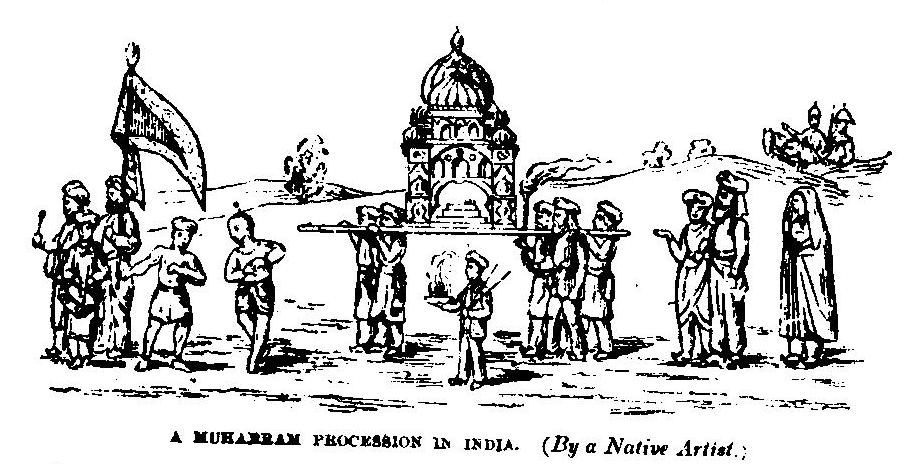
go about to each person at the height of his grief, with a piece of cotton in his hand, with which he carefully collects the falling tears, and which he then squeezes into a bottle, preserving them with the greatest caution. This practically illustrates that passage in the 56th Psalm, verse 8, "Put thou my tears into thy bottle, some Persians believe that in the agony of deaths when all medicines have failed, a drop of tears so collected, put into the mouth of a dying man, has been known to revive him; and it is for such use, that, they are collected.
On the Roz-i-Qatl, or day Of martyrdom, the tenth day. the Ambassador was invited by the King to be present at the termination of the ceremonies, in, which the death of al-Husain was to be represented. We set off after breakfast, and placed ourselves in a small tent, that was pitched for our accommodation over an arched gateway, which was situated close to the room in which His Majisty was to be seated.
We looked upon the great square which is in front of the palace, at the entrance of which we perceived a circle of Cajars, or people of the King's own tribe, who were standing barefooted, and beating their breasts in cadence to the chanting of one who stood in the centre, and with whom they now and then joined their voices in chorus. Smiting the breast is a universal act throughout the mourning; and the breast is made bare for that purpose, by unbuttoning the top of the shirt. The King, in order to show his humility, ordered the Cajars, among whom were many of his own 'relations, to walk about without either shoes or stockings, to super-intend the order of the different ceremonies about to be performed, and they were to be seen stepping tenderly over the stones, with sticks in their hands, doing the duties of menials, now keeping back a crowds then dealing out blows with their sticks, and settling the order of the processions.
Part of the square was partitioned was partitioned off by an enclosure, which was to represent the town of Karbala', near which al-Husain was
put to death; and close to this were two small tents, which were to represent his encampment in the desert with his family. A wooden platform covered with carpets, upon which the actors were to perform, completed all the scenery used on the occasion.
A short time after we had reached our tent, the King appeared, and although we could not see him, yet we were soon apprised of his presence by all the people standing up, and by the bowing of his officers. The procession then commenced as follows ;—First came a stout man, naked from the waist upwards, balancing in his girdle a long thick pole, surmounted by an ornament made of tin, curiously wrought with devices from Qur'an, in height altogether about thirty feet. Then another, naked like the former, balanced an ornamental pole in his girdle still more ponderous, though not so high, upon which a young darwesh resting his feet upon the bearer's girdle had placed himself, chanting verses with all his might in praise of the King. After him a person of more strength and more nakedness, a water carrier, walked forwards, bearing an immense leather sack filled with water slung over his back. This personage, we were told, was emblematical of the great thirst which al-Husain suffered in the desert.
A litter in the shape of a sarcophagus, which was called Qabr-i-Husain, or the tomb of al-Husain (a Ta'ziyah) succeeded, borne on the shoulders of eight men. On its front was a large oval ornament entirely covered with precious stones, and just above it, a great diamond star. On a small projection were two tapers placed on candlesticks enriched with jewels. The top and sides were covered with Cashmere shawls, and on
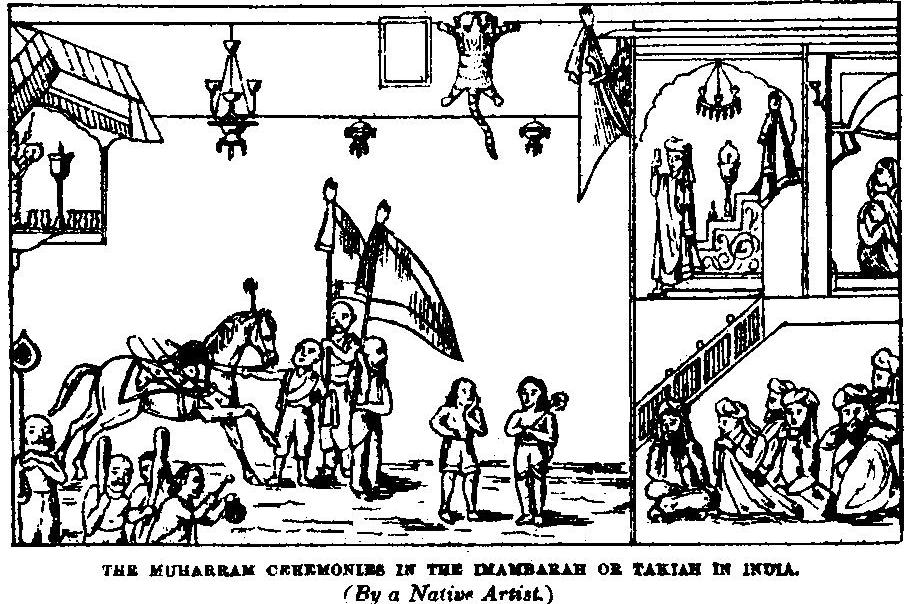
the summit rested a turban, intended to present the head-dress of the Khalifah. On each side walked two men bearing poles from which a variety of beautiful shawls were suspended.. At the top of which were representations of al-Husain a hand studded with jewelry.
After this came four led horses, caparisoned in the richest manner. The fronts of their beads were ornamented with plates, entirely covered with diamonds, that emitted a thousand beautiful rays. Their bodies were dressed with shawls and gold stuffs; and on their saddles were placed some objects emblematical of the death of al-Husain. When these had passed, they arranged themselves in a row to the right of the King's apartment. thrown over their naked bodies, marched forwards. They were all begrimed with blood; and each brandishing a sword, they sang a sort of a hymn, the tones of which were very wild. These represented the sixty-two relations, or the Martyrs, as the Persians call them, who accompanied al-Husain, and were slain in defending him. Close after them was led a white horse, covered with artificial wounds, with arrows stuck all about him, and caparisoned in black, representing the horse upon which al-Husain was mounted when he was killed. A band of about fifty men, striking two pieces of wood together in their hands, completed the procession. They arranged themselves in rows before the King, and marshalled by a maître de ballet, who stood in the middle to regulate their movements, they performed a dance clapping their hands in the best pos
sible time. The maître de ballet all this time sang in recitative, to which the dancers joined at different intervals with loud shouts and reiterated clapping of their pieces of wood.
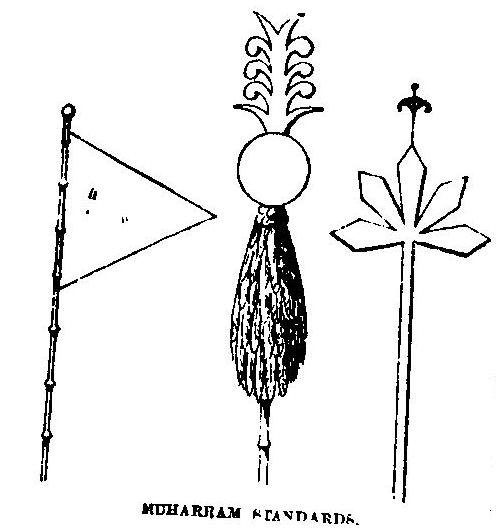
The two processions were succeeded by the tragedians. Al-Husain came forward, followed by his wives, sisters, and first relatives. They performed many long and
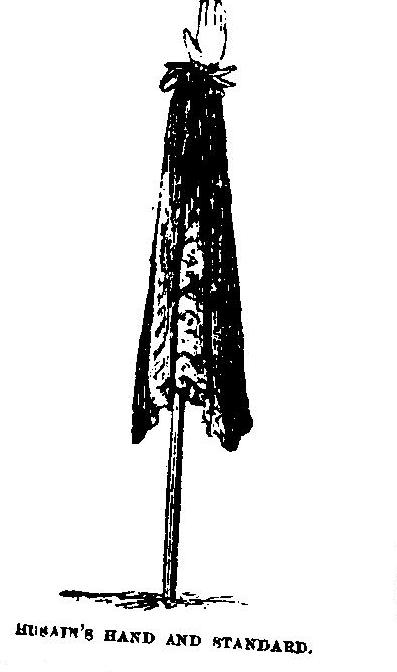
tedious acts; but as our distance from the stage was too great to hear the many affecting things which they, no doubt said to each other, we will proceed at once to where the unfortunate al-Husain lay extended on the ground, ready to receive the death-stroke from a villain dressed in armour, who acted the part of executioner. At this moment a burst of lamentation issued from the multitude, and heavy sobs and real tears came from almost every one of those who were near enough to come under our inspection. The indignation of the populace wanted some object upon which to vent itself, and it fell upon there of the actors who had performed the part of Yazid's soldiers. No sooner was al-Husain killed, than they were driven off the ground by a volley of stones, followed by shouts of abuse. We were informed that it is so difficult to procure performers to fill these characters, that on the present occasion a party of Russian prisoners were pressed into the army of Yazid, and they made as speedy an exit after the catastrophe as it was in their power.
The scene terminated by the burning of Karbala. Several reed huts and been constructed behind the enclosure before mentioned, which of a sudden were set on fire. The tomb of al-Husain was seen covered with black cloth, and upon it sat a figure disguised in a tiger's skin, which was intended to represent the miraculous lion, recorded to have kept watch over his remains after he had been buried. The most extraordinary part of the whole exhibition was the representation of the dead bodies of the martyrs; who having been decapitated, were all placed in a row, each body with a head close to it. To effect this, several Persians buried themselves alive, leaving the head out just above ground whilst, others put their heads under ground, leaving out the body. The heads and bodies were placed in such relative positions to each other as to make it appear that they had been severed. This is done by way of penance; but in hot weather, the violence of the execution has been known to produce death. The whole ceremony was terminated by a khutbah, or oration, in praise of al-Husain. (Morier's Second Journey through Persia.)
The martyrdom of Hasan and Husain is celebrated by the Shiahs all over India, during the first ten days of the month of Mohurrum Attached to every Shiah's house is an Imambarrah, a hall or inclosure built expressly for the celebration of the anniversary of the death of Husain. The enclosure is generally arcaded along its side, and in most instances it is covered in with a domed roof. Against the side of the Imambarrah, directed toward, Mecca, is set the tabut — also called tazia (ta'ziyah), or model of the tombs at Kerbela. In the houses of the wealthier Shiahs, these tabuts are fixtures and are beautifully fashioned of silver and gold, or of ivory and ebony, embellished all over with inlaid work. The poorer Shiahs provide themselves with a tabut made for the occasion of lath and plaster, tricked out in mica and tinsel. A week before the new moon of the Mohurrum, they enclose a space called the tabut khana in which the tabut is prepared: and
the very moment the new moon is seen, a spade is struck into the ground before "the enclosure of the tombs," when a pit afterwards dug, in which a bonfire is lighted, and kept burning through all the ten days of the Mohurrum solemnities. Those who cannot afford to erect a tabut khana, or even to put up a little tabut or taziah in their dwelling-house, always have a Mohurrum fire lighted, if it consist only of a night-light floating at the bottom of an earthen pot or basin sunk in the ground. It is doubtful whether this custom refers to the trench of fire Husain set blazing behind his camp, or is a survival from the older Ashura (ten days) festival, which is said to have been instituted in commemoration of the deliverance of Hebrew Arabs from Pharaoh and his host at the Red Sea; or from the yet more ancient Bael fire. But, in India, those Mohurrum fires, especially among the more ignorant populace, Hindus as well as Mohammedans, are regarded with the most superstitious reverence, and have a greater hold on them oven than the tabuts. All day long the passers by stop before the
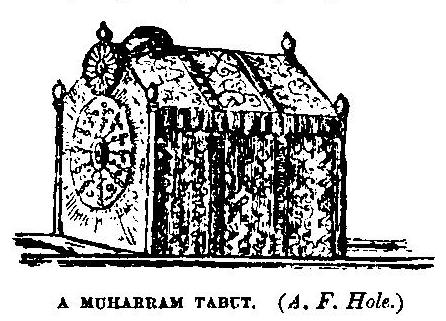
fires and make their vows over them, and all night long the crowds dance round them, and leap through the flames and scatter about the burning brands snatched from them. The tabut is lighted up like an altar, with innumerable green wax candles, and nothing can be more brilliant than the appearance of an Imambarrah of white stone, or polished white stucco, picked out in green, lighted up with glass chandeliers, sconces, and oil-lamps, arranged along the leading architectural lines of the building, with its tabut on one side, dazzling to blindness. Before the tabut are placed the "properties " to be used by the celebrants in the "Passion Play," the bows and arrows, the sword and spear, and the banners of Husain, &c.; and in front of it is set a movable pulpit, also made of the richest materials, and covered with rich brocade in green and gold. Such is the theatre in which twice daily during the first ten day's of the month of Mohurram, the deaths of the first martyrs of Islam are yearly commemorated in India. Each day has its special solemnity, corresponding with the succession of events during the ten days that Husain was encamped on the fetal plain of Kerbela: but the prescribed order of the services in the daily development of the greet Shiah function of the Mohurrum would appear not to be always strictly observed in Bombay (Polly's Miracle Play of Hasan and Husain, Preface, p. xvii.)
The drama, or "Miracle Play" which is recited in Persian during Moharram has been rendered into English by Colonel Sir Lewis Pelly, K..B. (Alln & Co.. 1879). from which we take the death scene of al-Hsain in the battle-field of Karbala, a scene which, the historian Gibbon (Decline and Fall, vol. ix. ch. 341) says, "in a distant age and climate, will awaken the sympathy of the coldest reader."
"Husain. — I am sore distressed at the unkind treatment received at the hands of the cruel heavens. Pitiful tyranny is exercised towards me by a cruel, unbelieving army! All the sorrows and troubles of this world have overwhelmed me! I am become a butt for the arrow of affliction and trouble. I am a holy bird stript of its quills and feathers by the hand of the archer of tyranny, and am become, O friends, utterly disabled, and unable to fly to my sacred next. They are going to kill are mercilessly, for no other crime or guilt except that I happen to be a prophet's grandson.
"Shimar (challenging him). — O Husain, why dost thou not appeal in the field? Why dost not thy majesty show thy face in battle? How long art thou going to sit still without displaying thy valour in war? Why dost thou not put on thy robe of martyrdom and come forth? If thou art indeed so magnanimous as not to fear death, if thou caveat not about the whistling sounds of the arrows when let fly from the bow, mount thou, quickly, thy swift horse named Zu'l janab, and deliver thy soul from so many troubles. Yea, come to the field of battle, be it as it may. Enter soon among thy women, and with tears bid them a last farewell; then come forth to war, and show us thy great fortitude.
"Husain (talking to himself). — Although the accursed fellow, Shimar, will put me to death in an hour's time, yet the reproachful language of the enemy seems to be worse than destruction itself. It is better that the foe should sever my head cruelly, from the body, than make me hear these abusive words. What can I do? I have no one left to help me, no Kasim to hold my stirrup for a minute when about to mount. All are gone! Look around if thou canst find anyone to defend the descendant of Muhammad, the chosen of God—if thou canst see any ready to assist the holy family of God's Prophet! In this land of trials there is no kind protector to have compassion on the household of the Apostle of God, and befriend them.
"Zainab. — May I be offered for the sad tones of thy voice, dear brother! Time has thrown on my head the black earth of sorrow. It has grieved me to the quick. Wait, brother, do not go till thy Kasim arrives. Have patience for a minute, my 'Ali Akbar is coming.
"Husain (looking around). — Is there one who wishes to please God, his Maker? Is
there any willing to behave faithfully towards his real friends? Is there a person ready to give up his life for our sake, to save us, to defend us in this dreadful struggle of Karbala?
"Zainab. —O Lord, Zainab's brother has no one to assist or support him! Occasions of his sorrows are innumerable, without anyone to sympathize with him in the least? Sad and desolate, he is leaning on his spear! He has bent his neck in a calamitous manner; he has no famous 'Ali Akbar, no renowned 'Abbas any more!
"Husain. — Is there anyone to pity our condition, to help us in this terrible conflict of Karbala? Is there a kind soul to give us a hand of assistance for God's sake?
"Zainah. — Brave cavalier of Karbala, it is not fitting for thee to be so hurried. Go a little more slowly; troubles will come quickly enough. Didst thou ever say thou hadst a Zainab in the tent? Is not this poor creature weeping and mourning for thee?
"The Imam Husain— Dear sister, thou rest of my disquieted, broken heart, smite on thy head and mourn, thou thousand noted nightingale. Today I shall be killed by ignoble Shimar. Today shall the rose turned out of its delightful spot by the tyranny of the thistle. Dear sister, if any dust happen to settle on the rose cheeks of my lovely daughter Sukainah, he pleased to wash away most tenderly with the rose-water thy tears? My daughter has been accustomed to sit always in the dear lap of her father whenever she wished to rest; for my sake, receive and caress her in thy bosom.
"Zainab. — O thou intimate friend of this assembly of poor afflicted strangers, the flaming effect of thy speech has left no rest to my mind. Tell me, what have we done that thou shouldest so reward us? Who is the criminal among us for whose sake we must suffer thus? Take us back, brother, to Madinah, to the sacred monument of our noble grandfather; let us go home, and live like queens in our own country.
"Husain. — O my afflicted, distressed, tormented sister, would to God there were a way of escape for me! Notwithstanding they have cruelly cut down the cypress-like stature of my dear son 'Ali Akbar; notwithstanding Kasim my lovely nephew tinged himself with his own blood; still they are intent to kill me also. They do not allow me to go back from Irak, nor do they let me turn elsewhere. They will neither permit me to go to India nor the capital of China. I cannot set out for the territory of Abyssinia, or take refuge in Zanzibar.
"Zainab. — Oh, how am I vested in my mind dear brother, on hearing these sad things! May I die, rather than listen to such affecting words any more! What shall we, an assembly of desolate widows and orphans, do after thou art gone? Oh! how can we live?
"Husain. — O miserable creature, weep not now, nor be so very much upset; thou shalt cry plentifully hereafter, owing to the wicked ness of time. When the wicked Shimar shall sever my head from the body; when thou shalt be made a captive prisoner, and forced to ride on an unsaddled camel; when my body shall be trampled under foot by the enemy's horses, and trodden under their hoofs; when my beloved Sukainah shall be so cruelly struck by Shimar, my wicked murderer; when they shall lead thee away captive front Karbala to Shsm and when they shall make thee and others live there in a horrible, ruined place; yes., when thou shalt see all this then thou mayest, and verily wilt, cry. But I admonish thee, sister, since this sad case has no remedy but patience, to resign the whole matter, submissively, to the Lord, the good Maker of all! Mourn not for my misfortune, but bear it patiently, without giving occasion to the enemy to rejoice triumphantly on this account, or speak reproachfully concerning us.
"Kulsum. — thou struttest about gaily, O Husain, thou beloved of my heart. Look a little behind thee; see how Kulsum is sighing after thee with tearful eyes! I am strewing pearls in thy way, precious jewels from the sea of my eyes! Let me put my head on the hoof of thy winged steed, Zu'l janab.
Husain. — Beloved sister, kindle not a fire to my heart by so doing take away thy head from under the hoof of my steed. O thousand-noted nightingale, sing not such a sad-toned toned melody. I am going away; be thou thou kind keeper of my helpless ones.
"Kulsum.- Behold what the heavens have at length brought on me! What they have done also to my brother! Him they have made to have parched lips through thirst, and me they have caused to melt into water, and gush out like tears from the eyes! Harah severity is mingled with tyrannous cruelty.
"Husain. — Trials, afflictions, the thicker they fall on man, the better, dear sister, do they prepare him, for his journey heavenward. We rejoice in tribulations, seeing they are but temporary, and yet they work out an eternal and blissful end. Though it is predestined that I should suffer martyrdom in is predestined that I should suffer martyrdom in this shameful manner, yet. the treasury of everlasting happiness shall be at my disposal as a consequent reward. Thou must think of that, and be no longer sorry. The dust raised in the field of such battles is as highly esteemed by me, O sister, as the philosopher's stone was, in former times, by the alchemists; and the soil of Karbala is the sure remedy of my inward pains.
"Kulsum. May I be sacrificed for thee? Since this occurrence is thus inevitable; I pray thee describe to thy poor sister Kulsum her duty after thy death. Tell me, where shall I go, or in what direction set my face? What am I to do? And which of thy orphan children am I to caress most?
Husain. Show thy utmost kindness, good sister, to Sukainah, my darling girl, for the pain of being fatherless, is most severely felt by children too much fondled by their parents, especially girls. I have regard to
all my children, to be sure, out I love Sukainah most.
"An old Female Slave of Husain's mother. — Dignified master, I am sick and weary in heart at the bare idea of separation from thee. Have a kind regard to me, an old slave, much stricken with age. Master, by thy soul do 1 swear that I am altogether weary of life. I have grown old in thy service; pardon me, please, all the faults ever committed by me.
"Husain.—Yes. thou hast served us, indeed, for a very long time. Thou hast shown much affection and love toward me and my children. O handmaid of my dear mother Fatimah; thou hast verily suffered. much in out house how often didst thou grind corn with thine own hand for my mother! Thou bast also dandled Husain most caressingly in thy arms. Thou art black-faced, that is true, but thou hast, I opine, a pure white heart, and ant much esteemed by us. To-day I am about to leave thee, owing thee, at the same time, innumerable thanks for the good services thou hast performed; but I beg thy pardon for all inconsiderate actions on my part.
"The Maid. — May I be a sacrifice for thee, thou royal ruler of the capital of faith! turn not my days black, like my face, thou benevolent master. Truly I have had many troubles on thy behalf. How many nights have I spent in watchfulness at thy cradle! At one moment I would caress thee in my arms, at another I would fondle thee in my bosom. I became prematurely old by my diligent service, O Husain! Is it proper now that thou shouldst put round my poor neck the heavy chain of thy intolerable absence? Is this, dear master. the reward of the services I have done thee?
"Husain. —Though thy body, O maid, is now broken down by age and infirmity, yet thou hast served us all the days of thy life with sincerity and love; thou must knew, therefore, that thy diligence and vigilance will never be disregarded by us. Excuse me today, when I am offering my body and soul in the cause of God, and cannot help thee at all; but be sure I will fully pay the reward of thy services in the day of universal account.
"The Maid. .-Dost thou remember, good sir, how many troubles I have suffered with thee for the dear sake of 'Ali Akbar, the light of thine eyes? Though I have not suckled him with my own breasts, to be sure, yet I laboured hard for him till he reached the age of eighteen years and came here to Karbala. But, alas! dear flourishing Ali Akbar has been this day cruelly killed—what a pity! and I strove so much for his sake, yet all, as it were, in vain. Yes, what a sad loss!
"Husain. - Speak not of my 'Ali Akbar any more, O maiden, nor set fire to the granary of my patience and make it flame. (Turning to his sister.) Poor distressed Zainab, have the goodness to be kind always to my mother's old maid, for she has experienced many troubles in our family; she has laboured hard in training 'Ali Akbar my son.
"Umm Lailah (the mother of 'Ali Akbar). — The elegant stature of my Akbar fell on the ground like, as a beautiful cypress tree it was forcibly felled! Alas for the memory of thy upright stature! Alas, O my youthful of handsome form and appearance! Alas my troubles at night-time for thee! How often did I watch thy bed, singing lullabies for thee until the morning! How sweet is the memory of those times! yea, how pleasant the very thought of these days! Alas, where art thou now, dear child? O thou who art ever remembered by me, come and see thy mother a wretched condition, come!
"Husein. — O Lord, why is this mournful voice so affecting? Methinks the owner of it, the bemoaning person, has a flame in her heart. It resembles the doleful tone of a lapwing whose wings are burned! like as when a miraculous lapwing, the companion of Solomon the wise, the king of God's holy people received intelligence suddenly about the death of its royal guardian!
"Umm Lailah. — Again I am put in mind of try dear son of my heart, melted into blood, poar thyself forth! Dear son, whilst thou wast alive, I had some honour and respect, everybody had some regard for me; but since thou art gone, I am altogether abandoned. Woe be to me! woe be to me! I am despised and rejected. Woe unto me! woe unto me!
"Husain. — Do not set fire to the harvest of my soul any further. Husain is, before God, greatly ashamed of his shortcomings towards thee. Come out from the tent, for it is the last meeting previous to separating from one another for ever; thy distress is an additional weight to the heavy burden of my grief.
"The Mother of 'Ali Akbar. — I humbly state it, O glory of all ages, that I did not expect from thy saintship that thou wouldest disregard thy handmaid in such a way. Thou dost show thy kind regard and favour to all except me. Dost thou not remember my sincere services done to thee? Am I not by birth a descendant of the glorious kings of Persia, brought as a captive to Arabia when the former empire fell and gave place to the new-born monarchy of the latter kingdom? The Judge, the living Creator, was pleased to grant me an offspring, whom, we called 'Ali Akbar, this day lost to us for ever. May I be offered for thee! While 'Ali Akbar my son was alive, I had indeed a sort of esteem and credit with the; but view that my cypress, my newly sprung up cedar, is am justly felled, I have fallen from credit too, and must therefore shed tears.
"Husain. — Be it known unto thee, O thou violet of the flower-garden of modesty, that thou art altogether mistaken. I swear by the holy enlightened dust of my mother Zahrah's grate, that thou art more honourable and dearer now than ever. 1 well remember the affectionate recommendations of 'Ali Akbar
our son, concerning thee. How much he was mindful of thee at the moment of his speaking! How tenderly he cared for thee, and spoke concerning thee to every one of his family.
"'Ali Akbar's Mother. O gracious Lord! I adjure thee, by the merit of my son 'Ali Akbar, never to lessen the shadow of Husain from over my head. May no one ever be in my miserable condition —never be a desolate, homeless woman, like me!
"Husain. — O thou unfortunate Zainab, my sister, the hour of separation is come! The day of joy is gone for ever! The night of affliction has draw near! Drooping, withering sister, yet most blest in thy temper, I fear to make known.
"Zainab. - May I be a sacrifice for thy heart, thou moon-faced, glorious sun! there is nobody here, if thou hast a private matter to disclose so thy sister.
"Husain. — Dear unfortunate sister, who art already severely vexed in heart, if I tell thee what my request is, what will be thy condition then ? Though I cannot restrain myself from speaking, still I am in doubt as to which is better, to speak, or to forbear.
"Zainab. — My breast is pierced! My heart boils within me like a cauldron, owing to this thy conversation. Thou son! of thy sister, hold not back from Zainab what thou hast in thy mind.
"Husein. —— My poor sister, I am covered with shame before thee, I cannot lift up my head. Though the request is a trifle, yet I know it is grievous to thee to grant. It is this: bring me an old, dirty, ragged garment to put on. But do not ask me, I pray thee, the reason why, until I myself think it proper to tell thee.
"Zainab. —I am now going to the tent to fetch thee what thou seekest; but I am utterly astonished, brother, as to why thou dost want this loathsome thing. (Returning in a tattered shirt.) Take it, here, is the ragged robe for which thou didst ask. I wonder what thou wilt do with it.
"Husain.—Do not remain here, dear sister. Go for awhile to thine own tent; for if thou see that which I am about to do, thou wilt he grievously disturbed. Turn to thy tent, poor miserable sister, listen to what I say, and leave me, I pray thee, alone.
"Zainab (going away). — I am gone, but I am sorry I cannot tell what this enigma means. It is puzzling indeed! Remain thou with thy mysterious cost. O Husain! May all of us be offered as a ransom for thee, dear brother. Thou art without any to assist or befriend thee! Thou art surrounded by the wicked enemy! Yes, thy kind helpers have all been killed by the unbelieving nation!
"Husain. (putting on the garment). — The term of life has no perpetual duration in itself. Who ever saw in a lower garden a rose without its thorn! I will put on his old robe close to my skin, and place over it my new apparel, though neither the old nor the of this world can be depended on. I hope Zainab has not been observing what I have been doing, for poor creature, she can scarcely bear the sight of any such like thing.
"Zainab. — Alas! I do not know what is the matter with Husain my brother. What has an old garment to do with being a king? Dost thou desire, O Husain, that the enemy should come to know this thing and reproach thy sister about it? Put off, I pray thee, this old ragged garment, otherwise I shall pull off my head-dress, and uncover my head for shame.
"Husain. — Rend not thy dress, modest sister, nor pull off thy head-covering. 'There is a mystery involved in my action. Know that what Husain has done has a good meaning in it. His putting on an old garment is without its signification.
"Zainab. — What mystery can be in this work, thou perfect high priest of faith? I will never admit any until thou shalt have fully explained the thing according to my capacity.
"The Imam. — Today, dear sister, Shimar will behave cruely towards me. He will sever my dear head from the body. His dagger not cutting my throat, he will be obliged to sever my head from behind. After he has killed me, when he begins to strip me of my clothes, he may perchance be ashamed to take off this ragged robe and thereby leave my body naked on the ground.
"Zanaib. — O Lord, have mercy on my distracted heart! Thou alone art aware of the state of my mind. Gracious Creator, preserve the soul of Hussain! Let not heaven pull down my house over me!
"Sakainah. — Dear father, by our Lord it is a painful thing to be fatherless; a misery, a great calamity to be helpless, bleeding in the heart, and an outcast! Dismount from the saddle, and make me sit by thy side. To pass over me or neglect me at such a time is very distressing. Let me put my head on thy deer lap. O father. It is sad thou shouldst not be aware of thy dear child's condition.
"Husain. — Bend not shy neck on one side, thou my beloved child, nor weep so sadly, like an orphan. Neither moan so melodiously, like a. disconsolate nightingale. Come, lay thy dear head on my knees once more, and shod not so copiously a flood of tears from thine eyes, thou spirit of my life.
"Sukainah. - Dear father, thou whose lot is but grief, have mercy on me, mercy! O thou my physician in every pain and trouble, have pity on me! have pity on me! Alas, my heart, for the mention of the word separation! Alas, my grievance, for what is unbearable!
"Husain. - Groan not, wail not, my dear Sukainah, my poor oppressed, distressed girl. Go to thy tent and sleep soundly in thy bed until thy father gets thee some water to drink.
"Zainab. — Alas! Alas! woe to me! my Husain is gone from me! Alas! Alas! The arrow of my heart is shot away from the hand! Woe unto me, a thousand woes! I am to remain without Husain! The wor-
shipper of truth is gone to meet his fate with a blood-stained shroud!
"Husain. — My disconsolate Zainab, be not impatient. My homeless sister, show not thyself so fretful. Have patience, sister, the reward of the patient believers is the best of all. Render God thanks, the crown of intercession is fitted for our head only.
"Zainab. — O my afflicted mother, thou best of all women, pass a minute by those in Karbala see thy daughters prisoners of sorrow! behold them amidst strangers and foreigners. Come out awhile from thy pavilion in Paradise, O Fatimah, and weep affectionately over the state of us, thy children.
"Husain. — I have become friendless and without any helper, in a most strange manner. I have lost my troop and army in a wonderful way. Where is Akbar my son? let him come to me and hold the bridle of my horse, that I may mount. Where is Kasim my nephew? will he not help me and get ready m stirrup to make me cheerful? Why should I not shed much blood from mine eyes, seeing I cannot behold 'Abbas my standard-bearer? A brother is for the day of misfortune and calamity! A brother is better than a hundred diadems and thrones! A brother is the essence of life in the world! Its who has a brother, though he be old, yet is young. Who is there to bring my horse for me? there is none. There is none even to weep for me in this state of misery!
"Kulsum. — Because there is no 'Ali Akbar, dear brother, to help thee, Zainab, thy sister will hold the horse for thee; and seeing 'Abbas, thy brother, is no longer to be found, I myself will bear the standard before winged steed instead of him.
"Zainab. —— Let Zainab mourn bitterly for her brother's desolation. Who ever saw a woman, a gentlewoman, doing the duty of a groom or servant? Who can know, O Lord, besides Thee, the sad state of Husain in Karbala, where his people so deserted him that a woman like myself is obliged to act as a servant for him.
" Kulsim. — I am a standard-bearer for Husain, the martyr of Karbala, O Lord God, I am the sister of 'Abbas; yea, the miserable sister of both. O friends, it being the tenth day of Muharram, I am therefore assisting Husain. I am bearing the ensign for him instead of 'Abbas my brother, his standard-bearer.
"Zainab. — Uncover your breasts a minute. O ye tear-shedding people, for it is time to beat the drum, seeing the king is going ride. O Solomon the Prophet, where is thy glory? what has become of thy pompous retinue? Where are thy brothers, nephews and companions?
"Husain. - There are none left to help me. My sister Zainab holds the bridle of the horse and walks before me. Who ever saw a lady acting thus?
"Zainab. — Thou art going all alone the souls of all be a ransom for thee! May thy departure make souls quit bodies! A resurrection will be produced in thy tent by the cry of orphans and widows.
"Husain —Sister or, though it grieves me to go, yet I do it ; peradventure I may see the face of Ashgar and the countenance of Akbar, those cypresses, those roses of Paradise.
"Zainab — Would to God Zainab had died I this very minute before thy face, in thy sight, that she might not behold such elegant bodies, such beautiful forms, rolling in their own blood
"Husain. — O poor sister, if thou die here in this land in that sudden, way that thou desirest, then who all will ride it thy stead, in the city of Kufah, on the camel's back?
"Zainab. — Slight not my pain, dear brother, for Zainab is somewhat alarmed as to the import of thy speech. What shall I do with thy family—with the poor widows and young children?
"Husain. – O afflicted one, it is decreed I should be killed by means of daggers and swords; henceforth, dear sister, thou shalt not see me. Behold, this is separation between me and thee.
"The nephew of Husain. — Dear uncle, thou hast resolved to journey. Thou art going once again to make me an orphan. To whom else wilt thou entrust us? Who is expected to take care of us? Thou wast, dear uncle instead of my father Hasan, a defence to this helpless exiled creature.
"Husain. — Sorrow not, thou faithful child, thou shalt be killed too in this plain of trials. Return thou now to thy tent in peace, without grieving my soul any further, poor orphan!
"The Darwish from Kabul. — O Lord God, wherefore is the outward appearance of a man of God usually without decoration or ornament? And why is the lap if the man of this world generally full of gold and jewels? On what account is the pillow of this great. person the black dust of the road? and for what reason are the bed and the cushion of the rebellions made of velvet and stuffed with down? Either Islam, the religion of peace and charity, has no true foundation in the world, or this young man, who is so wounded and suffers from thirst, is still an infidel.
"Husain. — Why are thine eyes pouring down tears young darwish? Hast thou also lost an Akbar in the prime of his youth? Thou art immersed, as a water-fowl, in thy tears. Has thine Abbas been slain, thirsting, on the bank of the River Euphrates, that thou cryest so piteously? But if thou art sad only on account of my misfortune, then it matters not. Let me know whence comest thou, and whither is thy face set?
"The Darwish. — It happened, young man, that last night I arrived in this valley, and made my lodging there. When one-half of the night had passed, of a sudden a great difficulty befell me, for I heard a child bemoaning and complaining of thirst, having given up altogether the idea of living any longer in this world. Sometimes it would beat its head and cry out for water; at other times it appeared to fall on the ground, fainting and motionless. I have, therefore, brought
some water in this cup for that poor child, that it may drink and be refreshed a little. So I humbly beg thee, dear sir, to direct me to the place where the young child may be found and tell me what is its name.
"Husuin. — O God, let no man be ever in my pitiful condition, nor any family in this sad and deplorable state to which I am reduced. O young man, the child mentioned by thee is the peace of my troubled mind; it is my poor, miserable little girl.
"The Darwish..—May I be offered for thee, dear sir, and for thy tearful eyes! Why should thy daughter be so sadly mourning and complaining? My heart is overwhelmed with grief for the abundance of tears running down thy cheeks. Why should the daughter of one like thee, a generous soul, suffer from thirst?
"Husain. — Know, O young man, that. we are never in need of the water of this life. Thou art quite mistaken if thou host supposed us to be of this world. If I will, I can make the moon, or any other celestial orb, fall down on the earth; how much more can I get water for my children. Look at the hollow made in the ground with my spear; water would gush out of it if I were to like. I voluntary die of thirst to obtain a crown of glory from God. I die parched, and offer myself a sacrifice for the sins of my people, that they should be saved from the wrath to come.
"The Darwish. — What is thy name, sir? I perceive that thou art one of the chief saints of the most beneficent God. It is evident to me that thou art the brightness of the Lord's image, but I cannot tell to which sacred garden thy holy rose belongs.
"Husain. — O darwish, thou wilt so be informed of the whole matter, for thou shalt be a martyr thyself; for thy planes and the result thereof have been revealed to we. Tell me, O darwish, what is the end thou hast in view in this thy hazardous enterprise? When thou shalt have told me that, I will disclose to thee who I am.
"The Darwish.. — I intend, noble sir, after have known the mystery of thy affairs, to set out, if God wills, from Karbala to Najaf. namely, to the place where 'Ali, the highly exalted king of religion, the sovereign lord of the empire of existence, the supreme master of all the darwishes, is buried. Yea, I am going to visit the tomb of 'Ali, the successor of the chosen of God, the son-in-law of the Prophet, the lion of the true Lord, the prince of believers, Haidar, the champion of. faith.
"Husain. — Be it known unto the O darwish, that I, who am so sad and sorrowful, am the rose of the garden of that prince. I am of the family of the believers thou hast mentioned. I am Husain, the intercessor on the Day of Resurrection, the rose of the garden of glory.
"The Darwish. — May I be offered a sacrifice for thy blessed arrival! Pardon me any fault, and give me permission to fight the battle of faith, for I am weary of life. It is better for me to be killed, and delivered at once from so many vexatious of spirit. Martyrdom is, in fact, one of the glories of my faith.
"Husain. — Go forth, O atom, which aspirest to the glory of the sun: go forth, thou hast become at last worthy to know the hidden mysteries of faith. He who is slain for the sake of Husain shall have on abundant reward from God; yea, he shall be raised to life with 'Ali Akbar the sweet sort oh Husain.
"The Darwish. (addressing Husain's antagonists) - you cursed people have no religion at all. You are fire-worshippers, ignorant of God and his law. How long will you act unjustly towards the offspring of the priesthood? Is the account of the Day of Resurrection all false?
"Ibn Sa'd, (The general of Yazid's army).— O ye brave soldiers of Yazid, deprive this fellow of his fund of life. Make his friends ready to mourn for him.
"Husain - Is there anyone to help me? Is there any assistant to lend me his aid?
"Ja'far (the king of jinns, with his troops, coming to Husain's assistance). .— O king of men and jinns, O Husain, peace be on thee! O judge of corporeal and spiritual beings, peace be on thee!
"Husain. .— On thee be peace, handsome youth! Who art thou, that salutest us at such a time? Though thine affairs are not hidden from me at all, still it is advisable to ask thy name.
Ja'far. — O lord of man and jinns. I am the least of thy servants, and my name is Ja'far, the chief ruler of all the tribes of jinns. Today, while I was sitting on the glorious throne of my majesty, easy in mind, without any sad idea of thought whatever. I suddenly heard thy voice, when thou didst sadly implore assistance: and on hearing thee I lost my patience and senses. And, behold. I have come out with troops of jinns, of various abilities and qualifications, to lend thee help if necessary.
"Husain. — In the old abbey of this perishable kingdom, none can ever, O Ja'far, attain to immortality. What can I do with the empire of the world, or its tempting glories, after my dear ones have all died and gone? It is proper that I, an old man, should live, and Akbar, a blooming youth, die in the prime of age? Return thou, Ja'far, to thy home and weep for me as much as thou canst.
Ja'far (returning).,.— Alas for Hasain's exile and helplessness! Alas for his continual groans and sighs!
"Husain (coming back from the field, dismounts his horse, and making a heap of dust, lays his head on it). O earth of Karbala, do thou assist me, I pray! since I have no mother, he thou to me instead of one.
"Ibn Sa'd orders the army to stone Husain, — O ye men of valour, Husain the son of 'Ali has tumbled down from the winged horse if I be not mistaken, heaven has fallen to earth! It is better for you to stone him most cruelly. Dispatch him soon, with stones, to his companions.
Husain — Ah, woe to me! my forehead is broken; blood runs down my luminous face.
"Ibn Sa'd.—Who is that brave shoulder, who, in order to show his gratitude to Yazid his sovereign lord, will stop forward and, with a blow of his soymetar, slay Hussain the son of 'Ali?
"Shimar. — I am he whose dagger is famous for bloodshed. My mother has borne me for this work alone. I care not about the conflict of the Day of Judgment; I am a worshipper of Yazid, and have no fear of God. I can make the great throne of the Lord to shake and tremble, I alone can sever from the body the head of 'Usman the son of 'Ali. I am he who has no share in Islam I will strike the chest of Husain, the ark of God's knowledge, with my boots without any fear of punishment.
"Husain. — Oh, how wounds caused by arrows and daggers do smart O God, have mercy in the Day of Judgment on my people for my sake. The time of death has arrived, but I have not my Akbar with me. Would to God my grandfather the Prophet were now here to see me!
"The Prophet (appearing). — Dear Husain, thy grandfather the Prophet of God has come to see thee. I am here to behold the mortal wounds of thy delicate body. Dear child, thou hast at length suffered martyrdom by the cruel hand of my own people! This was the reward I expected from them thanks be to God! Open thine eyes, dear son, and behold thy grandfather with dishevelled hair. If thou hast any desire in thy heart, speak out to me.
"Husain. — Dear grandfather, 1 abhor life; I would rather go and visit my dear ones in the next world. I earnestly desire to see my companions and friends — above all, my dearly beloved son 'Ali Akbar.
"The Prophet. — Be not grieved that 'Ali Akbar thy son was killed, since it tends to the good of my sinful people on the day of universal gathering.
"Husain.—Seeing 'Ali Akbar's martyrdom contributes to the happiness of thy people, seeing my own sufferings gave validity to thy office of mediation, and seeing thy rest consists in my being troubled in this way, I would offer my soul, not once or twice, but a thousand times, for the salvation of thy people!
"The Prophet. — Sorrow not, dear grand-child; thou shalt be a mediator, too, in that day. At, present thou art thirsty, but tomorrow thou shalt be the distributor of the water of Al Kausar.
"Husain. — O Lord God, besides Husain, who has happened to be thus situated? Every one when he dies has at least a mother at his head. But my mother is not here to rend her garments for me; she is not alive, that she might close my eyes when I die.
"Fatimah, his mother (appearing). — I am come to see thee, my child, my child! May I die another time, my child, my child! How shall I see thee slain, my son, my son! Rolling in thine own blood, my child, my child!
Husain. — Come, dear mother. I am anxiously waiting for thee. Come, come! I base partly to complain of thee. How is it that thou hast altogether forsaken thy son? How is it thou, camest so late to visit me?
Fatimah. May I be offered for thy wounded, defaced body! Tell me, what dost thou wish thy mother to do now for thee?
"Husain. — I am now, dear mother, at the point of death. The ark of life is going to be cast on shore, mother. It is time that my soul should leave the body. Come, mother, close my eyes with thy kind hand.
"Fatima - O Lord, how difficult for a mother to see her dear child dying! I am Zahrab who am making this sad noise, because I have to close the eyes of my son Husain, who is on the point of death. Oh, tell me if thou hast any desire long cherished in thy heart, for I am distressed in mind owing to thy sad sighs!
"Husain. — Go, mother, my soul is come to my throat; go, I had no other desire except one, with which I must rise in the Day of Resurrection, namely, to see 'Ali Akbar's wedding.
"Shimar. — Make thy confession, for I want to sever thy head, and cause a perpetual separation between it and the body.
"Zainab — O Shimar do not go beyond thy limit; let me bind something on my brother's.
"Husain. — Go to thy tent, sister, I am already undone. Go away; Zahrah my mother has already closed my eyes. Show to Sukainah my daughter always the tenderness of a mother. Be very kind to my child utter me.
"Shimar (addressing Husain). — Stretch forth thy feet toward the holy Kiblah, the sacred temple of Makkah. See how my dagger waves over thee! It is time to cut thy throat.
"Husain. — O Lord, for the merit of me, the dear child of thy Prophet; O Lord, for the sad groaning of my miserable sister; O Lord, for the sake of young 'Abbas rolling in his blood, oven that young brother of mine that was equal to my soul, I pray thee, in the Day of Judgment. forgive, O merciful Lord, the sins of my grandfather's people, and grant me, bountifully, the key of the treasure of intercession. (Dies.)" — (Pelly's Miracle Play, vol. ii. p. 81 seqq.)
MUHARRAMAT.
 .
pl. of Muharramah. Those persons with whom it is not lawful to contract marriage. [MARRIAGE.]
.
pl. of Muharramah. Those persons with whom it is not lawful to contract marriage. [MARRIAGE.]
MUHAYAT.
 .
A legal term used for the partition of usufruct. According to the Hidayah, vol. iv. 31:—
.
A legal term used for the partition of usufruct. According to the Hidayah, vol. iv. 31:—
Partition of property is more effectual than partition of usufruct in accomplishing the employment of the use; for which reason, if one partner apply for a partition of property, and another for a partition of usufruct, the Qasi must grant the request of the former, and if a partition of usufruct should have taken place with respect to a thing capable
of a partition of property (such as a house or a piece of ground), and afterwards one of the partners apply fore partition of property, the Qazi must grant a partition of property and annul the partition of usufruct.
MUHAZARAH.
 .
Lit. "Being present." A. term used by the Sufis for presenting of the soul to God in the service of zikr in order to obtain all the spiritual blessing possible from a contemplation of the ninety-nine attributes and titles of God. [ZIKR, GOD.]
.
Lit. "Being present." A. term used by the Sufis for presenting of the soul to God in the service of zikr in order to obtain all the spiritual blessing possible from a contemplation of the ninety-nine attributes and titles of God. [ZIKR, GOD.]
MUHRIM.
 .
The pilgrim in a state of Ihram, that is, after he has assumed the pilgrim's dress. [PILGRIMAGE.]
.
The pilgrim in a state of Ihram, that is, after he has assumed the pilgrim's dress. [PILGRIMAGE.]
AL-MUHSI.
 .
"The Counter." One of the ninety-nine names or attributes of God. "It is referred to in the Qur'an, Surah xxxvi. 11: "Verily We .quicken the dead and write down what they have done before, and the traces which they leave behind, and everything do We set down (lit. reckon up) in the clear Book of our decrees."
.
"The Counter." One of the ninety-nine names or attributes of God. "It is referred to in the Qur'an, Surah xxxvi. 11: "Verily We .quicken the dead and write down what they have done before, and the traces which they leave behind, and everything do We set down (lit. reckon up) in the clear Book of our decrees."
MUHTAKIR.
 .
Lit. "A forestaller." One who monopolises grain and other necessaries of life, which is unlawful. [MONOPOLY.]
.
Lit. "A forestaller." One who monopolises grain and other necessaries of life, which is unlawful. [MONOPOLY.]
MUHTASIB.
 .
The public censor of religion and morals, who is appointed by a Muslim ruler to punish Muslims for neglecting the rites of their religion.
.
The public censor of religion and morals, who is appointed by a Muslim ruler to punish Muslims for neglecting the rites of their religion.
Sir Alexander Burnes, in his Travels in Bokhara (vol. i. p. 313), relates that tie saw persons publicly scourged because they had slept during prayer-time and smoked on Friday. [DIRRAH.]
Burckhardt, in his account of the Wahhabis (vol. ii p. 146), says, the neglect of religious duty is always severely punished. When Sa'ud took al-Madinah, he ordered some of his people after prayers in the mosque to call over the names of all the grown up inhabitants of the town who were to answer individually. He then commanded them to attend prayers regularly; and if any, one absented himself two or three times, Sa'ud sent some of his Arabs to beat the man in his own house. At Makkah, when the hour of prayer arrived, he ordered the people to patrol the streets, armed with large sticks, and to drive all the inhabitants by force into the mosque; a harsh proceeding, but justified by the notorious irreligion of the Makkans.
Dr. Bellow, in his Kashmir and Kashgar (p. 281), gives an animated account of the way in which the Mubtasib performed his duties in the streets of Kashgar.
AL-MUHYI.
 .
"The giver of life." One of the ninety-nine names or attributes of God. It occurs twice in the Qur'an:-
.
"The giver of life." One of the ninety-nine names or attributes of God. It occurs twice in the Qur'an:-
Surah xxx. 49: "Look then to the vestiges of God's mercy, how he quickens the earth after its death; verily He is the quickener of the dead."
Surah xii. 39: "Verily, no who quicker (the earth) will surely quicken the dead."
AL-MU'ID.
 .
"The Restorer" (to life). One of the ninety-nine names or attributes of God. The word does not occur in the Qur'an, but the idea is expressed in Surah lxxxv. 13, and many other places, "Verily He produces and restores."
.
"The Restorer" (to life). One of the ninety-nine names or attributes of God. The word does not occur in the Qur'an, but the idea is expressed in Surah lxxxv. 13, and many other places, "Verily He produces and restores."
AL-MU'IZZ.
 .
"The One who giveth honour" One of the ninety-nine names or attributes of God. The word does not occur in the Qur'an, but the attribute is referred to in Surah iii. 25: "Thou honourest whom Thou pleasest."
.
"The One who giveth honour" One of the ninety-nine names or attributes of God. The word does not occur in the Qur'an, but the attribute is referred to in Surah iii. 25: "Thou honourest whom Thou pleasest."
AL-MUJADILAH.
 .
"She who disputed." The title of the LVIIIth Surah of tbe Qur'an, in which the expression occurs: "Now hath God heard use speech of her who disputed with thee concerning her husband." Which refers to Khaulah bint Sa'labah, the wife of Aus ibn Samit, who being divorced by her husband in the "time of ignorance" came to ask whether the divorce was lawful,
.
"She who disputed." The title of the LVIIIth Surah of tbe Qur'an, in which the expression occurs: "Now hath God heard use speech of her who disputed with thee concerning her husband." Which refers to Khaulah bint Sa'labah, the wife of Aus ibn Samit, who being divorced by her husband in the "time of ignorance" came to ask whether the divorce was lawful,
MUJAHID.
 .
A warrior in the cause of religion. [JIHAD.]
.
A warrior in the cause of religion. [JIHAD.]
AL-MUJIB.
 .
"The One who answers to" (a. prayer). One of the ninety-nine names or attributes of God. It occurs in the Qur'an. Surah xi. 64: "Verily my Lord is nigh and answers" (prayer).
.
"The One who answers to" (a. prayer). One of the ninety-nine names or attributes of God. It occurs in the Qur'an. Surah xi. 64: "Verily my Lord is nigh and answers" (prayer).
MU'JIZAH.
 .
[MIRACLES.]
.
[MIRACLES.]
MUJTAHID.
 .
pl. mujtahidun. Lit., "One who strives" to attain to a high position of scholarship and learning.
.
pl. mujtahidun. Lit., "One who strives" to attain to a high position of scholarship and learning.
The highest degree amongst Muhammadan divines which is conferred either by the people or the ruler of a Muslim country upon eminent persons. The four doctors of the Sunnis and their disciples were of this degree, but there are none of these enlightened teachers amongst the Sunnis of the present day. They still exist in Persia, and are appointed by the people, the appointment being confirmed by the king. Malcolm, in his account of Persia, says :—
"There are seldom more than three or four priests of the dignity of Mujtahid in Persia. Their conduct is expected to be exemplary, and to show no worldly bias; neither must they connect themselves with the king or the officers of Government. They seldom depart from that character to which they owe their rank. The reason is obvious: the moment they deviate, the charm is broken which constitutes their power; men no longer solicit their advice or implore their protection; nor can they hope to see the monarch of the country courting popularity by walking to their humble dwellings, and placing them on the seat of honour when they condescend to visit his court. When Mutjtahid dies, his successor is always a person of the most eminent rank in the ecclesiastical order; and, though he may be pointed out to the popu-
lace by others of the same class seeking him as-an associate, it is rare to hear of any intrigues being employed to obtain this enviable dignity.
The Mujtahids of Persia exercise a great though undefined, power over the courts of law, the judges of which constantly submit cases to their superior knowledge; and their sentence is deemed irrevocable, unless by a Mujtahid whose learning and sanctity are of acknowledged higher repute than that of the person by whom judgment has been pronounced. But the benefits which tic inhabitants of Persia derive from the influence of these high priests, is not limited to their occasional aid of the courts of justice. The law is respected on account of the character of its ministers; kings fear to attack the decrees of tribunals over which they may be said to preside, and frequently endeavour to obtain popularity by referring cases to their decision. The sovereign, when no others dare approach him, cannot refuse to listen to a revered Mujtahid when he becomes an intercessor for the guilty. The habitations of this high order of priesthood are deemed sanctuaries for the oppressed; and the hand of despotic power is sometimes taken off a city, because the monarch will not offend a Mujtahid who has chosen it for his residence, but who refuses to dwell amid violence and injustice."
There is a common opinion that the title of if Mujtahid can only be granted to those who are masters of seventy sciences. For a full account of the conditions of obtaining this rank, as expressed by a modern Muslim writer, will be found in the article on Ijma'. [IJMA'.]
MUKARI.
 .
A legal term for a person who lets horses, camels, &c., to hire. (Hidayah, vol. iii. p. 371.)
.
A legal term for a person who lets horses, camels, &c., to hire. (Hidayah, vol. iii. p. 371.)
MUKATAB.
 .
A slave who ransoms himself or herself, with the permission of the owner. [SLAVERY.]
.
A slave who ransoms himself or herself, with the permission of the owner. [SLAVERY.]
MUKHADDARAH.
 .
A legal term for a woman in a state of purity. It is also used for a veiled woman, the word being derived from khidr, a "curtain or veil."
.
A legal term for a woman in a state of purity. It is also used for a veiled woman, the word being derived from khidr, a "curtain or veil."
MUKHALATAH.
 .
Lit.
"Intermingling," or mixing together. A term used for general intercourse, but specially applied to intercourse with those who are ceremonially unclean.
.
Lit.
"Intermingling," or mixing together. A term used for general intercourse, but specially applied to intercourse with those who are ceremonially unclean.
MULES.
 .
Arabic baghl, pl.
bighal.
.
Arabic baghl, pl.
bighal.
Muhammad forbade the breeding of mules, for Ibn 'Abbas says the three special injunctions which he received were (1) to perform the ablutions thoroughly, (2) not to take alms, (3) not to breed mules. (Mishkat, book xvii. ch. ii.)
The flesh of a mule is unlawful. (Hidiyah, vol. iv. p. 74.)
They are not liable to zakat. (Hidayah, vol. i. p. 16.)
MULHAQ.
 .
Lit. "Joined."
A term used by the Sufis for the condition
of the human soul when it is absorbed into the essence of God." ('Abdu r-Razzaq's Dictionary of Sufii Terms.)
.
Lit. "Joined."
A term used by the Sufis for the condition
of the human soul when it is absorbed into the essence of God." ('Abdu r-Razzaq's Dictionary of Sufii Terms.)
MULHID.
 .
An infidel. Lit. One who has deviated, or turned aside from the truth.
.
An infidel. Lit. One who has deviated, or turned aside from the truth.
AL-MULK.
 .
Lit. "The Kingdom." The title of the LXIIVth Sura of the Qur'an in the first verse of which the word occurs: "Blessed is He in whose hand is the kingdom."
.
Lit. "The Kingdom." The title of the LXIIVth Sura of the Qur'an in the first verse of which the word occurs: "Blessed is He in whose hand is the kingdom."
MULES.
 .
MULLA.
A Persian form used for the Arabic Maulawi, "a learned man, a scholar."
.
MULLA.
A Persian form used for the Arabic Maulawi, "a learned man, a scholar."
In the Ghiyasu 'l-Lughah. it is said that a learned man is called a Mulla because he is 'filled" with knowledge; from mala', "to fill."
MU'MIN.
 .
pl. Mu'minun;
from India, "faith." One who believes.
.
pl. Mu'minun;
from India, "faith." One who believes.
(1) A term generally used for Muhammadans in the Qur'an and in all Muslim books.
(2) Al-Mu'min. The title of the XLth Surah of the Qur'an, in the 29th verse of which the word occurs: "A man of the family of Pharaoh who was a believer, but hid his faith."
(3) Al-Mu'min, "The Faithful." One of the ninety-nine names or attributes of God. It occurs in the Qur'an, Surah lix. 28: "He is . . . the Faithful."
AL-MU'MINUN.
 .
Lit.
"The Believers." The title of the xxiiird Surah of the Qur'an, in the first verse of which the word occurs-: "Prosperous are the believers."
.
Lit.
"The Believers." The title of the xxiiird Surah of the Qur'an, in the first verse of which the word occurs-: "Prosperous are the believers."
AL-MUMIT.
 .
"The Killer." One of the ninety-nine names or attributes of God. It is referred to in the Qur'an, Surah ii. 28: "He will kill you and then make you alive."
.
"The Killer." One of the ninety-nine names or attributes of God. It is referred to in the Qur'an, Surah ii. 28: "He will kill you and then make you alive."
MUMSIK.
 .
Lit. "One who withholds, a miser." Used for' a miserly person in contradistinction to munfiq, "a liberal person." [MUNFIQ.]
.
Lit. "One who withholds, a miser." Used for' a miserly person in contradistinction to munfiq, "a liberal person." [MUNFIQ.]
AL-MUMTAHINAH.
 .
Lit. "She who is tried." The title of the LXth Surah of the Qur'an, from the expression in the 10th verse: "O believers I when believing women come over to you as refugees, then make trial of them."
.
Lit. "She who is tried." The title of the LXth Surah of the Qur'an, from the expression in the 10th verse: "O believers I when believing women come over to you as refugees, then make trial of them."
Al-Baizawi says: "When such women sought an asylum at al-Madinah, Muhammad obliged them to swear that they were prompted only by a desire of embracing Islam, and that hatred of their husbands, or love of some Muslim, had not any influence on their conduct."
MUNAFIQ.
 .
pl. munafiqan.
Hypocrite." A term especially given to those who in the time of the Prophet, whilst outwardly professing to believe in his mission, secretly denied the faith. They form the subject of the LXIIIrd Surah of the
.
pl. munafiqan.
Hypocrite." A term especially given to those who in the time of the Prophet, whilst outwardly professing to believe in his mission, secretly denied the faith. They form the subject of the LXIIIrd Surah of the
Qur'an, which hence is termed the Suratu '1-Munafiqin.
AL–MUNAFIQUN.
 .
"The Hypocrites." Title of the LXIIIrd Surah of the Qur'an, whose opening verses are:-
.
"The Hypocrites." Title of the LXIIIrd Surah of the Qur'an, whose opening verses are:-
"When the Hypocrites come to thee, they say 'We bear witness that thou art the Sent One of God.' God knoweth that thou art His Sent One: but God beareth witness that the hypocrites do surely lie. Their faith have they used as a cloak, and they turn aside others from the way of God! Evil are all their doings. This, for that they believed, then became unbelievers! Therefore hath a seal been set upon their hearts, and they understand not."
MUNAJAT.
 .
Lit. "Whispering to, confidential talk." Generally used for the extempore prayer offered after the usual liturgical form has been recited. [PRAISES.]
.
Lit. "Whispering to, confidential talk." Generally used for the extempore prayer offered after the usual liturgical form has been recited. [PRAISES.]
MUNASSAF.
 .
Lit. "Reduced to one-half." A species of prohibited liquor. The juice of grapes boiled until a quantity less than two-thirds evaporates. (Hidayah, vol. iv. 158.)
.
Lit. "Reduced to one-half." A species of prohibited liquor. The juice of grapes boiled until a quantity less than two-thirds evaporates. (Hidayah, vol. iv. 158.)
MUNF, MANF.
 .
The ancient Memphis. Mentioned in the Commentary of the Jalalan in the Qur'an, Surah xxviii. 14, as the city in which Moses killed the Egyptian.
.
The ancient Memphis. Mentioned in the Commentary of the Jalalan in the Qur'an, Surah xxviii. 14, as the city in which Moses killed the Egyptian.
MUNFIQ.
 .
Lit. "One who spends." A charitable person. Qur'an, Surah iii. 15; "Upon the patient, the truthful, the devout, the charitable, and those who ask for pardon at the dawn." [MUMSIK.]
.
Lit. "One who spends." A charitable person. Qur'an, Surah iii. 15; "Upon the patient, the truthful, the devout, the charitable, and those who ask for pardon at the dawn." [MUMSIK.]
MUNKAR and NAKIR.

 .
"The Unknown" and "The Repudiating." The two angels who are said by Muhammad to visit the dead in their graves and to interrogate them as to their belief in the Prophet and his religion.
.
"The Unknown" and "The Repudiating." The two angels who are said by Muhammad to visit the dead in their graves and to interrogate them as to their belief in the Prophet and his religion.
They are described as two black angels with blue eyes. (Mishkat, book I. ch. v.) [PUNISHMENTS OF THE GRAVE.]
AL-MUNTAQIM.
 .
"The Avenger" One of the ninety-nine names or attributes of God. It is referred to in the Qur'an, Surah xxxii. 22: "Verily We will take vengeance on the sinners." Also Surahs xliii. 40, and xliv. 15.
.
"The Avenger" One of the ninety-nine names or attributes of God. It is referred to in the Qur'an, Surah xxxii. 22: "Verily We will take vengeance on the sinners." Also Surahs xliii. 40, and xliv. 15.
AL-MUQADDIM.
 .
"The Bringer-forward." One of the ninety-nine names or attributes of God. It does not occur in the Qur'an, but is given in the Hadis.
.
"The Bringer-forward." One of the ninety-nine names or attributes of God. It does not occur in the Qur'an, but is given in the Hadis.
MUQAUQIS.
 .
The Roman Viceroy of Egypt; al-Muqauqis being his official title.
.
The Roman Viceroy of Egypt; al-Muqauqis being his official title.
Muhammad, in the year A.H. 7 (A.D. 628), sent an embassy to this official, inviting hint to Islam The Governor received the embassy kindly, and sent the following reply, "I am aware' that prophet is yet to arise; but I am of opinion he will appear in Syria. Thy messenger hath been received with honour. I send for thine acceptance two female slaves, who are much admired by the Copts, and also a present of raiment, and a mule for thee to ride on."
Mary, the fairest of the Coptic damsels, Muhammad kept for himself, and gave the other to Hassan the poet. [MUHAMMAD, MARY THE COPT.]
MUQAYAZAH.
 .
Exchanging, bartering, giving an equivalent in anything but money (Hiddyah, Arabic ed., vol. iii. p. 8.)
.
Exchanging, bartering, giving an equivalent in anything but money (Hiddyah, Arabic ed., vol. iii. p. 8.)
AL-MUQIT.
 .
"The Mighty or Guardian." One of the ninety-nine names or attributes of God. Surah iv. 88: "Verily God keepeth watch over everything."
.
"The Mighty or Guardian." One of the ninety-nine names or attributes of God. Surah iv. 88: "Verily God keepeth watch over everything."
AL-MUQSIT.
 .
"The Equitable." One of the ninety-nine names or attributes of God. It does not occur in the Qu'ran, but is given in the Hadis.
.
"The Equitable." One of the ninety-nine names or attributes of God. It does not occur in the Qu'ran, but is given in the Hadis.
MUQTADA.
 .
Lit. "Followed, worthy to be followed." An exemplary person, as being eminent for sanctity of character.
.
Lit. "Followed, worthy to be followed." An exemplary person, as being eminent for sanctity of character.
MUQTADI.
 .
"Follower." The person who stands behind the Imam in the usual prayers and recites the Iqimaah.
.
"Follower." The person who stands behind the Imam in the usual prayers and recites the Iqimaah.
AL-MU'QTADIR.
 .
"The Powerful or Prevailing." One of the ninety-nine names or attributes of God. It occurs three times in the Qur'an :—
.
"The Powerful or Prevailing." One of the ninety-nine names or attributes of God. It occurs three times in the Qur'an :—
Surah xviii. 43: "For God is powerful over all."
Surah liv. 42; "As he only can punish, who is the Mighty, the Strong."
Surah v. 55; "With the powerful king."
MURABAHAH.
 .
A legal term for selling a thing for a profit, when the seller distinctly states that he purchased it for so much and sells it for so much.
.
A legal term for selling a thing for a profit, when the seller distinctly states that he purchased it for so much and sells it for so much.
MUQAYAZAH.
 .
MURAHAQAH.
Arriving at Makkah when the ceremonies of the hajj are nearly finished. [HAJJ.]
.
MURAHAQAH.
Arriving at Makkah when the ceremonies of the hajj are nearly finished. [HAJJ.]
MURAHIQ.
 .
A legal term for a boy or girl who is near the age of puberty.
.
A legal term for a boy or girl who is near the age of puberty.
MURAQABAH.
 .
Meditation, contemplation. An act of devotion performed by the Sufis. [SUFI.]
.
Meditation, contemplation. An act of devotion performed by the Sufis. [SUFI.]
MURDER.
 .
Arabic qatl.
Homicide of which Muhammadan law takes cognisance is of five kinds: (1) Qatlu 'l-'Amd:
.
Arabic qatl.
Homicide of which Muhammadan law takes cognisance is of five kinds: (1) Qatlu 'l-'Amd:
(2) Qatl shibhu 'l-Amd; (3) Qatlu 'l-Khata; (4) Qatl qa'im maqama 'l Kahata; (5) Qatl bi-Sahab.
(1) Qatlu 'l-'Amd  , or willful murder," is where the perpetrator willfully kills a person with a weapon, or something that serves for a weapon, such as a club, a sharp stone, or fire. If a person commit willful murder, two points are established: first, that the murderer is a sinner deserving of hell, for it is written in the Qur'an (Surah iv. 95), "Whosoever slayeth a believer purposely, his reward is hell"; and secondly, that he is liable to retaliation, because it is written in the Qur'an (Surah ii. 173), "It is incumbent on you to execute retaliation (Qisas) for murder." But although retaliation is the punishment for willful murder, still the heir or next of kin can either forgive or compound the offence; as the verse already quoted continues —" Yet he who is pardoned at all by his brother must be prosecuted in reason, and made to pay with kindness. In this respect Muhammad departed from the Old Testament law, which made the retaliation compulsory on the next of kin.
One effect of willful murder is that the murderer is excluded from being heir to the murdered person.
According to Abu Hanifah there is no expiation for willful murder but ash-Shafi'i maintains that expiation is incumbent as an act of piety.
(2) Qatl shiblu' l-'Amd  or "manslaughter." or, as Hamilton more correctly renders it, "A semblance of willful murder, is when the perpetrator strike a man with something which is neither a weapon nor serves as such."
The argument adduced by Abu Hanifah is a saying of the Prophet: "Killing with a rod or stick is not murder, but only manslaughter, ma the fine for it is a hundred camels, payable within three years."
Manslaughter is held to be sinful and to require expiation, and it excludes the manslayer from inheriting the property of the slain.
(3)Qatlu 'l'Khata'  , or "homicide by misadventure," is of two kinds: error in intention, and error in the act. Error in the act in where a person intends a particular act, and another act is thereby occasioned; as where, for instance, a person shoots an arrow at a mark and it hits a man. Error in intention, on the other hand, is where the mistake occurs not in the act, but with respect to the subject; as where a person shoots an arrow at a man supposing him to be game; or at a Muslim, supposing him to be a hostile infidel. The slayer by misadventure is required to free a Muslim slave, or fast two months successively, and to pay a fine within three years. He is also excluded from inheriting the property of the slain.
(4)Qatl qa'im maqamq 'l-Khata 
 , or "homicide of a similar nature to homicide by misadventure," is where, for
example a person walking in his sleep falls upon another, so as to kill him by the fall. It is subject to the same rule as homicide by misadventure.
, or "homicide of a similar nature to homicide by misadventure," is where, for
example a person walking in his sleep falls upon another, so as to kill him by the fall. It is subject to the same rule as homicide by misadventure.
(1) Qatl bi-Sabab  or, homicide by intermediate cause," is where, for instance, a man digs a well, or sets up a stone, and another falls into the well, or over the stone, and dies. In this case a fine must be paid, but it does not exclude from inheritance, nor does it require expiation.
No special mention is made in either the Qur'an or in Muhammadan law books, of taking the life by poison. (The same remark applies to the Mosaic law. See Smith's Dictionary of the Bible, Article "Murder.")
With regard to retaliation, a freeman is slain for a freeman, and a slave for a slave; a freeman is also slain for the willful murder of a slave the property of another.
According to Abu Hanifah, a Muslim is put to death for killing an unbeliever, but ash-Shafi'i maintains otherwise, because the Prophet said, "A Muslim shall not suffer death for an unbeliever."
A man is slain for a woman; a father is not slain for his child, but a child is slain for the murder of his father; a master is not slain for the murder of his own slave, or for the slave of his child.
If a person immerse another into water whence it is impossible for him to escape by swimming, according to Abu Hanifah retaliation is not incurred, but ash Shafi'i maintains that the murderer should be drowned.
Al-Baizawi the commentator in writing on Surah ii. 174, "This is an alleviation from your Lord and a mercy," says that in the Jewish law retaliation for murder was compulsory, but in the law of Christians were enjoined to forgive the murderer whilst in the Qur'an the choice is given of either retaliation or forgiveness.
MURID.
 .
Lit. "One who is desirous or willing." A disciple of some murshid, or leader, of a mystic order. Any student of divinity. [SUFI.]
.
Lit. "One who is desirous or willing." A disciple of some murshid, or leader, of a mystic order. Any student of divinity. [SUFI.]
MUBITIYAH, MURJFAH.
 .
Lit. "The Procrastinators." A sect, of Muslims who teach that the judgment of every true believer, who hath been guilty of a grievous sin, will be deferred till the Resurrection; for which reason they pass no sentence on him in this world, either of absolution or condemnation. They also hold that disobedience with faith hurteth not, and that, on the other hand, obedience with infidelity profiteth not. As to the reason of their name the learned differ, because of the different significations of its root, each of which they accommodate to some opinion of the sects. Some think them so called because they postpone works to intention, that is, esteem works to be Inferior in degree to intention, and profession of the faith; others, because they allow hope, by asserting that disobedience with faith hurteth not, &c.; others take the reason of the name to be, their deferring the sentence of the hei-
.
Lit. "The Procrastinators." A sect, of Muslims who teach that the judgment of every true believer, who hath been guilty of a grievous sin, will be deferred till the Resurrection; for which reason they pass no sentence on him in this world, either of absolution or condemnation. They also hold that disobedience with faith hurteth not, and that, on the other hand, obedience with infidelity profiteth not. As to the reason of their name the learned differ, because of the different significations of its root, each of which they accommodate to some opinion of the sects. Some think them so called because they postpone works to intention, that is, esteem works to be Inferior in degree to intention, and profession of the faith; others, because they allow hope, by asserting that disobedience with faith hurteth not, &c.; others take the reason of the name to be, their deferring the sentence of the hei-
nouns sinner till the Resurrection; and other,, their degrading of 'Ali, or removing him from the first degree to the fourths for the Murjivahs in some points relating to the office of Imam, agree with the Kharijiyahs. This sect is divided into four classes, three of which, according as they happen to agree in particular dogmas with the Kharijiyahs, the Qadiriyahs, or the Jabariyalis, are distinguished as Murjiyahs of those sects, and the fourth is that of the pure Murjiyahs, which last class is again subdivided into five others. The opinions of Mukatil and Bashar, both of a sect of the Murjiyahs called Saubanians, should not be omitted. The former asserted that disobedience hurts not him who professes the unity of God, and is endued with faith: and that no true believer shall be cast into hell; he also thought hat God will surely forgive all crimes except infidelity; and that a disobedient believer will he punished at the Day of Resurrection, on the bridge Sirat, laid over the midst of hell, where the flames of hell-fire shall catch hold on him, and torment him in proportion to his disobedience, and that be shall then be admitted into Paradise.
The latter held, that if God do cast the believers guilty of grievous sins into hell, yet they will be delivered thence after they shall have been sufficiently punished; but that it is neither possible nor consistent with justice that they should remain therein for ever.
MURSAL.
 .
pl. mursalun. A messenger or apostle. A term frequently used in the Qur'an for the prophets. It is only applied to those who are said to bringers of inspired books. [PROPHET.]
.
pl. mursalun. A messenger or apostle. A term frequently used in the Qur'an for the prophets. It is only applied to those who are said to bringers of inspired books. [PROPHET.]
AL-MURSALAT.
 .
Lit. "Those who are sent." 'The title of the LXXVIIth Surah of the Qur'an, in the first verse of which the word occurs. "By the angels who are seat by God following one another."
.
Lit. "Those who are sent." 'The title of the LXXVIIth Surah of the Qur'an, in the first verse of which the word occurs. "By the angels who are seat by God following one another."
MURSHID.
 .
A guide. From rashad, "a straight road." The title given to the spiritual director of any religious order. The title given to the spiritual director of any religious order. [SUFI.]
.
A guide. From rashad, "a straight road." The title given to the spiritual director of any religious order. The title given to the spiritual director of any religious order. [SUFI.]
MURTADD.
 .
[APOSTATE.]
.
[APOSTATE.]
AL-MUSABBIHAT.
 .
"The Praisers." A title given to those Surahs of the Qur'an, which begin with Subhana (Glory to), or Sabbaha (he glorified), or Sabbaha (he glorifies), or Sabbih (glorify thou). viz. Surahs xvii., lvii., lix., lii., liii., lxiv., lxxxvii.
.
"The Praisers." A title given to those Surahs of the Qur'an, which begin with Subhana (Glory to), or Sabbaha (he glorified), or Sabbaha (he glorifies), or Sabbih (glorify thou). viz. Surahs xvii., lvii., lix., lii., liii., lxiv., lxxxvii.
'lrbaz ibn Sariyah relates that Muhammad used to repeat the Musabbihat before going to sleep, and that he said. "In them there is a verse which is bettor than a thousand," Most writers say this verse is concealed like the Lailutu 'l-Qadr (the night of power), or the Sa'ata 'l-.Jum'ah (the hour on Friday), but 'Abdu 'l-Haqq says it is most probably either the last verse of the Suratu 1-Hashr (lix.)," He is God, the Pardoner, the Maker, the Fashioner! To him are ascribed excellent titles," &c. Or, the first verse of the Suratu 'l-Hadid (lvii). " All that is in the Heavens and in the Earth praiseth God." (See Majma'u 'l-Bihar, p. 86; Mishkat, book vii ch. i.)
MUSADDIQ.
 .
The collector of the zakat and sadaqah, or legal alms. In Muhammadan states he is appointed by the state. This officer does not now exist in Hindustan under British rule.
.
The collector of the zakat and sadaqah, or legal alms. In Muhammadan states he is appointed by the state. This officer does not now exist in Hindustan under British rule.
MUSAFAHAH.
 .
Taking the hand. Joining or shaking hands. A custom expressly enjoined by Muhammad, who said, "If two Muslims meet and join hands (i.e. shake hands), their sins will be forgiven before they separate." (Mishkat, book xiii. ch. iii. pt. 2.)
.
Taking the hand. Joining or shaking hands. A custom expressly enjoined by Muhammad, who said, "If two Muslims meet and join hands (i.e. shake hands), their sins will be forgiven before they separate." (Mishkat, book xiii. ch. iii. pt. 2.)
MUSAILAMAH.
 .
An impostor who appeared in the time of Muhammad, and claimed the Prophetic office, surnamed Musailamatu 'l-Kazzab, or, "Musailamah the Liar." He headed an embassy sent by his tribe to Muhammad in the ninth year of the Hijrah, and professed himself a Muslim; but on his return home, considering that he might possibly share with Muhammad in his power, the next year he set up for a prophet also, pretending to join with him in the commission to recall mankind from idolatry to the worship of the true God; and be published written revelations, in imitation of the Qur'an, of which Abu 'l-Faraj has preserved the following passage, viz. "Now hath God been gracious unto her that was with child, and hath brought forth from her the soul which runneth between the peritomoeum and the bowels.
.
An impostor who appeared in the time of Muhammad, and claimed the Prophetic office, surnamed Musailamatu 'l-Kazzab, or, "Musailamah the Liar." He headed an embassy sent by his tribe to Muhammad in the ninth year of the Hijrah, and professed himself a Muslim; but on his return home, considering that he might possibly share with Muhammad in his power, the next year he set up for a prophet also, pretending to join with him in the commission to recall mankind from idolatry to the worship of the true God; and be published written revelations, in imitation of the Qur'an, of which Abu 'l-Faraj has preserved the following passage, viz. "Now hath God been gracious unto her that was with child, and hath brought forth from her the soul which runneth between the peritomoeum and the bowels.
Musailamah, having formed a considerable party, began to think himself upon equal terms with Muhammad, and sent him a letter, offering to go halves with him, in these words: "From Musailamah, the Apostle of God, to Muhammad, the Apostle of God. Now let the earth be half mine and half thine. But Muhammad, thinking himself too well established to need a partner, wrote him this answer: "From Muhammad, the Apostle of God, to Musailamah, the Liar. The earth is God's; He giveth the same for inheritance unto such of His servants as He pleaseth; and the happy issue shall attend those who fear Him."
During the few months which Muhammad lived after this revolt, Musailamah rather gained than lost ground, and grew very formidable; but Abu Bakr, in the eleventh year of the Hijrah, sent a great army against him, under the command of that consummate general Khalid ibn al-Walid, who engaged Musailamah in a bloody battle, wherein the false prophet happening to be slain by Wahshi, the negro slave who had killed Hamsah at Uhud, and by the same lance, the Muslims gained an entire victory, ten thousand of the apostates being left dead on the spot, and the rest returning to Muhammadanism.
MUSALLA.
 .
The small mat, cloth, or carpet on which a Muslim prays. The term sajjadah is used in Egypt in Persia Jui-namaz.
.
The small mat, cloth, or carpet on which a Muslim prays. The term sajjadah is used in Egypt in Persia Jui-namaz.
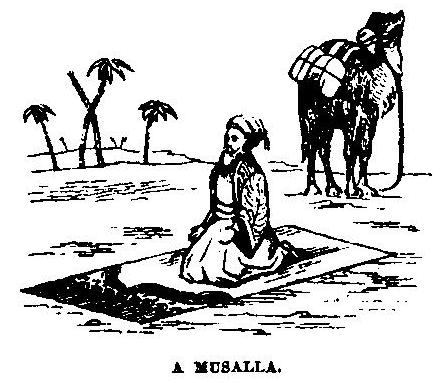
MUSALLAD.
 .
Lit. "Made into three, or into a third:' An aromatic wine composed of new wine boiled to a third part and then mixed with sweet herbs. It is
said by Abu Hanifah to be a lawful drink
(Hidayah, vol. iv. p. 162.)
.
Lit. "Made into three, or into a third:' An aromatic wine composed of new wine boiled to a third part and then mixed with sweet herbs. It is
said by Abu Hanifah to be a lawful drink
(Hidayah, vol. iv. p. 162.)
MUSALMAN.
 .
The Persian form of the word Muslim. A Muhammadan. [MUHAMMANISM.]
.
The Persian form of the word Muslim. A Muhammadan. [MUHAMMANISM.]
MUSAMARAH.
 .
Lit. holding night conversations." A term used by the Sufis for God's converse with the heart of man. ('Abdu'i-Razzaq's Dict. of Sufi
Terms.)
.
Lit. holding night conversations." A term used by the Sufis for God's converse with the heart of man. ('Abdu'i-Razzaq's Dict. of Sufi
Terms.)
MUSAQAT.
 .
A compact entered into by two persons, by which it is agreed that the one shall deliver over to the other his fruit trees, on condition that the other shall take care of them, and whatever is produced shall belong to them both, in the proportions of one half, one third, or the like, as may be stipulated. (Hidayah, vol. iv., p. 54.)
.
A compact entered into by two persons, by which it is agreed that the one shall deliver over to the other his fruit trees, on condition that the other shall take care of them, and whatever is produced shall belong to them both, in the proportions of one half, one third, or the like, as may be stipulated. (Hidayah, vol. iv., p. 54.)
AL-MUSAWWIR.
 .
"The Fashioner." One of the ninety-nine names or
attributes of God It occurs once in the
Qur'an, Surah lix. 24: "He is God, the
Creator, the Maker, the Fashioner."
.
"The Fashioner." One of the ninety-nine names or
attributes of God It occurs once in the
Qur'an, Surah lix. 24: "He is God, the
Creator, the Maker, the Fashioner."
MUSHABBIHAH.
 .
Lit. "The Assimilators." A sect of Muhammadans who allowed a resemblance between God and His creatures, supposing Him to be a figure composed of members of parts, and capable of local motion. Some of the Shiahs belong to this sect.
.
Lit. "The Assimilators." A sect of Muhammadans who allowed a resemblance between God and His creatures, supposing Him to be a figure composed of members of parts, and capable of local motion. Some of the Shiahs belong to this sect.
MUSHAHADAH.
 .
A vision or revelation. A Sufiistic expression for spiritual enlightenment.
.
A vision or revelation. A Sufiistic expression for spiritual enlightenment.
MUSHRIK.
 .
pl. mushrikun.
Those who give companions to God. It is used by modern Muslims for both Christians and idolators, for those who believe in the Holy Trinity as well as for those who worship idols. The Wahhabis also call their
religious opponents Mushrikun because they pray to saints for assistance. In the Qur'an the term is always used for the Makkan idolaters, and the Imam al-Baghawi says, in his commentary on Surah xcviii 1, that the term Ah u 'l-Kitab is always used for the Jews and Christians and Mushrikun for those who worship idols.
.
pl. mushrikun.
Those who give companions to God. It is used by modern Muslims for both Christians and idolators, for those who believe in the Holy Trinity as well as for those who worship idols. The Wahhabis also call their
religious opponents Mushrikun because they pray to saints for assistance. In the Qur'an the term is always used for the Makkan idolaters, and the Imam al-Baghawi says, in his commentary on Surah xcviii 1, that the term Ah u 'l-Kitab is always used for the Jews and Christians and Mushrikun for those who worship idols.
MUSHROOMS.
 .
Arabic kam, pl. akmu', kam'ah. Abu Hurairah
relates that Muhammad said: ' Mushrooms are a kind of manna which God sent to Moses, and its water is a cure for sore eyes. (Mishkat, book xxi. ch, i.)
.
Arabic kam, pl. akmu', kam'ah. Abu Hurairah
relates that Muhammad said: ' Mushrooms are a kind of manna which God sent to Moses, and its water is a cure for sore eyes. (Mishkat, book xxi. ch, i.)
MUSIC.
Arabic musiqa  , misiqi
  , which the author of the Ghiyasu 'l-Luqhah says is a Syriac word. It is generally held by Muhammadans to be contrary to the teachings of the Prophet for Nafi' relates that when he was walking with Ibn 'Umar on a road, they heard the music of a pipe, and that Ibn 'Umar put his fingers into his ears, and went on another road. Nafi' then asked Ibn 'Umar why he did so, and he said, "I was with the Prophet, and when he heard the noise of a musical pipe, he put his fingers into his ears; and this happened when I was a Child" (Mishkat, book xxii. ch. ix. pt. 3.)
Muhammadan doctors; however, are not agreed on the subject, for Abu Hanifah says, "If a person break a lute or tabor, or pipe, or cymbal belonging to a Muslim, he is responsible, because the sale of such articles is lawful." But his two disciples, Imams Muhammad and Abu Yusuf, do not agree with him. (Hidayah, vol. iii. p. 558.)
MUSLAH.
 .
The mutilation of the body, which is forbidden by Muslim law, except in the case of retaliation. (Mishkat, book xii. ch. ii.)
.
The mutilation of the body, which is forbidden by Muslim law, except in the case of retaliation. (Mishkat, book xii. ch. ii.)
MUSLIM.
 .
from Islam. One who has received Islam. .A Muhammadan. [MUHAMMADANISM, ISLAM.]
.
from Islam. One who has received Islam. .A Muhammadan. [MUHAMMADANISM, ISLAM.]
MUSLIM.
 .
Abu 'l-Husam Muslim, son of al-Hajjaj al-Qushairi, the compiler of the collection of the Traditions known as the Sahibu Muslim, was born at Haishapiir, A.H. 204, and died A.H. 261. His book of traditions ranks amnong the Sunnis a but second in authority to the Sahihu 'l-Bukhari. The two works being styled the Sahihan, or the two authorities." It is said
to contain 3,000 authentic traditions. [TRADITIONS.]
.
Abu 'l-Husam Muslim, son of al-Hajjaj al-Qushairi, the compiler of the collection of the Traditions known as the Sahibu Muslim, was born at Haishapiir, A.H. 204, and died A.H. 261. His book of traditions ranks amnong the Sunnis a but second in authority to the Sahihu 'l-Bukhari. The two works being styled the Sahihan, or the two authorities." It is said
to contain 3,000 authentic traditions. [TRADITIONS.]
MUSTAHAZAH.
 .
A woman who has an issue of blood (istihazah), independent of the menses or of the cleansings after parturition. A mustahazah is not considered junub, or unclean, but may say her prayers and perform the other religious offices. Compare Leviticus xv. 3.
.
A woman who has an issue of blood (istihazah), independent of the menses or of the cleansings after parturition. A mustahazah is not considered junub, or unclean, but may say her prayers and perform the other religious offices. Compare Leviticus xv. 3.
MUSTALIQ.
 .
Banu Mustatliq. An Arabian tribe in the time of Muhammad. He attacked the Banu Mustaliq in A.H. 5. and took many of them prisoners
.
Banu Mustatliq. An Arabian tribe in the time of Muhammad. He attacked the Banu Mustaliq in A.H. 5. and took many of them prisoners
(Muir's Life of Mahomet, vol. iii. p. 237). They embraced Islam at an early period.
MUSTA'MIN.
 .
Lit. "One who seeks security" One who, being a foreigner, and not a Muslim, enters Muhammadan territory, and claims safe conduct and immunity from hostilities.
.
Lit. "One who seeks security" One who, being a foreigner, and not a Muslim, enters Muhammadan territory, and claims safe conduct and immunity from hostilities.
AL-MUTA'ALI.
 .
"The Exalted." One of the ninety-nine names or attributes of God. It occurs in the Qur'an, Surah xlii 10; "He knows the unseen, and the visible,—the Great, the Lofty One."
.
"The Exalted." One of the ninety-nine names or attributes of God. It occurs in the Qur'an, Surah xlii 10; "He knows the unseen, and the visible,—the Great, the Lofty One."
MU'TADDAH.
 .
A woman in her 'iddah, or period of probation, after the death of her husband, or after her divorce.
.
A woman in her 'iddah, or period of probation, after the death of her husband, or after her divorce.
MUT'AH.
 .
Lit. "Usufruct, enjoyment." A marriage contracted for a limited period, for a certain sum of money.
Such marriages are still legal amongst the Shi'ahs, and exist in Persia (Malcolm's Persia, vol. ii. p 591) to the present day, but they are said to he unlawful by the Sunnis. They were permitted by the Arabian Prophet at Autia, and are undoubtedly the greatest stain upon his moral legislation; but the Sunnis say that he afterwards prohibited a mut'ah marriage at Khaibar. (Vide Mishkat, book xiii. ch. iv. pt. 2.)
.
Lit. "Usufruct, enjoyment." A marriage contracted for a limited period, for a certain sum of money.
Such marriages are still legal amongst the Shi'ahs, and exist in Persia (Malcolm's Persia, vol. ii. p 591) to the present day, but they are said to he unlawful by the Sunnis. They were permitted by the Arabian Prophet at Autia, and are undoubtedly the greatest stain upon his moral legislation; but the Sunnis say that he afterwards prohibited a mut'ah marriage at Khaibar. (Vide Mishkat, book xiii. ch. iv. pt. 2.)
The Shi'ahs establish the legality of mut'ah not only upon the traditions, but also upon the following verse in the Qur'an, the meaning of which, according to the commentary Tafsir-i-Mazhari, is disputed. Surah iv. 28: "Forbidden to you also are married women, except those who are in your hands as slaves. This is the law of God for you. And it is allowed you, beside this, to seek out wives by means of your wealth, with modest conduct, and without fornication. And give those with whom ye have cohabited their dowry. This is the law. But it shall be no crime in you to make agreements over and above the law. Verily, God is Knowing, Wise!"
According to the Imamiyah Code of Jurisprudence, the following are the conditions of Mut'ah, or "temporary marriages" There must be declaration and acceptance, as in the case of nikah, and the subject of the contract must be either a Musalimah, a Christian, or a Jewess, or (according to some) a Majusi; she should be chaste, and fine inquiries should be made into her conduct, as it is abominable to enter into contract with a woman addicted to fornication, nor is it lawful to make such a contract with a virgin who has no father. Some dower must be specified, and if there is a failure in this respect, the contract is void. There must also he a fixed period, but its extent is left entirely to the parties: it may be a year, a month, or a day, only some limit must be distinctly specified, so as to guard the period from any extension or diminution. The practice of 'azl (extrahere ante emissionem seminis) is lawful, but if, notwithstanding this the woman becomes pregnant, the child is the temporary husband's; but if he should deny the child, the denial is sustained by the law Mut'ah marriages do not admit of divorce or repudiation, but the parties become absolutely separated on the expiration of the period. (Baillie's Digest.)
There is a court account of a discussion at the Court of the Emperor Akbar with reference to the subject of Mut'ah marriages In the 'Ain-i-Akbari (Translation by H. Blochman, M.A., p. 173). At one of the meetings for discussion, the Emperor asked how many free-born women a man may legally marry. The lawyers answered that four was the limit fixed by the Prophet. His Majesty thereupon remarked that, from the time he had come of age he had not restricted himself to that number, and in Justice to his wives, of whom he had a large number, both free-born and slaves, he now wanted to know what remedy the law provided for his case. Most of the Manlawis present expressed their opinions, when the Emperor remarked that Shaikh 'Abdu 'n-Nabi had once told him that one of the Mujtahids had had as many as nine wives. Some of those present said that some learned men had allowed even eighteen from a too literal translation of the second verse of Suratu 'n-Nisa' in the Qur'an. [MARRIAGE.] After much discussion, the learned men present, having collected every tradition on the subject, decreed, first, that by mut'ah a man may marry any number of wives; and, secondly, that mut'ah marriages were sanctioned by the Imam Malik; but a copy of the Muwatta, of the Imam Malik was brought, and a passage cited from that collection of traditions against the legality of mut'ah marriages.
The disputation was again revived at a subsequent meeting, when at the request of the Emperor. Bada,'oni gave the following summary of the discussion: "Imam Malik, and the Shi'ahs are unanimous is looking upon mut'ah marriages as legal: Imam ash-Shafi'i and the great Imam Abu Hanfah look upon mut'ah marriages as illegal. But should at any time a Qazi of the Malaki sect decide that mut'ah is legal, it is legal, according to the common belief, even for Shafi'is and Hanafis. Every other opinion on this subject is idle talk." This saying pleased the Emperor, and he at once appointed a Qazi, who gave a decree which made mut'ah marriage legal.
In permitting these usufructuary marriages Muhammad appears but to have given Divine (?) sanction to one of the abominable practices of ancient Arabia, for Burckhardt (vol. ii. p. 378) says, it was a custom of their forefathers to assign to a traveller who became their guest for the night, some female of the family, most commonly the host's own wife.
AL-MUTAKABBIR.
 .
"The Great." (When used of a human being it implies haughtiness.) One of the ninety-nine names or attributes of God. It occurs in the Qur'an, Surah lii. 23: "He is . . . the Great One!"
.
"The Great." (When used of a human being it implies haughtiness.) One of the ninety-nine names or attributes of God. It occurs in the Qur'an, Surah lii. 23: "He is . . . the Great One!"
MU'TAMR.
 .
A performer of the 'Umrah. [UMRAH.]
.
A performer of the 'Umrah. [UMRAH.]
MU'TAQ.
 .
An emancipated slave. [SLAVERY.]
.
An emancipated slave. [SLAVERY.]
MUTAQADIM.
 .
Such a distance of time as suffices to prevent punishment. It operates in a way somewhat similar to the English statutory limitations.
.
Such a distance of time as suffices to prevent punishment. It operates in a way somewhat similar to the English statutory limitations.
MUTAWALLI.
 .
Lit, "A person endowed with authority." A legal term used for a person entrusted with the management of a religious foundation. [MASJID.]
.
Lit, "A person endowed with authority." A legal term used for a person entrusted with the management of a religious foundation. [MASJID.]
MU'TAZILAH.
 .
Lit. "The Separatists." A sect of Muhammadans founded by Wasil ibn 'Ata', who separated from the school of Hasan al-Basri (A.H. 110). The following are their chief tenets: (1) They entirely reject all eternal attributes of God, to avoid the distinction of persons made by the Christians; saying that eternity is the proper or formal attribute of his essence; that God knows by His essence, and not by his knowledge: and the same they affirm of His other attributes (though all the Mu'tazilahs do not understand these words in one sense), Hence this sect is also named Mu'attili, from their divesting God of His attributes; for they went so far as to say, that to affirm these attributes is the same thing as to make more eternals than one, and that the unity of God is inconsistent with such an opinion. This was the doctrine of Wasil, their master, who declared that whoever asserted an eternal attribute asserted there were two gods. This point of speculation concerning the divine attributes was not ripe at first, but was at length brought to maturity by Wasil's followers, after they had rend the books of the philosophers. (2) They believe the word of God to have been created in subjecto (as the schoolmen term it.), and to consist of letters and sound; copies thereof being written in books, to express or imitate the original. (3) They also go farther, and affirm that whatever was created in subjecto is also an accident, and hable to perish. They deny absolute predestination holding that God is not the author of evil, but of good only; and that man is a free agent; which is the opinion of the Qadariyah sect. On account of this tenet and the first, the Mu'tazilahs look on themselves as the defenders of the unity and justice of God. (4) They hold that if a professor of the true religion be guilty of it grievous sin, and die without repentance, he will he eternally damned, though his punishment will be lighter than that of the infidels. (5) They deny all .vision of God in Paradise by the corporeal eye, and reject all comparisons or similitudes applied to God.
.
Lit. "The Separatists." A sect of Muhammadans founded by Wasil ibn 'Ata', who separated from the school of Hasan al-Basri (A.H. 110). The following are their chief tenets: (1) They entirely reject all eternal attributes of God, to avoid the distinction of persons made by the Christians; saying that eternity is the proper or formal attribute of his essence; that God knows by His essence, and not by his knowledge: and the same they affirm of His other attributes (though all the Mu'tazilahs do not understand these words in one sense), Hence this sect is also named Mu'attili, from their divesting God of His attributes; for they went so far as to say, that to affirm these attributes is the same thing as to make more eternals than one, and that the unity of God is inconsistent with such an opinion. This was the doctrine of Wasil, their master, who declared that whoever asserted an eternal attribute asserted there were two gods. This point of speculation concerning the divine attributes was not ripe at first, but was at length brought to maturity by Wasil's followers, after they had rend the books of the philosophers. (2) They believe the word of God to have been created in subjecto (as the schoolmen term it.), and to consist of letters and sound; copies thereof being written in books, to express or imitate the original. (3) They also go farther, and affirm that whatever was created in subjecto is also an accident, and hable to perish. They deny absolute predestination holding that God is not the author of evil, but of good only; and that man is a free agent; which is the opinion of the Qadariyah sect. On account of this tenet and the first, the Mu'tazilahs look on themselves as the defenders of the unity and justice of God. (4) They hold that if a professor of the true religion be guilty of it grievous sin, and die without repentance, he will he eternally damned, though his punishment will be lighter than that of the infidels. (5) They deny all .vision of God in Paradise by the corporeal eye, and reject all comparisons or similitudes applied to God.
According to Shahrastani, the Mu'tazila hold:—
"That God is eternal : and that eternity is the peculiar property of his essence; but they deny the existence of any eternal attributes (as distinct from His nature). For they say. He is Omniscient as to His nature; Living to His nature; Almighty as to His nature but not through any knowledge, power or life existing in Him as eternal attributes; for knowledge, power and life are part of His essence, otherwise, if they are to be looked upon as eternal attributes of the Deity, it will give rise to a multiplicity of eternal entities.
"They maintain that the knowledge of God is as much within the province of reason as that of any other entity: that He cannot be beheld with the corporeal sight; and with the exception of Himself, everything else is liable to change or to suffer extinction. They also maintain that Justice is the animating principle of human actions: Justice according to them being the dictates of Reason and the concordance of the ultimate results of this conduct of man with such dictates.
"Again, they hold that there is no eternal law as regards human actions, that the divine ordinances which regulate the conduct of men are the results of growth and development; that God has commanded and forbidden, promised end threatened by a law which grow gradually. At the same time, say they, he who works righteousness merits rewards, and he who works evil deserves punishment. They also say that all knowledge is attained through reason, and must necessarily be so obtained. They hold that the cognition of good and evil is also within the province of reason; that nothing is known to be right or wrong until reason has enlightened us as to the distinction; and that thankfulness for the blessings of the Benefactor is made obligatory by reason, even before the promulgation of any law upon the subject. They also maintain that man has perfect freedom: is the author of his actions both good and evil, and deserves reward or punishment hereafter accordingly."
During the reigns of the Abbaside Khalifah al-Ma'muh, al-Mu'tasim, and al-Wasiq (A.H. 198—228) at Baghdad, the Mut'azilah were in high favour. Mr. Syed Ameer Ali Moulvi, M.A., L.L.B.. in the preface to his book, The Personal Law of the Mahommedans (W.H. Allen and Co.), claims to belong to "the little known. though not unimportant philosophical and legal school of the Mutazalas," and he adds, 'the young generation is tending unconsciously toward the Mutazalite doctrines."
According to the Sharhu 'l-Muwaqif, the Mu'tazilah are divided into twenty sects, viz. Wasiliyah, 'Umariyah, Bashariyah, Mazdariyah, Hishamiyah, Salhiyah, Habitiyah, Hadbiyah, Ma'mariyah, Samamiyah, Khaiyatiyal, Jabiziyah, Ka'biyah, Juba'iyah, and Bushamiyah.
AL-MUTI.  "The Giver." One of the ninety-nine names or attributes of God. It is referred to in the Qur'an, Surah
cviii. verse 1: "Verily we have forgiven thee al-Kausar."
MUTILATION. [THEFT.]
MU'TIQ.
 .
The master who emancipates a slave. [SLAVERY.]
.
The master who emancipates a slave. [SLAVERY.]
MUWAHHID.
 .
pl. mutahhidan. A believer in one God. A term often used by Muslims to express their belief as Unitarian.
.
pl. mutahhidan. A believer in one God. A term often used by Muslims to express their belief as Unitarian.
MUWATTA'.
 .
Lit. "That which has been complied." A title given to the book of traditions compiled by the Iman Malik (died A.H. 179). It is the, earliest compilation of traditions, and is placed by some amongst the Kutubu 's-Sittah, or the "six (correct) books." [TRADITIONS.]
.
Lit. "That which has been complied." A title given to the book of traditions compiled by the Iman Malik (died A.H. 179). It is the, earliest compilation of traditions, and is placed by some amongst the Kutubu 's-Sittah, or the "six (correct) books." [TRADITIONS.]
MUZABANAH.
 .
Lit. "Repelling or pushing back to selling without measure, for example. Selling green dates upon trees in exchange for dry ones in the house, and the seller saying that the loss or gain rests with him. This kind of sale is forbidden. (Miskat, book xii. ch. 6.)
.
Lit. "Repelling or pushing back to selling without measure, for example. Selling green dates upon trees in exchange for dry ones in the house, and the seller saying that the loss or gain rests with him. This kind of sale is forbidden. (Miskat, book xii. ch. 6.)
MUZARA'AH.
 .
Giving over land to the charge of another party on condition of receiving a fixed proportion of its produce.
.
Giving over land to the charge of another party on condition of receiving a fixed proportion of its produce.
MUZARABAH.
 .
In the language of the law, Muzarabah signifies a contract of co-partnership, of which the one party (namely the proprietor) is entitled to a profit on account of the stock, he being denominated Rabbu l-Mal, or proprietor cut' the stock (which is termed Rasu 'l-Mal), and the other party is entitled to a profit on account of his labour, and this last is denominated the muzarib (or manager), inasmuch as he derives a benefit from his own labour and endeavours. A contract of muzarabah therefore, cannot be established without a participation in the profit, for if the whole of the profit be stipulated to the proprietor of the stock, then it is considered as a biza'ah or, if the whole be stipulated to the immediate manager, it must be considered as a loan.
.
In the language of the law, Muzarabah signifies a contract of co-partnership, of which the one party (namely the proprietor) is entitled to a profit on account of the stock, he being denominated Rabbu l-Mal, or proprietor cut' the stock (which is termed Rasu 'l-Mal), and the other party is entitled to a profit on account of his labour, and this last is denominated the muzarib (or manager), inasmuch as he derives a benefit from his own labour and endeavours. A contract of muzarabah therefore, cannot be established without a participation in the profit, for if the whole of the profit be stipulated to the proprietor of the stock, then it is considered as a biza'ah or, if the whole be stipulated to the immediate manager, it must be considered as a loan.
AL-MUZILL.
 .
"The One 'who abases." One of the ninety-nine names or attributes of God referred to in the Qur'an. Surah iii. 25: "Thou honourest whom Thou pleasest and abasest whom Thou pleasest."
.
"The One 'who abases." One of the ninety-nine names or attributes of God referred to in the Qur'an. Surah iii. 25: "Thou honourest whom Thou pleasest and abasest whom Thou pleasest."
AL-MUZZAMMIL.
 .
Lit. "The Wrapped up." The title of the LXXIvth Surah of the Qur'an, in the first verse of which the word occurs. "O Thou, enwrapped, arise to prayer." It is said the chapter was
revealed to Muhammad when he was wrapped up in a blanket at night.
.
Lit. "The Wrapped up." The title of the LXXIvth Surah of the Qur'an, in the first verse of which the word occurs. "O Thou, enwrapped, arise to prayer." It is said the chapter was
revealed to Muhammad when he was wrapped up in a blanket at night.
MYSTICISM. The word mysticism is of a vague signification, out it is generally applied to all those tendencies in religion which aspire to a direct communication between man and his God, not through the medium of the senses, but through the inward perception of the mind. Consequently the term is applied to the Pantheism of the ancient Hindu, to the Gnosticism of the ancient Greek, to the Quietism of Madame Gayon and Fenelon to the Pietism of Molinos, to the doctrines of the Illuminati of Germany, to the visions of Swedenborg, as well as to the peculiar manifestations of mystic views amongst some modern Christian sects. It is a form of error which mistakes the operations of a merely human faculty for a divine manifestation, although it is often but a blind protest in behalf of what is highest and best in human nature.
The earliest mystics known are those of India, the best exposition of their system being the bhagavad-gita (see Wilkins' translation). Sir William Jones says:—" A figurative mode of expressing the fervour of devotion, the ardent love of created spirits, toward their Beneficent Creator, has prevailed from time immemorial in Asia; particularly among the Persian Theists, both ancient Hushangis and modern Sufis, who seem to have borrowed it from the Indian philosophers of the Vedanta School, and their doctrines are also believed to be the source of that sublime but poetical theology which glows end sparkles in the writings of the old Academics. 'Plato travelled into Italy and Egypt, says Blande Fleury, 'to learn the Theology of the Pagans at its fountain head.' Its true fountain, however, was neither in Italy nor in Egypt, though considerable streams of it had been conducted thither by Pythagoras, and by the family of Misra, but in Persia or India, which the founder of the Italic sect had visited with a similar design."
Almost the only religion in the world in which we should have concluded, before examination, that the Pantheistic and mystic spirit of Hinduism was impossible, is the stern unbending religions system of Muhammad and his followers. But even amongst Muslims there have ever been those who seek for divine intuition in individual souls, to the partial or entire rejection of the demands of creeds and ceremonies. These mystics are called Sufis, and have always included the philosophers, the poets, and the enthusiasts of Islam. For an account of these Muslims, see the article on SUFIISM.
Hughes' Dictionary of Islam
Answering Islam Home Page
 [ANGEL.]