 . "A thing put down." The legal term for a deposit. (See Hamilton's Hidayah, vol. iii. p. 259.)
WADI'AH.
. "A thing put down." The legal term for a deposit. (See Hamilton's Hidayah, vol. iii. p. 259.)
AL-WADUD.
 The Loving
One," or "The Beloved one: One of the the ninety-nine special attributes of God. It occurs twice in the Qur'an:-
The Loving
One," or "The Beloved one: One of the the ninety-nine special attributes of God. It occurs twice in the Qur'an:-
Surah xi. 92: My Lord is Merciful and Loving."
Surah lxxxv 14: "He is the Forgiving, the Loving."
Al-Maiku 'l-Wadud. the King of Love."
WAHDANIYAH.
 . (1) A
theological term for the doctrine of the Unity of God. (2) The name of a sect of Sufis. [GOD, SIKHISM, SUFI.]
. (1) A
theological term for the doctrine of the Unity of God. (2) The name of a sect of Sufis. [GOD, SIKHISM, SUFI.]
WAHDATU 'L - WUJUDIYAH.
 . A pantheistic sect of Sufis, who say that everything is God, and of the same essence.
AL-WAHHAB.  . The Bestower of gifts." One of the ninety-nine special attributes of God.. It occurs in the Qur'an, e.g. Sarah iii. 6: "Thou art He who bestoweth gifts."
WAHHABI.  . A sect of Muslim revivalists founded by Muhammad.
son of 'Abdu 'l-Wahhab, but as their opponents could not call them Muhammadans they have been distinguished by the name of the father of the founder of their sect and are called Wahhabis.
. A sect of Muslim revivalists founded by Muhammad.
son of 'Abdu 'l-Wahhab, but as their opponents could not call them Muhammadans they have been distinguished by the name of the father of the founder of their sect and are called Wahhabis.
Muhammad ibn 'Abdu 'l-Wahhab was born at Ayinah in Najd in A.D. 1691. Carefully instructed by his father in the tenets of the Muslim faith. according to the Hanbali sect, the strictest of the four great schools of interpretation, the son of 'Abdu 'l-Wahhab determined to increase his knowledge by visiting the schools of Makkah, al-Basrah and Baghdad. The libraries of those celebrated centres of Muhammadanism placed within the reach of the zealous student those ponderous folios of tradition known as the "six correct books," and also gave him access to numerous manuscript volumes of Muslim law. Having performed the pilgrimage to Makkah with his father, and visited the Prophets tomb at al-Madinah, he remained al the latter place to sit at the feet of Shaikh 'Abdu 'llah ibn Ibrahim, by whom he was carefully instructed in all the intricacies of the exegetical rules laid down for the exposition of ethics and jurisprudence.
For some years he resided with his father at Horemolab, a place which, according to Pelgrave, claims the honour of his birth; but after his fathers death, he returned to his native village, Ayinah, where he assumed the position of a religious leader.
In his various travels, Muhammad Ibn 'Abdu 'l-Wahhab had observed the laxities and superstitions of those who, whilst they professed to accept the stern unbending precepts of the Prophet of Arabia, had succeeded in stretching the rigid lines of Islam almost to breaking. Omens and auguries sacred shrines and richly ornamented tombs, the use of intoxicating drugs, the silks and satins of the wealthy, all seemed to the earnest reformer lamentable departures from the first principles of Islam, and unwarrantable concessions to the luxury, idolatry, and superstitions of the age. Having carefully studied the teachings of the Qur'an and the sacred traditions, he thought he had learned to distinguish between the essential elements of Islam and its recent admixtures, and now once more in the home of his childhood, be determined to teach and to propagate nothing lot the "pure faith" as laid down by the precepts and practice of the Prophet himself. The Muslim world had departed from the worship of the Unity, and had yielded a blind allegiance to Walis, Pirs, and Saints, amid all because the teachings of the sacred traditions had been neglected for that of learned but ambitious teachers.
To accept any doctrine other than that of those "Companions" who received their instructions from the Prophet's lips, was simply the blind leading the blind; and, therefore, the Reformer, refusing to join his faith to the uncertain leading-strings of even the four orthodox doctors, determined to establish the right of private judgment in time interpretation of those two great foundations of Islam — the Qur'an and the Ahadis.
His teaching met with acceptance, out his increasing influence excited the opposition of the ruler of his district, and he was compelled to seek an asylum at Deraiah, under the protection of Muhammad ibn Sa'ud a chief of considerable influence. The protection of the religious teacher was made, a pretext for more ambitious designs, and that which the zealous cleric had failed to accomplish by his persuasive eloquence, the warrior chief now sought to attain by the power of the sword; and he thus established in his own person that Wahhabi dynasty which, after a chequered existence of more than a hundred years, still exercises so powerful an influence not only in Central and Eastern Arabia, but wherever the Muhammadan creed is confessed. Like other great men before him, the chief of Deraiah strengthened his position by a matrimonial alliance, which united the interests of his own family with
that of the reformer. He married the daughter of Muhammad ibn 'Abdu 'l-Wahhab and she became the mother of the celebrated Wahhabi chief 'Abdu 'l-Aziz, who upon the death of his father (A.D. 1765), led the Wahabi army to victory, and succeeded in pushing his conquests to the remotest corners of Arabia.
'Abdu 'l-Azziz was not only a brave warrior, but a pious Muslim. and it is said that he fell a victim to the scrupulous regularity with which he performed his devotions in public. A Persian fanatic plunged his sharp Khuvasan dagger into his side, just as he was prostrating himself in prayer in the mosque of Deralan (A.H. 1803).
But the great military champion of the reformed doctrines was Sa'ud, the eldest son of 'Abdu 'l-'Aziz, who during the lifetime of his father led the Wahahbi armies to victory, and threatened even the conquest of the whole Turkish empire. He is said to have been a remarkably handsome man, praised for his wisdom in counsel and skill in war. Having wielded the sword from his youth (for he fought his first battle when a lad of twelve), he was regarded by the wild Arabs of the desert as a fit instrument to effect the conversion of the world, and men from all parts of Arabia flocked round his standard.
Sa'ud gained several derisive victories over Sulaiman Pasha, and afterwards, with an army of 20,000 men marched against Karbala'. the famed city of the East, which contains the tombs of the Shi'ah Khalifahs. The city was entered with the Wahhabi cry. "Kill and strangle all infidels which give companions to God," and every vestige of supposed idolatry, from the bright golden dome of al-Husain's tomb to the smallest tobacco pipe, was ground to the very dust, whilst the offerings of the numerous devotees, which formed the rich treasure of the sacred shrines, served to replenish the impoverished exchequer of the Wahhabi chief.
The following year the fanatical army effected the conquest of Makkah. and, on the 27th April 1803, Sa'ud made his formal entry into the sacred city of the Ka 'bah. The sanctity of the place subdued the barbarous spirit of the conquerors, and not the slightest excesses were committed against the people. The stern principles of the reformed doctrines were, however, stricfly enforced. Piles of green buqqas and Persian pipes were collected, rosaries and amulets were forcibly taken from the devotees, silk and satin dresses were demanded from the wealthy and worldly, and the whole, collected into the one heterogeneous mass, was burnt by the infuriated reformers. So strong was the feeling against the pipes, and so necessary did a public example seem to be that a respectable lady, whose delinquency had well nigh escaped the vigilant eye of the Mubtasib, was seized and placed on an ass, with a green pipe suspended from her neck, and paraded through the public streets — a terrible warning to all of her sex who may be inclined to indulge in forbidden luxuries. When the usual hours of prayer arrived, the myrmidons of the law sallied forth, and with leather whips drove all slothful Muslims to their devotions. The mosques were filled. Never since the days of the Prophet had the sacred city witnessed so much piety and devotion. Not one pipe, not a single tobacco-stopper, was to be seen in the streets or found in the houses, and the whole population of Makkah prostrated themselves at least five times, a day in solemn adoration. Having carried out his mission with fidelity Sa'ud hastened to convey the news of his success to the Sultan of Turkey in the following characteristic letter:
"Sa'ud to Salim, — I entered Makkah on the fourth day of Muharram in the 1218th year of the Hijrah. I kept peace towards the inhabitant. I destroyed all things that were idolatrously worshipped. I abolished all taxes except those required by the law. I confirmed the Qazi whom you had appointed agreeably to the command of the Prophet of God. I desire that you will give orders to the rulers of Damascus and Cairo not to come up to the sacred city with the Mahmal and with trumpets and drums. Religion is not profited by these things. May the peace and blessing of God be with you." [MAHMAL.]
Before the close of the year, al-Madinah was added to the Wahhabi conquests, and so thoroughly did Sa'ud carry out the work of reform, that even the Hujrah, containing the tomb of the Prophet, did not escape. Its richly ornamented dome was destroyed, and the curtain which covered the Prophet's grave would have been removed, had not the Leader of the Faithful been warned in his dreams not to commit so monstrous a sacrilege. [HUJRAH.]
For nine years did the Wahhabi rule exist at Makkah, and so strong was the position occupied by the Wahhabi army, and so rapidly did Wahhabi opinions spread amongst the people, that the Sultan of Turkey began to entertain the worst fears for the safety of his empire. 'Ali Pasha was therefore ordered by the Sultan of Turkey to collect a strong army to suppress the Wahhabi movement: and eventually, Makkah and al-Madinah were taken from the fanatics.
Upon the death of Sa'ud (A.D. 1814), his son, 'Abdu 'llah, became the Leader of the Faithful. He was even more distinguished than his father for personal bravery, but he lacked that knowledge of men which was so necessary for one called upon to lead the in disciplined nomadic tribes of the Arabian deserts. 'Abdu'llah and his army met with a series of reverses, and he was at last taken prisoner by Ibrahim Pashah and sent to Constantinople. He was executed in the public square of St. Sophia, December 19th. 18l8. Turki, the son of Abdu'lluh, abandoned all hope of regaining the position, and fled to Riyaz, where he was afterwards assassinated. Faizul succeeded his father A.D., 1830, and established the Wahhabi rule in Eastern Arabia, making Riyaz the capital of his king
dom. It was this chief who entertained the traveller Palgrave in 1863, and received Lieutenant-Colonel (now Sir Lewis Idly), is Her Majesty's representative, in 1865. Faizul died in 1866, soon after Sir Lewis Pelly's visit and was succeeded by his son Abdu 'llah.
But although the great political and military power of the Wahhtabis had seen well nigh crushed, and the rule of the dynasty of Sa'ud circumscribed within the limits of the province of Najd, the principles laid down by Muhammad ibn Abdu 'l-Wahhab were still zealously maintained by certain religious teachers within the sacred mosque itself. And so it came to pass that when a restless spirit from India was endeavouring to redeem a lawless life by performing the pilgrimage to Makkah, he fell in with teachers who had imbibed Wahhabi doctrines and were secretly disseminating them amongst the pilgrims. Saiyid Ahmad, the freebooter and bandit if Rai Bareli, having performed the sacred rites of the Pilgrimage, returned from Makkah (A.D. 1822), resolved to reclaim the whole of North India to the Faith of Islam. Being a direct descendant from the Prophet, he possessed (unlike the Wahhabi of Najd) the necessary qualification for a Leader of the Faithful, and the Muslims of India at once hailed him as the true Khalifah or al-Mahdi. Unheeded by the British Government, he traversed our provinces with a numerous retinue of devoted disciples, and converted the populace to us reformed doctrines by thousands. He appointed deputies at Patna, and then proceeded to Delhi, where he met with a ready listener in Muhammad Isnma'il, who became his most devoted disciple, and recorded the sayings of the new Khalifah in the well-known Wahhabi book, entitle the Siratu 'l-Mustaqim.
On the 21st December 1826, Saiyid Ahmad, the Leader of the Faithful, declared a religious war, or Jihad, against the Sikhs, and, hoping to unite the hosts of Islam in Central Asia under his banner, he commenced an insurrection on the Peshawar frontier. A fanatical war of varied successes followed, and lasted for four years; but the Wahhabi army was soon reduced in strength, and its disasters culminated in the death of its chief, who was slain by Sher Singh in an engagement at Balakot in Hazarah, May 1831. The remnant of the Saiyid's army fled across the border and settled at Sattana, where in 1857 their numbers were augmented by mutineers who joined their camp. They were eventually displaced by the British Government in the Umbeyla War of 1863, but there are still some three hundred of them residing at Palosi on the banks of the Indus, where they ace ruled by Shaikh 'Abdu'llah, an old mutineer of 1857, who has recently married his daughter to a former Imani of the Peshawar, Sadar Bazar; in order to combine the Wahhabi influences of Peshawar with those of the Palosi settlement.
But as in the case of the Wahhabis of Najd, so with the Wahhabis of India. The religious tenets of the reformers did not die with their political leader. What Sa'ud of Najd and Ahmad of Bareli failed to accomplish with the sword, the cheapness of lithographic printing has enabled less daring leaders to accomplish with the pen. The reformed doctrines, as embodied in the Siratu 'l-Mustaqim and the Taqwiyatu 'l-Imam, still exercise a powerful influence upon Muhammadan thought in India.
Wahhabiism has sometimes been designated the Protestantism of Islam, and so it really is, although with this remarkable difference, that whilst Christian Protestantism is the assertion of the paramount authority of sacred scripture to the rejection of traditional teachings, Wahhabiism is the assertion of the paramount authority of the Qur'an with the Traditions. But both systems contend for first principles, and if there appears to be any incongruity in applying the term Protestant to a sect which receives, instead of rejects, tradition, it arises from the very important fact that what is called " tradition" in Islam occupies a totally different place in the Muhammadan system from that which it does in the Christian, Tradition in Islam being nothing less than the supposed inspired sayings of the Prophet, recorded and handed down by uninspired writers, and being absolutely necessary to complete the structure of the faith. The daily prayer, the customs of the pilgrimage, and numerous other duties and dogmas held to be of Divine institution, being found not in the Qur'an but in the Ahadis, or Traditions. Hence it is that the Wahhabis of Najd and India call themselves Ahl-i-Hadis, or the people of Tradition, and promote in every way they can the study of those records. [TRADITION.]
The Wahhabis speak of themselves as Muwakhid, or "Unitarians," and call all others Mushrik, or those who associate another with God; and the following are some of their distinctive religious tenets :—
1. They do not receive the decisions of the four orthodox sects, but say that any man who can read and understand the Qur'an and the sacred Hadis can judge for himself in matters of doctrine. They, therefore, reject Ijma' after the death of the Companions of the Prophet.
2. That no one but God can know the secrets of men, and that prayers should not be offered to any prophet, wali, pir, or saint; but that God may be asked to grant a petition for the sake of a saint.
3. That at the Last Day, Muhammad will obtain permission (izn) of God to intercede for his people. The Sunnis believe that permission has already been given.
4. That it is unlawful to illuminate the shrines of departed saints, or to prostrate before them, or to perambulate (tawaf) round them, they do not even perform any act of reverence at the Prophet's tomb at al-Madinah.
5. That women should not be allowed to visit the graves of the dead, on account of their immoderate weeping.
6. That only four festivals ought to be observed, namely, 'Idu 'l-Fitr, 'Idu 'l-Azha, 'Ashura, and al-Lailatu 'l-Mubarakah.
7. They do not observe the ceremonies of Maulud, which are celebrated on the anniversary of Muhammads birth.
8. They do not present offerings (Nazr) at any shrine.
9. They count the ninety-nine names of God on their fingers, and not on a rosary.
10. They understand the terms " sitting of God" (Arabic Istiwa), and "hand of God " (Yadu 'llah), which occur in the Qur'an, in their literal (Haqiqi) sense, and not figuratively (Majazi): but, at the same time, they say it is not revealed how God sits, or in what sense be has a hand, &c,. and this a count the Christian doctrines of the Trinity and the Sonship of Christ do not present the same difficulties to the mind of a Wahhahi which they do to that of a Sunni.
Mr. Wilfrid Blunt, in his Future of Islam says:-
"I believe it is hardly now recognised by Mohammedans how near Abd el Wahhab was to complete success. Before the close of the eighteenth century, the chiefs of the Ibn Saouds, champions of Unitarian Islam, had established their authority over all Northern Arabia as far as the Euphrates, and in 1808 they took Mecca and Medina. In the meanwhile, the Wahhabite doctrines wore gaining ground still further afield. India was at one time very near conversion, and in Egypt, and North Africa, and even in Turkey. many secretly subscribed to the new doctrines. Two things, however, marred the plan of general reform and prevented its full accomplishment. In the first place, the reform was too completely reactive. It took no account whatever of the progress of modern thought, and directly it attempted to leave Arabia it, found itself face to face with difficulties which only political as well as religious success could overcome. It was impossible, except by force of arms, to Arabianise the world again, and nothing less than this was in contemplation. Its second mistake, and that was one that a little of the Prophet's prudence which always went hand in hand with his zeal might have avoided, was a too rigid insistence upon trifles. Abd el Wahhah condemned minarets and tombstones because neither were in use during the first years of Islam. Thu minarets, therefore, were every-where thrown down, and when the holy places of Hejaz fell into the hands of his followers, the tombs of saints which had for centuries been revered as objects of pilgrimage were levelled to the ground. Even the Prophet's tomb at Medina was laid waste and the treasures it contained distributed among the soldiers of Ibn Saoud. This roused the indignation of all Islam, and turned the tide of the Wahhabite fortunes. Respectable feeling which had hitherto been on their side now declared itself against them, and they never after regained their position as moral and social reformers. Politically, too, it was the cause of their ruin. The outside Musalman world, looking upon them as sacrilegious barbarians, was afraid to visit Mecca, and the pilgrimage declined so rapidly that the Hejazi became alarmed. The source of their revenue they found cut off, and it seemed on the point of ceasing altogether. Then they appealed to Constantinople, urging the Sultan to vindicate his claim to be protector of the holy places. What followed is well known. After the peace of Paris, Sultan Mahmud commissioned Mehemet Ali to deliver Mecca and Medina from the Wahhabite heretics, and this he in time effected. The war was earned into Nejd; Deriyeh, their capital. was sacked, and Ibn Saoud himself taken prisoner and decapitated in front of St. Sophia at Constantinople. The movement of reform in Islam was thus put back for, perhaps another hundred years.
"Still, the seed cast by Abd el Wahhab has not been entirely without fruit. Wahhabism, as a political regeneration of the world, has failed, but the spirit of reform has remained. Indeed, the present unquiet attitude of expectation in Islam has been its indirect result. Just as the Lutheran reformation in Europe, though it failed to convert the Christian Church, caused its real reform, so Wahhabbism has produced a real desire for reform it not yet reform itself in Mussulmans, Islam is no longer asleep, and were another and a wiser Abd el Wahhab to appear, not as a heretic, but in the body of the orthodox sect, he might play the part of Loyola or Borromeo with success.
"The present condition of the Wahhabites as a sect is one of decline. In India, and I believe, in other parts of Southern Asia, their missionaries still make converts and their preachers are held in high esteem. But at home in Arabia, their zeal has waxed cold, giving place to liberal ideas which in truth are far more congenial to the Arabian mind. The Ibn Saoud dynasty no longer holds the first position in Nejd, and Ibn Rashid who has taken their place, though nominally a Wahhabite, has little of the Wahhabite fanaticism. He is in fact a popular and national rather than a religious leader, and though still designated at Constantinople as a pestilent heretic, is counted as their ally by the more liberal Sunites. It is probable that he would not withhold his allegiance from a Caliph of the legitimate house of Koreysh."
(The following English works may be consulted on the subject of Wahhabiism: Burckhardt's Bedoouins and Wahhabys; Brydge's Brief History of the Wahhabi. Sir Lewis Pelly's Political Mission to Najd; Hunter's Musalmans of India; Palgraves Central and Eastern Arabia; Lady Ann Blunt's Pilgrimage to Najd; Dr. Badger's Imams and Seyids of 'Oman; Blunt's Future of Islam.
AL-WAHID.
 . "The One." One of the ninety-nine special attribntes of
the Almighty. It occurs frequently in the Qur'an, e.g. Surah ii. 158: "Your God is One God."
. "The One." One of the ninety-nine special attribntes of
the Almighty. It occurs frequently in the Qur'an, e.g. Surah ii. 158: "Your God is One God."
WAHY.
 . [INSPIRATION.]
WA'IZ.
 .
"A preacher." The word khatib is generally applied to the Maulawi who recites the khutbah on Fridays; wa'iz is of more general application. In the Qamus dictionary, the wa'iz is defined as one who reminds mankind of those punishments and rewards which soften the heart. The usual time for preaching is on Fridays, and in the months of Muharram and Ramazan. [KHUTBAH.]
.
"A preacher." The word khatib is generally applied to the Maulawi who recites the khutbah on Fridays; wa'iz is of more general application. In the Qamus dictionary, the wa'iz is defined as one who reminds mankind of those punishments and rewards which soften the heart. The usual time for preaching is on Fridays, and in the months of Muharram and Ramazan. [KHUTBAH.]
WAJD.
 . "Ecstasy," A Sufi term for the fifth stage of the mystic journey, when the spiritual traveller attains to a state of mental excitement which is supposed to indicate a high state of divine illumination. [SUFI.]
WAJH.
 .
Lit. "Presence: face." The word occurs in the Qur'an for the presence of God. Surah ii. 109. "Wherever turn there is the face of God (Wajhu 'llah).
.
Lit. "Presence: face." The word occurs in the Qur'an for the presence of God. Surah ii. 109. "Wherever turn there is the face of God (Wajhu 'llah).
WAJIB.
 .
Lit. "That which is obligatory." A term used in Muhammad law for those injunctions, the non-observance of which constitutes sin, but the denial of which does not attain to downright infidelity. For example, that Muslim who does not offer the sacrifice on the day of the Great Festival [IDU 'L-AZHA] commits a sin, and if he says the sacrifice is not a divine institution, he is a sinner, but not an infidel; and he who dos not observe the fast [RAMAZAN] is a sinner, but if be deny that the fast. is a divine institution, he is an infidel. The sacrifice being wajib, 'whilst the last is fanz. [LAW.]
.
Lit. "That which is obligatory." A term used in Muhammad law for those injunctions, the non-observance of which constitutes sin, but the denial of which does not attain to downright infidelity. For example, that Muslim who does not offer the sacrifice on the day of the Great Festival [IDU 'L-AZHA] commits a sin, and if he says the sacrifice is not a divine institution, he is a sinner, but not an infidel; and he who dos not observe the fast [RAMAZAN] is a sinner, but if be deny that the fast. is a divine institution, he is an infidel. The sacrifice being wajib, 'whilst the last is fanz. [LAW.]
(2) A term which frequently occurs in combination with others. For example, al-Wajibu 'l-wujud, "the necessary existence" — God; Wajibu 'l-itiiba', worthy to be obeyed," as a teacher or prophet; Wajibu 'l ada', "necessary to be discharged," as a debt or duty.
AL-WAJID.
 .
"The Finder Inventor, or Maker." One of the ninety-nine attributes of God, but the word dues not occur in the Qur'an.
.
"The Finder Inventor, or Maker." One of the ninety-nine attributes of God, but the word dues not occur in the Qur'an.
WAKALAH. WIKALAH.
 .
The office of substitute. An embassy; an agency; attorneyship. For the Muhammadan law, with regard to agency for sale, see Hamilton's Hidayah, vol. iii. pp. 1—62. [AGENT, BAIL, SALE]
.
The office of substitute. An embassy; an agency; attorneyship. For the Muhammadan law, with regard to agency for sale, see Hamilton's Hidayah, vol. iii. pp. 1—62. [AGENT, BAIL, SALE]
WAKIL.
 . An attorney, an agent, an ambassador. [AGENT.]
AL-WAKIL.
 . "The Guardian." One of the ninety-nine special attributes of God. It occurs in the Qur'an, Surah iv. 83: "For God is all sufficient for a Guardian."
WALA'.
 .Lit "Proximity, kin, friendship." A peculiar relationship voluntarily established, and which confers a right of inheritance on one or both parties connected. It is of two kinds:-
(1) Wala'u 'l-Ataqah  Relationship between a master and manumitted slave, in which the former inherits any property the latter may acquire after emancipation.
(2) Wala'u 'l-Miwalat  , The connection arising out of mutual friendship, especially between a Muhammadan and a convert. (See Hidayah, Grady's edition, p. 513.)
WALAHAN.
 .
The demon who troubles people when they are performing their ablutions. (Mishkat, book ii. ch. 7.) The name signifies grief or distraction of mind. (See Muntaha 'l-'Arab.)
.
The demon who troubles people when they are performing their ablutions. (Mishkat, book ii. ch. 7.) The name signifies grief or distraction of mind. (See Muntaha 'l-'Arab.)
WALI.
 . "One who is very near." (1) Saints, or holy men, e.g. Surah x. 63: "Are not, verily, friends (auliya') of God they on whom there is no fear? " [SAINTS.]
(2) Next of kin or kindred, e.g. Surah viii 73: "These shall be next of kin to each other."
Wali 'ahd, an heir, especially to a sovereignty.
Wali ba'id, a legal guardian of a more remote degree than father, brother, or uncle.
Wali jabir, an authoritative guardian recognised by law.
Wali ni'mat, a title of respect for a father a patron, a benefactor.
Waliyi 'd-dam, a relative entitled to exact retaliation.
(3) A benefactor or helper, e.g. Surah ii. 114: "Thou heat no helper but God."
(4) Al-Wali, "the helper." One of the ninety-nine special attributes of God.
WALI.
 , pl. wulut. A prince
or governer. A term used for the ruler of a country. It is assumed by the Ameer of Afghanistan in his treaties.
, pl. wulut. A prince
or governer. A term used for the ruler of a country. It is assumed by the Ameer of Afghanistan in his treaties.
The title implies one who rules a Muslim country as an Amir, on in behalf of the Khalifah of Islam.
(2) God, Qur'an, Surah xiii. 12: "Nor have they any governor beside him."
AL-WALID IBN 'UQBAH.

 A celebrated Companion. A brother to the Khalifah 'Usman, who was Governor of al-Kufah, and died in the reign of Mu'awiyah.
WALIMAH.
 The nuptial least. The wedding breakfast, which is generally given on the morning after the marriage. The custom is founded on the example of Muhammad, who is related to have given a feast of dates and a meal on the occasion of his marriage with Safiyah.
Ibn Mas'ud says the Prophet regarded the wedding feast as of divine authority, and he who is invited on such an occasion must accept the invitation. (Mishkat book xiii. ch. ix. pt. 1)
WALIYU 'L-'AHD.
 Vulg. Wali'ahd. The heir to a kingdom or state.
WALKING [DEPORTMENT.]
WAQF.
 Lit. "Standing, stopping, halting." (1) A term which in the language of the law signifies the appropriation or dedication of property to charitable user and the service of God. An endowment. The object of such an endowment or appropriation must be of a perpetual nature, and such property or land cannot be sold or transferred. If a person build a mosque his right of property is extinguished as soon as prayers have been recited in the building.
According to the Imam Abu Yusuf, if the place in which a mosque is situated should become deserted or uninhabited, inasmuch as there is no farther use for the mosque, no person coming to worship therein, still the property does not revert to the original owner and founder. But Imam Muhammad alleges that in such a case the laud and the material (bricks, &c.) again become the property of the founder or his heir.
If a person construct a reservoir or well for public use, or a caravansera, for travellers, or a hostel on an infidel frontier for the accommodation of Muslim warriors, or dedicate ground as a burying-place, his right is not extinguished until the magistrate, at his request, issues a decree to that effect. This is the opinion of lmam Abu Hanifah, but Imam Abu Yusuf maintains that the person's right of property ceases on the instant of his saying: "I have made over this for such and such purposes." Whilst Imam Muhammad asserts that as soon as the property is used for the purpose to which it is dedicated, it ceases to be the property of the original owner. (See Hamilton's Hidayah vol. ii. p. 334.)
(2) A term need for a full pause. and particularly for certain pauses in the reading of the Qur'an, which are marked with the letters  in the text.
WAQI'AH.
 Lit. The "inevitable." (1) A term generally used for an
accident or an unavoidable circumstance in life.
Lit. The "inevitable." (1) A term generally used for an
accident or an unavoidable circumstance in life.
(2) The Day of Judgment. See Qur'an, Surah lvi 2: "When the inevitable happens none shall call its happening a lie.
(3) The title of the LVIth Surah of the Qur'an.
AL-WAQIDI.
 His full name: Abu 'Abdi 'llah Muhammad ibn 'Umar al-Waqidi. A celebrated Muslim historian, much quoted by Muir in his Life of Mahomet. Born at al-Madinah, A.H. 130; died A.H. 207. He is said to have left a library of 600 boxes of books.
WAQS.
 . pl. auqas. Any property under the regulated value or number upon which zakat or legal alms is due.
WAQT.
 .The present time as distinguished from of al-Waqtu 'd-Da'im, or the eternal existence of God.
AL-WAQTU'D- DA'IM.  .
Lit. "The Everlasting Time." A Sufi term for the extent of the existence of the Eternal One. ('Abdu 'r-Rizzaq's Dictionary of Sufi
Terms.
.
Lit. "The Everlasting Time." A Sufi term for the extent of the existence of the Eternal One. ('Abdu 'r-Rizzaq's Dictionary of Sufi
Terms.
WARAQAH.  .
Waraqah ibn Naufal ibn Asad ibn 'Abdi 'l-'Uzza. The cousin of Khadijah; to whom she first made known the supposed revelation, or dream, of Muhammad, and who is related to have said that the Prophet must have seen the Namus which God sent to Moses. (Mishkat, book xxiv. ch. v. pt. 1.)
.
Waraqah ibn Naufal ibn Asad ibn 'Abdi 'l-'Uzza. The cousin of Khadijah; to whom she first made known the supposed revelation, or dream, of Muhammad, and who is related to have said that the Prophet must have seen the Namus which God sent to Moses. (Mishkat, book xxiv. ch. v. pt. 1.)
In the Arabic Dictionary al-Qamus, it is stated that Waraqah was the son of one of Khadijah's uncles, and that it is not certain if he ever embraced Islam. 'Abdu 'l-Haqq, the commentator on the Mishkat says he had embraced Christianity and had translated the Gospels into Arabic. There does, not seem to be any good authority for the supposition that he was originally a Jew. He appears to have died soon after the incident in the cave at Hira'. [MUHAMMAD.]
WARFARE.. There are three terms used in the Traditions for warfare.
(1) Jihad  warfare carried on by Muslims for the extension of Islam.
(2) Fitan  , seditions and commotions which will precede the Resurrection.
(3) Malahim  pl. of malhamah, warfare carried on between Muslim nations and tribes. These are also signs of the Resurrection. [FITAN, JIHAD, MALAHIM.]
AL-WARIS.  .
"The Heir"
(of all things). One of the ninety-nine attributes of the Almighty.
.
"The Heir"
(of all things). One of the ninety-nine attributes of the Almighty.
WASAN.  .
pl. ausan. An idol. [IDOLATRY.]
.
pl. ausan. An idol. [IDOLATRY.]
WASANI.  .
from wasan, an
idol. An idolater. [IDOLATER.]
.
from wasan, an
idol. An idolater. [IDOLATER.]
WASAYA.  .
pl. of wasiyah, Lit. "Precepts." Used in Muslim law for wills and regulations concerning them. [WILLS.]
.
pl. of wasiyah, Lit. "Precepts." Used in Muslim law for wills and regulations concerning them. [WILLS.]
AL-WASI'.  .
"The Capacious." One of the ninety-nine attributes of God. It occurs in the Qur'an, Surah ii. 248: "God is the Capacious one and knows.
.
"The Capacious." One of the ninety-nine attributes of God. It occurs in the Qur'an, Surah ii. 248: "God is the Capacious one and knows.
WASILAH.  .
Lit. "Nearness." The name of the highest station in paradise, which Muhammad said was reserved for one person only, and which he hoped to obtain for himself. (Mishkat, book
xiv ch. ii. pt. 2.)
.
Lit. "Nearness." The name of the highest station in paradise, which Muhammad said was reserved for one person only, and which he hoped to obtain for himself. (Mishkat, book
xiv ch. ii. pt. 2.)
It is usual for religious Muhammadans to pray, after the call to prayer (azan) has been concluded, that Muhammad may obtain this station of Wasilah. Hence the place of intercession, and the office of mediator. That which effects nearness to God.
WASITAH.  .
A thing or person intervening; an agent; a broker. Hence a mediation.
.
A thing or person intervening; an agent; a broker. Hence a mediation.
WASL.  . "Meeting; union." A Sufi term used for the seventh stage in the spiritual journey, when the mystic, as it were, sees the Divine One face to race. The stage previous to fana, or extinction in the essence of the Eternal One. [SUFI.]
WASWASAH.  Lit. "Inspiring," or "suggesting." A suggestion from the devil. The machinations of the devil, to the consideration of which a chapter is devoted in the Traditions. (Mishkat, book i. ch. iii.)
Muhammad said, "There is not a single child of man except Mary and her son, who is not touched by the devil at the tune of his birth, and hence the child makes a loud cry when he is born, nor is there one human being who has not a devil appointed to attend him. The devil sticks close to the sons of Adam, and also an angel; the business of the devil is to do evil, and that of the angel to guide them unto truth."
WATER.
Arabic ma'  . pl. miyah, amwah. Heb.
  mayim, waters.
In the Qur'an, Surah xxi. 31, it is said, " We gave them (the heavens and the earth) asunder, and by means of water, We gave life to everything." Which, as Sprenger (vol. i. p. 30n) remarks, is one of the principles of the Ebionite doctrine. Al-Baizawi says it means either that God made all animals from water, or that the chief element in animal life is water, or that animal life is supported chiefly by water.
Muhammadan writers say there are seven kinds of water which are lawful for the purposes of purification and drinking:-
Ma'u 'l-'ain, spring-water.
Ma'u 'l-bir, well-water.
Ma'u 'l-barad, hail-water.
Ma'u s-salj, snow-water.
Ma'u 'l-bahr, sea-water.
Ma'u 'n-nahr, river- water.
Water which is considered lawful for ablution is also lawful for drinking, and vice versa. Ibn 'Umar relates that Muhammad was asked about the water of the plains in which animals go to drink. &c., and he said, "When the water is equal to two qullahs, it is not impure." 'Abdu 'l-Haqq says two qulluhs are equal to 250 mans. (Mishkat, Matthew's ed., vol. i. p. l07.) [WELLS.]
Mr. Sell, in his
"Minute regulations are laid down with regard to the water which may be used for purification. The following kinds of water are lawful :- rain, sea, river, fountain, well, snow, and ice-water. Ice is not lawful. The first kind is authorised by the Qur'an. He sent you down water from heaven that He might thereby cleanse you, and cause the pollution of Satan to pass from you. (Sura viii. 11.) The use of the others is sanctioned by the Traditions. I give one illustration. A man one day came to the Prophet and said:
'I am going on a voyage and shall only have
A small supply of fresh water; if I use it for ablutions I shall have none wherewith to quench my thirst, may I use sea-water?
The Prophet replied "The water of the sea is pure' Tirmizi states that this is a Hadis i-Sahih. Great difference of opinion exists with regard to what constitutes impurity in water, and so renders it unfit for ablutions. It would be wearisome to the reader to enter into all details, but I may briefly say that, amongst the orthodox, it is generally held that if a dead body or any unclean thing falls into flowing water, or into a reservoir more then l5 feet square, it can be used, provided always that the color, smell, and taste are not changed. It is for this reason that the pool near a mosque is never less than ten cubits square. If of that size, it is called a dah dar dah (literally l0x10). It may be, and commonly is, larger than this. It should be about one foot deep."
Rights regarding water. According to Muhammadan law, water is of four kinds:—
(1) The water of the ocean, to which every person has a perfect and equal right, for the enjoyment of the ocean is common to everyone in the same manner as the light of the sun or the air we breathe.
(2) The waters of large rivers, such as the Euphrates, the Tigris, the Indus, or the Oxus, from which every person has an absolute right to drink, and also a conditional right to use it for the purpose of irrigating his lands". For example, if a person desire cultivate waste land, and dig a watercourse or canal for the purpose of conveying water to it from the river, he may lawfully do so, provided the act be in no sense detrimental to the people. The same law applies to the erection of a water-mill on the banks of a river.
(3) Water in which several have a share; in which case also the right of drinking is common to all, whilst there are certain restrictions regarding its use for the purposes of irrigation which will be hereafter treated of.
(4) Water which is kept in vessels : which is regarded as property, except in times of scarcity, when it is even lawful to seize it for common use.
The law regarding the division of water for the purposes of irrigation, known as shirb
several, it is the duty of the judge to make a distribution of the water according to the extent of land which they severally possess; for, as the object of right is, water is to moisten the lands, it is but fit that each should receive a just proportion. A rivulet must not be dammed up for the convenience of one partner without the consent of the others; nor can he dig a trench or erect a a mill upon a rivulet used for irrigation, without the general consent of all persons concerned. The same restriction applies, also, to a bridge. One partner cannot alter the mode of partition without
the others' consent, nor increase the number of sluices or openings through which he receives his share, nor convey his share into lands not entitled to receive it, nor even to lands which are entitled to receive it, nor can he shut up any of the sluices, or exchange the manner of division in any way, as, for example, by taking the water in rotation instead of division by sluices. A right to water cannot be consigned as a dower, nor given as a consideration in Khul', when a wife bargains for her divorce [KHUL'], nor in composition for a claim, nor sold to discharge the debts of a defunct owner. It is also noted that if a person, by irrigating his lands, should by that means overflow those of his neighbour, he is not liable to make compensation as he was not guilty of any transgression.
WA'Z . WAZIFAH.
(2) A pension or stipend granted to pious persons.
(3) Revenue collected at a stipulated rate.
WAZIR.
Mr. Lane (Arabian Nights, Intro., p. 28), says: "The poet of wezeer was the highest that was held by an officer of the pen; and the parson who occupied it was properly the next to the Sultan; last the Turkish Sultans of Egypt made the office of
Khalil az-Zahir relates that Muhammad said, "Whosoever is as authority over Muslims,
if God prosper him, shall be given a virtuous wazir. The wazir shall remind him when he forgetteth his duty, and shall assist him when he doth remember it. But to a bad
ruler God giveth an evil-minded wazir, who, when the ruler forgetteth his duty, doth not remind him of it, and when he remembereth his duty, doth not assist him to perform it."
WEDDING.
[MARRIAGE.]
WEEK. Arabic usbu WEEPING.
[BUKA'.]
WELLS.
Arabic bi'r
If a person dig a well in a high road (where no person is entitled to dig a well), he is liable to a fine for any accident which may happen by people falling into it. (Hidayah. vol. ii. p. 719.)
If any animal, or impurity of any kind, fall into a well, all the water must be drawn out before the well can be lawfully used; and if it be impossible to draw the whole of the water, then not less than 800 bucketfuls must be drawn out. If the animal has in any way become putrefied in the well, then the water must not be used for three whole days ; but in any other case the water can be used after the lapse of a whole day. (Sharhu 'l- Wiqayah, p. 10.)
WHISTLING.
Arabic muka' WIDOWS.
Arabic armalah
vol. i. p. 370) After this period she may lawfully take another husband, provided she be not pregnant of her first husband. A
widow's share of her late husband's property is one-eighth when there is a child, or a son's child, how low soever, and a fourth when there is no child. Though a man may have as many as four wives, the provisions for two or more is the same at, that for one; the fourth or eighth, as the case may, being divisible among them equally. (Baillie's Law of Inheritance, p. 59.)
If a Muslim, whose wife was once a Christian should die, and his widow appear before a Qazi and declare that she Muslim, and
that she embraced the faith prior to the death of her husband, and the heirs assert the contrary, the assertion of the heirs is to be
credited to the exclusion of the rights of the widow. And if a Christian die, and his widow appear before the Qazi as a Muslim, and the heirs declare the contrary, the assertion of the heirs is to be credited to the exclusion of the widow. (Grady's Hidayah, p. 347.)
WILLS.
Arabic waqiyah
The testator is called musi, fem. musiyah. The legatee is termed musa la-hu. The legacy, musa bi-hi. The person appointed to, carry out the will, or the executor, is called the wasiy, pl. ausiya.
It is not necessary that the will of a Muslim should be executed in writing, but it must be certified to by two male witnesses, or one male and two females.
The following are some of the chief points in Muslim law, regarding the making and the execution of wills:-
Wills are lawful and valid to the extent of a third of the testator's property, but not to any further extent unless by consent of the heirs, and it is laudable to avoid making bequests when the heirs are poor.
A bequest to an heir is not valid unless confirmed by the other heirs, and a bequest to a person from whom the testator has received a mortal wound is not valid; and if a legatee slay his testator, the bequest in his favour is void.
A bequest to a part of the heirs is not valid.
Bequests are valid between Muslims and Zimmis, that is, between Muhammadans and
Jews or Christians under protection. [ZIMMI.]
The acceptance or rejection of bequests is not determined until after the death of the testator.
The legatee becomes proprietor of the legacy by his acceptance of it, which may be either expressed or implied.
A bequest by an insolvent person is void, as also that of an infant, or a mukatab (a slave who has ransomed himself). A bequest or favour of a fetus in the womb is also invalid but. ash-Shafi'i says it is valid.
A female slave may be bequeathed, with the exception of her progeny. To bequeath the offspring of a female slave is unlawful.
A bequest is rescinded by the express declaration of the testator, or by any act on his part implying his retraction, or which extinguishes his property in the legacy. But the testator's denying his bequest is not a retraction of it, nor his declaring it unlawful or usurious, nor his desiring the execution of
it to be deferred. A bequest to one person is annulled by a subsequent bequest of the same article to another, unless that other be not then alive.
A legacy after being divided off by the magistrate, descends to the legatee's heirs in case of his decease.
If a person leave a third of his property to one man and a third to another, and the heirs refuse their consent to the execution
of the whole, it is then restricted to one third.
If a person bequeath the third of his estate to one, and then a sixth of it to another, and the heirs refuse their consent, in that case one-third of his estate is divided into three shares, of which two are given to the legates of the third and one to the legatee of the sixth.
A bequest of a son's portion of inheritance is void, but not the bequest of an equivalent to it. For example: If a parson say, "I bequeath my son's portion," such a bequest is null; but the bequest will be valid if he say, "I bequeath an equivalent to my son's portion."
A bequest of a "portion" of the estate is executed to the extent of the smallest portion inherited from it, and a bequest of "part of the estate," undefined, may be construed to apply to any part
A person bequeathing a third of any particular property, if two-thirds of it be lost, and the remainder come within a third of the testator's estate, the legatee is entitled to the whole of such remainder; and a bequest of "the third of" an article, part of which
is afterwards destroyed, holds with respect to a third of the remainder.
A legacy of money mast be paid in full with the property in hand, although all the rest of the estate should be expended in debts.
A legacy left to two persons, one of them being at that time dead, goes entire to the living legatee.
A legacy being bequeathed to two persons indefinitely, if one of them die, a. moiety of it only goes to the other.
A bequest made by a poor men is of force if he afterwards become rich.
A bequest of any article, not existing in the possession or disposal of the testator at his decease, is null, unless it was referred to his property, in which case it must be discharged by a payment at the value.
An acknowledgment of debt, upon a death-bed, is efficient to the extent of a third of the estate.
Any accident occasioning uncertainty with respect to the legatees, annuls the bequest.
An heir, after partition of the estate, acknowledging a bequest in favour of another, must pay the acknowledged legatee his proportion of such bequest.
As has already been remarked, Muhammadan wills are not as a rule written documents, and therefore the institutions of the law are entirely made for verbal rather than written bequests.
Gratuitous acts, of immediate operation, if executed upon a death-bed, take effect to the extent of one-third of the property only.
An acknowledgment on a death-bed is valid in favour of the person who, afterwards becomes an heir, but not a bequest or gift; neither is an acknowledgment so made valid, if the principle of inheritance had existed in the person previous to the deed.
Such acknowledgments, gift, or bequest, in favour of a son, being a slave, who afterwards becomes free, previous to father's decease, is nevertheless void.
The following curious paragraph occurs in the Hiddyah on this subject:-
"Paralytic, gouty, or consumptive persons, where their disorder has continued for a length of time, and who are in no immediate danger of death, do not fall under the description of mariz or 'sick,' whence deeds of gift, executed by such, take effect to the extent of their whole property; because, when a long time has elapsed, the patient has become familiarized to his disease, which is not then accounted as sickness. The length of time requisite, by its lapse, to do away with the idea of sickness in those cases, is determined at one year; and if, after that time, the invalid should become bed-ridden, he is then accounted as one recently sick. If, therefore, any of the sick persons thus described make a gilt in the beginning of their illness, or after they are bedridden, such gift taken effect from the third of their property, because at curb time there is apprehension of death (whence medicine is given to them), and therefore the disorder is then considered as a death-bed illness." (Hidayah, Grady's ed., p. 685.)
Emancipation and deeds of gift on a death-bed, take effect to the extent of a third of the property, cud emancipation - precedes in their execution the actual bequests.
The appropriation of a sum by bequest to the emancipation of a slave is annulled by the subsequent lose or failure of any part of it, but not the appropriation of a sum to the performance of a pilgrimage.
A slave, exceeding one-third of the property, emancipated on death-bed, is exempted
from emancipatory labor by the heirs assenting to his freedom.
A bequest of emancipation us favour of a slave is annulled by his being made over in compensation for en offence committed by him.
Where the heir and the legatee agree concerning a slave having been emancipated by the testator, the allegation of the heir is credited with respect to the date of the deed.
In the execution of bequests to certain pious purposes, the duties ordained by the command of God precede those which are voluntary, and are then benevolent acts towards mankind.
If a person will that "the pilgrimage which was incumbent upon him be performed on his behalf after his death." the heirs must depute a person for this purpose and pay all his expenses to Makkah.
But when all the purposes mentioned he of equal importance, the arrangement of the testator must be followed.
A legacy, appropriated to pilgrimage, if lost, must be repaired to the extent of a third of the estate.
Zimmis, or Jews and Christians paying tribute for protection, can make bequests, and they are held good in Muslim law, and are subject to the same test restrictions with those of Muslims.
A church, or synagogue founded during health descends to the founder's hairs, but the bequest of a house to the purpose of an infidel place of worship, is appropriated, whether any particular legatees be mentioned or otherwise.
Abu Hanifah says the bequests of Zimmis are of four kinds:-
(1) Those made for purposes held sacred in their belief, but not in that of Muslims, such as the building of a church or synagogue, which according to Hanifah is valid under certisin restrictions.
(2) Those made for purposes held pious by Muslims and not by Zimmis, such as the building of a mosque, in which case the bequest is invalid.
(3) Those made for a purpose held sacred by both Muslims and Zimmis, such as an offering to the Temple at Jerusalem, which are valid.
(4) Those made for purposes held to be wrong by both Zimmis and Muslims, such as the support of singers and dissolute women, which are invalid as being sinful.
The will of a sensualist or innovator is the
same as of an orthodox Muasulman, unless he
proceed to avowed apostasy. The will of a female apostate so valid, but not that of a
male apostate.
A Zimmi may bequeath the whole of his property; but if he bequeath a part only, the
residue is transmitted to his heirs.
An emancipation granted by him or his death-bed, takes effect in toto.
Any bequest in favour of a Zimmi is valid, and he may make a bequest in favour of an unbeliever of a different sect not being a hostile infidel.
An article bequethed in usufruct must be consigned to the legatee, but if it constitute the sole estate. being a slave, he is possessed by the heirs and logatee alternately; or, being a house, it is hold among them in their due proportions; nor are the heirs in the latter instance allowed to sell their slaves. The bequest becomes void on the death of the legatee.
A bequest of the precinct of an article does not entitle the legatee to the personal use of the article: nor does a bequest of the use entitle him to let it to hire. A bequest of the use of a slave does not entitle the legate to carry him out of the place, unless his family reside elsewhere. A bequest of a year's product, if the article exceed a third of the estate, does not entitle the legatee to a consignment of it.
In a bequest of the use of an article to one, and the substance of it to another, the legatee of usufruct is exclusively entitled to the during his term. A bequest of an article to one, and its contents to another, if connectedly expressed, entitles the second legatee to nothing.
A bequest of the fruit of a garden implies the present fruit only, unless it be expressed in perpetuity, and a bequest of the produce of an animal implies the existent produce only in every instance.
An executor having accepted his appointment in presence of the testator, is not afterwards at liberty to reject it, but his silence leaves him an option of rejection; but any act indicative of his acceptance binds him to the execution of the office.
Having rejected the appointment alter the testator's decease, be may still accept of it, unless the magistrate appoint an executor in the interim.
Where a slave, a reprobate, or an infidel tire appointed, the magistrate must nominate a proper substitute.
The appointment of the testator's slave is invalid if any of the heirs have attained to maturity, but not otherwise.
In case of the executor's incapacity, the magistrate must give him an assistant hut be must not do so on 'the executer pleading incapacity without due examination; and if he appear perfectly equal to the office, he cannot be removed, not even on the complaint of the heirs, unless his culpability be ascertained.
One of two joint executors cannot, act without the concurrence of the other, except in such matters as require immediate execution, or which are of an incumbent nature, or
in which the interest or advantage of the estate are concerned.
In case of the death of a joint executor the magistrate must appoint a substitute unless the deceased have himself nominated his successor. The executor of a executor is his substitute in office.
An executer is entitled to possess himself of the portions of infant and absent adult heirs on their behalf, but not of the legacies of infant or about legatees.
An executor may sell a slave of the estate, for the discharge of the debts upon it, in absence of the creditors, unless the slave be involved in debt.
An executor having sold and received the price of an article which afterwards proves to be the property of another, is accountable to the purchaser for the price lie had so received ; but if this has been lost be may reimburse himself from the person to whom the article had fallen by inheritance.
An executor may accept a transfer for a debt due to his infant ward, or sell or purchase movables on his account. He may also sell-movables on account of an absent adult heir, but he cannot trade with his ward's portion. He may sell movable property on account of the infant or absent adult brother of the testator.
The power of a father's executor precedes that of the grandfather. If there be no executor, the grandfather is the father's representative.
Thin evidence of two executors to the appointment of a third is not valid, unless he claim or admit it, and the evidence of orphans to the appointment of an executor is not admitted if he deny it.
The testimony of executors with respect to property on behalf of an infant or of an absent adult is not admitted.
The mutual evidence of parties on behalf of each other to debts due to each from an estate is valid, but not their evidence to legacies, unless each legacy respectively consists of a slave.
A mutual evidence of this nature is void where It involves a right of participation in the witnesses.
WINDS.
Arabic riyih
Sarsar, a violent hurricane (Surah lxix. 6); 'aqim, a barren wind (Surah li. 42); lawaqih, fertilizing winds (Surah xv. 22)
mubashshirat, harbingers of rain (Surah xxx. 47).
And it is related that the Prophet said he was assisted by an east wind at the battle of the Ditch, and that the tribe of 'Ad was destroyed by a west wind. A special chapter is devoted to the Prophet's sayings with regard to the wind, as it appears that he had a superstition of it. 'Avisi said, that when the clouds appeared, the
prophet used to change colour, and come out of his house and walk to suit fro, nor would his alarm cease until the storm had passed away. When she expressed her surprise at his excitement, he said, "O 'Ayishah, peradventure these winds be like those which destroyed the tribe of 'Ad."
WINE.
Heb.
Surah ii. 216: "They will ask thee concerning wine and games of chance. Say: in both is great sin, and advantage also, to men; but their sin is greater than their advantage."
Surah v. 92: "O believers! surely wine and games of chance, and statues, and the divining arrows, are an abomination of Satan's work! Avoid them, that ye may prosper. Only would Satan sow hatred and strife among you, by wine, and games of chance, and turn you aside from the remembrance of God, and from prayer: will ye not, therefore, abstain from them? Obey God and obey the Apostle, and be on your guard: but if ye turn back, know that our Apostle is only bound to deliver a plain announcement."
Al-Jalalan, the commentators, on these verses, say, 'Only that wine is forbidden which intoxicates the brain and affects the steadiness of the body." But all Muslim doctors hold that wine of any kind is forbidden.
Imam Abu Hanifah says: "This doctrine is founded upon a precept of the Prophet, who said, 'Whoever drinks wine, let him suffer correction by scourging as often as he drinks thereof." (Hamilton's Hidayah, vol ii. 53.)
If a Musalman drinks wine, and is seized whilst his breath yet smells of wine, or be brought before the Qazi whilst be is yet intoxicated, and two witnesses give evidence that be has drunk wine, scourging is to be inflicted. The punishment is eighty lashes for a free man, and forty lashes for a slave.
Mr. Lane says; "Several stories have been told as to the occasion of Muhammad's prohibiting the drinking of wine. Busbequius says: 'Muhammad, making a journey to a friend at noon, entered into his house, where there was a marriage feast, and, sitting down with the guests, he observed them to be very merry and jovial, kissing and embracing one another, which was attributed to the cheerfulness of their spirits raised by the wine; so that be blessed it as a sacred thing in being thus an instrument of much love among men. But, returning to the same house the next day, he beheld another face of things, as gore-blood on the ground, a hand cut off, an arm foot, and ether limbs dismembered, which he was told was the effect of the brawls and fightings occasioned by the wine, which made them mad, and inflamed them into a fury, thus to destroy one another. Whereon he
changed his mind, and turned his former blessing into a curse, and forbade wine ever after to all his disciples.' Epist. 8; This prohibition of wine hindered many of the Prophet's contemporaries from embracing his religion. Yet several of the most respectable of the pagan Arabs, like certain of the Jews and early Christians, abstained totally from wine, from a feeling of its injurious affects upon moral, and, in their ehmate, upon health; or, more especially, from the fear of being led by it into the commission of foolish and degrading actions. Thus Keys (Qais), the son of Asim, being one night overcome with wine, attempted to grasp the moon; and swore that he would not quit the spot where he stood until he had laid hold of it. After leaping several times with the view of doing so, he fell flat upon his face; and when he recovered his senses, and was acquainted with the cause of his face being bruised, he made a solemn vow to abstain from wine ever after."— Lane's Arabian Nights, vol. i. pp. 217, 218.
WITNESS.
Arabic shahid,
Terms which are used for witness in legal cases, an account of which is given in the article on EVIDENCE; and also for those who die as martyrs for the Muslim faith, or meet with sudden death from any accidental circumstance. [MARTYR.]
WITR.
The Traditions referred to are:—
The Prophet said: "has added to your prayers one prayer more: know that it is witr, say it between the Salatu 'l-'Isha and the dawn."
On the authority of Buzar, it is recorded that the Prophet said: " Witr is wajib upon Muslims," and in order to enforce the practice, he added: "Witr is right; he who does not observe it is not my follower."
The Prophet, the Companions, the Tabi'un and the Taba'u 't-Tabi'in, all observed it.
The word witr literally means "odd number," and a tradition says: "God is odd, He loves the odd."
Musalmans pay the greatest respect to an odd number. It is considered unlucky to begin any work, or to commence a journey on a day, the date of which is an even number.
The number of lines in a page of a book is nearly always an odd number. [SALATU 'L-WITR.]
WIVES.
Arabic zauj,
According to the Shi'ahs, he also sanctioned temporary marriages, an account of which will be found in the article on MUT'AH.
Regarding the treatment. of wives, the following verse in the Qur'an (Surah iv. 38) allows the husband absolute power to correct them: "Chide those whose refractoriness you have cause to fear. Remove them into sleeping chambers apart, and beat them. But if they are obedient to you, then seek not occasion against them."
(For other injunctions in the Qur'an on the subject, see the article WOMEN.)
The following is Muhammad's teaching, us given in the Traditions (see Mishkat, Arabic Edition; Babu 'n-Nikah)
"That is the moat perfect Muslim whose disposition is the best, and the best of you is he who behaves best to his wives."
"When a man has two wives and does not treat them equally, he will come on the Day of Resurrection with half his body fallen off."
"When a man calls his wife, she must come, although she be at an oven."
"The Prophet used to divide his time equally amongst his wives, and he would say, 'O God, I divide impartially that which thou hast put in my power.'"
Admonish your wives with kindness, because woman were created from a crooked bone of the side; therefore, if you wish to straighten it, you will break it, and if you let it alone, it will always be crooked."
"Not one of you must whip his wife like whipping a slave."
"A Muslim must not hate his wife, for if he be displeased with one bad quality in her, thou let him he pleased with another that is good."
"A Muslim cannot obtain anything better than an amiable and beautiful wife, such a wife who, when ordered by her husband to do a thing, will obey, and if her husband looks at her will be happy; and if her husband swears by her, she will make him a swearer of truth; and if ha be absent from her, she will honour him with her own person and property."
It is related that on one occasion the Prophet said': "Beat not your wives." Then Umar came to the Prophet and said, "Our wives have got. the upper hand of the their husbands from hearing this." Then the Prophet permitted beating of wives. Then an immense number of women collected round the Prophet's family, and complained of their husbands beating them. And the Prophet said," Verily a great number of women are assembled
in my home complaining of their husbands, and those men who beat their wives do not behave well. He is not of my way who teach a woman to go astray and
who entices a slave from his master.
The legal position of a wife under Sunni and, with some slight differences, under Shi'ah law also, may be generally stated as follows:-
Her consent to a marriage is necessary. She cannot legally object to be one of four wives. Nor can she object to an unlimited number of handmaids. She is entitled to a marriage settlement, or dower, which must be paid to her in case divorce or separation. She may, however, remit either whole or part of the dower. She may refuse to join her husband until the dower is paid. She may be at any time, with or without cause, divorced by her husband. She may seek or claim divorce (khul') from her husband with her husband's consent. She may be chastised by her husband. She cannot give evidence in a court of law against her husband. According to the Sunnis, her evidence in favour of her husband is net admissible, but the Shi'ahs maintain the opposite view. Her husband can demand her seclusion from public. If she becomes a widow, she must observe hidad, or mourning, for the space of four months and ten days. In the event of her husband's death, she is entitled to a portion of her husband's estate, in addition to her claim of dower, the claim of dower taking precedence of all other claims on the estate.
There are special arrangements made by Muslim law for the partition of the husband's time amongst his wives in case he may have two or more wives. For it is related that Muhammad said, "The man who has two or inure wives, and who, in partition of his time, inclines particularly to one of them, shall in the Day of Judgment incline to one side by being paralytic." And 'Ayishah relates that the Prophet said, "O God, I make an equal partition amongst my wives as to what is in my power; do not, therefore, bring me to account for that which is not in my power, namely, the affections." It is therefore ruled that the wife of a prior marriage and of a recent one, are all alike in the matter of the partition of time spent with them. The husband can, however, arrange and determine the measure of the partition of his time as to whether it ho one day or more at a time. But if a man marry two wives, the one a free woman and the other a bond-maid, be must divide his time into three portions, giving two portions to the free woman and one to the bond-maid. When the husband is on a journey, his wives can make no claim to accompany him on the journey, and it is entirely at his option to carry along with him whom-soever he pleases, but it is preferable for him to cast lots and take with him on the journey her upon whom the lot may happen to fall. The time of the journey is not to be counted against a husband, and he is therefore not obliged to make up for the partition lost within that time. It is also allowed by the
law, of one wife to give up her right as regards partition of time to any other of her husband's wives. But if a women give up her right, she is not at liberty to resume it. (Darru 'l-Mukhtar, in loco.)
The position of a wife as regards the law of divorce, is treated under the article DIVORCE.
We are indebted to Moulvi Syod Ameer Ali, MA., LL.B . a Muhammadan Barrister-at-Law, and Presidency Magistrate of Calcutta, for the following able exposition of the position of wives under the Muslim law:-
"prior to the Islamic legislation, and especially among the pagan Arabs, women had no locis standi the eye of the law. The pre-Islamic Arab customs as well as the Rabbinical law, dealt most harshly with them. (3 Caussin de Perceval. Hist. des Arabes, p. 387.)
"The Koran created a thorough revolution in the condition of women. For the first time in the history of Oriental legislation, the principle of equality between the sexes was recognised and practically carried into effect. 'The women,' says the Koran. 'ought to behave towards their husbands in like manner as their husbands should behave towards them, according to what is just.' (Koran, chap. ii., v. 228.) And Mohammed in his discourse on Jabl-i-Arafat, emphasised the precept by declaring in eloquent terms,' Ye men, ye have rights over your wives, and your wives have rights over you.' (Ibn Hisham.) In accordance with these precepts the Muhammedan law declares equality between the married parties to be the regulating principle of all domestic relationship. Fidelity to the marriage bed is inculcated on both sides: and unfaithfulness leads to the same consequences, whether the delinquent be the husband or the wife. Chastity is required equally from man and woman.
"The husband is legally bound to maintain his wife and her domestic servants, whether she and her servants belong to the Moslem faith or not. This obligation of the husband comes into operation when the contract itself comes into operation, and the wife is subjected thereby to the marital control. It continues in force during the conjugal union, and in certain cases even after it is dissolved.
"The maintenance (nafkam) of a wife includes everything connected with her support and comfort, such as food, raiment, lodging, &c., and must he provided in accordance with the social position occupied. (1 Futawa-i-Alamgiri, p. 737; 1 Fatawa-i-Khan Jama-ush-Shattat; Fusul-Imadiyah; Mafatih; 1 Hed., Eug. Trans., p. 392.)
"The wife is not entitled merely to maintenance in the English sense of the word, but has a right to claim a habitation for her own exclusive use, to be provided consistently with the husband's means.
"If the wife, however, is a minor, so that the marriage cannot be consummated, according to the Hanafi and the Shiah doctrines, there is no legal obligation on the husband's part to maintain her. (1 Fatawa-i-Alamgiri, p. 773; Kanz-ud-Dakaik; 1 Hed.. Eng. Trans., p. 394; Jama-ush-Shattat.)
"With the Shafeis it makes no difference, in the obligation of the husband to maintain his wife, whether the wife be a minor or not. (Kitab-ul-Anwar: 1 Hed.. Fug. Trans., p. 394.)
"Nor is a husband under the Hanaff and the Shiah law, entitled to the custody of the person of a minor wife whom he is not bound to maintain. (In re Khatija Bibi, 5 Bengal Law Reports, O. C. J. 557.)
"If the husband be a minor and the wife an adult, and the incapacity to complete or consummate the contract be solely on his part, she is entitled to maintenance. (I Hed., Eng. Trans., p. 395; Fusul-i-Imaddiyah: 1 Futawa-i-Kazi Khan, p. 480; Jameush-Shattat.)
"It makes no difference in the husband's liability to maintain the wife whether he be in health or suffering from illness, whether he be a prisoner of war or undergoing punishment, 'justly or unjustly,' for some crime, whether he be absent from home on pleasure or business, or gone on a pilgrimage. (1 Fatawa-i-Alamgiri, p. 733). In fact, as long as time status of marriage subsists, and is long as the wife is subject to time marital power, so long she is entitled to maintenance from him. Nor does she lose her right, by being afflicted with any disease. (1 Fatawa-i-Alamgiri, p. 734; Jama-ush-Shattat.)
" When the husband has left the place of the conjugal domicile without making any arrangement for his wife's support, the Kazi is authorized by law to make an order that her maintenance shall be paid out of any fund or property which the husband may have left in deposit or in trust, or invested in any trade or business. (Fatawa-i-Alamgiri, p. 750.)
"A wife may contract debts for her support during the husband's absence, and if such debts are legitimate, contracted bona fide for her support, the creditors have a "right of recovery" against the husband. (Nail-ul-Maram.) in the same way, if the husband be unable for the time being to maintain his wife, 'it would not form a cause for separation,' says the Hedayah, 'but the magistrate may direct the woman to pledge her husband's credit and procure necessaries for herself, the husband remaining liable for
the debts.' (1 Hed., Eng. Trans., p. 297.)
" When the husband is absent and has left real property either in the possession of his wife or of some ether person on her behalf, the wife is not entitled to sell it for her sup-port, though she may raise a temporary loan on it, which the husband will be bound to discharge, provided the mortgage was created bone fide for her or her children's support, and did, not go beyond the actual necessity of the case. Under such circumstances the mortgagee is bound to satisfy himself that the money advanced is applied legitimately to the support of the family of the absent husband. (1 Fatawa-i-Alamgiri, p. 737)
"When the woman abandons the conjugal domicile without isny valid reason, she is not
entitled to maintenance. (1Fatawa-i-Alamgiri, p. 133; Fusil-i-Imadiyah; Jama-ush-Sjattat). Simple refractoriness, as has been popularly supposed, does not lead to a forfeiture of her right if she live in the house but do not obey the husband's wishes, she would not lose her right to her proper maintenance. If she leave the house against his will without any valid reason, she would lose her right, but would recover it on her return to the conjugal domicile. (Fatawa-i-Alamgiri, Jama-ush-Shattat, Kitab-min la-Enhazzar al-Farik .)
"What is a valid and sufficient reason for the abandonment if the conjugal domicile is a matter for the discretion of the Kazi or judge. As a general principle and one which has been adopted and enforced by the Kazi's mahkamas in Algeria, a wife who leaves her husband's house on account of his or his relations continued ill-treatment of her, does not come within the category of nashizah and continues entitled to her maintenance.
"A woman who is imprisoned for some office, or is undergoing incarceration in the civil jail for non-payment of a debt, or who goes
on a voyage or pilgrimage without her husband's consent, has no right to claim any maintenance during her absence (1 Fatawa-i-Alamgiri, p. 734.)
"Among the Shiahs, it see gee; out an obligatory pilgrimage, even without her husband's consent, she is nevertheless entitled to maintenance.
"The husband's liability to support time wife continues during the whole period of probation, if the separation has been caused by any conduct of his, or has taken place in exercise of a right possessed by her. The husband would not, however, be liable to support the wife during the iddat, if the separation is caused by her misconduct. Fatawa-i-Alamgiri, p. 746; Jama-ush-Shattat, Fatawa-i-Kazi Khan p. 481.
"If she is pregnant at the time of separation her right remains intact until she is confined of the child.
"The Hedeya seems to imply that a woman is not entitled to maintenance during the period of probation she observes on the death of her husband. (I Hed. p. 407.) As the Koran, however, distinctly says, 'Such of you as shall die and leave wives ought to bequeath to them a year's maintenance,' several jurists have held that. a widow has a right to be maintained from the estate of her husband for a year, independently of any share she may obtain in the property left by him. This right would appertain to her whether she be a Moslemah or non-Moslemah.
"In the case of probation (iddat) observed by a woman on the death of her husband, the Sunnis calculate the period from the actual date of his decease; the Shiahs from the day on which the wife receives the news of the death.
"According to the Sunnis, the liability of the husband to maintain a pregnant wife from whom he has separated ceases at her confinement, (I Hed. p. 360.) The Shiahs on the
other hand, lucid that the liability last for the same period after confinement as if the woman was not enginte. (ama-ush-Shattat.)
" If the husband be insane, the wife it entitled, according to this Shafei doctrines and the views of the compilers of the Fatawa-i-Alamgiri, to maintenance for the period of one year, which is fixed by the Kazi in order to discover whether the insanity is curable or not. The Malikis, with whom the author of the Hedaya seems to agree, deny to the wife the right of asking for a dissolution of the marriage the on the ground of the husband's insanity. Among them the wife, therefore, retains the right of maintenance during the insanity of her husband, however long continued. With the Shiahs time wife is entitled to a cancellation of the marriage contract it the husband's insanity be incurable. Should she exercise this right amid dissolve the marriage, her right to maintenance ceases.
"The Muhommedan law lays down distinctly (1) that a wife is bound to live with her husband, and to follow him wherever he desires to go; (2) and that on her refusing to do so without sufficient or valid raison, the courts of justice, on a suit for restitution of conjugal rights by the husband, would order her to live with her husband.
"The wife cannot refuse to live with her
husband on pretexts like the following:-
"(1.) That she wishes to live with her parents.
"(2.) That the domicile chosen by the husband is distant from the house of her father.
"(3.)That she does not wish to remain away from the place of her birth.
"(4.) That the climate of the place where the husband has established his domicile is
likely to be injurious to her health.
"(5.) That she detests her husband.
"(6.) That the husband ill-treats her frequently (unless such ill-treatment is actually proved, which would justify the Kazi to grant a separation).
The obligation of the woman, however, to live with her husband is not absolute, The law recognises circumstances which justify her refusal to live with him. For instance, if he has habitually ill-treated her, if he has deserted her for a long time, or if he has directed her to leave his house or even connived at her doing so, he cannot require her to reenter the conjugal domicile or ask the assistance of a court of justice to compel her to live with him. The bad conduct or gross neglect of the husband is, under the Mussulman law, a good defence to a suit brought by him for restitution of conjugal rights.
"In the absence of any conduct on the husband's part justifying an apprehension that, if the wife accompanied him to the place chosen by him for his residence, she would be at his mercy and exposed to his violence, she is bound by law to accompany him wherever he goes. At the same time the law recognises the validity of express stipulations, entered into at the time of marriage, respecting the conjugal domicile. If it be agreed that the
husband shall allow his wife to live always with her parents he cannot afterwards force her to leave her father's house for hit own. Such stipulation in order to be practically carried into effect, muss be entered in the deed of marriage; a mere verbal understanding is not sufficient in the eye of the law.
"If the wife, however, once consent to leave the place of residence agreed upon at the time of marriage: she would he presumed to have waived the right acquired under express stipulation, and to have adopted the domicile chosen by the husband. If a
place be indicated in the deed of marriage as the place where the husband should allow the wile to live, and it appear subsequently that it is not suited for the abode of a respectable woman, or that injury is likely to happen to the wife if she remain there, or that the wife's parents were not of good character, the husband may compel the wife to remove from inch plane or from the house of such parents.
"The husband may also insist upon his wife accompanying him from one place to another, if the change is occasioned by the requirements of his duty.
"Every case in which the question of conjugal domicile is involved will depend, says De Menerville, upon its own special features. the general principle of the Mussulman law on the subject being the earns as in other systems of law, viz, that the wife Is bound to reside with her husband, unless there is any valid reason to justify her refusal to do so. The sufficiency or validity of the reasons is a matter for the consideration of the Kazi or judge, with special regard to the position hi he of the parties and the usages and customs of the particular country in which they reside."
Faqr Jani Muhammad As'ad, the author of the Akhlaq-i-Jalati, gives the following sage advice. which expresses very much the ordinary Oriental view of the question:-
The best of wives would be such an one as is graced with intellect, honour chastity, good sense, modesty. tenderness of heart, good manners, submission to her, husband, and gravity of demeanour. Barren she should not be, but prolific. . .A free woman is preferable to a bond woman inasmuch as this supposes the accession of new friends and connections, and the pacification of enemies and the furtherance of temporal interests. Low birth is likewise objectionable on the same account. A young maiden is to be preferred, because also may be expected more readily to attend to her husband's guidance and injunctions; and if she be further graced with the three qualifications of family properly, and beauty, she would be the acme of perfection.
To these three qualities, however, sundry dangers may attach; 'and of these we should accordingly beware. For Family engenders conceit; and whereas women are noted for weakness of mind, she will probably be all the dower to submit to the husband's control, nay, at times she will view him in the
light, of a servant, which mast needs prove a perversion of interest, an inversion of relation, and an injury in this world and the next. As to property and beauty, they are liable to the same inconvenience; while in beauty there is this further and peculiar evil, that a beauty is coveted of many; and since women possess less of that judgment which restrains from crime. It may thus lead to mischief without end.
There are three things to be maintained and three things to be avoided.
Of the three things to be maintained,:-
1. Dignity — The husband should constantly preserve a dignified bearing towards her, that she may forbear to slight his commands and prohibitions. This is the primary means of government, and it may be effected by the display of his merits and the concealment of his detects.
2. Compliance — He is to comply with his wife, as far as to assure her of his affection and confidence otherwise, in the idea of having lost it, she will proceed to set herself in opposition to his will. And this withal, he is to be particular in veiling and occluding her from all persona not of the harim. In conversing with her in conciliatory terms, and consulting her at the outset of matters in such a manner as to ensure her consent. (Observe the seclusion and veiling is here put as a compliment rather than a restraint)
3. Towards her friends and connections he is to follow the course of deference, politeness, cordiality, and fair dealing, and never, except on proof of her depravity, to take any wife beside her, however superior in family, property and person. For that jealousy and acrimony which, as well as weakness of judgment, is implanted in the nature of women, incites them to misconduct and vice. Excepting, indeed, in the case of kings, who marry to multiply offspring, and to whom the wife has no alternative hot obedience, plurality of wives is not defensible. Even in the case of kings, it would be better to be cautious; for husband and wife are like heart end body, and like as one heart cannot supply life to two bodies, one man cannot properly provide for two wives or divide hit affection equally between them.
The wife should he empowered to dispose of provisions as occasion may require, and to prescribe to the domestics the duties they are to perform. In order that idleness may not lead her into wrong, her mind should be kept constantly engaged in the transaction of domestic affairs and the superintendence of family interests.
As to the three things to be avoided In a husband towards his wife :—
1. Excess of affection, for this gives her the predominance and leads to a state of perversion. When the power is overpowered and the commander commanded, all regularity must infallibly be destroyed. If troubled with redundance of affection, let him at least conceal it from her.
2. Let him not consult her on matters of paramount importance; let him not make her acquainted with his secrets, nor let her know the amount of her property, or the stores he possesses. beyond those in present consumption, or her weakness of judgment will infallibly set things wrong.
3. Let him allow her no musical instruments, no visiting out of doors, no listening to men's stories, nor intercourse with women noted for such practices especially where any previous suspicion has been raised.
The particulars which wives should abide by are five:-
1. To adhere to chastity.
2. To wear contented demeanor.
3. To consider their husband's dignity and treats them with respect.
4. To submit to their husband's directions.
5. To humour their husbands in their moments of merriment and not to disturb them by captious remarks.
"The Refuge of Revelation (Muhammad) declared that if the worship of one created thing could be permitted to another, he would have enjoined the worship of husbands. Philosophers have said, a good wife is at a mother for affection and tenderness: as a slave-girl for cement and attention; as a friend for concord and sincerity. Whilst, on the other hand, a bad wife is as a rebel for unruliness and contumacy; as a thief contemptuousness and reproach; and as a thief for treacherous designs upon her husband's purse."
The Arab philosophers also say there are five sorts of wives to be avoided: the yearners, the favourers, the deplorers, the backbiters, and the toadstools. The yearner is a widow who has had a child by a former husband, and who will indulge her child out of the property of her present one. The favourer is a woman of properly who makes a favour of bestowing it upon her husband. The deplorer is one who is the widow of a former husband whom she will ever aver to be better than her present one. The back-biter is one invested with the robe of continence, and who will ever and anon in his absence brand his blind side by speaking of his faults. The toadstool is an unprincipled beauty, who is like vegetation springing up to corruption. (See Akhlaq-i-Jaiali, Thompson's ed., p. 263.)
Mr. Lane, in his Modern Egyptians, remarks :—
"Polygamy, which is also attended with very injunous effects upon time morals of the husband and the wives, and only to be defended because it serves to prevent a greater immorality than it occasions is more rare among the higher and middle classes than it is among the lower orders; and it is not very common among the latter. A poor man may indulge himself with two or more wives, each of whom may be able, by some art or occupation nearly to provide her own subsistence:
but most persons of the middle and higher orders are deterred from doing so by the consideration of the expense and discomfort which they would incur. A man having a
wife who has the misfortune to be barren, and being too much attached to her to divorce her, is sometimes induced to take a second wife merely in the hope of obtaining offspring; and from the same motive, he may take a third, and a fourth: but fickle passion is the most evident and common motive both to polygamy and repeated divorces. They are comparatively very few who gratify this passion by the former practice. I believe that not more than one husband among twenty has two wives.
"When there are two or more wives belonging to one man, the first (that is, the one first married) generally enjoys the highest rank:
and is called 'the great lady.' Hence it often happens that, when a man who has already one wife wishes to marry another girl or woman, the father of the latter, or the female herself who is sought in marriage, will not consent to the union unless the first wife be previously divorced. The women, of course, do not approve of a man's marrying more than one wife. Most men of wealth, or of moderate circumstances, and even many men of the lower orders, if they have two or more wives, have, for each, a separate house."
Mrs. Meer Hassan Ali, an Englishwoman who spent twelve years in a Muhammadan zananah at Lucknow, and who in 1832 published her Observations on the Musalmans of India says:-
Although he (the Muslim) may be the husband of many wives in the course of time, and some of them prove greater favourites, yet the first wife takes precedence in all matters were dignity is to be preserved. And when several wives meet (each have separate habitations if possible), all the rest pay to the first wife that deference which
superiority exacts from inferiors; not only do the secondary wives pay this respect to the first, but the whole circle of relations and friends make the same distinction, as a matter of course; for the first wife takes precedence in every way.
The latitude allowed by the law preserves the many-wived Musalman from the world's censure; and his conscience rests un accused when be adds to his numbers, if he cannot reproach himself with having neglected or unkindly treated any of the number bound to him, or their children. But the privilege is not always indulged in by the Musalmsns; much depends upon circumstances, and more on the man's disposition. If it be the happy lot of a kind hearted, good man to be married to a woman of assimilating mind, possessing the needful requirements to render home agreeable, and a prospect of an increasing family, then the husband has no motive to draw him lute further engagements, and he is satisfied with one wife. Many such men I have known in Hindustan, particularly among the Sayyuds and religious characters, who deans a plurality of wives a plague to the possessors in proportion to their numbers."
There is a curious work published in Persian, entitled Kitabi Kulsum Nuneh, in which
are given the maxima regarding waves as they are supposed to exist in Persia. It pretends to be a grave work, compiled under the direction of seven matron law-givers, but is really a specimen of Persian humour, a jeu d'espirt, founded upon female customs and superstitions. The work is of little worth as regards its legal value, but shows the popular views of Persian women regarding their own and the opposite sex. The chapter relating to 'The Conduct of the Wife to her Husband. Mother-in-Law, and other Relations,' is a fair specimen of its character.
"That man is to be praised who confines himself to one wife: for if he takes two it is wrong, and he will certainly repent of his folly. Thus say the seven wise women-.
"That man, too, must possess an excellent disposition, who never fails to comply with his wife's wishes, since the hearts of women are gentle and tender, and harshness to them would be cruel. If he be angry with her, so great is her sensibility, that she loses her health and becomes weak and delicate. A wife, indeed, is the mirror of her husband, and reflects his character: her joyous and agreeable looks being the best proofs of his temper amid goodness of heart. She never of herself departs from the right path, and the colour of her cheeks is like the full-blown rose; but if her husband is continually angry with her, her colour fades, and her complexion becomes yellow as saffron. He should give her money without limit: God forbid that she should die of sorrow and disappointment! in which case her blood would be upon the head of her husband.
"The learned conclave are unanimous in declaring that many instances have occurred of women dying from the barbarous cruelty of their husbands in this respect; and if the husband be even a day-labourer, and he does not give his wages to his wife, she will claim them on the Day of Judgment. It is incumbent on the husband to bestow on the wife a daily allowance in cash, and he must also allow her every expense of feasting, and of excursions, and the bath, and every other kind of recreation if he has not generosity and pride enough to do this, he will assuredly be punished for all his sins and omissions on the Day of Resurrection. And whenever he goes to the market, he must buy fruit and ether little things, and put them in his hand-kerchief, and take them to his wife, to show his affection for her, and to please her heart. And if she wishes to undertake a little Journey, to go to the house of her friends for a month, to attend the baths, or enjoy any
other pastime, it is not fit for the husband to deny those wishes, and distress her mind by refusal. And when she resolves upon giving an entertainment, it is wajib that he should anticipate what she wants and bring to her all kinds of presents, and food, and wine, required on the festive occasion. And in entertaining her guests, and mixing among them. and doing all that hospitality and cordial friendship demand, she is not to be interrupted or interfered with by her husband saying. 'What have you done? where have you been?' And if her female guests choose to remain all night, they must be allowed to sleep in the woman's room, while the husband sleeps apart and alone. The learned conclave unanimously declare that the woman who possesses such a husband—a man so accommodating and obedient, is truly fortunate; but if he happens to be of an opposite character, morose, disobliging, and irritable, then indeed must she be the most wretched of womankind. In that case she must of necessity sue for a divorce, or make him faithfully promise future obedience and readiness to devote himself wholly to her will and pleasure. If a divorce is denied, she roust then pray devoutly to be unburthened of her husband, and that she may soon become a widow. By artifice and maneuvering the spouse may thus he at length induced to say: 'Do, love, whatever you please, for I am your dutiful slave.' Bibi Jan Afroz says, 'A. woman is like a nosegay, always retaining its moisture so as never to wither.' it is not, therefore, proper that such a lovely object should ho refused the comfort and felicity of taking pleasant walks in gardens
with her friends, and manifesting her hospitality to her guests; nor is it reasonable that she should he prevented from playing on the dyra, and frequently visiting her acquaintance.
"Should her husband, however, maliciously and vexatiously refuse these rights, she cannot remain longer in his house. An old or ugly woman does not lie under the same obligation; she may submit to any privation without infringing the rules of decorum. The conclave also declare that the husband's mother, and other relations, are invariably inimical to the wife: it is therefore wajib that she should maintain her authority when thwarted in her views, by at least once a day using her lists, her teeth, and kicking and pulling their hair, till tears come into their eyes, and fear prevents further interference with her plans. Kulsum Naneh says that she must continue this indomitable spirit of independence until she has fully established her power, and on all occasions she must ring in her husband's ears the threat of a divorce. If he still resists, she must redouble all the vexations which she knows from experience irritate his wind, and day and night add to the bitterness and misery of his condition. She must never, whether by day or by night, for a moment relax. For instance, if he condescends to band her the loaf, she must throw it from
her, or at him, with indignation and contempt.. She must make his shoe too tight for him, and his pillow a pillow of stone so that at last he becomes weary of life, and is glad to acknowledge her authority. On the other hand, should those resources fail, the wife may privately convey from her husband's house everything valuable that she can lay her hands upon, and then go to the Kazi, and complain that her husband has beaten her with his shoe, and pretend to show the bruises on her skin. She must state such facts in favour of her case as she knows cannot be refuted by evidence, and pursue every possible plan to escape from the thraldom she endures. For that purpose, every effort of every description is perfectly justifiable, and according to law.
"And the seven learned expounders of the customs regarding the conduct and demeanour of women in Persia declare, that among the forbidden things is that of allowing their features to be seen by men not wearing turbans. unless indeed they are handsome, and have soft and captivating manners; in that case their veils may be drawn aside without the apprehension of incurring blame, or in any degree exceeding the discretionary power with which they are traditionally invested. But they must scrupulously and religiously abstain from all such liberties with Mullahs and Jews; since, respecting them, the prohibition is imperative it is not necessary, however, to be very particular in the presence of common people; there is nothing criminal in being seen by singers, musicians, hammam-servants, and such persons as go about the streets to sell their wares and trinkets." (Atkinson's Customs and Manners of the Women of Persia, p. 54.)
WOMEN.
Arabic nisa
Although the condition of women under Muslim law is most unsatisfactory, it must be admitted that Muhammad effected a vast and marked improvement in the condition of the female population of Arabia.
Amongst the Arabs who inhabited the peninsula of Arabia the condition of women was extremely degraded, for amongst the pagan Arabs a woman was a mere chattel. She formed the integral part of the estate of her husband or father, and the widows of a man descended to his son or sons by right of inheritance, as any other portion of patrimony. Hence the frequent unions between stepsons and mothers-in-law, which were subsequently forbidden by Islam, were branded under the name of Nikaru 'l-Maqt, or "odious marriages."
The pre-Islamic Arabs also carried their aversion to women so far as to destroy, by burying alive, many of their female children. This fearful custom was common amongst the tribes of Quraish and Kurdah. For
Although they used to call the angels "daughter of God"
They objected (as do the Badawi to this day) to female offspring and used to bury their infant daughters alive. This horrible custom is referred to in the Qur'an, where it is said, Surah ii, 138 "Thus have their associates made seemly to many of the idolaters the killing of their children to destroy them," And, again, Surah xvi. 60, 61: "When any one of them has tidings of a female child, his face is overclouded and black, and he has to keep back his wrath. He skulks away from the public for the evil tidings he has heard;—is he to keep it in disgrace, or to bury it in the dust?"
It is said the only time on which Usman shed a tear, was in the days of ignorance, when his little daughter, whom he was burying alive, wiped the dust of the grave-earth from his beard.
The ancient Arabic proverbs illustrate the ideas of pre-Islamic Arabia as to the position of women, e.g. :— "A man can bear anything but the mention of his wives."
"Women are the whips of Satan."
"Trust neither a king, a horse, nor a woman."
"Our mother Forbids us to err and runs into error."
"What has a woman to do with the councils of a nation? "
"Obedience to a woman will have to be repented of."
It has often been asserted by European writers that the Qur'an teaches that women
have no soul.. Such, however, is not the case. What that book does teach on the subject of women will be gathered on the following selections :— Surah xxxiii 35 :—
"Verily the resigned men and the resigned
women,
Surah xxiv. 81:— "Speak to the believing women that they
train their eyes, and observe continence; and that they display not their ornaments, wept those which are external; and that
they throw their veils over their bosoms, and
display not their ornaments, except to their husbands or their fathers, or their husbands' fathers, or their sons, or then- husbands' Sons, or their brothers, or their brothers' sons or their sisters' sons, or their women, or their slaves, or male domestics who have no natural force, or to children who note not women's nakedness. And let them not strike their feet together, so as to discover their hidden ornaments. (See Isaiah iii. 16.) And be ye all turned to God, O ye Believers! That it may be well with you"
Surah lx. 10-12:—
"O Believers! when believing women come over to you as refugees (Muhajirs), then make trial of them. God best knoweth their faith; but if ye have also ascertained their faith, let them not go beck to the infidels; they are not lawful for them, nor are the unbelievers lawful for these women. But give them back what they have spent for their dowers. No crime shall it be in you to marry them, provided ye give them their dowers. Do not retain any right in the infidel women, but demand back what you have spent for their dowers, and let the unbelievers demand back what they have spent for their wives. This is the ordinance of God which He ordaineth among you: and God is Knowing, Wise.
And if any of your wives escape from you to the Infidels from whom ye afterwards take any spoil, then give to those whose wives shall have fled away, the like of what they shall have spent for their dowers; and fear God in whom ye believe.
"O Prophet! when believing women come so thee, and pledge themselves that they will not associate aught with God, and that they will not steal or commit adultery, nor kill their children, nor bring scandalous charges, nor disobey thee in what is right, then plight thou thy faith to them, and ask pardon for them of God: for God Is Indulgent. Merciful!"
Surah iv, 1:-
"O Men! fear your Lord, who hath created you of one man (nafs, soul), and of him treated his wife, and from these twain hath spread abroad so many men and women. And fear ye God, in whose name ye ask mutual favours—and reverence the wombs that bare you. Verily is God watching you!
"And entrust not to the incapable the substance which God hath placed with you as a means of support but maintain them therewith, and clothe them, and speak to them with kindly speech."
Men are superior to women on account of the qualities with which God had gifted the one above the other and on account of the entity they make from their substance for them. Virtuous women are obedient bareful during the husbands absence, because God hath of them been careful. But chide those
for whose refractoriness ye have cause to fear; remove them into sleeping-chambers apart and scourge them, but if they are obedient to you, then seek not occasion against them; verily God is High, Great!
"And if a wife fear ill-usage or aversion on the part of her husband, then shall it be no fault in them it they can agree With mutual agreement, for agreement is best. Men's souls are prone to avarice, but if ye act kindly and piously, then, verily, your actions are not unnoticed by God!
"And ye may not have it at all in your power to treat your wives with equal justice even though you fain would do so; but yield not wholly to disinclination, so that ye leave one of them as it were in suspense; if ye come to an understanding and act in the fear of God, then verily, God is Forgiving, Merciful!
But if they separate, God can compensate both out of His abundance; for God is Vast, Wise!"
Surah xxiv. 4—9:-
"They who defame virtuous women, and bring not four witnesses, scourge them with fourscore stripes, and receive ye not their testimony for ever, for these are perverse persons.---
"Save those who afterwards repent and
live virtuously; for truly God is Lenient, Merciful!
"And they who shall accuse their wives, and have no witnesses but themselves, the testimony of each of them shall be a testimony by God four times repeated, that he is
indeed of them that speak the truth.
"And the fifth time that the malison of God be upon him, if he be of them that lie.
"But it shall, avert the chastisement from her if she testify a testimony tour times repeated, by God, that he is of them that lie;
"And a fifth time to call down the wrath of God on her, if he have spoken the truth."
will be gathered from the following quotations:-
"I have not left any calamity more detrimental to mankind than women."
"A bad omen is found in a woman, a house,
or a horse.
"The best women are those that ride on
camels, and the virtuous women of the Quraish are these who are affectionate to young children and who are most careful of their husband's property."
"The world and all things in it are valuable: but more valuable than all is a virtuous woman."
"Look to your actions and abstain from
the world and from women, for verily the first sin which the children of Israel committed was on account of women."
"God will reward the Muslim who, having beheld the beauties of a woman, shuts his
eyes."
"Do not visit the houses of men when they are absent from their homes, for the devil circulates within you like the blood in your veins. It was said, 'O Prophet, in your veins also?' He replied, 'My veins also. But God has given me power over the devil and I am free from wickedness.'"
"Two women must not sit together, because the one may describe the other to her husband, so that you might say the husband had seen her himself."
"Do not follow up one look at a woman with another, for verily the first look is causable, but the next is unlawful."
An adult woman may contract herself in marriage without her- guardian's consent. and an adult virgin cannot be married against her will. When divorced or a widow, she is at liberty to marry a second husband. She must be treated with, respect. and it is not lawful for a judge to see more than her face and the palms of her hands. She should go abroad veiled. She is not required to engage in war, although she may be taken by her husband on a. military expedition, but she can have no share in the plunder. She is not to be slain in war.
The fine for a women is half that of a man, and in evidence the testimony of two women
is but equal to that of one man, except in the ease of a birth, when the evidence of one woman is to be accepted. Her evidence is not accepted in the ease of retaliation. In the event of a person being found slain in the house or village belonging to a woman, the oath (in the matter of evidence) is administered to her fifty times repeatedly before the fine is imposed. If she apostatize from the faith of Islam, she is not to be put to death, but to be imprisoned until she return to the faith, for although Imm ash-Shafi'i maintains that she to be put to death, Imam Abu Hanifah holds that the Prophet has forbidden the slaying of women, without making any distinction between those who are apostates or those who are original infidels. But, according to an express injunction, they are to be stoned to death for adultery, and beaten for fornication. Women who have no means of subsistence are to be supported by the state.
(The law of divorce is treated under the article DIVORCE.)
It is a curious arrangement of Muslim law, that (according to the Hidayah, Grady's ed., p. 840) a woman may execute the office of a Qazi or judge; except in the cases hadd and qisas, in conformity with the rule that her
evidence is accepted in every legal case, except in that of hadd and qisas, or "retaliation." ? There is, in fact, no distinct prohibition against a woman assuming the government of a state The rulers of the Muhammadaan State of Bhopal in Central India have been women for several generations.
has been the subject of severe criticism as well as of some controversy. Mr. Stanley Lane-Poole says :—
"The fatal blot in Islam is the degradation of women. . . . Yet it would be hard to lay the blame altogether on Mohammed. The real roots of the degradation of women lie touch deeper. When Islam was instituted, polygamy was almost necessitated by the number of women and their need of support; and the facility of divorce was quite necessitated by the separation of the sexes, and the consequences that a man could not know or even see the woman he was about to marry before the marriage ceremony was accomplished. It is not Mohammad whom we must blame for these great evils, polygamy and divorce; it is the state of society which demanded the separation of the sexes, and in which it was not safe to allow men and women freely to associate; in other words, it was the sensual constitution of the Arab that. lay at the root of the matter. Mohammad might have done better. He might boldly have swept away the traditions of Arab society, unveiled the women, intermingled the sexes, and punished by the most severe measures any license which such association might at first encourage. With his boundless influence, it is possible that he might have done this, and, the new system once fairly settled, and the people accustomed to it, the good effects of the change would have begun to show themselves. But such an idea could never have occurred to him. We must always remember that we are dealing with a social system of the seventh century, not of the nineteenth. Mohammed's ideas about women were like those of the rest of his contemporaries. He looked upon them as charming snares to the believer, ornamental articles of furniture difficult to keep in order, pretty playthings; but that a woman should be the counselor and companion of a man does not seem to have occurred to him. Is to be wondered that the feeling of respect, he always entertained for his first wife Khadeejeh, (which, however. is partly accounted for by the fact that she was old enough to have been his mother,) found no counterpart in his general opinion of womankind: 'Woman was made from a crooked rib, and If you try to bend it straight, It will break; therefore treat your wives kindly.' Mohammad was not the man to make a social reform affecting women, nor was Arabia the country in which such a change should be made, nor Arab ladies perhaps the best subjects for the experiment.
Still he did something towards bettering the condition of women: he limited the number of wives to four; laid his hand with the utmost severity on the incestuous marriages that were then rife in Arabia; compelled husbands to support their divorced wives during their four months of probation; made in irrevocable divorce lees common by adding the rough, but deterring, condition that a woman triply divorced could not return to her husband without first being married to someone else — a condition exceedingly disagreeable to the first husband; and requited four witnesses to prove a charge of adultery against a wife — a merciful provision, difficult to be fulfilled. The evil permitted by Mohammed in leasing the number of wives four instead of insisting on monogamy was not great. Without considering the sacrifice of family peace which the possession of a large harem entails, the expense of keeping several wives, each of whom must have a separate suite of apartments or a separate house, is so great, that not more than one in twenty can afford it. It is not so much in the matter of wives as in that of concubines that Mohammad made an irretrievable mistake. The condition of the female slave in the East is indeed deplorable. She is at the entire mercy of her master, who can do what he pleases with her and her companions; for the Muslim is not restricted in the number of his concubines, as he is in that of his wives. The female white slave is kept solely for the master's sensual gratification, and is sold when he is tired of her, and so she passes from master to master, a very wreck of womanhood. Her condition is a little improved if she bear a son to her tyrant; but even then he is at liberty to refuse to acknowledge the child as his own. though it must be owned he seldom does this. Kind as the Prophet was himself towards bondswomen, one cannot forget the unutterable brutalities which he suffered his followers to indict upon conquered nations in the taking of slaves. The Muslim soldier was allowed to do as ho pleased with any infidel woman he might meet with on his victorious march. When one thinks of the thousands of women, mothers and daughters, who must have suffered untold shame and dishonour by this license, he cannot find words to express his horror, And this cruel
indulgence has left its mark on the Muslim character, nay, on the whole character of Eastern life." (Selections from the Kur-an, 2nd ed., Preface.)
The strict legislation regarding women as expressed in Muhammadan law, does not
affect their position amongst wild and uncivilized tribes. Amongst them she is as free as the wild goats on the mountain tops. Amongst the Afreedees in the Afghan hills, for example, women roam without protection from hill to hill, and are engaged in tending cattle and other agricultural pursuits. If ill-treated by their husbands, they either demand divorce or run away to souse neighbouring tribe. Not a few of the tribal fends arise from such circumstances.
Amongst the Bedouins ( Badawis), Mr. Palgrave tells us, their armies are led by a maiden of good family, who, mounted amid the fore ranks on a camel, shames the timid and excites the brave by satirical or encomiastic recitations. (Arabia, vol. ii. p 71.)
The influence which Afghan women have exercised upon Central Asian politics has been very great, and, as we have already remarked, the Muhammadan State of Bhopal in Central India has for several generations past been governed by female sovereigns.
[CONCUBINES, DIVORCE, MARRIAGE, WIVES.]
WORD OF GOD.
[INSPIRATION, OLD AND NEW TESTAMENTS, PROPHETS, QUR'AN.]
WOUNDS.
Arabic shijaj
According to he Hidayah, shijaj are of ten kinds:-
Harisah a scratch, such as does not draw blood.
Damiyah, a scratch which draws blood without. causing it to flow,
a scratch which causes the blood to flow.
Bazi'ah, a cut through the skin.
Mutalaimeh, a cut into the flesh.
Sinhaq, a wound reaching to the pericranium.
Musihah, a wound which lays bare the bone.
Hashimah, a fracture of the skull.
Munaqqilah, a fracture which requires part of the skull to be removed.
Amnah, a wound extending to the membrane which encloses the brain.
According to the injunctions of the Prophet, a twentieth of the complete fine for murder is due for musihah; a tenth for hashimah; three-twentieths for munaqqilah
and a third for amah. All other fines are left to the discretion of the judge.
WRITING.
Arabic 'Ilmu 'l-Khatt
"De Sacy and Caussin de Perceval concur in fixing the date of the introduction of Arabic writing into Mecca at A.D. 560 (Mém. de l'Acad., vol. 1. p. .306; C. do Pere., vol. l p. 291.) The chief authority is contained in a tradition given by Ibn Khallican, that the Arabic system was invented by Moramir at Anbar, whence it spread to Hira. It was thence shortly after its invention, introduced into Mecca by Harb, father of Abu Sofian, the great opponent of Mahomet. (Ibn Khallican, by Slane, vol. ii. p. 284.) Other traditions give a later date; but M C. de Perceval reconciles the discrepancy by referring them rather to the subsequent arrival
of some zealous and successful teacher than to the first introduction of the art (vol. 1. p. 295). I would observe that either the above traditions are erroneous, or that some sort of writing other than Arabic must have been known long before the date specified, i.e.
A.D. 560. Abd al Muttalib is described as writing from Mecca to his maternal relatives at Madina for help, in his younger days, i.e. about A.D. 520. And still farther back, in the middle of the fifth century, Cussel (Qusaiy) addressed a written demand of a similar tenor to his brother in Arabia Petraea.
(Katib al Wackidi 11 ½, Tabari, 18, 28.)
"The Himyar or Musnad writing is said by Ibn Khallican to have been confined to Yemen; but the verses quoted by C. de Perceval (vol. i. p. 295) would seem to imply that it had at one period been known and used by the Meccans, and was in fact supplanted by the Arabic. The Syriac and Hebrew were also known and probably extensively used in Medina and the northern parts of Arabia from a remote period.
"In fine. whatever the system employed array have been, it is evident that writing of some sort was known and practised at Mecca long before A.D. 560. At all events, the frequent notices of written papers leave no room to doubt that Arabic writing was well known, and not uncommonly practised there in Mahomet's carry days. I cannot think, with Weil, that any great 'want of writing materials' could have been felt, even 'by the poorer Moslems in the early days of Islam.' (Mohammad p. 850.) Reeds and palm-leaves would never be wanting." (Muir's Mahomet, Intro., p. viii.)
The Intimate connection of the Arabic alphabet, as it is now in use, with the Hebrew, or rather Phoenician alphabet, is shown not only by the form of the letters themselves, but by their more ancient numerical arrangement, known by the name of Abjad, and described under that head on page 3 of the present work. This arrangement; it will be remembered, is contained in the six meaningless words :—
The first six of these words correspond to
the Hebrew alphabet, the last two consist of the letters peculiar to Arabic, and it will be seen that the words abjad, hawwaz, and
hutti (as we transcribe them according to our system of transliteration), express the nine units, together with ten, kalaman and sa'fas, the tens from twenty to ninety, and qarashat, sakhaz, and zazigh, the hundreds together with one thousand.
The present arrangement of the Arabic alphabet, is the form which the letters take as finals, is the following:-
On examining these characters, as represented in the above synopsis, It will at once be seen that, with the exception of the first and the seven last ones, each character stands for two or- three sounds, their only distinction consisting in from one to three dots which
are added at the top or bottom of the letter, and that thereby the number of characters is reduced from twenty-eight to seventeen. it will, moreover, be noticed that several of these characters have an appendix or tail, which is well adapted to mark the end of a word, but which would prevent the letter from being readily joined to a following one, and therefore is dispensed with if the letter be initial or connected with others. Suppressing those dots and cutting off these tails, and arranging the characters in their reduced order, and in that form which fits
them to appear as initiate or medials, we obtain the following simplified schedule:-
A further examination of this reduced list shows, that the characters, 1, 4, 5 and 16,
which can be joined to a preceding letter, but must, even in the middle of a word, remain separate from a following one, and the eleven signs
which can be connected either way.
These, then, are the graphical elements, in their simplest expression, by means of which Arabic, etymologically perhaps the richest language in existence, was originally written, and which were expected to transmit the sacred text of the inspired book to the coming generations. The first in the above series of connectible characters
So it will be easily understood that the want of additional signs was soon felt, to obviate this double insufficiency of the original alphabet, that is to say, on the one hand to distinguish between letters of the same form but of different sound, and on the other hand to show with what vowel a letter was to he enounced in accordance with the rules of the I'rab or grammatical inflection.
Accounts differ as to when and by whom these signs were invented and introduced into the sacred as well as the secular writing. We must here at once remark that the form in which they now appear is by no means their oldest, form, as we have also, with regard to the characters of the alphabet themselves, to distinguish between two styles of writing, the one called Cufic, used in inscriptions on monuments and coins, in copies of the Qur'an, and documents of importance, the other of a more cursive character, better adapted to the exigencies of daily life. This latter style, it is true, seems to have existed, like the former, long before Muhammad, and resembles in a document of the second century of the Hijrah, which has come down to us, already very much the so-called Naskhi character now in use. But the two kept from the first quite apart, and developed independently from each other up to the middle of the fourth century of the Muhammadan era, when the more popular system began to supplant tire older one, which it finally superseded even in the transcriptions of the sacred book.
In tracing the origin of the vowel-marks and the diacritical signs, as we may now call them, in the first instance of the Cufic alphabet, we will follow Ibn Khallikan, whose information on the subject seems the most intelligible and self-consistent that has reached us. In his celebrated biographical dictionary, he relates that Zayed, a natural brother of the first Umaiyah Khalifah Mu'awiyah, and then Governor of the two 'Iraqs, directed Abu Aswad ad-Du'ili, one of the most eminent of the Tabi'un, to compose something to serve as a guide to the public, and enable them to understand "the book of God," meaning thereby a treatise on Grammar, the elements of which Abu Aswad was said to have learned from 'Ali, the son-in-law of the Prophet himself. He at first asked to be excused, but when he heard a man, on reciting the passage (Surah ix. 3): Anna 'llaha bari'un mina 'l-mushrikina wa rasuluhu pronounce the last
word rasulihi, which changes the meaning of the passage from " That God is clear of the idolaters, and His Apostle also," into "that God is clear of the idolators and of His Apostle," he exclaimed, "I never thought that things would have come to such a pass." He then went to Ziyad and said, "I shall do what you ordered find me an intelligent scribe who will follow my dircetions" On this a scribe belonging to the tribe of 'Abdu 'l-Qais was brought to him, but did not give him satisfaction: another then came, and 'Abdu -l-Aswad said to him: "When you see me open (fatah) my mouth in pronouncing a letter, place a point over it; when I close (zamm) my mouth, place a point before the letter, and when I pucker up (kasar) my mouth, place a point under the letter." Nöldeke, the learned author of Geschichte des Korans, rejects this part of the story as a fable, and it is certainly not to be taken in the literal sense, that each time a letter was pronounced, the scribe was supposed to watch the action of the dictator's lips. But it seems reasonable enough to assume that in cases where much depended on the correct vocalisation of a word, and where the reciter would naturally put a particular emphasis on It, Abu Aswad should instruct his amanuensis not to rely upon his ears only in fixing upon the sound, but also call the testimony of his eyes to his aid. At any rate, the name of the vowel-points: Fathah, "opening," for a, zummah, "contraction," for u, and kasrah, 'fracture" (as the puckering up of the mouth may fitly be called), is well explained, and the notation itself:
To return to Ibn Khallikan: he relates in another place, after Abu Ahmnad al-'Askari, that in the days of 'Abdu 'l-Malik ibn Marwan, the fifth Khalifah of the Umaiyah dynasty, the erroneous readings of the Qur'an had become numerous and spread through 'Iraq. This obliged the governor, al-Hajjaj ibn Yusuf, to have recourse to his katibs, for the purpose of putting distinctive marks on the words on uncertain pronunciation,
and it is said that Nas ibn 'Asim undertook that, duty and imagined single and double points (nuqat. pl. of nuqtah, "drop,""dot"), which he placed in different manners. The people then passed some time without making any copies of the Qur'an but with points, the usage of which did not, however, prevent some false readings from taking place, and for this reason they invented the I'jam (signs serving to distinguish the letters of the same form from one another), and they thus placed the I'jam posteriorly to the nuqat.
Prima facie, this seems to contradict the passage quoted previously, according to which Abu Aswad would be the inventor of the nuqat or vowel-points, and the same remark applies to another account of the same author, which we shall adduce presently. Pending our attempt to reconcile the different statements, we notice here two fresh particulars of some importance. For the first time mention is made of double points, and we shall scarcely be wrong if we refer this to the way in which the Nunation or Tanwin, that is the sounding of an n after the vowels, is expressed in the early writing. It is simply by doubling the vowel-signs in the same position in which the single points are placed:
According to a third tradition, it was Yahya ibn Ya'mar (died A.H. 129) and al-Hasan al-Basri (died A.H. 110), by whom al-Hajjaj caused the Qur'an to be pointed, and it is stated that Ibn Shirin possessed a copy of
it, in which Yahya ibn Ya'mar had marked the vowel points. He was remarkable as a Shi'ah of the primitive class, to use Ibn Khallikin's expression: one of those who, in assert-
ing the superior merit of the People of the House, abstained from depreciating the merit of those Companions who did not belong to that family. It is related by 'Asim ibn Abi 'n-Najad, the Qur'an reader (died A.H. 127), that al -Hajjaj summoned Yabhä on that account into his presence and thus addressed him:—
"Do you pretend that al-Hasan and al-Husain were of the posterity of the Apostle of God? By Allah, I Shall cast to the ground that part of you which has the most hair on it (that is : I shall strike off your head), sinless you exculpate yourself." "If I do so," said Yahya. "shall I have amnesty?" You shall," replied al-Hajjaj. " Well." said Yahya. "God, may His praise be exalted I said:
Now, the space of time between Jesus and Abraham is greater than that which separated al-Hasan and al-Husain from Muhammad, on all of whom be the blessing of God and his salvation!" Al-Hajjaj answered, "I must admit that you have got out of the difficulty I read that before, but did not understand it;' In the further course of conversation, al-Hajjaj said to him : Tell me if I commit faults in speaking." Yahya remained silent, but as al-Hajjaj insisted on having an answer, he at length replied: "O Emir, since you ask me, I must say that you exalt what should be depressed, and depress what should be exalted:" This has the grammatical meaning: You put in the nominative (raf') what should be in the accusative (nasb), and vice varsa; but it is, at the same time an epigrammatical stricture on al-Hajjaj's arbitrary rulership, which, it is said, won for Yahya the appointment as Qazi in Marw, that is to say, a honorary banishment from the former's court.
According to other sources, Yahya had acquired his knowledge of grammar from Abu Aswad ad—Du'ili. It is related that, when Abu Aswad drew up the chapter on the agent and patient (fa'il, subject, and ,af'ul object of the verb), a man of the tribe of Lais made some additions to it, and that Abu Aswad, having found on examination that there existed, in the language of the desert Arabs, some expressions which could not. be made to enter into that section, he stopped short and abandoned the work. Ibn Khallikan thinks it possible that. this person was Yahya ibn Ya'mar, who, having contracted an alliance by oath with time tribe of Lais, was considered as one of its members. But it is equally possible that the before-mentioned Nasr ibn 'Asim, whose patronymic was al-Laisi, may have been that man, and this supposition would enable us to bring the different statements which we have quoted
into some harmony. To Abu Aswad the honour can scarcely he contested of having invented the simple vowel-points or nuqat. Nasr ibn 'Asim, walking in his track, may have added the double points to designate the Tanwin.. Lastly, Yahyha would have completed the system by devising the i'jam, or diacritical signs of the consonants, and introduced it to a fuller extent into the writing of the Qur'an, in which task be may have been assisted by al-Hasan al-Basri, one of the most learned and accomplished Qur'an readers amongst the Tabi'un.
But whoever may have been the inventor of the diacritical signs in their earlier form, we must again remark that their shape in Cufic manuscripts like that of the vowel-points, is essentially different from the dots which are now employed for the same purpose. They have the form of accents
If, with regard to the Cufic alphabet, we have spoken of diacritical signs to distinguish between the consonants, and of vowel-points, we must now reverse these expressions, calling the former diacritical points, the latter vowel-signs. For, as already has been seen from the synopsis of the alphabet on p. 681, the point, or dot is there made use of for time distinction of consonants, while the vowels, which in the Greek and Latin alphabets rank as letters equally with the consonants, have no place in that synopsis. As this style of writing was to serve the purposes of daily life, it is probable that the want of some means of axing the value of the consonants was here more immediately felt, and that therefore the use of points for this end preceded the introduction of the vowel marks, or to speak more accurately, of marks for the short vowels. For the long vowels a, i, and u, were, as in the Cufic writing, also expressed by the weak consonants
When, later on, the necessity arose to re-present the short vowels equally in writing, the point or dot, as a distinctive mark, was disposed of, and other signs had to be invented for that purpose. This was accomplished, we are told, by al-Khalil, the celebrated founder of the Science of Arabic Prosody and Metric. His devine was simply to place the abbreviated form of the before-mentioned weak consonants themselves above or beneath the letter after which any short vowel was to be pronounced. The origin of the zammah or u
form which the
There remains a third set of signs supplementary to the Arabic alphabet, which may be called orthographical signs, and which, in their present form, were probably also in. vented and introduced by al-Khalil; at all events, this is distinctly stated with regard to two of them, the Hamzah and the Tashdid. The Hamzah, to be well understood, must be considered in connection with the letter 'am
Laqad za a shi'ri 'ala babikum, kama za'a 'iqdun 'ala Khalisah
Forsooth, my poetry is thrown away at your door, as the jewels are thrown away on the neck of Khalisah."
When this was reported, to Harun, he ordered Abu Nawas to be called back. On reentering the room, Abu Nawas effaced the final stroke of the
The fact is, that both time letter 'ain and the Hamzah are different degrees of the distinct effort, which we all make with the muscles of the throat, in endeavouring to pronounce a vowel without a consonant. In the case of the 'ain, this effort is so strong for the Arabic organ of speech, that it partakes in itself of the nature of a consonant, and found, as such, from the first, a representative in the written alphabet, while the slighter effort, embodied in the Hamnaah, was left to the utterance of the speaker. But when their language became the object of a favourite study with the learned Arabs, this
Difference not only called for a graphical expression, but led even to a further distinction between what is called Hamzatu 'l-Qat, or Hamzah of Disjunction, and Hamzatu 'l-Wasl or Hamzah of Conjunction. We will try shortly to explain the difference.
If we take the word
In the article, as it has been stated above, and in the word aiman, "oath," the original sound of the Hamzatu 'l-Wasl is fathat, a; it occurs besides in a few nouns, in several derived forms of the verb, and in the Imperative of the primitive triliteral verb, in all of which cases it is sounded with kasrah or i, except in the Imperative of those triliteral verbs whose aorist takes zammah or u for the vowel of the second radical, where the Hamzah is also pronounced with
sounded with a, and after the pronominal affixes of the second and third person plural,
We can pass over more rapidly the other signs of this class, which are the Maddah, the Tashdid, and the Jazmah or Sukun. If in consequence of any grammatical operation an Alif, as prop of a Hamzah sounded with fathah, comes to stand before another such Alif, we write
If, lastly, a consonant is not to be followed by a vowel, the sign
We have seen that the Hanzatu 'l-Qat'
Akhuttu 'l-hija'a.
"I write out the Alphabet,"
And these words, together with the two formulas given on page 682 (
However indispensable these various supplementary signs may seem to us for fixing the meaning of the Arabic text, educated Arabs themselves look at them in a different light. Although the need for them was from the first most urgently felt for the purpose of securing the correct reading of the Qur'an, several of the learned doctors of early Islam strongly opposed their introduction into the sacred book as a profane innovation. The great Sunni traditionist, Malik ibn Anas (died A.H. 179), prohibited their use in the copies employed at the religious service in the mosque (ummahatu 'l-masahif), and allowed them only in the smaller copies, destined for the
instruction of the young in schools. In course of time, however, when even the office of reading the Qur'an publicly more and more frequently devolved upon person who had not received a special theological training, the necessity of carefully marking the text with these signs all through went on increasing, and became at last a generally acknowledged principle. In secular literature and in epistolary intercourse amongst the educated, on the contrary, their use should, according to the competent authorities, be limited to those cases where ambiguity is to be apprehended from their omission. If these is no danger of miscomprehension, we are told by Haji Khalifah, it is preferable to omit them, especially in addressing persons of consequence and refinement, whom it would be impolite not to suppose endued with a perfect knowledge of the written language. Moreover, to a chastened taste, a superabundance of those extraneous signs seems to disfigure the graceful outline of the Arabic character. When a piece of highly elaborate penmanship was present to 'Abdu 'llah ibn Tahir, the accomplished governor of Khurasan under the Abbaside Khalifah al-Ma'mun, he exclaimed, "How beautiful this would be if there were not so much coriander seed scattered over it." The diacritical points of consonants, of course, are now always added, for they have grown to be considered as integral elements of the alphabet itself. Their absence, or their accidental misapplication, gave rise, in former times, to numberless ludicrous or serious perplexities and mistakes, instances of which abound in Muhammadan history. Al-Baladori e.g. relates that the poet al-Farazdaq (died A.H. 110) interceded by letter with Tamim, governor of the boundaries of Sind, in order to obtain release from military service for the son of a poor woman of the trine of Taiy. The youth's name was Hubaish
On the other hand, the employment of these signs in the Qur'an, together with several others, to mark its division into verses, chapters, sections, and portions of sections, to call attention to the paused that
should be observed in reciting it, and to indicated the number of ruku' or inclinations with which the recital is to be accompanied, gave occasion for graphical embellishment of various kinds. Brilliantly colored ink or a solution of gold to write with, delicately tinted and smoothly pressed pergament or paper, frequently overspread with gold or silver dust, highly finished ornamental designs of that fanciful and elegant description which has received the name of arabesques, such are the means which serve to render the copies of the Qur'an of the halcyon days of Islam gorgeous and oftentimes artistically beautiful. Writing became indeed an art, diligently cultivated, and eloquently treated upon in prose and verse by its possessors, to whom it opened access to the most exalted positions in the State. Amongst the most celebrated calligraphists are mentioned the Wazir Muhammad ibn Ali ibn Muqlah (died A.H. 328), 'Ali ibn Hilal, surnamed al-Bauwab (died A.H. 413), and Abu 'd-Durr Yaqut ibn Yaqut ibn 'Abdi 'llah ar-Rumi al-Must'asmi (died A.H. 698), whose father and grandfather had excelled in the art before him, but who, according to Haji Khalifah, was never surpassed in it by any of his successors.
It was a natural consequence of the
General development of the art of writing, that various styles were invented and cultivated independently of each other, and it will now be our task shortly to speak of the principal varieties, trying to describe their distinguishing features by help of a few illustrations chosen from Bresnier's Cours de Langue Arabe. Along with the fundamental distinction already mentioned, of the Cufic or monumental, and the Nashki or manuscript style, there runs, in the first instance, that of the Maghrib-Berber or Western, and Mashriq or Eastern style. It must, however be remarked, that the Western Naskhi stands in closer connection and has preserved a greater resemblance with the Western Cufic, that is the case with the Eastern Naskhi in reference to the Eastern Cufic, as the reader will scarcely fail to perceive on comparing the following specimens.
The first is the before-mentioned fragment of the Qur'an, written in the Cufic manuscript style, and provided with the vowel-points as invented by Abu Aswad ad-Du'ili (or Nasr ibn 'Asim, see page 632). Like the remainder of our specimens, we accompany it with a transcript in modern type, a transliteration in Roman character, and a rendering into English.
Wa ma tanazzalat bi-hi ash-shayatmu wa ma
"The Sa'ans were not sent down with (the Qur'an): it beseemed them not, and they had no the power."
(Surah xxvi. 210; the words in italics correspond to the word yastati una, which is not contained in the Cufic original.)
The next two specimens illustrate the Cufic style, as it is employed on monuments, and more particularly so its Maghrebian development.
No. 2 is part of an inscription copied from a public building in Tarragona in Spain. It reads:-
Bi-smi 'llah! Barakatun mina 'llahi li-'abdi
'llahi 'abdi 'r-rahmans amrir 'l-mu'minina atala 'llahu (baqa a hu).
"In them name of God! May a blessing from God be upon 'Abdillah 'Abdurrahman. Commander of the Faithful; may God lengthen his life."
No. 3, an inscription taken from the Alhambra, exhibits a style of monumental writing which can scarcely he called Cufic any longer, so much resembles it the Naskhi character. While in the previous specimen neither vowel points nor diacritical signs are made use of, here we find them employed in the shape, which they assume in manuscripts written in that hand. The reader will not have much difficulty in tracing the component letters by comparison with the following transcript and transliteration :—
Ya warisa 'l-ansari la 'an kalalatuin turasa jalai tastakhiffu 'r-rawasiya.
"O that thou inheritest from the Ansats a feet by way of distant kindred, a kingdom of glory that makes every summit of fame appear low."
It will be noticed that the
The first (No 4) is written in a bolder hand, and consequently shows more strikingly the close relationship with the monumental style of the Western Arabs.
Qalat 'Ayishatu raziya 'llahu 'an-ha fa-ji'tu rasala 'llahi salla 'llahu 'alai-hi.
"'Ayishah, may God be gracious to her, related:
On comparing the initial letter of either line, it will be found that the one is
Qala Abuqratu rahima-hu 'llahu 'l-'umru qasirun wa 's-sina atu tawilatum
"Hippocrates, may God hare compassion upon him, said: Life is short, art is long,
"Hippocrates neither allows nor forbids a man, who has a desire to drink at night-time,
Dismissing the Maghrib-Berber style of Arabic writing, with its numerous-local varieties, as less interesting for the English reader, we now turn to the Oriental style, where we meet again with a bipartition, viz, into the Eastern Naskhi, as it is written in Arabia itself, Egypt, and Syria, and the Ta'liq, current in Persia, India, and Central Asia.
No. 7 is a specimen of the Naskhi in the more limited sense of the word, meaning the style generally employed in manuscripts, and derived from nadkhor nuskhah, "copy."
Qala ya Adamu 'nbi'him bi-asma'i-him fa-lamma anba'a-hum bi-asmai-him aqla alam aqul la-kum
He said: 'O Adam, inform theta of their
names,' and when he had informed
them of their names, He said: ' Did I not say to you, -
(Surah ii, 31.32.)
From this ordinary Naskhi several more ornate manuscript styles are derived, as the Rihani, Yaquti, and Sulus. They are distinguished principally by the relative proportions of the characters and in the Sulus in particular, of which we give a specimen under No. 8, the letters are three times the size of the ordinary Naskhi, while the Rihani and Yaquti show intermediate proportions between the two.
I was a prophet, when man was yet a mixture of water and clay."
It will he observed that beneath the
Two other deviations from the pure Naskhi style are the Jari and Diwani, officially employed in Turkey, and exhibited in the specimen No. 9.:—
The Jari fragment in the upper division is a facsimile of the formula which accompanies the seal of the Sultan, and runs as
follows :—
Nishani sarifi 'alishan sami makan va tughra'I gharra I jihan ara I sitani kha-qan nufiza bi 'l-aun ar-rabbani wa 's-saun as-samadani hukmi oldur ki….
"This is the noble, exalted, brilliant sign-manual, the world-illuminating and adorning cipher of the Khaqan (may it be made efficient by the aid of the Lord
and the protection of the Eternal). His order is that, etc-"
The Diwani style, of which the lower division gives an example, hi used in the official correspondence of the Turkish administration. The final letters, and even words, are placed on the top of one another, and in its more intricate varieties the letters run together in a fanciful manner, which renders the decipherment of this writing frequently very difficult.
Finally, we present In No. 10 a specimen of the Persian Ta'liq writing:—
Hamin chashmi daram zi khwanandagun
"Such hope I cherish that in minstrel's lay,
(Firdausi.)
From this style of writing the Shikastah is derived, and bears the same relation to it which the Diwani bears to Naskhi. While In general preserving the peculiar outline of the Ta'liq, it superposes finals and words, and joins letters in a similar way to the Diwani, with which, however, it contrasts favourably by a far more elegant and graceful delineation of the characters.
It remains now only to add a few words on the writing materials which the Arabs, and Orientals In general, make use of. From the nature of the character and from the direction of the writing from the right to the left, it will be easily understood that our quill and steel pens would answer the purpose rather indifferently. The bolder stroke requires a broader nib, and, at the same time, the edges of the writing instrument should be smooth enough to glide with ease over the paper, so as to enable the hand to give that fine awing and swell to the curved lines, which form one of the chief beauties of the Arabic writing. These conditions are admirably fulfilled by the qalam or reed pen. For the same reasons their ink is richer and their
paper more glossy than those which we employ ourselves. The best ink is said to be made
of lamp-black and vinegar or verjuice, to which red ochre is added, well beaten up and mixed with yellow arsenic and camphor. The paper, before being used for writing, is submitted to the action of the press, or made smooth by placing it on a well-levelled board of chestnut wood, and polishing it with an egg of crystal of about half a pound's weight.
We cannot here enter into further particulars on the subject. The reader who might feel interested in it, will find some curious details in a short poem by Abu 'l-Hasan 'Ali ibn al-Bauwab, which De Sacy has published and translated in his Chrestomathie. As mentioned before, this calligraphist was one of the greatest masters of his art, so much so that
when he died, A.H. 413 or 423, the following
lines were written in his praise:—
Ibn Khallikan, from whom we quote, finds these verses very fine. Without disparaging his taste, we can happily assure our readers that Ibn al-Bauwab's verses are finer. With regard to the qalam, however, he rather mystifies us on the very point which would be most interesting, namely, the manner in which the nib should be cut or made. He says:-
"All that I will tell is, that you mitt-observe the golden mean between a too much rounded and too much pointed form."
Disappointed as we are at this oracular saying, we will condone him for his niggardly reticence on account of his final hues, with which we will also terminate our article:-
"For man will find, when the book of his actions will be unrolled before him, all that he has done during the days of his life."
WUJUD.
Wajibu 'l-Wujud, a necessary existence — God.
Mumkinu 'l-Wujud, a possible existence — Creation.
Mumtani'u 'l-Wujud, an impossible existence — an Associate with God.
WUQUF. WUZU'.
The Sunnah regulations (or those established on the example of Muhammad) regarding it are fourteen in number. (1) to make the intention or niyah of wuzu, thus:
"I make this wuzu' for the purpose of putting away impurity"; (2) to wash the hand up to the wrist, but care must be taken not to put the hands entirely into the water, until each has been rubbed three times with water poured on it; (3) to say one of the names of God at the commencement of the wuzu', thus:
"In the name of the Great God," or "Thanks be to God "; (4) to clean the teeth (miswak); (5) to rinse the mouth three times; (6) to put water into the nostrils three times; to do all the above in proper order; (8) to do all without any delay between the various acts; (9) each part is to be purified three times; (10) the space between the fingers of one hand must be rubbed with the wet fingers of the other; (11) the beard must be combed with the fingers ; (12) the whole head must be rubbed once; (13) the ears must be washed with the water remaining on the fingers after the last operation; (14) to rub under and between the toes with the little linger of the left hand, drawing it from the little toe of the right foot and between each toe In succession.
[ABLUTION, PRAYER, WATER.]
Hughes' Dictionary of Islam
 "a right to water," is most important in the East, where so much of the cultivation of land depends not upon the fall of rain hut upon irrigation. In Afghanistan., there are more disputes and more murders committed over the division of water than with regard to any other question. A claim of shirb, or "right of water," is valid, independent of any property in the ground, for a person may become endowed with it, exclusive of the ground, either by inheritance or bequest; and it sometimes happens that when a person sells his lands, he reserves to himself the right of shirb. No person can alter or obstruct the course or water running through his ground, and in the case of disputes regarding a rivulet held jointly by
666
 A sermon. [KHUTBAH, WA'IZ.]
 , from wazf, "a daily ration of food.' (1) A term used for a
daily lesson, or portion from the Qur'an which is read by devout Muslims. The Qur'an is divided into thirty sipirahs as the daily wazifah to be read during the month of Rammazan.
, from wazf, "a daily ration of food.' (1) A term used for a
daily lesson, or portion from the Qur'an which is read by devout Muslims. The Qur'an is divided into thirty sipirahs as the daily wazifah to be read during the month of Rammazan.
 A. Veneer. The principal minister in a Muhammadan country. There are three opinions respecting the etymology of the word. Some derive it from wizr "a burden," because the wazir bears the burden of state; others from wazar, "a refuge," because the ruler has recourse to the counsels of the wazir; others from azr, "the
back, or strength," because the ruler is strengthened by his wazir as the human frame is by the back.
A. Veneer. The principal minister in a Muhammadan country. There are three opinions respecting the etymology of the word. Some derive it from wizr "a burden," because the wazir bears the burden of state; others from wazar, "a refuge," because the ruler has recourse to the counsels of the wazir; others from azr, "the
back, or strength," because the ruler is strengthened by his wazir as the human frame is by the back.
 , subu'
  ; Heb.
  shavua' The Muhammadan week (as the Jewish and Christian) begins with Sunday and ends with Saturday. In the Qur'an, Surah vii. 52, it is said "God created the heavens and the earth in
six days." In Surah xvi. 125, it is said, "the Sabbath was only made for those who dispute thereon," which al-Baiziwi says means that the Sabbath was established for the Jews who disputed with Moses regarding it but there is no injunction in the Qur'an for the due observance of the Sabbath. [DAY, FRIDAY.]
shavua' The Muhammadan week (as the Jewish and Christian) begins with Sunday and ends with Saturday. In the Qur'an, Surah vii. 52, it is said "God created the heavens and the earth in
six days." In Surah xvi. 125, it is said, "the Sabbath was only made for those who dispute thereon," which al-Baiziwi says means that the Sabbath was established for the Jews who disputed with Moses regarding it but there is no injunction in the Qur'an for the due observance of the Sabbath. [DAY, FRIDAY.]
 , pl.
ab'ar. Heb.
, pl.
ab'ar. Heb.  Be'er. If a person dig a
well for public use, it is held by Imam Muhammad that his right to the well ceases as soon as the people drink of the well.; but Imam Abu Hanifah is of opinion that it does not become common property until the magistrates issue a decree to that effect. (Hidayah, vol. ii. p. 357.)
Be'er. If a person dig a
well for public use, it is held by Imam Muhammad that his right to the well ceases as soon as the people drink of the well.; but Imam Abu Hanifah is of opinion that it does not become common property until the magistrates issue a decree to that effect. (Hidayah, vol. ii. p. 357.)
 Mentioned in the Qur'an, Surah viii. 35: "Their (the Quraish) prayer at the House was naught but whistling and clapping hands: Taste, then, the torment, for that ye misbelieve? Prom which it is understood that whistling was one of the idolatrous ceremonies in the days of ignorance in the Makkan temple. Whistling is therefore generally held to be unlawful for pious Muslims.
 Heb.
Heb.  almanah Mourning is incumbent upon a widow for a period of four months and ten days after the death of her husband. (Hamilton's Hidayah,
667
 , pl. wasaya, which term is held by Muslim legists to moan "an endowment with the property of anything after death, as if one person should say to another, 'Give this article of mine, after my death, to a particular person.'"
668
669
 , pl.
Of rih Heb.
, pl.
Of rih Heb.  ruakh. There are four
special winds mentioned in the Qur'an:
ruakh. There are four
special winds mentioned in the Qur'an:
670
 khemer, Is. i. 22, "old wine." Wine under the term khamr
  , which is generally held to imply all things which intoxicate, is for-bidden in the Qur'an in the following verses:-
 dual shahidan; pl. shuhada, or shuhud.
 . Lit. "An odd number." Witr rak'ahs are an odd, number of rak'ahs, 3, 5, or 1, which may be said after the last prayer at night, and before the dawn of day. Usually they are added to the Salatu 'l-'Isha. Imam Abu Hanifah says they are wajib, that is, ordered by God, although they are not authorised by any text in the Qur'an. But they are instituted by traditions, each of which is generally received as a Hadis Sahih; and so witr rak'ahs are regarded as being of divine authority. Imam Shafa'i, however, considers them to be sunnah only.
671
 , pl. azwaj, also zaujah. pl. zaujat. Although Muhammad himself claimed the special indulgence of eleven lawful wives, he limited his followers to four, allowing at. the same time as many female concubines or domestic slaves as the master's right hand possessed. See Qur'an, Surah iv. 8: "Marry what seems good to you of women, by twos, or threes, or fours, or what your right hand possesses." [MARRIAGE.]
672
673
674
675
676
With one his cheeks retain their bloom,
His voice a cheerful tone;
These speak his honest heart at rest,
And be and she are always blest;
But when with two he seeks fur joy,
Together they his soul annoy;
With two no sun-beam of delight
Can make his day of misery bright.
677

The believing men and the believing
women,
The devout men and the devout women,
The truthful men and the truthful
women,
The patient men and the patient women, The humble men and the bumble women,
The charitable men and the charitable women,
The fasting men and the fasting women,
The chaste men and the chaste women,
And the men and women who oft remember God,
For them bath God prepared forgiveness and a mighty recompense."
678
679
680
 , pl. of shajjah. The Muhammadan law only treats of wounds on the face and head, all other wounds being compensated for by arbitrary atonement.
 . Sir William Muir, in the
introduction of his Life of Mahomet, writes
on this subject as follows:-
. Sir William Muir, in the
introduction of his Life of Mahomet, writes
on this subject as follows:-
681
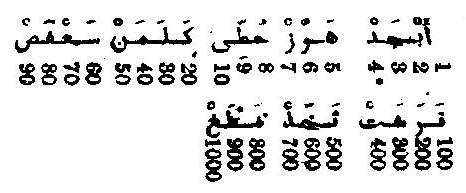
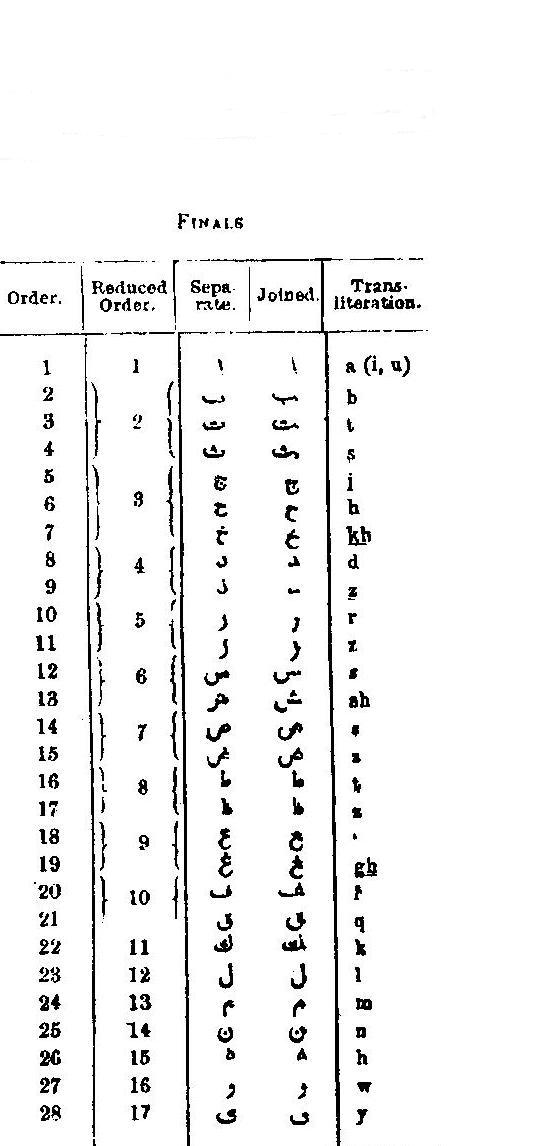
682
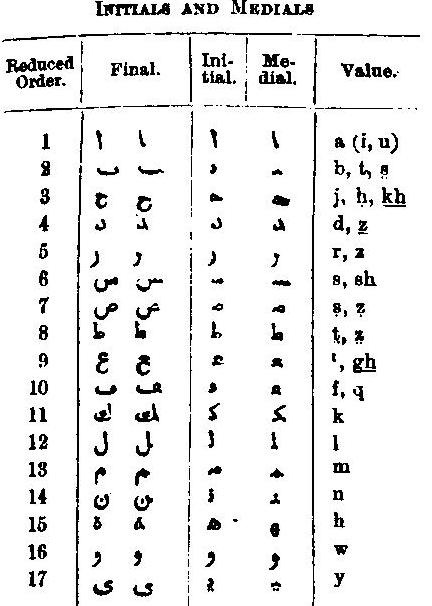

 and
and  do not admit of the horizontal prolongation towards the left which serves to connect a letter with a following one, or, in other words, that they can only be joined to a preceding letter, and that the characters 14 and 17, viz.
  and
and  , in their initial and medial form, differ from the character b only by the superadded dots, and may therefore count for one with it, finally limiting the number of characters to fifteen. Thus the whole Arabic alphabet resolves itself into the four signs


 represents five different sounds, b, t, s, n, and y;
the second
represents five different sounds, b, t, s, n, and y;
the second  three sounds, h, j, and kh; the neat five
 , together with
  and two sounds each, s and sh, s and z, and z, t and gh, f and q, d and z, r and z, respectively, and only five out of the whole number of fifteen
  are single
signs for a single consonantal sound each. As for the vowels, only the long ones, a, u, and i, were in this system of writing graphically expressed, being represented by the so called weak consonants,
are single
signs for a single consonantal sound each. As for the vowels, only the long ones, a, u, and i, were in this system of writing graphically expressed, being represented by the so called weak consonants,  and
and  , which, in this case, act as letters of prolongation. Yet the corresponding short vowels, a, u, and i, were of the utmost importance for the correct reading of a text, for the whole system of Arabic inflection is based upon them, and their faulty employment in the recital of the Qur'an would frequently lead to grave mistakes, or, at all events, grievously shock the pious and the learned.
683
 for fathah
  , for zammah and
  for kasrah, is that which we still find in some qf the old Cufic manuscripts of the Qur'an marked in red ink or pigment. We refer the reader to the first specimen of Cufic writing given below (p. 687), which he is requested to compare with the transcript in the modern Arabic character and with our Roman transliteration, when he will readily perceive that the points or dots in the Cufic fragment correspond to the short vowels of the transliteration, while, in the Arabic transcript, they serve to distinguish the consonants. Take, for instance, the point above the second letter of the third word, and it will at once be seen that in the Cufic form it expresses the a after the n of tanazzalat, for it recurs again after the l in the last syllable, and that in the Naskhi character it distinguishes the n
  itself from the preceding double-pointed t
  , both which letters remain without a distinctive sign in the Cufic.
 for an,
  for un, and
  for in. Secondly, we meet with the distinct assertion that the invention of the I'jam or diacritical signs followed that of the nuqat or vowel-points. Nöldeke thinks the reverse
more probable, not only because the letter b
for in. Secondly, we meet with the distinct assertion that the invention of the I'jam or diacritical signs followed that of the nuqat or vowel-points. Nöldeke thinks the reverse
more probable, not only because the letter b  is found already pointed on coins of 'Abdu 'l-Malik, but also because the diacritical signs are in the ancient manuscripts, like the letters themselves, written with black ink, while the vowel-points are always of a different colour. But the early use of a pointed b does not prove that the other letters were similarly marked at the same time.
On the contrary, if such a distinction was once established for the b, which would be
most liable to be confounded with one of its
four sister-forms, the other characters of a
like shape could for some time dispense with distinctive signs, as for an Arabian reader accustomed to hear, see, and think certain
groups of consonants together, and deeply imbued with an instinctive consciousness of the phonetic laws of his language, the danger of mistaking one letter for another would not be by far so great as it appears to us. And as for the argument taken from the different colour of the ink, Nöldeke himself remarks that it was natural to use the same tint for the consonants and their distinctive signs, which forum only a part of them, while the vowel-points are an entirely new element.
is found already pointed on coins of 'Abdu 'l-Malik, but also because the diacritical signs are in the ancient manuscripts, like the letters themselves, written with black ink, while the vowel-points are always of a different colour. But the early use of a pointed b does not prove that the other letters were similarly marked at the same time.
On the contrary, if such a distinction was once established for the b, which would be
most liable to be confounded with one of its
four sister-forms, the other characters of a
like shape could for some time dispense with distinctive signs, as for an Arabian reader accustomed to hear, see, and think certain
groups of consonants together, and deeply imbued with an instinctive consciousness of the phonetic laws of his language, the danger of mistaking one letter for another would not be by far so great as it appears to us. And as for the argument taken from the different colour of the ink, Nöldeke himself remarks that it was natural to use the same tint for the consonants and their distinctive signs, which forum only a part of them, while the vowel-points are an entirely new element.
684
 , or of horizontal lines
  , or of triangular points, either resting on their basis or with their apex turned to the right
  . As it cannot be our intention to give here an exhaustive treatise on Arabic writing, we pass over the remaining orthographical signs made use of in the old copies of the Qur'an, in order to say a few words on the system of notation which is employed in the Naskhi character and our modern Arabic type.
 and
and  taken as letters of prolongation.
 from the
  is at once evident. The sign for the fathah or a
  differs only by its slanting position from the
685
 assumes frequently in such words as
  for
for  and the kusrah or a
  is derived from the bend towards time right which the letter
  takes in its older shape
  . The Tanwin was then, as in the Cufic writing, expressed by doubling the signs for the simple vowels:
  .... for an,
  or
or  for un, and
  for in.
 of which its sign
  is the abbreviated form. If the latter assertion needed proof against, the erroneous opinion, put forth by some writers, that the Hamzah is derived from the
  , this proof would be afforded by the following anecdote. The Khalifah Harunu r-Rashid was sitting one day with a favourite negro concubine, called Khalisah, when the poet Abd Nawas entered into his presence and recited some verses in his praise, Absorbed in conversation with the fascinating slave-girl, the Khalifah paid no attention to the poet, who, leaving him in anger, wrote upon ar-Rashid's door:-

 in the word
 (za'a "is lost" or " thrown away"), changing it thereby into
  (zaa'a), written with the Hasnzah and entirely different in meaning. For when the Khalifah asked "What have you written upon the door?" the answer was now:
 amir, " a commander or chief," the initial a remains the same, whether the word begins the sentence or is proceeded by another word : we say
  amirun qala, "a commander said" (according to the Arabic construction literally "as for a commander, he said "), as well as
  qala amirun, "there said a commander" (in Arabic literally "he said, namely, a commander "). Here the Hamzah
  , with the Alif
  as its prop and the fathah or a .is its vowel, is called Hamzatu 'l-Qat', because in the letter case it-disjoins or cuts off, as it were, the initial a of the word amirun from the final a of the word qala; and the same holds good if the Hamzah is pronounced with i, as in
  imarah, "commandership.' or with u, as in
  umara, "commanders," plural of amir. But it would ho otherwise with the a of the article
  al if joined
with the word amir. In
al if joined
with the word amir. In  al-amiru qala, "the commander said," it would preserve its original sound, because it begins the sentence; but if 'we invert the order of words, we must drop it in pronunciation altogether, and only sound the final a of qala instead, thus: qalo 'l-amiru, "said the commander," and the same would take place if the preceding word terminated in another vowel, as yaqdlu 'l-amiru "says the commander," or bi-qauli 'l-amiri, "by the word of the cornmander." Here the Hamzah would no longer be written
  but
but  , and would be called Hamzatu 'l- Wasl or Hamzatu 's-Silah, because it joins the two words together in closest connection.
 uskut, "be silent"). But the reader must always keep in mind that it preserves this original pronunciation only at the beginning of a sentence; if it is preceded by any other word, the final vowel of that preceding word takes the place of the Hamzah, and if this word terminates in a consonant, the Hamzah is generally pronounced with i. We say generally because the only exceptions are after the preposition
  min, where it is
686
 kum and
  hun, where it takes u.
 , pronounced
  , instead of
  , and the upper horizontal sign is called Maddah or Madd, "lengthening," "prolongation." While thus the Maddah is the sign for the doubling of an Alif, the Tashdid (
 is the sign for the doubling of a consonant
 or
or  , named Jazmah (cutting off) or Sukun (rest), is placed above it, and the consonant is called "quiescent" (sakinah), in contradistinction from a "moved" consonant (muharrakah), that is, one sounded with a vowel (barakah "motion").
 is an abbreviated form of the letter 'Ain
  . In similar manner, the sign for the Hamzatu 'l-Wasl or Hamzatu 's-Silah
  is an abbreviated form of the initial
  s of the word Silah. The sign for the Maddah
  , as written in old manuscripts, seems to be a stretched out form for the word Madd
  itself, and the sign for the Tashdid
  represents the initial
  of the word Shiddah, which is the technical term for it. The original sign for the Jazmah
  is the ciphers or zero, employed to indicated the absence of vowel sound. A native Arab scholar of out days, the late Nasif al-Yaziji of Beyrout, has combined the vowel marks as well as the last-mentioned orthographical signs in the words:

 and
and  ), and the dot as a diacritical sign, contain the whole system of Arabic writing, as it were, in a nut-shell.
 ; but as the critical points were not marked in al-Farazdaq's letter, Tamim was at a loss whether to read Hubaish or Khunais
  , and solved the difficulty by sending home all soldiers whose names contained the dubious letters. A more tragical event is recorded by Haji Khalifah, to which we would fain apply the Italian saying: Sè non è vero è ben trovato. The Khalifah al-Mutawakkil is said to have sent an order to one of his officials to ascertain the number of Zimmis in his province, and to report the amount. Unfortunately, "a drop fell," as the Arabic original expresses it, upon the second letter of the word
  (ahsi, "count"), and the result was, that the officious functionary submitted the ill-fated Zimmis to a certain painful and degrading operation, in consequence of which they all died but two.
687
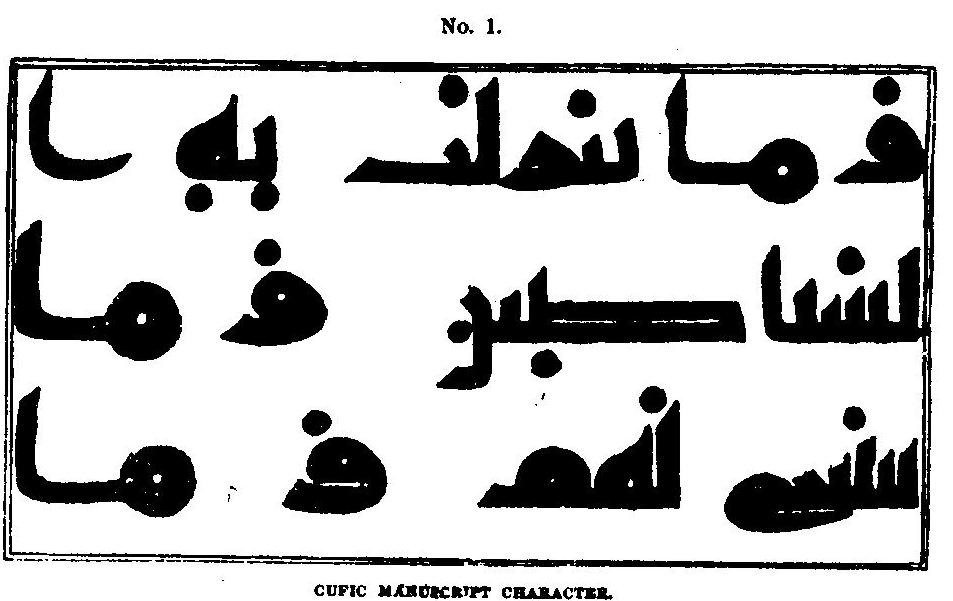
Sanbaghi la-hum wa ma (yastati'una).
688




 of the word tastakhiffu is left without the diacritical point which distinguishes this letter from the letter
  . This tallies with a remark of Hall Khalifah, according to which the diacritical point; of these two letters may be put or omitted ad libitum; and we seem therefore justified in concluding that the necessity for their distinction was latest felt and provided for. Hence arises one of the peculiarities which at once mark the difference between the Western and Eastern styles of writing, and which the reader will observe in the next three specimens presenting instances of the Maghrib manuscript character.
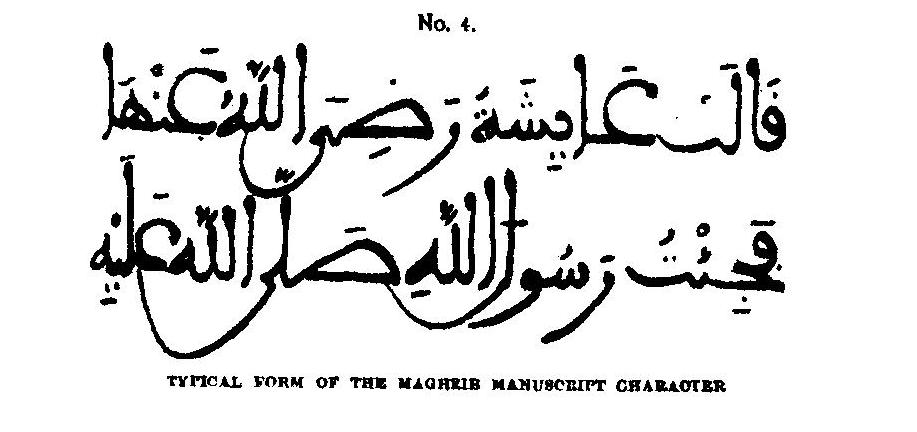
689
I went to the Apostle of God, may God's blessing be upon him," &c.
 (in qalat), the other
  (in fa- ji'tu): but in the Maghrebian original, the former is marked by a dot above, the latter by a dot beneath the
character instead of the superscribed double and single point respectively is the transcript. This is the distinguishing feature between the two styles previously alluded to, and it seems to prove that the use of the diacritical points for these two letters is of late origin, and dates from a time when the two great divisions of the nation had definitely separated and followed each their own destinies. Another point to which we draw attention, is the different form of the Tashdid, as seen in the word Allahr, The Maghrib form is
(in fa- ji'tu): but in the Maghrebian original, the former is marked by a dot above, the latter by a dot beneath the
character instead of the superscribed double and single point respectively is the transcript. This is the distinguishing feature between the two styles previously alluded to, and it seems to prove that the use of the diacritical points for these two letters is of late origin, and dates from a time when the two great divisions of the nation had definitely separated and followed each their own destinies. Another point to which we draw attention, is the different form of the Tashdid, as seen in the word Allahr, The Maghrib form is  instead of
  ; and while in the Oriental writing the vowel signs are placed over it, the Western style places the sign for the Tashdid and for the vowel frequently side by side, as it is done here.

Wa 'l-waqtu zaiyiqun wa 't-tairibatu khatirun wa 'l-qaza u 'asrin.
Time is narrow, experience dangerous, judgment difficult.'"
690
La yashraba lakinna-hu in shariba wa nama ba'da shurbi-hi fa'inna-hu ajwadu min an la
Yamana wa zalika li-anna 'n-nauma yatadaraku zarara 'sh-shurbi wa zalika anna 'l-'adata lam
Tajri bi-'sh-shurbi li-'l-laili fa 'iza shariba fi-hi fa-la mahalata anna zalika 'sh-shurba yahdisu
Fi –l-hazmi fajajatan wa fasadan ka-hali 'l- ma I 'l-baridi iza subba fi qardin
Fi-ha ta 'amun wa huwa yaghli 'ala 'n-nari.
to satisfy his desire. If, however, he drinks, and sleeps after drinking, it is better
than not to deep, this being so because sleep counteracts, in this case, the evil effect of drinking;
for it is not customary to drink at night-time, and if one does so, this will of necessity produce
a disturbance and derangement in the digestion, just as if cold water were poured into a vessel
containing food that is being boiled."
 (d) and,
  (z) take in the Magbrib character, as in the words ajwadu towards the end of the second line, and ya'zan near the beginning of the first.
Anni a'lama ghaiba 's-samawati wa 'l-arzi wa a'almu ma tabduna
Wa ma kuntum taktumuna. Wa iz qulna li-'l-mala i-kati 'sjudu.
That I know the hidden things of the heavens - and of the earth, and know what ye bring to light,
And 'what ye hide?' And when we said to the angels: 'Bow down' …."
691

 (m) of the words
  (al-adamu) and
  (al-ma'i), in the Sulus fragment, the letter is written a second time in a smaller character, and that, moreover, in the word
  it is surmounted by the sign
  , which in Maghrib writing, as we have seen, generally represents the Tashdid. This is done in the above-mentioned ornate styles, especially with those letters which admit of diacritical points, viz.
  , &c. To indicate that no such diacritical point is intended, the sign
  is placed on the top of the letter, or to make still surer of preventing
a mistake, the letter itself is repeated in a
minute shape at the bottom. Only the letter
is placed on the top of the letter, or to make still surer of preventing
a mistake, the letter itself is repeated in a
minute shape at the bottom. Only the letter  (h), as distinguished from
  (t), is, in this case.
written above the line, because it frequently occurs as abbreviation of
(t), is, in this case.
written above the line, because it frequently occurs as abbreviation of  huwa, "He," or
  Allah, "God," and it would therefore be considered irreverential towards the Deity to write it beneath the other Letters. As a feature common to this division of the Eastern Arabic manuscript style, we lastly point out the inclination of the characters from the left to the right, in contradistinction both to
the Maghrib and Ta'liq writing, where the letters are traced perpendicularly, or even with a slight bend from the right to the left.
Allah, "God," and it would therefore be considered irreverential towards the Deity to write it beneath the other Letters. As a feature common to this division of the Eastern Arabic manuscript style, we lastly point out the inclination of the characters from the left to the right, in contradistinction both to
the Maghrib and Ta'liq writing, where the letters are traced perpendicularly, or even with a slight bend from the right to the left.
692
Ki namam ba niku barand bar zaban.
With right fair fame my name -will live for aye!"
693
 . An existence. Philosophers say existences are of three kinds :—
  .
"Standing."
A name given to those ceremonies of the Pilgrimage which are performed on Mount
'Arafat. (Burton, Pilgrimage, vol. ii. p. 883.)
.
"Standing."
A name given to those ceremonies of the Pilgrimage which are performed on Mount
'Arafat. (Burton, Pilgrimage, vol. ii. p. 883.)
 .
The ablution made before saying the appointed prayers. Those which are said to be of divine institution are four in number, namely: to wash (1) the face from the top of the forehead to the chin, and as far as each ear; and (2) the hands and
arms up to the elbow (3) to rub (masat) with the wet hand a fourth part of the head; also (4) the feet to the ankles. The authority for these actions is the Qur'an, Surah v. 8: "O Believers! When ye address yourselves to prayer, wash your hands up to the elbow, and wipe your heads and your feet; the Shi'ahs are apparently more correct, for they only wipe, or rather rub, (masah) them. In these ablutions, if the least portion of the specified part is left untouched, the whole act becomes useless and the prayer which follows is vain.
.
The ablution made before saying the appointed prayers. Those which are said to be of divine institution are four in number, namely: to wash (1) the face from the top of the forehead to the chin, and as far as each ear; and (2) the hands and
arms up to the elbow (3) to rub (masat) with the wet hand a fourth part of the head; also (4) the feet to the ankles. The authority for these actions is the Qur'an, Surah v. 8: "O Believers! When ye address yourselves to prayer, wash your hands up to the elbow, and wipe your heads and your feet; the Shi'ahs are apparently more correct, for they only wipe, or rather rub, (masah) them. In these ablutions, if the least portion of the specified part is left untouched, the whole act becomes useless and the prayer which follows is vain.
Answering Islam Home Page