Page 190
THE BIOGRAPHY OF MAHOMET, AND RISE OF ISLAM.
CHAPTER SIXTH.
From the Tenth Year of the Mission of Mahomet to the Hegira;
viz. from the Fiftieth to the Fifty-third Year of his Life.
Mahomet and his party remained in the Skeb of Abu Talib for three years; - from 617-618 to 619-620 A.D.
In the beginning of the tenth year of his Mission (the fiftieth of his life), Mahomet and his kinsmen were still shut up in the isolated quarter of
Abu Talib. The only interval of freedom and relief, as has been already stated, occurred at the annual pilgrimage. Buying and selling, giving and receiving in marriage-all the intercourse of social life, was totally suspended between them and the rest of the Coreish. The Hashimites were thus virtually blockaded for the space of two or three years.
The sympathy of their opponents excited
At last the sympathies of a numerous section of of the Coreish were aroused. They saw in this form of persecution something more than a conscientious
struggle against an impostor. The justice of extending the ban to the whole Hashimite stock seemed doubtful. Many, especially those related to
the family, began to grieve at the rupture.
Abu Talib acquaints the Coreish that
It was discovered by some of the friends of Mahomet that the parchment in the Kaaba, on
Page 191
which the ban was engrossed, had been almost entirely devoured by insects.
their deed had been eaten by insects; and upbraids them
The important news was told to Mahomet; and Abu Talib resolved to
found thereon an effort for the dissolution of the league. The venerable chief now more than four-score years of age,1 issued forth from his closed quarter, and proceeded, with a band of followers, to the Kaaba. Addressing the chief men of the Coreish, as usual assembled there, he said,- "Intelligence hath reached me that your parchment hath been eaten up of insects. If my words be found true, then desist from your evil designs; if false, I will deliver up Mahomet that ye may do with him
as ye list." The whole company agreed that it should be thus. So they sent for the document; and when they had opened it out, they saw that it was even as Abu Talib had said; a great part had been devoured by white-ants and was no longer legible. Abu Talib, perceiving their confusion, bitterly upbraided them with inhumanity and breach of social obligation. He then advanced with his band to the Kaaba, and standing behind the curtain, prayed to the Lord of the Holy House for deliverance from
their machinations. Having done this, he retired again to his abode.
The Hashimites released from their imprisonment 619-620 A.D.
The murmurs of the party that favoured the
Hashimites, now found an opportunity of effective
utterance. The partizans of the Prophet were
Page 192
emboldened. The Coreish had hardly recovered from surprise at the sudden appearance and sudden departure of Abu Talib, when five chief men rose
up from their midst, and declaring themselves inimical to the league, put on their armour, and proceeded to the quarter of Abu Talib. Standing by, they commanded all that had taken refuge there to
go forth to their respective homes in security and peace. So they went forth in the tenth year of the prophet's mission. The Coreish, confounded by the boldness of the stroke, offered no opposition.
They perceived that a strong party had grown up who would resent by arms any attempt to lay violent hands upon the Moslems.2
The version in the text is chiefly from the Secretary of Wackidi,
(p.40,) with the omission only of the fiction that God had communicated to his prophet the information that the document had
been eaten up all except the words "in the name of God," with
which (according to the ancient Meccan custom, Tabari, p.147,)
it commenced, and that Abu Talib told this to the Coreish.
Two separate traditions are given both by Hishami and Tabari.
One as above. The other that the five chiefs had preconcerted a
plan for the dissolution of the league. Repairing to the place of
concourse, each began, as if independently, to speak against the
ban, ant' the Coreish were already influenced by their appeal,
when Mutim arose to tear up the document, and found that it
had been eaten up. Hishami, p.118; Tabari, p.145.
Page 193
Domestic trials
Repose and liberty followed the breaking up of the
hostile league; but they were not long to be enjoyed
by Mahomet. In a few months he was visited by
trials more severe than any that had yet befallen
him. The tenth year of his mission (the third
before the Hegira) had not yet passed when Khadija
died; and five weeks later he lost his protector Abu
Talib also3.
I have endeavoured to weave both versions into the likeliest historical form. Weil supposes the document to have been destroyed during the night by some partizan of Mahomet. But this could hardly have been done. The ravages of white ants are not thus easily counterfeited: they have a peculiar appearance.
The Katib al Wackidi says (p.23,) that Khadija died after
Abu Talib a month and five days: Ibn Coteiba also, that she died
after him three days. The authorities, however, quoted in the
Mowahiballadoniya, give Ramadhan (December 619,) as the date
of Khadija's death, and Shawwai (January 620,) for that of Abu
Talib. Sprenger is not clear; in one place (p. 196, note 2,) he
says that "Khadija died after Abu Talib;" but in the next page,
"one month and five days after his wife he lost 'his uncle and
protector, the noble-minded Abu Talib."
The middle of Shawwai is the date generally agreed upon for
Abu Talib's decease (Katib al Wackidi p.23); and the end
of the same month, or about a fortnight later, as the period when
Mahomet, downcast and distressed by the two bereavements, set
out for Tayif. We must therefore either suppose that Khadija
died within this fortnight, i.e. within the last fifteen days of
Shawwai, or that she died before Abu Talib. Ibn Coteiba’s tradition that she died three days after Abu Talib, would be consistent' with the former supposition. But this is unlikely; and
moreover the interval between the two deaths is generally represented as thirty-five days. Katib al Wackidi, pp. 23, 40.
Page 194
Death of Khadija, December, 619 A.D.
The death of his wife was a grievous affliction. For five-and-twenty years she had been his counselor and support; and now his heart and home were left desolate. His family however no longer needed her maternal care. The youngest daughter, Fatima, was approaching womanhood,4 and an attachment was perhaps already forming with Ali, her father's nephew, and adopted son. Though Khadija (at her death threescore and five years old) must long ago have lost the charms of youth, and though tire custom of Mecca allowed polygamy, yet Mahomet was, during her lifetime, restrained from other marriages by affection and gratitude, and perhaps also by the wish to secure more entirely for his cause the influence of her family. His grief at her death at first
was inconsolable, for he was liable to violent and deep emotion; but its effects were transient. The place of Khadija could be filled, though her devotion and virtues might not be rivalled, by numerous successors.5
In this view, it seems more natural to adopt the alternative that
sire died in the first half of Ramadhan (December 619); that
Abu Talib died in the middle of Shawwai (January 620): and that Mahomet, overcome by despondency at these successive bereavements, and by the renewed opposition of the Coreish, set out for Tayif the end of the latter month.
Page 195
Death of Abu Talib, January, 620 A.D.
The loss of Abu Talib, who lived and died an death of an unbeliever, was, if possible, a still severer bereavement. We may dismiss without much attention
the legend that on his deathbed, in reply to the earnest appeal of his nephew, he declared that he was prevented from giving his assent to the creed of Islam only because he feared the imputation of terror at the approach of death6. Whatever he may have said to comfort Mahomet, his whole life belies the accusation that the apprehended contempt of the Coreish restrained him from avowing his convictions; The sacrifices to which Abu Talib exposed himself and his family for the sake of his nephew, while yet incredulous of his mission, stamp his character as singularly noble and unselfish. They afford at the same time strong proof of the sincerity of Mahomet. Abu Talib would not have acted thus for an interested deceiver; and he had ample means of scrutiny.
The loss of Abu Talib severely felt
When the patriarch felt that life was ebbing, he summoned his brethren, the sons of Abd al Muttalib around his bed, commended his nephew to their protection; and, relieved of this trust, died in peace7. Mahomet wept bitterly for his uncle;
Page 196
and not without good reason. For forty years he had been the prop of his childhood, the guardian of his youth, his tower of defence in later life. The
place of Khadija might be supplied, but not that of Abu Talib. "is very unbelief rendered his influence the stronger. So long as he survived, Mahomet needed not to fear violence or attack. But there was no strong hand now to protect him from his foes.
Abu Lahab for a short time protects Mahomet
Grieved and dispirited by these bereavements following so closely one upon the other, and dreading the unrepressed insolence of the Coreish, Mahomet kept chiefly at home, and seldom went abroad8. The dying behest of Abu Talib had now an unexpected
in scepticism. Katib al Wackidi p. 23. See also Sura 115. This verse however occurs in one of the latest Suras; there is no reason to believe that the rule enunciated in it had yet been given forth before the Hegira, though the system was fast tending towards it.
It is also said that Mahomet wept and commanded All to wash his father's corpse, and place it in the winding sheet, and bury him. Katib al Wackidi, Ibid. But this looks like one of the Alyite traditions, which would refer all important commissions to Ali. It is not probable that the last services to a man of Abu Talib's position, surrounded by brothers and sons, would be left
to Ali alone, acting under Mahomet's orders.
Page 197
effect; for Abu Lahab, heretofore the avowed enemy of Mahomet, was softened by his despondency and distress, and spontaneously became his guardian. "Do," he said, "as thou hast been in the habit of doing, while Abu Talib was yet with us. By Lat! no one shall hurt thee while I live." But
tire generous pledge was not long observed. Abu Lahab was gained over by the Coreish to their party, and Mahomet left to protect himself as he best could9.
Critical position of Mahomet
The position of the Arabian Prophet now was critical. He must either gain the ascendancy at Mecca, abandon his prophetical claims, or perish in the struggle. Islam must either destroy idolatry, or idolatry must destroy Islam. Things could not remain stationary. His followers, though devotedly attached, and numbering a few once influential citizens, Were but a handful against a host. Open
Whatever may have been the immediate cause, It is evident that Abu Lahab soon was led again to abandon his nephew through the instigation of the evil-disposed Coreish.
Page 198
hostilities, notwithstanding every endeavour to prevent them, might any day be precipitated, and ruin irretrievably his cause. The new faith had not
been gaining ground at Mecca There had been no conversions, none at least of any note, since those of Omar and Hamza, three or four years before. A few more years of similar discouragement, and his chance of success was gone.
He resolves to make trial of the Bani Thackif at Thaif
Urged by such reflections as these; Mahomet began to look around him. The Meccans knew not the day of their visitation, and had well nigh sealed
their doom. It was perhaps the will of the Lord that succour and salvation should come from some other people. Tayif (sixty or seventy miles to the east of Mecca) was the nearest city of importance. It might be that God would turn the hearts of its inhabitants, the idolatrous. Thackifites, and use them as his instruments to chastise the Meccans, and establish his religion on the earth. To them, accordingly, he resolved to deliver his message.
His journey thither January and February, 620 A.D.
Abu Talib had been buried hardly a fortnight, when Mahomet, followed only by the faithful Zeid, set out on his adventurous mission10. His road (as far as Arafat it was the pilgrim's route) lay over
Page 199
dismal rocks and through barren defiles for about forty miles, when it emerged on the crowning heights of Jebel Kora, with its rich gardens and charming
prospect. Thence, descending through fertile valleys, the smiling fruits and flowers of which suggested perhaps the bright picture of the conversion
of the Thackifites, he advanced to their city. Though connected by frequent intermarriage, the inhabitants of Tayif were jealous of the Coreish11.
They had a Lat, or chief idol, of their own. It might be possible, by appealing to their national pride, as well as to their conscience, to enlist them on the side of Islam against the "people of Mecca. Mahomet proceeded to the three principal men of the city, who were brothers12; and, having explained his mission, invited them to claim the honour of sustaining the new faith, and supporting him in the face of his hostile tribe.
He fails in gaining over its chief men, and is ignominiously expelled from the city
But he failed in producing conviction. They Cast in his teeth the common objections of his own people, and advised that he should seek protection in some other quarter13.
Page 200
Mahomet remained in Tayif for about ten days; but, though many of the influential men came at his call, no hopeful impression was made upon them.
Thus repulsed, he solicited one favour only, that they would not divulge the object of his visit, for he feared on his return the taunts and aggravated
hostility of the Coreish. But this, even if it had been possible, the men of Tayif were little likely to concede. For the first few days, perhaps, the com-
mon people regarded with awe the Prophet who had turned Mecca upside down, and whose preaching probably many had heard at the pilgrimage or fairs. But the treatment he was receiving at the hands of their Chiefs, and the disproportion to the outward eye between the magnitude of his claims and his solitary helpless condition, turned fear into contempt. They were stirred up to hasten the departure of the unwelcome visitor. They hooted him in the streets; they pelted him with stones; and at last they obliged him to flee out of their
city, pursued by a relentless rabble. Blood flowed from wounds in both his legs; and Zeid, endeavouring to shield him, received a" severe injury in his
head. The mob did not desist until they had chased him two or three miles across the sandy plain to the foot of the hills that surround the city.
There, wearied and mortified, he took refuge in one of the numerous orchards, and rested under a vine14.
Page 201
Rest at a garden in the outskirts
Hard by was the garden of two of the Coreish, Otba and Sheyba; for the wealthy Meccans had their pleasure grounds (as they still have) near Tayif15. They watched the flight of Mahomet; and, moved with compassion, sent a tray of grapes for his refreshment16. Their slave, a Christian from Nineveh, who brought the fruit to him, was charmed by the pious style of the Prophet's address; and Mahomet was perhaps solaced more by the humble devotion of Addas than by the grateful shade and juicy grapes17. After a little, composed and re-assured, he
encircle the sandy plain. I did not see any gardens, nor even a
single tree within the walls; and the immediate neighbourhood is
entirely destitute of verdure." The nearest gardens appeared to
be on the S. W. side, at the distance of about half or three
quarters of an hour." Burkhardts Travels in Arabia, p.85.
The quarter from which Mahomet made his escape would be
the west; so that he would probably have at least some three
miles of sandy plain to cross before he secured his retreat to
one
of the gardens.
Page 202
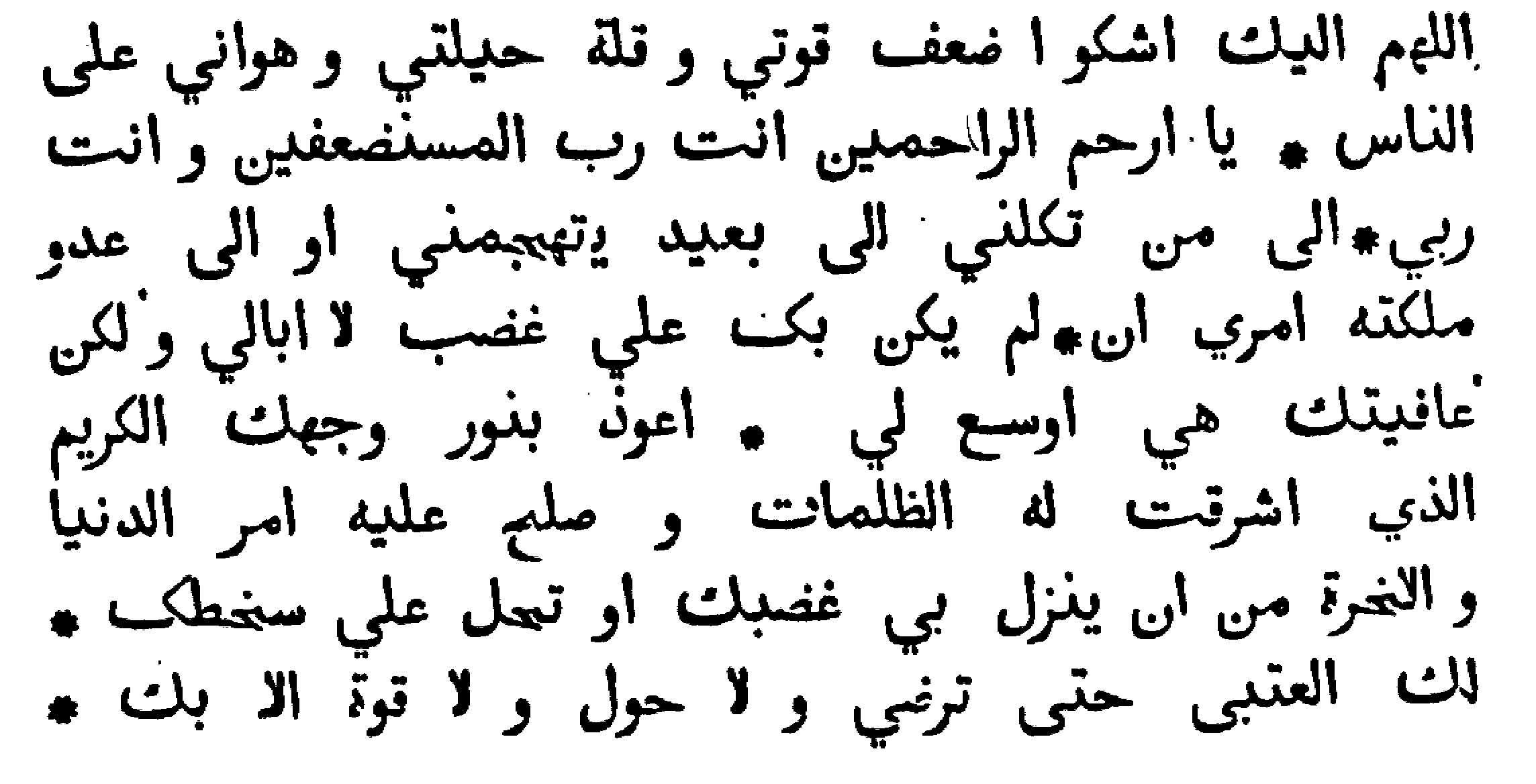
betook himself to prayer, and the following touching and plaintive petitions are still preserved as those in which his burdened soul gave vent to its
distress.
His prayer
Oh Lord! 18 I make my complaint unto Thee of the feebleness of my strength, and the poverty of my expedients; and of my insignificance
"And of what country" said Mahomet "art thou, and what is thy? "A Christian of the people of Nineveh." "Ah!" replied Mahomet, "the people of the righteous Jonas the son of Mattail" "And, what" rejoined the slave, "hath made thee acquainted with Jonas son of Mattai?" "He was my brother; for he was a prophet, and I too am a prophet." Whereupon Addas fell to kissing the head and hands and feet of Mahomet, to the astonishment of his masters who were looking on from a distance.
The story in this form is of course apocryphal; and I should have omitted the incidents regarding Addas altogether, but that it is difficult to conceive how they could have found their way into this particular part of the history, without some foundation of fact. It is probable therefore that Mahomet did meet and converse with a Christian slave on this occasion.
Page 203
before mankind. Oh Thou most Merciful! thou art the Lord of the weak, and thou art my Lord. Into whose hands wilt thou abandon me? Into the hands of the strangers that beset me round? or of the enemy to whom thou hast given the mastery over me? If Thy wrath be not upon me, I have no concern; but rather thy favour is the more wide unto me. I seek for refuge in the light, of thy
gracious countenance, by which the darkness is dispersed, and peace ariseth both for this world and the next, that thy wrath light not upon me, nor
thine indignation. It is thine to show anger until Thou art pleased; and there is not any power or resource but in Thee."
Audience of the Genii at Nakhla
Re-invigorated by the pause, he set forth on his journey homewards. About half way, l9th to return to Mecca, he halted in the valley of Nakhla, where was an idol-temple, a grove, and a garden19.
There was there an image of Uzza, held in estimation by the Coreish and other tribes, and destroyed after the taking of Mecca; Katib al Wackidi p. 129; Hishami, p. 371; M.C. de Perceval vol. i. p.280, vol. LLL. p.24l. Its position is farther marked by the "engagement bf Nakhla" in the sacrilegious war during the youth of Mabomet. The Hawazin pursued the Coreish from the
Page 204
There, as he arose at night to prayer, or perhaps as he dreamed, his nervous and excited imagination pictured crowds of Genii pressing forward to hear his exhortations, and ardent to embrace Islam. The romantic scene has been thus perpetuated in the Coran:-
"And call to mind when We caused a company of the Genii to turn aside unto thee that they might listen to the Coran. When they were present at the recitation thereof, they said Give ear. And when it was ended, they returned unto their people, preaching. They said,- Oh our People! verily we have been listening to a Book which hath been sent down since Moses, attesting the Truth of the Scripture preceding it. It guideth unto the Truth, and into the straight Path. Oh our People!
Obey the Summoner from God, and believe in him, that he may forgive you your sins, and save you from an awful punishment20.
fair of Ocatz to this spot, which was within the sacred limits around Mecca, or at least close upon them ;- See chap. ii. p.2; M.C. de Perceval, vol. i. p; 807.
It may probably be the same as the "Wady Mohram," noticed by Burkhardt as the point in the direction of Tayif at which the pilgrims assume the Ibram or pilgrim garb; (p 67). The supposition is, perhaps, confirmed by the fact that the party sent by Mahomet to Nakhla shaved themselves there, to, deceive the caravan they were about to attack into the belief that they were peaceable pilgrims. Wady Mohram, like the Nakhla of Mahomet's time, has still fruit trees and gardens. The Katib al Wackidi's statement that there was a garden at Nakhla proves that it was on the Tayif side of the mountain range; since all on the Meccan side is barren.
On the whole M. C. de Perceval's description of Nakhla as "midway between Mecca mid Tayif (vol. iii. p.34,) may be accepted as pretty accurate.
Cnf Sprenger's "First notice of A. von Kremer's Wackidi," Asiatic Society's Journal, 1866, p. 15, which I did not see till the above had been written.
Page 205
Mahomet returns to Mecca
After spending some days at Nakhla, he again
proceeded toward Mecca. But before entering the
city, which he feared to do (now that the object of
SAY; it hath been revealed to me that a company of Genii
listened, and they said,- "Verily we have heard a marvellous discourse (lit.
Coran;) It leadeth to the right direction; wherefore we believed therein, and we will not henceforth associate any with our Lord;
And as to Him,- may the Majesty or our Lord be exalted! - He hath taken no Spouse, neither hath He any Offspring. But verily the foolish people amongst us have spoken of God that which is unjust; And we verily thought that no one amongst men or Genii would have uttered a lie against God.
And truly there are people amongst Men, who have sought for
refuge
unto people among the Genii, but they only multiplied their
folly.
And they thought, as ye think, that God would not raise any from
the dead.
And we tried the heavens, but found them filled with a powerful
Guard,
and with flaming Darts;
And we sat on some or the Stations to listen, but whoever listeneth
now
findeth an ambush of flaming Darts.
And truly we know not whether evil be intended for them that are
on
Earth, or whether their Lord intendeth for them right direction
And there are amongst us righteous persons, and amongst us person.
of another kind ;-we are of various sorts:
And verily we thought that no one could frustrate God on earth,
neither
could we escape from him by flight;
Whencefore when we heard the direction, we hollered
therein."- (and a
On, the Genii speaking as true Moslems.)
And verily when the servant of God (Mahomet) stood up to call upon
Him, they (the Genii) were near jostling him by their numbers,
&C.
Notwithstanding the crowds of genii here alluded to, Hishami
(whose traditional authorities seem to have had a wonderfully
intimate acquaintance, with the habits and haunts of the Genii,)
states that they were seven Genii belonging to Nisibin, who
happened to pass that way, and were arrested by hearing Mahomet
at his devotions reciting the Coran. Others say they were nine
in number and came from Yemen, or from Nineveh. And it is
added that they professed the Jewish religion! This of course
arose from the reference made by them in the Coran to Moses.
Page 206
his visit to Tayif could not be kept secret) without a protector, he turned aside by a northward path to his ancient haunts in the vicinity of M1ount Hira.21 From thence he despatched two unsuccessful messages to solicit the guardianship of certain influential chiefs. At last he bethought him of Mutim
(one of the five who had been instrumental in procuring the removal of the ban); and sent word beseeching that he would bring him in to the city
under his protection. Mutim assented; and, having summoned his sons and adherents, bade them
buckle on their armour and take their stand by the Kaaba. Mahomet and Zeid then entered Mecca; and, when they had reached the Kaaba,
Mutim stood upright on his camel and called aloud, -
"O ye Coreish! verily I have given the pledge
of protection unto Mahomet; wherefore let not any
one amongst you molest him." Then Mahomet
went forward, kissed the corner stone, and returned
to his house guarded 'by Mutim and his party.
The generosity and faithfulness of Mutim 22 have
The modem traditions on the subject seem to place the site
much nearer Mecca. See Burton, vol. iii, p.353.
Page 207
been perpetuated by Hassan the poet of Medina
and friend of the Prophet.
There is something lofty and heroic in this journey of Mahomet to Tayif; a solitary man, despised
and rejected by his own people, going boldly forth
in the name of God, - like Jonah to Nineveh, - and
summoning an idolatrous city to repentance and to
the support of his mission. It sheds a strong light
on the intensity of his own belief in the divine
origin of his calling.
Mahomet marries Sawda, Feb, March 620 A.D.;
Mahomet sought for solace in the midst of family
bereavement and public indignities, from a double
matrimonial alliance. Sarkan with his wife Sawda,
both of Coreishite blood (but of a stock remote
from Mahomet), early became converts to Islam,
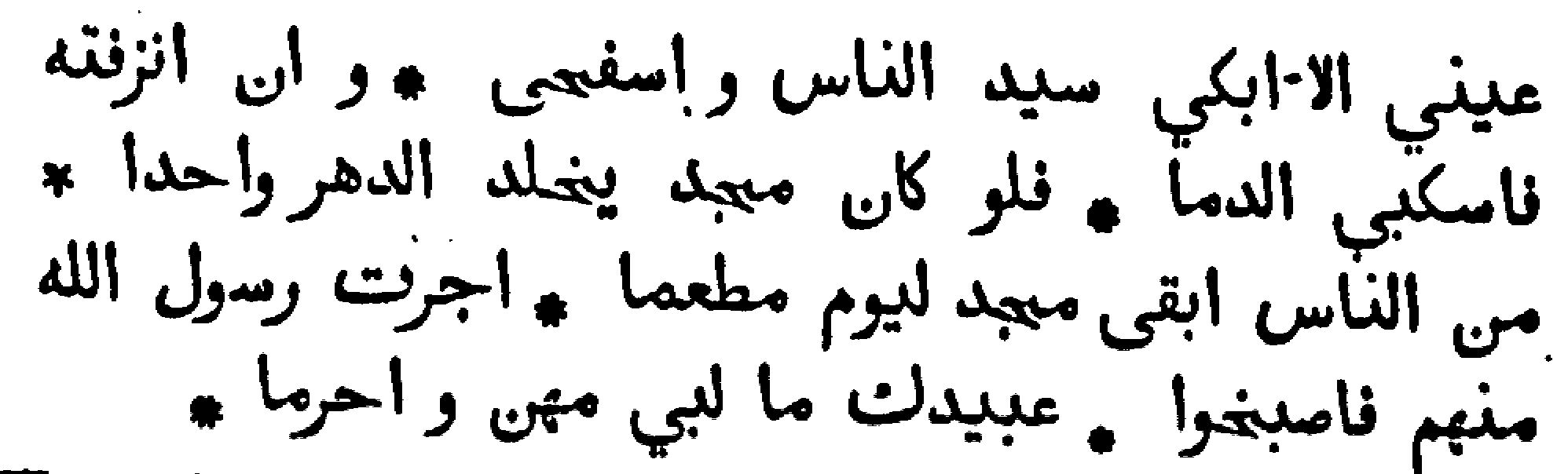
Weep, Oh my eyes, for the chief of men; let tears gush forth; and
when
they run dry, then pour forth blood!
If Greatness had caused any to Survive for ever amongst Mankind,
then
Greatness had preserved Mutim unto this day.
Thou gavest the pledge of protection to the prophet of God from
the
Coreish; and they became Thy servants so long as a pilgrim shall
shout "Labeik!" or assume the pilgrim garb.
Mutim was a Chief descended from Abd Shams the brother or
Hashim (great grandfather of Mahomet;) and, along with Harb,
commanded his tribe in one of the great battles in the
Sacrilegious War, 586 A.D.. M.C, de Perceval, vol.i. p.309.
Page 208
and emigrated to Abyssinia. They had lately returned to Mecca, where Sakran died. Mahomet now made suit to Sawda, and the marriage (so far
as we know not one of mere interest and convenience, but of affection,) was celebrated within two months from the death of Khadija.23
and is betrothed to Ayesha
About the same time he contracted a second
marriage with Ayesha, the younger daughter of Abu Bakr,----a connection mainly designed to cement the attachment with his bosom-friend. The
yet undeveloped charms of Ayesha could hardly have swayed the heart of Mahomet. Though her betrothed husband had reached fifty, she was but six or seven years of age. Still there may have been something more than ordinarily interesting and precocious about the child, for the real marriage with her took place not more than three years afterwards.
His private means
There is no information as to the terms on which
meant Mahomet continued with the family of his deceased
wife, Khadija; and whether he retained any part of
the property that belonged to her. During the late
Sprenger says she had a son by Sakran; but if so, he did not survive, for Ibn Coteiba says that Sakran left no issue. Supposing Khadija to have died in December, 619 A.D., Mahomet's nuptials with Sawda may have taken place in February or the beginning of March, 620.
Page 209
few troublous years, and especially under the ban, it is probable that her wealth had much diminished. Perhaps it was shared with the poorer brethren. It is certain that during his remaining stay at Mecca the Prophet had not much property at his disposal; and there are even indications (as we shall see below,) that he was straitened in his means. He appears still to have continued to live, at least occasionally, in the quarter, if not in the house, of Abu Talib.24
Light dawns through the darkness
Repulsed from Tayif, and utterly hopeless of farther success at Mecca, the fortunes of Mahomet were enveloped in thick gloom, when hope suddenly dawned from an unexpected quarter.
Mahomet meets at the Pilgrimage a party from Medina, March, 620 A.D.
The season of pilgrimage was at hand; and, as
his custom was, the Prophet plied the crowds of
pilgrims with his solicitations wherever they afforded
a likely audience. The ceremonies were nearly at
an end; Mahomet had followed the votaries of the
Kaaba on their procession to the hill of Arafat, and
now back again to Mina; whence, after sacrificing
their victims, the multitude would disperse to their
homes. Wandering through the busy scene that
now presented itself in the narrow valley of Mina,
he was attracted by a little group of six or seven
Page 210
persons, whom he recognized as strangers from Medina. "Of what tribe are ye?" said he, coming up and kindly accosting them. "Of the tribe of
Khazraj," they replied. "Ah! confederates of the Jews?" "We are." "Then, why should we not sit down for a little, and I wilt speak with you you?" The offer was accepted willingly, for the fame of Mahomet had been noised abroad in Medina, and the strangers were curious to see more of the
man who had created in Mecca so great an excitement. He then expounded to them his doctrine, asserted the warrant of a divine mission, set forth
the difficulties of his position at home, and enquired whether they would receive and protect him at Medina. The listeners were not slow to embrace
the faith of Islam. "But as for protecting thee", said they, "we have hitherto been at variance among ourselves; and have fought great battles, as that of Boath,. If thou comest to us thus we shall be unable to rally around thee.
who believe and spread his cause in Medina
Let us, we pray
thee, return unto our people, if haply the Lord will
create peace amongst us; and we will come back
again unto thee. Let the season of pilgrimage in
the following year be the appointed time." Thus they
returned to their homes, and invited their people to
the faith; and many believed, so that there remained
hardly a family in Medina in which mention was
not made of the Prophet.25
Page 211
Medina prepared by the influences of Judaism and Christianity
This success at Medina, though unexpected, was not without perceptible causes. Numerous and powerful Jewish tribes were settled in the city or its immediate vicinity, and (as we have seen in a former chapter) divided their adherence between the two contending factions of the Aws and Khazraj, whose strife frequently stained with blood the city and its environs.26 "When the Jews used thus to fight with the idolaters at Medina,"- relates Ibn Ishac with much simplicity,-" they would say ;- A ,Prophet is about to arise; his time draweth nigh. Him shall we follow; and then we shall slay you with the slaughter of Ad, and Irem. So when Mahomet addressed the pilgrims of Medina at Mina, they spake one with another - Know surety that is the same Prophet whom the Jews are wont to threaten us with. Wherefore let us make haste and be the first to join him."27 There is truth, though exaggerated and distorted, in this statement. In the close and constant intercourse.
Wackidi mentions six as composing the company, and in another
place eight. It is impossible satisfactorily to reconcile
discrepancy in the names. See Sprenger, p.202. In one tradition it is said that the Prophet first met and spoke with two persons from Medina, not on the occasion of the Iflearly, but of the "Lesser"
or Personal pilgrimage (Omra). It seems, however, more likely,
from Mahomet's being at Mina when he met the Converts, that it
was the Annual pilgrimage, Cnf. Introduction, chap. iii. p. ccv.
Page 212
between the Jews and the Arabs of Medina, the expectation of a Messiah, interwoven throughout the whole life of the former, could not but in
some measure be communicated to the latter. Nor could the idolatrous inhabitants live in daily contact with a race professing the pure theism, and practising the stern morality of the Old Testament,
without being influenced by the practical protest thus continually made against the errors of Paganism as contrasted with the spiritual worship of the one true God. Moreover, Medina was only half the distance of Mecca from the Christian tribes of southern Syria; the poet Hassan, and men of his stamp from Medina, used to frequent the Christian
Court of the Ghassanide king; so that Christianity as well as Judaism wrought probably a more powerful effect upon the social condition of Medina, than elsewhere in Arabia.
Internal strife had neutralized the fear of foreign influence
The city had been long torn by internal war. The sanguinary conflict of Boath, a few years before, had weakened and humiliated the Bani
Khazraj, without materially strengthening the Bani Aws. Assassination had succeeded to open fighting. There was no one bold or commanding enough, to
seize the reins of Government; and the citizens, both Arabian and Jewish, lived in uncertainty and suspense. Little apprehension was felt from the
advent of a stranger; even although he was likely to usurp, or gain permission to assume, the vacant
Page 213
authority. Deadly jealousy at home, had extinguished the jealousy of influence from abroad.
Medina thus ready to accept Mahomet
Such was the position of Medina. A tribe addicted to the superstition of Mecca, yet well acquainted with a purer faith, was in the best state
of preparation to join itself to a reformer of the Kaaba worship. Idolatrous Arabs impressed with the indefinite anticipation of a Messiah, would
readily recognize Mahomet as their Prophet. A city weaned with faction and strife, would cheerfully admit him to their hospitality as a refugee, if not
welcome him to their counsels as a Chief.
Its Inhabitants familiar with his Claims
Looking now to their acquaintance with the new faith, it may be remarked that the politics of Mecca, and the history of the Prophet, could not
be unknown at Medina. The Syrian caravans of the Coreish not unfrequently halted there. Occasional intermarriages took place between the inhabitants of the two cities. Mahomet himself was descended from a distinguished lady of Khazraj birth, espoused by Hashim; and a favourable interest, among that tribe at least, was thus secured.
Abu Cays, a famous poet of Medina, had some time before addressed the Coreish in verses intended to dissuade them from interference with Mahomet and his followers.28 The Jews were already acquainted

Page 214
with the Prophet as a zealous supporter of their
Scriptures. Parties from Medina went up yearly
to the solemnities of the Meccan Temple. A few
had thus come under the direct influence of his
preaching29, and all were familiar with the general
nature of his claims. To this was now superadded
the advocacy of actual converts.30
One, who is his own master, hath chosen a (new) religion; and there is none other keeper over you than the Lord of the heavens;" (that is, it belongs to God alone to call man to account for his religious opinions).
Abu Cays had a Coreishite wife, and had lived some time at
Mecca. When Islam began to spread at Medina, his adverse
influence held back his own tribe (the Aws Monat or Aws Allah)
from joining it. Hishami p. 147; M.C. de Perceval, vol. iii. p.5. He commanded the Awsites at the battle of Boath. M. C. de
Perceval, vol. ii. p. 680.
Thus, before the battle of Boath, a deputation from the Bani
Aws is said to have visited Mecca, to seek for auxiliaries from
among the Coreish in the coming struggle. "And they listened
to Mahomet; and Ayas, a youth of their number, declared that
this was far better than the errand they had come upon; but Abul
Haysar their Chief cast due) upon him, saying, they had another
business than to hear these things." Ayas, who was killed
shortly after in the intestine struggles at Medina, is said to have died a true Mussulman. Hishami, p. 142; Tabari, p.169.
Page 215
The year 620 A.D. one of anxiety and suspense
This was to Mahomet a year of anxiety and expectation. Would the handful of Medina converts remain steady to his cause? Would they be able
to extend that cause among their fellow-citizens? If they should prove unfaithful, or fail of success, what resource would then remain? He might be forced to emigrate to Syria or to Abyssinia; and seek refuge with the Ethiopian Najashy, or amongst the Christian tribes of the northern desert.
Similarly, Suweid, son of Samit, an Awsite poet, came and
repeated to Mahomet the Persian tale of Locman. Mahomet,
eraying that he had something better than that, recited the Coran
to him. The poet was delighted with it; "he was not far from
Islam, and some said that he died a Moslem." Hashami, p 141;
Tabari, p.158.
Anticipations of Islam are supplied by tradition, for Medina as
well as for Mecca. Thus; - "The first that believed were Asad
ibn Zorkra and Dzakwan, who set out for Mecca to contend in
rivalry with Otba son of Rabia. But, on their arrival, Otba said
to them ; - That praying fellow who fancieth himself to be the
prophet of God, hath occupied us to the exclusion of every other,
business. Now Asid and Abul Haytham used to converse at Medina with
teach other, about the unity of God. When Dzakwan, therefore,
heard this saying of Otba, he exclaimed,- Listen, oh Asad! - this
must be thy religion. So they went straight to Mahomet, who
expounded to them Islam, and they both believed and returned to
Medina. And Asad related to Abul Haytham (a resident of
Medina) all that had passed, and he said "I too, am a believer,
with thee" Katib al Wackidi, p.41 1/2. Sprenger adopts this version as the true one, since it corresponds with his theory of the
existence of Islam before Mahomet.
It is admitted on all hands that Asad and Abul Haytham were
forward, and early, in the movement at Medina.
Page 216
The first pledge of Acaba, by the men of Medina, April 621 A.D.
The days of pilgrimage at last again came round,
and Mahomet sought the appointed spot in a
sheltered glen near Mina. His apprehensions were
at once dispelled; for there he found a band of
twelve faithful disciples ready to acknowledge him
as their prophet. Ten were of the Khazraj, and
two of the Aws, tribe.31 They plighted their faith
to Mahomet thus ; We will not worship any but
the One God; we will not steal, neither will we
commit adultery, or kill our children; we will not
slander in anywise; and we will not disobey the
Prophet,32 in anything that is right." This was
afterwards called the Pledge of Women,33 because,
as not embracing any stipulation to defend the
Prophet, it was the only oath ever required from
females. When all had taken this engagement,
Mahomet replied ; - If ye fulfil the pledge, paradise
shall be your reward. He that shall fail in any part
thereof, to God belongeth his concern, either to punish
or forgive. This memorable proceeding is known
in the annals of Islam as TUE FIRST FLEDGE OF
ACABA,34 for that was the name of the little eminence or defile whither they retired from observation.
Page 217
Continued and increasing success of Islam at Medina during 621 A.D.
These twelve men were now committed to the cause of Mahomet. They returned to Medina the missionaries of Islam, again to report their success at the following pilgrimage. So prepared was the
ground, so zealous the propagation, that the new faith spread rapidly from house to house and from tribe to tribe. The Jews looked on in amazement at the people, whom they had in vain endeavored for
generations to convince of the errors of Polytheism
and to dissuade from the, abominations of Idolatry,
suddenly and of their own accord casting away
their idols, and professing belief in the One true
God. The secret lay in the adaptation of the
instrument. Judaism, foreign in its growth, touched
few Arab sympathies; Islam, grafted upon the faith,
the superstition, the customs, the nationality of the
Peninsula, gained, ready access to every heart.
Musab deputed thither to instruct the converts
The leaders in the movement soon found themselves unable to keep pace with its rapid progress. So they wrote to Mahomet for a teacher, well versed in the Coran, who might initiate the enquirers in the rudiments of the new Faith. The youthful and devoted Musab, who had lately returned from exile, in Abyssinia, was deputed for that purpose35. He
Page 218
lodged at Medina with Asad ibn Zorara, who used to gather the converts together to him for prayer and the reading of the Coran. The combined devotions of the Aws and Khazraj tribes were first conducted by Musab; for even in such a matter they were impatient of a common leader from amongst themselves.36 Thus speedily, without let or hindrance, did Islam take firm root at Medina, and attain to a full and mature growth.37
Musab will be remembered as the youth, whose pathetic interview with his mother has been described in chap. iv. p.119.
Asad and Musab on a certain day went to the quarters of the
Awsites, and entering one of their gardens, sat down by a well,
when a company of believers gathered around them. Now Sad ibn
Muadz and Oseid ibn Khuzeir were chief men of the Abdal Ashal (a branch of the Awsites); and they were both idolaters following the old religion. So when they heard of the gathering at the well, Sad, who was unwilling himself to interfere (being related to Asad,) bade his comrade go and disperse them. Oseid seized his weapons, and hurrying to the spot, began thus to abuse them What brings you two men here amongst us, to mislead our youths and silly folk? Begone, if ye have any care for your lives. Musab disarmed his wrath by courteously inviting him to sit down and listen to the doctrine. So he stuck his spear into the round and seated himself; and as he listened, he was charmed with the new faith, and purified himself and embraced Islam. And he said
Page 219
The midnight journey to Jerusalem and the Heavens
The hopes of Mahomet were now fixed upon Medina. Visions of his journey northwards flitted before his imagination. The musings of the day
re-appeared in midnight, slumbers. He dreamed that he was swiftly carried by Gabriel on a winged steed past Medina to the temple at Jerusalem, where he was welcomed by the former Prophets, all assembled for his reception in solemn conclave. His excited spirit conjured up a still more transcendant, scene. From Jerusalem he seemed to mount upwards, and ascend from one Heaven to another; he found himself at last in' the awful presence of his Maker, who dismissed him with the behest that his people were to pray five times
"there is another beside me, even Sad ibn Muadz, whom I will send to you: if you can gain him over, there will not be one in his tribe left unconverted," So he departed and sent Sad, and Musab persuaded him in like manner. And Sad returned to his tribe and swore that he would, not speak to man or woman that did not acknowledge Mahomet:-and so great was his influence, that by the evening every one of the tribe was converted."
"Such were the exertions of Asad and Musab that there
remained not a house among the Arabs of Medina in which there
were not believing men and women, excepting the branches of the
Aws Allah who, owing to the influence of Abu Cays the poet,
continued unbelievers, till after the siege of Medina" Hishami,
p.146; Tabari, p.165.
There is, a story 'of Amr ibn al Jumoh who, like the other chiefs of Medina, had an image in his house. This image the young converts used to, cast every night into a filthy well, and the old man as regularly cleansed it; till, one day, they tied it to a dead dog and cast it into a well. Then the old man abandoned his image and believed. Hishami, p.153.
Page 220
in the day. As he awoke in the morning in the house of Abu Talib, where he had passed the night, the vision was vividly before his eyes; and he exclaimed to Omm Hani, the daughter of Abu
Talib, that during the night he had prayed in the Temple of Jerusalem. While he was going forth to tell the vision to others, she seized him by the mantle, and conjured him not thus to expose himself to the mockery and revilings of the unbelievers.
But he persisted. As the story spread abroad, the idolators scoffed, the believers were staggered, and some are said even to have gone back.38 Abu Bakr supported the Prophet, and declared his implicit belief in the Vision.39 In the end the credit of
Islam among its adherents suffered no material injury.
The Vision subsequently embellished by fancy
The tale is one in which tradition revels with congenial ecstacy. The rein has been given loose to a pious imagination. Both the journey and the ascent to Heaven, are decked out in the most extravagant
Page 221
colouring of Romance, and in all the
gorgeous drapery that Fancy could conceive.40 But
It is said that incredulous idolaters wished to throw him into
confusion by asking for a description of the Temple he had thus been to see: and he was in great straits, until Gabriel placed before him a model of the Temple, and he was able then satisfactorily to answer all their questioning. But this is only of a piece with the other childish stories told of the occasion. Thus Mahomet replied to his questioners that, on his way to Jerusalem, he had passed over a caravan from Syria; that the whizzing noise of Borac, the flying steed on which he travelled, had frightened away one of the camels; and that the people of the caravan could not find it till he pointed it out to them. So also, on his way
back, he passed another caravan, in the encampment of which
was a covered vessel filled with water; as he passed, he drank up
the water and restored the cover. And both caravans on arriving
at Mecca confirmed this evidence of the reality of the heavenly
journey! Hishami p.130.
Sprenger considers Mahomet here to have committed "an unblushing forgery: he sold a description of the Temple of Jerusalem, which he may have obtained from books or oral information, to the best advantage." I would rather look upon the tradition regarding the model and the questions answered from it, in the same light as the two last foolish stories, - equally worthless and fabricated. Sprenger holds by the respectability of the authorities; there is no event of his lire, he says, "on which we have more numerous and genuine traditions than on his nightly journey." But on a supernatural and imaginary subject, numerous traditions forming around some early common type, were to be expected, and their number can add little if anything to the historical
value or their contents. See Introduction, chap. i. p. lxvll.
The earliest authorities point only to a vision, not to a real
bodily journey. Sprenger seems to be in error when he says that
Page 222
Only notice of it in the Coran
the only mention in the Coran of this notable vision, is contained in the seventeenth Sura, which opens thus;-
Praise be to Him who carried His servant by night from the
Sacred Temple, to the farther Temple* the environs of which we
have blessed, that we might show him some of our signs. Verily
He it is that heareth and seeth.41
"all historical records are for the latter opinion" (i.e. a bodily journey:) "the former" (that it was a mere Vision) "is upheld by some Sceptics only" (p.186). I. In opposition to this, we have the story of Omm Hani, as in the text, given both by the Katib al Wackidi (p.41) and Hishami (p. 129). II. Cutada and Ayesha are quoted as holding that "the Prophet's body did not disappear, but that God carried him away by night in the spirit." Hishami, ibib. III. Hasan applies the verse in the Coran (Sura xvii. v.61) regarding "the Vision" correctly to this heavenly journey, and Muavia farther illustrates it by the Vision in which Abraham appeared to himself to be sacrificing his son. Others make the Vision, in the verse referred to, to mean the model of the Temple held by Gabriel before Mahomet! Katib al Wackidi, p.41. IV. Hishami draws the conclusion that, whichever of the two views be accepted, "the vision at any rate was true and faithful." Tradition cannot therefore be aid to be adverse to the
theory that it was a simple Vision.
After his visit to Heaven, Mahomet is said to have consoled his
faithful Zeid by telling him how beautiful and happy he saw the
little daughter whom he had lately lost, in Paradise. Hishami,
p.153.
Most authors agree that the Ascent to Heaven (Miraj) occurred
the same night as the journey to Jerusalem (Isra): but the Katib
al Wackidi, who is more credulous and less critical than Ibn Ishac and Hishami in this instance, makes the former to have happened on the 17th Ramadhan, a year and a half before Mahomet's flight to Medina; and the latter on the 17th Rabi I, six months later; p.40.
Page 223
Mahomet watches the struggle between Persia and the Roman empire
The political events in the North had long engaged the attention of Mahomet. His interest was now quickened by the prospect of approaching himself so much nearer to the scene of action. Almost from the period at which he had assumed the prophetical office, the victorious arms of Chosroes had been turned against the Grecian frontier. The
desert tract, with its Arab Christian tribes who used to oscillate between one dominion and the other according to the fortune of war, first fell into the hands of Persia. The enemy then ravaged the
whole of Syria; Jerusalem was sacked; Egypt and Asia Minor overrun; an army advanced upon the Thracian Bosphorus, "and a Persian camp was
maintained above ten years in the presence of Constantinople."42 In 621 A.D. when the fortunes of the Grecian empire were at the lowest ebb, Heraclius was roused from inaction, and after several years of
unto Thee, Verily thy Lord hedgeth in mankind; and We made not
the Vision which WE showed unto Thee other than a trial unto
the people, - and likewise the accursed Tree in the Coran. And
we (seek to) strike tenor into them, but it only increaseth in
them enormous wickedness."
This is quoted by traditionists as bearing out (but seemingly on
insufficient grounds,) the falling away of those believers who
were scandalized by the Vision. A pious gloss in Hishami goes still
farther, for it says that had the journey been a mere Vision,
nobody would have been scandalized; but scandal having been
raised, and believers having gone back, therefore the journey was
a real and a corporeal one! Hishami p.128.
Page 224
arduous conflict rolled back the invasion, and totally discomfited the Persians.
His sympathies are with Heraclius, and he foretells the victory of the Greeks
In this struggle, the sympathies and hopes of Mahomet were all
enlisted on the side of the Caesar. Christianity was a Divine faith
that might coalesce with Islam; but the fire-worship and superstitions
of Persia were utterly repugnant to its principles. It was while the career
of Persian conquest was yet unchecked, that Mahomet, in the opening
of the thirtieth Sura, uttered the following augury of the eventual issue
of the contest;-
The GREEKS have been conquered,
In the neighbouring coast; but, after their defeat, they shall again be victorious,
In a few years. To GOD belongeth the matter from before, and
after; and, in that day, the Believers shall rejoice
In the aid of GOD. He aideth whom he chooseth; and he is
the GLORIOUS, the MERCIFUL.
It is the Promise of GOD. GOD changeth not his promise; but
the greater part of Mankind know it not."43
A lull at Mecca
There was now a lull at Mecca. Mahomet despaired, by the simple influence
of preaching and persuasion, of effecting farther progress there. His
But the story is apocryphal. It is neither in the Katib al
Wackidi nor in Hishami; and bears a most auspicious stamp of
being a late fabrication in illustration of the passage in the
Coran.
Page 225
eye was fixed upon Medina, and he waited in quietness and confidence, until succour should come from thence. At home, meanwhile, offensive measures were abandoned. Islam was no longer aggressive. And the Coreish, congratulating themselves that their enemy had tried his worst, and now was harmless, relaxed their vigilance and opposition. For his new course of action, Mahomet, as usual, had divine authority:-
Follow that which hath been revealed unto thee from thy
Lord ; - there is no God but He;-and retire from the
Idolaters.
If God had so desired, they had not followed Idolatry; and WE
have not made thee a Keeper over them, neither art
thou unto them a Guardian.
And rattle not those whom they invoke besides God, lest they
revile God in enmity from lack of knowledge.
Thus have We rendered attractive unto every People their own
doings; then unto the Lord
Shall be their return, and he shall declare unto them that
which they have wrought.44
But a continued assurance or success on the part of Mahomet
But with this cessation of aggressive measures, there was no wavering of principle, nor any distrust of eventual success. A calm and lofty front
was maintained of superiority, if not of defiance. Eventual success, in spite of present discouragement,
Page 226
was clear and assured. The Lord had given to all
his Apostles of old the victory, and he would give
the same to Mahomet ;-
We shall hurl THE TRUTH against that which is False, and it
shall shiver it, and lo, that which is False shall vanish;
- Wo unto you for that which ye imagine!
Vengeance shall fall suddenly upon thorn. It shall confound
them. They shall not be able to oppose the same,
neither shall they be respited.
Verily, Apostles before thee hare been mocked; but they that
laughed them to scorn were encompassed by the
Vengeance which they mocked at.
The unbelieving (Nations) said unto their Apostles ;- We will
surely expel you from our Land, or ye shall return to our
Religion. Then their Lord spake by revelation unto
them, saying ;-Verily We shall destroy the Unjust!
And WE shall cause you to inherit the Land after them ;-this
shall be for him that feareth my appearing and feareth
My threatening.
So they asked assistance of the Lord, and every Tyrant and
rebellious one was destroyed.
Verily, they have devised evil devices; but their devices are in
the hand of God, even if their devices could cause the
Mountains to pass away.
Wherefore think not thou that God will work at variance with
his promise which he made unto his Apostles. Verily
the Lord is Mighty, and a God of Vengeance45.
Judgments threatened against Mecca,
A dearth fell upon Mecca ; - it was a punishment from God because the citizens had rejected his
Page 227
Messenger. Relief was vouchsafed; it was intended to try whether the goodness of God would not lead to repentance. If they still hardened their hearts, a more fearful fate was denounced.46
which Mahomet might, or might not behold
That ten-fold vengeance would overtake the people if they continued to refuse the truth, Mahomet surely believed. He might not live to see it; but the decree of God was, unchangeable:-
And if We have mercy upon them and withdraw the affliction that
befall them, they plunge into their wickedness, widely, wandering.
And verily We visited them with Affliction, and they humbled not
themselves before their Lord, nor made Supplication;-
Until, when We open unto them a Door or severe Punishment, lo!
they are in despair thereat Sura xxiii vv.77-79.
The latter punishment referred to in this passage the commentators will have to be the battle of Badr; but that, of course, is an anachronism. Again;-
And when We made the People to taste Mercy: after the affliction
that befel them, lo! they devise deceit against our Signs. SAY, God is
more swift than ye in deceit; Verily Oar Messengers write down
that which ye devise.
It is He that causeth you to travel by Land and by water, so that
when ye are in Ships, and sail in them with a pleasant breeze, they
rejoice thereat.
A fierce Storm overtaketh them, and the Waves come upon them from
every quarter, and they think that verily they are closed in
thereby; then they call upon God, rendering unto Him pure Service, and
saying, If thou savest us from this, we shall verily be amongst the
Grateful.
But when he hath saved them, behold! they work evil in the Earth
unrighteously. Oh ye People. verily your evil working is against
your own Souls, &C Sura x. vv. 22-24; Cnf Sura vii. v. 95.
Page 228
What! Canst thou make the Deaf to hear, or guide the Blind,
or him that is wandering widely?
Wherefore, whether We take thee away, verily We who pour
our vengeance upon them;
Or, whether We cause thee to see that which We have threatened them with, verily We are all powerful over them.
Therefore hold fast that which bath been revealed unto thee,
for thou art in the straight path.47
Sublime spectacle presented by Mahomet at this Juncture
Mahomet, thus holding his people at bay; waiting in the still expectation of victory; to outward appearance defenceless, and with his little band as it were in the lion's mouth; yet, trusting in His
almighty power whose Messenger he believed himself to be, resolute and unmoved;-presents a spectacle of sublimity paralleled only, in the Sacred Records, by such scenes as that of the Prophet of Israel when he complained to his Master, "I, even I only, am left." Nay, the spectacle is in one point of view more marvellous; because the Prophets of old were upheld by a divine inspiration, accompanied (as we may conclude) by an unwavering consciousness in its reality, and strengthened by the palpable demonstrations of miraculous power; while
with the Arabian Prophet, the memory at least of former doubt, and the confessed inability to work
Page 229
any miracle, must at times have caused a gleam. of uncertainty to shoot across the soul. It is this which throws out into if possible still bolder prominence the amazing self-possession, and enduring enthusiasm, which sustained his course. "Say unto the Unbelievers;" -such was the divine message he professed to receive,--" Say, Work ye in your place. wait ye in expectation. We, too, in expectancy, will wait."48
Authority assumed in reference to his own followers
His bearing towards his own followers, no less
than towards his opponents, exhibits the full assurance
of being the Vicegerent of God. Obedience
to "God and his Apostle," is now the watchword of
Islam;--
Whomsoever disobeyeth GOD AND HIS PROPHET; verily to him
shall be the Fire of Hell; they shall be therein alway,
-for ever! 49
When they see that with which they were threatened, then they
shall know which side was the weaken in succour, and the fewest in
number.1
SAY I know not whether that which ye are threatened with be near,
or whether my lard shall make for it a limit of time.
He knoweth the secret thing, and he unveileth not His Secret unto
any;
Excepting unto such of His Apostles as pleaseth Him, and He
maketh a Guard to go before and behind him (i.e. His Apostles);
That He may know that they verily deliver the messages of their
Lord,
He encompasseth whatever is beside them,
And counteth everything by number.
In further illustration of the text see Sura lxiv. v. 9:-
Page 230
Fearful asseverations that he is not the fabricator of a Revelation
The confidence in his inspiration is sometimes
expressed with imprecations, which one cannot read
Without a shudder;-
(I, swear) by that which ye see,
And by that which ye do not see,
That this is verily the speech of an honourable Apostle!
It is not the speech of a Poet; little is it ye believe!
And it is not the speech of a Soothsayer; little is it ye reflect!
It is a Revelation from the Lord of Creation.
And if he (Mahomet) had fabricated concerning us any sayings,
Verily We had caught him by the right hand,
Then had We cut asunder the artery of his neck,
Nor would there have been amongst you any to hinder therefrom.50
But verily it is an Admonition to the Pious,
And truly We know that there are amongst you those who belie
the same;
But it shall cause Sighing unto the Unbelievers.
And it is the TRUTH ;-the CERTAIN!
Therefore praise the name of thy Lord,- the glorious!51
Means of support deficient
It would seem as if the difficulties of the prophet
were at this period increased by straitened means.
Though supported probably by help' from his relatives
Wherefore believe in GOD AND HIS APOSTLE, and the Light which WE
have sent down, &C.
And obey God and obey the Apostle; but if ye turn back, verily
our Apostle hath only to deliver his message. v.13.
Thenceforward the expression becomes common.
Page 231
and followers, there was yet ground for care and anxiety. The Divine promise re-assures him in such terms as these;--
And stretch not forth thine eyes to the Provision We have made
for divers among them,-the show of this present life,
-that We may prove them thereby; and the Provision
of the Lord is better and more lasting.
And command thy Family to observe prayer, and to persevere
therein: We ask thee not (to labour) for a, Provision;
We shall provide for thee, and a successful Issue shall
be to Piety.52
Pilgrimage, March, 622 A.D. Preparations made secretly for the Second pledge of Acaba
Thus another year passed away in comparative tranquillity, and the month of Pilgrimage, when the Medina converts were again to rally around the
prophet, came round. Written accounts, as well as messages, of the amazing success of Islam had no doubt reached Mahomet;53 yet he was hardly prepared for the large and enthusiastic band ready to crowd to his standard, and swear allegiance to him as their prophet and their master. But it was necessary to proceed with caution. The Coreish, if aware of this extensive and hostile confederacy,-- hostile because pledged to support (though only as yet defensively) a faction in their community,-- would have good ground for umbrage; the sword
Page 232
might prematurely be unsheathed, and the cause of Islam seriously endangered. The movements were, therefore, conducted with the utmost secrecy. Even
the other pilgrims from Medina, in whose company the converts travelled, were unaware of their object.54
Musab joins the pilgrimage from Medina, and reports success to Mahomet
Musab, the teacher, who also joined the pilgrimage to Mecca, immediately on his arrival repaired to Mahomet, and related all that had happened during his absence at Medina. The prophet rejoiced greatly when he heard of the numbers of the converts, and their eagerness in the service of Islam.55
The meeting by night, at Acaba, at the close of the Pilgrimage
To elude the scrutiny of the Meccans, the meeting between Mahomet and his Medina followers was to be by night; and that the strangers might, in case suspicions were aroused, be for as short a time as
possible within reach of their enemies, it was deferred
to the very close of the pilgrimage when, the ceremonies and sacrifices being finished, the multitude would on the following day disperse to their homes56.
The expression in all our three authorities is 
Page 233
The spot was to be the secluded glen, where the men of Medina had before met Mahomet, close by the road as the traveller quits the valley of Mina, and beneath the well-known eminence Acaba.57 They were to move cautiously thither, when all had retired to rest;-"waking not the sleeper, nor
tarrying for the absent."58
 "in the days of the Tashrick," i.e. the three, days intervening between the loth and the 13th of Dzul Hijj. A tradition in Hishami adds that it was after the pilgrimage was ended:-
  p.147. The Secretary of Wackidi relates as follows;-
  ,
,  "Then Mahomet arranged that they should meet him at Mina, in the days of the Tashrick, on the (night preceding) the first day of departure, when men had fallen asleep," p.424. The "first day of departure," al Nafr, is the 12th of Dzul Hijj. See Taj ul Lughat, Lucknow, in loco. Some pilgrims stay at Mina till the 13th, which may perhaps
account for the the expression "first day of departure." For the
ceremonies here alluded to, see Burton, vol, iii. p.241, and
chap. xxxii. At p.286 he refers to an intermediate Nafr, or return to Mecca on the 10th, on which occasion the pilgrim repairs to the
Kaaba, but again revisits fihut before his final departure. It
is possible that this ceremony may be alluded to in the expression
above quoted. See also above, Introduction, chap. iii. p. ccvi.
"Then Mahomet arranged that they should meet him at Mina, in the days of the Tashrick, on the (night preceding) the first day of departure, when men had fallen asleep," p.424. The "first day of departure," al Nafr, is the 12th of Dzul Hijj. See Taj ul Lughat, Lucknow, in loco. Some pilgrims stay at Mina till the 13th, which may perhaps
account for the the expression "first day of departure." For the
ceremonies here alluded to, see Burton, vol, iii. p.241, and
chap. xxxii. At p.286 he refers to an intermediate Nafr, or return to Mecca on the 10th, on which occasion the pilgrim repairs to the
Kaaba, but again revisits fihut before his final departure. It
is possible that this ceremony may be alluded to in the expression
above quoted. See also above, Introduction, chap. iii. p. ccvi.

As the valley of Mina descends towards Mecca, the "right hand" means probably that of a person proceeding to Mecca, and therefore points to the north side of the valley. See Burkhardt, pp.59-277.
Page 234
Mahomet proceeds at midnight to the spot, attended by Abbas,
One or two hours before midnight, Mahomet repaired to the rendezvous, the first of the party.59 He was attended only by his uncle Abbas. To
secure the greater secrecy, the assembly was perhaps
kept private even from the Moslems of Mecca.60 Abbas was the wealthiest of the sons of Abd al Muttalib, but he was weak in character, and ordinarily sailed with the tide. He was not a convert;
but close relationship, and the long community of interest excited by the three years confinement in the Sheb of Abu Talib, rendered him sufficiently trustworthy on the present occasion.61
Hishami makes the Medina converts to have assembled first,
and to have waited for Mahomet, who arrived later, (p. 148).
Tabari, p.170.
The presence of Abbas at this meeting is supported by traditions in each of our early authorities. Tabari has one to the effect that the Medina converts recognized him, because he used frequently to pass through their city on his mercantile expeditions to Syria.
Page 235
and is joined by the Medina Converts
Mahomet had not long to wait. Soon the Medina converts, singly, and by twos and threes, were descried through the moonlight moving stealthily
along the stony valley and among the barren rocks towards the spot63. They amounted to seventy-three men and two women. All the early converts
who had before met the prophet on the two preceding pilgrimages were there63. When they were seated, Abbas, in a low voice, broke the silence by a speech something to the following effect:-
Speech of Abbas,
"Ye company of the KRAZRAJ! 64 This my kinsman dwelleth amongst us in honour and safety. His clan will defend him,--both those that are converts, and those who still adhere to their ancestral faith. But he preferreth to seek protection from you65. Wherefore, consider well the matter; and
Page 236
count the cost. If ye be resolved, and able, to defend him,-well. But if ye doubt your ability, at once abandon the design."
and of Abu Bara
Then spoke Abu Bara, an aged Chief: - "We have listened to thy words. Our resolution is unshaken. Our lives are at his service. It is now
for him to speak."
The address of Mahomet
Mahomet began, as was his wont, by reciting appropriate passages from, the Coran; then he invited all present to the service of God, dwelt upon
the claims and blessings of Islam, and concluded by saying that he would be content if the strangers pledged themselves to defend him as they did their own wives and children66. He had no sooner
however, that it was he who opened the proceedings. The
sentiments are those which would naturally be attributed to him; and
are appropriate enough, excepting that, both here and in the other
addresses, there is too distinct an anticipation of the future
armed
struggle with Arabia and the whole world. Thus Abbas speaks
of the people of Medina incurring by their league with Mahomet
the enmity of "all the Arabs, who would discharge themselves
against Medina, like arrows from one bow." And Abbas ibn
Obada, one of the Medina converts, tells his brethren that they
have "now pledged themselves to fight all mankind," (lit. the
red
and the white amongst men). The last tradition is not in the
Katib al Wackidi, and possesses little weight.
Page 237
ended than, from: every quarter, there arose a confused
and tumultuous noise; it was the eager voices
of the Seventy67 testifying their readiness to take
the pledge, and protesting that they would receive
the prophet even if it cost the loss of property, and
the slaughter of their chiefs. Then Abbas, who
stood by holding his nephew's hand, called aloud;
-" Hush! 68 There are spies about. Let your men
of years stand forth, and let them speak on your
behalf. Of a verity, we are fearful for your safety
if our people should discover us. Then when ye
have plighted your faith depart to your encampments." So their chief men stood forth. Then
said Bara ;-" Stretch out thy hand, Oh Mahomet!"
And he stretched it out; and Bara clapped his
hand thereon, as the manner was in taking an oath
of fealty69. Then the seventy came forward one by
and make peace with whom ye make peace. But the sentiment is
altogether an after-thought. There was not at that time the
slightest suspicion that Mahomet would break with the Jews.
One of the first things he did on going to Medina, was to make a
close and firm treaty with them.
The fact is that, by their present act in joining Mahomet, the
Medina converts were to outward appearance drawing nearer to
the Jews, rather than "cutting their bonds with them."
Page 238
The Second pledge of Acaba
one, and did 'the same'70. And Mahomet named
twelve of the chief men and said ;-- Moses chose from amongst his people twelve Leaders. Ye shall be the sureties for the rest, even as were the Apostles of Jesus; and I am the surety for my people. And all answered; "Be it so71". At this moment the
Abu Bara, who bore so conspicuous a part throughout this
transaction, died the next month (Safar, i.e. May 622 A.D.)
before Mahomet reached Medina. He is said to have been the first
over whose grave Mahomet preyed in the formula that became
usual afterwards - Oh Lord pardon him! Be merciful unto him! Be
reconciled unto him! And verily thou art reconciled. He is said
to have left a third of his property to Mahomet to dispose of as he
chose: and to have desired that he should he buried with his face
towards the Meccan Kibla. The latter point has reference to a
curious fiction that Bana anticipated the divine command (declared a year and a half later,) that Mussulmans were to turn in prayer to the Kaaba, and not as hitherto to the Temple at Jerusalem. Katib al Wackidi, p.299.
Accordinig to Hishami, Mahomet desired the seventy themselves
to choose their Leader. The Katib al Wackidi, on the contrary,
Page 239
voice of one calling aloud, probably a straggler seeking for his company, was heard near at hand. The excited fancy or apprehensions of the party conjured up a Meccan, if not an infernal, spy. Mahomet gave the command, and all hurried back to their halting places72. Thus passed the memorable night of the SECOND PLEDGE OF ACABA.
not only says that Mahomet chose them, but that he added, "Let
no one among you be vexed because another than he is chosen;
for it is Gabriel that chooseth," p.424. - Hishami quotes
poetry
by Kab (who was himself present on the occasion,) in which the
names of the twelve are enumerated; and it is probably genuine.
"And when the ceremony was ended, the Devil called out with
a loud voice - Ye people of Mecca! Have ye no concern for Mahomet
and his renegades? They have counselled war against you."
Katib al Wackidi, p.42 1/2. So Hishami:-When we had pledged our-
selves to the Prophet, Satan called out with such a piercing cry
as I never heard before,---- Oh ye that are encamped round about!
Have ye no care for MUDZAMMAM (the "blamed," a soubriquet for
Mahomet,) and the renegades that are with him? They have
resolved upon war with you. Then said Mahomet ;-" This is the demon of
Acaba; this is the Son of the Devil. Hearest thou, enemy of
God? Verily I will ease myself of thee!" p.151. The word
used is Azabb.

So at the battle of Ohad, he that cried "Mahomet is fallen," is
called "the Demon of Acaba, that is to say the Devil;" Azabb al
Acaba yani al Sheitan Hishami p.258. We shall meet the Devil
(who is easily conjured up by tradition) again, at the council of
the Coreish to put Mahomet to death; and it will be remembered that
he appeared in order to oppose Mahomet at the placing of the
corner stone when the Kaaba was rebuilt. Chapter II. p.89, note.
Weil has mistaken the word for Izb or Azab, "a Dwarf."
Mohammad, p.75.
Page 240
The Coreish, suspicious of the hostile movement, challenged the Medina chiefs
So large a gathering could not be held close by Mina, without rumours reaching the Coreish enough to rouse their suspicion. It was
notorious that great numbers at Medina had embraced the doctrines of Mahomet. The clandestine meeting must have been on his behalf; and, therefore, an unwarrantable interference with the domestic affairs
of Mecca. It was virtually a hostile movement. Accordingly, next morning their chief men repaired to the encampment of the Medina pilgrims,73 stated their suspicions, and complained of such conduct at
the hand of a tribe with whom, of all the tribes throughout Arabia, they declared, it would grieve them most to be at war. The converts glanced
Both the Katib al Wackidi and Hishami add that Abbfls son of
Obada said to Mahomet: "If thou wishest it, we shall now fall
upon the people assembled here at Mina with the sword." And
no one had a sword that day but he. Mahomet replied, "I have
not received any command to do thus: depart to your homes."
But the circumstance is most improbable.
Some authorities affirm that the "command to fight" was
received and promulgated by Mahomet at this time. But there is
no reason for believing that any such commsnd was given, till long
after the emigration to Mecca. Sprenger (p. 207) appears to be
at fault here. Hishami (p.167) and Tabari (p.181) speak of the
command to fight; but the Secretary of Wickidi has nothing of it;
ana Tabari elsewhere (p.190) says that the emigration to Medina
preceeded the command to fight Indeed armed opposition was not
practicable till long after. Mahomet and his followers were too
glad to escape peaceably.
page 241
at each other, and held their peace74. The rest, ignorant of their
comrades' proceedings, protested that the Coreish had been misinformed, and
that the report was utterly without foundation. Their chief Abdallah ibn
Obey, assured them that none of his people would venture on such a step
without consulting him. The Coreish were satisfied, and
took their leave.
During that day, the vast concourse at Mina broke up. The numerous caravans
again prepared for caravan,
their journey, and took each its homeward course.
The Medina party had already set out, when the
Coreish having strictly enquired into the midnight
assembly, (which Mahomet hardly cared now to
keep a secret,) found to their confusion, that not
only had it really taken place, but that far larger
numbers than they suspected had pledged them-selves to the defence of
Mahomet. Foiled and
Such tales, containing supposed proofs of service rendered to
the cause of Islam, were plentifully fabricated, even in the
earliest
times, and deserve little credit.
Page 242
and maltreat one of the converts
exasperated, they pursued the Medina caravan in the hope that they might lay hands on some of the delinquents; but, though they scoured the roads
leading to Medina, they fel1 in with only two. Of these one escaped. The other, Sad ibn Obada, they seized and, tying his hands behind his back, dragged him by his long hair to Mecca. There he would no doubt have suffered farther maltreatment, had he not been able to claim protection from certain
of the Coreish to whom he had rendered service at Medina. He was released, and rejoined the caravan just as his friends were about to return in search
of him.
The Meccans enraged, recommence persecution,
It soon became evident to all the Meccans that, in consequence of the covenant entered into at Acaba, both Mahomet aud his followers contemplated an early emigration to Medina. The prospect of such a movement, which would remove their opponents entirely out of reach, and plant them in an asylum where they might securely work out their machinations and, when opportunity offered, take an ample revenge,- at first irritated the Coreish. They renewed, after a long cessation, the persecution of the believers; and, wherever they had the power, sought either to make them recant, or by confinement to prevent their escape75.
Page 243
and precipitate the departure of the converts
Such seventies, or the dread of them, (for the Moslems were conscious that they had now seriously compromised their allegiance as citizens of Mecca,) hastened the crisis. And, indeed, when Mahomet had once resolved upon a general emigration, no advantage was to be gained by protracting their residence amongst enemies.
Mahomet gives command for them to emigrate to Medina
It was but a few days after the "second pledge of Acaba," that Mahomet gave command to his followers, saying ;- Depart unto Medina; for the
Lord hath verily given you brethren in that city, and
a home in which ye may find refuge76. So they made
Coreish to severity; and this severity forced the Moslems to
petition Mahomet for leave to emigrate. The two causes might
co-exist and re-act on one another ;-the persecution would hasten
the departure or the converts, while each fresh departure would
irritate the Coreish to greater cruelty.
Tabari says :-" There were two occasions on which persecution
raged the hottest; viz. first, the period preceding the emigration
to Abyssinia; second, that following the second covenant at
Acaba," (p.178).
But there is good reason to suspect that stronger epithets have
been used in" tradition regarding this persecution than are
warranted by facts. Hand it been as bad as is spoken of; we should have had plenty of instances. Yet, excepting the imprisonment or surveillance of a few waverers, we have not a single detail of any
injuries or sufferings inflicted on this occasion by the Coreish. There
was, no doubt, abundant apprehension, and good ground for it.
Page 244
preparation, chose companions for the journey, and set out in parties secretly. Such as had the means rode two and two upon camels, and the rest walked.77
Some fall away through persecution. Story of Ayash
Persecution and artifice caused a few to fall away
from the faith. One example will suffice. Omar
had arranged a rendezvous with Ayash and Hisham
at a spot in the environs of Mecca, whence they
were to set out for Medina. Hisham was held back
by his family, and relapsed for a time into idolatry.
"Thus I, and Ayash; relates, Omar, "went forward
alone, and journeyed to Cuha78 in the outskirts of
Medina, where we alighted, and were hospitably
received at the house of Rifaa. But Abu Jahl, and
another brother of Ayash,79 followed him to Medina,
and told him that his mother had vowed she would
retire beneath no shade, nor should a comb or any
oil touch her hair, until she saw his face again.
Then I cautioned him (continues Omar,) saying;-
"By the Lord! they only desire to tempt thee from
thither", p.43. If this incident be real, the first vision may
have been a sort of feeler to try what his people thought of going
to Medina; for, long before this time, he must have fully made up
his own mind when he was going. But the story is most probably
a fiction, growing out of the idea that Mahomet must have had a
divine and special command for so important a step as that of
emigration to Medina.
Page 245
thy religion80. Beware, Ayash! of denying thy
faith." But he replied ;----" Nay, I will not recant.
But I have property at Mecca. I will go and fetch
it, and it will strengthen me. And I will also release
my mother from her vow." Seeing that he was
not to be diverted from his purpose, I gave him a
swift camel and bade him, if he suspected treachery,
to save himself thereon. So when they alighted
to halt at Dhajnan, they seized him suddenly,
and bound him with cords; and, as they carried
him into Mecca, they exclaimed ;- Even thus, ye
Meccans; should ye treat your foolish ones! Then
they kept him in durance81.
The emigration begins
It was about the beginning of the month Muharram
There is another tradition, at variance with the above. Mahomet when at Medina, said one day, "Who will bring me Ayah and
Hisham from Mecca?" And forthwith Walid, son of Mughira,
set out; and he traced them to their place of confinement, and
assisted them with a stone and his sword to break off their
fetters, and, having released them carried them off to Mahomet. Ibid. But, notwithstanding the details in this version, it is evidently a fiction to justify Ayash and Hisham from the charge of apostacy, by making it appear that they were imprisoned at Mecca.
Page 246
in the middle of April, 622 A.D.
that the emigration commenced82. Medina lies some 250 miles to the north or Mecca. The journey is accomplished by the pilgrim caravans "in eleven days, and if pressed for time, in ten83."
And goes on for about two months
Within two months, nearly all the followers of Mahomet, excepting the few detained in confinement, or unable to escape from slavery, had migrated with their families to their new abode. They numbered
The next that emigrated was Amir ibn Rabia with his wife
Laila. Katib al Wackidi; p. 43 1/2; Hishami, p. 159. Then
Abdallah iba Jahsh, and his wife, a daughter of Abu Sofian.
In vol. iii. p.147, the stages by the Najd, or eastern route, travelled by Burton, are given as eleven, and the distance estimated at 248 miles.
Page 247
between one and two hundred souls84. They were received with cordial and eager hospitality by their brethren at Medina, who vied with one another for the honour of having them quartered in their houses, and supplying them with such things as they had need of85.
The Coreish paralysed by this sudden movement
The Coreish were paralysed by a movement so suddenly planned, and put into such early and this sudden extensive execution. They looked on in amazement, as families silently disappeared, and house after house was abandoned. One or two quarters of the city were entirely deserted, and the doors of the dwelling houses left deliberately locked86.
"Otba, Abbas, and Abu Jahl passed by die dwelling-place of
the Bani Jahsh, and the door was locked, and the house deserted.
And Otba sighed heavily, and said, 'Every house, even if its
peace be lengthened, at the last a bitter word will reach it. The
quarter of the Bani Jahsh is left without an inhabitant! Then
Page 248
There was here a determination and sacrifice hardly calculated upon. But even if the Coreish had foreseen, and resolved to oppose, the emigration, it is difficult to perceive what preventive measures they
could have adopted. The multitude of independent clans and separate branches effectually prevented unity of action. Here and there. a slave or helpless dependent might be intimidated or held back; but in all other cases there was no right to interfere with private judgment or with family counsels; and the least show of violence might rouse a host of champions, who would forget their antipathy to Islam in revenging the insulted honour of their tribe.
Mahomet, Abu Bakr, and Ali, remain behind
At last Mahomet and Abu Bakr, with their
families, including Ali, now a youth of above twenty years of age, were the only believers left (excepting those unwillingly detained) at Mecca. Abu Bakr was ambitious of being the companion of the prophet in his flight; and daily urged him to depart. But Mahomet told him that "his time was not yet come -the Lord had not given him the command to emigrate." Perhaps he was deferring his departure until he could receive assurance from Medina, that the arrangements for his reception were secure, and his adherents there
he added; 'This is the work of our good-for-nothing nephew, who hath dispersed our assemblies, ruined our affairs, and made a separation amongst us." Hishami, p. 160.
Page 249
not only ready, but able in the face of the rest of the people, to execute their engagement for his defence87. Or, there may have been the more generous desire to see all his followers safely out of Mecca, before he himself fled for refuge to Medina. Alight we conjecture that he was waiting with the undefined hope that a divine interposition, as with the prophets of old, was about to subdue or overthrow the unbelieving and devoted city, in which peradventure even ten righteous men could not now be found?
Preparations of Abu Bakr
Meanwhile Abu Bakr made preparations for the
journey. In anticipation of the emergency, he had
already purchased, for 800 dirhems, two swift
camels, which were now tied up and highly fed in
the yard of his house. A guide, accustomed to, the
devious tracks. and byways of the Medina route,
was hired; and the camels were committed to his
custody88.
Page 250
Council of the Coreish
The Coreish were perplexed at the course which Mahomet was taking. They had expected him to emigrate with his people; and perhaps half rejoiced at the prospect of being rid of their enemy. By remaining almost solitary behind, he seemed by his very loneliness to challenge and defy their attack. What might his motive be for this strange procedure? The chief men assembled to
discuss their position. Should they imprison him? -his followers would come to his rescue.
Their Deliberations
Should
they forcibly expel him? - he might agitate his
cause among the tribes of Arabia, and readily lure
adherents by the prospect of supremacy at Mecca.
Should they assassinate him? - the Bani Hashim
would exact an unrelenting penalty for the blood
of their kinsman. But representatives from every
tribe, including even that of Hashim, might plunge
each his sword into the prophet; would the
llftsliimites dare to wage a mortal feud with the
whole body of the Coreish thus implicated in the
a tribe descended from Kinina; and thus affiliated with the
Coreish. His mother was pure Coreish.
He was still an idolator; and Wackidi, anticipating the era
when war was waged against all idolators, adds,-" but Mahomet
and Abu Bakr had given him quarter - or pledge of protection;'
 - if he required any protection then from the fugitives he was guiding! The expression is significant of the way
in which subuequent principles and events insensibly threw back
their light and colour upon the tissue of tradition. Katib al Wachidi, p. 212; Hishami p.167.
- if he required any protection then from the fugitives he was guiding! The expression is significant of the way
in which subuequent principles and events insensibly threw back
their light and colour upon the tissue of tradition. Katib al Wachidi, p. 212; Hishami p.167.
Page 251
murder ?--Even then there would remain his followers at Medina, whose revenge of their master's blood would surely be ruthless and desperate. Assassination by an unknown hand on the road to Medina, might prove the safest course ;-but there the chances of escape would preponderate. At last they resolved that a deputation should proceed to the house of Mahomet.
Chiefs deputed to visit him
What was the decision as to their future course of action, what the object even of the present deputation, it is impossible, amid the hostile and marvellous tales of tradition, to conclude. There is little reason to believe that it was assassination, although the traditionists assert that this was determined upon at the instigation of Abu Jahl, supported by the Devil who, in the person of an old man from Najd shrouded in a mantle, joined the council. Mahomet himself speaking in the Coran of the designs of his enemies, refers to them in these indecisive terms:-- "And call to mind when the unbelievers plotted against thee, that they might detain thee, or slay thee, or expel thee. Yea, they plotted;-- but God plotted likewise. And God is the best of plotters."89 Assuredly had assassination been the sentence, and its immediate execution (as pretended by tradition) ordered by the council, Mahomet would have indicated the fact in clearer language than these alternative expressions. A resolution
Page 252
so fatal would unquestionably have been dwelt upon at length both in the Coran and tradition, and produced as a justification (for such indeed it
would have been) of all subsequent hostilities90.
The Coreish, irritated by hearing of the warm reception the
converts experienced at Medina, held a council to discuss the
matter. The Devil, in the shape of an old man, shrouded in a
cloak, stood at the door, saying that he was a Sheikh from Najd,
who had heard of their weighty consultation, and had come, if
haply he might help them to a right decision. So they inivited
him to enter.
One proposed to imprison, another to expel, Mahomet. The
old man from Najd warmly opposed both suggestions. Then
said Abu Jahl ;-"Let us choose one courageous man from every
family of the Coreish, and place in their hands sharp swords, and
let the whole slay him with the stroke of one man; so his blood
will be divided amongst all our families, and the relatives of
Mahomet will not know how to revenge it." The old man of Najd
applauded the scheme, saying :- May God reward this man;
this is the right advice, and none other." And they separated,
having agreed to follow it.
Gabriel forthwith apprised Mahomet of the design, who arose
and made Ali to lie down upon his bed. The murderous party
came at dusk, and lay in wait about the house. Mahoment went
forth, and casting a handful of dust at them, recited from the
1st
to the 10th verses of Sura xxxiv, ending with the words; and
WE have covered them, so that they shall not see. So he departed
without their knowing what had passed; and they continued to
watch, some say, til morning, thinking that the figure on the
bed was Mahomet. As light dawned, they found out their mistake,
and saw that it was Ali. Others say they watched till some
one passed and told them that Mahomet had left, when they arose
in confusion anid shook from their heads the dust which Mahomet
had cast upon them.
Page 253
had such a resolution ever been formed, it must
have reached the ears of Mahomet sooner or later.
Mahomet and Abu Bakr escape to the cave of Thaur
Whatever the object of the visit, Mahomet received previous notice of it, and anticipated the danger by
The whole story of the council and the attempt on Mahomet's life is so mingled with what is marvellous and unlikely, as to render it almost impossible to disentangle the truth, or even a consistent and probable story, from the spurious details. Indeed there is some reason for suspecting with Sprenger, "the whole story of the council, and the resolution of assassinating him, to be apocryphal," p.208. Parts of the story are evidently fabricated to illustrate or support the verse of the Coran above quoted, and the other regarding the counter-plot of God, (Sura vii. v. 29) ; - and to cover the opponents of Mahomet with infamy.
The reasons given in the text make it in the last degree improbable that assassination was ever attempted or even resolved upon. The tale of the assassins surrounding the house for so long a period in the face of Mahomet's family and kinsmen, even apart from the miraculous details, is absurd. If intent on murder, they would at once have rushed on Ali, and finding their mistake, have set off for Aba Bakr's house, (vide Sprenger, ibidem). The clear intimation in the Katib al Wackidi that Mahomet left for
the house of Abu Bakr in the middle of the day, is also opposed
to the whole story.
Mahomet's sudden flight, and long concealment in the cave, were probably supposed by his followers to have been caused by the apprehension of immediate violence. This supposition would require illustrative grounds: and hence the fiction. It seems to me, however, that it was not violence at Mecca, but
assassination by the way, which he most feared, and which led to his concealment in the care till the pursuit had ceased, and thus to the securing of a free and safe road.
Upon the whole, the council itself is not unlikely or improbable:
and I have therefore given it a place in the text, endeavouring to adapt it as well as possible to the other incidents that are clearly proved.
Page 254
stealing away at once from his house. There he left Ali; around whom, that the suspicions of his neighbours might not be aroused, he threw his
own red Hadhramaut mantle91, and desired him to occupy his bed. He went straight to the house of Aba Bakr, and after a short consultation matured the plans for an immediate flight. Abu Bakr shed tears of joy; the hour for emigration had at last arrived, and he was to be the companion of the prophet's journey92. After a few hasty preparations
Tabari gives a tradition to the effect that Abu Bakr proceeded to the house of Mahomet. Ali, whom he found there alone, told him that Mahomet had gone to the cave in Mount Thaur and that, if he wanted him, he should follow him thither. So he hurried in that direction, and made up on Mahomet by the way.
And as he approached, the Prophet hearing the footsteps thought that it was the Coreish in pursuit, and he quickened his pace and ran, and burst the thong of his shoe, and struck his foot against a rock, so that it bled much. Then Abu Bakr called aloud, and
Page 255
(among which Abu Bakr did not forget to secure his remaining wealth), they both crept in the shade of evening through a back window, escaped unobserved from the southern suburbs of the city, and ascending the lofty mountain Thaur (about an hour and a half's journey to the south,) took refuge in a cave near its summit.93 Here they rested in security, for the attention of their adversaries would in any case be fixed upon the country north of Mecca and the route to Medina, whither they knew that Mahomet would proceed.
The cave referred to in the Coran
Eight or nine years after, Mahomet thus alludes in the Coran to the position of himself and his friend in the cave of Thaur:--
If ye will not assist the Prophet, verily GOD assisted him when
the unbeliever. cast him forth, in company with a second only;
the prophet recognized his voice, and they went both together;
and blood flowed from Mahomet's leg, till they reached the care
at break of day, p.187.
Notwithstanding the apparent freshness and circumstantiality
of these details, the story is no doubt spurious. It looks like an
Alyite or Abasside tale fabricated to detract from the honour of
Abu Bakr in being selected by the prophet as the companion of
his flight, by representing it as an accidental, and not a
previously planned, arrangement
The following is from Burkhardt "JEBEL THOR. About an
hour and a half south of Mecca, to the left of the road to the
village of Hosseynye, is a lofty mountain of this name, higher it
is said than Djebel Nour. On the summit of it in a cavern, in
which Mohammad and his friend Abu Bakr took refuge from the
Page 256
-when they two were in the cave alone;94 when the Prophet said
unto his companion - Be not cast down. for verily God is with
us. And God caused to descend tranquility95 upon him, and
strengthened him with hosts which ye saw not, and made the
word of the Unbelievers to be abased; and the word of the
Lord, it is exalted; and God is mighty and wise96.
Abu Bakr "the Second of the Two"
The "sole companion; or in Arabic phraseology
the Second of the two, became one of Abu Bakr's
most honoured titles. Hassan, the contemporary
poet of Medina, thus sings of him:-
And the Second of the two in the Glorious Cave, while the
Foes were searching around, and they two had ascended
the Mountain;
And the Prophet of the Lord, they well knew, loved him,-
more than all the world; he held no one equal unto
him97.
Mekkawys before he fled to Medina," p.176. But he did not visit
the spot. Nor does Ali Bey appear to have done so either.

And Mahomet was amused by it, and laughed so heartily as
even to show his back teeth: and he answered-" Thou hast
spoken truly, Oh Hassan! It is just as thou hast said." Katib al Wackidi,p. 212.
Page 257
Their alarm
Whatever may have been the real peril, Mahomet and his companion felt it to be a moment of jeopardy. Glancing upward at a crevice whence
the morning light broke into the cave, Abu Bakr whispered ;-" What if one of them were to look beneath him; he might see us under his very
feet!" "Think not thus, Abu Bakrl" said the Prophet, "WE ARE TWO, BUT GOD IS IN THE MIDST, A THIRD98."
The Katib al Wackidi says that after Mahomet and Abu Bakr
entered, a spider came and wove her webs one over the other at
the mouth of the cave. The Coreish hotly searched after Mahomet
in all directions, till they came close up to the entrance. And
when they looked, they said one to another; - Spiders' webs are
over it from before the birth of Mahomet. So they turned back,
p. 44.
Another tradition is that "God commanded a tree and a spider
to cover his prophet, and two wild pigeons to perch at the
entrance
of the cave. Now two men from each branch of the Coreish,
armed with swords, issued from Mecca for die pursuit. And they
were now close to Mahomet, when the foremost saw the pigeons,
and returned to his companions, Saying that he was sure from
this that nobody was in the cave. And the prophet heard his
words, and blessed the wild pigeons, and made them sacred in
the holy Territory. Ibidem.
The verses (quoted in the text,) in Sura viii. v.29, about
God plotting so as to deceive the Meccans, and in Sura ix. v.42,
about God assisting the two refugees in the cave, have probably
given rise to these tales.
Page 258
Food and intelligence conveyed to them
Amir ibn Foheirah, the freed man of Aba Bakr,99
who tended his master's flock, in company with the other shepherds of Mecca, stole
unobserved every evening with a few goats to the cave, and furnished its inmates
with a plentiful supply of milk. Abdallah, the son or Abu Bakr, in the same manner,
nightly brought them food cooked by sister Asma100.
It was his business also to watch closely by day the progress of events and of opinion
at Mecca, and to report the result at night.
Search in Mecca after Mahomet
Much excitement had prevailed in the city, when
the disappearance of Mahomet was first noised
abroad. The chief of the Coreish went to his
house, and finding Ali there, asked where his uncle
was. "I have no knowledge of him;" replied Ali:
am I his keeper? Ye bade him to quit the city,
and he hath quitted101."
Then they repaired
There are some miraculous stories, but of later growth,
regarding Abu Bakr putting his hand into the crevices of the cave to
remove the snakes that might be lurking there, and being unharmed by their venomous bites.
Page 259
to the house of Abu Bakr, and questioned his
daughter Asma102.
Failing to elicit from her any
information, they despatched scouts in all directions,
with the view of gaining a clue to the track and
destination of the prophet, if not with less innocent
instructions. But the precautions of Mahomet and
Abu Bakr rendered it a fruitless search. One by
one the emissaries returned with no trace of the
fugitives; and it was believed that, having gained a
fair start, they had outstripped pursuit. The people
soon reconciled themselves to the idea. They even
breathed more freely now that their troubler was
gone. The city again was still.
After three days Mahomet and Aba Bakr resolve to quit the cave
On the third night, the tidings brought by
Abdallah satisfied the refugees that the search had
ceased, and the busy curiosity of the first agitation
relaxed. The opportunity was come. They could
slip away unobserved now. A longer delay might
excite suspicion, and the visits of Abdallah and
Amir attract attention to the cave. The roads
were clear; they might travel without the apprehension
him go." The notice is, however, quite unsupported by any other proof
or collateral evidence; and is evidently fabricated to enhance the merits of Ali.
Page 260
(and it was a fear not unreasonable) of arrow or dagger from the wayside assassin.
Preparations for the journey
Abdallah received the commission to have all
things in readiness the following evening. The
guide was instructed to wander about with the two
camels near the summit of mount Thaur. Asma
prepared food for the journey, and in the dusk
carried it to the cave. In the hurry of the moment,
she had forgotten the thong for fastening the wallet.
So, tearing off her girdle, with one of the pieces
she closed the wallet, and with the other fastened
it to the camel's gear. From this incident Asma
became honorably known in Islam as "She of the
two Shreds103." Abu Bakr did not forget his money,
and safely secreted among his other property a
purse of between five and six thousand dirhems104.
They start for Medina 20th June, 622, A.D.
The camels were now ready. Mahomet mounted the swifter of the two, Al Caswa, thenceforward
Page 261
his favourite,105 with the guide; and Abu Bakr
having taken his servant Amir ibn Foheira behind
Ilini on the other,106 they started. Descending from
mount Thaur, and leaving the lower quarter of
Mecca107 a little to the right, they struck off by a
track considerably to the left of the common road
to Medina; and, hurrying westward, sooned gained
the vicinity of the sea-shore nearly opposite Osfan.108
The day of the flight was the 4th Rabi I. of the
first year of the Hegira, or, by the calculations of
M. Caussin de Perceval, the 20th June, A.D. 622.109
Page 262
And safely escape the pursuit of the Meccans
By morning, they had reacheed the Bedouin
encampment of a party of the Bani Khuzza. An
Arab lady sat in the door of her tent ready to give
food and drink to any travellers that might chance
to pass that way. Mahomet and his followers were
fatigued and thirsty (for the heat was extreme);
and they gladly refreshed themselves with the
milk which she offered them in abundance.110
During the hottest part of the day, they rested
at Cudeid. In the evening, thinking they were
now at a safe enough distance from Mecca, they
joined the common road.. They had not proceeded
far when they met one of the Meccan scouts returning on horseback. Suraca (for that was his
name), seeing that he had small chance of success
The chronology of M.C. de Perceval is supported by the notices of extreme heat.  Hishami, p. 71.
Her husband, who had been absent, returned shortly after the
party had left; and on his wife giving a description of the
stranger, he perceived who it was, and said that he too would
have gone with him if he had been at home.
Omm Mibad herself is said to have emigrated to Medina find
been converted. Ibid.
Page 263
single-handed against four opponents, offered no
opposition; but on the contrary pledged his word
that, if permitted to depart in peace, he would not
reveal that he had met them111. The party proceeded. The prophet of Arabia was safe.
Tidings reach Mecca of the night
The first tidings that reached Mecca of the real
course taken by Mahomet, were brought, two or
three days after his flight from the cave, by a
traveller from the Khuzaite camp at which he
The tale, as given by Hishami, is that the Meccans offered a
reward of 100 camels to any one who would bring back Mahomet.
Suraca had private intimation that a party on three camels had
been seen on the Medina road, and forthwith set out in pursuit.
When he had made up on them, his horse stumbled and threw
him; then it sank in the earth and stuck fast. Mahomet, at
Suraca's entreaty, prayed that it might be loosened, and it was
accordingly freed. This happened over again; and then Suraca
pledged himself to go back, and withdraw from their pursuit all
the
emissaries that were out in quest of Mahomet. He farther begged
of Mahomet a writing in remembrance, which Abu Bakr having
indited "on a bone, or a piece of paper, or a bit of cloth,"
threw
down to him. Suraca picked it up and slipped it into his quiver.
He kept the whole transaction secret till after the capture of
Mecca,
when he produced the writing as an introduction to the favour
of Mahomet, and embraced Islam. Hishami; p.169.
The traditions in the Katib al Wackidi, though not quite so
absurd as the above, are sufficiently marvellous, p.44 1/2.
Page 264
had rested. It was now certain, from his passing there, that he was bound for Medina111.
Ali also quits for Medina
Ali remained at Mecca three days after the departure
of Mahomet, appearing every day in public,
for the purpose of restoring the property placed by
various persons in trust with his uncle. He met
with no opposition or annoyance, and leisurely took
his departure for Medina112.
Families or Mahomet and Aba Bakr unmolested at Mecca
The families of Mahomet and Abu Bakr were
equally unmolested. Zeinab continued for a time
to dwell at Mecca with her unconverted husband.
Rockeya had already emigrated with Othman to
Medina. The other two daughters of Mahomet,
Omm Kolthum and Fatima, with his wife Sawda,
were for some weeks left behind at Mecca113. His
Page 265
betrothed Ayesha, with the rest of Abu Bakr's family, and other females, likewise remained for a time114.
Forbearance of the Coreish.
Mahomet and Abu Bakr tritsted their respective
clans to protect their families from insult. But no
insult or annoyance of any kind was offered by the
Coreish. Nor was the slightest attempt made to
detain them; although it was not unreasonable that
they should have been detained as hostages against
any hostile incursion from Medina. These facts
lead us to doubt the intense hatred and bitter
cruelty, which the strong colouring of tradition is
ever ready to attribute to the Coreish115.
Thus ends the first grand period of the prophet's
life. The next scene opens at Medina.
that she was strongly attached to him, The story of their both
joining Mahomet at Mecca, sometime afterwards, is rornantic and
affecting. Katib al Wakidi, p.46; Hishdami p.284.
Similarly, Abdallah brought away the family of his father Ibn
Bakr, and Ayesha among the rest. Katib al Wackidi, p.46.
Page 266
SUPPLEMENT TO CHAPTER SIXTH.
The teaching of Mahomet during the last stage at Mecca, and its effects.
Before dismissing from our view the career of Mabomet at
Mecca, it will be useful to pause and enquite what had up to this
time been his general teaching, and what its effect upon the
people.
Style or the Coran during the period preceding the Flight
The Coran continues, during the period reviewed in the fore-
going chapter,116 to be made up, as before, of arguments in refutation of idolatry and the idle objections of the Meccan people; of
the proofs of God's omnipotence, omniscience, and unity; of
vivid picturings of the Judgment, Heaven, and Hell; and of
legendary and Scriptural stories. The great verities of a minute
and over-ruling Providence, and of a final retribution, are sometimes illustrated by passages of exquisite imagery and living poetry. The bold impersonation of THUNDER, in the following quotation (which may be taken as a sample of the better portions of this period,) has given its name to the Sura from which it is taken:-
Verily God changeth not His dealings with a People, until they
change that which is in their Souls. And when God willeth Evil unto a
People, there is none that can turn it away, nor hare they any protector beside them.
It is He that showeth you the Lightning to Inspire Fear and Hope; and raised the heavy Clouds.
Page 267
The THUNDER doth celebrate His praise; and the Angels also from
awe of Him. And He sendeth forth His bolts: and shivereth therewith
whom He pleaseth, while they are wrangling about God:-for He is
terrible in might!
He only is rightly invoked. And these, whom they invoke beside
Him, answer them not at all, otherwise than as one stretching forth
both hands unto the water that it may reach his month, and it reacheth it not. So is the invocation or the unbelievers founded only in error.
And to God boweth down in worship whatsoever is in the Heavens,
and in the Earth, voluntarily and by force; and their Shadows
likewise in the morning and in the evening116.
Say :Who is the lord of the Heavens and or the Earth: Say - God.
Say: Wherefore, then, do ye take besides Him guardians who have
no
power to do even their own selves a benefit nor an injury.
Say:- What! Are the Blind and the Seeing equal? What? is the Darkness equal with the Light? Or do they give unto God partners that have created like unto His creation, so that the creation (of both) appear alike in their eyes? Say:- God is the Creator of all things. He is the One the AVENGER!
He bringeth down from on high the Rain, and the Valleys flow,
each according to its measure: and the Flood beareth the swelling
Froth And from that which men melt in the furnace, to make ornaments or
vessels withal, ariseth a Scum, the like thereof Thus doth God compare
the Truth with Falsehood. As for the Scum it passeth away like Froth: but that which benefitteth mankind remaineth on the Earth.
Thus doth God put forth Similitudes117.
Positive precepts
The positive precepts of this period are still very limited. The
five times of prayer, it is said, were enjoined by God at the
period of the prophet's ascent to heaven, one or two years before the
Hegira118. All kinds of flesh were permitted for food, if killed in
Page 268
the name of the Lord,120 but the blood, and that which dieth of
itself; and the flesh or swine, were strictly prohibited121.
Some superstitions discountenanced
While a few superstitions, by which the meat of animals was
under certain circumstances held by the Arabs to be unlawful,122
were denounced, and the practice of compassing the holy temple
But the Meccan Pilgrimage and its rites maintained
naked was proscribed as a device of Satan123, the rites of Meccan pilgrimage were maintained. They were enjoined as of divine
command, and propitious to true piety. It is probable that the
Jews strongly objected to this new feature of the reformed faith,
and we accordingly find a laboured defence of the innovation,
which may be interesting to the reader;-
And call to remembrance when We gave unto Abraham the place or
the Temple (at Mecca); saying, - Join not in worship anything with me,
and purify my house for than that compass it, and for them that stand
up and bow down to pray.
And proclaim unto Mankind a pilgrimage, that they may come unto
thee on foot, upon every lean camel,124 flocking from every distant
road - that they may testify to the benefits they have received, and
commemorate the name of God, on the appointed days, over the brute beasts which We have given them for a provision - Wherefore eat thereof and feed the wretched and the poor. Then let them stop the neglect of their persons125, and fulfil their vows, and compass the ancient House.
Page 269
This do. And he that honoureth the sacred ordinances of God126
it is well for him with his Lord. The flesh of cattle is lawful unto you excepting that which bath been read unto you. Wherefore abstain from the pollutions of Idols, and abstain from the false speech, following the
Catholic faith unto God, not associating any with Him; for he that associateth any with God is like that which faileth from the Heavens, and the birds snatch it away, and the wind bloweth it into a distant place.
Hearken to this - whosoever honoureth the Sacrifices of God,127 verily
they proceed from Purity of heart From them (the victims) ye
derive benefits until the appointed time: then they are brought for
sacrifice unto the ancient House.
And unto every People have We appointed rites, that they may commemorate the name of God over the brute beasts He hath provided for them.
And your GOD Is ONE GOD); wherefore submit thyself unto Him and
bear good tidings unto the Humble:-
Unto those whose hearts, when God is mentioned, tremble
thereat:- and unto those that patiently bear what befalleth them and observe prayer, and spend in alms of that We hare provided them with.
And the victims have We made unto you as ordinances128 of God. From
them ye receive benefit Commemorate therefore the name of God over
them as they stand disposed in a line, and when they fall slain
upon their sides, eat thereof, and give unto the Poor both to him that is silent and him that beggeth. Thus have We given thee dominion over them that ye may be thankful.
Their Flesh is not accepted of God, nor yet their Blood: but
your Piety is accepted of Him129.
Mighty effect produced by the teaching of Mahomet
Few and simple as the positive precepts of Mahomet up to
this time thus appear, they had wrought a marvellous and a
mighty work. Never, since the days when primitive Christianity
startled the world from its sleep and waged a mortal combat with
Heathenism, had men seen the like arousing of spiritual life,-
the like faith that suffered sacrifice and took joyfully the
spoiling of goods for conscience sake.
Previous dark and torpid state of Mecca and Arabia
From time beyond memory, Mecca and the whole Peninsula
had been steeped in spiritual torpor. The slight and transient
Page 270
influences of Judaism, Christianity, or Philosophy, upon the Arab
mind, had been but as the ruffling here and there of the surface
of a quiet lake ;-all remained still and motionless below. The
people were sunk in superstition, cruelty, and vice. It was a common
practice for the eldest son to marry his father's widows inherited
as property with the rest of the estate130. Pride and poverty had
introduced among them, as it has among the Hindus, the crime
of female infanticide131. Their religion consisted in gross
idolatry, and their faith was rather the dark superstitious dread of unseen beings, whose goodwill they sought to propitiate, and to avert
their displeasure, than the belief in an over ruling Providence.
The Life to come and Retribution of good and evil were, as
motives of action, practically unknown.
Effect produced on the Moslem converts by the thirteen years of Mahomet's ministry at Mecca
Thirteen years before the hegira, Mecca lay lifeless in this debased state. What a change had those thirteen years now produced! A band of several hundred persons had rejected Idolatry, adopted the worship of the one great God, and surrendered themselves implicitly to the guidance of what they believed a revelation from Him ;-praying to the Almighty with frequency and fervour, looking for pardon through his mercy, and striving
to follow after good works, alms-giving, chastity, and justice.
They now lived under a constant sense of the Omnipotent power
of God, and of His providential care over the minutest of their
concerns. in all the gifts of nature, in every relation of life,
at each turn of their affairs individual or public, they saw His
hand. And, above all, the new spiritual existence in which they joyed
and gloried, was regarded as the mark of His especial grace;
while the unbelief of their blinded fellow-citizens was the
hardening stamp of His predestined reprobation. Mahomet WAS the
Minister of life to them,- the source under God of their new-born
hopes; and to him they yielded a fitting and implicit
submission.
Page 271
Their sacrifices and abandonment of home
In so short a period, Mecca had, from this wonderful movement, been rent into two factions, which, unmindful of the old land-marks of tribe and family, were arrayed in deadly opposition one against the other. The believers bore persecution with a patient and a tolerant spirit. And, though it was their wisdom so to do, the credit of a magnanimous forbearance may be freely accorded to them: One hundred men and women, rather than abjure the precious faith, had abandoned their homes, and sought refuge, till the storm should be overpast, in Abyssinian exile. And now, again, even a larger number, with the Prophet himself emigrated from their fondly-loved city, with its sacred temple,--to them the holiest spot on earth,--and fled to Medina. There the same wonder-working charm had, within two on three years, prepared for them a brotherhood ready to defend the Prophet and his followers with their blood. Jewish truth had long sounded in the ears of the men of Medina; but it was not till they heard the spirit-stirring strains of the Arabian prophet, that they too awoke from their slumber, and sprang suddenly into a new and earnest life.
Description or his followers by Mahomet
The virtues of his people shall now be described in the words
of Mahomet himself; -
The servants of the Merciful are they that walk upon the earth
softly; and, when the ignorant speak unto them, they reply PEACE!
They that spend the night worshipping their Lord, prostrate and
standing;-
And that say,-' Oh, our Lord! turn away from us the torment of
Hell; Verily, from the torment thereof there is no release. Surely it
is an evil abode and resting-place!
Those that when they spend are neither profuse nor niggardly, but
take
a middle course;-
Those that invoke not with God any other God1 and slay not a soul
that God hath forbidden, otherwise than by right; and commit not
Fornication;
(For he who doeth that is involved in sin,- His torment shall be doubled unto him in the day of judgment: therein ignominiously shall he remain for eve;
Excepting him that shall repent and believe and perform righteous
works; as for them God shall change their evil things into good things;
and God is forgiving and merciful.
And whoever repenteth and doeth good works, verily, he turneth
unto God with a true repentance.)-
Page 272
They who bear not witness to that which is false; and when they
pass by vain sporty they pass it by with dignity:-
They who, when admonished by the Revelations or the Lord,
thereupon fall not down as if deaf and blind;-
Who say, "Oh, our Lord Grant us of our wives and children such as
shall be a comfort unto us, and make us examples unto the pious!"
These shall be rewarded with lofty mansions (in Paradise), for
that they persevered; and they shall be accosted therein with Welcome and Salutation:-
For ever therein with fair Abode and Resting-place!
Praise not absolutes but in comparison with heathen Arabia
When I speak, however, with praise of the virtues of the early
Mussulmans, it is only in comparison with the state and habits
of their heathen countrymen. Neither their tenets nor their
practice will in any respect bear to come in competition with
Christian, or even with Jewish, morality. This is plentifully
illustrated by the actual working of the system when, shortly
after at Medina, it had a free field for natural development.
Illustrated in the matter of Chastity
For instance, we call the Moslems chaste because they abstained from indiscriminate profligacy, and kept carefully within the bounds prescribed as licit by their prophet. But those bounds, besides the utmost freedom of divorce and change of wives, admitted an illimitable license of cohabitation with "all that the right hand of the believer might possess," or in other words, with any possible number of damsels he might choose to purchase, to receive in gift, or take captive in war.
Facility of Divorce
The facility of divorce at this period, (when even the easy check of three intervening months before the re-marriage of the divorced female was not imposed,) may be illustrated by the following incident. Abd al Rahmin, son of Awf, on his first reaching Medina, was lodged by Sad son of Rabi, a Medina convert to whom Mahomet had united him in brotherhood.132
As they sat at meat Sad thus addressed his guest :-"My brother! I have abundance of wealth; I will divide with thee a portion thereof. And behold my two wives I Choose which of them thou likest best, and I will divorce her that thou mayest take her to thyself to wife." And Abd al Rahman replied;--" The
Page 273
Lord bless thee, my brother, in thy family and in thy property!"
So he married one of the wives of Sad133.
Comparison of the life of Mahomet prior to his emigration, with the life of Christ
At the opening scene of the prophetical life of Mahomet, we ventured to fetch an illustration of his position from the temptation of our Saviour.134 The parallel between the founders of Christianity and Islam might be continued to the Flight of Mahomet, but there it must stop; for it is the only point at all corresponding with the close of Christ's ministry. Beyond that term, in the life of Rule, of Rapine, and Indulgence, led by Mahomet at Medina, there is absolutely no feature whatever in common with the life of Jesus.
The above is intended by the traditionists to illustrate the
poverty of Abd al Rahman when he reached Medina, as contrasted with the vast wealth subsequently amassed by him. "At his death he left gold in such quantities, that it was cut with hatchets till the people's hands bled." He had l000 camels, 3,000 sheep, and 100 horses. He had issue by sixteen wives, besides children by concubines. One of the former was Tamadhir, the daughter of a Christian chieftain, whom he married at Mahomet's bidding, and who bore to hint Abdallah (Abu Salma) the famous traditionist. As one of his four widows, she inherited 100,000 dinars.
Abd al Rahman was penurious. Mahomet said to him "Oh son of Awf!
Verily thou art amongst the rich, and thou shalt not enter Paradise but with great difficulty. Lend therefore to thy Lord, so that He may
loosen thy steps" And be departed by Mahomet's advice to give away all his property. But the prophet sent for him again, and told him by Gabriel's desire that it would suffice if he used hospitality and gave alms.
It will be a curious and useful task to trace the tendencies of
the new Faith to indulgence, as shown by the multitude of wives and concubines, and the vast wealth of the chief leaders of early Islam. These forcibly illustrate its grous and earthly spirit even in its best days, and when closest to the fountainhead.
Page 274
Apparent effect produced by Mahomet greater
During the periods thus indicated as possible for comparison, persecution and rejection were the fate of both. But the thirteen
years' ministry of Mahomet had brought about a far greater change to the external eye, than the whole lifetime of Christ. The apostles fled at the first sound of danger; and, however deep the inner work may have been in the 500 by whom our Lord was seen, it had produced as yet but little outward action. There was amongst them no spontaneous quitting of their homes, nor emigration by hundreds, such as distinguished the early Moslems; nor any rapturous resolution by the converts of a foreign city to defend the prophet with their blood.
But the comparison to be equal should commence from the day of Pentecost
This is mainly owing to the fact that Christianity a fully developed system, begin to assert its claims till after the personal ministry of Christ had ceased. His life was in fact its preparation, his death its key-stone. Islam, on the contrary, formed a complete and an aggressive Faith from the date of the assumption by Mahomet of his public ministry. To make the comparison, therefore, equal between the early effects of Christianity and of Islam, the outpouring of the Holy Ghost at Pentecost must be reckoned as parallel with the beginning of the ministry of Mahomet. And, in this view, Christianity will not yield to Islam in the rapidity of its first spread, or in the devotion of its early followers.
The condition or the Jews also widely different from that of the Arabs
But confining, for the moment, our comparison to the lives of Jesus and of Mahomet, advertence must be had to the different state of the two people among whom respectively they ministered; --Jesus amongst the Jews, whose law He came not to destroy but to fulfil, and in whose outer life therefore there was no marked change to be effected : - Mahomet amongst a nation of idolators sunk in darkness and vice, whose whole system must be overturned, and from the midst of whom converts, to exhibit any consistency whatever, must go forth with a bold and distinctive separation.
The system of Jesus spiritual, and exclusive or worldly means
There was, too, a material difference of aim and teaching. The spiritual system of Jesus was essentially incompatible with worldly means and motives. His people, as such, though in the world, were to be not "of the world." At every step, he checked
Page 275
the Jewish notion of an earthly Messiah's reign. That his followers should have made him a king, or the citizens of another Country been invited to receive him and support his cause by arms, would have been at direct variance with the whole spirit and principles of Jesus. It was this spirituality of aim and agency, to the entire exclusion of earthly aids, that chiefly tended to produce the difference in apparent progress.
Material inducements sought after by Mahomet
The principles of Mahomet were utterly diverse. His reason for the toleration
of his Meccan opponents was present weakness only. While patience for awhile
was inculcated by God on Mahomet and his followers, the future all breathed
of revenge and victory. It is true that, in the Coran, the instruments as yet
lay hid,-- known to God alone. But not the less were the enemies of the prophet
to be overthrown and perish; and that with a material destruction, like the Flood,
and the flames of Sodom and Gomorrha. Human agency was moreover diligently
sought after. The tribes as they came up to the yearly solemnities of Mecca,
were one by one canvassed and exhorted to rally round "the cause of God and
his prophet;" the chiefs of Tayif were tempted by the prospect of sovereignty
over the rival City and Temple; and, at last, when all nearer aid was despaired of;
the converts of Medina were bound by an oath of fealty to defend the Prophet
with the same weapons and the same devotion as they did their wives and children.
Prospect of a warlike struggle
It was easy to be foreseen that, on the first rise of opposition,
arms and warfare, with all the attractive accompaniments of
revenge and predatory raids, would decide the struggle. And
the prospect of this had, even before the Hegira, a marvellous
effect upon the plunder-loving Arabs.
The sword of Islam contrasted with the expedients of early Christianity
It was, I believe, with the full anticipation of such a struggle
(for he was not long at Medina before taking the initiative,)
that Mahomet, alarmed by the council of the Coreish, hid himself
in the cave, and fled from Mecca. Compare with this, if indeed
there be any common ground of comparison, the peaceful and
sublime serenity with which Jesus calmly awaited the diabolical
machinations of the Jewish council. And contrast with the sword
about to be unsheathed by Mahomet, the grand principle.
Page 276
for the propagation of his faith pronounced by Jesus before his
heathen judge:-" My kingdom is not of this world; if My kingdom
were of this world, then would My servants fight that I
should not be delivered to the Jews; but now is My kingdom
not from hence." Jesus was "from above," and used heavenly
weapons; Mahomet, "of the earth," and leaned upon earthly
means. Islam is human; Christianity divine.
The Life of Mahomet, Volume II [Table of Contents]



 Sura xi. v.18. So, in the same Sura, v.25, "the likeness of the two parties -
  - is as the Blind and Deaf, compared with him that both Sight and Hearing: - What! are these equal in resemblance? Ah! do ye not comprehend?"
 adjoining the lower or southern quarter.

 sekinah: borrowed from the" Shekinah" of the Jews. The expression occurs repeatedly in the
Coran.
sekinah: borrowed from the" Shekinah" of the Jews. The expression occurs repeatedly in the
Coran.
 Ibid.
The crowd of miracles that cluster about the Cave, are so well known as hardly to need repetition. It will be interesting, however, to note how far they are related by our early authorities.
Ibid.
The crowd of miracles that cluster about the Cave, are so well known as hardly to need repetition. It will be interesting, however, to note how far they are related by our early authorities.
 Katib al Wackidi, pp. 44, 212.
  Hishami, p.168. These little incidents add life and interest to
the story. The names, "the Second of the Two," and "She of the
Shreds," must have been current generally. They could hardly
have been invented for the story, and are therefore corroborative
of it.
Hishami, p.168. These little incidents add life and interest to
the story. The names, "the Second of the Two," and "She of the
Shreds," must have been current generally. They could hardly
have been invented for the story, and are therefore corroborative
of it.

 Rites, or Offerings; but from what follows, would seem to be here meant.