CHAPTER V.
THE word Quran signifies in Arabic "the reading," or rather, "that which ought to be read." The syllable Al is only the Arabic article signifying the, and therefore ought to be omitted when the English article is prefixed.
The work is divided into 114 chapters, called "Suras," an epithet, properly signifying a row, order, or regular series; as a course of bricks in building, or a rank of soldiers in an army.
In the manuscript copies these chapters are not distinguished by their numerical order, but by particular titles, which (except that of the first, which is the initial sura, or introduction to the rest) are taken sometimes from a particular matter treated of, or person mentioned therein ; but usually from the first word of note. Occasionally there are two or more titles, a peculiarity due to the difference of the copies.
Some of the chapters having been revealed at Mecca, and others at Madina, the explanation of this circumstance makes a part of the title ; but several of the1chapters are said to have been revealed partly at the former town, and partly at the latter; and as to others, it is yet a dispute among the commentators to which place of the two they belong.
Every chapter is subdivided into smaller portions, of very unequal length, customarily called verses; but the Arabic word is "Ayat," and signifies signs or wonders.
Notwithstanding this subdivision is common and well known, yet no manuscript exists wherein the verses are actually numbered; though in some copies the total verses in each chapter is set down after the title. And the Muhammadans seem to have some scruple in making an actual distinction in their copies, because the chief disagreement between their several editions of the Quran consists in the division and number of the verses.
Besides these unequal divisions of chapter and verse, the Muhammadans have also divided the book into sixty equal portions which they call Ahzab, each again subdivided into four equal parts; but the Quran is more usually apportioned into thirty sections, named Ajza, each of twice the length of the former, and in the like manner subdivided into four parts. These divisions are for the use of the readers in the royal temples, or in the adjoining chapels where the emperors and great men are interred. There are thirty of these readers belonging to every chapel, and each reads his section every day, so that the whole work is read over once a day.
Next after the title, at the head of every chapter, except only the ninth, is prefixed the following solemn form, by the Muhammadans called the Bismilla, " In the name of the most mercifol GOD"; which sentence they constantly place at the beginning of all their books and writings in general, as a peculiar mark or distinguishing characteristic of their religion, it being counted a sort of impiety to omit it.
This auspicatory form, and also the titles of the chapters, are by the generality of the doctors and commentators believed to be of divine origin, no less than itself; but the more moderate are of opinion that they are only human additions, and not the very word of GOD.
Twenty-nine chapters have this peculiarity, that they begin with certain letters of the alphabet, some with a single one, others with more. These letters the Muhammadans believe to be the peculiar marks of the
Quran, and to conceal several profound mysteries, the certain understanding of which, the more intelligent confess, has not been communicated to any mortal, their prophet only excepted. Notwithstanding which, some take the liberty of guessing at their meaning, and suppose the letters to stand for as many words expressing the names and attributes of GOD, His works, ordinances, and decrees. Others explain the intent of these letters from their nature, or else from their value in numbers; but in all probability their true meaning has yet to be found.
The Quran is universally allowed to be written with the utmost elegance and purity of language, in the dialect of the tribe of Quraish (the most noble and polite of all the Arabians), but with some mixture, though very rarely, of other dialects. It is confessedly the standard of the Arabic tongue, and as the more orthodox believe, and are taught by the book itself, inimitable by any human pen.
But it must not be overlooked that the rules of language have been made to conform to this venerated composition, and that, therefore, it cannot be otherwise than perfect, judged according to the canons of grammar and learning, of which it is itself the basis and substratum.
It is asserted by the Muslims that each Prophet who has appeared in the world, has performed miracles in that department of skill or science which flourished in his particular age; thus, Moses was a magician, Jesus healed the sick, while Muhammad produced a work which, for its eloquence and beauty of diction, was unrivalled by any of the compositions of its time. This circumstance is deemed to stamp the Quran as having a divine origin, and indeed to this miracle, for such it is considered in Islam, Muhammad himself appealed for the confirmation of his mission, publicly challenging the most learned and gifted men of the day to produce a single chapter to compare with the book which he alleged God had whispered into his ear. The challenge was accepted, and a poem written by Labid Ibn Rabia,
one of the greatest wits in Arabia, being fixed up on the gate of the temple of Mecca, an honour allowed to none but the most esteemed performances, none of the other poets durst offer anything of their own in competition with it. But the second chapter of the Quran being placed by its side soon after, Labid himself (then an idolator) on reading the first verses only, was struck with admiration, and immediately professed the religion taught thereby, declaring that such words could only proceed from an inspired person.
That Muhammad's boast as to the literary excellence of the Quran was not. unfounded, is further evidenced by a circumstance, which occurred about a century after the establishment of Islam. The story runs that in those days a body of religious "Nihilists," seeing the enormous power which the Quran exercised over the hearts of the Faithful, commissioned a certain Ibn al Muqaffa, a man of profound learning, unsurpassable eloquence and vivid imagination, to produce a book to rival the emanation of Muhammad's pen. Ibn al Muqaffa agreed, but stipulated that he should be allowed a period of twelve months wherein to accomplish his task, during which time all his bodily wants should be supplied, so that he might be enabled to concentrate his mind on the task which he had undertaken. At the expiration of half the allotted interval his friends, on coming to make inquiries as to his progress, found him sitting, pen in hand, deeply absorbed in study, while before him was a blank sheet of paper, and around his desk a wild confusion of closely-written manuscripts torn to pieces, and scattered indiscriminately over the apartment. In good truth he had tried to write a single verse equalling the Quran in excellence, and failed; and he confessed with confusion and shame that a solitary line had baffled all his efforts for six months, so he retired from the task hopeless and crestfallen.But in addition to the charm of the language in which Muhammad clothed his mission, he possessed,
pious Muslim : "The poets before him had sung another source of power. To quote the words of a of valour and generosity, of love and strife, and revenge .... of early graves, upon which weeps the morning cloud, and of the fleeting nature of life, which comes and goes as the waves of the desert sands, as the tents of a caravan, as a flower that shoots up and dies away; or they shoot their bitter arrows of satire right and left into the enemies' own soul. Muhammad sang of none of these. No love-minstrelsy his-not the joys of the world, nor sword, nor camel, nor jealousy, nor human vengeance; not the glories of tribe or ancestor. He preached Islam.
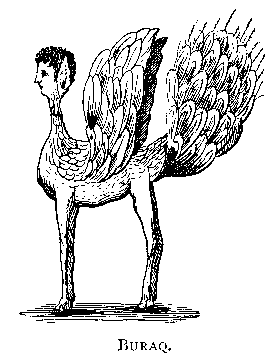
It is worthy of note that Muhammad in the Quran disclaims all power of working miracles ; trusting, as has been before said, to that sacred book itself as evidence of his mission from on high. After his death, however, his followers, found the temptation of attributing supernatural endowments to the founder of their religion too strong to be resisted. Of the many traditions which clothe the Prophet of Arabia with little less than divine power, the most striking is the account which has been handed down of his "Night Journey" when bestriding a mystic steed he was permitted to enter the precincts of Heaven. Pious Muslims believe that the "Messenger of God" was sitting in his house at Mecca, when of a sudden the roof was rent asunder, and the Angel Gabriel descended. Opening the Prophet's breast the heavenly visitant proceeded to wash the heart with water from the holy spring which flows in the sacred city. This done, the messenger of God's behests brought a golden vessel, full of Faith and Knowledge, which he poured into the Prophet's bosom, and then placing him on an animal called " Buraq," a creature between a mule or an ass and a bird, carried his astonished companion towards the skies. On arriving at the first heaven he was introduced to Adam, who is described as being "of a very dark brick-dust complexion, for he was made out of reddish earth, whence
his name Adam." On the right hand and on the left of the forefather of mankind were black appearances, the spirits of his children, in the shape of men. Those on his right were destined for Paradise, those on his left for the regions of despair; as a consequence, when Adam looked to his right he laughed, but wept when his glance fell on the luckless beings on his left. Mounting upwards, the Prophet proceeded in turn the remaining six heavens, meeting on his way successively Moses, "a man of tall stature, and the
colour of wheat, and of middling body," and Jesus, "a middle-sized man, with a red and white complexion, and hair not curly but flowing loosely." All these greeted Muhammad as a friend and a brother. He was then shown the Houris of Paradise, destined for the solace and delight of the Faithful ; and witnessed also the terrible punishments prepared for the unbelievers and hypocrites. Time for prayers being announced, Muhammad acted as Imam, or leader of all the prophets who had gone before him into Heaven.
The general design of the Quran seems to be to
unite in the knowledge and worship of the infinite, eternal, invisible God, by whose power, wisdom, and goodness all things were made, the supreme, and One only Governor, Judge, and absolute Lord of creation, the professors of the different religions then followed in the populous country of Arabia, who for the most part lived promiscuously, and wandered without guides, the far greater number being idolaters, and the rest Jews and Christians, mostly of erroneous and heterodox belief; and to bring them all to the obedience of Muhammad, as the prophet and Ambassador of God, who after the repeated admonitions, promises, and threats of former ages, was at last to establish and propagate God's religion on earth by force of arms, and to be acknowledged chief pontiff in spiritual matters, as well as supreme prince in temporal affairs.
In the early ages the religion of the Arabs, which they call the state of ignorance, in opposition to the knowledge of God's true worship revealed to them by 1their prophet, was chiefly gross idolatry; the Sabian worship having almost overrun the whole nation, though there were also great numbers of Christians, Jews, and Magians among them.
These people not only believed one God, but produced many strong arguments for His unity, though they also paid an adoration to the stars, or the angels and intelligences which they supposed to reside in them and govern the world under the Supreme Deity. They endeavoured to perfect themselves in the four intellectual virtues, and believed the souls of wicked men will be punished for nine thousand ages, but will afterwards be received to mercy. They were obliged to pray three times a day; the first, half an hour or less before sunrise, ordering it so that just as the sun rises they might finish eight adorations, each containing three prostrations ; the second prayer ended at noon, when the sun begins to decline, in saying which they performed five such adorations as the former: and the same they used to do the third time, their task ending just as the
sun sets. They fasted three times a year, the first time thirty days, the next nine days, and the last seven. They offered many sacrifices, but ate no part of them, burning them all. They abstained from beaus, garlic, and some other pulse and vegetables. As to the Sabian "Qibla," or part to which they turn their faces in praying, authors greatly differ; one will have it to be the north, another the south, a third Mecca, and a fourth the star to which they paid their devotions; perhaps, too, there might have been some variety in their practice in this respect They were wont to go on pilgrimage to a place near the city of Harran in Mesopotamia, where great numbers of them dwelt, and they had also a great respect for the temple of Mecca, and the pyramids of Egypt; fancying these last to be the sepulchres of Seth, and of Enoch and Sabi his two sons, whom they regarded as the first propagators of their religion; at these structures they sacrificed a cock and a black calf, and offered up incense. Besides the book of Psalms, the only true scripture they read, they had other books which they esteemed equally sacred, particularly one in the Chaldee tongue which they called the Book of Seth, a work full of moral discourses. This sect is supposed to have taken the name of Sabians from the above-mentioned Sabi, though it seems rather to be derived from the word Saba, signifying the host of heaven, which they worshipped. Travellers commonly called them Christians of St. John the Baptist, whose disciples they also pretended to be, using a kind of baptism similar in some degree to that customary in Christian worship. This is one of the religions the practice of which Muhammad tolerated (on paying tribute), and the professors of it are often included in that expression of the Quran, "those to whom the scriptures have been given," or literally, the people of the book.
The idolatry of the Arabs then, as Sabians, chiefly consisted in worshipping the fixed stars and planets, and the angels and their images, which they honoured
as inferior deities, and whose intercession they begged, as their mediators with God. For the Arabs acknowledged one supreme God, the Creator and Lord of the universe, whom they called Alla Taala, the Most High God; and their other deities, who were subordinate to him, they called simply al Ilahat, i.e., the goddesses.
It was from this gross idolatry, or the worship of inferior deities, or companions of God, as the Arabs continue to call them, that Muhammad reclaimed his countrymen, establishing the sole worship of the true God among them; so that the Muslims are far from being idolaters, as some writers have pretended.
The worship of the stars the Arabs might easily have been led to adopt from their observing the changes of weather to happen at the rising and setting of certain of them, a circumstance which after a long course of experience induced them to ascribe a divine power to those stars, and to think themselves indebted to them -for their rains, a very great benefit and refreshment to their parched country: of this superstition the Quran particularly takes notice.
The ancient Arabians and Indians, between which two nations there was a great conformity of religions, had seven celebrated temples, dedicated to the seven planets.
Though these deities were generally reverenced by the whole nation, yet each tribe chose some one as the more peculiar object of their adoration of the angels or intelligences which they worshipped, the Quran makes mention only of three, known under the female names of Allat, al Uzza, and Mana. These were by them called goddesses, and the daughters of God; an appellation they gave not only to the angels, but also to their images, which were either believed to be inspired with life by God, or else to become the tabernacles of the angels, and to be animated by them; and divine worship was accorded them, because it was imagined they interceded with God for such as were their devotees.
Allat was the idol of a tribe which dwelt at Tayif, and had a temple consecrated to her in a place called Nakhla. This idol was destroyed by Muhammad's order, in the ninth year of the Hijra (= A.D. 630). The inhabitants of Tayif, especially the women, bitterly lamented the loss of this their deity, of which they were so fond that they begged of the Prophet as a condition of peace, that it might not be destroyed for three years, and not obtaining that, asked only a month's respite; but he absolutely denied them even this concession. There are several derivations of this word, which most probably takes its origin from the root Alla, of which it is a feminine form meaning "goddess."
Al Uzza, as some affirm, was the idol of the Quraish and lesser tribes ; others are of opinion that it was a tree called the Egyptian thorn, or acacia, worshipped by the tribe of Ghatfan, who built a chapel over it, called Boss, so contrived as to give a sound when any person entered. Khalid Ibn Walid being sent by Muhammad in the eighth year of the Hijra (A.D. 629) to destroy this idol, demolished the chapel, and cutting down the tree or image, burnt it he also slew the priestess, who ran out with her hair dishevelled, and her hands on her head as a suppliant. Yet the author who relates this, in another place says the chapel was pulled down, and its architect himself killed, because he consecrated this chapel with design to draw the pilgrims thither from Mecca, and lessen the reputation of the Kaba. The name of this deity is derived from the root azza, and signifies the most mighty.
Mana, the object of worship of the tribes between Mecca and Madina, was a large stone, demolished by one Saad, in the eighth year of the Hijra (= A.D. 629), a year so fatal to the idols of Arabia. The name, derived from a word signifying to flow, refers to the outpouring of the blood of the victims sacrificed to the deity; whence the valley of Mina, near Mecca, where the pilgrims at this day slay their sacrifices, had also its name.
There are also some antediluvian idols against which Noah preached ; these were afterwards taken by the Arabs for gods, having been men of great merit and piety in their day, whose statues they reverenced at first with a civil honour only, which in process of time became heightened to a divine worship.
Of these Wadd was supposed to be the heaven, and was worshipped under the form of a man.
Sawa was adored under the shape of a woman. This idol, lying under water for sometime after the Deluge was at length, it is said, discovered by the devil, and was worshipped by certain tribes, who instituted pilgrimages to it.
Yaghuth was an idol in the shape of a lion. Its name seems to be derived from a term which signifies to to help
Yauk was worshipped under the figure of a horse. It is said he was a man of great piety, and his death much regretted; whereupon the devil appeared to his friends in human form, and undertaking to represent him to the life, persuaded them, by way of comfort, to place his effigies in their temples, that they might have it in view when at their devotions. This was done, and seven others of extraordinary merit had the same honours shown them, till at length their posterity made idols of them in earnest. The name Yauk probably comes from a word meaning to prevent or avert.
Nasr was a deity adored under the image of an eagle, which the name signifies.
Besides the idols mentioned, the Arabs also worshipped great numbers of others: for every house-had his household god or gods, which he last took leave of and first saluted at his going abroad and returning home. There were no less than 360 idols, equalling in number the days of their year, in and about the Kaba of Mecca; the chief of which was Hobal, the statue of a man, made of agate, which having by some accident lost a hand, the Quraish
repaired it with one of gold: he held in his hand seven arrows without heads or feathers, such as the Arabs used in divination. This idol is supposed to have been the same with the image of Abraham found and destroyed by the Prophet, on his entering the Kaba, in the eighth year of the Hijra (= A.D. 629), when he took Mecca; the image was surrounded with a great number of angels and prophets, as inferior deities ; among whom, as some say, was Ishmael, with divining arrows in his hand.
Asaf and Nayala, the former the image of a man, the latter of a woman, were also two idols brought from Syria, and placed the one on Mount Safa, and the other on Mount Marwa. It is related that Asaf was the son of Amru, and Nayala the daughter of Sahal, both of the tribe of Jorham, who committing improprieties together in the Kaba, were by God turned into stone, and afterwards worshipped by the Quraish, and so much reverenced by them, that though this superstition was condemned by Muhammad, yet he was forced to allow them to visit those mountains as monuments of divine justice.
One idol more 9f this nation merits notice, and that was a lump of dough worshipped by the tribe of Hanifa who treated the sacred mass with a respect worthy of the Papists, presuming not to eat it till they were compelled so to do by famine.
Several of their idols, as Mana in particular, were no more than large rude stones, the worship of which the posterity of Ismael first introduced: for as they multiplied, and the territory of Mecca grew too strait for them great numbers were obliged to seek new abodes; and on such migrations it was usual for them to take with them some of the stones of that holy land, and set them up in the places where they located themselves; and these they at first only compassed out of devotion, as they had accustomed to do the Kaba. But this at last ended in rank idolatry, the Ismailites forgetting the religion left them by their father so far as to pay
divine worship to any one stone which they might happen to meet.
Some of the pagan Arabs gave credence to neither a creation past, nor a resurrection to come, attributing the origin of things to nature, and their dissolution to age. Others believed both, amongst whom were those who, when they died, had their camel tied by their sepulchre, and so left, without meat or drink, to perish, so as to accompany them to the other world, lest they should be obliged, at the resurrection, to go on foot, which was reckoned very scandalous. Some held to a metempsychosis, fancying that of the blood near the dead person's brain was formed a bird named Hama, which once in a hundred years visited the sepulchre; though others say this bird is animated by the soul of him who is unjustly slain, and continually cries, "give me to drink "-meaning of the murderer's blood-till his death be revenged, and then it flies away.
The great doctrine of the Quran is the unity of God, to restore which point was the chief end of Muhammad's mission; it being laid down by him as a fundamental truth, that there never was, nor ever can be, more than one true orthodox religion. For though the particular laws or ceremonies are only temporary, and subject to alteration according to divine direction, yet the substance being eternal truth, is not liable to change effectually to engage people to hearken to him, a great but continues immutably the same. And the more part of the book is devoted to examples of dreadful punishments formerly inflicted by God on those who rejected and abused his messengers; several of which stories are in whole or part taken from the Old and New Testaments.
The other portion of the Quran comprises necessary laws and directions, admonitions to moral and divine virtues, and above all, precepts regarding the worship and reverence of the only true God, and resignation to His will.
But besides these, there are a great number of pas
sages which are occasional, and relate to particular emergencies. For whenever anything happened which perplexed Muhammad, he had constant recourse to a new revelation, as an infallible expedient in all cases of difficulty.
That Muhammad was really the author of the Quran is beyond dispute; though it is highly probable that he had no small assistance in his design from others.
However this may be, the Muslims absolutely deny that the Book was composed by their Prophet himself, or by any other for him; it being their general and orthodox belief that it is of divine original, nay, that it is eternal and uncreated, remaining, as some express it, in the very essence of God ; that the first transcript has been from everlasting by God's throne, written on a table of vast size, in which are also recorded the divine decrees past and future: that a copy from this table, in one volume on paper, was by the ministry of the angel Gabriel sent down to the lowest heaven in the month of Ramazan, on the night of power; whence Gabriel revealed it to Muhammad by parcels, some at Mecca, and some at Madina, at different times, during the space of twenty-three years, as the exigency of affairs required: giving him, however, the consolation to show him the whole (which they tell us was bound in silk, and adorned with gold and precious stones of Paradise) once a year; though in the later period of his life he had the favour to see it twice.
The number of visits which the angelic messenger paid to earth for the purpose of revealing to the Prophet the wishes of his Creator is said to have been no less than 24,000; but in what shape Gabriel appeared is a matter with regard to which there is considerable difference of opinion amongst Muslims, though they all agree in thinking that his angelic form was laid aside when he came down to this mundane sphere. It is supposed that few chapters were delivered entire, the most part having been revealed piecemeal, and written down from time to time by the Prophet's amanuensis,
till they were completed, according to the directions of the angel. The first parcel that was revealed, is generally agreed to have been the first five verses of the ninety-sixth chapter.
After the passages had been taken down in writing by his scribe, from the Prophet's mouth, they were published to his followers, several of whom took copies for their private use, but the far greater number learned them by heart. The originals, when returned, were put promiscuously into a chest, no order of time being observed, for which reason it is uncertain when many passages were revealed.
When Muhammad died, he left his revelations in the same disorder in which he had put them away, and not digested into the method in which we now find them. This was the work of his successor, Abu Bakr, who, considering that a great number of passages were committed to the memory of the Prophet's followers, many of whom had been slain in the wars, ordered the whole on which they had been written, and which were kept to be collected, not only from the palm-leaves and skins between two boards or covers, but also from the mouths of such as had acquired them by heart. And this transcript when completed he committed to the custody of Hafsa, the daughter of Omar, one of the Prophet's widows.
Owing to this circumstance it is generally imagined that Abu Bakr was really the compiler of the Quran; though for aught appears to the contrary, Muhammud left the chapters complete as we now have them, excepting such passages as his successor might have added or corrected from those who knew them by heart; what Abu Bakr did else being perhaps no more than to range the chapters in their present order a labour which seems to have been performed without any regard to chronological sequence, the longest having as a rule been placed first.
In the thirtieth year of the Hijra, Othman being then Khalif, and observing the great disagreement in the
copies of the Quran as regards the several provinces of the empire, by advice of the companions, ordered a great number of copies to be transcribed from the compilation of Abu Bakr, in Hafsa's care, under the inspection of some specially selected scholars, whom he directed that wherever they disagreed about any word, they should write it in the dialect of the Quraish, in which it was at first delivered. These copies when made were dispersed in the several provinces of the empire, and the old ones burnt and suppressed. Though many things in Hafsa's copy were corrected by the above-mentioned supervisors, yet some few various readings still occur.
It may interest the curious to learn that of the seven principal editions of the Quran two were published and used at Madina, a third at Mecca, a fourth at Kufa, a fifth at Bussora, a sixth in Syria, and a seventh called the common or vulgar edition. Of these, the first makes the whole number of the verses 6,ooo; the second and fifth, 6,214; the third, 6219; the fourth, 6,236; the sixth, 6,226; and the last, 6,225. But they are all said to contain the same number of words, namely, 77,639; and the same number of letters, viz., 323,015.
The first printed edition of the entire Quran was published at Venice, in the year 1530, by Paganinus of Brescia. The Pope of Rome, however, was alarmed for the safety of Papal superstition, and all the copies were committed to the flames. The next complete edition appeared at Hamburgh in 1684 in quarto, under the auspices of Hinckleman. A later and more celebrated edition was printed at St. Petersburgh, by command of the Empress Catherine, for the benefit of such of her Tartar subjects as were Muslims; and in order not to offend their prejudices against printed books, the type was cast in such a manner as to present the appearance of a manuscript. A Latin translation was produced in the year 1550, followed after the interval of a century and a half (1698), by the elaborate volumes in the same language which were given to the world by Father Lewis Marani, the confessor of Pope Innocent XI. The
translation best known in England is that by G. Sale, though the labour of his predecessor, Pocock, in no inconsiderable degree paved the way for his more fortunate rival.
It has been said that amongst the Muslims the Quran is considered to have had a divine origin, having been uncreated and eternal; but such a notion is not universal, and many and heated have been the controversies on this very point. One anecdote will suffice to indicate the nature of the dispute which rent Islam in sunder. The Imam ash Shafii, who flourished from about A.H. 150 (=A.D. 767) to AH. 204 (= AD. 819), held a public disputation in Baghdad on this very point quoting the verse from the Quran, "God said be and it was." He proceeded to inquire "Did not therefore God create all things by the word be?" His opponent assented. "If then," was the rejoinder, "the Quran were created, must not the word 'be' have been created with it?" So plain a proposition was unanswerable. "Then," said Shafli, "all things according to you were created by a created being, which is a gross inconsistency and manifest impiety." The disputant was reduced to silence, and proclaimed a pestilent heretic, for whom death was the only reward.
The Muslims would have it believed that the Arabic of the Quran is the language of Heaven, and an effort was made in the first days of Islam to preserve an uniform pronunciation and reading of the Sacred lection but men of strange lands could not acquire the pure intonation of the people of Mecca, and no less than seven different ways of reading the book became current, owing in a great measure to the absence of vowel points and other diacritical marks. So a voice from Heaven revealed to mankind that they were at liberty to read the Sacred Book in seven dialects, and a recognized School of Readers, seven in number, sprang into existence, whose readings are universally accepted throughout the Muslim world.
The Doctrines and Precepts of the Quran relating to
Faith and Religious Duties.- To his religion Muhammad gave the name of Islam, which word signifies resignation, or submission to the service and commands of God.
The Muhammadans, again, divide Islam into two distinct parts: Iman, i.e. faith, or theory, and Din, i.e. religion, or practice; and teach that it is built on five fundamental points, one belonging to faith, and the other four to practice.
The first is the confession of faith; that "there is no God but the true God; and that Muhammad is His apostle." Under which they comprehend six distinct branches; viz., 1. Belief in God; 2. In his angels; 3. In his scriptures; 4. In his prophets; 5. In the resurrection and day of judgment; and, 6. In God's absolute decree and predetermination both of good and evil.
The four points relating to practice are: 1. Prayer, under which are comprehended those washings or purifications which are necessary preparations required before prayer; 2. Alms; 3. Fasting; and 4. The Pilgrimage to Mecca.
Belief in God-The fundamental position on which Muhammad erected the superstructure of his religion was that from the beginning to the end of the world there has been, and for ever will be, but one true orthodox belief; consisting, as to matter of faith, in acknowledging the only true God, and believing in and obeying such messengers or prophets as He should from time to time send, with proper credentials, to reveal His will to man-kind; and as to matter of practice, in the observance of the immutable and eternal laws of right and wrong, together with such other precepts and ceremonies as God should think fit to order for the time being, according to different dispensations in different ages of the world.
Under pretext that this eternal religion was in his time corrupted, and professed in its purity by no one sect of men, Muhammad claimed to be a prophet sent
by God to reform those abuses which bad crept into it, and to reduce it to its primitive simplicity; with the addition, however, of, peculiar laws and ceremonies some of which had been used in former times, and others were now first instituted. And he comprehended the whole substance of his doctrine under these two propositions, or articles of faith; viz., that there is but one God, and that himself was the apostle of God; in consequence of which latter article, all such ordinances and institutions as he thought fit to establish must be received as obligatory and of divine authority.
Regarding the attributes of God the Muhammadans believe that he is (1) Living and Eternal ; (2) all-knowmg; (3) all-powerful (4) able to do what he wills (5) all-hearing; (6) all-seeing; and (7) endued with speech. But there is a considerable diversity of opinion as to the interpretation to be put upon some of these powers, and Islam is rent into factions holding views totally at variance with each other on many points of dogma relative to the Almighty Ruler of the world.
The names of God are supposed to be 3,000 in number, of which one thousand are known to the angels, and a thousand to the Prophets, while the remaining thousand are thus distributed: in the Pentateuch three hundred, in the Psalms and in the Gospels respectively a similar number, while in the Quran there are to be found ninety and nine, one being still hidden, and concealed from mankind.
Angels. - The Muhammadans believe in the existence of Angelic beings free from all sin, who neither eat nor -drink, and who have no distinction of sex. As a rule invisible, save to animals, who, according to common belief can see them, they occasionally at special times appear in human form. Of such beings there is a hierarchy. In the highest rank are those nearest to God. These are the firm supporters of His throne, who receive the homage of the others. The first of these is in the likeness of a man, the second in that of a bull, the third in that of an eagle, and the fourth in
that of a lion: On the day of judgment, however, four other angels will be added to these, because in the Quran it is written that on that occasion eight angels will sustain the throne of God. After these comes the angel named "Ruh" or "Spirit," thus named, because -every breath he draws creates a soul.-The four angels who are considered to enjoy God's favour in a pre-eminent degree are (1) Gabriel, the guardian and communicator of His revelation, who in the space of one hour can descend from Heaven to earth, and who, with one wing, of which he has 6oo, can lift up a mountain; (2) Michael, an archangel, whose special province is to see that all created beings -have what is needful for them, both as regards body -and soul (3) Izrail, the angel of death, whose feet stand on the foundation of the earth, while his head reaches to the highest heavens, to whom is assigned -the duty of receiving men's souls when they die; and lastly (4) Israfil, the angel of the Resurrection.
In addition to these are the cherubim, occupied exclusively in chanting the praises of God; the two secretaries, who record the actions of men ; the observers who spy out the least gestures, and hear every word of mankind; the travellers, who traverse the whole earth in order to know when people utter the name of God, and pray to Him; the angels of the seven planets ; the two guardian angels appointed to keep watch over the world; these latter are changed every day; the two angels of the grave; the nineteen who have charge of Hell; and lastly, the countless multitudes of heavenly beings who, according to the Muslim belief, are charged with the care of the earth, each particle of which has a separate angel, and who fill the illimitable expanse of space.
The devil, whom Muhammad names Iblis from his despair, was once one of those angels nearest to God's presence, and fell, according to the doctrine of the Quran, for refusing to pay homage to Adam at the command of the Lord of Heaven.
According to the notions of the Muslims, there is a special arrangement made by Providence to mitigate -the evils of Satanic interference. Iblis, though able to assume all other forms, is not permitted to appear in the semblance of the Deity, or any of His Angels, or Prophets. There would otherwise be much danger to -human salvation, as under the appearance of one of the prophets, or of some superior being, the Tempter might make use of his power to seduce men to sin. To prevent this, whenever he attempts to assume such forms, fire comes down from heaven and repulses him.
It has been said that the angels are immaculate, but, if the story of Harut and Marut is to be accepted as genuine-a matter upon which there is considerable difference of opinion amongst Muslims themselves - this dictum must be qualified to some extent. The runs that in the time of Enoch the Prophet, when the angels beheld the wickedness of mankind, they sorely distressed, and said to the Creator of Heaven and Earth, "O Lord! Adam and his descendants, whom Thou hast appointed as Thy vicegerents on earth, act disobediently." To which the Lord replied, "If I were to send you on earth, and to give you hurtful and angry dispositions, you too would sin." The angels thought otherwise, so God bade them select two of their number, who should undergo this ordeal. A choice having been made, the Almighty implanted in their hearts the passions of lust and anger, saying, "Go to and fro on the earth from day to day, put an -end to the quarrels of men, ascribe no equal to me, do not commit adultery, drink no wine, and every night repeat the exalted name of God, then return to Heaven." For a while all went well, till one day a beautiful woman -named Zohra brought them a cup of wine, whereupon one of the angels said, "God has forbidden it." But -his brother was bewitched with the seductive persuasiveness of the fair daughter of Eve, and pleaded "God is -merciful and forgiving." So they drank the wine, killed -the husband of Zohra, to whom in their jovial moments
they had revealed the "exalted name" of God, and fell into grievous sin. But they found to their cost, on -awakening from their debauch, that the "name" which -they had disclosed had fled from their memories, and so they could not return to heaven. Thereupon they begged Enoch to intercede for them. The Prophet consented with the result that they were allowed to choose between a present and a future punishment. They elected -the former alternative, and are to this day hanging suspended with their heads downwards in a well, a fresh spring ever flowing just beyond reach of their parched lips. The woman, the author of all this evil and mischief, was changed into a star. The story is doubtless legendary, but it serves to show that according to the Muhammadan view the Angels of Heaven are not immaculate, or free from the vices which degrade their -less favoured brethren on earth.
Besides angels and devils, the Muhammadans are taught by the Quran to believe in an intermediate order of creatures, which they call Jinn, or Genii, created of fire, but of a grosser fabric than angels; since they eat and drink, and propagate their species, and are subject to death, though they are supposed generally to live several centuries. Some of these are good, and others bad, but all capable of future salvation or damnation, alike as men; whence Muhammad claimed to be sent for the conversion of genii as well as men. The Orientals pretend that these spirits inhabited the world for many -ages before Adam was created, under the government of several successive princes, who all bore the common name of Solomon; but falling at length into an almost general corruption, Iblis was sent to drive them into a remote part of the earth, there to be confined: that some of that generation still remaining, they were -forced by one of the ancient kings of Persia, who waged war against them, to retreat into the famous -mountains of Qaf. Of which successions and wars they have many fabulous and romantic stories. They also make different ranks and degrees among these beings
if they be not rather supposed to be of a different species), some being called absolutely Jinn, some Pen or fairies, some Div or giants, others Taqwins or fates.
Scriptures. - As to the Scriptures, the Muhammadans are taught by the Quran that God, in diverse ages of the world, gave revelations of His will in writing to several prophets, the whole and every word of which it is absolutely necessary for a good Muslim to believe. The number of these sacred books was, according to them, 104. Of which ten were given to Adam, fifty to Seth, thirty to Idris or Enoch, ten to Abraham; -and the other four, being the Pentateuch, the Psalms, the Gospel, and the Quran, were successively delivered to Moses, David, Jesus, and Muhammad which last -being the seal of the prophets, those revelations are now closed, and no more are to be expected. All these divine books, except the four last, they agree to be now entirely lost, and their contents unknown; though the Sabians have several works which they attribute to some of the antediluvian prophets. And of those four the Muslims hold that the Pentateuch, Psalms, and Gospel, have undergone so many alterations and corruptions, that though there may possibly be some part of the true word of God therein, yet no credit is to be given to the present copies in the hands of the Jews and Christians. The Jews in particular are frequently stigmatized in the Quran for falsifying and corrupting their copies of the law. As Muhammad acknowledged the divine authority of the Pentateuch, Psalms, and Gospel, he often appeals as proofs of his mission, to the consonancy of the Quran with those writings, and to the prophecies therein which he alleged concerned himself; and he frequently charges the Jews and Christians with stifling the passages which bear witness to him. His followers also fail not to produce several texts even from our present copies of the Old and New Testament, to support their master's cause.
Prophets.-The number of Prophets sent by God to
make known his will is usually stated at about 200,000, of whom twenty-five are mentioned in the Quran; of these latter the principal, ranked in order of merit, are Noah (the prophet of God), Abraham (the friend of God), Moses (the speaker of God), Jesus (the spirit of God), and chief of all, Muhammad (the messenger of God). These, one and all, will be permitted to intercede in the Day of Judgment for their followers. There is some difference of opinion as to whether the prophets are superior to the angels. Some Muhammadans are inclined to one view, some to another. Again the question of sinlessness on the part of these favoured mortals is one to which considerable attention has been paid by Muslim theologians. The orthodox belief is that they are free from sin owing, as some think, to the Grace of God, which perpetually keeps them in the right path, or, as others suppose, because the power of sinning is not created in them. As, however, history records that Prophets have at times stepped aside from the paths of rectitude and propriety, Muhammadans to meet the difficulty, divide sin into two distinct categories, "great sins" and "little sins." It is the universal belief that a prophet never, either wittingly or unwittingly, commits offences in the former category; but there is a latitude allowed with regard to the latter class of wrongdoings, though some excuse the frailties of the Prophets as faults and slight imperfections, not amounting to sin; and it is not a little curious that the one sinless prophet of Islam, he who alone of all is mentioned in the pages of the Quran as free from guilt, is the founder of the Christian Faith.
It is the universal belief that Prophets work miracles. It is true that in the Quran Muhammad disclaims such a power; but, none the less, his followers ascribe to him mighty and wonderful deeds, far transcending the feeble attempts of all those who preceded him: thus - the sun and the moon obeyed his behests, the elements, too, were subservient unto him, while not only were the keys of the treasuries of earth in his possession, but
Heaven itself opened its portals to receive the chosen of God.
Resurrection.- The next article of faith required by the Quran is the belief in a general resurrection and a future judgment. But before considering the Muhammadan tenets on those points, it will be well to mention their views concerning the intermediate state, both of the body and of the soul, after death. When a corpse is laid in the grave, he is received by an angel, who gives him notice of the coming of the "examiners," in the shape of two livid black angels, with blue eyes and of terrible appearance, named Munkir and Nakir. These order the dead person to sit upright, and examine him concerning his faith, as to the unity of God, and the mission of Muhammad: it is for this reason that, when a person is buried, a cavity is made in such a way as to leave room for the body to be raised at the period of examination. If the answer be satisfactory, the body is suffered to rest in peace, and it is refreshed by the air of Paradise; but if not, the angels beat him on the temples with iron maces, till he roars out for anguish so loud, that he is heard from east to west, by all except men and genii. Then they press the earth on the corpse, which is gnawed and stung till the resurrection by ninety-nine dragons, each having seven heads; or, as others say, sins will become, as it were, venomous beasts, the grievous ones stinging like dragons, the smaller like scorpions, and the others like serpents; circumstances which are not infrequently understood in a figurative sense.
As to the soul, when it is separated from the body by the angel of death, who performs his office with ease and gentleness towards the good, and with violence towards the wicked, it enters into that state which they call Al Barzakh or the interval between death and the resurrection. If the departed person were a believer, two angels meet it, who convey it to heaven, that its place there may be assigned according to its merit and degree. For the souls of the faithful are divided into
three classes : first, prophets, whose spirits are admitted into Paradise immediately; second, martyrs, whose souls according to a tradition of Muhammad, rest in the crops of green birds, which eat of the fruits and drink of the rivers of Paradise; and third, other believers, concerning whose state before the resurrection there are various opinions. 1. Some say they stay near the sepulchres, with liberty, however, of going wherever they please; which they confirm from the Prophet's custom of making a salutation when reaching a place of burial, and from a statement on his part that the dead answer none the less though they cannot hear such salutations as well as the living. Whence perhaps proceeds the custom of visiting the tombs of relations, so common among the Muhammadans. 2. Others imagine they are with Adam, in the lowest heaven ; an opinion which they support by the authority of their Prophet, who gave out that on his return from the celestial regions in his well-known night-journey, he saw there the souls of those who were destined to Paradise on the right hand of Adam, and of those who were condemned to destruction on his left. 3. Some again fancy the souls of believers remain in the spring Zamzam, and those of infidels in a certain well in the province of Hadramaut, called Burhut; but this opinion is branded as heretical. 4.-Others say they stay near the grave for seven days but that whither they go afterwards is uncertain. 5.-There are not wanting Muslims who hold that they are all in the trumpet the sound of which is to raise the dead. 6.- Lastly, it is thought that the souls of the good dwell in the form of white birds, under the throne of God. As to the condition of the spirits of the wicked,· besides the opinions that have been already mentioned, the more orthodox hold that they are taken by the angels to heaven, whence being repulsed as unclean and filthy, they are brought to the earth, and being also refused a place there, are carried down to the seventh earth, and thrown into a dungeon, which they call Sijjin, under a green rock, or according to a tradition of Muhammad,
under the devil's jaw, to be tormented till they are called up and joined again to their bodies.
Touching the matter of children there is a similar difference of opinion: the general notion is that if their parents be believers, the young people will be questioned, but that angels will teach them to say, "Allah is my Lord, Islam my religion, and Muhammad my Prophet." But with reference to the offspring of unbelievers, some think that they will be in Araf -a place between heaven and hell, to be hereafter descended while others suppose that they will be compelled to act in Paradise as servants and attendants for the followers of God.
Though not a few among the Muhammadans hold to the view that the resurrection will be merely spiritual, and consist in no more than the return of the soul to the place whence it first came; and others, who allow man to be composed of body only, that it will be merely corporeal, the received opinion is that both body and soul will be raised, and Muslim doctors argue strenuously for the possibility of the resurrection of the body, and dispute with great subtlety concerning the manner thereof. In any case it is supposed that one part of the human frame will be preserved whatever becomes of the rest, to Serve for a basis of the future edifice, or rather a leaven for the mass which is to be joined to it. For the Prophet taught that a man's body was entirely consumed by the earth, except only the bone called al Ajb: and that, as it was the first formed in the creation of a human being, it will also remain uncorrupted till the last day, as a seed whence the whole is to be renewed and this it is said will be effected by a forty days rain sent by God, which will cover the earth to the height of twelve cubits, and cause the bodies to sprout forth like plants.
The time of the resurrection is admitted to be a perfect secret to all but God alone. But the approach of that day will be known from certain signs which are to precede it.
The lesser signs are: 1. The decay of faith among
men. 2. The advancing of the meanest persons to eminent dignity, 3. That a maid-servant shall become the mother of her mistress (or master); by which is meant either that towards the end of the world men shall be much given to sensuality, or that the Muhammadans shall then take many captives. 4. Tumults and seditions. 5. War with the Turks. 6. Great distress in the world, so that a man when he passes by another's grave shall say "Would to God I were in his place." 7. That the provinces of Iraq and Syria shall refuse to pay their tribute. And, 8. That the buildings of Madina shall reach to Ahab, or Yahab.
The greater signs are:
1. The sun's rising in the west: which some have imagined was originally the case.
2. The appearance of a beast, apparently similar to that in the Book of Revelations.
3. War with the Greeks, and the taking of Constantinople by seventy thousand of the posterity of Isaac. On the division of the spoil, news will come of the appearance of Antichrist, whereupon the captors shall leave all, and return back.
4. The coming of Antichrist, called al Masihud Dajjal, i.e. the false or lying Christ, or simply al Dajjal. He is to be one-eyed, and marked on the forehead with the letters C.F.R., signifying as some think the word "Kafir," or infidel.
He will bring with him the resemblance of Paradise and Hell, but in fact that which is supposed to be the abode of the Lost is Heaven, while that which appears as the realm of Bliss is the region of Eternal Misery. According to the traditions of the Prophet this Antichrist is to appear first between Iraq and Syria, or according to others in the province of Khorassan; riding on an ass, he will be followed by seventy thousand Jews of Ispahan, and continue on earth forty days, of which one will be equal in length to a year, another to a month, another to a week, and the rest will be common days; he will, moreover, lay waste all places, but will not enter Mecca or
Madina, which are to be guarded by angels; in the end he will be slain by Jesus, who is to encounter him at the gate of Ludd. It is said that Muhammad foretold several Antichrists, to the number of about thirty, but one of greater note than the rest.
5. The descent of Jesus on earth. It is supposed that he is to alight near the white tower to the east of Damascus, when the people are returning from the capture of Constantinople; that he is to embrace the Muslim religion, marry a wife, get children, kill Antichrist, and at length die after remaining on earth forty or, according to others, twenty-four years. During this period there will be great security and plenty in the world, all hatred and malice being laid aside; while lions and camels, bears and sheep, will live in peace, and a child play with serpents unhurt.
6. War with the Jews; of whom the Muhammadans are to make a religious slaughter, the very trees and stones discovering such of the race as hide themselves, except only the tree called Gharqad, which is the tree of the Jews.
7. The irruption of Gog and Magog, or, as they are called in the east, Yajuj and Majuj; of whom many things are related in the Quran, and the traditions of the Prophet. These barbarians having passed the lake of Tiberias, which the vanguard of their vast army will drink dry, will come to Jerusalem, and there greatly distress Jesus and his companions; till, at His request, -God will destroy them, and fill the earth with their carcasses, which, after some time, God will send birds to carry away, at the prayers of Jesus and His followers. Their bows, arrows, and quivers the Muslims will burn for seven years together; and at last God will send a rain to cleanse the earth, and to make it fertile.
8. A smoke, which shall fill the whole earth.
9. An eclipse of the moon. Muhammad predicted that there would be three eclipses before the last hour; one to be seen in the east, another in the west, and the third in Arabia.
10. The returning of the Arabs to the worship of Allat and al Uzza, and the rest of their ancient idols; after the decease of every one in whose heart there was faith equal to a grain of mustard-seed, none but the very worst of men will be left alive. For God, they say, will send a cold odoriferous east wind, blowing from Syria Damascena, which shall sweep away the souls of all the faithful, and even the Quran itself, so that men will remain in the grossest ignorance for a hundred years.
11. The discovery of a vast heap of gold and silver by the receding of the Euphrates, an event which will be the destruction of many persons.
12. The demolition of the Kaba or temple of Mecca, by the Ethiopians.
13. The speaking of beasts and inanimate things.
14. The breaking-out of fire in the province of Hijaz; or, according to others, in Yaman.
15. The appearance of a man of the descendants of Kahtan, who shall drive men before him with his staff.
16. The coming of the Mahdi or director; concerning whom Muhammad prophesied that the world should not have an end till one of his own family should govern the Arabians, whose name should be the same with his own name, and whose father's name should also be the same with his father's name, and who should fill the earth with righteousness. This person, some sects, as has been previously stated, believe to be now alive, and concealed in a secret place, till the time of his manifestation ; for they suppose him to be none other than the last of the twelve Imams, named Muhammad Abu'l Kasim.
17. A wind which shall sweep away the souls of all who have but a grain of faith in their hearts, as has been mentioned under the tenth sign.
These are the greater signs, which, according to the doctrine of the followers of the Prophet of Arabia, are to precede the resurrection, but still leave the precise
hour uncertain: for the immediate token of its appearance will be the first blast of the trumpet; which latter they believe will be sounded three times. The first they call the blast of consternation; the second, the blast of examination; and the third, after forty years, the blast of resurrection; on this latter occasion the trumpet will be sounded by Israfil. This angel having, by the divine order, set the trumpet to his mouth and called together all the souls from all parts, will throw them into the same, whence, on his giving the last sound, at the command of God, they will fly forth like bees, and fill the whole space between heaven and earth, and then repair to their respective bodies, which the opening earth will suffer to arise; and the first who shall so come forth, according to a tradition of Muhammad will be himself.
As to the length of the Day of Judgment, the Quran in one place indicates that it will last 1,000 years, and in another 50,000.
The resurrection will be general, and extend to all creatures, both angels, genii, men, and animals. Those who are destined to be partakers of eternal happiness will arise in honour and security; and those who are doomed to misery, in disgrace and under dismal apprehensions. The Prophet further taught, by another tradition, that mankind shall be assembled at the last day, distinguished into three classes. (a) Those who go on foot; (b) those who ride; and (c) those who creep grovelling with their faces on the ground The first class is to consist of those believers whose good works have been few; the second of those who are in greater honour with God, and more acceptable to Him ; whence Ali affirmed that the pious when they come forth from their sepulchres, shall find ready prepared for them white-winged camels, with saddles of gold; and the third class, will be composed of the infidels, whom God shall cause to make their appearance with their faces on the earth, blind, dumb, and deaf. But the ungodly will not thus alone be distinguished;
for, according to a tradition of the Prophet, there will be ten sorts of wicked men on whom God will on that day fix certain marks. The first will appear in the form of apes,-these are the professors of Zandicism; the second in that of swine,-these are they who have been greedy of filthy lucre, and enriched themselves by public oppression ; the third will be brought with their heads reversed and their feet distorted,-these are the usurers; the fourth will wander about blind,-these are unjust judges ; the fifth will be deaf, dumb, and blind, understanding nothing,-these are they who glory in their own works; the sixth will gnaw their tongues, which will hang down upon their breasts, corrupted blood flowing from their mouths like spittle so that everybody shall detest them,-these are the learned men and doctors, whose actions contradicted their sayings; the seventh will have their hands and feet cut off-these are they who have injured their neighbours; the eighth will be fixed to the trunks of palm trees or stakes of wood,-these are the false accusers and informers; the ninth will smell worse than a corrupted corpse,-these are they who have indulged their passions and voluptuous appetites, but refused God such part of their wealth as was due to Him; the tenth will be clothed with garments daubed with pitch,-these are the proud, the vain-glorious, and the arrogant.
The end of the resurrection the followers of Islam declare to be, that they who are so raised may give an account of their actions, and receive their eternal reward. And they believe that not only mankind, but the genii and irrational animals also, shall be judged on this great day; to an extent that the unarmed cattle will be permitted to take vengeance on the horned till entire satisfaction shall be given to the injured.
As to mankind, they hold that when they are all assembled together, they will not be immediately brought to judgment, but the angels will keep them in their ranks and order while they are waiting for that purpose.
and this interval of suspense some say is to last forty years, others seventy, others 300, nay, some say no less than 50,000 years, each of them vouching their Prophet's authority. During this space people will stand looking up to heaven, but without receiving thence any information or orders, and will suffer grievous torments, both the just and the unjust, though with manifest difference. For the limbs of the former, particularly those parts which they used to wash in making the ceremonial ablution before prayer, will shine gloriously, and their sufferings will be light in comparison, lasting no longer than the time necessary to say the appointed prayers; but the latter will have their faces obscured with blackness, and disfigured with all the marks of sorrow and deformity. What will then occasion not the least of their pain, is a wonderful and incredible perspiration, which will even stop their mouths, and in which they will be immersed in various degrees according to their demerits, some to the ankles only, some to the knees, some to the middle, some so high as their mouth, and others as high as their ears. And this sweat, it is supposed, will be provoked not only by that vast concourse of all sorts of creatures mutually pressing and treading on one another's feet, but by the near and unusual approach of the sun, which will then be no farther from them than the distance of a mile, or, as some translate the word, the signification of which is ambiguous, than the length of a bodkin. So that their skulls will boil like a pot, and they will all be bathed in moisture. From this inconvenience, however, the good will be protected by the shade of God's throne; but the wicked will be so miserably tormented there-with, and also with hunger, thirst, and a stifling air, that they will cry out, "Lord, deliver us from this anguish, though thou send us into hell-fire."
When those who have risen shall have waited the fixed time, God will at length appear to judge them; Muhammad undertaking the office of intercessor, after
it shall have been declined respectively by Adam, Noah, Abraham, and Jesus, who one and all will beg deliverance only for their own souls. On this solemn occasion God will come in the clouds, surrounded by angels, and producing the books wherein the actions of every person are recorded by their guardian angels, will command the prophets to bear witness against those to whom they have been respectively sent. Then every one will be examined concerning all the words and actions uttered and done in this life; not as if God needed any information in those respects, but to oblige the person to make public confession and acknowledgment of Almighty's justice. The particulars of which they shall give an account, as the Prophet himself enumerated them, are-of their time, how they spent it; of their wealth, by what means they acquired it, and how they employed it; of their bodies, wherein they exercised them; of their knowledge and learning, what use they made of them. It is said, however, that Muhammad affirmed that no less than seventy-thousand of his followers will be permitted to enter Paradise without any previous examination. Another advantage which on the day of judgment the Muslims will possess over less-favoured races, is that either a Jew or a Christian will be assigned to each faithful Mussulman as a substitute to be cast into the everlasting pit in case the accident of an adverse sentence on the part of the Lord of heaven should overtake the hapless follower of the Prophet!
To the above-mentioned questions each person shall answer, and make his defence in the best manner he can, endeavouring to excuse himself by casting the blame of his evil deeds on others, so that a dispute shall arise even between the soul and the body, to which of them their guilt ought to be imputed, the soul saying, "O Lord, my body I received from Thee; for Thou createdst me without a hand wherewith to lay hold, a foot wherewith to walk, an eye wherewith to see, or an understanding wherewith to apprehend, till I came and entered into this body; therefore, punish it
eternally, but deliver me." The body, on the other side, will make this apology :- "O Lord, thou createdst me like a stock of wood, having neither hand with which I could lay hold, nor foot with which I could walk, till this soul, like a ray of light, entered into me, and my tongue began to speak, my eye to see, and my foot to walk; therefore punish it eternally, but deliver me." But God will propound to them the following parable of the blind man and the lame man. A certain king, having a pleasant garden, in which were ripe fruits, set two persons to keep it, one of whom was blind and the other lame, the former not being able to see what to pick nor the latter to gather it; the lame man, however, beholding the fruit, persuaded the blind man to take him upon his shoulders; and by that means he easily plucked the same, and they then divided it between them. The lord of the garden, coming some time after, and inquiring as to his property, each began to excuse himself; the blind man said he had no eyes to see the trees, and the lame man that he had no feet to approach them. But the king, ordering the lame man to be set on the blind, passed sentence on and punished them both. And in the same manner will God deal with the body and the soul.
Though the Muhammadans assign a long space for the attendance of the resuscitated before their trial, yet they tell us the trial itself will be over in much less time, and, according to an impression of their Prophet, familiar enough to the Arabs, will last no longer than while one may milk an ewe, or than the space between the two milkings of a she-camel. Some, explaining those words so frequently used in the Quran, "God will be swift in taking an account," say that He will judge all creatures in the space of half a day, and others that it will be done in less time than the twinkling of an eye.
At this examination they also believe that each person will have delivered to him the book, wherein all the actions of his life are written; the righteous will
receive the same in their right hand, and read with great pleasure and satisfaction; but the ungodly will be obliged to take the fatal records against their wills in their left hand, which will be bound behind their backs, its neighbour on the right being tied up to their necks.
To show the exact justice which will be observed on this great day of trial, a balance will be brought, wherein all things shall be weighed. It will be held by Gabriel, and it is of so vast a size, that its two scales, one of which hangs over Paradise, and the other over Hell, are capacious enough to contain both heaven and earth: and those whose balances laden with their good works shall be heavy, will be saved, but those whose balances are light will be condemned. Nor will any have just cause to complain that God suffers any good action to pass unrewarded, because the wicked have their reward in this life, and therefore can expect no favour in the next.
But when this ordeal is passed, the trials of man-kind are not ended, for the Muhammadans hold that on the Day of Judgment two angels, named Mihr and Surush, will stand on the bridge called Pul-i-Chinavad, which spans the abyss of Hell, to examine every person as he passes; that the former, who represents the divine mercy, will hold a balance in his hand, to weigh the actions of men; that according to the report he shall make thereof to God, sentence will be pronounced, those whose good works are found more ponderous, if they turn the scale but by the weight of a hair, being permitted to pass forward to Paradise; but those whose good works shall be found light, will be precipitated from the bridge into Hell by the other angel, who represents God's justice.
This examination being passed, and every one's works weighed in a just balance, mutual retaliation will follow, according to which every creature will take vengeance one of another, or receive satisfaction for the injuries which have been suffered. And
since there will then be no other way of returning like for like, a proportionable part of the good works of him who offered the injury, will be taken away and added to the amount of him who suffered it. Which being done, if the angels (by whose ministry this is to be performed) say, "Lord, we have given to every one his due; and there remaineth of this person's good works so much as equalleth the weight of an ant," God will of His mercy cause it to be doubled unto him, that he may be admitted into Paradise; but if; on the contrary, his good works be exhausted, and there remain but evil works, and there be any who have not yet received satisfaction from him, God will order that an equal weight of their sins whom he had injured, be added unto his own, that he may be punished for them in their stead, and he will be sent to Hell laden with this additional burden. Such will be the method of God's dealing with mankind. As to brutes, after they shall have likewise taken vengeance of one another, as mentioned above, He will command them to be changed into dust; wicked men being reserved to more grievous punishment: so that they shall cry out, on hearing the sentence passed on the brutes, "Would to God that we were dust also!" As to the genii, many are of opinion that such of them as are true believers will undergo the same fate as the irrational animals, and have no other reward than the favour of being converted into dust; but others assign them a place near the confines of Paradise, where, to a certain extent, they will enjoy felicity, though they be not admitted into that delightful mansion. But the unbelieving genii, it is universally agreed, will be punished eternally, and be thrown into Hell with the infidels of mortal race.
The trials being over and the assembly dissolved, those who are to be admitted into Paradise will take the right-hand way, and those who are destined to perdition (upwards, it is said, of 999 out of every 1,000)
will take the left; but both of them must first pass the brldge, called in Arabic as Sirat, which they say is laid over the midst of Hell, and described to be finer than a hair, and sharper than the edge of a sword so that it seems very difficult to conceive how any one shall be able to stand upon it. This bridge is beset on each side with briers and hooked thorns which, however, will be no impediment to the good, for the latter will pass with wonderful ease and swiftness, like lightning or the wind, Muhammad and his Muslims leading the way; whereas the wicked, what with the slipperiness and extreme narrowness of the path, the entangling of the thorns, and the extinction of the light, which directed the saved to Paradise, will soon miss their footing, and fall down headlong into the yawning abyss beneath.
As to the punishment of the wicked, the Muhammadans are taught that Hell is divided into seven circles, one below another, designed for the reception of as many distinct classes of lost souls. The first, Jahannam, will be the receptacle of those who acknowledged one God, that is, the wicked followers of Islam, who after having there been punished according to their demerits, will at length be released. The second, named Laza, will receive the Jews ; the third, named al Hutama, the Christians; the fourth, named al Sair, the Sabians ; the fifth, named as Saqar, the Magians; the sixth, named al Jahim, the idolaters; and the seventh, al Hawiyat, the lowest and worst of all, the hypocrites, or those who outwardly professed some religion, but in their hearts were without a God.
With reference to the torments of Hell, it must be remarked, however, that the infidels alone will be liable to eternity of damnation, for the Muslims who having embraced the true religion, have none the less been guilty of heinous sins, will be delivered thence after they shall have expiated their crimes by their sufferings.
The wall or partition between Paradise and Hell,
seems to have been suggested by the great gulf of separation mentioned in Scripture. They call it al Arf and more frequently in the plural, al Araf, a word derived from the verb arafa, which signifies to distinguish between things, or to part them; though some commentators give another reason for the imposition of this name, because, they say, those who stand on this participation will know and distinguish the blessed from the lost, by their respective marks or characteristics; while others think the word properly intends anything that is high raised or elevated, as such a wall of separation must be supposed to be. The Muhammadan writers greatly differ as to the persons who are to be found on al Araf. Some imagine it to be a sort of limbo for the patriarchs and prophets, or for the martyrs and those who have been most eminent for sanctity, among whom will be also angels in the form of men. Others place here those whose good and evil works are so equal that they exactly counterpoise each other, and, therefore, deserve neither reward nor punishment; and these, they say, will, on the last day, be admitted into Paradise, after they shall have performed an act of adoration, which will be imputed to them as a merit, and will make the scale of their good works to overbalance. Others: again, suppose this intermediate space will be a receptacle for those who have gone to war without their parents' leave, and therein suffered martyrdom; being excluded Paradise for their disobedience, and escaping Hell because they are martyrs. The breadth of this partition wall cannot be supposed to be exceeding great, since not only those who shall stand thereon will hold conference with the inhabitants both of Paradise and of Hell, but the blessed and the damned themselves will also be able to talk to one another.
The righteous, having surmounted the difficulties, and passed the sharp bridge above mentioned, before they enter Paradise will be refreshed by drinking at the pond of their Prophet, who describes it to be an exact square, of a month's journey in compass: its water
which is supplied by two pipes from al Qawsar, one of the rivers of the celestial realms, being whiter than milk or silver and more odoriferous than musk, with as many cups set around it as there are stars in the firmament, of which water whoever drinks will thirst no more for ever. This is the first taste which the blessed will have of their future, and now near-approaching felicity.
Though Paradise is so very frequently mentioned in the Quran, yet it is a dispute among the Muhammadans whether it is already created, or is yet to be created hereafter: some sectaries asserting that there is not at present any such place in nature, and that the Paradise which the righteous will inhabit in the next life, will be different from that from which Adam was expelled. However the orthodox profess the contrary, maintaining that it was created even before the world, and describe it, from their Prophet's traditions, in the following manner:
It is situate above the seven heavens (or in the seventh heaven) and next under the throne of God: the earth thereof is composed of the finest wheat flour, or of the purest musk, or, as others will have it, of saffron; its stones are pearls and jacinths, the walls of its buildings being enriched with gold and silver, while the trunks of all its trees are of the first-mentioned precious metal, among which the most remarkable is the tree called Tuba, or the tree of happiness. Concerning this latter it is believed that it stands in the palace of Muhammad, though a branch of it will reach to the house of every true believer; that it will be laden with pomegranates, grapes, dates, and other fruits of surprising size, and of tastes unknown to mortals. So that if a man desire to eat of any particular kind of fruit, it will immediately be presented to him; or if he choose flesh, birds ready dressed will be set before him according to his wish. The boughs of this tree will spontaneously bend down to the hand of the person who would gather of its fruits, and it will supply the blessed not only with food, but
also with silken garments, and beasts whereon to ride ready saddled and bridled, and adorned with rich trappings which will burst forth from its fruits ; this tree, too, is so large, that a person mounted on the fleetest horse would not be able to gallop from one end of its shade to the other in a hundred years.
As plenty of water is one of the greatest additions to the pleasantness of any Eastern locality, the Quran often speaks of the rivers of Paradise as a principal ornament thereof; some of these streams, they say, flow with water. some with milk, some with wine, and others with honey, all taking their rise the of from root the tree "Tuba." And lest these should not be sufficient, this garden is also watered by a great number of lesser springs and fountains, whose pebbles are rubies and emeralds, their earth of camphire, their beds of musk, and their sides of saffron, the most remarkable among them being "Salsabil" and "Tasnim."
But all these glories will be eclipsed by the resplendent and ravishing girls of Paradise, the enjoyment of whose company will be a principal felicity of the faithful. These, they say, are created not of clay, as in the case of mortal women, but of pure musk: being, as their Prophet often affirms, free from all natural impurities, defects, and inconveniences incident to the sex; further, too, they will be of the strictest modesty, and secluded from public view in pavilions of hollow pearls, so large that, as some traditions have it, one of them will be no less than sixty miles long, and as many broad.
The name which the Muhammadans usually give to this happy mansion, is "al Jannat," or the garden; and sometimes they call it, with an addition, Jannat al Firdaus, the garden of paradise, Jannat Adan, the garden of Eden, Jannat al Mawa, the garden of abode, Jannat al Naim, the garden of pleasure, and the like; by which several appellations some understand a similar number of different abodes, or at least places of various degrees of felicity (for they reckon no less than a hundred such in all), the very meanest whereof will
afford its inhabitants so many pleasures and delights, that one would conclude persons must even sink under them, had not the Prophet declared, that in order to qualify the blessed for a full enjoyment of such bliss, God will give to every one the abilities of a hundred men.
Besides Muhammad's pond, already described, some authors mention two fountains, springing from under a certain tree near the gate of Paradise, and say, that the blessed will also drink of one of them, to purge their bodies and carry off all impurities, and will wash themselves in the other. When they are arrived at the gate itself, each person will there be met and saluted by the beautiful youths appointed to serve and wait upon him, one of them running before, to carry the news of his arrival to the wives destined for him; two angels will also appear, bearing the presents from God, one of whom will invest him with a garment of Paradise, and the other will put a ring on each of his fingers, with inscriptions on them alluding to the happiness of his condition. By which of the eight gates of Paradise they are respectively to enter, is not worth inquiry; but it must be observed that Muhammad has declared that no persons good works will gain him admittance, and that even himself shall be saved, not by his merits, but merely by the mercy of God. It is, however, the constant doctrine of the Quran, that the felicity of each person will be proportioned to his deserts, the abodes being assorted according to the varied gradations of happiness; the most eminent degree for the Prophets, the second for the doctors and teachers of God's worship, the next for the martyrs, and the lower for the rest of the righteous. There will also be some distinction made in respect to the time of admission ; Muhammad (to whom the gates will first be opened) having affirmed, that the poor will enter Paradise five hundred years before the rich: nor is this the only privilege which the former will enjoy in the next life; since the Prophet has also declared, that when he took a view of the celestial regions, he saw that the majority of its inhabitants were
composed of the poor; while when he looked down into Hell, he noticed that the greater part of the wretches confined there were women!
For the first entertainment of the blessed on their admission, the whole earth will then be as one loaf of bread, which God will reach to them with his hand, holding it like a cake; while for meat they will have the ox Balaam, and the fish Nun, the lobes of whose livers will suffice 70,000 of the principal guests, viz., those who, to that number, will be admitted into paradise without examination.
From this feast every one will be dismissed to the mansion designed for him, where he will enjoy such a share of felicity as will be proportioned to his merits, but vastly exceeding comprehension or expectation; since the very meanest will have 80,000 servants, seventy-two wives of the girls of Paradise, besides the spouses he had in this world (in some cases it may be feared a questionable felicity), and a tent erected for him of pearls, jacinths, and emeralds, of a very large extent; according to another tradition he will be waited on by 300 attendants while he eats, his food being served in dishes of gold, whereof 300 shall be set before him at once, containing each a different kind of food, the last morsel of which will be as grateful as the first; he will also be supplied with as many sorts of liquors in vessels of the same metal. To complete the entertainment, there will be no want of wine, which, though forbidden in this life, will yet be freely allowed to be drunk in the next, and with-out danger, since that beverage in Paradise will neither inflame nor inebriate. The flavour of this celestial potation we may conceive to be delicious beyond description, since the water of Tasnim and the other fountains which will be used to dilute it, is said to be wonderfully sweet and fragrant. If any object to these pleasures, as an impudent Jew did to Muhammad, and contend that so much eating and drinking must necessarily involve various bodily functions, it
may be answered that the inhabitants of Paradise will not need even to blow their noses, for all superfluities will be discharged and carried off by perspiration, or a sweat odoriferous as musk, after which their appetite will return afresh.
The magnificence of the garments and furniture promised by the Quran to the godly in the next life, is answerable to the delicacy of their diet. For they are to be clothed in the richest silks and brocades, chiefly of green, which will burst forth from the fruits of Paradise, and will be also supplied by the leaves of the tree Tuba; they will be adorned with bracelets of gold and silver, and crowns set with l)earls of in-comparable lustre; and will make use of silken carpets, litters of a prodigious size, couches, pillows, and other rich furniture embroidered with gold and precious stones.
That the inhabitants of Paradise may be the better able to taste these pleasures in their height, they will enjoy a perpetual youth; at whatever period of life they may happen to die, they will be raised in their prime and vigour, and become as if about thirty years of age, which they will never exceed (it may also be remarked that the tortures of Hell are perpetuated to the lost souls in a precisely similar manner). When the blessed enter into bliss, they will be of the same stature with Adam, who, as is fabled, was no less than 60 cubits high. And to this age and stature their children if they shall desire any (for the choice will be in their own hands), will immediately attain; according to that saying of their Prophet, "If any of the faithful in Paradise be desirous of issue, it shall be conceived, born, and grown up within the space of an hour." And in the same manner, if any one shall have a fancy to employ himself in agriculture (which rustic pleasure may suit the wanton fancy of some), what he shall sow will spring up and come to maturity in a moment.
Lest any of the senses should lack their proper
delight, the ear will there be entertained, not only with the ravishing songs of the angel Israfil, who has the most melodious voice of all God's creatures, and with the strains of the daughters of Paradise; but even the trees themselves will celebrate the divine praises with a harmony exceeding whatever mortals have heard; to which will be joined the sound of the bells hanging on the trees, which latter will be put in motion by the wind proceeding from the throne of God, so often as the blessed wish for music: nay, the very clashing of the golden-bodied trees, whose fruits are pearls and emeralds, will surpass human imagination ; so that the pleasures of this sense will not be the least of the enjoyments of the saved.
The delights above enumerated will be common to all the inhabitants of Paradise, even those of the lowest of all the hundred orders therein. What then, must they enjoy who shall obtain a superior degree of honour and felicity ? For these, there are prepared, besides all this, "such things as eye hath not seen, nor ear heard, nor hath it entered into the heart of man to conceive. Muhammad is reported to have said, that the meanest of them will see his gardens, wives, servants, furniture, and other possessions take up the space of a thousand years' journey (for so far and farther will the blessed see in the next life); but that he will be in the highest honour with God, who shall behold the face of the Almighty morning and evening: and this favour is supposed to be that additional or superabundant recompense, promised in the Quran, which will give such exquisite delight, that in respect thereof all the other pleasures of Paradise will be forgotten and lightly esteemed. In face of this circumstance, it can scarcely be contended, as some maintain, that the Muhammadans admit of no spiritual pleasure in the next life, but make the happiness of the blessed to consist wholly in corporeal enjoyments.
Before quitting this subject it may not be improper to observe the falsehood of a vulgar imputation on the
followers of Islam, who are by several writers reported to hold that women have no souls; or, if they have, that they will perish, like those of brute beasts, and will not be rewarded in the next life. But whatever may be the opinion of ignorant people, it is certain that Muhammad had too great a respect for the fair sex to teach such a doctrine; and there are several passages in the Quran which affirm that women, in the next life, will not only be punished for their evil actions, but will also receive the rewards of their good deeds, just as in the case of the men, and that in this case God will make no distinction of sexes. It is, avowedly, by no means certain that they will be admitted into the same abode with men, because their places will be supplied by the paradisiacal females (though some allow that a man will there also have the company of those who were his wives in this world, or at least such of them as he shall desire); but it is equally taught that good women will go into a separate place of happiness, where they will enjoy all sorts of delights; whether, however, one of those pleasures will be the enjoyment of agreeable companions of the male persuasion created for them, to complete the economy of the Muhammad an system, is nowhere decided. One circumstance relating to these beatified females, conformable to what has been asserted of the men, may be gathered from the Prophet's reply to an old woman, who, desiring him to intercede with God that she might be admitted into Paradise, he told her that no old woman would enter that place; which setting the poor creature crying, he explained himself by saying that God would then make her young again.
Predestination.-The sixth great point of faith, which the Muhammadans are taught by the Quran to believe, is God's absolute decree and predestination both of good and evil. For the orthodox doctrine is, that whatever hath been or shall come to pass in this world, whether it be good or whether it be bad, proceedeth entirely from the divine will, and is irrevocably fixed and recorded from all eternity in the preserved table
God having secretly predetermined not only the adverse and prosperous fortune of every person in this world, in the most minute particulars, but also his faith or infidelity, his obedience or disobedience, and consequently his everlasting happiness or misery after death which fate it is not possible, by any foresight or wisdom, to avoid.
Of this doctrine Muhammad makes great use in his Quran for the advancement of his designs; encouraging his followers to fight without fear, and even desperately, for the propagation of their faith, by representing to them that all their caution could not avert their inevitable destiny, or prolong their lives for a moment; and deterring them from disobeying or rejecting him as an imposter, by setting before them the danger they might thereby incur of being abandoned, by the just judgment of God, to seduction, hardness of heart, and a reprobate mind, as a punishment for their obstinacy.
As this doctrine of absolute election and reprobation has been thought by many Muslim divines to be derogatory to the goodness and justice of God, and to make Him the author of evil, several subtle distinctions have been invented, and disputes raised, to moderate or soften it; and different sects have been formed, according to their several opinions or methods of explaining this point.
It will suffice to mention the three well-defined schools of thought which exist in this matter.
(1.) The Jabrians, so called from the word "Jabr," compulsion, who deny all free agency in man, and say that the latter is necessarily constrained by the force of God's eternal and immutable decree to act as he does. They hold that as the Almighty is the absolute Lord, He can, if He so wills, admit all men into Paradise, or cast them into Hell. The difficulties which this doctrine involves, may be gathered from a tradition current amongst Muslims that Adam and Moses once maintained a debate before God; the
latter said, "Thou art that Adam whom God created and breathed into thee His own Spirit, and made the angels bow down before thee, and placed thee in Paradise after which thou threwest man upon the earth, from the fault which thou didst commit." Adam rejoined, "Thou art that Moses whom God selected for His Prophet, and to converse with thee, and He gave thee twelve tables, in which are explained everything, and He made thee His confidant and the bearer of His secrets: then how long was the Bible written before I was created? Moses taken off his guard, promptly replied, "Forty years." pursued Adam, "thou didst see therein that I disobeyed God." "Yes," was the necessary response. "Dost thou reproach me," so spake the triumphant victor, "on a matter which God wrote in the Bible forty years before creating me?"
(2.) The Quadrians, who deny "Al Qadr" or God's absolute decree, and maintain that evil and injustice ought not to be attributed to God, but to man, who is altogether a free agent. "What happens," pertinently inquire their opponents, "if a man wills to move his body, and God at the same time wills it to be steady?
(3.) The Asharians, so called after the founder of their sect, who maintain that God has one eternal will, which is applied to whatsoever He wisheth: that the destiny of man was written on the eternal table before the world was created; but whenever a man desires to do a certain thing, good or bad, the action corresponding to the desire is there and then created by God, and, as it were, fitted on to real desire.
Prayer.- Of the four fundamental points of religious practice required by the Quran, the first is prayer, under which, as has been said, are also comprehended those legal washings or purifications which are necessary preparations thereto.
Of these purifications there are two degrees; (i.) "Wazu" or "Abdast," the ordinary ablution in
common cases, and before prayer consists in washing the face from the top of the forehead to the chin, as far as the ear; in cleansing the hands and arms up to each elbow; in rubbing a fourth part of the head with the wet hand, and in wiping the feet to the ankles.
These actions may be done in silence, or prayer may be repeated: of the invocation to the Deity, used on such occasions, one example will suffice. When cleaning the teeth, the votary says, "Vouchsafe, O God, as I clean my teeth, to purify me from my faults, and accept my homage, O Lord! May the purity of my teeth be for me a pledge of the whiteness of my face at the Day of Judgment."
The other purification which is known as "Ghusl," consists in an ablution of the whole body after certain defilements. The modus operandi is as follows: The person, having put on clean clothes and performed the "wazu," proclaims his intention to make "Ghusl" and "to put away impurity." All being ready, he pours water over the right shoulder three times, then over the left three times, and lastly on his head a like number of times; so particular and careful must he be, that it is accepted amongst Muslims that if but one hair of the body be left untouched with the water, the whole act of purification is rendered vain and useless.
When water is not procurable, or when, in case of sickness, its use might be injurious, purification by sand is allowable.
Minute regulations are laid down with regard to the water which may be used for purification: rain, water from the sea, rivers, fountains, and wells is allowable, as also snow, and ice-water; but, singularly enough, ice itself is not lawful. As to what constitutes impurity in water, and so renders it unfit for ablutions, it may be said, briefly, that it is universally accepted amongst the orthodox that if a dead body or any unclean thing falls into flowing water, or into a reservoir more than fifteen feet square, the liquid
can be used, provided always that the colour, smell, and taste be not changed. It is for this reason that the pool near a mosque is never less than a certain size.
There are also special prayers for individual occasions, such as an eclipse of the sun, moon, times of drought, funerals (in the latter case they are always repeated in the open space in front of the mosque, or in some neighbouring spot, never in the graveyard), special work, fast of "Ramazan," &c., &c.
Circumcision.-Circumcision, though not so much as once mentioned in the Quran, is yet held by the Muhammadans to be an ancient divine institution, confirmed by the religion of Islam, not indeed so absolutely necessary but that it may be dispensed with in some cases, yet highly proper and expedient. The Arabs used this rite for many ages before the advent of the Prophet, having probably learned it from Ishmael, who in common with other tribes practised the same. The Ishmaelites, we are told, used to circumcise their children, not on the eighth day, as is the custom of the Jews, but when about twelve or thirteen years old, at which age their father underwent that operation; and the Muhammadans imitate them so far as not to circumcise children before they be able, at least, distinctly to pronounce that profession of their faith, "There is no God but God, Muhammad is the apostle of God"; the age selected varies from six to sixteen or thereabouts. Though the Muslim doctors are generally of opinion that this precept was originally given to Abraham, yet some have imagined that Adam was taught it by the angel Gabriel, to satisfy an oath he had made to cut off that flesh which, after his fall, had rebelled against his spirit; whence an odd argument has been drawn for the universal obligation of circumcision.
Prayer. -Prayer was by Muhammad thought so necessary a duty, that he used to call it the pillar of
religion and the key of Paradise; and when in the ninth year of the Hijra a neighbouring tribe sent to make their submission to the Prophet, after the retention of their favourite idol had been denied them, begging that, at least, they might be excused saying the appointed prayers, he answered, "There could be no good in that religion wherein was no prayer."
That so important a duty, therefore, might not be neglected, Muhammad obliged his followers to pray five times every twenty-four hours, at certain stated periods, viz., 1. In the morning, before sunrise 2. When noon is past, and the sun begins to decline from the meridian; 3. In the afternoon, before sunset; 4. In the evening, after sunset, and before close of day; and 5. After the day is ended, and before the first watch of the night. For this institution he asserted that he had received the divine command from the throne of God himself, when he took his night journey to heaven; and the duty of observing the stated times of prayer is frequently insisted on in the Quran, though they be riot particularly prescribed therein. Accordingly, at the aforesaid periods, of which public notice is given by the Muazzin, or Crier, from the steeples of their mosques (for they use no bell), every conscientious Muslim prepares himself for prayer, which he performs either in the sanctuary or any other place (provided it be clean), after a prescribed form, and with a certain number of phrases or ejaculations (which the more scrupulous count by a string of beads), and using certain postures of worship; it is not permissible to abridge the devotions, unless in some special cases; as on a journey, or preparing for battle, &c.
For the regular performance of the duty of prayer among the Muhammadans, besides the particulars above mentioned, it is also requisite that they turn their faces, while they pray, towards the temple of Mecca; the quarter where the same is situate being, for that
reason, pointed out within their mosques by a niche, which they call "al Mihrab," and without, by the situation of the doors opening into the galleries of the steeples; in places where they have no other direction there are also tables calculated for the ready finding out their "Qibla," or part towards which they ought to pray.
But what is principally to be regarded in the discharge of this duty, is the inward disposition of the heart, which is the life and spirit of prayer; the most punctual observance of the external rites and ceremonies before mentioned being of little or no avail, if performed without due attention, reverence, devotion and hope : so that it must not hastily be concluded that the Muhammadans, or the considerate part of them at least, content themselves with the mere opus operatum, nor may it be imagined their whole religion consists in a mere external system of devotion.
Two matters deserve mention in connection with this subject. One is, that the Muhammadans never address themselves to God in sumptuous apparel, though they are obliged to be decently clothed; but lay aside their costly habits and pompous ornaments, if they wear any, when they approach the divine presence, lest they should seem proud and arrogant. The other is, that they do not admit their women to pray with them in public ; that sex being obliged to perform their devotions at home, or if they visit the mosques it must be at a time when the men are not there: for the Muslims are of opinion that their presence inspires a different kind of devotion from that which is requisite in a place dedicated to the worship of God.
Alms. -The next point of the Muhammadan religion is the giving of alms, which are of two sorts, legal and voluntary. The former are of indispensable obligation, being commanded by the law, which both directs the portion which is to be given, and determines
what things ought to be given; but the latter are left to every one's liberty to give more or less, as he shall see fit. Obligatory alms some think to be properly called Zakat, while voluntary alms are known as Sadaqat; though this name, is somewhat indiscriminately used. They are called Zakat, either because they increase a man's store, by drawing down a blessing thereon, and produce in his soul the virtue of liberality, or because they purify the remaining part of his substance from pollution, and the soul from the A filth of avarice; while Sadaqat indicates that they are a proof of a man's sincerity in the worship of God. Some writers have called the legal alms tithes, but improperly, since in some cases they fall short, and in others exceed that proportion.
The giving of alms is frequently commanded in the Quran, and often recommended therein jointly with prayer; the former being held of great efficacy in causing the latter to be heard of God; for which reason the Khalif Omar used to say, "that prayer carries us half-way to God, fasting brings us to the door of His palace, and alms procure us admission."
The traditions, also, are very severe upon persons who omit to observe the duty of charity: "To whomsoever God gives wealth," so runs the terrible denunciation," and he does not perform the charity due from it, his wealth will be made into the shape of a serpent on the day of resurrection, which shall not have any hair upon its head, and this is a sign of its poison and long life: and it has two black spots upon its eyes, and it will be twisted round his neck like a chain on the day of resurrection: then the serpent will seize the man's jawbones, and will say, 'I am the wealth, the charity from which thou didst not give, and I am thy treasure for which thou didst not separate any alms.'" Another tradition says, "Verily two women came to the Prophet, each having a bracelet of gold on her arm, and the Prophet said, 'Do ye perform the alms for them?' They said 'we
do not.' Then the Prophet said to them, 'Do you wish that God should cause you to wear Hell fire in place of them?' They eagerly responded in the negative, whereupon he commanded them to 'Perform the alms for them.'"
In these circumstances the Muhammadans, esteem almsdeeds to be highly meritorious, and many of them have been illustrious for the exercise thereof Hasan, the son of Ali, and grandson of Muhammad, in particular, is related to have thrice in his life divided his substance equally between himself and the poor, and twice to have given away all he had: and the generality are so addicted to acts of benevolence, that they extend their charity even to brutes.
Alms, according to the prescriptions of the Muhammadan law, are to be given of five things - 1. Of cattle, that is to say, of camels, kine, and sheep. 2. Of money, 3. Of corn. 4. Of fruits, viz., dates and raisins. And 5. Of wares sold. Of each of these a certain portion is to be given in charity, being usually one part in forty, or two and a half per cent. of the value. But no alms are due for them, unless they amount to a certain quantity or number; nor until a man has been in possession of them eleven months, he not being obliged to give therefrom before the twelfth month is begun: nor are they due for cattle employed in tilling the ground, or in carrying of burdens. In some cases a much larger portion than the before-mentioned is reckoned due oblation: thus of what is gotten out of mines, or the sea, or by any art or profession, over and above what is sufficient for the reasonable support of a man's family, and especially where there is a mixture or suspicion of unjust gain, a fifth part ought to be given in charity. Moreover, at the end of the fast of Ramazan, every Muslim is obliged to give in alms for himself and for everyone of his family, if he has any, a measure of wheat, barley, dates, raisins, rice, or other commonly eaten provisions.
The legal alms were at first collected by the Prophet
himself, who employed them as he thought fit, in the relief of his poor relations and followers, though he chiefly applied them to the maintenance of those who served in his wars, and fought, as he termed it, in the way of God. His successors continued to do the same, till, in process of time, other taxes and tributes being imposed for the support of the government, they seem to have been weary of acting as almoners to their subjects, and to have left the latter to pay their donation according to their consciences.
Fasting.- The third point of religious practice is fasting; a duty of so great moment, that Muhammad used to say it was "the gate of religion," and that "the odour of the mouth of him who fasteth is more grateful to God than that of musk." According to the Muslim divines, there are three degrees of fasting: 1. The restraint of the stomach and other parts of the body from satisfying their lusts; 2. The maintenance of the ears, eyes, tongue, hands, feet, and other members free from sin; and 3. The fasting of the heart from worldly cares, and the concentration of the thoughts solely on God.
The Muhammadans are obliged, by the express command of the Quran to fast the whole month of Ramazan, from the time the new moon first appears, till the appearance of the next new moon; during which time they must abstain from eating, drinking, and lust, during the period from daybreak till night or sunset. If on account of dull weather, or of dust storms, the new moon be not visible, it is sufficient to act on the testimony of a trustworthy person, who may declare that Ramazan has commenced. This injunction they observe so strictly, that while they fast they suffer nothing to enter their mouths, or other parts of their body, esteeming the fast broken and null if they smell perfumes, take a clyster, bathe, or even purposely swallow their spittle; some being so cautious that they will not open their mouths to speak, lest they should breathe the air too freely. The fast is also deemed void if a man kiss or touch a woman,
or if he vomit designedly, while even should a portion of food no larger than a grain of corn, from the nightly meal remain between the teeth, or in a cavity of the mouth, the fast is destroyed. But after sunset they are allowed to refresh themselves, and to eat and drink, and enjoy the company of their wives until daybreak though the more rigid begin the fast again at midnight. This fast is extremely rigorous and mortifying when the month of Ramazan happens to fall in summer (for the Arabian year being lunar, each month runs through all the different seasons in the course of thirty-two years), the length and heat of the days making the observance of it much more difficult and uneasy in such case than in winter.
Its distinctive feature is that it lasts only during light: accordingly the rich mitigate its rigours as far as possible by turning night into day: but amongst the poorer and industrial classes such a proceeding is obviously impossible ; none the less, however, so strictly do they obey the injunction of the Prophet in this matter that when Burton visited Cairo in the disguise of a Musulman doctor, he found but one patient who would break his fast, even though warned that the result of obstinacy might be death.
The reason given why Ramazan was selected for this purpose is, that on that month the Quran was sent down from heaven. But some assert that Abraham, Moses, and Jesus received their respective revelations in the same month.
From the fast of Ramazan none are excused, except only travellers and sick persons (under which last denomination the Muslims comprehend all whose health would manifestly be injured by their keeping the fast; as women with child and giving suck, elderly people, and young children); but then they are obliged, as soon as the impediment is removed, to fast an equal number of other days: the deliberate breaking of the fast is ordered to be expiated, either by setting a slave at liberty, by fasting every day for two months, or by giving
sixty persons two full meals each, or one man a like number of repasts daily for sixty days: if the omission arise from the infirmity of old age the expiation consists in the bestowal of alms.
When the thirty days have expired the fast is broken, and this joyous occasion is known as the Idul Fatr, i.e., the "feast of the breaking of the Fast," though it is sometimes called the lesser Bairam. The reaction which sets in after so lengthened a period of restraint finds vent in every conceivable token of joy; the men lounge about happy, merry, and convivial, while the fair sex don their best jewelery and lightest attire; festive songs and loud music fill the air, friends meet, presents are distributed, and all is life, joy, cheerful mirth, and amusement. The voluntary fasts of the Muhammadans are such as have been recommended either by the example or approbation of their Prophet; especially in regard to certain days of those months which they esteem sacred: there being a tradition that he used to say, "That a fast of one day in a sacred month was better than a fast of thirty days in another month; and that the fast of one day in Ramazan was more meritorious than a fast of thirty days in a sacred month." Among the more commendable days is that of Ashura, the tenth of Muharram: regarding which it is related that when Muhammad came to Madina, and found the Jews there fasted on the day of Ashura, he asked them the reason of it; they told him it was because on that day Pharaoh and his people were drowned, Moses and those who were with him escaping: whereupon he said that he bore a nearer relation to Moses than they, and ordered his followers to fast on that day. However, it seems afterwards he was not so well pleased in having imitated the Jews; and therefore declared that, if he lived another year, he would alter the day, and fast on the ninth, abhorring so near an agreement with them.
While, however, on the one hand certain days are considered especially fitting for the observance of fastings,
there are on the other, a few occasions when it is unlawful to observe this duty, these are five in number, viz., the Idu'l Fatr, the Baqid, which will be explained hereafter, and the 11, 12 and 13 of the month Zu'l Hijja.
The Pilgrimage to Mecca. - "It is a duty towards God incumbent on those who are able to go thither to visit this house" [Becca or Mecca] (Quran, Sura 3). Thus decreed the Prophet, the law-giver of Arabia, and for more than twelve centuries the injunction has been observed with a pious zeal and ardent fervour which put to shame the apathetic indifference of the civilized West. Volumes have been written by Muslim commentators in regard to this pilgrimage to the Holy Cities of Mecca and Madina, some laying more and some less stress upon the duty in question. Without seeking to follow in this labyrinth of sophistry and argument, it will suffice to assert that, whatever may be the precise value which Muhammad attached to the ceremony, he considered the discharge of the duty as all-important; and there is a tradition that he held that he who passes through life without fulfilling the injunction, "Perform the Pilgrimage of Mecca" (Quran, Sura 2), may as well die a Jew or a Christian. Nor must it be overlooked that the Prophet of Islam made the "Hajj" one of the five pillars or foundations of practice in the religion of Arabia.
Every Muslim is therefore bound to visit Mecca at least once during his lifetime, but there is a saving clause-provided "able" so to do. The discussions as to the definition of the elastic qualification attached to the injunction of the Prophet have been endless and undecided. As a general rule, however, intending votaries must comply with four conditions: (1) Profession of the faith of Islam ; (2) adolescence, generally fixed at the age of fifteen; (3) freedom from slavery (4) mental sanity. To these some authorities add four more requirements, viz: (1) sufficiency of provision (2) the possession of a beast of burden if living more
than two days' journey from Mecca; (3) security on the road; and (4) ability to walk two stages if the pilgrim have no beast. Others, again, include all conditions under two heads: (1) health, and (2) ability. It is even maintained by some, that those who have money enough, if they cannot go themselves, may hire some one to go to Mecca in their stead. But this privilege in the early days of Islam was very sparingly, if ever, used, and even now it is mostly considered amongst the orthodox sects that pilgrimage cannot be performed by proxy. None the less, however, if a Muhammadan on his death-bed bequeath a sum of money to be paid to some person to visit Mecca on behalf of his patron, it is considered to satisfy in a way the claims of the Muslim law. It is also decreed a meritorious act to pay the expenses of those who can not afford to obey the injunction of the Prophet. Many pilgrims, too poor to be able to collect the money which their religion requires them to spend for this purpose, beg their way, and live upon the charity of those who are blessed with means and a benevolent heart to help their more necessitous brethren. Even women are not excused from the performance of the pilgrimage, and one portion of the temple is called "Haswatu'l Haram," or "the women's sanded place," because it is appropriated to female devotees. But the weaker sex are forbidden to go alone; if therefore, a fair lady have no husband or near relation to protect her, she must select some virtuous person worthy of confidence to accompany her, his expenses being charged to her account. This circumstance gives rise to a curious illustration of supply and demand. There are a class of idle and impudent scoundrels known as "dalils," or guides, who besiege the pilgrim from morn till eve, obtruding advice whether it be sought or not, and sharing the votary's meals, but not his expenses, of which indeed they pocket a portion. These worthless vagabonds are wont, when the occasion presents itself to let themselves out as husbands for rich old
widows who repair to Mecca, or perchance now and again lend their services to some younger matrons who may have happened to lose their spouses on the road, it being meritorious and profitable to facilitate the progress of desolate ladies through the sacred territory of Arabia. The marriage under these circumstances, though formally arranged in the presence of the "Qazi," or magistrate, is merely nominal, and a divorce is given on the return of the parties to Jedda, or elsewhere beyond the limits of Mecca. Pilgrimage is not obligatory upon slaves, who, should they accompany their master to Mecca, must none the less on being released from bondage again repair to the Holy City as "free men."
It need scarcely be said that Muhammad, ready as he was to impose the pilgrimage as a duty upon others, was no less willing to accept the obligation himself while after his death the Khalifs who succeeded him gloried in following his example; though it is but fair to add that they journeyed in many cases with great pomp and luxury, at the head of a magnificent retinue. This devout practice continued certainly as late as the time of Khalif Harun u'r Rashid, who early in the ninth century visited Mecca no less than nine times on one occasion expending, it is said, a sum of upwards of 700,000 pounds sterling! If however, his own confession is to be accepted, the result of his piety was satisfactory, inasmuch as he gained thereby numerous victories over his enemies-a circumstance which led him to inscribe on his helmet an Arabic passage to the effect that "he who makes the pilgrimage to Mecca becomes strong and valiant."
So firmly impressed, indeed, are the Muhammadans with the impiety of neglecting the decree of their Prophet with regard to the pilgrimage, that in A.H. 319 (A.D. 931-2), when in consequence of the proceedings of the Karmathians, who, on one occasion at that period, had slain 20,000 pilgrims, and plundered the temple of Mecca, the journey to the Holy Cities was too dangerous
to be hazarded, devout Muslims, rather than omit the duty altogether, betook themselves to Jerusalem. It is also recorded that a famous doctor, by name Hullage, was put to death for having taught certain ceremonies and prayers to supply the neglect of performing the "Hajj." Great indeed must be the merit of bowing in adoration before the mosque of the Arabian holy city, since it is taught that every step taken in the direction of the sacred precincts blots out a sin, while he who dies on his way is enrolled in the list of martyrs. In spite of all this (such is the weakness of human nature), in Burckhardt's time (about 1815), he found that Muhammadans were getting more and more lax in complying with the injunction of the Quran relative to pilgrimage, pleading the increased expense attendant on this duty, which in many cases they evade by giving a few dollars to some pious votaries to add to their own prayers some words on behalf of their errant and absent brethren.
It must not, however, be supposed that Muhammad introduced this rite amongst the Arabs; far otherwise, for he merely lent to an institution which he found in existence the all-potent weight of his sanction and approval. Omitting reference to primeval times, it will suffice to draw attention to the fact that, so far back as the middle of the fifth century, or upwards of 200 years before the era of the Prophet, the command of Mecca having passed into the hand of Qussai, "he maintained the Arabs," thus writes Tabari, one of the most trustworthy of native historians, "in the performance of all the prescriptive rites of pilgrimage, because he believed them in his heart to be a religion which it behoved him not to alter." Indeed, according to Sir W. Muir, who has carefully investigated the subject, "the religious observances thus perpetuated by Quassi were in substance the same as in the time of Muhammad, and with some modification the same as we still find practised at the present day." It is not improbable that the Arabs in turn borrowed the notion of
pilgrimage from the Jews. According to Muslim divines man being but a "wayfarer," winding his steps towards another world, the "Hajj" is emblematical of his transient condition here below. The idea, though admittedly poetical, is so far borne out in practice that pilgrimage is common to all faiths of olden times. In the words of a modern writer, "the Hindus wander to Egypt, to Thibet, and to the inhospitable Caucasus; the classic philosophers visited Egypt, the Jews annually flocked to Jerusalem, and the Tartars and Mongols (Buddhists) journey to distant Lama serais. The spirit of pilgrimage was predominant in medieval Europe, and the processions of the Roman Catholic Church are, according to her votaries, modern memorials of the effete rite."
Before entering upon any description of the mode in which the pilgrimage is carried out, it may be well to notice some incidental matters, not only in themselves worthy of attention, but in regard to which a clear understanding is necessary to make intelligible the account of the "Hajj" which will follow.
The temple of Mecca, termed indifferently " Masjidu'l Haram"(the Sacred Mosque), or Bait'ullah (the House of God), is an oblong square enclosed in a great wall, the measurement of which is variously estimated. Burckhardt reckons it at 440 yards long, by 352 broad, while Burton gives the dimensions as 452 yards by 370. None of the sides are quite in a straight line, though a casual observer would not detect the irregularity. On the eastern side the open square is enclosed by a colonnade, round which are pillars in a quadruple row, being three deep on the other sides; these are united by pointed arches, every four of which support a dome plastered and whitened on the outside. These domes are 152 in number. The pillars are about 20 feet in height and generally from one foot and a half to one foot and three quarters in diameter, being more or less irregular. Some are of white marble, granite or porphyry, but the greater number are of common stone
from the mountains of Mecca. Between every three or four columns stands an octagonal pillar about four feet in 1thickness. On the east side are two shafts of reddish grey granite in one piece, and one of fine grey porphyry, with slabs of white felspar. On the north side is one red granite column, as well as a pillar of fine grained red porphyry. Some parts of the walls and arches are gaudily painted in stripes of yellow, red, and blue, as are also the minarets, though paintings of flowers in the usual Mussulman style are nowhere seen. The floors of the colonnades are paved with large stones badly cemented together. Causeways, also paved, lead from the colonnades towards the centre; these latter are of sufficient breadth to admit four or five persons to walk abreast, and they are elevated about 9 inches above the ground. Between these causeways, which are covered with fine gravel or sand, grass appears growing in several places, produced by the water oozing out of the jars which are arranged on the ground in long rows during the day. There is a descent of eight or ten steps from the gates on the north side into the platform of the colonnade, and of three or four steps from the gates on the south side. The whole of these buildings are studded with small domes or cupolas, while seven minarets with varied quadrangular and round steeples with gilded spires and crescents, lend to the Mosque a picturesque and pleasing appearance.
Towards the middle of the area stands the Kaba, an oblong massive structure, the dimensions of which, according to Burckhardt, are as follows : length 45 feet, breadth 35 feet, and height from 35 to 40 feet. Burton, however, gives the measurements, as 55 feet x 45 feet, while it appeared to him taller than it was long. it is composed of grey Mecca stone in large blocks of differ ent sizes. According to some authorities these latter are roughly joined together with bad cement, while others maintain that the stones are tolerably fitted, and held by excellent mortar like Roman cement. The The
Kaba stands upon a base two feet in height, composed of fine white marble slabs, polished like glass, welded in which are large brass rings for the purpose of holding down the covering. The outer roof (for there is also an inner roof) is supported from within by three octangular pillars of aloe wood, between which, on a bar of iron, hang some silver lamps. The only door which affords entrance is on the eastern side (though Burckhardt erroneously places it in the northern wall), about 7 feet above the ground. It is universally accepted that originally the door was on a level with the pavement, and no satisfactory explanation has ever been forthcoming for the hollow round the Kaba. Some chroniclers are of opinion that the Quraish tribe, when in charge of the Holy Temple, raised the door to prevent devotees entering without permission, an explanation which does not, however, account for the fact that the floor of the building is on a level with the door. It is generally supposed that in days gone by there was a second door, on the side of the temple opposite the present entrance. However, there is now but one door; this, which was brought to Mecca from Constantinople in A.D. 1633, is coated with silver, and ornamented with several gilt decorations. At its threshold various small lighted wax candles and perfuming pans filled with musk, aloe wood, &c., are placed every and pilgrims and pious devotees collect the drippings of wax, the ashes from the aloe wood, and the dust from the" Ataba," or threshold, either to rub upon their foreheads or to preserve as relics.
At the south-eastern corner of the Kaba, near the door is the famous "Black Stone," or "Hajaru'l Aswad," which forms a part of the sharp angle of the building at from 4 to 5 feet from the ground. It is an irregular oval about 7 inches in diameter, with an undulating surface, composed of about a dozen smaller stones of different sizes and shapes, well joined together with a small quantity of cement, and perfectly well-smoothed; the whole looking as if the stone had
been broken into many pieces by a violent blow, and then united again. Worn away as the precious relic has been by the kisses of countless myriads of pilgrims, who have touched and kissed the sacred emblem, it is hazardous to conjecture what was its original colour; at present it is a deep reddish brown, approach mg to black, but it is popularly supposed amongst the Arabs themselves, that, at first, whiter than milk, it grew black long since by the touch of an impure woman, or, as others proclaim, by the sins of man-kind The more reasonable amongst the sons of the desert, however, hold, what is probably the case,

that the inside is still white, the colour of the exterior being the result of the touches and kisses of countless devotees; a theory which is confirmed by the experience of a recent traveller, who was bold enough to scratch the surface of the Holy Stone. It is surrounded on all sides by a border composed of a substance like pitch, mixed with gravel, of a similar but slightly different brownish colour. This border, which serves to support its detached pieces, is two or three inches in breadth and rises a little above the surface of the stone. Both the border and the stone itself are encircled by a silver band, wider below than above, and as regards two sides with a considerable swelling below, as if a part
of the stone were hidden under it. The lower portion of the border is studded with silver nails.
It is asserted by Sale that when the Karmathians, a sect which rose to power about A.H., 278 (A.D. 891), took away the Black Stone, they could not be prevailed on for love or money to restore it, though the people of Mecca offered no less than 5,000 pieces of gold for the precious charm. After, however, keeping the relic for twenty-two years, seeing that they could not thereby draw the pilgrims from Mecca, they, of their own accord, sent back to them the worthless burden, at the same time openly declaring it not to be the true stone. It was, however, proved to be no counterfeit, so runs the legend, by its peculiar quality of swimming on the water! It is contended by Muslims, that at the Day of Judgment this stone, then endowed with sight and speech, will bear witness in favour of all those who have touched it with sincere hearts.
In another corner of the Kaba there is a second stone about 5 feet from the ground : it is 1 1/2 feet in length and 2 inches in breadth, placed upright, and is merely common Mecca stone. As the people walk round they touch this emblem with their right hand while others, more zealous than correct, occasionally kiss it.
The four sides of the Kaba are covered with a black silk stuff hanging down and leaving the roof bare, but secured at the bottom to the metal rings in the basement. This covering is known as the "Kiswa," an Arabic word which signifies a "robe or habit." On it are various prayers interwoven in the same colour as the stuff itself, while a little above the middle, and running round the whole building, is a zone composed of five pieces of the same material as the covering, sewn together so as to form one continuous band. This is also decorated with inscriptions in gold, the characters, which are large and elegant, being surrounded by a band of the same metal. At the end where the
borders unite, there is a plentiful array of green and red silk. On the first and second pieces is inscribed in letters of gold worked into red silk, the "Throne" verselet from the Quran, and on the third and fourth the title of the reigning Sultan. That part of the "Kiswa" which covers the door is richly embroidered with gold and silver, and lined with green silk, openings being left for the black stone and the other stone, both of which thus remain uncovered. The gold-embroidered curtain which conceals the entrance is called by the learned Burqau'l Kaba the "Kaba's face-veil," though the vulgar, connecting it in some way with the Prophet's daughter, term it "Burqa Fatima." Some, however, maintain that the popular appellation is derived from the circumstance that a certain person of that name, the wife of Sultan As Salih, was the first person who sent a veil of this kind to cover the door of the Kaba. The origin of this latter curious custom is ascribed by Burton to the practice of typifying the church visible by a virgin or bride, an idea which bas found its way into the poetry of the East, wherein this sacred object of veneration is elegantly styled "Mecca's Bride." It is also worthy of remark that the "Holy of Holies" is guarded by Eunuchs, just as would be the case were it the abode of fair damsels, who amongst the richer classes are universally surrounded in the East by a band of those hideous monstrosities.
"The black colour of the 'Kiswa,'" says Buckhardt, "covering a large cube in the midst of a vast square, gives to the Kaba, at first sight, a very singular and imposing appearance. As it is not fastened down tightly, the slightest breeze causes it to move in slow undulations which are hailed with prayers by the congregation assembled around the building, as a sign of the presence of its guardian angels, whose wings, by their motion, are supposed to he the cause of the waving of the covering. 70,000 angels have the Kaba in their holy care, and are ordered to transport it to Paradise when the trumpet of the Last Judgment shall be sounded."
The Meccan temple was first dressed as a mark of honour by a certain Tobba the Himyarite, and the custom was preserved from his day amongst the Arabs,who however, did not remove the old covering when placing a new one, till at length the weight threatened to crush the building. At the time of Qussai the Kaba was veiled by subscription, till one Abu Rabiatu'l Mughayrah lin Abdullah, who had acquired great wealth by commerce, offered to provide the " Kiswa on alternate years, an act of piety which gained for the zealous votary the name of "al Adl" or "the Just One." The Prophet of Arabia directed that the covering should be of fine Yaman cloth, and the expense thereof paid out of the public treasury. The Khalif Omar, on the other hand, preferred Egyptian linen, and ordered that the "Kiswa" should be removed every year, and the old veil be distributed among the pilgrims. In the reign of Othman the Holy of Holies was twice clothed, in winter and summer respectively, receiving in the former season a shirt of brocade, with a veil, and in the latter a suit of fine linen. Muawiya at first supplied linen and brocade, but he subsequently exchanged the former for striped Yaman stuff, and further directed that the walls should be cleaned and perfumed. At this period, too, the custom originated by the Khalif Omar of dividing the old "kiswa" among the pilgrims became confirmed; it had been at first proposed to bury the disused covering that it might not be worn by the impure, whereupon Ayisha, the wife of the Prophet suggested that it should be sold and the proceeds distributed amongst the poor. The Meccans, however, followed the first half of the proposal emanating from the " Mother of the Muslims," but neglected the rest of the injunction. In recent years the old "Kiswa" has not unfrequently been the perquisite of the tribe which have the custody of the Holy Temple, who do not scruple to "turn an honest penny" by the sale of the precious relic. As a matter of fact, however, the fees which the pious pilgrim is, as a rule,
only too pleased to give for so sacred a memento of a visit to the Mosque generally fall to the lot of the "Dalils" or guides, to whom reference has been already made.
Strictly speaking, the embroidered cloth which hangs over the door of the shrine, and the belt or zone on which the name of the Emperor of Constantinople is inscribed, belong to the Grand Sharif of Mecca; while of the rest one half goes to the keeper of the key, and the remainder to the slaves employed in the Temple. Once in seven years, when the "Feast of Sacrifices" falls on a Friday, the "Kiswa" is sent in its entirety to the Sultan of Turkey.
In the ninth century the dress was changed three times a year, viz., on the 10th of Muharram, when it was red brocade, on the 1st of Rajjab, on which occasion it was fine linen and on the 1st Shavval, when it was white brocade. It was found, however that the covering got spoilt by the pilgrims, whereupon two veils were supplied, and the brocade shirt was let down as far as the pavement, but in the end a new veil was sent every two months. During the Khalifate of the Abbasides this investiture came to signify sovereignty in the Hijaz, which passed alternately from Baghdad to Egypt and Yaman. In the twelfth century the "Kiswa" was composed of black silk, and renewed by the Khalif of Baghdad annually, but it was afterwards green and gold. During the next century, two villages were assigned by the Sultans of Egypt for the purpose of defraying the expenses attendant on providing a black covering for the outside of the Kaba, the inside of which, now, for the first time, was decked with a "Kiswa" the colour selected being red: hangings, too, were sent for the Prophet's tomb at Madina. When the Holy Land fell under the power of the Turks, in the sixteenth century, considerable sums were devoted for the expenses of the "Kiswa," the colour of which was retained as before, black; the custom was also established that the inner "Kiswa" should be renewed at the accession of each Sultan. Regular rules were also instituted
regarding the outer covering, which henceforth was taken off on the 25th Zu'l qada, the building is then left "Uryana," or naked, for the period of fifteen days, till the 10th Zu'l Hijja, the first day of the great festival of the pilgrimage. This is done annually in consequence of the injury which the old curtain suffers from exposure to the weather, &c.
The outer " Kiswa" is worked at a cotton manufactory, "al Khurunfish" at Cairo, by a hereditary family known as the Baitu'l Sadi. Its texture is of coarse silk mixed with cotton, this latter being introduced in consequence of the Muslim prohibition against the use of stuff composed of pure silk. The veil of the temple, which is composed of eight pieces, two for each face of the Kaba, the seams being concealed by the zone or girdle, is lined with white calico, and supplied with cotton ropes. There is a tradition that in days gone by all the Quran was interwoven into the "Kiswa." At the present day the inscriptions are: a verse which in English runs, "Verily the first of houses founded for mankind is that at Bakka; blessed and a direction to all creatures"; added to this there are seven chapters from the same sacred work, namely the Cave, Mariam, the Family of Imran, Repentance, T. H., Tabarruk, and Y. S. The character of the writing is the largest style of Eastern caligraphy and is legible from a considerable distance.
When the "Kiswa" is ready at Khurunfish it is carried in procession to the Mosque Al Hasanain, at Cairo, where it is lined, sewn, and prepared for the journey. At the time of the departure of the great caravan of pilgrims from Egypt the veil is borne upon a high flattish frame of wood, termed "Kajawa" and packed on the back of a fine camel; a procession is then formed, composed of numerous companies of darwishes with their banners and "shalishes," the latter being a pole about twenty feet in length, like a large flag-staff, with a huge conical ornament of brass on the top. Some of the people also carry flags inscribed with the profession of their faith, "There is no God
but God and Muhammad is his Apostle," or with quotations from the Quran; sometimes, too, there are to be seen the names of the Prophets and the founders of the various orders which bear the banners. Occasionally some of the darwishes carry nets of various colours extended upon a frame-work of hoops, to denote the origin of their fraternity as fishermen. But the most curious part of the procession is in no way connected with religion or pious zeal. Quite otherwise, for it consists in a mock combat between two men armed with swords and shields, while in another direction may be seen a fantastically dressed "Mulla" clothed in sheepskin, and wearing a high skin cap, as well as a grotesque false beard, composed of short pieces of cord or twist, apparently of wool, with moustachios formed of two long brown feathers. This soi-disant priest pretends from time to time to write judicial decisions, known in the East as "fatwas," the paper being supplied by the spectators who flock around him. But a more remarkable group in the procession yet remains to be noticed, consisting of several darwishes, of the sect of the Rifais, called "Aulad Ilwan," each of whom bears in his hand an iron spike about a foot in length, with a ball of the same metal at the thick end, having a number of small and short chains attached to it. To appearance these individuals thrust the spike in their eyes, and withdraw it without showing any mark of injury. The recompense for this piece of juggle ry, for such it is, though the spectators are never disposed to acknowledge the deception, is but a few small coins or a pipeful of tobacco. The procession of the "Kiswa" takes place about three weeks before that of the Mahmil, which latter will be subsequently described, though On reaching Arafat near Mecca, and indeed sometimes shortly after starting, the two are not infrequently united in order to add to the dignity and importance of the show. Sometimes, also, a further oblong curtain of black material, embroidered with gold, is borne in the procession being destined to cover the "Maqam Ibrahim"in the Holy City.
The interior of the Kaba consists of a single room, the roof of which is supported by two columns, there being no other light but what is received through the door. The ceiling, the upper half of the two columns, and the side walls to within about five feet of the floor, are hung with a thick stuff of red silk richly interwoven with flowers and inscriptions in large characters of silver; this latter, as previously stated, is renewed on the accession of each Sultan of Turkey, but not annually as is the case with the outer covering. The lower part of each of the above-mentioned colunms is lined with carved aloe-wood, in contradistinction to that part below the silk hangings, where it is fine white marble ornamented with inscriptions, cut in relief, and with elegant arabesques, the whole being of exquisite workmanship. The floor, which as previously stated is level with the door, and therefore about seven feet above the area of the Mosque, is inlaid with marble of different colours. Between the pillars numerous lamps are suspended; these, which are donations of the faithful, are said to be made of solid gold, though there is a tradition that once upon a time the Shaikhs of Mecca, tempted by the prize, stole these costly relics, and conveyed them away in the wide sleeves of their gowns; but for the credit of Arab integrity no less than Muslim zeal for the House of their God, it may be hoped that this is but a lying legend of an embittered enemy.
The key of the Kaba is placed in a bag made indifferently in one of three colours, red, black, or green; the material being silk embroidered with golden letters, which latter for the word "Bismillah" (in the name of God), the name of the reigning Sultan, an Arabic sentence proclaiming the circumstance that it is "the bag of the key of the Holy Kaba," and a verselet from the Quran, entitled the "Family of Imran." The bag is made at the same place as the "Kiswa."
The temple is partly surrounded at some distance by an enclosure in the shape of an irregular oval, composed of thirty-two slender gilt pillars connected at the base
by a low balustrade, and at the top by bars of silver. Between every two of these are suspended seven glass lamps, which are always lighted after sunset. There is also a good pavement of marble, about eight inches below the level of the great square. This structure was erected A.H. 981 (A.D. 1573), by order of the Sultan of Turkey. Beyond this there is a second pavement, about twelve feet broad, somewhat elevated above the first, but of coarser work; then another six inches higher, and twenty-seven feet broad, upon which stand several small buildings; further on than this the ground is gravelled, so that two broad steps may be said to lead down to the Kaba.
There are several holy spots and venerated relics in the vicinity of the Holy of Holies. Of these little more than a bare enumeration must suffice. The four "Maqams" or "buildings," where the Imams of the orthodox Muhammad an sects, the Hanifites, Malikites, Hambalites and Shaflites, take their station, and lead prayers for the congregation. The Maqam Ibrahim, said to contain the sacred stone upon which Abraham stood when he built the Kaba, and which, with the help of his son Ishmael, he removed from the spot where he is supposed to have kneaded the chalk and mud required for his work, is also sacred in the eyes of the Muslims. The "Mimbar" or pulpit of the Mosque constructed of fine white marble with many sculptured ornaments; it dates back to AH. 969 (AD. 1561). The "Myzab" is the spout through which the rain-water collected on the roof of the Kaba is discharged upon Ishmael's grave, where pilgrims are wont to stand to catch the precious liquid. This contrivance, which is about four feet in length and six inches in breadth, was sent from Constantinople in A.H. 981 (A.D. 1573) and is reported to be of pure gold.
No account of the temple at Mecca would be complete without an allusion to the famous well "Zam zam," the waters of which are held in the highest esteem, being used for drinking purposes and religious
ablutions, but not for any baser objects. It is also sent in bottles to most parts of the Muslim world as a memento of the Holy Mosque. The Muhammadans contend that it is the identical spring which gushed out when Hagar was wandering in the desert with her son Ishmael, and some supposed that, when she spied the water, she called out in the Egyptian tongue, "Zam, Zam" that is, "stay, stay!" Others, however, incline to the idea that the name takes it origin from the murmuring of the waters, the sound being rudely depicted by the two syllables in question. The matter must, however, remain unsettled, as it is impossible to solve the point beyond the pale of doubt. It is interesting to know that the water is said to be most efficacious on the i5th of the month Shaban, the 21st, 23rd, 25th and 27th Ramazan, the 1st and 7th Shavval, and the 10th Muharram.
Allusion must not be omitted to the sacred pigeons which congregate on the Mosque at Mecca, the "doves of the Kaba," as they are called. These birds are held in sacred reverence never being killed for food, as elsewhere is the case. Various reasons have been assigned for the veneration with which they are regarded, the most plausible theory being that propounded by Burton, that it is connected with the tradition of the Arabs in regard to Noah's dove.
The cleansing of the sacred edifice occurs three times a year, and the mode of doing it is as follows :- The Grand Sharif and the Pasha (of whom hereafter) having each fastened round their waist a shawl, accompanied by two or three slaves and the "key bearer," enter the shrine which they first wash thrice over, including walls, floor, pillars and ceiling, the third time using rose-water, then they rub the walls with sandal-wood, and "itr" (scent), and afterwards they fumigate it with incense. The waste water is collected by the people in phials, &c., and preserved as a charm, or treasured as a sacred gift for their intimate friends and kindred on return home from the pilgrimage to Mecca. Of the
shawls used by the Grand Sharif and Pasha during the process one is given to the Keeper of the Key, and the other to the slaves. For sweeping out the shrine small brushes are used, which are afterwards thrown away outside; but even these are picked up by the people as sacred relics of the holy building. The dates on which this purification takes place are 20th Rabiu'l Avval, 20th Zu'lqada and 12th Muharram.
The temple of Mecca has been an object of veneration amongst the Arabs from time immemorial. Indeed, an antiquity is claimed for it dating back 2,000 years before the creation! The tradition runs, that when the Almighty informed the celestial throng of Angels that he was about to send a vicegerent on earth they deprecated the design. "God knoweth what ye know not," was the gentle reproof Allah thereupon created a building in Heaven with four jasper pillars and a ruby roof, which done, he ordered the angels to make a like edifice for man on earth. According to some authorities this latter house is supposed to have been erected by Adam when first he appeared on the earth, while others are of opinion that it was not constructed till after his expulsion from the Garden of Eden, when, no longer able to hear the prayers of the angels, he was mercifully allowed a place of worship in which he might pay his devotions to his Creator. On Adam's death his tabernacle was taken to heaven-so say the Muslim legends, and a building composed of stone and mud was placed in its stead by his son Seth. Some hold the view that this later Kaba was destroyed by the deluge, while others declare that the pillars were allowed to remain. Information regarding the fourth house is more precise. Abraham and his son were ordered to erect an edifice upon the old foundations. It is supposed to have been of an irregular shape, without a roof, but with two doors level with the ground, and a hole for treasure in the interior. Gabriel brought the black stone from the mountains where it had been stored up, and Abraham thereupon,
by direction of his angelic visitor, placed it in its present corner to mark the spot where the complicated rites of pilgrimage, into which the patriarch was then initiated, should begin.
The Amalika, or descendants of Sam the son of Noah, who settled near Mecca, raised the fifth house. The sixth was built about the Christian era by the Bani Jorham, the first of the Hebrews to abandon their mother tongue, and adopt the dialect of the Arabs from amongst whom their founder had married a wife.
The celebrated Qussai, the forefather (in the fifth generation) of the Prophet built the seventh house according to the design which Abraham had previously adopted. He roofed it over with palm leaves, and stocking it with idols, induced his tribe to settle in its vicinity.
This last-mentioned place of worship was accidentally burnt down by a woman’s censer, which set fire to the "Kiswa," or covering, and to complete the destruction the walls were destroyed by a torrent. The Quraish, who rebuilt the house, were assisted by the crew of a merchant ship wrecked at Jedda, while the vessel itself afforded material for the roof. But lacking money they curtailed its proportions, though at the same time they doubled the height of the walls; they also built a staircase in the northern side, closed the western door, and placed the eastern porch above the ground to prevent men entering without leave. It is said that while digging the foundations the workmen came to a green stone, like a camel's hunch, which when struck with a pickaxe sent forth blinding lightning, and prevented further excavation. This house was built during the time of the Prophet of Arabia, who, as has been explained, was called upon to settle a dispute amongst the tribes as to the position of the Black Stone.
In A.H. 64 (A.D. 683) Abdullah bin Zubayr, nephew of the Prophet's widow, Ayisha, rebuilt the House of God, for the ninth occasion, its predecessor having been injured by fire which burnt the covering, besides splitting
the Black Stone into three pieces. The edifice was, on this occasion, made of cut stone and fine lime, brought from Yaman. Abdullah lengthened the building by 7 cubits, and added 9 cubits to its height, which was thereupon 27 cubits. He also roofed over the whole, reopened the western door, supported the interior with a single row of three columns, instead of the double row of six placed there by the Quraish. When finished it was perfumed internally and externally, and invested with brocade, after which Abdullah and all the citizens, going forth in procession, slew 100 victims, and rejoiced with great festivities. In the course of a decade (A.H. 74 = A.D. 623) it was ruled that Abdullah had made unauthorized additions to, and charges in, certain of the more sacred portions of the House, and one Hajjaj bin Yusuf was charged to rebuild the edifice, the tenth of the series, one and all of which had failed to resist the attacks of fate. The greater part of the present building dates from the period of this latter house, but on Tuesday, 20 Shaban A.H. 1030 (A.D. 1620), a violent storm swept away the Mosque, while the waters, rising above the threshold of the Kaba, carried away the lamp-posts, the Maqam Ibrahim, all the northern wall of the house, half of the eastern and one third of the western side. The repairs, which were so considerable that some authorities deem them to constitute the eleventh house, were not finished till upwards of ten years. It may be added that the Khalifu'r Harun Rashid wished to rebuild the House of God, but was forbidden by the Imam Malik.
The sanctity of the Kaba is, of course, a fundamental article of belief with every pious Muslim, and as might have been expected, no effort has been spared to prove to mankind how the Almighty has blessed the House where His honour dwelleth. The signs of divine favor - in themselves curious and interesting - are thus summarized by Captain Burton, from whose well known work many of the particulars as to the Baitullah have been gathered.
"The preservation of the Hajaru'l Aswad, and the Maqam Ibrahim, from many foes, and the miracles put forth (as in the war of the Elephant) to defend the house; the violent and terrible deaths of the sacrilegious, and the fact that, in the Deluge, the large fish did not eat the little fish in the Haram. A wonderful desire and love impel men from distant regions to visit the holy spot; and the first sight of the Kaba causes awe and fear, horripilation and tears. Furthermore, ravenous beasts will not destroy their prey in the sanctuary land, and the pigeons and other birds never perch upon the house, except to be cured of sickness, for fear of defiling the roof. The Kaba, though small, can contain any number of devotees.* No one is ever hurt in it,# and invalids renew their health by rubbing themselves against the 'Kiswa,' and the Black Stone. Finally it is observed that every day 100,000 mercies descend upon the house, and especially that if rain come up from the northern corner there is plenty in Iraq, if from the south, there is plenty in Yaman, if from the east, plenty in India, if from the western, there is plenty in Syria, and if from all four angles, general plenty is presignified."
The pilgrimage must be performed between the seventh and tenth days of the month Zu'l Hijja, a visit to Mecca at any other time not having the full merit attaching to that act of piety if undertaken at the enjoined period. Hence the Muhammadan year being lunar, while the seasons are regulated by the sun, the time of the "Hajj " varies every twelvemonth, and occurs in spring, summer, autumn, or winter, as the case may be, the entire change being completed during a cycle of thirty-two years. This year (i886) the pilgrimage will commence on September 6.
The ceremony is of three kinds: (1) the lesser pilgrimage (Umra), performed at any time save the appointed season ; (2) the simple pilgrimage (Hajj),
*According to Burckhardt the Baitullah will contain 35,000 persons, but there are not generally more than 10,000 to be seen therein.
#This fact is disputed by Burton, who said that the Mosque is hardly ever opened without some accident happening.
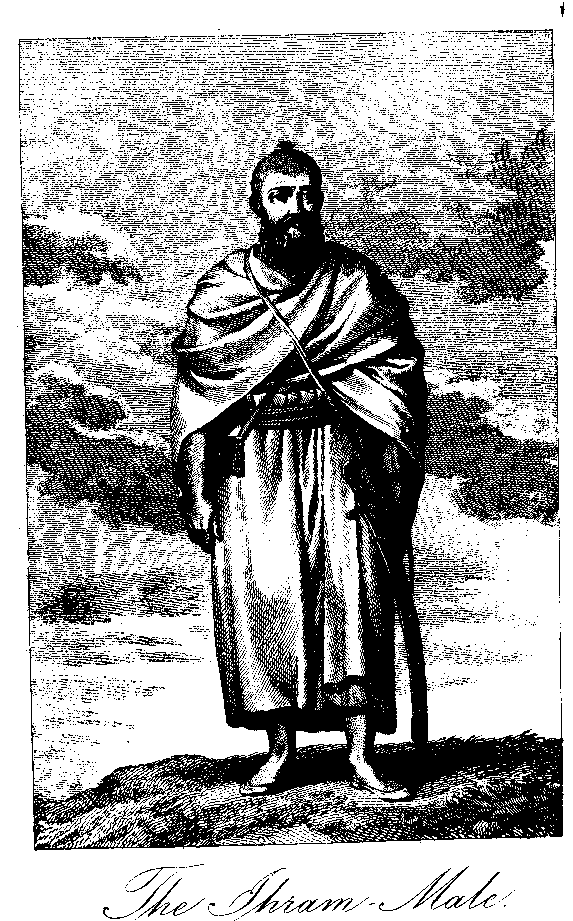
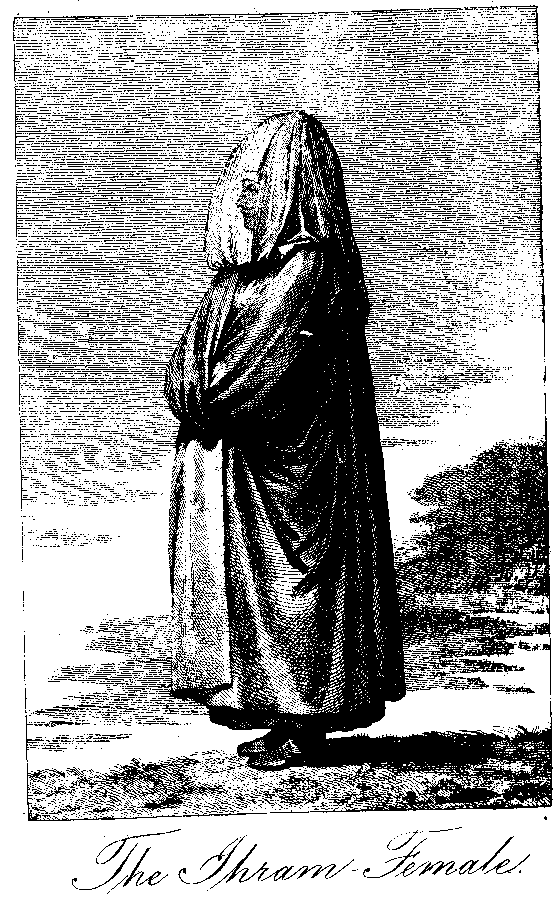
undertaken at the appointed period ; and (3) the greater pilgrimage (Hajju'l Akbar), the usual "Hajj" carried into execution when the day of "'Arafat " (of which more anon) falls on a Friday.
As regards the lesser pilgrimage it is only necessary to state that it is generally confined to a journey to a mosque about six miles from Mecca, whence, after a prayer, the votary repairs to the Holy City and performs the "Tawaf" and "Sai " (to be hereafter described); be then shaves his head, lays aside his pilgrim's garb (Ihram), and all is finished. This act of piety and devotion may be performed at any season of the year, but it is considered especially meritorious during the sacred month "Rajab," which forms a break in the middle of the eight secular months.
When the votary performs the "Hajj " and the "Umra" together, as Was done by the Prophet on the occasion of his last visit to Mecca, it is termed "Al Muqarinna" (the meeting); "Al Ifrad" (singulation) is when either the "Hajj" or the " Umra" is undertaken separately; but in any case the former must precede the latter. A third description, termed "Al Tamattu (Possession), is when the pilgrim assumes the "Ihram," and does not cast it aside throughout the months "Shavval," "Zu'l Qada," nine days (ten nights) in "Zu'l Hijja," Performing the "Hajj " and "Umra" the while.
Sir W Muir says that, "according to the rules of Islam, the pilgrim must resolve before he assumes the pilgrim garb which Pilgrimage he will perform."
The Musulman who has Performed the Pilgrimage is called " Haji."
Upon the votary's arrival at the last stage (of which there are five), about five or six miles from Mecca, he bathes himself and assumes the sacred robe which is called" Ihram." This latter, however, may be taken into wear at other Spots, the farther from Mecca the greater the merit; consequently some poor wretches from India and Egypt travel the whole journey in this costume. As a rule, however, those who come from
Hindustan array themselves in their befitting costume the day previous to their arrival at Jedda. The "Ihram" consists of two new cotton seamless cloths, each six feet long by three and a half broad, the colour being white with narrow red stripes and fringes. One of these garments, called "Izar," is wrapped round the loins from the waist to the knee, and knotted or tucked in at the middle; the other, known as the "Radha," which is knotted at the right side, being thrown loosely over the back, exposing the arm and shoulder, while leaving the head uncovered. It is allowable, however, to carry an umbrella, should health require such a protection against the weather. Women dispense with the " Ihram," some attiring themselves in the veil usually worn by their sex in the East, while others put on, for the occasion, a large white veil in which they envelop themselves down to their feet. The veils, in common with the "Ihrams" worn by the men, being sanctified by use, are religiously kept by pilgrims during their life, in order to serve at death as winding-sheets for the corpse of the pious owners.
Nothing is allowed upon the instep, a prohibition which precludes the use of shoes or boots. To meet the requirements of the case sandals are made at Mecca expressly for the pilgrimage. The poorer classes cut off the upper leather of an old pair of shoes. After the pilgrims have assumed the garb enjoined by the Prophet, they must not anoint their head, shave any part of the body, pare the nails, or wear any other garment than that described above, even scratching is not permissible, lest perchance vermin be destroyed, or a hair uprooted; accordingly, it is a general practice to call the "barber" into requisition immediately before donning the " Ihram," the head is then shaved, the nails are cut, and the mustachios trimmed--thus much for the men; the weaker sex gather up their hair and cut off about four fingers length. It is further forbidden, while clad in the garment of sanctity, to hunt wild animals, or to kill those
which were such originally; but the pilgrim may destroy five noxious creatures, viz., kites, crows, rats, scorpions, and dogs given to biting. Trees are to be spared, as also self-growing plants, but it is allowable to cut grass. For each infraction of these ordinances it is incumbent to sacrifice a sheep as an indication that the offender is worthy of death.
After the toilet is completed the pilgrim, turning the face in the direction of Mecca, says aloud some Arabic words, which may be rendered, "I vow this Ihram of Hajj and the Umra to Allah Almighty." It is also customary at this stage to raise the "Talbiya " - literally translated it runs thus:
"Here I am, O Allah here am I, No partner hast Thou, here am I, Verily praise and beneficence are thine, and the kingdom, No partner hast Thou, here am I."
Immediately on arrival at Mecca the pilgrim performs the legal ablutions. Entering the Holy City by day and on foot, a visit is at once paid to the sacred mosque, taking care that when the glance first alights upon the "Kaba" (Holy of Holies), the following or some similar words are uttered : "O Allah! increase this Thy house in degree and greatness and honour and awfulness, and increase all those who have honoured it and glorified it, the Hajis and Mutamirs [Umra performers], with degree and greatness and honour and dignity." A visit is next paid to the "Black Stone," which is touched with the right hand, and then reverently kissed; that done the "Kaba" is encompassed seven times. This latter act, called "Tawaf," is performed, commencing on the right and leaving the Holy of Holies on the left, the circuits being made thrice with a quick step or run, and four times at a slow pace. These processions are supposed to take their origin from the motions of the planets. The votary then repairs to the "Maqam Ibrahim," a hallowed and venerated spot in the temple of Mecca, and
utters two prayers, after which steps are retraced to the "Black Stone," which is once again devoutly kissed. It should be stated that the devotions are performed silently by day, and aloud at night.
All visitors do not enter the "Kaba"; indeed, there is a tradition that Muhammad himself, on being questioned as to the reason why he had passed the sacred portal, replied : "I have this day done a thing which I wish I had left undone. I have entered the Holy House, and haply some of my people, pilgrims, may not be able to enter therein, and may turn back grieved in heart; and, in truth, the command given to me was only to encircle the Kaba, it is not incumbent on any one to enter it." Those, however, who elect to tread the hallowed floor, are mulcted in a nominal fee, equivalent to about four shillings per head, but the charge by no means exhausts the demands on the pilgrim's purse. Moreover, after visiting the sacred precincts a person is bound, amongst other things, never again to walk barefooted, to take up fire with the fingers, or to tell an untruth. The last mentioned is indeed "a consummation most devotedly to be hoped for," seeing that lying is to an Oriental "meat and drink and the roof that covers him." It may here be mentioned that the Kaba is opened free to all comers about ten or twelve times in each year, while on other occasions the pilgrims have to collect amongst themselves a sum sufficient to tempt the guardians' cupidity. The mosque itself there being no doors to the gateway, is open at all times, and the people of Mecca love to boast that at no hour neither by day or night is the temple without a votary to perform the "Tawaf."
The pilgrim afterwards repairs to the gate of the temple leading to Mount Safa, whence, ascending the hill and raising the cry of "Takbir" (praise to God), it is incumbent to implore pardon for past sins. This done, a descent is made preparatory to a clamber up the hill of Marwa, a proceeding called "As Sai" (running), and repeated several times. The prayer used on
this occasion is as follows: "O my Lord, pardon and pity and pass over that sin which Thou knowest; verily Thou knowest what is not known, and verily Thou art the Most Glorious, the Most Generous. O our Lord! grant us in this world prosperity, and in the future prosperity, and save us from the punishment of fire." It is usual, in the case of male pilgrims, to run between Safa and Marwa, because Hagar the mother of Ishmael when in these parts is supposed to have sped in haste searching after water to preserve the life of herself and her hapless infant; but, notwithstanding the example thus set by one of their own sex, the women as a rule walk the distance. Some, however, are of opinion that the custom of running arose from the circumstance that on one occasion the infidel Meccans mocked the companions of the Prophet, and said that the climate of Madina had made them weak, whereupon this vigorous method was adopted to disprove the calumny.
The eighth of the month Zu'l Hijja is called "Tarwiya" (carrying water), and is probably commemorative of the circumstance that in the pagan period the Arabs used to spend their time in providing themselves with this necessary of life. On this day the worshipper unites with fellow pilgrims at a spot called Mina, in performing the usual services of the Muslim ritual, and stays the night at the last-mentioned locality. On the morning of the ninth, a rush is made to Mount Arafat, a holy hill which, says Burton-"Owes its name and honours to a well-known legend. When our first parents forfeited heaven by eating wheat, which deprived them of their primeval purity, they were cast down Iupon earth. The serpent descended at Ispahan, the peacock at Kabul, Satan at Bilbays (others say Sennar or Seistan), Eve upon Arafat, and Adam at Ceylon. The latter, determining to seek his wife, began a journey to which earth owes its present mottled appearance. Wherever our first father placed his foot-which was large-a town afterwards arose, while between the strides will always be a 'country.' Wandering for many years he came to the mountain of mercy, where
our common mother was continually calling upon his name, and their recognition gave the place the name of Arafat. Upon its summit Adam, instructed by the archangel, erected a 'Madab,' or place of prayer and between the spot and the 'Nimra' Mosque the pair abode till death. Others declare that after recognition the first pair returned to India, whence for forty-four years in succession they visited the Holy City at pilgrimage time."
At Mount Arafat, after first performing early worship at the time of morn, when "a man cannot see his neighbour's face," the votary on arrival says two prayers with the Imam (priest), and hears the " Khutba" or sermon (which generally lasts three hours!), the preacher all the while holding in his left hand a short staff, probably emblematical of the early days of Islam, when a sword was carried as a protection against surprise. Those present, to the tune, it is said, of 70,000 souls of all nationalities, speaking as many as forty different languages, appear before the priest in ordinary clothes, the "Ihram" being laid aside for the occasion ; any deficiency in number is supplied, it is said, by angels from heaven. This act of devotion is so all-important, that if the luckless pilgrim be too late to listen to the homily the labour of the journey is irretrievably lost. There must also be abundant supplication, while they who repeat 11,000 times the chapter of the Quran commencing, "Say He is our God," will obtain from Allahall that is desired!
When the sermon is finished the votary waits till sunset, preparatory to a visit to the Holy Hill. It is thought meritorious to accelerate the pace on quitting the mountain of Eve, and a strange race therefore ensues, called by the Arabs "Ad dafa' Min 'Arafat" (the pushing from Arafat). It may well be imagined that a huge camp 3 or 4 miles long and from 1 to 2 miles in breadth cannot pass through a comparatively narrow gorge with out affrays occurring, and on some occasions as many as 200 lives have been lost. It is a truly remarkable scene; innumerable torches are lighted
twenty-four being carried by the grandees, soldiers fire their muskets, martial bands play, sky-rockets are thrown into the air, and all the while the "Hajj" proceeds at a quick pace in the greatest disorder, amidst a deafening clamour, through the Pass of Mazinmain en route to Muzdalifa, at which latter place each pilgrim picks up several small pebbles, and repeats the sunset and evening prayers, after his work is done for the night.
The next morning, or third day of the pilgrimage is the great "day of days," distinguished in the East by several names. The Turks call it "Qurban Bayram" (the sacrifice of Bayram) ; to the Indians it is known as "Baqr Id" (the kine fete); while the Arabs designate it indifferently, "Idu'l Qurban"(the feast of sacrifice), "Idu'l Azha" (the feast of the forenoon), and "Idu'l Akbar"(the great feast)-the last mentioned being perhaps most commonly in use. The festival, which embraces the slaughter of an animal without spot or blemish, is supposed to commemorate the sacrifice of Ishmael by Abraham hence the name of Qurban (sacrifice) which it bears. It may be here explained that it is the commonly received opinion amongst the was Ishmael not Isaac. Muslim commentators also Muhammadans that the son whom the Patriarch offered assert that the "Friend of God" went so far as to draw the knife with all his strength across the lad's throat, but was miraculously hindered from hurting him. As regards the victim, some suppose it to have been a ram -the very same creature indeed which Abel sacrificed -this said animal having been brought for the occasion from Paradise. Others are of opinion that it was a wild goat, the horns of which were afterwards hung up on the spout of the Kaba, where they remained till the building was consumed by fire.
The pilgrim now proceeds to Mina, and repairs at once in succession to three places indicated by a like number of pillars, at each of which spots he takes one of the seven small stones brought from Muzdalifa, and having repeated a particular prayer over the same,
and blown upon it, he throws it at a pillar. When the largest is reached, the pilgrim exclaims as he casts the pebble, "In the name of Allah-Allah is almighty - I do this in hatred of the Fiend and his shame." This action is repeated till all the stones are used. This curious custom, known as "ramy" (the throwing of the pebbles), is supposed to have its origin in the circumstance that once upon a time the devil, in the shape of an elderly Shaikh, appeared successively to Adam, Abraham and Ishmael, but was driven back by the simple process, inculcated by the Angel Gabriel, of throwing stones about the size of a bean, a mode of exorcism fatal to the wiles of the enemy of mankind. The scene of these adventures is marked by pillars, one of which bears the characteristic appellation, "Shaitanu'l Kabir" (the Great Satan). Others incline to the view that Abraham, meeting the devil in this place, and being disturbed thereby in his devotions, and tempted to disobedience in the contemplated sacrifice of his son, was commanded by God to drive away the Fiend with stones. The "Shaitanu'l Kabir" is a dwarf buttress of rude masonry about eight feet high by ten and a half broad, placed against a rough wall of stones at the Meccan entrance to Mina. As each devotee strives to get as near to this pillar as possible before casting a stone thereat, fights and quarrels are of frequent occurrence, and many a broken limb or injured head betokens the pious zeal of the unhappy worshipper, whom no danger or difficulty can deter from carrying out to the letter the injunctions of the Prophet.
This dangerous ceremony finished, the pilgrim performs the usual sacrifice of the "Idu'l Azha" (feast of the forenoon). This is perhaps the most revolting spectacle which can well be pictured; thousands of animals are slaughtered in "the Devil's Punch Bowl," the number being variously estimated at from 80,000 to 200,000; the entrails are then cast about the valley in every direction, where they remain to rot and putrefy in the sun; the effiuvium, as may be supposed, passes
imagination. In the midst of this loathesome scene 1may be beheld poor Hajjis collecting morsels of flesh with greedy avidity, while negroes and Indians not in-frequently employ themselves in cutting the meat into slices and drying it for their travelling provision. Such are the horrors of the valley of Mina: a spot so wonderful that it is said occasionally to extend itself so as to provide room for the votaries present at the ceremonies of which it is annually the scene, while orthodox Muslims further assure us that vultures never carry off the slaughtered flesh, which, indeed, they piously leave for the destitute but zealous pilgrims; not even a fly, too, will settle upon food sanctified to the use of religion. Unhappily the testimony of travellers conflicts with the truth of these miracles, which exist but in the imagination. It may be added that of late years provision is made for the burial of the carcases instead of their being allowed to putrefy and fester on the surface of the ground.
The votary now gets shaved and the nails pared; the religious garb is then removed and the "Hajj" is ended, the weary zealot being allowed a well-earned rest at Mecca during the ensuing three days, known as "Ayyamu'l Tashriq"(the days of drying up, i.e., the blood of the sacrifice). Before, however, leaving Mecca the pilgrims should once more perform the circuit round the "Kaba," and throw seven stones at each of the sacred pillars. The total number of stones thrown differs somewhat among the various sects. The Shaflis use forty-nine, viz., seven on the tenth day, seven at each pillar (total twenty-one) on the eleventh day, and the same on the twelfth Zu'l Hijja. The Hanafis further throw twenty-one stones on the thirteenth of the month, thus raising the number to seventy. The first seven pebbles must be collected at Muzdalifa, but the rest may be taken from the Mina valley; in any case, however, each stone should be washed seven times prior to its being thrown, and there must be a total of not less than seven for each pillar. The Hanafis attempt
to approach as near as possible to the devil pillar, while the Shafiis are allowed more latitude, provided they do not exceed a limit of five cubits.
Ordinary pilgrims remain at Mecca from ten to fifteen days after the completion of all the requisite ceremonial. Some, however, stay for several months, while others again dwell there for years; but residence at the Holy City is not encouraged by Muhammadan authorities, nominally on the ground that it tends to lessen the respect due to the House of God ; in reality however, the difficulty of sojourning for any lengthened period in a town so ill calculated to support a large population is probably the true cause of the objections raised against such a pious proceeding as remaining constantly in sight of the Holy of Holies.
There is a peculiar custom at Mecca, that if a person engages a house he is obliged to pay a full year's rent, even should but a few weeks remain till the expiry of the month Zu'1 Hijja, which ends the Muhammadan year; and not only so, but when this latter period arrives, the occupier has either to leave the house, or become liable for another year's rent; so that not unfrequently a hapless tenant is compelled to pay two years' rent for the use of a house during the term of but a few weeks. On the occasion of the pilgrimage season houses are generally hired furnished for a few weeks but the poorer classes live in free-houses termed "Ribats," built by rich and pious votaries for the benefit of such of their fellow countrymen as cannot afford either to pay rent or to hire rooms; it not unfrequently happens, however, that the purpose of the founder is defeated, owing to the circumstance that the occupier has to pay the manager for the privilege of living rent-free, and the highest bidder is pretty sure to win the day. Some ribats are reserved for the gentle sex. The principal of these houses belong to the Javanese authorities, the rulers of Haidarabad, Bhopal, &c. The welfare of the various peoples who flock to Mecca is further promoted by the presence of agents
charged with the duty of protecting the interests of the respective nations to which they belong. There is also a hospital; but the accommodation is limited, and in spite of every precaution, the condition of the poor is most miserable. When they get ill, scarce a soul cares to attend to the hapless wretches, who cannot at times procure even that necessity of life, water ; weak, sick, ill-fed, and houseless, they drag on a miserable existence in the streets, till death puts an end to their troubles, which their fellow creatures are unable or unwilling to assuage.
After the pilgrimage is finished, a certain amount of time is consumed in collecting mementos of the "Hajj"; these are for the most part pieces of wood off the tree called "Filu," which are well adapted for cleaning the teeth. "Lif," a kind of grass like silk thread, white, black and red antimony for the eyelids, barley of the species eaten by the Prophet, commonly grown in the valleys about Mecca and Madina, and dates from the latter city. After all these arrangements are completed, many of the Hajis betake themselves to the Mosque of the Prophet at Madina; this act of piety, called "Ziarat" or "Visitation," is a practice of faith, and the most effectual way of drawing near to Allah through his messenger Muhammad ; though highly meritorious it is none the less a voluntary undertaking, the choice being left to the individual's free will.
The Mosque of the Prophet at Madina is built on much the same plan as that at Mecca, though the dimensions are considerably smaller, the edifice being but 290 feet in length, and 229 in breadth. A minute description of the building scarcely seems necessary; but it would not be possible to omit mention of the "Hujra," or sacred enclosure, a square building of black stones, supported by two pillars, in the interior of which structure are, it is alleged, the tombs of Muhammad and his two earliest friends and immediate successors, Abu Bakr, and Omar. In front of these sacred objects of veneration a curtain is drawn to the height of at
least 30 feet; there is also a small gate always kept shut, no person being permitted under any pretence to enter within the holy precincts except the chief eunuchs, who take care of the place, and who at night put on the new curtains, which latter are sent from Constantinople whenever the old covering is decayed (according to some authorities this happens about once in six years), or when a new sultan ascends the throne. The old veils are sent to Constantinople, and serve to cover the tombs of the sultans and princes.
The temple was founded by Muhammad himself, who erected a small chapel on the spot where his camel had first rested in the town; this building was made of mud walls, with a roof of palm leaves, supported by pillars composed of the stems of the same description of tree. During the first century and a half after his death, the edifice was enlarged by successive Khalifs, till it attained a considerable size and corresponding splendour. From A.H. 160 (A.D. 776) till A.H. 654 (AD. 1256) the structure remained unaltered; but in the latter year the Mosque caught fire, and was burnt to the ground, a calamity which occurred again in A.H. 886 (AD. 1481), this time owing to its having been struck with lightning. The havoc was complete, the interior of the "Hujra" being the only portion which escaped destruction. The Mosque, as it now stands, was built in A.H. 892 (A.D. 1486) by Qaid Bey, King of Egypt, who sent 300 workmen from Cairo for that purpose; but so great was the debris of the former building that it was with the greatest difficulty the original place of the Prophet's tomb could be ascertained. Since that date a few immaterial improvements have been made by the Emperors of Constantinople.
The ceremonies on visiting the Mosque are as follows:-
Before entering the town the pilgrim purifies himself with a total ablution, rubbing his body, if possible, with perfumes. Arrived in sight of the dome he utters some
pious ejaculations, after which the cicerone, or "Muzzavir," as he is here called, leads him to the gate known as "Babu's Salam," the threshold of which
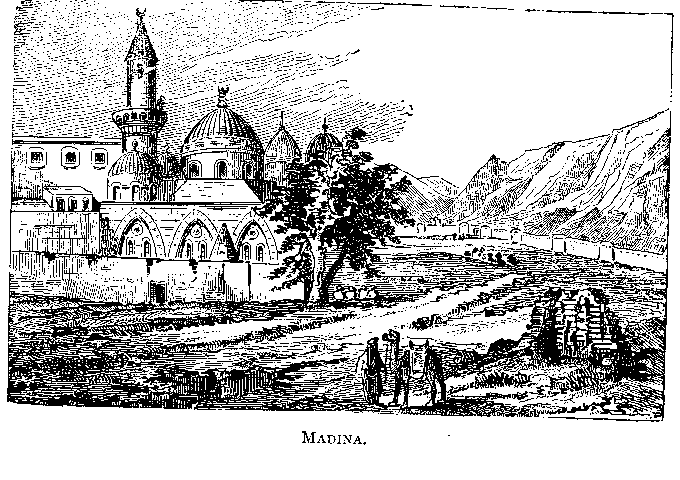
must be passed with the right foot foremost, a custom general as to regards all Mosques, but especially insisted upon at Madina. Reciting some prayers as he walks,
the votary then makes his way to a particular spot, where he utters a short prayer and salutes the mosque with four prostrations, repeating two short chapters of the Quran, the 109th, entitled "The Unbelievers," and the 112th, which proclaims the Unity of God. The pilgrim now makes his way to the "Hujra," taking his stand beneath the western window, where, with arms half raised, he addresses his invocations to Muhammad, recapitulating as many as he can recollect of the ninety appellations, by which the Prophet is characterized, and prefixing to each a few words equivalent to "I salute thee." Next, intercession is made to Heaven on behalf of all those relatives and friends for whom it is considered desirable to pray, and finally a charitable hope is expressed that God will "destroy our enemies, and may the torments of Hell fire be their lot." It is in consequence of this custom that letters addressed to the people of Madina invariably conclude with a request that the writer's name may be mentioned at the Prophet's tomb.
After a few minutes spent in pressing the head close against the window in silent adoration, the visitor steps back and performs a prayer of four prostrations under a neighbouring colonnade; he then approaches the second window, on the same side, said to face the tomb of Abu Bakr, and repeats the procedure adopted on the first occasion. So also as regards the window where Omar is supposed to be buried. This done, the pilgrim betakes himself to another corner of the building, where the tomb of the daughter of Muhammad is situated; here, after four prostrations, a prayer is addressed to the "bright Fatima." Retracing his steps to the porch of departure, a prayer is uttered as a salutation to the Deity on leaving the Mosque. This completes the ceremony, which lasts about twenty minutes, and the votary is then at liberty to withdraw, not, however, without having paid his fee to the numerous individuals - alike men and women - who sit with handkerchiefs spread out to receive the gifts of the faithful.
According to Burckhardt, "the ceremonies may be repeated as often as the visitor wishes; but few perform them all, except on arriving at Madina, and when on the point of departing. It is a general practice, however, to go every day at least once to the window opposite Muhammad's tomb, and recite there a short prayer. Many persons do it whenever they enter the Mosque. It is also a rule never to sit down in the Mosque for any of the usual daily prayers, without having previously addressed an invocation to the Prophet, with uplifted hands, and the face turned towards his tomb. A similar practice is prevalent in many other Mosques in the East, which contain the tomb of a saint. The Muslim divines affirm that prayers recited in the Mosque of Madina are peculiarly acceptable to the Deity, and incite the faithful to perform this pilgrimage by telling them that one prayer said in sight of the "Hujra" is as efficacious as 1,000 said in any other Mosque except that of Mecca."
One peculiarity at Madina must not escape attention, to wit, that there are placed at the pulpit and in one or two other places in the Mosque large wax candles sent from Constantinople; these, which are as thick as a man's body, and twelve feet high, are lighted in the evening by means of a ladder placed near them. The doors of the building are closed about three hours after sunset, and opened about an hour subsequent to dawn; but those who wish to pray all night can easily obtain permission from the eunuch in charge, who sleeps near the "Hujra." During Ramazan the Mosque is kept open all night. It may be added that the whole charge of the sacred building is entrusted to about forty or fifty eunuchs, who are much respected in Madina, assuming in consequence airs of great importance-indeed, when they pass through the bazaar it is customary for persons to kiss these monsters' hands. They have large stipends, which are sent annually from Constantinople by the Syrian caravan, and they also share in all the donations made to the Mosque, while, in addition, they expect presents from every rich pilgrim, as well as fees from visitors to the "Hujra." These hideous creatures live
together in one of the best quarters of the city, and their houses are said to be furnished in the most costly and luxurious manner. One distinctive peculiarity attaches to Madina - Burckhardt's remarks in allusion to it are at once instructive and interesting.
"The mosque at Mecca is visited daily by female Hajis, who have their own station assigned to them. At Madina, on the contrary, it is thought very indecorous in women to enter the mosque. Those who come here from foreign parts visit the tomb during the night after the last prayer, while the women resident in the town hardly ever venture to pass the threshold; my old landlady, who had lived close to it for fifty years, assured me that she had been only once in her life within its precincts, and that females of a low character only are daring enough to perform their prayers there. In general, women are seldom seen in the mosques in the East, although free access is not forbidden A few are sometimes met in the most holy temples, as that of "Azhar" at Cairo, where they offer up their thanks to Providence for any favour which they may have taken a vow thus to acknowledge. Even in their houses the women seldom pray, except devout old ladies and it is remarked as an extraordinary accomplishment in a woman if she knows her prayers well, and has got by heart some chapters of the Quran women being considered in the East as inferior creatures, to whom some learned commentators on the Quran deny even the entrance into Paradise; their husbands care little about their strict observance of religious rites, and many of them even dislike it, because it raises them nearer to a level with themselves, and it is remarked that the woman makes a bad wife who can once claim the respect to which she is entitled by the regular reading of prayers."
Last, but perhaps not least, amongst the peculiarities of Madina, are the millions of animals of the most irritating description, who are only too happy to transfer their allegiance to any devout pilgrims who visit the mosque, be they rich or be they poor, for these creatures are no respecters of persons; nor does the evil end here, for the votary of necessity transfers these plagues to the lodging houses which there swarm with vermin.
Grandees and persons of wealth make the journey to Mecca with a numerous array of servants and attendants, well supplied with all £he good things of this world; but the less pretentious and the humbler classes form companies of from fifteen to twenty persons, who travel together, thereby securing their safety, and saving their pockets. The whole cavalcade then generally makes a contract with some one to supply the caravan with animals as well as food and stores, the sum being stipulated before the start is commenced. Some three or four months prior to the period of the pilgrimage, these entrepreneurs, many of whom amass considerable fortunes, repair to the various villages and announce the approaching departure of the votaries: this is done by beat of drum, a sort of religious chant being sung at the same time, exhorting all faithful and pious Muslims to obey the injunctions of the Prophet. The principal gathering of pilgrims, known as the Syrian Caravan, sets out from Constantinople on the 12th of the month Rajab, and collects the votaries of northern Asia in its passage through Anatolia and Syria, until it reaches Damascus, where it remains for several weeks, being placed under the charge of the Pasha of the Province who, in virtue of the duties which fall to his share, assumes the title and dignity of Amiru'l Hajj, or "Chief of the Hajj." As the early Khalifs for many years discharged personally this high and important office, and placed themselves at the head of the pilgrims, it may well be imagined that -this position is at once respected and coveted nor is it cause for astonishment that in such circumstances, nothing can equal the pomp with which the Pasha of Damascus is surrounded, when he commences to march with the pilgrims. There are generally a large number of officers and soldiers clad in coats of mail, or covered with the skins of tigers, some carrying shields and quivers decked with silver, or it may be gold, and occasionally even with precious stones: while others bear lances and pikes, either gilt or silvered, as the case
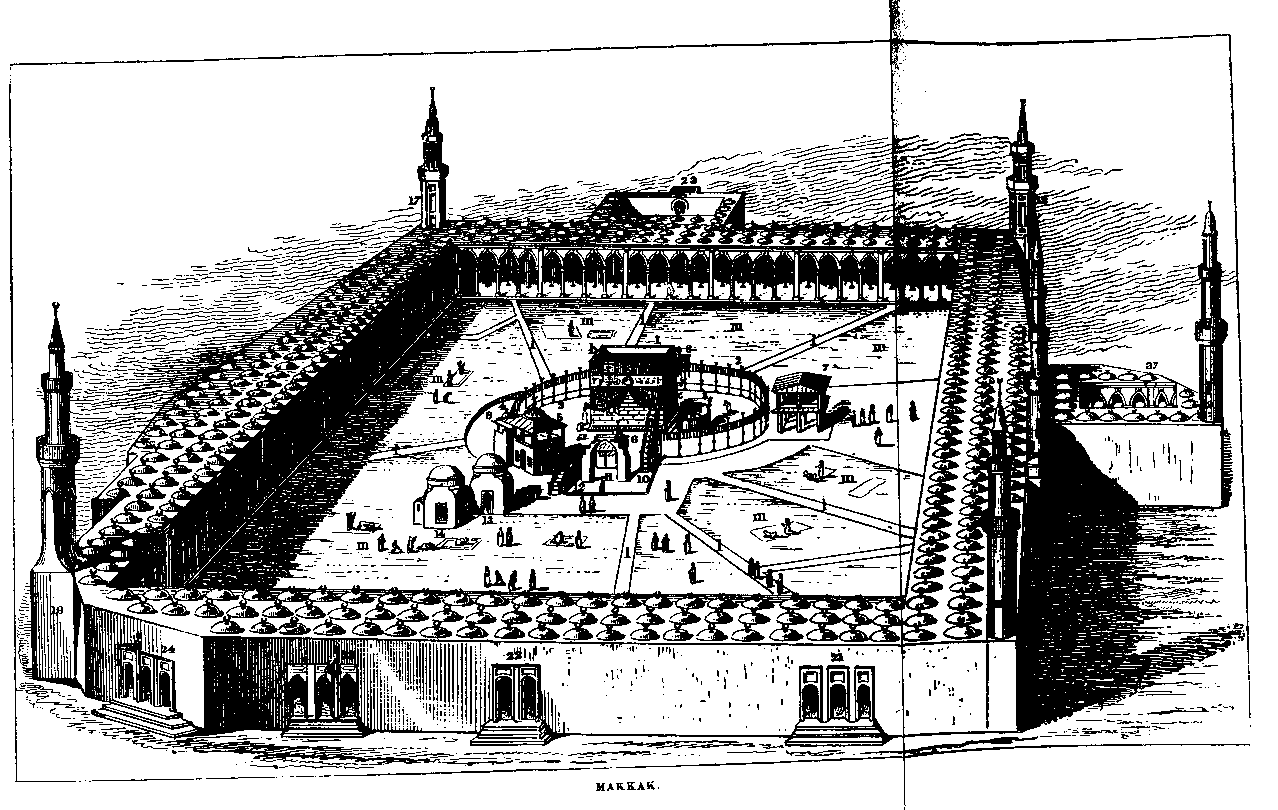
may be, and ornamented with streamers. The grandees of the country, as well as the citizens and common people of the town, accompany the caravan, bestowing pious wishes for the auspicious termination of the journey, while at every station caravanseraies and public fountains have been constructed by former Sultans to accommodate it on its passage, which for - some stages is attended with continual festivities and rejoicings. But at Damascus it is necessary to make arrangements for a thirty days' journey across the Desert to Madina, and the animals which carry the burdens thus far have to be changed, since the Anatolian camel is not able to bear the fatigues of such a journey. This, however, presents no difficulty, seeing that almost every town in the eastern part of Syria furnishes beasts for the purpose; these latter are, of necessity, very numerous, seeing that they have to carry not only water and provisions for the "Hajis" and soldiers, their horses, and the spare animals brought to supply such as may fail on the road, but also daily food for the camels themselves, as well as provisions which are stored in repositories on the route to provide a supply for the return journey. It has been asserted that, on one occasion, when the mother of the last of the Abbasides performed the pilgrimage in A.H. 631 (AD. 1233), her caravan was composed of 120,000 camels. It is also related that it took 900 camels to transport the wardrobe of Sulaiman Ibn Abdu'l Malik (AH. 97 = AD. 715). But far eclipsing these was the pilgrimage of a Sultan of Egypt in AH. 719 (AD. 1319), when 500 camels were hired to convey sweet-meats and confectionery alone, and 280 were laden with pomegranates, almonds, and other fruits, while the travelling larder could boast of 1,000 geese and 3,000 fowls! Truly might this be termed pilgrimage made enhanced by the presence of the Pasha of Tripoli, and easy! The splendour of the cavalcade is subsequently minor officials, at the head of a large body of troops for the protection of the caravan, lest it should be
molested by brigands, more especially in the deserts of Syria and Arabia. On more than one occasion, notwithstanding all these precautions, the pilgrims have been attacked and robbed, sometimes even massacred, by the Nomad tribes, through whose regions they had - to pass; but as such calamities are more sorely felt by the nation at large than even the defeat of their troops in war, the authorities are perforce compelled to take every pains to ensure, as far as possible, the safety of the pilgrims, who are thus escorted till within three stages from Madina.
At night torches are lighted, and the journey is performed between three o'clock in the afternoon and an hour or two after sunrise on the following day. The Bedouins, however, who carry the provisions for the troops, travel only by day, and in advance of the caravan, the encampment of which they pass in the morning, being in turn overtaken by the latter on the following night at their own resting-place. The journey with these tribes, though less fatiguing, as ensuring a night's rest, is seldom attempted, owing to the questionable character which the children of the desert enjoy in the East.
At every watering-place on the route there is a small castle with a large tank attached to it, at which the -camels water. These buildings are inhabited by a few persons, who remain there the whole year, to protect the provisions made over to their charge. At the watering-places which belong to the Bedouins, the Shaikhs of the tribes meet the caravan and receive the accustomed tribute. Water is plentiful on the route, the station being nowhere more distant than eleven or twelve hours' march ; while in winter pools of rain-water are frequently found. Pilgrims who travel with "litters," or on commodious camel-saddles, suffer comparatively little inconvenience; but the poorer classes who follow the caravan on foot, often die on the road from exhaustion and fatigue.
The Egyptian caravan, which assembles near Cairo
on 25th Shavval, and starts on the 27th of that month, -is under the same regulations as the Syrian cavalcade, but is composed solely of Egyptians. The journey, which occupies thirty-seven days, is along the shore of the Red Sea, and leads through the territories of wild and warlike tribes of Bedouins, who not unfrequently attack the caravan. The watering-places also are much fewer than on the Damascus route, three days occasionally intervening between the wells, which are, moreover, seldom copious, and often brackish. So dangerous, indeed, is this route, that on one occasion, in 1814, all the pilgrims took the route via Suez, leaving the Egyptian caravan composed solely of soldiers. It is sometimes accompanied by parties of public women and dancing girls, whose tents and equipage are generally amongst the most splendid in the caravan. Female "Hajis," of a similar class, are also to be found in the Syrian caravan. Both the great cavalcades from Constantinople and Cairo return from Mecca on 23rd Zu'l Hijja, after a stay of ten days in the Holy City.
One custom, peculiar to both nations, remains to be noticed, the procession of the "Mahmil" or "Mahmal" as it is commonly, but erroneously, called. This term, which means "that by which anything is sup-ported," is universally applied in the East to the litter which accompanies the pilgrims to Mecca. Not infrequently, however, and with reason, it is used to designate the camel which bears the burden in question.
It is composed of a square skeleton frame of wood, with a pyramidal top, and has a covering of black brocade, richly worked with inscriptions and ornamental embroidery in gold, in some parts upon a ground of green or red silk, and bordered with a fringe of silk, with tassels, surmounted by silver balls. Its covering is not always made after the same pattern with regard to the decorations, being sometimes a fine silk brocade, adorned with ostrich feathers. But generally, if not invariably, on the upper part of the -front, a view of the Temple of Mecca is worked in
gold, and over it the Sultan's cipher. As a rule, it contains nothing in the interior, but has two copies of the Quran attached externally at the top,-one a small scroll, and the other in the usual form of a book, also small, each enclosed in a case of gilt silver. The Egyptian Mahmil, however, in place of the two copies
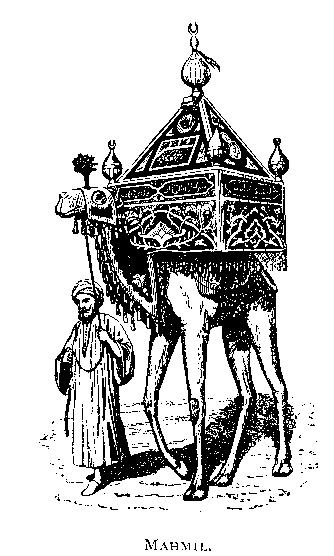
of the Quran attached to the cover has a small book of prayer, and some charms packed within the litter. The five balls, with crescents, which ornament the Mahmil are of gilt silver. The whole is borne by a fine tall camel, which is generally indulged with exemption from every kind of labour during the remainder
of its life. On the line the Mahmil is stripped of its embroidered cover, the frame of wood being carried on a camel's back. Even the gilt silver balls and crescent are exchanged for similar articles in brass.
The most commonly accepted version as to the origin of the procession of the Mahmil is, that about the middle of the thirteenth century a beautiful Turkish female slave, after the death of the Ruler of Egypt, whom she had married, caused herself to be acknowledged as Queen of that kingdom, and performed the pilgrimage in a magnificent covered litter borne by a camel. After this, for several successive years, her empty litter accompanied the caravan merely for the sake of State; hence succeeding Princes of Egypt sent with each year's caravan of pilgrims a Mahmil, as an emblem of Royalty.
Burckhardt, however, believes the custom to have arisen from the circumstance that the Bedouins from time immemorial were in the habit of carrying banners in battle, a practice which gave rise to the idea of a Mahmil, which indeed they most resemble. D'Ohsson, on the other hand, is of opinion that the custom is intended to perpetuate the memory of the camel upon which the Prophet of Arabia used to travel, and on which a species of throne was erected, from which latter he was wont to dispense justice to the people. Buckhardt and Burton however, demur to this view, and are not disposed to attach any peculiar sanctity to what they are led to think is a mere act of regal state. The point a short time since assumed considerable importance, owing to the circumstance that the British troops in Egypt were present at the ceremony, which took place at Cairo, on the occasion of the departure of the "Mahmil," and their presence evoked much criticism on the part of a considerable section of the public of this country, while, to add to the difficulties with which the case was surrounded, the procession of the "Kiswa" took place on this occasion simultaneously with that of the "Mahmil" in consequence of the disturbed
state of the country, which rendered impracticable its departure at the proper date.
The day of the departure of the "Mahmil" from Constantinople is a sort of religious fete. The ceremony on this occasion is very quaint and merits notice. The representative of the Sultan repairs at the head of a great cortege to the Palace to receive the orders of his monarch, as well as the "Mahmil" and treasure. The Sovereign seats himself under a great, gaily decked, pavilion in the middle of a vast corridor adjoining the portion of the palace set apart for the ladies. After this the Imams of the Imperial Mosques and other high personages are introduced and form a semicircle around His Majesty, sitting on small rugs placed upon the larger carpet, which covers the floor of the pavilion. At their head is one of the fourteen shaikhs of the Imperial Mosques, who enjoy the honour alternately every year, according to seniority. The dignitary whose turn it is to take the lead commences by chanting different songs in praise of the Prophet, the other prelates joining him from time to time, and finishes with good wishes for his Majesty's health. On the termination of this part of the ceremony the principal members of the body of black eunuchs present themselves in the midst of the Court with a camel magnificently draped, having a silver chain round its neck. An officer then advances and, placing his hand on the camel, kisses the latter respectfully. This done he leads the animal about before the Sultan, after which he consigns it to the charge of the officer destined to take it en route to Mecca, which latter is thereupon decorated with a vest of honour; the first mentioned officer also receives from the grand master of the ceremonies a sable fur with a gold-cloth vest. The treasure is then loaded upon eight mules, of whom five carry cases decorated with green velvet. The documents relating to the distribution of the money annually sent by the Sultan for the support of the Holy Mosque, said to amount to upwards of 70,000 pounds, are then sealed and placed, in the presence of the Sultan in
the hands of the leader of the cortege. After these preliminaries are finished, the Chief Chancellor of the Empire produces a letter from the Sultan to the Grand Sharif of Mecca, which, too, is handed with great state to the officer in charge of the "Mahmil." All is now completed, and the latter personage carries the Sultan's letter in a gold cloth purse, as far as the second door of the palace, accompanied the while to the precincts of the first court by a high officer of state, the compliment being paid rather to the "Mahmil" than to the man. All the prelates now follow the cavalcade, which marches thence through the streets of Constantinople, presenting a most extraordinary and imposing sight. First of all there are the numerous functionaries of dignity and importance in full uniform, both preceding and coming after the camel, which, it may be added, is followed by a second to replace the first in case of accident, as also by eight mules laden with treasure. After this sedate and serious procession there follows a body of buffoons and jesters playing antics and making fun to indicate their joy at the approaching pilgrimage. The procession is also accompanied by numerous mules carrying peculiar-looking boxes, of various shapes and sizes, decorated with banners and feathers. The mules, laden with treasure are taken in a galley to the Asiatic side of the water, but the camels are stripped of their ornaments on the quay and led back without any ceremony to the Palace, where they are carefully tended. They are not taken to Mecca, for fear they should succumb to the fatigues of so long a journey, their place being supplied at the sacred city by two others, supposed to have descended from the animal which carried the Prophet. Of these one is kept in Syria by the Pasha of Damascus, who sends it every year to Mecca; the other is sent from Egypt by one of the Beys of the province, charged with the care of the pilgrims. For the first time, probably, in the history of Muhammad an ism, the cavalcade in the autumn of 1882, instead of Journeying the usual caravan route, through the desert
went by special train to Suez, and thence by steamer to Jedda.
A similar procession takes place at Cairo, when the "Mahmil" passes through the Metropolis. This usually happens about the 23rd of Shavval, though the final departure of the caravan does not occur till the 27th of that month.
The Persian caravan sets out from Baghdad, but being "sectaries" (Shias), and in many cases men of property, it is apt to suffer so much molestation and imposition during the route, that great numbers of the people now come by sea, embarking at Bussora for Mocha, where, if the wind be favourable, they go to Jedda, if not they form themselves into a caravan, and come by land along the coast of Yaman. Sometimes they swell the numbers of the Syrian caravan; from which they are, however, easily distinguishable owing to the cirumstance that their camel drivers hail from Baghdad. The Persians being heretics who conceal their doctrine during the "Hajj" were not always permitted to come to the Holy City. "In 1634," writes Burckhardt, "a few years after the temple of Mecca had been rebuilt, Sultan Murad IV. commanded that no Persian of the sect of Ali should be allowed to perform the pilgrimage or enter the Baitu'llah. This prohibition was complied with for several years, but the money expended by the Persians soon reopened the way to Arafat, and the Kaba. We hear from Asami that in 1625 a sectary of Ali was impaled alive at Mecca because he would not "abjure his creed." Failing a pilgrimage to Mecca, where an outward manifestation of respect to the memory of the first Khalifs is rigorously enforced, the mass of the population of Persia content themselves with a visit to the sepluchres of Ali, and his sons Hasan and Husain, whose remains are deposited at Najaf and Karbala, or to the tomb of the Imam Reza at Meshed. When a Persian journeys to the Holy City he not unfrequently contrives on entering the mosque to pollute the tombs of the detested Khalifs Abu Bakr
and Omar, "an act of foolish fanaticism which has cost many an innocent life ; for on such occasions the Arabs seize their sabres, and cut down every Persian they see," in any case rarely do the Shia votaries escape without an unmerciful beating at the hands of their Sunni rivals To avoid these dangers the Shias deem themselves entitled to put in practice a pious fraud, and pass themselves off for Sunnis, an act of hypocrisy which the latter severely condemn as unworthy of true followers of the Prophet of Arabia.
In former times there used to be a regular Maghrabi caravan, starting from Morocco and proceeding by way of Tunis and Tripoli to Alexandria and thence to Cairo, after which it followed the common pilgrim route; but for many years this caravan has ceased to be regular, and pilgrims from Barbary usually proceed by sea to Alexandria and Jedda, in parties of from 50 to 100 at a time.
There are minor caravans, which come ordinarily when the roads are open, and the country is tranquil but they are from time to time discontinued, and need not be more than mentioned: these are the Yaman caravan, which either starts from Sada in Yaman, and takes its course along the mountains to Tayif and Mecca, or follows a line along the coast. From time to time also small parties of pilgrims, consisting of Indians, Persians, and Arab beggars arrive in the Hijaz by way of Muskat and Najd.
Of all the poor pilgrims who annually repair to the sacred cities of Arabia, none bear a higher name than the negroes called "Takruris" who come via Massowa, Suakim and Cosseir. A most industrious class of men, some employ themselves as porters, labourers or water-carriers, while others make small hearths of clay, painted with yellow and red, which they sell to the pilgrims, who boil their coffee-pots upon them. Many again manufacture small baskets, and mats of date leaves, or prepare an intoxicating drink called "Buza." They generally manage during their stay in the Hijaz
to scrape together a small sum of money which enables them, on their return, to start some slight venture on their own account.
When once the pilgrims reach the confines of Arabia they are under the care of the Grand Sharif of Mecca, who is supposed to be answerable for them, a regulation which is perhaps more honoured in the breach than in the observance This worthy, who enjoys entire religious power in the Hijaz, is appointed by the Sultan of Turkey; but the latter, in view that the dignity is nominally hereditary, generally confines his selection to members of two powerful families. On his attaining office the Grand Sharif is invested with a gold embroidered mantle edged with marten sable, which together with a diploma of creation, the Sultan sends from Constantinople. This ceremony used for many years to be repeated annually, but it is believed that the custom has fallen into disuse. This high dignitary, who is clad in white, is always distinguishable by a peculiar turban of the same colour, ornamented with large tufts, the gold threads of which hang down upon the shoulders. His only symbol of office is a large green satin umbrella, carried by an attendant. His salary, which is paid by the Sultan, is nominally 15,000 pounds per annum, but it is open to question whether this amount ever really reaches the Grand Sharif's pocket.
The secular authority centres chiefly in the Pasha of Jedda, who, in common with the governor of Madina, bears the title of "Shaikhu'l Haram," or "Governor of the Holy Sanctuary." As might be supposed, the secular and sacred officers clash, and the two rivals "thwart each other on all possible occasions, quarrels are bitter and endless, there is no government, and the vessel of state is in danger of being water-logged in consequence of the squabbling between her two captains." Such is the testimony of Burton, founded upon personal experience on the spot.
Pilgrims of the better class generally come by land. These pass the interval before the " Hajj" pleasantly
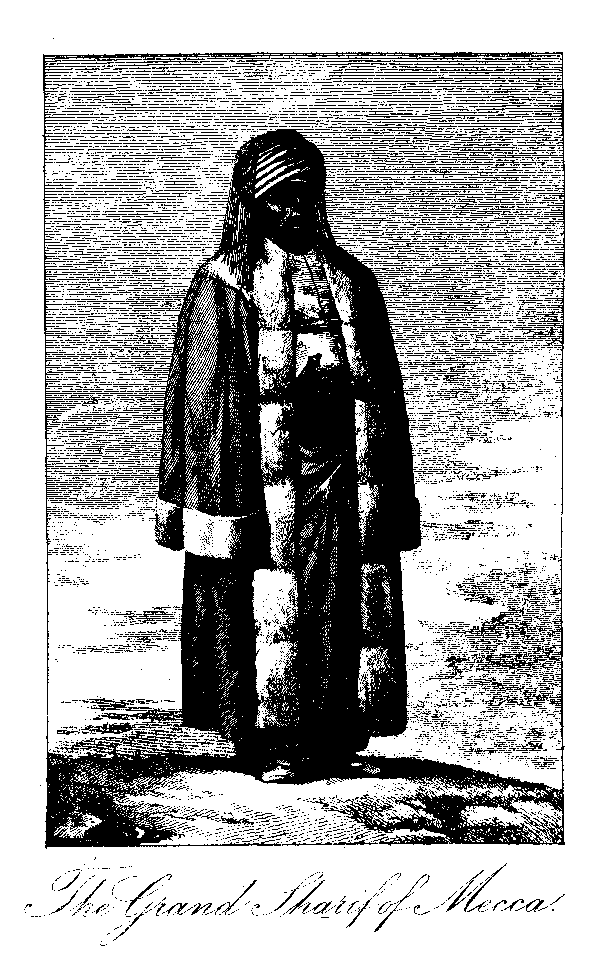
enough, living together in a state of freedom and equality. They keep but few, if any, servants, and divide amongst themselves the various duties of daily life. They are to be seen in scores reading the Quran, smoking in the streets or coffee-houses, praying or conversing in the mosque in full pride of being near the holy shrine, and in pleasurable anticipation of adding to their names in due course the auspicious title of "Haji."
Few of them, except mendicants, arrive without bringing some production of their respective countries for disposal, the profits on the sale of which diminish, to some extent, the heavy expenses of the journey to Mecca. The Maghrabis, for instance, bring their red bonnets and woollen cloaks; the European Turks shoes and slippers, hardware, and embroidered stuffs, sweetmeats, amber trinkets of European manufacture, knit silk purses, &c.; their kinsmen from Anatolia sell carpets, silks, and Angora shawls ; the Persians deal in Kashmir shawls, and large silk handkerchiefs; the Afghans barter tooth-brushes made of the spongy boughs of a tree growing in Bokhara, beads of a yellow soap-stone, and plain, coarse shawls manufactured in their own country; the Indians display the numerous productions of their rich and extensive region; the people of Yaman provide snakes for the Persian pipes, sandals, and numerous other works in leather; while the Africans trade in various articles adapted to the wants of their nation. The wares, however are generally sold by auction, owing to the impecuniosity of the owners, who are, as a rule, compelled to accept prices much below the intrinsic value of the article itself.
A very considerable number of the pilgrims who annually visit Mecca travel by sea to Jedda, whence they betake themselves in company to the City of Cities. The condition of these poor wretches is beyond the pale of description. Sometimes as many as 600 or 700 miserable creatures are huddled together on board a single ship, without proper accommodat on, and with
few or none of the decent arrangements of life, so that the condition of the vessel, after a few days have elapsed, is filthy and disgusting beyond description. That women as well as men should elect to witness such scenes as they are compelled to experience on this journey by sea to Jedda, is an additional proof of the strong hold which the religion of Islam has taken upon the millions who glory in undergoing discomforts and dangers the bare mention of which occasions a shudder of horror on the part of any one accustomed to the proprieties and comforts of modern civilization. Nor is the return home less distressing, for, added to the discomforts attendant on the voyage, the votaries are frequently compelled to endure great suffering while waiting at the port for a vessel to take them away. Many during this period, which is often protracted, sell everything they possess in the world, and when this is not sufficient to procure food, they are turned into the streets to starve and perish.
That such a state of affairs should not have escaped attention on part of the British authorities may well be imagined; the result may be gathered from a resolution recently published by the Government of India under date, 21 Jan. 1886.
For several years past the attention of the Government of India has from time to time been directed to the desirability of alleviating, so far as is possible, the discomforts and sufferings experienced by Muhammadan pilgrims during the journey from India to the Hijaz. The existence of these sufferings, more especially in the case of those of the poorer class of Muhammadans who undertake the pilgrimage, is an admitted fact; but the action taken with a view to afford relief has been necessarily of a restricted nature, owing to the unwillingness felt by the Government to undertake any direct interference with what is considered to be a religious obligation by a large section of the Muhammadan community in India. In 1880 intimation was received from Her Majesty's Secretary of State that the Turkish Government had issued orders requiring passports from all passengers and
pilgrims arriving in Jedda, whether Turkish or foreign subjects, and announcing that those who came unprovided with such documents would be liable to be repelled from the ports of the Hijaz. In order to render these Turkish regulations as little irksome as possible to natives of India proceeding to the Hijaz on pilgrimage, the Government of India, after consulting Local Governments and Administrations, resolved to establish a system under which passports should be unconditionally given to every intending pilgrim, not only at the Indian ports of embarkation but also at the central stations of every district in British India, and at the head quarters of all Political Agencies in Native States. Arrangements were also made to grant informal passes to the subjects of other Governments, e.g., natives of Kashghar, Russian Turkestan, Afghanistan, &C. who embark for Mecca from Indian ports, it being explained that these passes impose no responsibility on the Government of India in regard to the holders, and that the Governor-General in Council could not in any way guarantee their recognition by the officials of the Turkish or any other Foreign Government. Further, in consideration of the very large number of pilgrims who annully embark at, and return to, Bombay, and of the necessity of making some special arrangements to meet their requirements, a Muhammadan Protector of Pilgrims was appointed at that port and instructed to supply intending pilgrims with all the information and assistance within his power in respect of every matter connected with the pilgrimage.
2. Since the above measures were undertaken, further efforts have been made by the Government of India towards the proper regulation of the India pilgrim traffic by amending the provisions of the Native Passenger Ships Act (No. VIII. of 1876) in certain important respects, and by revising the rules issued under that Act with reference to the fitting, pro-visioning, sanitary arrangements, &c., of pilgrim ships. These rules have been assimilated, as far as possible, with those in force for regulating the transport of emigrants to the French and British colonies, and have been widely circulated in the form of a "Manual for the guidance of officers and others concerned in the Red Sea Pilgrim Traffic." It has been made obligatory on ships conveying more than 100 pilgrims to carry a qualified medical officer, and in order to promote the welfare of Indian pilgrims during their stay in the Hijaz, an
Indian Vice-Consul has been appointed at Jedda, whose special duty it is to attend to the interests and well-being of the pilgrims. In order further to afford protection and assistance to the pilgrims, especially in connection with their detention in quarantine under the orders of the Turkish Government, a Muhammadan Vice-Consul has been temporarily appointed for Hodeida and Camaran. A dispensary has also been established at Jedda for affording relief to Indian pilgrims in the Hijaz. Lastly, in order to regulate and bring under proper control the transactions of pilgrim-brokers in the city of Bombay, it is proposed to introduce a Bill into the local Legislative Council under which the business will in future be restricted to licensed persons; and certain penalties will be imposed for any breach of the terms of the license. The action hitherto taken cannot fail to have effected a substantial improvement in the position of pilgrims during the voyage to Jedda and while staying in the Hijaz. In the course of the correspondence which has taken place with Her Majesty's Secretary of State on the subject, it was considered whether intending pilgrims should be required before proceeding on the voyage to deposit a sum of money sufficient to cover the cost of their return journey. The Government of India admitted that such a regulation would prevent much misery and suffering, but the opinion of the local authorities was opposed to interference of this nature on the ground that it might be misunderstood and misinterpreted, and the Governor-General in Council accordingly decided that action of the kind was unadvisable. At the same time a public notice was issued in the English, Hindustani, and Persian languages warning persons who propose to undertake the pilgrimage of the difficulties to which they would be exposed owing to the imposition by the Turkish Government of quarantine for at least ten days at the Island of Camaran (during which period pilgrims are required to pay certain fees besides arranging for their own provisions), and impressing upon intending pilgrims the desirability of not starting unless provided with sufficient funds (at least Rs. 300) in order to meet the expenses of quarantine, of the journey from Jedda to Mecca and back, and of the return journey to India.
3. In October 1884 a communication was received from Messrs. Thomas Cook and Son, expressing the readiness of that firm to undertake the conveyance of pilgrims between
India and Mecca. The extensive experience gained by Messrs. Cook and Son in connection with requirements of schemes of a similar character, and the considerable degree of success which has attended their operations, clearly pointed to that firm as peculiarly qualified to assist the Government in still further regulating the conveyance of pilgrims between India and Arabia, and in placing the arrangements on a footing more satisfactory to the Government and more convenient to the pilgrims themselves than has hitherto been found possible. Messrs. Cook and Son were accordingly informed that if they were able to make the necessary arrangements, the Governor-General in Council would be prepared to give them such assistance as might be within his power. Messrs. Cook and Son have now informed the Government of India of the conditions upon which they are prepared to undertake the agency and control of the conveyance of pilgrims to and from Jedda, and the Governor-General in Council, after careful consideration and personal communication with Mr. J. M. Cook, is of opinion that those conditions are such as may be accepted. The conditions contemplate the appointment of Messrs. Thomas Cook and Son to be pilgrim agents for the whole of India, local officers and officers in charge of treasuries being instructed to assist that firm in making known the terms of through conveyance to Jedda and back, and in disposing of through tickets. The Bombay Government will be requested to make over to the representatives of the firm the issue of passports in Bombay after these have been signed by the proper authorities, and to instruct the Protector of Pilgrims to work in harmony with the firm and to render it every possible assistance. On the other hand, Messrs. Thomas Cook and Son agree to arrange with the railway administrations, steam ship proprietors, and others concerned, for the conveyance of the pilgrims, at through fares, from all the chief stations in India to Jedda and back, and to do all in their power to secure the transit of the pilgrims in satisfactory ships supplied with proper accommodation in accordance with the regulations laid down by the Government. They are prepared to provide the requisite agency for the work, Muhammadans being appointed for this purpose in all cases where necessary; to establish a special pilgrimage office in the most convenient position at Bombay, and possibly also at Jedda; and to make all detailed arrangements
in connection with the issue of the necessary announcements, forms of tickets, &c. Lastly, the firm has expressed its readiness to comply with the requirements and regulations which may be laid down from time to time by the Government of India precisely in the same manner as though they were in the service of the Government.
4. The Governor-General in Council feels convinced that a scheme of the nature above described cannot fail, if successfully carried out, to be productive of much benefit to Indian pilgrims to the Hijaz, but if success is to be ensured, it is essential that every assistance should be afforded to Messrs. Cook and Son, not only by Local Governments and Administrations, hut also by District and other officers upon whom it will devolve to give effect to the detailed arrangements. His Excellency in Council accordingly trusts that Local Governments and Administrations will see that this is done, and will direct local officers to co-operate in every possible manner with the representatives of the firm in carrying on their operations.
It is difficult to state accurately the precise number of pilgrims who annually repair to Mecca, but perhaps 40,000 to 60,000 may be taken as a fair average. Of these about one half journey by sea in the following proportions
Indians ... ... ... ... ... ... 8,500
Turks, Egyptians, and Syrians ... ... 8,000
Malays ... ... ... ... ... ... 7,000
Persians ... ... ... ... ... ... 3,400
Maghrabis ... ... ... ... ... 1,700
Soudanis and Yamanis... ... ... ... 1,300
29,900
It will be seen that the Indian and Turkish "Haj is" are the most numerous, while the Malays come next in importance. The last are mostly Dutch subjects from Java, who are encouraged by their rulers to visit the holy places in Arabia, on the ground that "the experience gained on the journey as to the tyranny and extortion of the Musulman Government in the Hijaz tends to increase in a 'Haji' the sense of the advantages
he enjoys at home, and dissipates many of the illusions with regard to the temporal power of Muhammadanism."
Mr. Blunt, taking the year 1880 as his basis, estimates the number of pilgrims as follows
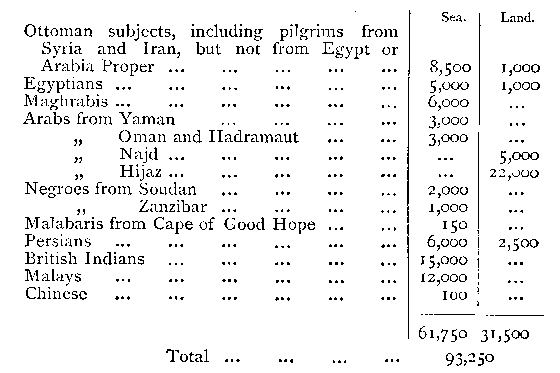
A more recent return which has just reached me gives the figures for 1885 in the former column at 17,303, carried on 26 vessels; of these pilgrims Java supplied 6,799; India, 6,577; Persia, 713 ; Arabia, 1,627; Bokhara, i,i6i ; Turkey, 397; Afghanistan, 18; and China, 11. It is probable that Mr. Blunt's totals much exceed the truth.
Prohibitions. -Having seen what are the fundamental points of the Muhammadan religion both as regards faith and practice, it may be well to refer to the prohibitions which are imposed upon the faithful followers of the Prophet.
The drinking of wine, under which name all sorts of strong and inebriating liquors are comprehended, is forbidden in the Quran in more places than one. Some, indeed, have imagined that excess therein is alone
reprehended, and contend that moderate use is allowed by two passages in the same book: but the more received opinion is, that to drink any strong liquors, either in a lesser quantity, or in a greater, is absolutely unlawful; and though libertines indulge themselves in a contrary practice, yet the more conscientious are so strict, especially if they have performed the pilgrimage to Mecca, that they hold it unlawful not only to taste wine, but to press grapes for the making of it, to buy or to sell it, or even to maintain themselves with the money arising by the sale of that liquor. The Persians, however, as well as the Turks, are very fond of wine and if asked how it comes to pass that they venture to drink it, when it is so directly forbidden by their religion, they answer, that it is with them as with the Christians, who, their religion prohibiting drunkenness and profligacy as great sins, glory, notwithstanding, some in their debaucheries and others in drinking to excess.
It has been a question whether coffee does not come under the above-mentioned prohibition, because the fumes of it have some effect on the imagination. This drink, which was first publicly used at Aden in Arabia Felix, about the middle of the ninth century of the Hijra, and thence gradually introduced into Mecca, Madina, Egypt, Syria, and other parts of the Levant, has been the occasion of great disputes and disorders, having been sometimes publicly condemned and forbidden, and again declared lawful and allowed. At present the use of coffee is generally tolerated, if not granted, as is that of tobacco, though the more religious, especially the "Wahabis," make a scruple of taking the latter, not only because it inebriates, but also out of respect to a traditional saying of their Prophet, "That in the latter days there should be men who should bear the name of Muslims, but should not be really such; and that they should smoke a certain weed, which should be called tobacco." However, eastern nations are generally so addicted to both, that they say, "A dish of coffee and a pipe of tobacco are a complete
entertainment;" and the Persians have a proverb that coffee without tobacco is meat without salt.
Opium and "bhang" (which latter is the leaves of hemp in pills or conserve), though not mentioned in the Quran, are also, by the rigid Muhammadans, esteemed unlawful, because they intoxicate and disturb the understanding, yet these drugs are now commonly taken in the east; but they who are addicted to them are generally looked upon as debauchees.
Several stories have been told as to the occasion on which Muhammad prohibited the drinking of wine: but the true reasons are given in the Quran, viz., because the ill qualities of that liquor surpass its powers for good, the common effects thereof being quarrels and disturbances in company, coupled with neglect in the performance of religious duties.
Gaming is prohibited by the Quran in the same passages, and for the same reasons as wine. The word which is there used, signifies a particular manner of casting lots by arrows, much practised by the pagan Arabs and performed in the following manner: -A young camel being bought and killed, and divided into ten or twenty-eight parts, persons to the number of seven cast lots for them; eleven arrows were then provided, without heads or feathers, seven of which were marked, the first with one notch, the second with two, and so on, and the other four had no mark at all. These arrows were put promiscuously into a bag, and then drawn by an indifferent person, who had another near him to receive them, and to see he acted fairly; those to whom the marked arrows fell won shares in proportion to their lot, and those to whom the blanks feil were entitled to no part of the camel at all, but were obliged to pay the full price thereof. The winners, however, did not taste the flesh any more than the losers, but the whole was distributed among the poor; and this they did out of pride and ostentation, it being reckoned a shame for a man to stand out, and not venture his money on such an occasion. This custom, therefore,
though it was of some use to the poor, no less than a diversion to the rich, was forbidden by Muhammad as the source of great inconveniences, by occasioning quarrels and heart-burnings, which arose from the winners insulting those who lost.
Under the name of lots, commentators agree that all other games whatsoever, which are subject to hazard or chance, are comprehended and forbidden, as dice, cards, tables, &c. And they are reckoned so ill in themselves, that the testimony of him who plays at them is, by the more rigid, judged to be of no validity in a court of justice. Chess is almost the only game which the Muslim doctors allow to be lawful (though it has been a doubt with some), because it depends wholly on skill and management, and not at all on chance: but it is only allowed under certain restrictions, viz., that it be no hindrance to the regular performance of devotions, and that no money or other thing be played for or betted; which last the Turks religiously observe, but the Persians neglect. But what is supposed chiefly to have been disliked in the game of chess was the carved pieces or men, with which the pagan Arabs played, being little figures of men, elephants, horses, and dromedaries; and these are thought, by some commentators, to be truly meant by the images prohibited in one of the passages of the Quran. That the Arabs in Muhammad the Prophet's time actually used such images for chessmen appears from what is related of Ali, who passing accidentally by some who were playing at chess, asked, "What images they were upon which they were so intent?" for they were perfectly new to him, that game having been but very lately introduced into Arabia, and not long before into Persia, whither it was first brought from India in the reign of Nushirwan (AD. 530-578). Hence the Muhammadan doctors infer that the game was disapproved only for the sake of the images; wherefore the Turks always play with plain pieces of wood or ivory; but the Persians and Indians, who are not so scrupulous, continue to make use of the carved figures.
The Muhammadans comply with the prohibition of gaming much better than they do with regard to that of wine; for though the common people, among the Turks more frequently, and the Persians more rarely, are addicted to play, yet the better sort are seldom guilty of such a proceeding.
Another practice of the idolatrous Arabs forbidden also in one of the above-mentioned passages, was that of divining by arrows. The arrows used by them for his purpose, which like those with which they cast lots were without heads or feathers, were kept in the temple of some idol, in whose presence they were consulted. Seven such arrows were stored in the mosque at Mecca but generally in divination they made use of three only, on one of which was written, "My LORD hath commanded me;" on another, "My LORD hath forbidden me;" and the third was blank. If the first was drawn, it was looked upon as an approbation of the enterprise in question; if the second, a contrary conclusion was made; but if the third happened to be drawn, it was customary to mix them and draw over again, till a decisive answer was given by one of the others. These divining arrows were generally consulted before anything of moment was undertaken; as when a man was about to marry, or about to go a journey, or the like.
A distinction of meats was so generally used by the eastern nations, that it is no wonder that Muhammad made some regulations in that matter. The Quran, therefore, prohibits the eating of blood and swine's flesh, and whatever dies of itself, or is slain in the name or in honour of any idol, or is strangled, or killed by a blow or a fall, or by any other beast. In case of necessity, however, where a man may be in danger of starving, he is allowed by the law of Islam to eat any of the said prohibited kinds of food.
In the prohibition of usury, Muhammad followed the example of the Jews, who are strictly forbidden by their law to exercise it among one another, though they are guilty of it in their dealing with those of a different
religion: but the Prophet of the Arabs has not made any distinction in this matter.
The Mussulman law also put a stop to the inhuman custom which had been long practised by the pagan Arabs, of burying their daughters alive, lest the parents should be reduced to poverty by providing for them, or else that they might avoid the displeasure and the disgrace which would follow, if they should happen to be made captives, or to become scandalous by their behavior; - the birth of a daughter being, for these reasons, reckoned a great misfortune, and her death an equal happiness. The manner of practising this infanticide is differently related: some say that when an Arab had a daughter born, if he intended to bring her up, he sent her, clothed in a garment of wool or hair, to keep camels or sheep in the desert; but if he designed to put her to death, he let her live till she became six years old, and then said to her mother, "Perfume her, and adorn her, that I may carry her to her mothers;" which being done, the father led her to a well or pit dug for that purpose, and having bid her to look down into it, pushed her in headlong as he stood behind her, and then filling up the pit, levelled it with the rest of the ground; but others say, that when a child was about to be born, they dug a pit ; to the brink the mother was brought, and if the child happened to be a daughter, they threw it into the pit, but if a son, they saved it alive.
This wicked practice is condemned by the Quran in several passages; one of which, as some commentators judge, also alludes to another custom of the Arabians, altogether as wicked, and as common among other nations of old, viz., the sacrificing of their children to their idols; as was frequently done, more particularly in satisfaction of a vow not infrequently made, that if they had a certain number of sons born, they would offer one of them in sacrifice.
Civil and Criminal Law. - The Muhammadan civil law is founded on the precepts and determinations of
the Quran. And it may be well to explain some of the more prominent usages and ordinances appertaining to this branch of the rites and institutions of Islam.
As regards polygamy, it is a vulgar mistake to suppose that the Prophet granted to his followers an unbounded plurality; some pretending that a man may have as many wives, and others as many concubines, as he can maintain: whereas, according to the express words of the Quran, no man can have more than four, whether wives or concubines; and if a man apprehend any inconvenience from even that number of lawful wives, it is added, as an advice (which is generally followed by the middling and inferior people), that he marry one only, or, if he cannot be contented with one, that he take up with his she-slaves, not exceeding, however, the limited number; and this is certainly the utmost Muhammad allowed his followers: nor can the corrupt manners of his followers, many of whom, especially men of quality and fortune, indulge themselves in criminal excesses, be urged as an argument against so plain a precept; nor yet the example of the Prophet himself, who had peculiar privileges in this and other points.
Divorce is also well known to be allowed by Muhammadan law: but it must not be overlooked that the Prophet, to prevent his followers from divorcing their wives on every light occasion, or out of an inconstant humour, ordained that, if a man divorced his wife the third time (for he might divorce her twice without being obliged to part with her, if he repented of what he had done), it should not be lawful for him to take her again until she had been first married and divorced by some second husband. And this precaution has had so good an effect that the Muhammadans are seldom known to proceed to the extremity of divorce, notwithstanding the liberty given them, it being reckoned a great disgrace so to do; and there are but few, besides those who have little or no sense of honour, that will take a wife again on the condition enjoined. It must be
observed, that though a man is allowed to repudiate his wife even on the slightest disgust, yet the women are not allowed to separate themselves from their husbands unless it be for ill-usage, want of proper maintenance, neglect of conjugal duty, or some cause of equal import; but then she generally loses her dowry, which she does not if divorced by her husband, unless she has been guilty of immodesty or notorious disobedience.
When a woman is divorced she is obliged, by the direction of the Quran, to wait three months before she marry another; after which time she is at full liberty to dispose of herself as she pleases should it, however, thus happen, she must wait the birth of the child, continuing in the meantime in the husband's house, and maintained at his expense, it being forbidden to turn the woman out before the expiration of the term, unless she be guilty of impropriety. Where a man divorces a woman who has been his wife only in name, she is not obliged to wait any particular time, nor is he obliged to give her more than one half of her dower. If the divorced woman have a young child, she is to suckle it till it be two years old ; the father, in the meantime, maintaining her in all respects a widow is also obliged to do the same, and to wait four months and ten days before she marry again.
Immorality on the part of either single or married women was, in the beginning of Muhammadism, very severely punished; it being ordered that such offenders should be shut up in prison till they died; but afterwards it was ordained that an adultress should be stoned, and an unmarried woman guilty of impropriety scourged with a hundred stripes, and banished for a year. A she-slave, if convicted of adultery, suffers but half the punishment of a free woman, viz., fifty stripes, and banishment for six months; but is not to be put to death. To convict a woman of adultery, so as to made it capital, four witnesses are expressly required, and those, as the commentators say, ought to be men; and if a man falsely accuse a respectable
woman of disreputable behaviour of any kind, and is not able to support the charge by that number of witnesses, he is to receive fourscore stripes, and his testimony is to be held invalid for the future. Immorality, in either sex, is by the sentence of the Quran to be punished with a hundred stripes.
If a man accuse his wife of infidelity, and is not able to prove it by sufficient evidence, and will swear four times that it is true, and the fifth time imprecate God's vengeance on him if it be false, she is to be looked on as convicted, unless she will take the like oaths, and make the like imprecation, in testimony of her innocency; which if she do, she is free from punishment though the marriage ought to be dissolved.
Before leaving the subject of marriages, it may be proper to take notice of some peculiar privileges in relation thereto, which, as is asserted, were granted by God to Muhammad, to the exclusion of all other Muslims. One of them was that he might lawfully marry as many wives and have as many concubines as he pleased, without being confined to any particular number; a privilege which, he asserted, had been granted to the prophets before him. Another was, that he might alter the turns of his wives, and favour such of them as he thought fit, without being tied to that order and equality which others are obliged to observe. A third privilege was, that no man might marry any of his wives, either such as he should divorce during his lifetime, or such as he should leave widows at his death.
The laws of the Quran concerning inheritances are principally designed to abolish certain practices of the pagan Arabs who used to treat widows and orphan children with great injustice, frequently denying them any share in the inheritance of their fathers or their husbands, on pretence that the property ought to be distributed among those only who were able to bear arms, while widows were disposed of' even against their consent, as part of their husbands' possessions. To
prevent such injuries for the future, the Prophet ordered that women should be respected, and orphans have no wrong done them; and in particular that the former should not be taken against their wills, as by right of inheritance, but should themselves be entitled to a distributive part, in a certain proportion, of what their parents, husbands, and near relations should leave behind them.
The general rule to be observed in the distribution of the deceased's estate is, that a male shall have twice as much as a female; but to this principle there are some few exceptions; a man's parents, for example, and also his brothers and sisters, where they are entitled not to the whole, but a small part of the inheritance, have equal shares with one another in the distribution thereof without any difference on account of sex.
If a man dispose of part of his estate by will, two witnesses, at the least, are required to render the same valid ; and such witnesses ought to be of his own tribe, and of the Muslim religion, if such persons can be found. Though there be no express law to the contrary, yet it is reckoned very wrong for a man to give away any part of his substance from his family, unless it be in legacies for pious uses; and even in that case a person ought not to bestow all he has in charity, but only a reasonable part in proportion to his substance. On the other hand, though a man make no will, and bequeath nothing for charitable uses, yet the heirs are directed, on the distribution of the estate, if the value will permit, to bestow something on the poor, especially such as are of kin to the deceased, and to the orphans.
The first law, however, laid down by Muhammad touching inheritances, was not very equitable; for he declared that those who had fled with him from Mecca, and those who had received and assisted him at Madina should be deemed the nearest of kin, and consequently heirs to one another, preferably to, and in exclusion of their relations by blood; nay, though a man were a true believer, yet if he had not quitted his country for
the sake of religion and joined the Prophet, he was to be looked on as a stranger; but this law did not long continue in force, being quickly abrogated.
It must be observed that among the Muhammadans, the children of their concubines or slaves are esteemed as equally legitimate with those of their legal wives; none being accounted bastards, except such only as are born of common women, and whose fathers are unknown.
As to private contracts between man and man, the conscientious performance of them is frequently recommended in the Quran. For the preventing of disputes all contracts are directed to be made before witnesses, and in case such contracts are not immediately executed, the same ought to be reduced into writing in the presence of at least two witnesses, who ought to be Muslims and of the male sex ; but if two men cannot be conveniently had, then one man and two women may suffice. The same method is also directed to be taken for the security of debts to be paid at a future day; and where a writer is not to be found, pledges are to be taken. Hence, if people trust one another with-out writing, witnesses, or pledge, the party on whom the demand is made is always acquitted if he denies the charge on oath, and swears that he owes the plaintiff nothing, unless the contrary be proved by very convincing circumstances.
Wilful murder, though forbidden by the Quran under the severest penalties to be inflicted in the next life, is yet, by the same book, allowed to be compounded for, on payment of a fine to the family of the deceased, and freeing a Muslim from captivity; but it is in the election of the next of kin, or the avenger of blood, as he is called in the Pentateuch, either to accept of such satisfaction, or to refuse it; for he may, if he pleases, insist on having the murderer delivered into his hands, to be put to death in such manner as he shall think fit.
If the Muhammadan laws seem light in case of murder, they may perhaps be deemed too rigorous in case of manslaughter, or the killing of a man undesignedly,
which must be redeemed by fine (unless the next of kin shall think fit to remit it out of charity), and the freeing of a captive; but if a man be not able to do this, he is to fast two months together by way of penance. The fine for a man's blood, which is set at a hundred camels, is to be distributed among the relations of the deceased, according to the laws of inheritance; but it must be observed that, though the person slain be a Muslim, yet if he be of a nation or party at enmity, or not in confederacy with those to whom the slayer belongs, he is not then bound to pay any fine at all, the redeeming a captive being, in such case, declared a sufficient penalty.
As to injuries done to men in their persons, the law of retaliation is approved by the Quran; but this law, which seems to have been allowed by Muhammad to his Arabians to prevent particular revenges, being neither strictly just nor practicable in many cases, is seldom put in execution, the punishment being generally turned into a mulct or fine, which is paid to the party injured.
Theft is ordered to be punished by cutting off the hand, as the offending part, which, at first sight, seems just enough; but on reflection it will at once occur that to sever that limb would be to deprive the culprit of the means of getting his livelihood in an honest manner.
In injuries and crimes of an inferior nature, where no particular punishment is provided by the Quran, and where a pecuniary compensation will not do, the Muhammadans have recourse to stripes or beating, the most common chastisement used in the East at this day, as well as formerly; the cudgel, which for its virtue and efficacy in keeping their people in good order and within the bounds of duty, they say came down from heaven, being the instrument wherewith the judge's sentence is generally executed.
Notwithstanding the Quran is in general regarded by the followers of Islam as the fundamental part of their civil law, the decisions of the Sunna among the Turks,
and of the Imams among those of the Persian sect. with the explications of their several doctors, being usually followed in judicial determinations, yet the secular tribunals do not think themselves bound to observe the same in all cases, but frequently give judgment against those decisions which are not consonant to equity and reason; and therefore distinction is to be made between the written civil law, as administered in the ecclesiastical courts, and the law of nature or common law (so to speak) which takes place in the secular courts, and has the executive power on its side.
Under the head of civil laws may be comprehended the injunction of warring against infidels, which is repeated in seven passages of the Quran, and declared to be of high merit in the sight of God, those who are slain fighting in defence of the faith being reckoned martyrs, and promised immediate admission into paradise. Hence this duty is greatly magnified by the Muslim divines, who call the sword the key of Heaven and Hell, and persuade their people that the least drop of blood spilt in the way of God, as it is called, is most acceptable unto him, and that the defence of the territories of the faithful for one night is more meritorious than a fast of two months: on the other hand, desertion, or refusing to serve iii these holy wars, or to contribute towards carrying them on, if a man has ability, is accounted a most heinous crime.
While Muhammadism was in its infancy, its opponents when taken in battle were doomed to death, without mercy; but this was judged too severe to be put in practice when that religion came to be sufficiently established, and past the danger of being subverted by its enemies.
When the Muhammadans declare war against people of a different faith, they give them their choice of three offers, viz., either to embrace the faith of Islam, in which case they become not only secure in their persons, families, and fortunes, but entitled to all the privileges of other Muslims; or to submit and pay tribute, by
doing which they are allowed to profess their own religion, provided it be not gross idolatry or against the moral law; or else to decide the quarrel by the sword, in which last case, if the followers of the Prophet prevail, the women and children which are made captives become absolute slaves, and the men taken in the battle may either be slain, unless they turn Muhammadans, or are otherwise disposed of at the pleasure of the prince.
On the first considerable success of Muhammad in war, the dispute which happened among his followers in relation to the division of the spoil rendered it necessary for him to make some regulation on this point; he therefore pretended to have received the divine commission to distribute the plunder among his soldiers at his own discretion, reserving thereout, in the first place, one-fifth part for the uses after-mentioned; and, in consequence, he took himself to be authorised on extraordinary occasions, to distribute it as he thought fit, without observing an equality.
The fifth part directed by the Quran to be taken out of the Spoil before it be divided among the captors, is declared to belong to God, and to the apostle and his kindred, and the orphans, and the poor, and the traveller; which words are variously understood.
Immovable possessions, as lands, &c., taken in war, are subject to the same laws as the movable; excepting only that the fifth part of the former is not actually divided, but the income and profits thereof or of the price if sold, are applied to public and pious uses, and distributed once a year, while the prince may either take the fifth part of the land itself' or a like portion of the income and produce of the whole, as he shall make his election.
It was a custom among the ancient Arabs to observe four months in the year as sacred, during which they held it unlawful to wage war, so that taking off the heads from their spears, they used to cease from incursions and other hostilities. During those months even they in fear of their enemies lived in full security
so that if a man met the murderer of his father or brother he durst not offer him any violence.
The months which the Arabs held sacred were al Muharram, Rajab, Zu'l qada, and Zu'l hijja; the first, the seventh, the eleventh, and the twelfth in the year. The last mentioned of these being the time wherein they performed the pilgrimage to Mecca, not only that month, but also the preceding and the following, were for that reason kept inviolable, that every one might safely and without interruption pass and repass to and from the festival. Rajab is said to have been more strictly observed than any of the other three, probably because in that month the pagan Arabs used to fast; Ramazan, which was afterwards set apart by Muhammad for that purpose, being in the time of ignorance dedicated to drinking in excess.
The observance of the aforesaid months seemed so reasonable to the Prophet that it met with his approbation; and the duty is accordingly confirmed and enforced by several passages of the Quran, which forbid war to be waged during those months against such as acknowledge them to be sacred, but grant, at the same time full permission to attack those who make no such distinction, in the sacred months as well as in the profane.
One practice, however, of the pagan Arabs, in relation to these sacred months, Muhammad thought proper to reform: for some of them, weary of sitting quiet for three months together, and eager to make their accustomed incursions for plunder, used, by way of expedient, whenever it suited their inclinations or convenience to put off the observing of al Muharram to the following month Safar thereby avoiding to keep the former, which they supposed it lawful for them to profane provided they sanctified another month in lieu of it, and gave public notice thereof at the preceding pilgrimage. This transferring the observation of a sacred month to a profane month is absolutely condemned in a passage of the Quran and declared to be an impious innovation.
The setting apart of one day in the week for the more peculiar attendance on God's worship, so strictly required by the Jewish and Christian religions, appeared to Muhammad to be so proper an institution, that he did not hesitate to imitate an example of which he approved; though, for the sake of distinction, he obliged his followers to observe a different day from either. Several reasons are given why the sixth day of the week was selected for this purpose; but Muhammad seems to have preferred the day on which the people used to assemble together long before his time, though such gatherings were held, perhaps, rather on a civil than a religious account. However it be, Muhammadan writers bestow very extraordinary encomiums on this day, calling it the prince of days, and the most excellent day on which the sun rises, asserting also that it will be the day whereon the last judgment will be solemnized; and they esteem it a peculiar honour to Islam, that God has been pleased to appoint this same to be the feast-day of the Muslims, and grant them the advantage of having first observed it.
Though the Muhammadans do not think themselves bound to keep their day of public worship so holy as is the case with the Jews and Christians, there being a permission, as is generally supposed, in the Quran, allowing them to return to their employments or diversions after divine service is over; yet the more devout disapprove of any part of that day being devoted to worldly affairs, and require it to be wholly dedicated to the business of the life to come.
The portion of this chapter relating to the pilgrimage to Mecca, appeared as an article in the April number of the Asiatic Quarterly Review.
Muhammad - His Life and Doctrines with Accounts of his Immediate Successors
Answering Islam Home Page