ABUL ALA MAWDUDI
translated and annotated by
Syed Silas Husain and Ernest Hahn
1994
Dedicated to Christian converts from Islam, who have contributed so much to the Kingdom of God and the Church, who have ministered, physically and spiritually, among their Muslim brothers and sisters, who have died as martyrs for confessing Jesus the Messiah as their Saviour and Lord.
Jesus said:
How blest you are, when you suffer insults and persecution and every kind of calumny for my sake. Accept it with gladness and exultation, for you have a rich reward in heaven; in the same way they persecuted the prophets before you. (Matt. 5:11,12)
| Introduction | 1 | |
| A. | Why This Translation | 1 |
| B. | Why This Translation: A Personal Note (Syed Silas Husain) | 4 |
| C. | About Mawlana Abul Ala Mawdudi | 6 |
| D. | Translating and Editing Concerns | 7 |
| E. | Anticipating Some Readers' Thoughts | 8 |
| THE PUNISHMENT OF THE APOSTATE ACCORDING TO ISLAMIC LAW | ||
| Publisher's Request | 11 | |
| Preface by the Author | 12 | |
| I | The Problem of the Apostate's Execution from a Legal Perspective | 13 |
| A. | Proof from the Qur'an for the Commandment to Execute the Apostate | 14 |
| B. | Proof from the Hadith for the Commandment to Execute the Apostate | 15 |
| C. | View of the Rightly-Guided Caliphs | 17 |
| D. | The First Caliph's Jihad against Apostates | 19 |
| E. | Agreement of the Leading Mujtahids | 21 |
| II | The Problem of the Propagation of Kufr in the House of Islam | 27 |
| A. | Investigating the Problem | 27 |
| B. | The Fundamental Objective of Islamic Rule | 29 |
| C. | The Position of Dhimmis and Protected Ones in the House of Islam | 30 |
| D. | The Course of Action during the Period of the Prophet and the Rightly Guided Caliphs | 30 |
| III | The Execution of the Apostate: A Rational Consideration | 32 |
| A. | The Arguments of the Critics | 32 |
| B. | A Fundamental Misconception | 34 |
| C. | The Natural Requirement of an Organized Society | 35 |
| D. | Response to Criticisms | 36 |
| E. | The Basic Difference Between a Mere Religion and a Religious State | 38 |
| F. | The Legal Right of the Government | 39 |
| G. | The Example of England | 40 |
| H. | The Example of America | 42 |
| I. | The Natural Right of the State | 43 |
| J. | Why Distinguish between the Kafir (Infidel) and the Murtadd (Apostate) | 43 |
| K. | The Danger of Counterattack | 46 |
| L. | Muslims by Birth | 48 |
| IV | Concerning the Propagation of Kufr: The Rationale of the Islamic Stance | 52 |
| Appendices | ||
| A. | The Dhimmi | 55 |
| B. | Apostasy in Islam and Its Punishment: Some Quotations | 57 |
| C. | A Recent Pronouncement from Lebanon on Apostasy | 73 |
| D. | A Prisoner's Testament in Iran | 77 |
| E. | Interpreting Qur'an 2:256 | 81 |
| F. | Universal Declaration of Human Rights, 1948 | 87 |
| Glossary | 91 | |
Introduction
A. Why This Translation
Why the need to translate Abul Ala Mawdudi's book The Punishment of the Apostate according to Islamic Law?[1] Here are two reasons.
1. The Islamic law of apostasy is a symptom of a strong and pervasive traditional Muslim attitude, religious and political, toward non-Muslims and the non-Islamic world. Despite the legal pronouncement of Islam upon Salman Rushdie the West has hardly recognized the law of apostasy in Islam. It is imperative that Westerners, especially with the intensifying orthodox Islamic revival throughout the world and the continued growth of Muslim presence in the West, become more familiar with this law also.
2. Abul Ala Mawdudi has been one of the most influential religious thinkers of the Muslim World in the 20th century. His presentation of the subject is an unusually full and lucid exposition of the theological and legal foundations of the traditional understanding of the law of apostasy and its punishment in Islam and a contemporary rational justification for its continued implementation.
It is hoped that the following points will further elucidate a rationale for the translation of Mawdudi's book and provide a fuller context for a wider discussion on the subject:
1. Many Muslims disagree with Abul Ala Mawdudi's understanding and argumentation. In fact, Mawdudi's book indicates serious doubt of other Muslims (at least on the Indian subcontinent) about the validity and integrity of the law and the main issues at stake: a. the actual meaning of apostasy; b. its presence and significance in the Qur'an; c. the relation of Qur'an 2:256 ("There is no compulsion in religion") to the law. This particular verse is central to the more liberal exposition of the law of apostasy found in the former Chief Justice of Pakistan, S. A. Rahman's book Punishment of Apostasy in Islam[2], in which he castigates the traditionalists' abuse of the sources of Islam (the Qur'an and the Hadith). Still, virtually all Muslims in the East who possess any serious grasp of early Islamic history recognize the law of apostasy and its implementation as far back as Abu Bakr's wars in Arabia against the Arabs who wished to secede from the Muslim community shortly after Muhammad's death and the pervasive influence of this law throughout Islamic history up to the present.
2. On occasions in the past, no doubt, Muslims have moderated the penalty for the law of apostasy, whether because of external or internal political pressures or other reasons. No doubt, in past and present some converts have left Islam for Christianity (or other religions) and lived as Christians with little or no obvious Muslim opposition. Even fewer have been executed.
Nevertheless it is also true that in various parts of the world converts -- their numbers are significant -- have endured persecutions physically and psychologically, at times violently. The techniques are varied. Some converts are tortured. Few in traditional Muslim countries escape unscathed. At times even the convert's Muslim family members are subjected to severe harassment to induce the convert to return to Islam. The persecution emanates from governments, officially or unofficially, from Muslim communities, or simply from one or two zealous individuals, possibly a relative and even a father, intent on taking the law into his own hands when he thinks the government or community has failed to do its job. Even some converts from Islam in the West exercise caution in Muslim circles, fearing possible retaliation upon themselves or even their families in their native lands, while, paradoxically, converts to Islam in the West (from Christianity, Judaism, another religion or no religion) boldly and with no need to fear announce their conversion privately and publicly and extol the virtues of Islam, including its freedom!
3. People from the East, Muslim and non-Muslim minorities and Westerners who have spent time in Muslim countries are aware of the law of apostasy. But otherwise how many Westerners are aware that it even exists, not to speak about its nature and history? Or, given an awareness of its existence, does it exist simply as an aberration of Islam? Is it possibly a later accretion with no roots in Islamic sources, perhaps even a figment of Western imperialist and missionary imagination, another false allegation of "the Orientalists"?
If Westerners are interested in International Human Rights, including Muslim expressions of human rights, they will be interested in the law of apostasy and Mawdudi's exposition of it in this work.[3] Diplomats and other personnel concerned with immigration and refugees may find it illuminating, probably even more so since (if our limited evidence is at all indicative) many immigration officials seem unfamiliar with it. If our government documentation centres provide basic information on the persecution of Baha'is and Ahmadis, do they provide something comparable on the persecution of Jews and Christians living as minorities among Muslims? If not, is it because Christians have not provided them with the information?
Are Christians in the West, in fact, concerned with such problems? Should they be? If documentation centres are devoid of information about Muslim apostates who have become Christians, does this reflect the Western Christian Church's ignorance? Or, assuming church awareness, is the plight of the convert a possible inconvenience and even embarrassment to the church, especially a church whose great priority in its relations with other religions has become simply reconciliation between religions or peoples of different religions rather than the proclamation of God's reconciliation with humankind through His Messiah? Is the suffering of converts, converts to Christianity also, because of conversion a concern of the ecumenical Church? Occasionally one hears of Muslim surprise about (= disdain for?) Christians who appear indifferent toward their persecuted Christian brothers and sisters. Did not early Christian worship regularly include remembrance of the martyrs and other Christians suffering for their faith, as they also shared in the Eucharist in remembrance of the Messiah's suffering and death?
Though there are Muslims in the West who are aware and supportive of Islam's law of apostasy, it is hardly surprising that they talk little about it. On the other hand many Muslims concerned with Islam's image in the West vehemently insist that Islam proclaims religious tolerance and freedom, as if the law of apostasy never existed or is now obsolete. Do they know the law of apostasy, its sources, its history, its current implementation? Is it that they, to paraphrase Mawdudi, have removed it from the rule book because it is inconvenient to keep it in the West?
Like the Islamic pronouncement upon Salman Rushdie, the law of apostasy is not simply "an obscene edict from a fanatic sect in Islam".[4] It has a profound connection with Islamic source materials, with all traditional Sunni and Shi'i Islamic legal schools, with Islamic history since its inception. Its legality is a contentious issue in some nations today. Many able and sophisicated Muslim leaders and thinkers justify it and call for its revival and implementation. In short the law of apostasy in Islam is not just a relic of the past but quite alive and well.
B. Why This Translation: A Personal Note (Syed Silas Husain)
Until recently I had never felt the need for documentary evidence to understand Islam's traditional punishment for apostasy. Since the time of my conversion from Islam to Christianity in India about three decades ago, I have personally experienced its intention and direction through verbal and physical persecution, including two attempts on my life by Muslims who believed that an apostate from Islam should be killed. (By what Islamic standard did they measure themselves to be qualified to assume this responsibility?)
But sharing such experiences with others carries no guarantee that others will accept the truth of these experiences. After all, do not all religions teach us to do good to others, at least not to harm them?
It was only a few years ago that a few friends and I sought authoritative evidence in English to encourage Canadian Immigration officials to help stop the deportation of a convert from Islam back to his Muslim homeland. Where was this hard evidence to be found? To my surprise no Muslim publisher or bookstore seemed to have anything on the subject in English. My letters to Muslim theological schools and propagation centres in West Asia, India, Pakistan and South Africa brought no response, apart from a reply from Qom in Iran which stated that no literature on apostasy in English existed and that I should beware of Western propaganda. The immigration officials with whom I was in contact appeared to be unaware of, or to ignore or even dismiss, the consequences of apostasy from Islam. I had to continue looking for written evidence to establish for others the credibility of even my own experience!
On the other hand, to know that many Muslims today uphold the traditional Islamic law of apostasy and its punishment in Islam is not to suggest that all Muslims everywhere thirst for the blood of apostates from Islam. Many of us converts remain alive and well and normally move freely among Muslims, especially in countries such as India and Canada -- though we may be uneasy about travelling in some Muslim countries. We gladly attend festival celebrations, weddings and funerals, aqiqah and circumcision ceremonies.
We come to these gatherings, of course, because relatives and friends have kindly invited us. And we are grateful for these opportunities. We do not come to abuse Islam, to blaspheme Muhammad and the Qur'an, to undermine government and society. Nor have we become Christians for these purposes. In fact Muslim friends and relatives continue to communicate with us; some may even solicit our counsel and our prayers for themselves and for their families. Are they tolerant toward us because they are less Muslim than they should be, or because they are unfamiliar with traditional Islamic law and practice, or they simply focus on Qur'an 2:256 ("There is no compulsion in religion") or they respect the laws of their nation, living and letting live? Whatever the reason, we thank God for Muslim brothers and sisters who remain tolerant toward us.
Still, we naturally do have concerns about Muslims whose attitudes and actions have been shaped by Islam's traditional law of apostasy. What this law is all about and how it has been understood, what its sources and purpose are, are competently presented in Abul Ala Mawdudi's book, The Punishment of the Apostate in Islam. The author's extensive apology for its contemporary validity and his own remarkable influence throughout the Muslim world only enhance the value of his presentation. Could we have chosen a better book or author to explain Islam's law of apostasy and its punishment as masses of Muslims throughout the world have understood it and continue to understand it -- and at the same time to explain our own apprehension about this law and its punishments, particularly when we are in company with Muslims we do not know? To initiate further discussions on this topic we have introduced the opinions of some Muslims who represent greater tolerance.
Our purpose in translating Mawdudi's book is thus not to malign Islam. Rather it is, firstly, to present something which Muslims consider authentic on the subject for Christians, especially those sharing the Christian Gospel with Muslims, so that Christians may begin to grasp the cost which a convert from Islam may have to pay to live as a disciple of Jesus the Messiah, to learn to pray for the convert and to be ready to help him, protect him and even suffer for him and with him. The convert who may be unfamiliar with the law of apostasy should also, of course, be instructed about it. Secondly, this translation is to remind Muslim missionaries and those whom they invite to enter the House of Islam, to note Mawdudi's pertinent admonition about careless decisions in becoming a Muslim. To enter the fold may be easier than to exit. Is the law of apostasy a part of the Muslim missionary's da'wah, his invitation to non-Muslims to become Muslims?
Finally we hope that this translation will help national and international organizations interested in human rights and refugees to better understand the plight of those persons in many Muslim nations who have converted from Islam to another religion and no longer feel safe where they currently reside.
Remembering Abul Ala Mawdudi (1903-1979) is to remember a twentieth century Pakistani deeply immersed in the planning and formation of Pakistan, and as much in the revival and renewal of Islam not only on the Asian subcontinent but throughout the whole Muslim world. Remembering him is to remember his strong opposition to British rule in India, his unwillingness to cooperate with Mahatma Gandhi and Indian nationalist movements, even his rejection of the nationalist motivations of other Muslim movements for the independence of India and the formation of Pakistan. Remembering him is to remember a man passionately devoted to Islam, ready not only to talk but to act and suffer on behalf of his faith, convinced of its superiority over all religions and desirous that it be practised again as it was manifested in its purity during the time of Muhammad and the Rightly-Guided Caliphs for the welfare of all mankind.
Charles Adams offers us an excellent summary of his significance for Islam and Pakistan:
No discussion of the demand for an Islamic state in Pakistan and no account of the contemporary resurgence of Islam would be complete without attention to the major role played by Abul Ala Mawdudi in these movements. By far the most powerful and effective factors that worked to create sentiment for an Islamic state in the years immediately after the partition of the Indian subcontinent and the creation of Pakistan were Mawdudi and the movement which he founded and headed, the Jamaat-i-Islami. Indeed, it would be difficult to think of any issue of religious significance that has arisen in Pakistani public life concerning which the same could not be said. Mawdudi was, until his death in 1979 but especially to the time of his resignation as amir of the Jamaat-i-Islami in 1972, the best known, most controversial, and most highly visible of all the religious leaders of the country. He poured his energy unstintingly into speeches, writings, and religious and political activities, leaving behind a rich heritage of literature and thought on most of the issues that have troubled Pakistanis over the years. The number, size, and range of the published writings from his pen in the periods both before and after the founding of Pakistan are truly remarkable. They are evidence of an altogether unusual degree of devotion and great creativity. Although these works were produced originally in Urdu primarily for a Pakistani or Indian audience, many have been translated into other languages of both the Islamic and the Western worlds. Thus, Mawdudi has attracted attention outside the Indian subcontinent, especially in other Muslim countries where he is now revered as one of the foremost modern exponents and interpreters of Islam. Today Mawdudi must rank among the more popular and respected authors in the Islamic domains, if indeed he is not the single most widely read writer among Muslims at the present time. His writings give strong expression to the themes basic to the present-day Islamic resurgence. When the time comes for the religious history of Islam in the twentieth century to be written, Mawdudi's name will unquestionably have a prominent and an honored place in its pages.[5]
In his introduction as translator and editor of Mawdudi's Toward Understanding Islam, Khurshid Ahmad writes about Mawdudi:
It is no exaggeration to say that by the time of his death he had become the most widely read Muslim author of our time, contributing immensely to the contemporary resurgence of Islamic ideas, feelings and activity all over the world.[6]
Toward Understanding Islam itself is a clear indication of Mawdudi's powerful and extensive influence in promoting the cause of Islam. It was originally published in Urdu in 1932 as a textbook for students and for the general public. It has been translated also into Arabic, Hindi, Persian, German, French, Italian, Turkish, Portuguese, Swahili, Indonesian, Japanese, Malayalam, Tamil, Pashtu, Bengali, Gujarati and Sindhi. In all these languages over a million copies have appeared.[7]
Surely it speaks volumes for Mawdudi's popularity and authority that he provides an Introduction to A. Yusuf Ali's The Holy Qur'an, Translation and Commentary.[8]
In "A Bibliography of Writings By and About Mawlana Sayyid Abul A'la Mawdudi" Qazi Zulqadr Siddiqi, S. M. Aslam and M. M. Ahsan cite 138 works written by Mawdudi and 62 writings about him.[9] They also note translations into other languages apart from Urdu and English: Arabic, Bengali, Danish, French, Gujarati, German, Hindi, Hausa, Indonesian, Italian, Japanese, Kannada, Malayalam, Marathi, Pashtu, Portuguese, Persian, Sindhi, Swahili, Telugu, Tamil, Turkish. In the list of 138 works Murtadd ki Saza Islami Qanun men (The Punishment of the Apostate according to Islamic Law), Lahore, 1953 is also noted on p. 8. Apparently this work has never been translated into English or any other language.
D. Translating and Editing Concerns
No doubt, there is room for improving our translation. Still, we would contend that this translation, perhaps at the expense of elegance, accurately reproduces what Mawdudi has written. We welcome corrections, of course!
A glossary is provided at the end of this work. This allows for explanations for some technical vocabulary also which, it seems, is better preserved in its original language in the translated text.
A number of Appendices have been included. Appendix A appears as an extended Note in Mawdudi's original text. The others, it is hoped, demonstrate the reality of the law of apostasy and its punishment and the variety of opinions on the subject under discussion and related matters held by responsible Muslim scholars and/or Muslim community leaders.
E. Anticipating Some Readers' Thoughts
May we briefly bring the following matters to the readers' attention:
1. In one sense the content of Mawdudi's work covers more than the title suggests. This is evident even from his Preface, which has reference also to the question of the Islamic legality of non-Muslims propagating their religions particularly in countries predominantly Muslim. It has been included in the translation simply because Mawdudi included it in his original text and because it will be of interest to many Muslims and non-Muslims.
2. In another sense Mawdudi (unfortunately?) limits his topic to the penal consequences of apostasy. A complete understanding of apostasy must also consider the civil consequences of apostasy as related to matters such as marriage, property, wills and inheritance as expressed unanimously or variously by the different Islamic schools of law in the past and present. Just as significantly it must reckon more seriously with the nature of apostasy itself, with a variety of past and present Muslim interpretations of apostasy, with apostasy not only with reference to the apostate's new point of allegiance but with apostasy simply as renouncing Islam.[10]
3. Our intention in translating and annotating Mawdudi's work is not to exalt Christianity at the expense of Islam, to forget those sordid chapters and episodes in Christendom's history of intolerance and persecution (of Muslims also), to ignore the present commission of injustice and the omission of justice by Christians in the world today, sins all the more flagrant in the light of the Messiah's teachings and His personal implementation of His teachings.
4. Our concern, in indicating various Muslim responses to the law of apostasy and its punishment in Islam, is not to decide for Muslims which interpretation is correct or which is appropriate for Muslim belief and practice today. Though our preference as Christians is obvious, we are aware that Muslims themselves must make these decisions. Still, we would venture to repeat that able, intelligent, Islamically informed and committed Muslims hold significantly different and dramatically opposed opinions on the subject, a fact which should be recognized and not ignored by Muslims as well as non-Muslims.
Should not the whole topic of religious tolerance and intolerance, in fact, be aired more freely, especially because of the unprecedented intermingling of different religious communities today? Surely all religious communities must review their attitudes not only toward their fellow believers but also toward the followers of other religions. Would it then be possible for Muslims and Christians together to consider their attitudes toward those of the other community and even toward those who have left their community to join the other community?
| Syed Silas Husain |
Ernest Hahn Mississauga, Canada |
Notes
1. Originally published in Urdu as Murtadd ki Saza Islami Qanun men. The edition available to us was published by Islamic Publishers Ltd., Lahore, 1963.
2. Institute of Islamic Culture, Lahore, 1972.
3. See Ann Elizabeth Mayer, Islam and Human Rights, Pinter Publishers, London, 1991. She writes with reference to apostasy: "The Islamic human rights schemes... are evasive on the question of protections for freedom of religion.... The failure of a single one of these Islamic human rights schemes to take a position against the application of the shari'a death penalty for apostasy means that the authors of these schemes have neglected to confront and resolve the main issues involved in harmonizing international human rights and shari'a standards." (pp.186, 187)
Arij A. Roest Crollius (in Wie tolerant ist der Islam ed. Walter Kerber, Kindt Verlag, Muenchen, 1991, p. 42) illustrates more clearly the basic presupposition of the different charters: "A significant difference between the United Nations' Charter (of Human Rights) and the Islamic Declaration (of Human Rights) of 1981 is the starting point: the Charter is based on the dignity of the individual human being, while the Islamic Declaration of Human Rights is founded on the Qur'an and Hadith. Thus the shari'ah is the foundation of this Charter and is presupposed by it. The United Nations' Charter has a starting point which is seen as valid for all mankind, i.e., the dignity of human nature. The portrayal of man which is presupposed in the Islamic Declaration is the Islamic portrayal of man. Against this the United Nations' Charter indeed does not exclude a religiously inspired portrayal of man; still, it acknowledges none among the religions. In 1981 the General Assembly of the United Nations accepted a declaration eliminating any form of intolerance and discrimination on the basis of religion or faith. It is thus not easy to understand how such a declaration may be compatible with the Islamic Declaration of Human Rights."
For a summary of this general contrast between International Human Rights statements and Islamic Rights statements see Patrick Sookhdeo, The Law of Apostasy in Islam and Its Relation to Human Rights and Religious Liberty, an unpublished paper presented at the Glen Eyrie Consultation on the Persecuted Church in the Muslim World, 1992, pp. 11-15.
4. Globe and Mail, Toronto, a letter to the editor. I have misplaced the reference and date.
5. Charles J. Adams, "Mawdudi and the Islamic State" in Voices of Resurgent Islam, ed. John Esposito, Oxford University Press, Oxford, 1983, p. 99. For further information on Mawdudi see Charles Adams, "The Ideology of Mawlana Mawdudi" in South Asian Politics and Religion, ed. Donald P. Smith, Princeton University Press, Princeton, 1966; cf. W. C. Smith, Islam in Modern History, Princeton University Press, Princeton, 1957, esp. pp. 233-237.
6. The Islamic Foundation, U.K., 8th printing in 1988, p. 13.
7. ibid., pp. 15, 16.
8. American Trust Publications for The Muslim Students' Association, 2nd edition, 1977. Mawdudi's "Introduction" covers 21 pages. A. Yusuf Ali's Preface to the first edition of this popular translation and commentary originated in Lahore and is dated 1934. However Mawdudi's contribution is not found in the 4th edition, now entitled The Meaning of the Holy Qur'an, Amana Corporation, Bentwood, 1992 and described as a "new edition with revised translation and commentary".
9. In Islamic Perspectives, Studies in Honour of Mawlana Sayyid Abu'l A'la Mawdudi, ed. Khurshid Ahmad and Zafar Ishaq Ansari, The Islamic Foundation, U.K. in association with Saudi Publishing House, Jeddah, 1979, pp. 3-14.
10. For a useful discussion on the whole topic of apostasy in Islam, including apostasy's civil consequences, see Rudolph Peters and Gert J. J. De Vries, "Apostasy in Islam" in Die Welt des Islams, (Brill, Leiden, Vol. XVII, 1976-77), pp. 1-25. See also The Hedaya, tr. Charles Hamilton, Kitab Bhavan, New Delhi, Vol. II, pp. 228-246 and Majid Khadduri, The Islamic Law of Nations: Shaybani's Siyar, tr. by Khadduri, The Johns Hopkins Press, Baltimore, 1966, pp. 195-229. Shaybani (A.D. 750-804) was a disciple of Abu Hanifah. Peters and De Vries briefly refer to legal and illegal ways to execute the apostate. (op. cit., p. 5)
Publisher's Request
At present the evil of apostasy has spread extensively among Muslims because they are unfamiliar with their religion. In view of this fact there is an urgency now as never before to present the actual injunctions of Islam related to this problem.
Mawlana Sayyid Abul Ala Mawdudi, recognized as a well known and competent scholar throughout the Muslim world, has fully covered and clarified all aspects of this problem. He has dealt with the matter convincingly and effectively from both the revelational and the rational perspectives. He has demonstrated the perfection of the Islamic teaching on the subject and has effectively countered the objections raised by Islam's opponents. This valuable book should be distributed widely now in order to save Muslims unfamiliar with the subject from this terrible evil.
Three editions of this book have been previously published. Even then, the book has not been available for a period of time. We are publishing the fourth edition by offset in a more attractive format. It is our firm hope that our kind readers will enjoy this new edition and will co-operate in giving it as wide a distribution as previous editions received.
| A.H. 22 Muharram, 1383 A.D. 25 June, 1963 |
Respectfully Akhlaq Husain, General Manager Islamic Publications Ltd., Lahore |
This brief essay was written originally in response to a question and was published in the October 1942 to June 1943 issue of the magazine Tarjuman al-Qur'an. Since the topic deals with a very contentious problem in Islamic law and has created a disturbance in the hearts of most people, this essay is now presented as a separate publication.
The question alluded to above was as follows:
Under a truly Muslim rule should non-Muslims receive the same right to propagate their religions as Muslims ought to receive to propagate their religion? Under the Rightly-Guided Caliphs and their successors were rights accorded to kuffar (infidels) and ahl-i kitab ("The People of the Book": Jews and Christians) to propagate their religions? To what extent do the Qur'an, the Sunnah and reason demonstrate the absence of this legality?
I have thought much about both these matters but have not been able to arrive at any conclusion. Both sides have strong arguments. The Qur'an and the Sunnah offer no special explanation about these matters, at least as far as my limited understanding goes. It will be good if an answer to this can be published in Tarjuman al-Qur'an because many others like me are interested in this discussion.
Two matters in the question require clarification:
1. What are the authentic injunctions of Islam regarding the execution of an apostate and religious propagation by non-Muslim communities?
2. What arguments do we have which will satisfy us and which, we expect, will satisfy others that these injunctions are rational?
Both of these matters are discussed on the following pages.
I The Problem of the Apostate's Execution from a Legal Perspective
To everyone acquainted with Islamic law it is no secret that according to Islam the punishment for a Muslim who turns to kufr (infidelity, blasphemy) is execution. Doubt about this matter first arose among Muslims during the final portion of the nineteenth century as a result of speculation. Otherwise, for the full twelve centuries prior to that time the total Muslim community remained unanimous about it. The whole of our religious literature clearly testifies that ambiguity about the matter of the apostate's execution never existed among Muslims. The expositions of the Prophet, the Rightly-Guided Caliphs (Khulafa'-i Rashidun), the great Companions (Sahaba) of the Prophet, their Followers (Tabi'un), the leaders among the mujtahids and, following them, the doctors of the shari'ah of every century are available on record. All these collectively will assure you that from the time of the Prophet to the present day one injunction only has been continuously and uninterruptedly operative and that no room whatever remains to suggest that perhaps the punishment of the apostate is not execution.
Some people have been influenced by the so-called enlightenment of the present age to the point that they have opened the door to contrary thoughts on such proven issues. Their daring is truly very astonishing. They have not considered that if doubts arise even about such matters which are supported by such a continuous and unbroken series of witnesses, this state of affairs will not be confined to one or two problems. Hereafter anything whatever of a past age which has come down to us through verbal tradition will not be protected from doubt, be it the Qur'an or ritual prayer (namaz) or fasting (roza). It will come to the point that even Muhammad's mission to this world will be questioned. In fact a more reasonable way for these people, rather than creating doubt of this kind, would have been to accept as fact what is fact and is proven through certified witnesses, and then to consider whether or not to follow the religion which punishes the apostate by death. The person who discovers any established or wholesome element of his religion to conflict with his intellectual standards and then tries to prove that this element is not really a part of the religion, already proves that his affliction is such that, "You cannot become a kafir (infidel); since there is no other choice, become a Muslim" (kafer natavani shod nachar Musalman sho). In other words, though his manner of thought and outlook has deviated from the true path of his religion, he insists on remaining in it only because he has inherited it from his forefathers.
A. The Proof from the Qur'an for the Commandment to Execute the Apostate
Here I wish briefly to offer proof that will quiet the doubt in the hearts of those who, for lack of sources of information, may think that perhaps the punishment of death did not exist in Islam but was added at a later time by the "mawlawis" (religious leaders) on their own.
God Most High declares in the Qur'an:
But if they repent and establish worship and pay the poor-due, then are they your brethren in religion. We detail our revelations for a people who have knowledge. And if they break their pledges after their treaty (hath been made with you) and assail your religion, then fight the heads of disbelief -- Lo! they have no binding oaths in order that they may desist. (9:11,12)[1]
The following is the occasion for the revelation of this verse: During the pilgrimage (hajj) in A.H. 9 God Most High ordered a proclamation of an immunity. By virtue of this proclamation all those who, up to that time, were fighting against God and His Apostle and were attempting to obstruct the way of God's religion through all kinds of excesses and false covenants, were granted from that time a maximum respite of four months. During this period they were to ponder their own situation. If they wanted to accept Islam, they could accept it and they would be forgiven. If they wanted to leave the country, they could leave. Within this fixed period nothing would hinder them from leaving. Thereafter those remaining, who would neither accept Islam nor leave the country, would be dealt with by the sword. In this connection it was said: "If they repent and uphold the practice of prayer and almsgiving, then they are your brothers in religion. If after this, however, they break their covenant, then war should be waged against the leaders of kufr (infidelity). Here "covenant breaking" in no way can be construed to mean "breaking of political covenants". Rather, the context clearly determines its meaning to be "confessing Islam and then renouncing it". Thereafter the meaning of "fight the heads of disbelief" (9:11,12) can only mean that war should be waged against the leaders instigating apostasy.[2]
B. Proof from the Hadith (Canonical Tradition) for the Commandment to Execute the Apostate
After the Qur'an we turn to the Hadith. This is the command of the Prophet:
1. Any person (i.e., Muslim) who has changed his religion, kill him.[3]
This tradition has been narrated by Abu Bakr, Uthman, Ali, Muadh ibn Jabal, Abu Musa Ashari, Abdullah ibn Abbas, Khalid ibn Walid and a number of other Companions, and is found in all the authentic Hadith collections.
2. Abdullah ibn Masud reports:
The Messenger of God stated: In no way is it permitted to shed the blood of a Muslim who testifies that "there is no god except God" and "I am the Apostle of God" except for three crimes: a. he has killed someone and his act merits retaliation; b. he is married and commits adultery; c. he abandons his religion and is separated from the community.[4]
3. Aisha reports:
The Messenger of God stated that it is unlawful to shed the blood of a Muslim other than for the following reasons: a. although married, he commits adultery or b. after being a Muslim he chooses kufr, or c. he takes someone's life.[5]
4. Uthman reports:
I heard the Messenger of God saying that it is unlawful to shed the blood of a Muslim except in three situations: a. a person who, being a Muslim, becomes a kafir; b. one who after marriage commits adultery; c. one who commits murder apart from having an authorization to take life in exchange for another life.[6]
Uthman further reports:
I heard the Messenger of God saying that it is unlawful to shed the blood of a Muslim with the exception of three crimes: a. the punishment of someone who after marriage commits adultery is stoning; b. retaliation is required against someone who intentionally commits murder; c. anyone who becomes an apostate after being a Muslim should be punished by death.[7]
All the reliable texts of history clearly prove that Uthman, while standing on the roof of his home, recited this tradition before thousands of people at a time when rebels had surrounded his house and were ready to kill him. His argument against the rebels was based on the point of this tradition that apart from these three crimes it was unlawful to put a Muslim to death for a fourth crime, "and I have committed none of these three. Hence after killing me, you yourself will be found guilty." It is evident that in this way this tradition became a clear argument in favour of Uthman against the rebels. Had there been the slightest doubt about the genuineness of this tradition, hundreds of voices would have cried out: "Your statement is false or doubtful!" But not even one person among the whole gathering of the rebels could raise an objection against the authenticity of this tradition.
5. Abu Musa Ashari reports:
The Prophet appointed and sent him (Abu Musa) as governor of Yemen. Then later he sent Muadh ibn Jabal as his assistant. When Muadh arrived there, he announced: People, I am sent by the Messenger of God for you. Abu Musa placed a cushion for him to be comfortably seated.
Meanwhile a person was presented who previously had been a Jew, then was a Muslim and then became a Jew. Muadh said: I will not sit unless this person is executed. This is the judgement of God and His Messenger. Muadh repeated the statement three times. Finally, when he was killed, Muadh sat.[8]
It should be noted that this incident took place during the blessed life of the Prophet. At that time Abu Musa represented the Prophet as governor and Muadh as vice-governor. If their action had not been based on the decision of God and His Messenger, surely the Prophet would have objected.
6. Abdullah ibn Abbas reports:
Abdullah ibn Abi Sarh was at one time secretary to the Messenger of God. Then Satan seized him and he joined the kuffar. When Mecca was conquered the Messenger of God ordered that he be killed. Later, however, Uthman sought refuge for him and the Messenger of Allah gave him refuge.[9]
We find the commentary on this last incident in the narration of Sad ibn Abi Waqqas:
When Mecca was conquered, Abdullah ibn Sad ibn Abi Sarh took refuge with Uthman ibn Affan. Uthman took him and they presented themselves to the Prophet, requesting: O Messenger of God, accept the allegiance of Abdullah. The Prophet lifted his head, looked in his direction and remained silent. This happened three times and he (the Prophet) only looked in his direction. Finally after three times he accepted his allegiance. Then he turned towards his Companions and said: Was there no worthy man among you who, when he saw me withholding my hand from accepting his allegiance, would step forward and kill this person? The people replied: O Messenger of God, we did not know your wish. Why did you not signal with your eyes? To this the Prophet replied: It is unbecoming of a Prophet to glance in a stealthy manner.[10]
7. Aisha narrates:
On the occasion of the battle of Uhud (when the Muslims suffered defeat), a woman apostatized. To this the Prophet responded: Let her repent. If she does not repent, she should be executed.[11]
8. Jabir ibn Abdullah narrates:
A woman Umm Ruman (or Umm Marwan) apostatized. Then the prophet ordered that it would be better that she be offered Islam again and then repent. Otherwise she should be executed.[12]
A second report of Bayhaqi with reference to this reads:
She refused to accept Islam. Therefore she was executed.
C. The Views of the Rightly-Guided Caliphs
After the above I note the views during the era of the Rightly-Guided Caliphs:
1. During the time of Abu Bakr a woman named Umm Qarfa became a kafir after accepting Islam. Abu Bakr requested that she repent but she did not. Abu Bakr had her put to death.[13]
2. Amru ibn al-As, the governor of Egypt, wrote to Umar that a man accepted Islam, then became a kafir, then accepted Islam and then became a kafir. He committed this act several times. Now should his Islam be accepted or not? Umar replied: As long as God has accepted his Islam, you too should do so. Offer him Islam. If he accepts it, leave him alone. Otherwise kill him.[14]
3. Sad ibn Abi Waqqas and Abu Musa Ashari sent a messenger to Umar after the Battle of Tustar. The messenger presented a report of the events to Umar. Finally Umar asked: Did anything unusual happen? He said: Yes, Leader of the Faithful. We caught an Arab who had become a kafir after accepting Islam. Umar asked: Then what did you do with him? He said: We killed him. At that, Umar said: Why did you not confine him to a room, put a lock on the door, keep him there for three days and daily throw him a loaf of bread? Perhaps during that time he may have repented. O God! This act did not take place at my command or in my presence; nor after hearing about it am I pleased with it. Nevertheless Umar enquired no further about the matter from Sad and Abu Musa Ashari, nor did he plan to punish them.[15]
This proves that the action of Sad and Abu Musa was indeed within the limits of the law, but that in Umar's opinion it would have been much better to have given the person an opportunity to repent before killing him.
4. Abdullah ibn Masud was informed that in one of the mosques of the Banu Hanifah some people were testifying that Musaylimah was a messenger of God. Hearing this, Abdullah sent police to arrest and bring them. When they were brought before him, they all repented and promised never to do it again. Abdullah let all of them go except one, Abdullah ibn al-Nawahah, whom he punished by death. The people said: How is it that you have given two conflicting verdicts in the same case? Abdullah replied that Ibn al-Nawahah was the very man who has been sent by Musaylimah as an ambassador to the Prophet (Muhammad). I was present at that time. Another man, Hajar ibn Wathal, was also with him as a partner in this diplomatic mission. Muhammad asked both of them: Do you bear witness that I am the Messenger of God? They both responded by asking: Do you bear witness that Musaylimah is the Messenger of God? Hearing that, Muhammad replied: If it were permitted to execute the delegates of a political mission, I would execute you both. After relating this event, Abdullah said: For this reason I punished Ibn al-Nawahah by death.[16]
It is clear that this event occurred during the time of Umar when Abdullah ibn Masud was chief judge of Kufah under him.
5. Some men who were spreading the claim of Musaylimah were captured in Kufah. Uthman was informed in writing about it. He wrote in response that the true religion (din-i haqq) and the confession: "There is no god except God and Muhammad is the Messenger of God", should be presented before them. Whoever accepts it and reveals his rejection of Musaylimah should be released. Whoever upholds the religion of Musaylimah should be executed.[17]
6. A man who was formerly a Christian, then was Muslim, and again became a Christian was brought before Ali. Ali asked him: What is the cause of your conduct? He replied: I have found the religion of the Christians better than your religion. Ali asked: What is your belief about Jesus? He said: He is my Lord (Rabb); or else he said: He is Lord of Ali. Hearing this, Ali ordered that he be executed.[18]
7. Ali was informed about a group of Christians who had become Muslims and then became Christians again. Ali arrested them, summoned them before himself and enquired about the truth of the matter. They said: We were Christians. Then we were offered the choice of remaining Christians or becoming Muslims. We chose Islam. But now it is our opinion that no religion is more excellent than our first religion. Therefore we have become Christians now. Hearing this, Ali ordered these people to be executed and their children enslaved.[19]
8. Ali was informed that some people regarded him as their Lord (Rabb). He called them and asked: What do you say? They said: You are our Lord, our Creator and Sustainer. Ali said: You are in a sad situation. I am a servant like you. Like you I eat and drink. If I obey God, He rewards me. If I disobey Him, I fear He will punish me. Therefore fear God and abandon your confession. But they refused. The next day Qanbar came and reported the people were saying the same thing. He called them, and on enquiring about the matter, they repeated the same things. The third day Ali called and threatened them: If you say the same thing, I will kill you in a most terrible manner. Still they remained adamant in their opinion. Finally Ali had a pit prepared and a fire burning in it. Then he said: Look, stop this confession immediately. Otherwise I will throw you into this pit. But they persisted in their affirmation. Then at Ali's command all of them were thrown into the pit.[20]
9. When Ali was in Rahbah, someone informed him that the occupants of a particular house kept an idol in it and worshipped it. Hearing this, Ali himself went there. The idol was discovered after searching. Ali set the house on fire and it was burnt along with its occupants.[21]
10. A man who had been a Muslim but became a kafir was arrested. This happened during the time of Ali and he was brought to Ali. Ali gave him a one month period to repent and then enquired of him. But he refused to repent. Finally Ali had him put to death.[22]
These ten examples cover the whole period of the Rightly-Guided Caliphate and demonstrate that whenever apostasy occurred during the time of these four caliphs, the punishment meted out for it was death alone. In any of the events that these examples portray, the inclusion of another crime, apart from the apostasy itself, cannot be demonstrated whereby it could have been said that, in fact, the punishment of death had been given for another crime, not for apostasy.
D. The First Caliph's Jihad (Holy War) against Apostates
But more weighty than all of these examples is the example of the jihad of Abu Bakr Siddiq against "the people of apostasy". The whole company of the Companions of the Prophet participated in it. Even if in the beginning anyone disagreed with this war, later the disagreement changed to agreement. This event therefore clearly proves that those persons who received religious instruction directly from the Prophet were united in deciding that an Islamic government should wage war against any group that renounces Islam. Some people argue that this event was a jihad because they understand the apostates to have been in fact rebels who had ceased paying the government tax (zakat), dismissed the government officials and began to establish their own governments. But this argument is definitely wrong on four accounts:
1. Not all the people against whom the jihad was conducted withheld zakat. In fact they included various types of apostates. Some Arabs believed in individuals who had laid claim to prophethood and proclaimed their message in various corners of Arabia. Others renounced their faith in the prophethood of Muhammad, saying that if Muhammad had been a prophet, he would not have died (law kana Muhammadun nabiyyan ma mata). Some people acknowledged all the requirements of religion and were ready to pay even zakat. But, they added, they themselves would collect and spend their zakat and would not give it to the officials of Abu Bakr. Still others said: We followed God's Messenger when he was among us, but how amazing that Abu Bakr's rule is imposed upon us!
It was as if they opposed the establishment of the caliphate after the prophet and the arrangement that all Muslims by compulsion were attached to this focal point as they had been attached to the personality of the Messenger of God.
2. For all these various kinds of people the Companions of the Prophet used the word "apostate" (murtadd) instead of "rebel" and the word "apostasy" (irtidad) instead of "rebellion" when referring to that disturbance. From this it is clearly evident that in their view the real crime that the people had committed was apostasy and not rebellion. At the time when Abu Bakr sent Ikrimah ibn Abi Jahl to wage a jihad against the people in South Arabia who had confessed the prophethood of Laqit ibn Malik al-Azdi, he advised him: Wherever you find apostates from Oman to Hadramaut and Yemen, crush them.
3. When doubt was expressed regarding the permissibility or otherwise of waging a war against those who refused to pay zakat, Abu Bakr replied: By God! I will wage war against anyone who differentiates between namaz (ritual prayer) and zakat (almsgiving). This clearly means that in the view of the first caliph their real crime was not the withholding of zakat but the acceptance of one pillar (of Islam) and the rejection of another.[23]
Finally the companions agreed with the caliph to wage jihad against those refusing to pay zakat only because they were completely satisfied with the incumbent caliph's arguments that the opponents had renounced the true religion by drawing a (false) distinction between namaz and zakat.
4. More decisive than all of the above is Abu Bakr's proclamation which he had issued in writing to each of the commanders of the eleven armies at the time he sent the armies to the various parts of Arabia to wage jihad against the apostates. Hafiz ibn Kathir has copied the full proclamation in his book al-Badayah w'al-Nahayah (Vol. 6, p. 316). The following sentences especially merit consideration:
I have come to know about the movement of those among you who have accepted following Satan and who, having no fear of God, have turned from Islam to kufr. Now I have sent you someone with an army of faithful followers[24] and have advised him to accept nothing from anyone except faith and to execute no one without first inviting him to God, the Mighty and Glorious One. Then whoever accepts his invitation to God and, after confession, maintains good conduct, he will accept his confession and assist him in walking in the right path. And he will fight whoever refuses until he returns to the commandment of God. And he has been ordered to leave no one alive whom he has seized among those who have refused, to set fire to their villages, to destroy them, to enslave their women and children and to accept nothing from anyone except Islam. Thus whoever accepts his word does it for his own good and whoever does not will not be able to impoverish God. I have also directed the commander whom I have sent to announce my plan in all your assemblies and that the sign of accepting Islam is the call to prayer. Do not oppose the village where the call to prayer is heard. Where there is no call to prayer, ask the people why. If they refuse, attack them. If they confess, treat them as they deserve.[25]
E. Agreement of the Leading Mujtahids (Jurists)
To copy the consecutive writings of all the lawyers from the first to the fourteenth century A.H. would make our discussion very long. Yet we cannot avoid mentioning that however much the four Schools of Law may differ among themselves regarding the various aspects of this problem, in any case all four Schools without doubt agree on the point that the punishment of the apostate is execution.
According to the School of Malik, as written in his book Muwatta:
From Zayd ibn Aslam, Malik has reported that the Apostle of God declared: Whoever changes his religion should be executed. Malik said about this tradition: As far as we can understand this command of the prophet means that the person who leaves Islam to follow another way, but conceals his kufr and continues to manifest Islamic belief, as is the pattern of the Zindiqs[26] and others like them, should be executed after his guilt has been established. He should not be asked to repent because the repentance of such persons cannot be trusted. But the person who has left Islam and publicly chooses to follow another way should be requested to repent. If he repents, good. Otherwise, he should be executed.[27]
According to the Hanbali School as explained in the well authenticated book al-Mughni:
In the opinion of Imam Ahmad ibn Hanbal any adult and rational man or woman who renounces Islam and chooses kufr should be given a three day period to repent. The person who does not repent should be executed. This is also the opinion of Hasan Basri, Zuhri, Ibrahim Nakhi, Makhul, Hammad, Malik, Layth, Awzai, Shafi'i and Ishaq ibn Rahwiyah.[28]
Imam Tahawi has provided an interpretation of the Hanafi School in his book Sharh Ma'ani al-Athar as follows:
The lawyers differ among themselves concerning whether or not the person who has apostatized from Islam should be requested to repent. One group says it is much better that the imam (leader) requests the apostate to repent. If he repents, he should be released. Otherwise he should be executed. Imam Abu Hanifah, Abu Yusuf and Muhammad Rahmatullah are among those who have expressed this opinion. A second group says there is no need to request repentance. For them the condition of the apostate resembles that of the harbi kafir ("the infidel at war"). The infidels at war whom our invitation has already reached need not be invited to Islam before initiating war against them. Nevertheless every effort should be made to fully inform all others who have not been previously invited to repent, before attacking them. Likewise every effort should be made to bring back to Islam the person who has apostatized for lack of information about Islam. But the person who understands Islam well and deliberately renounces Islam, should be executed without any invitation to repentance. This opinion is supported by a statement of Imam Abu Yusuf also who writes in his book al-Amla': I will execute an apostate and will not ask for repentance. If, however, he hastens to repent, I will leave him and commit his affair to God.[29]
An extended explanation of the Hanafi school is found in the Hidayah and reads:
When any person forsakes Islam -- Refuge is in God -- then Islam should be presented to him. If he has any doubt, every effort should be made to clear it. For it is highly possible that he is afflicted by some doubt, which, if removed, will avert his evil prospect of death by the better prospect of re-embracing Islam. But according to the leading lawyers it is not necessary to offer him Islam because he has already received its invitation.[30]
Unfortunately at this time I have no reliable book dealing with Shafi'i jurisprudence; yet the representation of this school as found in the Hidayah is as follows:
It is recorded from Shafi'i that it is incumbent upon the imam to grant the apostate a three day respite. It is illegal for him to execute him before the respite expires, since the apostasy of a Muslim could be the result of some form of doubt. Thus there must be some time given him as an opportunity for consideration and reflection. We consider three days to be sufficient for this purpose.[31]
Probably these many witnesses will dispel all doubt about the penalty for the apostate according to Islamic law. The penalty is execution, and the penalty is because of apostasy itself and not because of any other crime that may have been connected with the apostasy.[32]
Some people, after hearing these discourses from the Hadith and the Law, keep on asking: Where is the punishment written in the Qur'an? Even though we have demonstrated the presence of this order also in the Qur'an in the beginning of our discussion, yet, for the satisfaction of these people, let us suppose the commandment is not found in the Qur'an. Still the large number of Hadith, the decisions of the Rightly-Guided Caliphs and the united opinions of the lawyers suffice fully to establish this commandment.
We ask those who deem this evidence insufficient and request some Quranic reference to prove the existence of this commandment: In your opinion is the full Islamic penal code the same as that which is found in the Qur'an? If your answer is in the affirmative, it is as if you are saying that apart from those actions which the Qur'an designates as criminal and for which a penalty is prescribed, no other action will be punishable as a crime. Then consider this matter again. Can you run any government in the world successfully even for one day on this principle? If you answer in the negative and you yourself also admit that an Islamic order of government must reckon with other crimes also besides those crimes and their punishment mentioned in the Qur'an and the need for a detailed penal code relative to them, then we ask a second question. Which law will be more worthy to be called Muslim: The law which was in use during the rule of the Prophet and the four Rightly-Guided Caliphs and which was accepted with full agreement and without break for thirteen hundred years by the whole Muslim community's judges, magistrates and legal scholars or the law formulated at present by some persons who have been influenced and overcome by non-Islamic studies and non-Islamic culture and civilization and who have not obtained even a partial education in Islamic disciplines?
Notes
1. All Quranic quotations come from M. M. Pickthall, The Meaning of the Glorious Koran, The New American Library, New York, n.d., unless otherwise noted.
Mawdudi's variations within these verses in brackets: "But if they repent (from kufr)..."; "And if they break their pledges after their treaty (i.e., treaty of accepting Islam)...." Arberry translates ahad more appropriately as "covenant" rather than "treaty". (The Koran Interpreted, Oxford University Press, London, 1964)
For S. A. Rahman's rejection and reflection on Mawdudi's application and interpretation of this verse, see Punishment of Apostasy in Islam, Institute of Islamic Culture, Lahore, l972, pp. 10-13.
As the following line in the text indicates, Muslims understand this verse to be revealed in A.H. 9 = After Hijrah. Muhammad's emigration (hijrah) from Mecca to Medina marks the beginning of the Islamic calendar.
2. After a detailed review of the Quranic evidence for the execution of the apostate, Rahman concluded "that not only is there no punishment for apostasy provided in the Book but that the Word of God clearly envisages the natural death of the apostate. He will be punished only in the Hereafter...." (ibid. p. 54)
Mohamed S. El-Awa is of the same opinion, noting also that he agrees with Heffening's statement (under murtadd in the Encyclopaedia of Islam): "In the Qur'an the apostate is threatened with punishment in the next world only." (Punishment in Islamic Law: A Comparative Study, American Trust Publications, Indianapolis, 1982, pp. 50, 51)
Majid Khadduri (War and Peace in the Law of Islam, John Hopkins Press, Baltimore, 1955) cites Qur'an 2:217 (latter portion); 4:88, 89; 5:54; 16:106, noting also that while "only the second of these four verses specifically states that death sentence should be imposed on those who apostatize or turn back from their religion, all the commentators agree that a believer who turns back from his religion (irtadda), openly or secretly, must be killed if he persists in disbelief" (p. 150). For his whole discussion on kafir and murtadd see pp. 149-152. Cf. S. M. Zwemer, The Law of Apostasy in Islam, Marshall Brothers, Ltd., London, 1924, pp. 33-35.
3. We have translated this and the following traditions from Mawdudi's Urdu translations of the original Arabic texts. Cf. al-Bukhari, The Translation of the Meanings of Sahih al-Bukhari, tr. Dr. Muhammad Muhsin Khan, Kitab Bhavan, New Delhi, vol. 9, p. 45. The translator translates din as "Islamic religion".
This and the following citations of Arabic source materials are Mawdudi's.
4. Bukhari, Kitab al-Diyat; Muslim, Kitab al-Qasamah w'al-Maharabin w'al-Qisas w'al-Diyat; Abu Dawud, Kitab al-Hudud, Bab al-Hukm fi Man Artadda.
5. Nasa'i, Sunan, Bab Dhikr Ma Yuhillu Bihi Dam al-Muslim.
6. ibid.
7. Nasa'i, Sunan Bab al-Hukm fi'l Murtadd.
8. ibid.; Bukhari, Sahih, Bab Hukm al-Murtadd w'al Murtaddah wa Istitabathum; Abu Dawud, Kitab al-Hudud Bab al-Hukm fi Man Artadda; cf. al-Bukhari, tr. Khan, op. cit. vol. 9, pp. 45, 46.
9. Abu Dawud, op. cit.
10. ibid. For more information on how Abdullah ibn Sad fabricated Quranic passages, deceived Muhammad and later, under Uthman, became a general and governor see The Life of Muhammad, A Translation of Ishaq's Sirat Rasul Allah by A. Guillaume, O.U.P., London, 1955, p. 550; Encyclopaedia of Islam[2] (under Abdullah ibn Sa'd); T. P. Hughes, Dictionary of Islam (under Abdullah ibn Sa'd); I. Goldziher, Die Richtungen der Islamischen Koranauslegung, Brill, Leiden, 1920, p. 35. Has any Muslim writer provided a serious analysis of the dynamics involved in this event as alluded to in this tradition and its commentary?
11. Bayhaqi.
12. Daraqutni and Bayhaqi.
13. ibid.
14. Kanz al-'Ummal.
15. Tahawi, Kitab al-Siyar, Bahth Istitabat al-Murtadd; also Bayhaqi, Muwatta; al-Shafi'i, Kitab al-Umm.
16. Tahawi, op. cit. Mawdudi adds the following note: "To understand this matter one must know that the tribe of Banu Hanifah, along with Ibn al-Nawahah and Hajar bin Wathal, had previously become Muslims. When Musaylimah laid claim to prophethood, they acknowledged it. Thus, when the Prophet said to Abdullah ibn al-Nawahah and Hajar ibn Wathal: 'If it were permitted to execute the delegates of a diplomatic mission, I would execute you both', it clearly means that because of your apostasy you ought to die. But since you have come this time as an ambassador, the rule of the shari'ah cannot be applied against you. For more information on the Wars of Secession (Riddah), Musaylimah and others, see any edition of The Encyclopaedia of Islam.
17. Tahawi, op. cit.
18. ibid.
19. ibid.
20. ibid., p. 239.
21. Fath al-Bari, vol. 12, p. 239.
22. Kanz al-'Ummal, vol. 1, p. 8.
23. The five duties of Islam: 1. confession of faith; 2. ritual prayer; 3. fasting; 4. alms; 5. pilgrimage.
24. lit. "migrants (from Mecca) and helpers (from Medina) and their good followers".
25. For an early Muslim historian's report on the apostasy of the Arabs at the time of Abu Bakr, see al-Baladhuri, Kitab Futuh al-Buldan (The Origins of the Islamic State), tr. P. K. Hitti, Khayat, Beirut, 1966, esp. pp.116-162. The even earlier biography of Muhammad Ibn Ishaq refers to the apostasy of Ubaydullah ibn Jahsh, who "had migrated with the Muslims, but when he got to Abyssinia he turned Christian and died there as such having abandoned Islam ..." (The Life of Muhammad: A Translation of Ishaq's Sirat Rasul Allah, op. cit., p. 527). Nothing indicates he was punished for apostasy. Do this and other early events during the life of Muhammad suggest the possibility of a development in the legal response to apostasy from Islam, perhaps even the matter of consistency regarding the response? Cf. ibid., especially p. 504 regarding the truce of Hudaybiyya which seems to allow for the possibility of followers of Muhammad returning to the enemy. For a useful account of jihad in general and jihad against apostates in particular see Khadduri, op. cit., esp. pp. 76, 77. Among Muslims today, especially in the West, the nature of jihad is perhaps an even more contentious issue than apostasy.
26. Mawdudi's footnote: "Zindiq means 'atheist'"
27. Bab al-Qada' fi Man Artadda 'an al-Islam; cf. Imam Malik, Muwatta, trans. by Muhammad Rahim-ud-din, Kitab Bhavan, New Delhi, p. 317.
28. Vol. 10. p. 74.
29. Kitab al-Siyar Bahth Istitabat al-Murtadd.
30. Bab Ahkam al-Murtaddin. The Urdu text has been translated. A later reprinting of the English translation of the Hidayah: The Hedaya, tr. Charles Hamilton Kitab Bhavan, New Delhi, 1985, which appears to be a photocopy of the original edition in 1791. The section "Of the Laws concerning Apostates" contains 22 pages. A portion of it appears in this work as part of Appendix B and includes Hamilton's versions of the above and following quotations.
Another reprint of the English translation (The Hedaya, Charles Hamilton, Premier Book House, Lahore, 1975) claims to be an exact reproduction of the second edition (1870), adding: "It is hoped that the publication of this treasure of Islamic Jurisprudence which remained out of print for more than half a century will be greatly appreciated." The whole of Book IX, containing also ch. 9 on Apostates, is only outlined and concludes with the note: "This subject is omitted, as it is inapplicable to India" (pp. 205, 206). Would converts from Islam in India agree to its inapplicability?
31. Again, our translation. See Note 30.
32. For Mawdudi, it seems, apostasy "pure and simple", quite apart from any consideration of the apostate's rebellion against or threat to the state, merits execution. Or, he would insist, the apostate is a rebel against the state; his apostasy is his act of treason against the state. Mawdudi's apparent rejection of any distinction between the two is what appears especially to frustrate S. A. Rahman and other like-minded Muslims, who would insist that the execution of the apostate for "pure and simple" apostasy from Islam mocks Islam's claim to proclaim religious freedom.
II The Problem of the Propagation of Kufr in the House of Islam
Thus far we have discussed whether or not in Islam the punishment of an apostate is execution. We now move to the next question, which the enquirer has posed in these words:
Under a truly Muslim rule should non-Muslims receive the same right to propagate their religions as Muslims ought to receive to propagate their religion? Under the Rightly-Guided Caliphs and their successors were rights accorded to the kuffar(infidels) and the People of the Book to propagate their religions?
To a great extent the law of the execution of the apostate itself has decided the matter in that when within the boundaries of our authority we do not grant any person who is a Muslim the right to leave Islam to accept another religion (madhhab) or way (maslak), then we must infer from this only that within the confines of the House of Islam (Dar al-Islam) we also do not tolerate the proclamation and spread of any other religion in opposition to Islam. To grant other religions and ways the right to propagate and then to declare a Muslim's change to another religion a crime are affirmations which contradict each other. The second law automatically negates the first law. Therefore, the law of the execution of the apostate, by its very nature, suffices to lead us to conclude that Islam does not tolerate the propagation of kufr within the boundaries of its authority. It might be said, however, that the law protects only Muslims from the effects of the propagation of kufr. Then the question would still remain whether or not Islam allows within its boundaries non-Muslims and preachers from abroad to spread the message of their respective religions and ways among the non-Muslim population.
A. Investigating the Problem
For an investigation of this question it is necessary to properly understand the true position of Islam and the nature of Islamic rule. As it truly is, Islam itself offers mankind a way and categorically claims that this way is the true way and all other ways are false. The welfare of humanity rests upon this way alone. All other ways lead humanity to nothing but destruction. Hence all people should walk along this way and forsake other ways.
And (He commandeth you, saying): This is My straight path, so follow it. Follow not other ways, lest ye be parted from His way.... (6:154)
According to Islam every path of thought and action which any non-Muslim promotes is crooked. The person following it ends up incurring loss and nothing but pure loss.
... These invite unto the Fire, and Allah inviteth unto the Garden, and unto forgiveness by His grace.... (2:221)
Islam's claim and message create no inner conflict within Islam. For Islam the doubt that another way also may be true and a source of salvation for mankind does not arise. Islam is fully confident that it is the authentic way and all other ways are false. It asserts firmly, seriously and sincerely that all other ways lead mankind to hell and understands its own way alone to be the one way of salvation for mankind.
Now when this is the real position of Islam, obviously our preference about it is irrelevant. Moreover it is extremely difficult even to tolerate the spreading of those messages among the children of Adam which lead them to eternal destruction. It cannot give an open licence to the proclaimers of falsehood to drag other people to the same pit of fire toward which they themselves are going. At most it can tolerate, and that with heavy heart, only that the person who wishes to remain firm in kufr has the choice to abandon the way of his own welfare and walk on the way of his own destruction. And this too it tolerates only because the law of nature renders it impossible to instil faith into someone forcibly. If, on the other hand, it were possible forcibly to save people from the poison of kufr, then concern for human welfare would necessitate restraining the hand of everyone in the process of drinking the cup's poison. Islam's avoidance of compulsory protection and salvation does not rest on its understanding of the right of people to move toward the pit of destruction and to deem it wrong to stop and to save them; rather the reason for avoidance of this good action rests on the sole fact that in accordance with the law by which God created the present arrangement of the universe, no person can be saved from the destructive results of kufr unless he himself acknowledges and confesses the error of his blasphemous manner of thought and action and is ready to choose the Muslim way of life. For this reason, and for this reason only, Islam gives the servants of God the option of taking the path of destruction, if that is what they wish. From this, however, it is absurd to expect that it will give these "suicidal persons" the further option of inducing other servants of God to proceed along the same path of destruction on which they themselves are going. Where it has no authority, there it is helpless. But if, where its rule is established and it has taken responsibility for the welfare and prosperity of God's servants, it is impossible to give licence to the preachment of theft, prostitution, opium and poison, then how can it be possible there to give licence to preach the much more dangerous kufr, shirk (idolatry), atheism and rebellion against God?
B. The Fundamental Objective of Islamic Rule
Islam establishes its rule not only with the purpose of organizing a nation but with a clear and fixed objective which it explains in these words:
He it is who hath sent His messenger with the guidance and the Religion of Truth, that He may cause it to prevail over all religion, however much the idolaters may be averse. (9:33)
And fight them until persecution is no more, and religion is all for Allah.... (8:39)
Thus We have appointed you a middle nation, that ye may be witnesses against mankind, and that the messenger may be a witness against you.... (2:143)
According to these verses the true purpose of the Messenger's mission is to ensure the victory of the guidance and Religion of Truth, which he has brought from God over every other competing order of life of a religious nature. From this it necessarily follows that where the Messenger achieves success in his mission, there he cannot let any movement arise which competes with God's guidance and His religion and strives for the ascendancy of another religion or order of life.
As the successors of the Messenger after the Messenger's departure are heirs of the religion which he had brought from God, in the same way they are heirs of the mission for which God had ordained him. The very purpose of all their struggles, it is agreed, is to make all religion the sole preserve of God.
Hence, wherever they control the affairs of this life and must be fully answerable to God for the administration of a particular country or territory, in no way during their tenure of supervision can they there legally provide an opportunity to any other religion to spread its message as competition to the religion of God, because the provision of such an opportunity will certainly mean that all religion will not be for God and whatever evil of any false order of life remains will further grow. In the end, to what will they testify before God? Will they testify: Where You have granted us the power to rule, there we have provided evil an opportunity to raise its head against Your religion?
C. The Position of Dhimmis and Protected Ones in the House of Islam
Under Islamic rule the freedom given to non-Muslims to remain in their religion and, in compensation for jizyah, the responsibility undertaken for the protection of their life, property and religious practice have at most only the following consequence: They may continue to walk on the path they want. If, by going beyond this, they try to make their way prevail, then no Islamic government worthy of its name can ever give them this permission. The clear words of the Quranic verse explaining the law of jizyah read:
... until they pay the tribute readily, being brought low. (9:29)[1]
According to this verse the true position of Dhimmis under Islamic rule is to be content to remain low (saghirun). As Dhimmis they cannot try to become great (kabirun). Similarly non-Muslims from abroad who come seeking protection may enter into the House of Islam. They can certainly come for commerce, arts and crafts, politics, education and all other cultural purposes. But they can never come with the purpose of exalting the message of their religion at the expense of God's Word. The sole purpose of the help which Allah gave His messenger and, following him, the Muslims against the kuffar or in the future will give them, and as a result of which the House of Islam was previously established or will be established in the future at some point, was and will be in the future also to make low the word of kufr and to lift high the Word of God.
And Allah caused His peace of reassurance to descend upon him and supported him with hosts ye cannot see and made the word of those who disbelieved (kafaru) the nethermost, while Allah's Word it was that became the uppermost (9:40)
Thus Muslims will be terribly "unmindful of good" and "ungrateful for blessing" if, after benefiting from this help from God, they allow those who disbelieved to attempt to raise their "nethermost" word to become "uppermost" within their area of control.
D. The Course of Action During the Period of the Prophet and the Rightly-Guided Caliphs
The strict policy carried out during the rule of the Prophet and the Rightly-Guided Caliphs has been described above. In Arabia Musaylimah, Aswad Ansi, Tulhah Asadi, Sajah, Laqit ibn Malik Azdi and whoever else proclaimed a message contrary to Islam were forcibly suppressed. Non-Muslim nations covenanted with the Muslims by paying jizyah and accepted living under Muslim rule as Dhimmis. Many of these covenants, word for word, are found in the Hadith and history books. But while these books detail all rights and privileges, nowhere is there mention of any right which would allow them to proclaim their religion within the boundaries of the House of Islam. Moreover the details of the Dhimmis' rights, which Muslims themselves graciously bestowed on non-Muslims, are found in the books on jurisprudence (fiqh). But these books too are devoid of any reference to this so-called "right". How Islamic rule should treat non-Muslims coming from outside as protected ones is fully explained by the lawyers. Here too we have not even the slightest hint to suggest that Islamic rule should give any such person, who may wish it, permission to promote his own religion within its boundaries. If later "world-worshipping" caliphs and kings ever acted against this principle, this does not prove that Islamic law allows it; rather it demonstrates, in fact, that these people have become unfamiliar with the duties of a truly Islamic government or have deviated from them. The people who have considered the present concept of tolerance as the standard of truth can present with great pride the achievements of kings for appreciation before non-Muslims, such as those Muslim kings who donated so many properties for non-Muslim places of worship and schools and other kings during whose period full freedom was provided the people of all groups to proclaim their respective religions. But from an Islamic point of view all these achievements warrant inscription on the list of the crimes of those kings.
Note
1. The whole verse reads: "Fight against such of those who have been given the Scripture as believe not in Allah nor the Last Day, and forbid not that which Allah hath forbidden by His messenger, and follow not the religion of truth, until they pay the tribute readily, being brought low." See Appendix A for Mawdudi's fuller explanation of Dhimmi.
III The Execution of the Apostate: A Rational Consideration
We must now discuss the second aspect of our question, i.e., if in Islam the punishment of the apostate is really execution and if, truly, Islam does not tolerate the rise and spread of any rival religion within its borders, then what are our arguments that lead us to understand its attitude to be correct and reasonable? First we shall speak about the problem of the execution of the apostate. Then we will deal with the question of prohibiting the preachment of kufr.
A. The Arguments of the Critics
The most likely objections against the execution of the apostate are these:
1. This idea is against the freedom of conscience. Every person should have the freedom to accept whatever satisfies his heart and to reject whatever does not satisfy him. As every person initially must be able to accept or reject the way before him, similarly he should also have the option later to remain on or abandon the way of his original choice. The person who is ready to abandon the way he has chosen to follow is ready to do it because he no longer believes in the truth of that way. Then how can it be right to offer him the gallows when he has determined to leave that way because he no longer believes it? Does this mean that if you cannot change a person's belief by arguments, then you should force him to change his belief by threatening him with death? And if he does not change, then do you punish him because he did not change his belief?
2. In any case the faith which is thus forcibly changed or the faith which people maintain because of the fear of death cannot be a genuine faith. This faith will be manifestly hypocritical, chosen to deceive in order to save one's life. Finally how can a religion provide security by such deception and hypocrisy? Following a religion or a way, whatever it may be, is meaningless, unless the follower can believe it with a true heart. And it is clear that belief within oneself cannot be created by force or sustained by force. A man's neck can surely be bent by sheer force but sheer force cannot create faith and confidence in anyone's mind and heart. Hence, of what use is it if a person, a kafir by conviction, hypocritically keeps living as a Muslim externally in order to be saved from the punishment of death? Neither will he be a true follower of Islam; nor in the presence of God can this external display of Islam be the means of his salvation; nor can the continued membership of such a person within the Muslim community serve as a wholesome community gain.
3. If the principle is accepted that a religion has the right to compel all the people who have entered into its sphere of influence to continue to follow it and views it lawful to punish by death those who leave its circle, then the proclamation and promotion of all religions will cease. This would prove a serious obstacle also for Islam itself. All people virtually are followers of one religion or another. If, then, every religion approves the punishment of execution for apostasy, it will be difficult not only for Muslims to embrace another religion but also for non-Muslims to embrace Islam.
4. Islam has adopted a totally contradictory stance in this matter. On the one hand it says: "There is no compulsion in religion" (la ikraha fi'd din: Qur'an 2:256) and "Whosoever will, let him believe and whosoever will, let him disbelieve" (fa man sha'a falyu'min wa man sha'a falyakfur: Qur'an 18:30). On the other hand it itself threatens to punish by death the person who renounces Islam and determines to move toward kufr. On the one hand it severely criticizes hypocrisy and wants to see its followers as righteous believers. On the other hand it itself, through death threats, compels Muslims who have lost faith in Islam to engage in a hypocritical show of faith. On the one hand it severely reprimands those non-Muslims who hinder their co-religionists from accepting Islam. On the other hand it itself directs Muslims to execute any of their co-religionists who want to go over to another religion.
Externally these objections appear so strong that one Muslim group, conceding defeat before them, had to resort to the old policy of a subdued people, i.e., when your opponents gain the upper hand in a dispute over a problem in your religion, then tear it out of the rule book and clearly state that the matter under dispute has nothing whatever to do with your religion. A second Muslim group, finding it impossible to reject the truth like the first group, acknowledged the reality of the issue. Nevertheless its inability to formulate a rational response to these intellectual criticisms left even the staunchest Muslims convinced that, while doubtless the order to execute the apostate is found in Islam, supporting it rationally is difficult. I remember well about 18 years ago when on one occasion a terrible agitation arose in India over the problem of executing an apostate.[1] It called forth a downpour of objections from everywhere. At this time even so true a Muslim as the now deceased Mawlana Muhammad Ali capitulated to these arguments. Numerous distinguished persons among the religious leaders ('ulama') on this occasion represented the true legal aspects of the problem very competently. But the arguments they presented to refute the intellectual objections were feeble enough to make one wonder whether they themselves perhaps felt in their hearts that the matter lacked rational support. The effects of that weak defence remain until now.
B. A Fundamental Misconception
The truth of the matter is this: If Islam is truly a "religion" in the sense that religion is understood at present, surely it would be absurd to prescribe the penalty of execution for those people who wish to leave it because of their dissatisfaction with its principles. Currently religion is considered to be a belief or thought which a person selects with reference to metaphysical concerns. To obtain salvation in the life after death there is a way on which a man acts according to his belief. But what about the organizing of society, the negotiating of the concerns of this world and the shape of government? All this has to do with this world only and has no connection with religion. According to this concept the nature of religion is merely that of belief, even that kind of belief which is concerned with a totally remote phase of life whose existence and change has no noticeable effect on the great and significant ramifications of human life. In the matter of such faith a person must indeed be free. It makes no sense that he should be free to choose a particular belief regarding metaphysical matters but not be free to change it when he begins to feel his previous belief to be wrong on the basis of other proofs which confront him. Similarly, there is no reason why he should be able to choose to follow a way on which he fixes his hope for salvation in the other world and not have the right to choose a new way as his hope of salvation and abandon the previous way. Thus, if the nature of Islam is simply the nature of religion as it is understood these days, nothing could be more absurd than that Islam keep its door open for those entering but station an executioner at the door for those departing.
In fact, this has not at all been the nature of Islam. It is not only a "religion" in the modern technical sense of that term but a complete order of life. It relates not only to the metaphysical but also to nature and everything in nature. It discourses not only on the salvation of life after death but also on the questions of prosperity, improvement and the true ordering of life before death. It establishes a dependence of salvation after death upon the true ordering of life before death. Granted that it is nevertheless only a belief. Yet it is not a belief which is concerned only with some remote phase of life. Rather, it is that belief on whose foundation a plan for the whole of life rests. It is not a belief whose existence or change has no noticeable effect on the great and significant ramifications of human life but a belief on whose continuation the continuation of civilization and the state depend and the changing of which means changing the order of civilization and state. It is not a faith which a person may choose with only the concern of the individual in mind. It is that faith on the basis of which a society of people establishes a complete order of a civilization in a particular form and brings into existence a state to operate it. A faith and idea of this nature cannot be made into a game for the liberties of individuals. Nor can the society, which establishes the order of civilization and state on that faith, make way for any brainwave to enter, then to be displaced by another brainwave, to come and go at will. This is not a game or picnic intended to entertain a person in a totally irresponsible manner. This is a terribly serious and extremely delicate work whose fine balance affects the order of society and state. Its success and failure affect the success and failure of thousands and millions of God's servants. Its outcome is a matter of life and death for a very large company of people. When in this world was such a faith and membership in a society holding this faith made the toy of individual free wills? Does anyone suggest that this is Islam's expectation?
C. The Natural Requirement of an Organized Society
An organized society which has chosen the form of a state can hardly provide a place within its sphere of activity for people who differ from it in fundamental matters. Differences of lesser significance can more or less be tolerated. But it is very difficult to give people a place in society and make them a part of the state if they completely oppose the foundations on which the order of society and the state are established. In this matter Islam has practised a degree of tolerance which no other order in the history of the world has ever practised. All other orders either force those who differ on fundamentals to conform to their principles or they destroy them. Islam alone, while making them tributaries and providing them with the greatest possible freedom of action, gives them place within its borders and tolerates many of their activities that directly conflict with the foundation of the Islamic state and society. The sole cause of this toleration is because Islam does not despair of human nature. It operates with an enduring hope in the servants of God, trusting that when those who at present do not see the light of the true religion will have an opportunity to live under it and experience its gifts and blessings, they will finally accept this truth. Therefore it works patiently and continues to tolerate those obdurate elements which do not assimilate into society and the state, hoping that at some point they will experience transformation and accept assimilation. But the sole treatment for the person whose hard heart, once transformed, has again hardened and who demonstrates no capacity whatever to assimilate into society's order is to cast him out. In any case, the value of the individual, however great it be, cannot be great enough to allow the whole order of society to be corrupted because of it.
D. Response to Criticisms
The person who says "the execution of the apostate" means simply a punishment for changing a faith after choosing it in fact himself already interprets one matter wrongly and then himself imposes a false commandment upon it. As indicated above the true position of an apostate is that he by his apostasy provides proof that he not only rejects the foundation for the order of society and state but offers no hope that he will ever accept it in the future. When such a person finds this foundation on which society and the state are constructed to be unacceptable to himself, it will be appropriate for him to move outside its borders. But when he fails to do this, only two ways of dealing with him are possible. Either he should be stripped of all his rights of citizenship and allowed to remain alive or else his life should be terminated. In fact the first form of punishment is worse than the second since in this terrible state "he will neither die nor live" (Qur'an 20:74). Moreover, alive, he becomes a greater danger for society, since his existence will be a permanent plague spreading among the people and a source of fear lest also the other whole and healthy members of society be permeated with his poison. It is therefore better to punish him by death and thereby at one and the same time to put an end to his own and society's misery.
It is also wrong to interpret "the execution of the apostate" as our forcing a person, by threatening him with death, to adopt a hypocritical behaviour. In fact the matter is the opposite. We want to block entrance into our society of those people who are afflicted with the disease of capriciousness and keep on playing musical chairs with theories and ideas for their own amusement, and who lack totally the stability of belief and character which the building of an order of life requires. Constructing an order of life is a highly serious task. In the society which takes on this task, there can be no place for fickle and unstable people. Only those people should compose it who seriously accept the order and, having accepted it, apply heart and soul to its construction and maintenance. It is therefore a matter of true wisdom and discretion that everyone who wishes to join this community should first be informed that the punishment for reverting is death, so that he may think a hundred times whether or not he ought to join this community before he joins. Then only he will join the community who will never leave it.
The basis for the criticism which we have noted under part 3 is also wrong. What the critics have in mind is, in fact, the matter of the "religions" and their propagation, which we have explained in the beginning. Truly such religions should keep their doors open for those who come and go. Closing them to those wishing to leave would be an inappropriate action on their part. But any reasonable person who has even some understanding of a co-operative society cannot advise the religion on whose ideas and actions society and state are constructed to keep open its door that would spell its own ruin, the scattering of its own structure's parts, the stripping away of the bonds of its own existence. Building and destroying an ordered society and state have always been a life-risking task. By its very nature this task will always remain the same. It has never happened in the world, and it cannot be expected to happen in the future, that any order of life can be changed apart from playing with fire and blood. Only that order of life can be ready for change, without hindrance, whose roots have rotted and in whose foundation no confidence remains to justify its continued existence.
Then there is the criticism of contradiction, which for the most part will disappear automatically by carefully reading the above discussion. "There is no compulsion in religion" (la ikraha fi'd din: Qur'an 2:256) means that we do not compel anyone to come into our religion.[2] And this is truly our practice. But we initially warn whoever would come and go back that this door is not open to come and go. Therefore anyone who comes should decide before coming that there is no going back. Otherwise he should kindly not come. Let someone explain what contradiction is finally to be found here. Without doubt, we deplore hypocrisy and want to see everyone in our community as a true believer. But if hypocrisy overtakes anyone who steps away from his community through the door he knows is no exit, the fault lies with himself. To extricate him from this condition, we cannot expose our order to anarchy. If he has such concern for righteousness that he does not want to remain a hypocrite but wants to be true to the object of his present belief, then why would he himself not come forward to receive the punishment of execution?
True, the criticism that Islam does not consider it objectionable to punish its followers who renounce it but objects that other religions may punish their followers for leaving their religions to embrace Islam holds some weight superficially. But the contradiction which superficially appears from these two attitudes in reality does not exist. Moreover, if in both cases a single attitude were adopted, then assuredly there would be a contradiction. Islam calls itself the truth and considers itself to be the truth in all sincerity. For this reason it can never recognize those moving toward the truth and those moving away from the truth to be on an equal level. It is right for anyone coming to the truth to come and whoever blocks his path deserves to be reprimanded. It is not right for anyone reverting from the truth to revert and whoever blocks his path does not deserve to be reprimanded. There is no contradiction in this attitude. Surely, if Islam calls itself the truth and then recognizes those moving toward it and those moving away from it to be on the same level, no doubt it would be acting in a contradictory manner.
E. The Basic Difference between a Mere Religion and a Religious State
Above we have noted the arguments of those who object to the execution of the apostate and the arguments we have presented in response to them. When comparing them, one thing clearly emerges and it is this: Whatever objections the critics pose regarding the punishment of the apostate, they make them bearing in mind only a single "religion" (madhhab). In contrast, when we present our arguments to demonstrate the validity of this punishment, we have in view no mere "religion" but a state which is constructed on a religion (din) and the authority of its principles rather than on the authority of a family, clan or people.
As far as a mere religion is concerned, our critics and we agree that such a religion has no right to punish the apostate when the order and arrangement of society and the existence of the state are not, for all practical purposes, established on its foundation. Wherever and in whatever circumstances Islam actually assumes that character of a religion which the critics understand religion to have, there we ourselves also reject punishing the apostate by execution. Islamic jurisprudence is not confined to the punishment of apostasy. None of Islam's penal laws can be applied when the Islamic state (or, in terms of the shariah, the "sultan") is not existing. Thus the discussion on this aspect of the problem between our critics and ourselves automatically ends.
Now only the second aspect of this matter remains to be discussed, i.e., where religion itself is the ruler, where religious law is state law, where religion has taken into its own hands the responsibility of maintaining peace and order, does or does not religion have the right to punish those who have promised loyalty and obedience to it and then turn away. We answer this question in the affirmative. Do our critics answer in the negative? If they do not, then the conflict completely disappears. If they do, then we want to know their objection and the evidence for it.
F. The Legal Right of the Government
This separate discussion asks whether or not a religious state is intrinsically good. Since generations of Westerners have borne the burden of the painful history of the Papacy and have been so hurt by it, they even tremble with fear when they hear the term "state religion". Hence, whenever they chance to converse on a topic which sounds suspiciously related to "state religion" (however completely unrelated it be with the Papacy), then the emotional excitement of these poor souls incapacitates them from carrying on a rational conversation on the topic in a dispassionate manner. As for their Eastern disciples, they have borrowed from the West whatever treasure of knowledge they have on social and temporal problems. Moreover, they not only inherit their knowledge from their teachers, but along with this inherited knowledge they also acquire their emotions, proclivities and prejudices. Therefore, when discussion arises over the execution of the apostates and other problems of a like nature, then normally both Westerners and their Eastern disciples lose their balance and begin to confuse the true legal and constitutional question in their discussions which are related to the discussion whether or not a state religion is inherently valid. Yet, if, suppose, an Islamic state would mean "religious state" (madhhabi riyasat) in the sense that Westerners understand it, then here too this discussion is entirely unrelated to the problem. The sole question is whether or not a state having jurisdiction over a portion of the earth has the right to protect its own existence by declaring those acts wrong which undermine its order. If anyone objects to this, then let him tell us when a world state did not exercise this right. And which state today does not exercise this right? Forget the communist and fascist states. Look only at those democratic states whose history and ideas have been a lesson in democracy for the modern world and who today have the honour of holding high the banner of democratic order. Do they not exercise this right?
G. The Example of England
Let us take England as an example. The people with whom English law is concerned are divided into two large groups: British subjects and aliens. The designation "British subject" belongs, firstly, to those who are born, within or outside of Britain, of a lineage of fathers who owe their allegiance and obedience to the king of England. They are called natural born British subjects and are considered by themselves as owing allegiance and obedience without voluntarily taking an oath of allegiance to the king of England. The term applies, secondly, to those who previously were aliens and then, after fulfilling some legal conditions, took an oath of allegiance to the king of England and received a certificate of British citizenship. Then the term "aliens" refers to all those who are of another nationality and who owe allegiance to another state but dwell within the borders of British rule. The following principles of British law concerning these various types of people are worthy of attention:
1. Every alien who has fulfilled the required legal conditions for becoming a British subject has the choice of renouncing his previous nationality and applying to become a British national. In this case the Secretary of State, after investigating his situation, will take from him the oath of allegiance and obedience to the king of England and grant him a certificate of British citizenship.
2. Any person, whether he is a British subject by birth or has become a British subject by personal choice, does not legally have the right, while living within the borders of British rule, to opt for another nationality and to take an oath of allegiance to another state or to return to the nation to which he formerly belonged. He can acquire this right only when he resides outside of British borders.
3. Even when an individual British citizen (whether a citizen by birth or by naturalization) resides outside of British borders, he does not have the right in times of war to renounce British nationality and to opt for either becoming a citizen of a nation or giving allegiance to a state which is at war with the king of England. Such an act according to British law is high treason and punishable by death.
4. Likewise any British citizen who, while residing within or outside British borders, has contact with the enemies of the king and provides them with help and convenience, or does anything to strengthen the king's enemies and weakens the defense and offense of the nation and king, commits high treason and his punishment also is death.
5. To be intent upon the death of the king, the queen or the heir to the throne or to plan it, to dishonour the king's consort, his oldest daughter or the consort of the heir to the throne, to point a weapon at the king or to aim it or to bring a weapon in his presence with the purpose of harming or intimidating him, to use force to change the religion of the state or to abrogate the laws of the state: All these too are acts of high treason and their perpetrator likewise deserves the penalty of death.
6. To strip or deprive the king of his position, his honours or his titles is also a crime, whose penalty can be life imprisonment.
In all these cases "king" means the person who is de facto king, whether or not he is de jure king. From this it is clearly evident that these laws are based not on some emotional foundation but on the principle that an established state, on whose establishment the establishment of an ordered society on a portion of the earth is dependent, has the right to use force to prevent the disintegration of its composite parts and to preserve its order from harm.
So now you see that the status of those whom British law calls "aliens" is, with minor difference, the same as that of those whom Islamic law calls "Dhimmi".[3] As the term "British subject" designates both one born a subject either by birth or by choice, similarly in Islam the term "Muslim" designates two kinds of people: 1. those born of Muslim lineage; 2. those non-Muslims who have accepted Islam by their own choice. Islamic law gives the same position to God and the Apostle which British law gives to the King and the royal family in their capacity as supreme authority. Further, as British law differentiates between the rights and obligations of British subjects and aliens, similarly Islam also distinguishes between the rights and obligations of Muslims and Dhimmis. As British law does not give the right to any British subject, while he is residing in the British Empire, to choose another nationality or take an oath of allegiance to another state or revert to his previous nationality, similarly Islamic law also does not give any Muslim the right, while he is residing within the House of Islam (Dar al-Islam), to choose any other religion or revert to the religion he had renounced to embrace Islam. As, according to British law, the British subject deserves the punishment of death because, while residing outside of British borders, he chooses the nationality of an enemy of the king of England and swears allegiance to any enemy government, similarly, according to Islamic law, the Muslim also deserves the punishment of death who, while residing outside the house of Islam, chooses the religion of the infidels at war (harbi kafiron ka din). And as British law is ready to give rights, such as aliens have, to those who have chosen to give up British nationality for a nationality of a nation at peace with England, similarly Islamic law also treats apostates, who have left the House of Islam to join an infidel nation which has a treaty with a Muslim government, in the same way it treats the kafirs of that nation. For us, then, it remains an insoluble enigma how people can understand the British legal position but they cannot understand the Islamic legal position.
H. The Example of America
After Britain let us take the country of America as the second banner bearer of democracy in the world. Although its laws differ to some extent in detail from those of Britain, in principle they fully agree. They differ simply in that the position given to the king in England is given to the national government and the federal constitution of the United States. Every person is a natural born citizen of the United States who was born from the children of a citizen, whether he was born inside or outside the United States. And a citizen by choice can be any person, who, after fulfilling some legal conditions, takes an oath of allegiance to the constitution to the United States. Apart from both of these kinds of citizens the remaining people are aliens according to American law. American law distinguishes between citizens' and aliens' rights and obligations in the same way that British law distinguishes between subjects' and aliens' rights and obligations. An alien is free to become a citizen of the United States after he has fulfilled the legal conditions for citizenship. But after he becomes a citizen he does not have the freedom, while residing within the borders of the United States, to renounce this citizenship and to revert to his previous citizenship. Likewise a born citizen also does not have the right, while in the United States, to choose another nationality and to take an oath of allegiance to another state. Analogously in the United States also the laws of treason and rebellion with reference to citizens rest on the same principles on which the British laws of treason and rebellion are founded.
The above response does not stop with these two powers. Consider the law of any nation in the world and you will see the same principles operative, i.e., any state uses force to prevent the disintegration of those elements which unite it and to suppress anything tending to destroy its order.
I. The Natural Right of the State
The validity or otherwise of the existence of a state in itself is a separate discussion. In this matter a sharp difference exists between the supporters of our view of the state and those of the secular state. In our opinion constructing a state on any rule other than the rule of God is totally invalid. Therefore, when any state per se is established on an invalid foundation, we cannot accept as valid this state's use of force to protect an invalid existence and a false order. Contrary to this our opponents consider the divine state to be invalid and only the secular state to be valid. Hence, according to them, it is the intrinsic right of the secular state to use force to protect its own existence and order but intrinsically wrong for the divine state to act in the same way. Yet leaving aside this discussion, it is a universally accepted principle that the intrinsic nature of the state and government demands that it have the right to use force to protect its own existence and order. This right is an inherent right of the state. If anything can negate this right, then it would be only that state which, itself established on a false foundation, wished to take advantage of this right. Because the existence of a falsehood in itself is a crime, it becomes a graver crime if it uses force to establish and maintain it.
J. Why Distinguish between the Kafir (Infidel) and the Murtadd (Apostate)
From the discussion thus far an ordinary person may be confused enough to ask what finally the difference is between the person who was always a kafir and another person who became a kafir after apostatizing. If a law tolerates a person who has always been a kafir and grants him a haven within its borders, then why, he asks, does it not finally tolerate a person who embraced Islam and then became a kafir or a Muslim by birth who chooses kufr. What fundamentally distinguishes the kufr of the first kafir from the kufr of the second kafir so that legally the one is not a criminal but the second is a criminal, the first is made a Dhimmi whose life and goods are protected and the second loses all his rights and is "lifted into a noose"?
In response let it be said that human nature necessarily distinguishes between one who was never affiliated and another who was affiliated and then severed the affiliation. To be unaffiliated generates no bitterness, hatred and hostility. But to affiliate and then sever affiliation does generate these passions in almost one hundred percent of these cases. The unaffiliated can never become the cause of these evils in the way that the affiliated one who severs his affiliation can become. You do not establish co-operation, friendship, confidentialities, commerce, marriage and countless types of cultural and moral relationships with an unaffiliated person as you do with an affiliated person whom you associate with and trust. Therefore the unaffiliated cannot inflict damage in the way the affiliated who severs the affiliation can. For this same reason a person naturally treats the unaffiliated in a completely different manner than he treats the affiliated who severs his affiliation. In the life of an individual the result of a separation after union is limited and is therefore generally confined to displeasure. In the life of a society it causes extremely widespread damage. Hence the society's action against the individual is also harsher. Where it is the large group rather than the individual that separates, there the extent of the damage increases greatly and hence results necessarily in an outbreak of war.
Those people who are surprised that Islam adopts different attitudes towards the kafir (infidel) and the murtadd (apostate) perhaps do not know that no social order in the world treats equally those who are not included in it and those who were but no longer are included in it. Those who separate are certainly given some kind of punishment and many times are even compelled to return. In this matter especially the greater the importance the state gives to social responsibilities, the more severe its response will be. Take the army, for example. Military legislation throughout almost the whole world shares the idea that enlistment in the army is by choice, not be compulsion. However, once a person has entered the army on his own free will, he is under compulsion to remain there. If he resigns, his resignation cannot be accepted. If he leaves on his own accord, he is a criminal. If he flees from active service in war, he merits the punishment of execution. If he escapes from ordinary military service, he can receive a life sentence. Anyone offering him refuge or covering his crime is also considered a criminal. Revolutionary parties adopt this same method of action. They compel no one to join them, but whoever leaves after joining is shot.
This concern has to do with the individual versus the community. Where the concern takes the form of community versus community, there it becomes more violent. You have often heard the terms "federation" (wafaq) and "confederation" (tahaluf). States are given the choice of participating or not participating in a union of this kind. But once a state enters as a partner, constitutionally any exit is closed to it. Moreover, where constitutionally no clause of this kind exists, there even exercising the right to separate often culminates in war. In the nineteenth century two wars focused on this issue. The first took place in Switzerland when in A.D. 1847 seven Roman Catholic cantons decided to leave the confederacy. Thereupon the remaining partners in the confederacy went to war against the seceding cantons and forced them to return. The second is the well known American civil war. In A.D. 1860 seven states from the United States of America left the union and established their own confederacy (tahaluf). Thereafter another four states separated and joined this group. Moreover six states held the common opinion that in principle each state had the right to secede and that the federal government had no right to force them to return to the federation of the United States. And so in A.D. 1861 the federal government fought against these states and, after three to four years of terrible bloodshed, forced them to become members of the Union again.
Why, generally, do all social orders, especially those of a political and military nature, take harsh action against separation after union? The strongest argument in favour of this action is naturally the social order's need of stability for its own welfare, a stability in turn which completely depends upon the utmost confidence in the harmony of those elements which brought the order into existence. A collection of untrustworthy, shaky, and fissiparous elements whose continuity cannot be trusted and whose stability is unreliable can never generate any proper kind of community life. In particular the social institution which carries the burden of providing the important community services can never be willing to assume the danger that it become composed of parts which may disintegrate at any time. If a building made from fragile bricks and stones is not a satisfactory place for human habitation, how then can a fort, on which the peace of the whole nation depends, be made from such fragmented parts! Recreational organizations whose concern is confined to providing playhouses for children may certainly give preference to the personal freedom of individuals over their own group existence. But those institutions which are involved in life threatening situations in the interest of any significant community purpose can never function in this manner. Therefore the state, the military and the various parties -- and any other order of this kind -- which are seriously established to be engaged in the dangerous service of any important community objective are absolutely compelled to close all their exits to those wishing to leave and to avoid the disintegration of the community's organized segments. There is no more successful way to ensure stable and trustworthy segments than in the very beginning to caution those who enter that departure results in death. This way those who are indecisive will avoid entering. Similarly the most effective way to stop the present segments from disintegrating is to crush those segments which insist on breaking away so that wherever separatist tendencies find nourishment, there they will be eliminated automatically.
Nevertheless the fact must again be stressed here that to acknowledge this plan to be correct does not mean that using this plan for every social order is appropriate before considering whether it in itself is good or bad. It is right solely for that social order which is intrinsically good. With reference to an evil order, as we earlier stated, it is by its very nature a tyranny. If, then, it employs force in a tyrannical matter to keep its segments together, this latter tyranny is even greater than the former.
K. The Danger of Counterattack
The examples of the punishment for apostasy employed by other world orders which we have presented above remove still another point of confusion which often keeps on perplexing people who view this problem superficially. These people think that if the other religions also establish the death penalty as law for those who leave their fold in the same way Islam has done, this act will become an obstacle for the preaching of Islam as it has become for the other religions. Above, we have given a response in principle to this. But there is a practical response to it also. In ignorance the critics offer their objection to the word "if" as though it were not a fact, even though in fact the thing about which they express this doubt is present as a reality. Any religion in the world which has its own government has firmly closed its door to apostasy within the area of its authority. The misunderstanding arises only because nowadays the Christian nations do not punish anyone who apostatizes from Christianity in their countries and give every person the liberty to choose whichever religion he wishes. As a result people begin to suppose that according to their law apostasy is no crime and that this is a mercy allowing for the propagation of religion free from all obstacles. But the fact of the matter is this that Christianity is only a personal religion for the individual peoples of these nations. As a religion it lacks the corporate element which might serve as a base for their social order and state structure. Therefore when anyone renounces Christianity, they do not feel it sufficiently important to stop him. As for their "corporate religion" on which the foundation of their society and state is established, indeed they too declare apostatizing from it to be a crime just as Islam declares apostasy from it to be a crime and they too suppress it as harshly as an Islamic state. The corporate religion of the English is not Christianity. Rather it is the power of the British nation and the sovereignty of the British constitution and law as represented by the British crown. Likewise the corporate religion of the United States of America is not Christianity. Rather it is the authority of the American nation and the federal constitution on which their society has been organized into a state. Likewise the corporate religion of other Christian nations is not Christianity but their respective national states and constitutions. Let anyone of them, an adherent by birth or by choice, apostatize a little from these religions (adyan) and watch. He will find out for himself whether or not they consider apostasy to be a crime.
An author on English law elucidates this matter well. He writes:
We do not propose to inquire fully into the grounds upon which the state has assumed to itself the right of punishing certain offences against religion. It is sufficient to say that it has been experienced that certain acts or courses of conduct which are forbidden by religion, are also productive of disorder and mischief to the community. These acts have therefore been declared illegal, and offenders are punishable, not for a breach of the law of God, as such, but for offending against the law of the country.[4]
He continues:
The punishment for apostasy, or the total renunciation of Christianity, was for a long period death. It was afterwards provided that if any one educated in, or having made profession of, the Christian religion, by writing, printing, teaching, or advised speaking, maintained that there were more Gods than one, or denied the Christian religion to be true, or the Holy Scripture to be of divine authority, he should for the first offence be incapacitated for civil or military employment, and for the second offence suffer imprisonment for three years.[5] It is believed that there has been no prosecution under this statute.
After a few lines he then writes:
Christianity has been said to be a part of the law of England, and a gross outrage against it is punished by the state. The offence includes the denying, whether orally or by writing, of the being or providence of the Almighty, contumelious reproaches of our Lord and Saviour Christ, profane scoffing at the Holy Scriptures, or exposing any part thereof to contempt or ridicule.... It remains merely to add that the law is rarely put in force....[6]
From this explanation it is clearly evident that since Christianity (i.e., what they call the "Law" of God) is now not the law of the country, therefore the state in the first place does not take upon itself the responsibility for punishing those who rebel against it (Christianity). Or if because until now Christianity is the religion of the individuals holding power, it accepts this responsibility in name only, yet avoids implementing it. But do they operate similarly in regard to the law of the land itself which is really their corporate religion? For all practical purposes you can find your answer in a somewhat courageous individual who, while residing within British boundaries as a British subject, refuses to submit to the supreme authority of the British crown and the laws of the kingdom.
Thus, in fact, for all practical purposes that condition exists about which it was asked, on the basis of misunderstanding, that "if" this is so, then what will happen. But the existence of this condition serves as no obstacle to religious propagation in present times because in today's world renouncing one of the several religions which are propagated to join another creates no rupture in "the community religion" of the kingdoms of this world. In practice all religions remain obedient to this community religion and are subject to those limitations to which it has confined them. Therefore if, while remaining subject to its order and obedient to its command, you have renounced one belief and practice and opted for another belief and practice, the community religion in fact will perceive no difference in you; nor will they question you about any commitment of apostasy. To be sure, if you deny the faith and practice of this community religion and try to become a faithful believer of another community religion and a practising Muslim, every leader today will be ready to do with you what the ruler was ready to do with Moses three and a half thousand years ago:
Suffer me to kill Moses, and let him cry unto his Lord, Lo! I fear he will alter your religion or that he will cause confusion in the land. (40:26)
L. Muslims by Birth
Related to this, one final question remains that causes confusion in many minds with reference to the command to execute the apostate. You can say about a person who initially was a non-Muslim, then chose Islam and thereafter chose kufr again, that he knowingly erred. Why did he not remain a Dhimmi? Why did he join a community religion, knowing that its door of departure was closed to him? But it is a somewhat different matter when a person himself never accepted Islam but Islam naturally became his religion by virtue of his being born to Muslim parents. If such a person, having arrived at the age of discretion, is dissatisfied with Islam and wants to leave it, it is a terrible injustice for you to compel him also to remain in Islam by threatening to punish him by death. This not only appears extreme but necessarily results in a goodly number of born hypocrites finding nourishment within the community order of Islam.
There is an answer in principle and a practical answer to this doubt. In principle no distinction can be made in the rules between followers by birth and citizens by choice. Nor has any religion ever made a distinction between them. Every religion considers the children of its followers to be its followers by nature and imposes on them all the rules it imposes on citizens by choice. It is in practice impossible and intellectually utter nonsense that the followers of a religion or, in political terms, the children of subjects and citizens initially be raised as infidels or aliens and when they become mature they be left to decide whether or not to follow this religion or take allegiance to that state in which they were born. No community order in the world can ever function in this manner. Survival and strength of the community order for the most part depend upon the permanent population who have demonstrated their allegiance to it and are guardians of its continuity of life. And such a permanent population only comes into existence through generation after generation taking responsibility for the continuity of the order. If every generation of followers and citizens is followed by another generation which is doubtful and uncertain about preserving this following and citizenship and in maintaining this order, then the foundation of this community order will be permanently unstable and it will never be firm. Hence to change allegiance and citizenship by birth to allegiance and citizenship by choice and to keep the door open for every succeeding generation to deviate from religion, constitution, laws and all loyalties is to provide for a procedure which in itself is totally irrational and which until now no religion, no community order and no state in the world has chosen.
As for the practical response, the apprehension which our critics have expressed in fact has never been apparent in the practical world. Every community which has some power and zest for life carefully arranges to transmit its traditions, its culture, its principles and its loyalties to the new generations born within its borders and to make them as reliable as possible on its own behalf. Because of this education and training the vast majority of the new generations, "more than 999 out of a 1000", are pleased to obey the order and to grow up faithful to the order into which they were born. Under these conditions only a few can be born who, for various reasons, might grow up with a tendency towards deviation and rebellion or get that way later. It is evident that for the sake of a few individuals of this type no such change can be made in fundamentals that would endanger and disturb the life of the total community. If a few such individuals wish to deviate from the community religion, two doors are open to them: Either they can leave the state and change, or, if they are firm in their change and faithful in their adherence to this other order which they have chosen and have seriously determined to establish in the place of the religion of their fathers, then let them place their life in danger and play the game of "life risk", apart from which no order can be changed.
In any case the heart of the matter is that children born of Muslim lineage will be considered Muslims and according to Islamic law the door of apostasy will never be opened to them. If anyone of them renounces Islam, he will be as deserving of execution as the person who has renounced kufr to become a Muslim and again has chosen the way of kufr. All the jurists of Islam agree with this decision. On this topic absolutely no difference exists among the experts of shari'ah.
Nevertheless there is one aspect of this matter where I see some complication. It has to do with the fact that our community order has remained extremely feeble and remiss for a long period of time. Among the past several generations every generation has failed badly to provide adequate Islamic education and training to the next generation. Particularly in the past era of enslavement our national insensitivity reached the point where hundreds of thousands carelessly, and thousands consciously, surrendered their children to infidel education and training. That is why the proportion among us of those inclined to rebel and turn away from Islam has increased to a dangerous level and keeps on increasing. If at some time in the future an Islamic order of government is established,[7] the law of executing the apostate is implemented and all those within the confines of Islam are compulsorily imprisoned who are recognized as Muslims by birth because they are children of Muslims, no doubt in this situation the fear will arise that a very great number of hypocrites will be included in the social order of Islam who will pose as a permanent threat for every kind of treason.
In my opinion its solution -- and God conforms us to rectitude -- is to notify the Muslim population in the area where an Islamic revolution occurs that people who in belief and practice have defected from Islam and wish to remain as defectors should formally disclose their non-Muslim identity and leave our social order within a year from the date of the notification. After this period all those who are born of Muslim lineage will be considered to be Muslim, they will be subject to all Islamic laws, they will be compelled to perform the religious duties and obligations, and then whoever steps outside the fold of Islam will be executed. Following this announcement utmost effort should be made to save as many sons and daughters born of Muslims as possible from the lap of kufr. Then whoever cannot be saved by any means should be cut off and cast away, sadly but firmly, from his society forever. After this act of purification a new life for Islamic society may begin with only those Muslims who are dedicated to Islam.
Notes
1. The Urdu text notes that Mawdudi wrote this work was written in 1942. For the probable reference to this event see Shabbir Akhtar, Be Careful with Muhammad!, Bellew Publishing, London, 1989, p. 12 and Hazrat Mirza Tahir Ahmad, Murder in the Name of Allah, by Syed Barakat Ahmad, Lutterworth Press, Cambridge, 1989, p. 20.
2. For a detailed discussion on 2:256, see Appendix E.
3. See Appendix A for Mawdudi's elucidation of this point, which he had inserted into his Urdu text as a footnote. For a remarkable presentation on the subject see Bat Ye'or, The Dhimmi, Fairleigh Dickinson University Press, London, 1985.
4. Seymour F. Harris, Principles of the Criminal Law (Twelfth Edition by Charles Attenborough), Stevens and Haynes, London, 1912, p. 61.
5. ibid., The final sentence in this paragraph is actually a footnote on the same page in the English text.
6. ibid., p. 62.
7. See Note 1 above.
IV Concerning the Propagation of Kufr: The Rationale of the Islamic Stance
The questioner finally asks: If the propagation of kufr is not permitted within the jurisdiction of Islamic rule, how can its prohibition be justified from a rational perspective?
Prior to discussing this topic, it is necessary to understand clearly the nature of that propagation of kufr which Islam prohibits. Within the borders of the House of Islam, Islam does not prohibit any non-Muslim from teaching his religion to his children or from explaining his beliefs and principles to people through writing or lecturing or, if he has some objections against Islam, from presenting them verbally or in writing in a dignified manner. Moreover Islam does not prohibit any Dhimmi within the House of Islam from accepting the religion of any non-Muslim whose thoughts have influenced him. What in fact is prohibited is the rise of any organized movement in support of the thought and action of any religion or organization which invites residents within the borders of the House of Islam to join that religion or organization. Such an organized invitation -- it matters not whether it originates with Dhimmis or outsiders[1] -- Islam is not prepared to tolerate within its borders under any circumstances.
The clear and simple reason for this is that an organized invitation will be necessarily either of a political or of a religious and ethical nature. If it is of a political nature and has as its objective the changing of the community lifestyle, then an Islamic state will oppose this invitation in the same way that any other state in the world opposes it. If it is an invitation of another nature, then Islam, in contrast to purely secular states, cannot tolerate it because to allow some creedal or ethical error to emerge under Islamic supervision and protection is to undermine decisively the purpose for which Islam grasps the reins of the nation to direct it. In this matter, purely secular governments certainly function differently than an Islamic government because the purposes of both governments differ. Secular governments allow within their borders the spread of every kind of lie, every creedal deviation and every type of evil act and immorality, as well as every religious perversity also. They offer the purveyors of these various wares a long leash as long as they remain faithful to them, keep on paying taxes to them and avoid any activity which might harm their political authority. Nevertheless, if they detect even the slightest indication of harm to their political authority from these movements, they do not hesitate in the least in declaring them illegal and in crushing them. They function this way because they are not interested in the ethical and spiritual prosperity of God's servants. For them their political authority and their material purposes are everything. But Islam has genuine interest in the spiritual and ethical prosperity of God's servants and for the sake of this prosperity takes the management of the nation into its hands. Hence, as Islam cannot tolerate movements which instigate political dissension or revolution, likewise it cannot tolerate movements which spread moral dissension and creedal deviation.
Here again we face the same question which keeps on arising regarding the problem of the execution of an apostate, i.e., what would happen if also non-Muslim governments legislate against the propagation of Islam within their borders? Briefly, in reply, Islam does not wish to purchase the freedom to proclaim the truth in exchange for having to give the freedom to proclaim falsehood and vanity. It says to its followers: "If with a true heart you acknowledge me to be true and in following me only you see your salvation and the salvation of humanity, then follow me, uphold me and summon the world to me, whether you come close to Abraham's garden or have to pass through Nimrod's fire.[2] Your own faith demands this. Seeking God's good pleasure and then fulfilling this demand or not fulfilling it depends upon your devotion to God. But for the sake of delivering you from the dangers of this path and easing your task, it is impossible for me to grant to the devotees of falsehood the reciprocal 'right' to mislead the servants of God and to drive them along paths where, I know, they face nothing but ruin and destruction." This is Islam's unalterable decision, a decision which Islam is not ready to negotiate with anyone. If now or at any time in the future non-Muslim governments make the preaching of Islam a crime as they previously have done, even then this decision will not be modified. Furthermore, the truth of the matter is that it was a terribly wretched hour for Islam when, in the opinion of the infidels, it had become so harmless that they gladly began to tolerate its invitation and preachment and to provide it with every convenience to spread it under the care and protection of the law of kufr. In fact these concessions of kufr to Islam are not welcome. They indicate that the spirit of Islam is not present in its body. Otherwise today's infidels are no purer of heart than Nimrod, Pharoah, Abu Jahl[3] and Abu Lahab[4] so that, if the true essence of Islam was present in this Muslim like body, they then would honour it with their patronage and protection or at least grant it freedom to spread. Ever since Islam's invitation has become only a place of recreation in the garden of Abraham because of their favours, Islam has suffered the humiliation of being included along with those religions which can find a place of rest under every tyrant of a political and civilized order. How greatly blessed that hour will be when these concessions are withdrawn and the fire of Nimrod again will obstruct the path of those who summon to the religion of truth. Then Islam will have true followers and proclaimers who will humiliate Taghut[5] and be able to make the truth victorious over him.
Notes
1. i.e., it would seem, non-Muslims who are or are not residing within the House of Islam.
2. Commentators suggest Nimrod is the one who argues with Abraham in Qur'an 2:258;
cf. also 21:68, 69.
3. Abu Lahab ("Father of Flame") is mentioned in Qur'an Surah 111.
4. Abu Jahl ("Father of Folly"): Some Muslim commentators suggest Qur'an 22:8 refers to him.
5. Taghut: Qur'an 2:256, 257; 4:51: "idol", or, as Pickthall translates, "false deities"; perhaps even "Satan".
To understand this discussion one must bear in mind that according to British law "alien" has reference to the person who comes to Britain and resides within its borders but owes no allegiance to the British crown. Such a person will be provided protection within British borders on condition that he enters the country legally and respects its law and order, but will be given no citizenship rights. Citizenship rights belong only to those who owe allegiance to the British crown. In addition, those coming from abroad can be given the right to remain as aliens within British borders on a temporary basis only. Permanent and natural residents in the British Empire cannot be permitted to become "aliens" (i.e., they pay allegiance to the British crown and to no one else) and remain within British borders.
Contrary to this the constitutional law of Islam declares as "non-Muslim" all those who do not owe allegiance to God and to the Apostle (Muhammad). It then divides them according to their status and rights as follows:
1. Non-Muslims who are the protected ones (musta'min), i.e., those who have legally come from abroad into the Islamic kingdom and take it upon themselves to respect the law and order of the country. They receive protection but no citizenship rights.
2. To those who are permanent and native residents of the Islamic kingdom Islamic law (in contrast to the constitutional laws of the whole world) gives the right to remain in the kingdom as non-Muslims, i.e., they owe no allegiance to God and the Apostle. If such people pledge obedience to the Islamic kingdom and strive for its welfare, Islamic law makes them Dhimmi subjects and provides them not only with protection but, to an extent, the rights of citizenship also.
3. If non-Muslims also who have come from abroad want to become Dhimmi subjects, they can be included in this company after fulfilling the conditions of Dhimmiyyat ("Dhimmihood") and receive partial citizenship (nim shahriyyat) rights along with protection. But after they have become Dhimmi, they cannot be given the right to leave the status of Dhimmah while they remain in an Islamic kingdom. The only way for them to leave the status of Dhimmah is to leave the kingdom.
4. In an Islamic empire the rights of full citizenship are special solely for those people who are "Muslim", i.e., who, whether they are residents in the empire from birth or have come after emigrating from abroad, owe obedience and allegiance to God and the Apostle. But the person who is a Muslim or has become a Muslim cannot then become a non-Muslim while residing in the kingdom. If he leaves the kingdom and wishes this status, then he may opt for it. If he opts for it within the kingdom, not only does he not have the rights of a Dhimmi or of a protected one but his action in itself will be construed as rebellion (ghadr).
Note
1. See Ch. 3, Note 3.
Introduction: From Mohamed S. El-Awa, Punishment in Islamic Law: A Comparative Study, American Trust Publications, Indianapolis, 1982, p. 54:
... it is common knowledge among Muslims that nothing is worse than becoming a disbeliever after being a Muslim.
1. From The Hedaya, or Guide: A Commentary on the Mussulman Laws, tr. Charles Hamilton, London, 1791, Vol. II, pp. 225-228:
When a Mussulman apostatizes from the faith, an exposition thereof is to be laid before him, in such a manner that if his apostasy should have arisen from any religious doubts or scruples, those may be removed. The reason for laying an exposition of the faith before him is that it is possible some doubts or errors may have arisen in his mind, which may be removed by such exposition; and as there are only two modes of repelling the sin of apostasy, namely, destruction or Islam, and Islam is preferable to destruction, the evil is rather to be removed by means of an exposition of the faith; -- but yet this exposition of the faith is not incumbent, (according to what the learned have remarked upon this head), since a call to the faith has already reached the apostate.
An apostate is to be imprisoned for three days, within which time if he return to the faith, it is well: but if not, he must be slain. -- It is recorded in the Jama Sagheer that "an exposition of the faith is to be laid before an apostate, and if he refuse the faith, he must be slain:" -- and with respect to what is above stated, that "he is to be imprisoned for three days," it only implies that if he require a delay, three days may be granted him, as such is the term generally admitted and allowed for the purpose of consideration. It is recorded from Haneefa and Aboo Yoosaf that the granting of a delay of three days is laudable, whether the apostate require it or not: and it is recorded from Shafei that it is incumbent on the Imam to delay for three days, and that it is not lawful for him to put the apostate to death before the lapse of that time; since it is most probable that a Mussulman will not apostatise but from some doubt or error arising in his mind; wherefore some time is necessary for consideration; and this is fixed at three days. The arguments of our doctors upon this point are twofold. -- First, God says, in the Koran, "Slay the unbelievers," without any reserve of a delay of three days being granted to them; and the prophet has also said "Slay the man who changes his religion," without mentioning anything concerning a delay: secondly, an apostate is an infidel enemy, who has received a call to the faith, wherefore he may be slain upon the instant, without any delay. An apostate is termed on this occasion an infidel enemy, because he is undoubtedly such; and he is not protected, since he has not required a protection; neither is he a Zimmee, because capitation-tax has not been accepted from him; hence it is proved that he is an infidel enemy. It is to be observed that, in these rules, there is no difference made between an apostate who is a freeman, and one who is a slave, as the arguments upon which they are established apply equally to both descriptions.
The repentance of an apostate is sufficiently manifested in his formally renouncing all religions except the religion of Islam, because apostates are not a sect: or if he formally renounce the religion which he embraced upon his apostasy, it suffices, since thus the end is obtained.
If any person kill an apostate, before an exposition of the faith has been laid open to him, it is abominable, (that is, it is laudable to let him continue unmolested). Nothing however, is incurred by the slayer; because the infidelity of an alien renders the killing of him admissible; and an exposition of the faith, after a call to the faith, is not necessary.
If a Mussulman woman become an apostate, she is not put to death, but is imprisoned, until she returns to the faith. Shafei maintains that she is to be put to death; because of the tradition before cited; -- and also, because, as men are put to death for apostasy solely for this reason, that it is a crime of great magnitude, and therefore requires that its punishment be proportionally severe, (namely, death), so the apostasy of a woman being likewise (like that of a man) a crime of great magnitude, it follows that her punishment should be the same as that of a man. The arguments of our doctors upon this point are twofold. -- First, the prophet has forbidden the slaying of women, without making any distinction between those who are apostates, and those who are original infidels. Secondly, the original principle in the retribution of offences is to delay it to a future state, (in other words, not to inflict punishment here, but to refer it to hereafter), since if retribution were executed in this world, it would render defective the state of trial, as men would avoid committing sin from apprehension of punishment, and therefore would be in the state of persons acting under compulsion, and not of free agents: but in the case of apostasy of men the punishment is not deferred to a future state, because it is indispensably requisite to repel their present wickedness, (namely, their becoming enemies to the faith), which wickedness cannot be conceived of women, who are, by natural weakness of frame, incapable thereof: contrary to men. -- A female apostate, therefore, is the same as an original female infidel; and as the killing of the one is forbidden, so is the killing of the other also. She is however, to be imprisoned, until she returns to the faith; because, as she refuses the right of God after having acknowledged it, she must be compelled, by means of imprisonment, to render God his right, in the same manner as she would be imprisoned on account of the right of the individual. It is written in the Jama Sagheer, -- "A female apostate is to be compelled to return to the faith, whether she be free, or a slave" -- The slave is to be compelled by her master; -- she is to be compelled, for the reasons already recited; and this compulsion is to be executed by her master, because in this a regard is had to the right both of God and of the master. It is elsewhere mentioned that a female apostate must be daily beaten with severity until she return to the faith.
2. From M. Hamidullah, Introduction to Islam, Centre Cultural Islamique, Paris, 1969, pp. 155, 156:
The Islamic law expressly recognizes for non-Muslims liberty to preserve their beliefs; and if it forbids categorically all recourse to compulsion for converting others to Islam, it maintains a rigorous discipline among its own adherents. The basis of the Islamic "nationality" is religious and not ethnic, linguistic or regional. Hence apostasy has naturally been considered political treason. It is true that this crime is punished by penalties, but the necessity scarcely arose as history has proved. Not only at the time when the Muslims reigned supreme from the Pacific to the Atlantic Oceans, but even in our own age of political as well as material and intellectual weakness among Muslims, apostasy of Muslims is surprisingly non-existent.[1] This is true not only of regions where there is semblance of a Muslim State, but even elsewhere, under the colonial powers who have made all humanly possible efforts to convert Muslims to other religions.[2] Islam is gaining ground today, even among Western people, from Finland and Norway to Italy, from Canada to Argentine. And all this in spite of the absence of any organized missionary activity.
Notes:
1. Some Muslims and non-Muslims might wonder how Hamidullah, a highly respected Muslim scholar, could make such a claim, unless, for him, being Muslim can also mean simply to be a Muslim sociologically, with no apparent heart commitment to God at all or through the implementation of the traditional tenets of Islam. Muslims have defined apostasy in different ways. This is not to speak of the considerable number of Muslims who have espoused other religions or who are perceived to have succumbed to communism or to the godless secularism of the West. See also the Publisher's Request preceding Mawdudi's Preface to this work.
2. Suffice it to say that colonial powers often opposed, as well as supported, Christian missions.
3. From Afzalur Rahman, Muhammad, Blessing for Mankind, Seerah Foundation, London, Revised Second Edition, 1988, p. 218 under "Apostasy":
People who turn away from Islam and do not repent but wage war and create mischief in the land are also considered as murderers. "But if they break their oaths after making compacts and taunt you for your faith, you should fight with these ringleaders of disbelief because their oaths are not trustworthy: it may be that the sword alone will restrain them" (9:12).[1] And in Surah Al-Nahl, "But whosoever accepts disbelief willingly, he incurs God's Wrath, and there is severe torment for all such people" (16:106).
Note:
1. Compare Mawdudi's quotation from the Qur'an (9:11, 12) in chapter 1.
4. From Yusuf al-Qaradawi, The Lawful and the Prohibited in Islam, American Trust Publications, Indianapolis, n.d., pp. 326, 327 under "Capital Punishment":[1]
Apostasy from Islam after willingly accepting it and subsequently declaring an open revolt against it in such a manner which threatens the solidarity of the Muslim community is a crime punishable by death. No one is compelled to accept Islam, but at the same time no one is permitted to play tricks with it, as some Jews did during the Prophet's time:
A party of the people of the Book say, 'Believe in what has been revealed to the Believers' at the beginning of the day and reject it at the end of it, in order that they may turn back (from Islam). (3:72)
The Prophet (peace be on him) limited capital punishment to these three crimes only, saying,
The shedding of the blood of a Muslim is not lawful except for one of three reasons: a life for a life, a married person who commits zina (adultery), and one who turns aside from his religion and abandons the community.
In any of these instances, the death penalty can be implemented only by the proper authority after due process of law prescribed by the Shari'ah; individuals cannot take the law into their own hands, becoming judges and executioners, since this would result in absolute chaos and disorder. However, the judge may turn the murderer over to the victim's next-of-kin to be executed in his presence so that their hearts may be eased and the desire for revenge extinguished. This is in obedience to the saying of Allah Ta'ala,
...And whoever is killed wrongfully, We have given authority to the heir; but let him not go to excess in killing (by way of retaliation), for indeed he will be helped. (17:33)
Note:
1. From this publication: "Dr. Al-Qaradawi is a prominent Muslim scholar who has devoted his life to the cause of Islam. Born in Egypt, he was educated at al-Azhar University, the most distinguished institution of Islamic learning in the world."
5. From Ismail R. al Faruqi, Islam, Argus Communications, Nile, 1984, p. 68:[1]
...To convert out of Islam means clearly to abandon its world order which is the Islamic state. That is why Islamic law has treated people who have converted out of Islam as political traitors. No state can look upon political treason directed to it with indifference. It must deal with the traitors, when convicted after due process of law, either with banishment, life imprisonment, or capital punishment. The Islamic state is no exception to this. But Islamic political theory does allow converts from Islam to emigrate from the Islamic state provided they do so before proclaiming their conversion, for the state does not keep its citizens within its boundaries by force. But once their conversion is proclaimed, they must be dealt with as traitors to the state.
Note:
1. For a recent study on al-Faruqi, as a prominent Muslim leader and scholar in North America, see John Esposito, "Ismail R. al-Faruqi" in The Muslims of America, ed. Y. Y. Haddad, Oxford University Press, New York, 1991, pp. 65-79. For further Muslim confirmation of the relation between apostasy and treason, note the quotations in Rudolph Peters and Gert J. J. De Vries, "Apostasy in Islam" in Die Welt des Islams, Brill, Leiden, Vol. XVII, 1976-77, pp. 16-18 and Patrick Sookhdeo, The Law of Apostasy in Islam and Its Relation to Human Rights and Religious Liberty, an unpublished paper presented at the Glen Eyrie Consultation of the Persecuted Church in the Muslim World, 1992.
6. From Mohamed S. El-Awa, Punishment in Islamic Law: A Comparative Study, American Trust Publication, Indianapolis, 1982:
The common view among Muslim jurists, as well as among Western orientalists, is that apostasy from Islam is a crime for which the death penalty is prescribed. The majority of the Muslim jurists ... classify this punishment as being in the hadd (fixed punishment) category. (p. 50)
Nevertheless ... Islam is regarded by Muslims not as a mere religion but as a complete system of life. Its rules are prescribed not only to govern the individual's conduct but also to shape the basic laws and public order in the Muslim state. Accordingly, apostasy from Islam is classified as a crime for which ta'zir (discretionary) punishment may be applied. The punishment is inflicted in cases in which the apostate is a cause of harm to the society, while in those cases in which an individual simply changes his religion the punishment is not to be applied. But it must be remembered that unthreatening apostasy is an exceptional case, and the common thing is that apostasy is accompanied by some harmful actions against the society or state. A comparison between the concept of punishing those who commit treason in modern systems of law and those who commit apostasy in Islamic law would be useful. Assuredly, the protection of society is the underlying principle in the punishment for apostasy in the legal system of Islam. (p. 64)
7. "Islam: The Universal and Final Message" from Shaikh Muhammad as-Saleh al-'Uthaimin, The Muslim's Belief, tr. Dr. Maneh Hammad al-Johani, World Assembly of Muslim Youth, Riyadh, 1987, pp. 21, 22:
We believe that the Shari'ah of the Prophet Muhammad, peace be upon him, is the religion of Islam which Allah has chosen for His servants and does not accept from anyone other religion, because Allah, the Exalted, said, "Surely, the true religion in Allah's sight is Islam," (3:19) and He also said, "Today I have perfected your religion for you and I have completed my favour upon you, and I have chosen Islam to be your religion." (5:3). And "Whoever desires a religion other than Islam, it will never be accepted from Him, and in the Hereafter he will be among the losers." (3:85)
It is our opinion that whoever claims the acceptability of any existing religion today -- other than Islam -- such as Judaism, Christianity and so forth, is a non-believer. He should be asked to repent; if he does not, he must be killed as an apostate because he is rejecting the Qur'an.
8. From Shabbir Akhtar, A Faith for All Seasons, Bellew Publishing, London, 1990, pp. 21, 22:
The availability of religious freedom, then, effectively presupposes the need to countenance desertion from the scriptured society. Whether or not we Muslims should allow individuals in the Muslim community to exercise free reflective choice is, of course, itself a matter for considered judgement. And, of course, it is a matter of great moment. My own view ... is that the potential risks inherent in the offer of religious freedom are worth taking. Why? Well, if there is a God, I would argue, it can be expected a priori that he wants a voluntary response born of genuine gratitude and humility themselves rooted in reflection and morally responsible choice. Seen in this light, heresy and even apostasy are morally more acceptable than any hypocritical attachment to orthodox opinion out of the fear of public sanctions. Fortunately, for us, we have the evidence of the Koran itself in favour of this view: 'there should be no compulsion in religion' (2:256). Unfortunately, however, many learned authorities have sought to cancel this noble sentiment by finding verses within the sacred volume that favour the opposite opinion.
...Suffice it to say here that even in terms of a pragmatic (as opposed to a moral or religious) outlook, there is much to be said in favour of religious freedom....
Islam is, of course, like medieval Christianity, profoundly opposed to heresy and apostasy. According to some authorities at al-Azhar, Islam's policy-making centre, apostasy is punishable by death. A missionary faith, with its political overtones, cannot naturally tolerate leakage from the vessel of belief; indeed, it cannot turn a blind eye on the heretic, the 'brother that walketh disorderly'.
The religious fear of heresy, apostasy and social dismemberment is fully justified and understandable. But the concern with intellectual honesty must also claim our attention....[1]
Note:
1. See also Shabbir Akhtar, Be Careful with Muhammad! The Salman Rushdie Affair, Bellew, London, 1989, pp. 70-77, for the author's longer discourse on apostasy (and blasphemy and treason).
9. "Apostasy Is a Glaring Sin in Islam", Kayhan International, March 3, 1986 (a Shi'i statement):
In Islam apostasy is a flagrant sin and guilt for which certain punishments have been specified in fiqh (Islamic law).
Apostasy means to renounce the religion or a religious principle after accepting it.
In other words, one's departure from Islam to atheism is called apostasy.
A person who abandons Islam and adopts atheism is called an apostate. There are special laws concerning apostates in the Islamic fiqh. In this lesson we will be familiarized with them.
With regard to the above mentioned points, we will continue to discuss the issue of apostasy and apostates in the following parts: (There follows an outline.)
1. Types of apostasy: As it was mentioned, apostasy means to return from Islam to atheism and polytheism. That is why it can also be called "reaction". Therefore, from the standpoint of Islam and the Islamic fiqh, reaction is to actually give up Tawhid (monotheism) and return to atheism and polytheism. Reaction is to abandon monotheism and take up paganism, idolatry and materialism. Reaction is to return from faith and knowledge to ignorance. Therefore, the exact examples of reaction in the current world, especially Muslim-inhabited regions, are apostate materialists, Marxists, and polytheistic capitalists and Zionists who have abandoned Tawhid and resorted to Trinity and racism. Heretical groups in the Muslim world, such as Ba'athists and the likes of them are reactionary and apostate. Because by denying the genuineness of Islam or many of its rules they have practically become apostate and contracted the fatal disease of apostasy and reaction.
Apostasy has two types: one is "voluntary" apostasy and the other is "innate" apostasy. Therefore, there are also two types of apostates: voluntary apostate and innate apostate who are treated according to different rules.
In the jurisprudential book of Tahrir al-Wassilah voluntary and innate apostates are defined as follows:
"An apostate, that is one who abandons Islam and takes up atheism may be of two types:
1. Voluntary apostate: a person whose parents or either of them were Muslim at the time of his or her development in mother's womb and who takes up atheism after growing up.
2. Innate apostate: a person who is born of atheist parents and who accepts Islam after growing up but returns to atheism later."[1]
2. The way to prove one's apostasy: After the meaning of apostasy and its two types have been clarified, this question may come to mind: How can a person's apostasy be proved?
In response I should say that since Islam is an easy religion, it has adopted an easy and untroubled manner in this connection which does not involve any slander and accusation. Here, before anything else the judge attaches importance to the confession of the accused person. Whatever the charged person says about himself or herself, the judge takes it as an evidence. If the charged person confesses to his apostasy, his word will be accepted and if he denies the charge of apostasy and claims Islam, again his word will be taken as valid.
Tahrir al-Wassilah reads so in this regard: "Apostasy is proved in two ways: First, the person himself confesses to his apostasy twice. Second, two just and truthful men bear witness to the person's apostasy. But women's testimony does not prove apostasy in any case; either they bear witness individually, in a group or beside a man."[2]
There should also be several conditions or prerequisites in a person charged of apostasy to be convicted of this guilt. These conditions are: adultness, wisdom, free will, and intention. Therefore, apostasy does not apply to children, lunatics, and those who have been forced to pretend it. Also, apostasy does not apply for a Muslim who utters a blasphemous word or commits a blasphemous act neglectfully or jokingly and without intention, or in a coma, or in anger; that is to say, he is still a Muslim and considered a Muslim.
"If a person utters or does something indicative of apostasy, and he claims that he was compelled to do so, or did not have real intention and uttered it unconsciously, his or her claim is accepted, even though there is already ample proof of his having done a blasphemous act."[3]
3. The punishment of apostates: The punishment that Islam has considered for voluntary and innate apostates are different.
1. Voluntary apostate: If this apostate is a man, the following punishment will be executed about him: "His wife is separated from him (that is, she becomes forbidden to him) and as though her husband is dead, she should not marry another man for a certain period of time and after that period she can marry someone else if she wants.
"In addition to this, the property of a male apostate is divided among his lawful heirs. In this division they won't await his death and his property is distributed among them while he is still living; of course his debts are first repaid (and the apostate himself is executed). The repentance of a voluntary apostate is not accepted and has no effect in regaining his property and wife. His inward repentance will be accepted by God (that is to say, the other worldly chastisement will be lifted from him).
"In some cases a voluntary apostate's apparent repentance is also accepted and as a result his prayers and worship will be accepted, his body will be clean and touchable again; he will be allowed to gain new property through legitimate ways such as trade, work, and inheritance. He can also marry a Muslim woman or marry his former wife again."[4]
This is the punishment of a male voluntary apostate. As you observe, Islam considers him a dead person and issues the rule of the dead about his property and wife.
The words of the great Faqih Imam Khomeini indicate that if a voluntary apostate repents, he will be relieved of death punishment. However, some of the earlier Faqihs such as Allamah Helli believed that a voluntary apostate should be executed immediately and that his repentance was not acceptable.[5]
Imam Khomeini's statement in this regard is based on common law and rationality. Some of the former Faqihs like Eskafi and Sahib al-Massalik were of the same opinion. Concerning the documents invoked by the opponents of this opinion, Sahib al-Massalik says: "...Reliable jurisprudential documents generally indicate that an apostate's repentance is acceptable, and any different interpretation of these documents is doubtful.[6]
A similar statement has also been narrated from the Sunnis. For example, Taliha Ibn Khowailad Assadi, a well-known apostate in the early years of Islam who was defeated after apostasy and rebellion against Muslims, repented after some time (and thus was pardoned). In the Nahavand battle he was one of the commanders of the Muslims' army and was killed in that battle.[7]
But the punishment of a female voluntary apostate is as follows: "Her property remains in her ownership and is not transferred to her lawful heirs, unless she dies. (A female apostate is not executed on charges of apostasy.) She is separated from her husband without any need to remain unmarried for a certain period, of course if no intercourse has taken place between her and her husband. But if they have had sexual intercourse, she should remain unmarried for a certain period as of the moment of her apostasy just as if she were divorced. If the woman repents in the middle of the period of remaining unmarried, she will become the wife of her former husband without any need to hold marriage ceremonies again."[8]
Therefore, a female apostate is never executed but is imprisoned.
2. Innate Apostate: An innate apostate is treated in this way: "His or her property is not transferred to the heirs as a result of apostasy. An innate man or woman is separated from his or her spouse as a penalty for apostasy. In case of repenting before the expiration of the period that the woman has to remain unmarried, they will again belong to each other. But if repentance is uttered after the expiration of this special period, they will no longer be each other's wife and husband."[9]
An innate apostate is not executed if he repents. This is a matter agreed on by all faqihs (Islamic jurisprudents).
4. Apostate's Repentance: The case of an apostate's repentance has become clear and, therefore, there is no need to explain it again.
5. A View of the Qur'anic Verses About Apostasy: There are many verses in the Glorious Qur'an and numerous narrations in Islamic historical and narrative books that help us have a deep understanding of the phenomenon of apostasy. Let us take a look at some of them:
1. "O you who believe! Whoever from among you turns back from his religion, then Allah will bring a people, He shall love them and they shall love Him, lowly before the believers, mighty against the unbelievers, they shall strive hard in Allah's way and shall not fear the censure of any censurer; this is Allah's grace, He gives it to whom He pleases, and Allah is Ample-giving, Knowing."[10]
2. "...And they will not cease fighting with you until they turn you back from your religion, if they can; and whoever of you turns back from his religion, then he dies while an unbeliever -- these it is whose works shall go for nothing in this world and the hereafter; and they are the inmates of the fire; therein they shall abide."[11]
3. "Surely (as for) those who return on their backs after that guidance has become manifest to them, the Shaitan has made it a light matter to them; and He gives them respite.
"That is because they say to those who hate what Allah has revealed: We will obey you in some of the affairs; and Allah knows their secrets.
"But how will it be when the angels cause them to die smiting their backs.
"That is because they follow what is displeasing to Allah and are averse to His pleasure, therefore He has made null their deeds."[12]
4. "O you who believe! If you obey a party from among those who have been given the Book, they will turn you back as unbelievers after you have believed."[13]
5. "And Muhammad is no more than an apostle; the apostles have already passed away before him. If then he dies or is killed, will you turn back upon your heels? And whoever turns back upon his heels, he will by no means do harm to Allah in the least, and Allah will reward the grateful."[14]
As you observe, these verses have approached apostasy from different aspects and meditation upon them will shed light on many issues.
6. Answer to a Controversial Question: In connection with the subject of apostasy and the punishment that the holy religion of Islam has considered for it, the narrow-minded or the enemies of justice and truth may attempt to create doubt in the people's minds by raising a question and taking advantage of it opportunistically in their anti-Islamic propaganda. This is the question: Do the Muslims not claim that Islam is the religion of the freedom of belief and creed and that there is no compulsion in choosing one's opinion? Then why has Islam considered such heavy penalties and punishment for apostasy?
The answer to this irrelevant question is this: Yes, Islam and the Glorious Qur'an have denied compulsion and coercion in belief, and the Exalted God says so in the Glorious Qur'an:
"There is no compulsion in religion" (Surah Baqarah, verse 256). But the issue of apostasy differs from the free adoption of an opinion or belief.
In other words, I should say that from the viewpoint of the Islamic fiqh, there is a skeptic who is seeking the truth and there is also an obstinate apostate. These two are basically different from each other.
A skeptic is one who does not want to take up a creed and follow a religion in a hereditary way. He or she is doubtful and hesitant of what parents and family or society have inculcated upon his or her mind about God and Islam, and doubts whether they are true or not. That is why he doubts and thus embarks on studying and searching for the discovery of truth and reality.
Not only is this doubt not reproachable and bad from the viewpoint of Islam, but it is also praised. Becaue the Glorious Qur'an reproaches ancient nations for having imitated their ancestors in religion and creed. Even research facilities should be provided for the searching and studying of a skeptic out of the Muslims' public treasury. Because the root of this doubt lies in honesty, sincerity, and knowledge. Doubt is a very good passageway but a very bad place to stop in.
However, apostasy is a matter of treason and ideological treachery which originates from hostility and hypocrisy. The destiny of a person who has an inborn handicap is different from the destiny of one whose hand should be cut off, due to the development of a dangerous and infectious disease.
The apostasy of a Muslim individual whose parents have also been Muslim is a very infectious, dangerous, and incurable disease that appears in the body of an ummah (people) and threatens people's lives, and that is why this rotten limb should be severed.
An apostate is an adversary who has penetrated the Islamic ummah as the faith column of the enemy of Islam and Muslims and who has taken advantage of his natural situation.
Apostasy is escape from the pattern of creation and nature and that is why the word voluntary has been adopted for such an apostate and that is the reason why the punishment of a voluntary apostate is heavier than that of an innate apostate. Can the penalty of escaping from the path and pattern of nature and creation be anything other than annihilation? This is the same thing that has been crystallized in the penal code of Islam.
The anti-apostasy punishment of Islam are proper laws to rescue mankind from falling into the cesspool of treason, betrayal, and disloyalty and to remind the human being of his ideological commitments. A committed man should not violate his promise and vow, especially his promise to God. All the punitive laws of Islam have a similar goal. For example, they ask, why is a thief's hand cut for stealing five hundred or one thousand tomans? This is the denial of the value of the human being! But the fact is that a thief's hand is not cut off for the sake of a hundred or a thousand tomans, but his hand is severed for having deprived the human society of security. In other words, a thief's hand is cut for the revival of human values.
An objective and real proof of the fact that apostasy always has a treacherous and warlike nature and revolves around high political and social positions indeed, and not around the free adoption of a belief, as it is alleged, can be seen in the events of the early days of Islam.
After the demise of the Prophet of Islam (SAWA), most Arab tribes became apostate under the influence of their errant, arrogant, and idolatrous chiefs. These apostates were led by the false claimers of prophethood. Their first step after the Prophet's death was to attack Medina and other centers of Islam. In the wars that the bellicose apostates waged against Muslims, fifty or sixty thousand people were killed and the number of casualties is unprecedented in Arab history.
Their most heinous ringleaders were "Ablaha ibn Ka'b" known as "Asswad Ghassi"; in Yemen "Mosailimah Kadhdhab" at Hadra Moat, and "Taliha Ibn Khowailad Assadi" in the Bani Assad tribe. These wars and similar wars which occurred later show the tyrannical nature of apostasy and justify the necessity of a decisive combat against it.[15]
Another example which is expressive of the insincere nature of the sinister phenomenon of apostasy is the ruthless inhuman murder of faithful Muslims by Marxian apostates in Iran under the shah's regime under the pretext of "changing their ideology". They committed these crimes as "revolutionary assassinations". Yet instead of assassinating the ringleaders of SAWAK (the shah's secret police) they murdered anti-shah and anti-U.S. Muslims who worshipped God. This is the shameful face of apostasy.
Notes:
1. Tahrir al-Wassilah, vol 2, p. 367 (?), written by Ayatollah
Imam Khomeini. The (?) indicates a problem in reading the text.
2. ibid. vol. 2, page 496.
3. ibid. vol. 2, page 495.
4. ibid. vol. 2, page 367.
5. Tabsarat al- Motammenin (?), new edition, page 179.
6. Jawahir al-Kalam, vol. 41, page 608, new edition.
7. Horub al-Raddah, pages 88 and 106, printed in Beirut,
written by Muhammad Ahmad Bashmil.
8. Tahrir al-Wassilah, vol. 2, page 367.
9. ibid. vol. 2, page 367.
10. Surah Ma'idah, verse 54.
11. Surah Baqarah, verse 217.
12. Surah Muhammad, verses 25, 26, 27 and 28.
13. Surah Ali Imran, verse 99.
14. Surah Ali Imran, verse 143.
15. Refer to Horub al-Raddah written by Muhammad Ahmad Bashmil.
10. From Amnesty International, Law and Human Rights in the Islamic Republic of Iran, Feb. 1980, MDE/13/03/80:
Apostasy and a Period for Repentance
In most schools (of Islam) the apostate is given the chance to return from error and follow the ordained path. If this is not done he or, according to the Shi'a Imamiya, she, will be executed. The period which is given to the apostate to return varies according to the schools but the Shi'a Imamiya are particularly harsh in that they say that whoever was born into Islam and turns away from it should be killed and no repentance accepted.
11. From Muhammed Zafrullah Khan, Punishment of Apostasy in Islam, London Mosque, London, n.d., p. 59:
Apostasy means a plain and clear repudiation of Islam of a professing Muslim .... Simple apostasy, which is not aggravated by rebellion, treason or grave disorderliness, is not punishable in any manner in this life....[1]
Note:
1. This and the following quotation came from Ahmadiyya Anjuman sources. Generally Muslims do not recognize members of the Ahmadiyya Anjuman as Muslims. See Encyclopaedia of Islam[2] in loco for a brief account of this movement.
12. From Hazrat Mirza Tahir Ahmad, Murder in the Name of Allah, tr. Syed Barakat Ahmad, Lutterworth Press, Cambridge, 1989, p. 49:
The Maulana's (Mawdudi's) ideas on apostasy, though originating from an interpretive error of early Muslim jurisprudence (fiqh), are, in fact, based on medieval Christianity.... The Tahrik-i Jamaati Islami is a curious blend of medieval Christian practices, Deobandi/Wahabi intolerance and Marxist incitement to disruption.
Several years ago a Lebanese family in Germany requested official information from the Office of the Mufti in Lebanon regarding the law of apostasy in Islam. The family received a response in Arabic, the translation of which is as follows:
In the Name of the Merciful and Compassionate Allah
Dar al-Fatwa in the Republic of Lebanon,
Beirut
Praise be to Allah, the Lord of the Universe, prayers and peace be upon our Master Muhammad, the Apostle of Allah, and upon his family, his compatriots and his followers and those who have found the way through him.
A question has come from ...: "What is the stand of the Islamic Law regarding the Muslim who has renounced Islam and embraced another religion?" The answer is, with Allah's help:
Etymologically, raddah (renouncing) means to go back on a thing to something else. As far as religious law is concerned, it means the severing of the continuity of Islam. The murtadd (apostate) is the one who has renounced Islam. The state of raddah (apostasy), should it continue and he die in it, will nullify the value of his work. Such a person will have died outside Islam. This is based on the saying of the Exalted One (i.e., Allah in the Qur'an): "Those who among you renounce their religion and die as unbelievers, their works would have failed them."
The loss of the merit of his works is linked to two conditions: apostasy, and dying in the state of apostasy. These two conditions are necessary and are not the same. Should the apostate renounce his apostasy and return to Islam, his status would be valid as long as he gave these two testimonies:
1. "I testify that there is no god but Allah, and that Muhammad is the Apostle of Allah."
2. (The second testimony) should be a clear declaration that he is free from every religion which is contrary to Islam; that he no longer adheres to the faith which had caused him to apostatize; that he is not innocent from the transgression he fell into on account of his apostasy.
The person who renounces his apostasy is not obliged to repeat the performance of everything he had accomplished prior to his apostasy (i.e., while he was still a practising Muslim) such as the hajj (pilgrimage) and the prayers. His works will no longer be counted as having failed him, now that he has returned to Islam. But he must perform all that he has missed during the raddah and the period leading up to it. For he is still under obligation (even) while he was in the state of apostasy to perform all that is required of a Muslim.
Now should the apostate (male or female) persist in his apostasy, he should be given the opportunity to repent, prior to his being put to death, out of respect to his Islam. A misunderstanding on his part may have taken place, and there would thus be an opportunity to rectify it. Often apostasy takes place on account of an offer (of inducement). So Islam must be presented to the apostate and things should be clarified, and his sin made manifest. He should be imprisoned for three days so that he may have the opportunity to reflect upon his situation. This three day period has been deemed adequate. But if the man or the woman has not repented of his (or her) raddah, but has continued to persist in it, then he (she) should be put to death. (This is in harmony with) his saying, may Allah's blessings and peace be upon him (reference is made here to a saying of Muhammad as preserved in the Hadith):
"Kill him who changes his religion." This is based on the traditionist authority, al-Bukhari.
He who executes the apostate is the imam (ruler or leader in Islam), or with his permission, his deputy. When a person deserves capital punishment in accordance with the will of Allah, the carrying out of the penalty is left to the imam or the one allowed to do so by his permission. But if someone, other than the imam or his deputy has not abided by this rule and executed the apostate, he should be punished because he has usurped the function of the imam. This punishment is not specifically described. It is left up to the judge to decide the amount of the punishment in order that it will keep people from usurping the role of the imam.
An apostate may not be buried in the cemetery of the Muslims since by his apostasy he has departed from them.
According to Imam Abu Hanifah, may the mercy of Allah be upon him, the female apostate should not be put to death, but must be imprisoned until she islamizes. Reference is then made to Khatib al-Sharbini, Ibn Hajar al-Haythami, and other authorities. Allah knows best. Praises be to Allah and to our Master Muhammad and his compatriots. Thanks be to God, the Lord of the universe.
Done in Beirut on the 14th of Rabi' Athani in the year 1410 A.H. (the equivalent of) 13 November 1989.
Signed:
Signed:
Lieutenant of the Mufti of the Republic of Lebanon
The translator added the following note: Dar al-Fatwa is the official Sunni Muslim authority for the interpretation of the Shari'ah (Law) in Islam. Every Muslim country designates an official mufti, i.e., the expert who interprets the Law. Imam Abu Hanifah is one of the four Orthodox (Sunni) Muslim authorities whose interpretation of the Shari'ah is accepted among Muslims.
Note
1. We are grateful for a retyped copy of this fatwa in Arabic (since the original text and stationery could not be clearly reproduced) and for the English translation of the same. For security reasons we omit the name of our benefactor and the name of the person who initially solicited the fatwa.
The Original Arabic Text of the Prouncement:
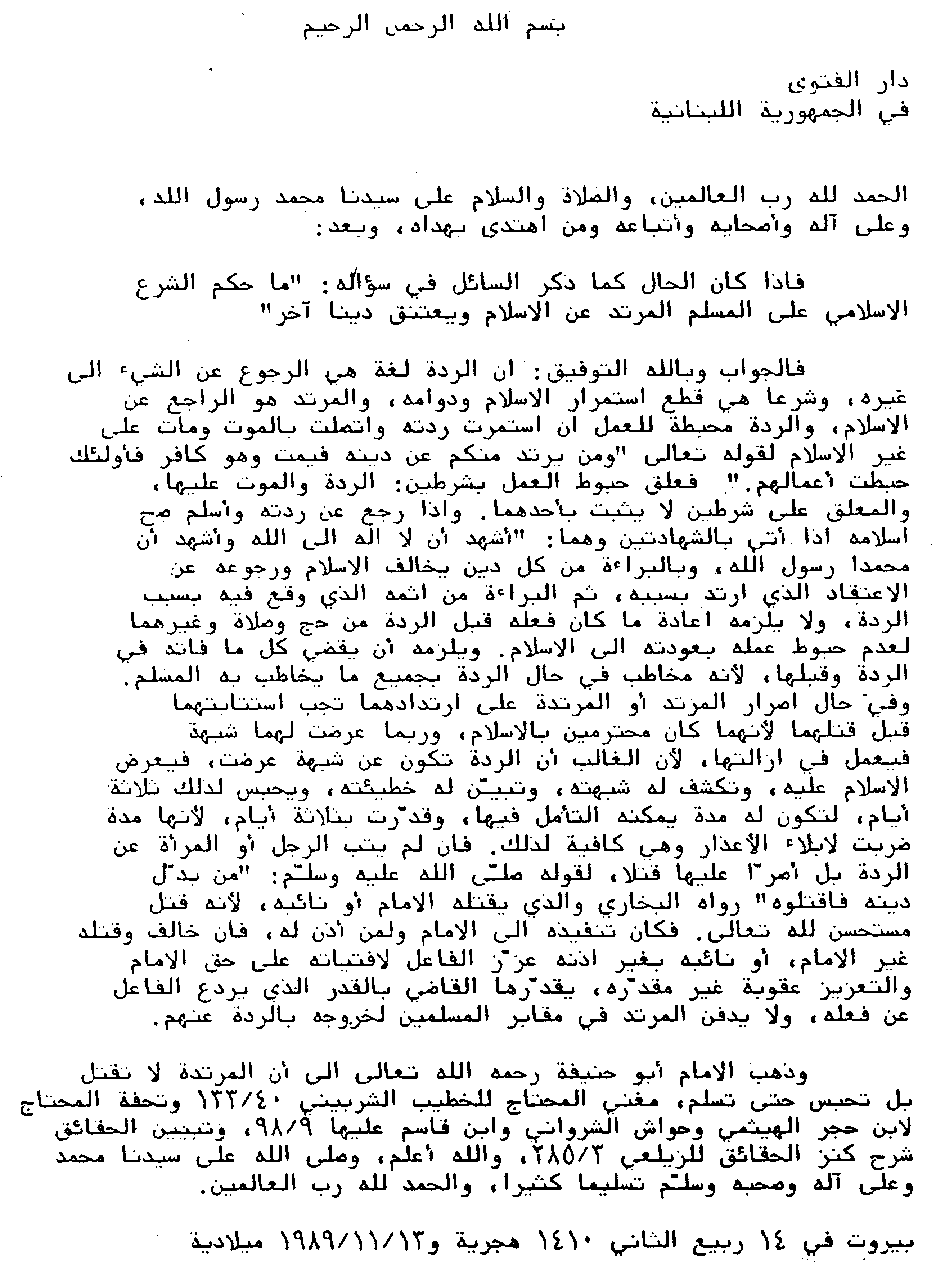
A Prisoner's Testament in Iran[1]
Written Defence of Mehdi Dibaj
Delivered to the Court for His Trial as an Apostate from Islam
on December 3, 1993.
"In the Holy Name of God who is our life and existence"
In the Holy name of God who is our life and existence. With all humility I express my gratitude to the Judge of all heaven and earth for this precious opportunity, and with brokenness I wait upon the Lord to deliver me from this court trial according to His promises. I also beg the honoured members of the court present to listen with patience to my defence and with respect for the Name of the Lord.
I am a Christian, a sinner who believes Jesus has died for my sins on the cross and, by His resurrection and victory over death, has made me righteous in the presence of the Holy God. The true God speaks about this fact in His Holy Word, the Gospel. Jesus means Saviour "because He will save His people from their sins". Jesus paid the penalty of our sins by His own blood and gave us a new life so that we can live for the glory of God by the help of the Holy Spirit and be like a dam against corruption, be a channel of blessing and healing, and be protected by the love of God.
In response to this kindness, He has asked me to deny myself and be His fully surrendered follower, and not fear people even if they kill my body, but rather rely on the Creator of life who has crowned me with the crown of mercy and compassion, and who is the great protector of His beloved ones and their great reward.
I have been charged with "apostasy"! The invisible God who knows our hearts has given assurance to us Christians that we are not among the apostates who will perish but among the believers so that we may save our lives. In Islamic Law an apostate is one who does not believe in God, the prophets or the resurrection of the dead. We Christians believe in all three!
They say "You were a Muslim and you have become a Christian." No, for many years I had no religion. After searching and studying I accepted God's call and I believed in the Lord Jesus Christ in order to receive eternal life. People choose their religion but a Christian is chosen by Christ. He says "You have not chosen me but I have chosen you." From when? Before the foundation of the world.
People say "You were a Muslim from your birth." God says "You were a Christian from the beginning." He states that He chose us thousands of years ago, even before the creation of the universe, so that through the sacrifice of Jesus Christ we may be His! A Christian means one who belongs to Jesus Christ.
The eternal God, who sees the end from the beginning and who has chosen me to belong to Him, knew from everlasting whose heart would be drawn to Him and also those who would be willing to sell their faith and eternity for a pot of porridge. I would rather have the whole world against me but know that the Almighty God is with me, be called an apostate but know that I have the approval of the God of glory, because man looks at the outward appearance but God looks at the heart, and for Him who is God for all eternity nothing is impossible. All power in heaven and on earth is in His hands.
The Almighty God will raise up anyone He chooses and bring down others, accept some and reject others, send some to heaven and others to hell. Now because God does whatever He desires, who can separate us from the love of God? Or who can destroy the relationship between the creator and the creature or defeat a heart that is faithful to his Lord? He will be safe and secure under the shadow of the Almighty! Our refuge is the mercy seat of God who is exalted from the beginning. I know in whom I have believed, and He is able to guard what I have entrusted to Him to the end, until I reach the Kingdom of God, the place where the righteous shine like the sun, but where the evildoers will receive their punishment in hell fire.
They tell me "Return!" But from the arms of my God, whom can I return to? Is it right to accept what people are saying instead of obeying the Word of God? It is now 45 years that I am walking with the God of miracles, and His kindness upon me is like a shadow and I owe Him much for His fatherly love and concern.
The love of Jesus has filled all my being and I feel the warmth of His love in every part of my body. God, who is my glory and honour and protector, has put his seal of approval upon me through His unsparing blessings and miracles.
This test of faith is a clear example. The good and kind God reproves and punishes all those whom He loves. He tests them in preparation for heaven. The God of Daniel, who protected his friends in the fiery furnace, has protected me for nine years in prison and all the bad happenings have turned out for our good and gain, so much so that I am filled overflowing with joy and thankfulness.
The God of Job has tested my faith and commitment in order to strengthen my patience and faithfulness. During these nine years he has freed me from all my responsibilities so that under the protection of His blessed Name, I would spend my time in prayer and study of His Word, with heart- searching and brokenness, and grow in the knowledge of my Lord. I praise the Lord for this unique opportunity. "You gave me space in my confinement, my difficult hardships brought healing and your kindnesses revived me." Oh what great blessings God has in store for those who fear Him!
They object to my evangelizing. But "If you find a blind person near a well and keep silent then you have sinned" (a Persian poem). It is our religious duty, as long as the door of God's mercy is open, to convince evil doers to turn from their sinful ways and find refuge in Him in order to be saved from the wrath of a righteous God and from the coming dreadful punishment.
Jesus Christ says "I am the door. Whoever enters through me will be saved." "I am the way, the truth and the life. No one comes to the Father except through me." "Salvation is found in no one else, for there is no other name under heaven given to men by which we must be saved." Among the prophets of God, only Jesus Christ rose from the dead, and He is our living intercessor for ever.
He is our Saviour and He is the Son of God. To know Him means to know eternal life. I, a useless sinner, have believed in His beloved person and all His words and miracles recorded in the Gospel, and I have committed my life into His hands. Life for me is an opportunity to serve Him, and death is a better opportunity to be with Christ. Therefore I am not only satisfied to be in prison for the honour of His Holy Name, but am ready to give my life for the sake of Jesus my Lord and enter His kingdom sooner, the place where the elect of God enter everlasting life, but the wicked to eternal damnation.
May the shadow of God's kindness and His hand of blessing and healing be upon you and remain for ever. Amen.
With respect,
Your Christian prisoner,
Mehdi Dibaj
Note:
1. This statement, with a brief introduction to it by Bernard Levin, appeared in The Times of London, Jan. 18, 1994. In Dec. 1993 an Islamic court in Iran had ordered the execution of Mehdi Dibaj on the charge of apostasy. Shortly thereafter he was released from jail, probably because of international pressures. Since June 24, 1994 he was reported missing. On July 5th law enforcement officials reported finding his body in a forest near Tehran.
While discussing the issue of apostasy in Islam, probably no verse is more frequently cited to decide the issue, especially by Muslims in the West who advocate freedom of religion, than Qur'an 2:256: "There is no compulsion in religion."
S. A. Rahman makes the distinct claim:
This verse is one of the most important verses in the Qur'an, containing a charter of freedom of conscience unparalleled in the religious annals of mankind....[1]
While discussing the nature of jihad, Dr. Abdelwahib Boase, formerly professor at University of Fez and then a research associate at Westfield College, University of London, writes:
... it must be emphasized that jihad in the military sense does not have as its object the propagation of religion. The fallacy that Islam imposes on the non-Muslim the choice between "conversion or the sword" is disproved by the Quranic injunction: "There is no coercion in matters of faith."[2]
In a personal letter, dated January 20, 1986, Hasan Moola writes from Saskatchewan, Canada:
Muslims have never compelled non-Muslims to become Muslims, and this myth has been propagated by Western Christian writers, like yourself. In fact it is quite clearly written in the Qur'an Surah 2 verse 256, "There is no compulsion in religion."[3]
A portion of a letter to the editor of a Toronto newspaper reads:
... it was Islam that proclaimed, "there is no compulsion in religion" when the echo of the time was "onward Christian soldiers".... After all, Muslims have been presented with the perfect belief system and they would like to share it peacefully with all those people with whom they share the Earth.[4]
An important commentary of the Ahmadiyya Community comments on this verse:
... The verse enjoins Muslims in the clearest and strongest of words not to resort to force for converting non-Muslims to Islam. In the face of this teaching ... it is the height of injustice to accuse Islam of countenancing the use of force for the propagation of its teaching.[5]
For S. A. Rahman discussion on the apostate and freedom of religion does not simply begin and end with the citation of Qur'an 2:256. True to his assertion that the verse "deserves detailed discussion", he proceeds to discuss the matter, sadly noting also a variety of concerns and opinions on the matter which "whittle down" the verse's "broad humanistic meaning".[6] They are in summary form:
1. Some Quranic exegetes state that Qur'an 2:256 has been abrogated by the following verses:
O Prophet! Strive against the disbelievers and the hypocrites! Be harsh with them.... (9:73)
O ye who believe! Fight those of the disbelievers who are near to you, and let them find harshness in you.... (9:123)
Say unto those of the wondering Arabs who were left behind: Ye will be called against a folk of mighty prowess to fight them until they surrender.... (48:16)[7]
2. Rahman also notes the various opinions of the Quranic commentators regarding the circumstances surrounding the revelation (shan-i nuzul) of Qur'an 2:256: a. the revelation blocked an Ansar woman from forcing her Jewish boy to convert to Islam; b. the revelation blocked an Ansar father from forcing his two Christian sons to convert to Islam; c. the revelation permitted a member of the People of the Book to retain his religion; d. the revelation referred to the People of the Book who agreed to pay jizyah. He also notes, however, that the esteemed Indian Muslim scholar, Shah Wali Ullah, does not confine the application of such a verse to the particular incident only. "On the contrary, the verse should be held to convey the commandment contained therein, generally."[8]
3. Nevertheless Rahman notes a variety of interpretations which Muslim scholars have given to this verse, not of least significance -- and much to Rahman's dismay! -- that of the same Indian scholar Shah Wali Ullah who, after giving the normal meaning, adds:
That is to say, the reasoned guidance of Islam has become manifest. Therefore, so to speak, there is no compulsion, although, in sum, there may be coercion.[9]
Rahman concludes his remarks on Shah Wali Ullah's gloss:
Such an interpretation can perhaps be attributed to the unconscious pressure of orthodox tradition.[10]
Rahman then presents the position of Nawab Siddiq Hasan Khan in Fath al-Bayan:
... one should not say of a person converted to Islam under the shadow of the sword, that he was compelled to the Faith for "there is no compulsion in religion". Another construction ... confines the verse to the People of the Scriptures who submitted to the Muslims and agreed to pay jizyah (poll-tax) but excludes the idolaters from its scope. In the case of the latter, only two alternatives are said to be open -- Islam or the sword -- on the authority of al-Shabi, al-Hasan, Qatadah and al-Dahhaq.[11]
Then Rahman cites Ibn al-Arabi's work Ahkam al-Qur'an, adding thereafter his own objections to this interpretation:
He (Ibn al-Arabi) declares dogmatically that to compel to the truth is part of the Faith, on the authority of a hadith: "I have been commanded to fight people till they recite the declaration of faith...", which he considers to have been derived from the Quranic verse: "And fight them until persecution is no more and religion is for Allah alone." (8:39; 2:193)[12]
Recently a Pakistani Muslim friend, a doctoral candidate in South Asian Islamic studies at the University of Toronto, kindly shared his interpretation of Qur'an 2:256: Qur'an 2:256 obviously forbids compulsion in religion. The Hadith obviously state that the apostate from Islam should be executed. Since the Qur'an also states that Muslims are to obey the Prophet as well as the Book, Qur'an 2:256 can have application only for non-Muslims. Muslims must be compelled to remain Muslim.
Part 2: Surah 2:256: la ikraha fi d-dini Tolerance or Resignation? by Rudi Paret (Tuebingen)[13]
The Quranic passage la ikraha fi d-dini ("there is no compulsion in religion") is generally understood to mean that no one should use compulsion against another in matters of faith. There is much to commend this interpretation. As it is understood here, the statement represents a principle which has gained a recognition of international dimensions: the principle of religious tolerance. Historically also the alleged meaning of la ikraha fi d-dini appears to be warranted. "The People of the Book", i.e., the members of the older revealed religions, particularly the Jews and the Christians, were in principle never compelled to accept Islam. They were obliged, while residing in territory under Islamic domination (dar al-Islam), only to recognize the supremacy of Muslims and, at the same time, as an external indication of this recognition, to pay a separate tax. In all other matters they could maintain their inherited beliefs and perform their practices as usual. They even were allowed to establish their own internal administration.
To be sure, however, the situation was different for members of the pre-Islamic pagan Arab society. After the community which the Prophet had established had extended its power over the whole of Arabia, the pagan Arabs were forcefully compelled to accept Islam; stated more accurately, they had to choose either to accept Islam or death in battle against the superior power of the Muslims (cf. surahs 8:12; 47:4). This regulation was later sanctioned in Islamic law. All this stands in open contradiction to the alleged meaning of the Quranic statement, noted above: la ikraha fi d-dini. The idolaters (mushrikun) were clearly compelled to accept Islam -- unless they preferred to let themselves be killed.
In view of these circumstances it makes sense to consider another meaning. Perhaps originally the statement la ikraha fi d-dini did not mean that in matters of religion one ought not to use compulsion against another but that one could not use compulsion against another (through the simple proclamation of religious truth). This seems even more likely in the light of surah 10:100, 101:
And if thy Lord willed, all who are in the earth would believe together. (Or "if thy Lord had willed, all who were on earth would have believed together".) Wouldst thou (Muhammad) compel men until they are believers (a-fa-anta tukrihu n-nasa hatta yakunu mu'minina)?
It is not for any soul to believe save by the permission of Allah. He has set uncleanness upon those who have no sense (and therefore remain hardened).
Compare Surah 12:103:
And though thou try much, most men will not believe.[14]
Both of these passages demonstrate that the Prophet's zeal to convert was doomed for the most part to be without success as a result of human recalcitrance. In agreement with this it is possible to understand la ikraha fi d-dini to mean that no one can be compelled to (right) belief. The statement of the Qur'an, then, would be not a proclamation of tolerance, but much more an expression of resignation. For a transition from la ikraha fi d-dini to the following portion of this verse (qad tabaiyana r-rushdu mina l-ghayi), something to this effect would have to be supplied if the meaning proposed here should agree: "(Since the individual cannot be compelled to truly believe by external influences, he must himself find a way to faith and that should not be difficult for him.) The correct way (of faith) has (through the proclamation of Islam) become clear (so that he can clearly be freed) from the error (of pagan unbelief)."
Whoever holds the interpretation of 2:256 as it has been presented above need not therefore simply cast overboard the meaning of the statement la ikraha fi d-dini as it usually has been understood for a long time. In the contemporary world of Islam the acknowledgement of religious tolerance is well established. And how can it be formulated more precisely than by the pregnant Arabic statement: la ikraha fi d-dini! Still the fact must always be kept in mind that in many ways the circumstances governing early Islam differed from those of today and that the presuppositions for a general and complete religious tolerance were not given at that time.
Notes
1. S. A. Rahman, Punishment of Apostasy in Islam, Institute of Islamic
Culture, Lahore, 1972, p. 16.
2. Arabia, The Islamic World Review, July, 1986, p. 79.
3. Letter of Hasan Moolla from Saskatchewan, dated January 20, 1986 to FFM.
4. Syed Nouman Ashraf, Public Relations Committee, Muslim Student Association,
University of Toronto in The Globe and Mail, July 15, 1992.
5. The Holy Qur'an with English Translation and Commentary, Sadr
Anjuman Ahmadiyya, Qadian, 1947, vol. 1, in loco.
6. Rahman, op. cit., p.16. His full discussion covers pp. 16-25.
Its openness and breadth differs from that of the Qur'an "expositor" whose
mere citation of 2:256 precludes for him (and for all?) the need for further
discussion.
7. A more recent publication states that Ibn Hazm accepted the abrogation
of 2:256 in order to avoid a contradiction between this passage and the
death penalty for apostasy. On the other hand, the author claims that
2:256 has not been abrogated (Mohamed S. El-Awa, Punishment in Islamic Law:
A Comparative Study, American Trust Publications, Indianapolis, 1982,
p. 51). For two general discussions on abrogation in Islam and some of its
complexities, including differing opinions within the traditional Schools
of Law about whether or not the Hadith can abrogate the Qur'an, compare
Islamic Jurisprudence: Shafi'i's Risala, translated with an
Introduction, Notes and Appendices by Majid Khadduri, The Johns Hopkins
Press, Baltimore, 1961, esp. pp.123-145 with M. H. Kamali, Principles
of Islamic Jurisprudence, Pelanduk Publications, Malaysia, esp. pp.
189-210. The doctrine of abrogation is especially rooted in Qur'an 2:106,
16:101, 87:6, 7.
8. Rahman, op. cit., p. 18.
9. ibid., pp. 18, 19.
10. ibid., p. 19.
11. ibid., p. 19.
12. ibid., p. 20. For further opinions see pp. 21-24, including
a brief rebuttal of Mawdudi's interpretation.
13. A translation of "Sure 2, 256: la ikraha fi d-dini: Toleranz
oder Resignation?" in Der Islam, Walter De Gruyter, Berlin,
Vol. 45, 1967, pp. 299-300. Compare the same thesis as discussed by
Adolf L. Wismar A Study in Tolerance, AMS Press Inc., New York,
1966, pp. 4-13. Apparently this work was originally published by Columbia
University Press in 1927.
14. Compare also 16:37 in Rudi Paret, Kommentar and Konkordanz,
Zweite Auflage, Kohlhammer, Stuttgart, 1977, p. 54: "Though thou art
ever so eager to guide them, God guides not those whom He leads astray."
(English translation, A. J. Arberry, The Koran Interpreted,
Oxford University Press, London, 1969, p. 262)
The text of the Declaration reads:
"Whereas recognition of the inherent dignity and of the equal and inalienable rights of all members of the human family is the foundation of freedom, justice and peace in the world, whereas disregard and contempt for human rights have resulted in barbarous acts which have outraged the conscience of mankind, and the advent of a world in which human beings shall enjoy freedom of speech and belief and freedom from fear and want has been proclaimed as the highest aspiration of the common people,
whereas it is essential, if man is not to be compelled to have recourse, as a last resort, to rebellion against tyranny and oppression, that human rights should be protected by the rule of law,
whereas it is essential to promote the development of friendly relations between nations,
whereas the peoples of the United Nations have in the Charter reaffirmed their faith in fundamental human rights, in the dignity and worth of the human person and in the equal rights of men and women and have determined to promote social progress and better standards of life in larger freedom,
whereas Member-States have pledged themselves to achieve, in cooperation with the United Nations, the promotion of universal respect for and observance of human rights and fundamental freedoms,
whereas a common understanding of these rights and freedoms is of the greatest importance for the full realization of this pledge. Now, therefore, the General Assembly proclaims this Universal Declaration of Human Rights as a common standard of achievement for all peoples and all nations, to the end that every individual and every organ of society, keeping this Declaration constantly in mind, shall strive by teaching and education to promote respect for these rights and freedoms and by progressive measures, national and international, to secure their universal and effective recognition and observance, both among the peoples of Member-States themselves and among the peoples of territories under their jurisdiction.
Art. 1 All human beings are born free and equal in dignity and rights. They are endowed with reason and conscience and should act towards one another in a spirit of brotherhood.
Art. 2 Everyone is entitled to all the rights and freedoms set forth in this Declaration, without distinction of any kind, such as race, color, sex, language, religion, political or other opinion, national or social origin, property, birth or other status. Furthermore, no distinction shall be made on the basis of the political, jurisdictional or international status of the country or territory to which a person belongs, whether it be independent, trust, non-self-governing or under any other limitation of sovereignty.
Art. 3 Everyone has the right to life, liberty and security of person.
Art. 4 No one shall be held in slavery or servitude; slavery and the slave trade shall be prohibited in all their forms.
Art. 5 No one shall be subject to torture or to cruel, inhuman or degrading treatment or punishment.
Art. 6 Everyone has the right to recognition everywhere as a person before the law.
Art. 7 All are equal before the law and are entitled without any discrimination to equal protection of the law. All are entitled to equal protection against any discrimination in violation of the Declaration and against any incitement to such discrimination.
Art. 8 Everyone has the right to an effective remedy by the competent national tribunals for acts violating the fundamental rights granted him by the constitution or by law.
Art. 9 No one shall be subject to arbitrary arrest, detention or exile.
Art. 10 Everyone is entitled in full equality to a fair and public hearing by an independent and impartial tribunal, in the determination of his rights and obligations and of any criminal charge against him.
Art. 11(i) Everyone charged with a penal offence has the right to be presumed innocent until proved guilty according to law in a public trial at which he has had all the guarantees necessary for his defence.
(ii) No one shall be held guilty of any penal offence on account of any act of omission which did not constitute a penal offence, under national or international law, at the time it was committed. Nor shall a heavier penalty be imposed than the one that was applicable at the time the penal offence was committed.
Art. 12 No one shall be subject to arbitrary interference with his privacy, family, home or correspondence, nor to attacks upon his honor and reputation. Everyone has the right to the protection of the law against such interference or attacks.
Art. 13(i) Everyone has the right to freedom of movement and residence within the borders of each state.
(ii) Everyone has the right to leave any country, including his own, and to return to his country.
Art. 14(i) Everyone has the right to seek and to enjoy in other countries asylum from persecution.
(ii) This right may not be invoked in the case of prosecutions genuinely arising from non-political crimes or from acts contrary to the purposes and principles of the United Nations.
Art. 15(i) Everyone has the right to a nationality.
(ii) No one shall be arbitrarily deprived of his nationality nor denied the right to change his nationality.
Art. 16(i) Men and women of full age, without any limitation due to race, nationality or religion, have the right to marry and to found a family. They are entitled to equal rights as to marriages, during marriage and at its dissolution.
(ii) Marriage shall be entered into only with the free and full consent of the intending spouses.
(iii) The family is the natural and fundamental group unit of society and is entitled to protection by society and the state.
Art. 17(i) Everyone has the right to own property as well as in association with others.
(ii) No one shall be arbitrarily deprived of his property.
Art. 18 Everyone has the right to freedom of thought, conscience and religion; the right includes freedom to change his religion or belief, and freedom, either alone or in community with others and in public or private, to manifest his religion or belief in teaching, practice, worship and observance.
Art. 19 Everyone has the right to freedom of opinion and expression; this right includes the right to freedom to hold opinions without interference and to seek, receive and impart information and ideas through any media and regardless of frontiers.
Art. 20(i) Everyone has the right to freedom of peaceful assembly and association.
(ii) No one may be compelled to an association.
Art. 21(i) Everyone has the right to take part in the government of his country, directly or through freely chosen representatives.
(ii) Everyone has the right of equal access to public service in his country.
(iii) The will of the people shall be the basis of the authority of the government; this will shall be expressed in periodic and genuine elections which shall be by universal and equal suffrage and shall be held by secret vote or by equivalent free voting procedures.
Art. 22 Everyone, as a member of society, has the right to social security and is entitled to realization, through national effort and international cooperation and in accordance with the organization and resources of each State, of the economic, social and cultural rights indispensable for his dignity and the free development of his personality.
Art. 23(i) Everyone has the right to work, to free choice of employment, to just and favorable conditions of work and to protection against unemployment.
(ii) Everyone, without any discrimination, has the right to equal pay for equal work.
(iii) Everyone who works has the right to just and favorable remuneration ensuring for himself and his family an existence worthy of human dignity, and supplemented if necessary, by other means of social protection.
(iv) Everyone has the right to form and to join trade unions for the protection of his interests.
Art. 24 Everyone has the right to rest and leisure, including reasonable limitation of working hours and periodic holidays with pay.
Art. 25(i) Everyone has the right to a standard of living adequate for the health and well-being of himself and of his family, including food, clothing, housing and medical care and necessary social services, and the right to security in the event of unemployment, sickness, disability, widowhood, old age or other lack of livelihood in circumstances beyond his control.
(ii) Motherhood and childhood are entitled to special care and assistance. All children, whether born in or out of wedlock, shall enjoy the same social protection.
Art. 26(i) Everyone has the right to education. Education shall be free, at least in the elementary and fundamental stages. Elementary education shall be compulsory. Technical and profession education shall be made generally available and higher education shall be equally accessible to all on the basis of merit.
(ii) Education shall be directed to the full development of the human personality and to the strengthening of respect for human rights and friendship among all nations, racial or religious groups and shall further the activities of the United Nations for the maintenance of peace.
(iii) Parents have a prior right to choose the kind of education that shall be given to their children.
Art. 27(i) Everyone has the right freely to participate in the cultural life of the community, to enjoy the arts and to share in scientific advancement and its benefits.
(ii) Everyone has the right to the protection of the moral and material interest resulting from any scientific, literary or artistic production of which he is the author.
Art. 28 Everyone is entitled to a social and international order in which the rights and freedoms set forth in this Declaration can be fully realized.
Art. 29(i) Everyone has duties to the community in which alone the free and full development of his personality is possible.
(ii) In the exercise of his rights and freedoms, everyone shall subject only to such limitations as are determined by law solely for the purposes of securing due recognition and respect for the rights and freedoms of others and of meeting the just requirements of morality, public order and the general welfare in a democratic society.
(iii) These rights and freedoms may in no case be exercised contrary to the purposes and principles of the United Nations.
Art. 30 Nothing in this Declaration may be interpreted as implying for any State, group or person any right to engage in any activity or to perform any act aimed at the destruction of any of the rights and freedoms set forth herein."
Abu Bakr - Muhammad's successor, the first caliph.
Ahl-i Kitab - "People of the Book" (Persian), usually Jews and Christians, but possibly also other groups who possess a Scripture; cf. Dhimmi; Arabic Ahl al-Kitab.
Ahmadiyya - Followers of Mirza Ghulam Ahmad (d. A.D. 1908) of India (Pakistan) are members of the Ahmadiyya Anjuman. Though they claim to be Muslims, mainline Muslims often reject them and may even persecute them.
Ali - the fourth caliph; cousin and son-in-law of Muhammad.
aman - security; the pledge of safe conduct and security granted by a Muslim authority to a harbi ("enemy") within Dar al-Islam, who thus becomes a musta'min ("one secured").
amir - leader.
Ansar - "helpers"; the believers in Medina who welcomed and helped Muhammad and the migrants (muhajirun) after their migration from Mecca to Medina.
aqiqah - a sacrifice, on or about the seventh day after a child is born, involving the naming of the child, cutting the child's hair and the slaying of an animal.
Dar al-Harb - "the house of war"; the area of the world not under Muslim sovereignty.
Dar al-Islam - "the house of Islam"; the area of the world under Muslim sovereignty.
da'wah - Muslim invitation to non-Muslims to enter the House of Islam, i.e., to become Muslim.
Dhimmi - non-Muslim living under Muslim rule, particularly a member of the People of the Book, i.e., Jews and Christians. See Appendix A.
fatwa - an authoratative legal declaration prepared by a mufti.
fiqh - jurisprudence.
Hadith - the second source of Islam and the shari'ah; reports of what especially Muhammad said and did, of Muhammad's sunnah; Canonical Tradition.
harbi - a member of the Dar al-Harb; he may be a polytheist (mushrik) or a member of the People of the Book.
harbi kafir - "infidel at war".
hijrah - "emigration", "flight" of Muhammad (and his followers) from Mecca to Medina (A.D. 622). The Muslim calendar commences with the hijrah; hence After Hijrah = A. H.
iman - a Muslim community leader.
irtidad - apostasy.
jihad - "struggle"; war against the inner self; war against non-Muslims in the interest of Islamic political sovereignty.
jizyah - "tribute", "poll tax" paid by the People of the Book to their Muslim rulers.
kafir, pl. kuffar - an ingrate, but normally infidel, unbeliever, disbeliever; "infidel" better carries the traditional significance of the word.
khalifah - caliph, "successor" to the Prophet Muhammad; khulafa'-i rashidun, "the rightly guided caliphs" or first four rulers of the Muslim community after Muhammad.
kufr - ingratitude, disbelief (in God).
mawlavi - religious leader.
mufti - legal expert who issues the fatwa.
muhajirun - "migrants" (with Muhammad) who left Mecca to settle in Medina. See hijrah.
mujtahid - "one who exerts himself"; a Muslim legal expert who provides ijtihad (expert legal opinion).
murtadd - apostate.
mushrik - polytheist; idolator; one who does shirk, i.e., "associates" someone or something with God.
musta'min - see aman.
namaz - ritual prayer, litany (Persian); the second Pillar among Islamic religious duties; Arabic salat.
riddah - apostasy; in particular, referring to the Arab tribes who rejected Abu Bakr's leadership raddah and abandoned the Muslim community after the death of Muhammad; the wars of riddah.
roza - fasting (Persian); the fourth Pillar among Islamic religious duties; Arabic sawm.
salat - prayer, litany; see namaz.
Sahaba - "Companions" of the Prophet Muhammad who knew him.
shari'ah - the sacred law of Islam; the Qur'an and Canonical Traditions are its chief sources.
shirk - "association" of anything with God or in the place of God; idolatry.
sunnah - "path"; tradition; primarily the path of Muhammad, whence the "Sunni" Muslims.
surah - "revelation" of the Qur'an; for practical purposes, a chapter of the Qur'an.
Tabi'un - "Followers", i.e. Muslims who were familiar with the Companions (Sahaba) of the Prophet Muhammad.
'Ulama', s. 'alim - "scholars", those well versed in Islam.
Umar - the second caliph.
Uthman - the third caliph.
zakat - almsgiving; the third Pillar among Islamic religious duties.
zindiq - heretic, atheist, or one inclined to atheism.
More on the issue of apostasy from Islam
Books by Dr. Ernest Hahn
Answering Islam Home Page